

You've landed, you're tired, your phone battery is dropping, and now you need to get from one huge London airport to the other without missing the next leg of your trip. That's when the usual “from £11.99” advice stops being useful. A cheap ticket doesn't feel cheap if you're dragging two suitcases, trying to find the right coach bay, and worrying about traffic on the M25.
If you're searching for the right coach Gatwick to Heathrow option, the smart move isn't to look only at fare or headline journey time. You need to judge the whole transfer. That means walking distance inside the terminals, how hard the boarding process feels with luggage, how exposed you are to road delays, and whether the service still makes sense if you're a family, an older traveller, or heading on to a cruise port after Heathrow.
Table of Contents
- Planning Your Gatwick to Heathrow Connection
- Direct Coach Services A Side-by-Side Comparison
- How to Book and Find Your Coach Transfer
- Exploring Alternatives to the Coach
- Cost vs Time vs Convenience The Real Trade-Offs
- Our Recommended Transfer for Your Travel Style
- Gatwick to Heathrow Transfer FAQs
Planning Your Gatwick to Heathrow Connection
The transfer between Gatwick and Heathrow catches people off guard because it looks simple on paper. Two major airports. One city region. Plenty of transport. In practice, it can feel messy fast, especially after a long-haul flight.
A first-time visitor often makes the same mistake. They search the fare, see a direct coach, and assume the problem is solved. Then reality kicks in. They still need to get out of arrivals, work out which terminal they're really in, find the correct coach stop, manage bags, and keep one eye on the clock the entire time.
Cruise passengers feel this even more sharply. If you're arriving from the US or Canada, you may already be travelling with more luggage than a typical weekend flyer. Families get hit by the same issue. A stroller, hand luggage, a child who's had enough, and a transfer that looked “easy” suddenly isn't.
Practical rule: choose your transfer based on your weakest point, not your ideal scenario. If luggage, mobility, or timing is your weak point, prioritise ease over the very lowest fare.
That's why I don't treat this route as just a coach-price comparison. The important question is simpler. What will this journey feel like for you on the day?
Ask yourself these three things before booking:
- Budget first: If your main goal is to keep costs down and you're travelling light, a direct coach is usually the sensible place to start.
- Effort first: If you hate navigating terminals, waiting around, or lifting bags more than necessary, you should care more about door-to-door simplicity than ticket price.
- Risk first: If a missed flight would wreck your day, journey predictability matters more than a cheap fare.
The good news is that this is a mature route with plenty of service. The bad news is that abundance can make the decision harder. You don't need more options. You need the right option for your circumstances.
Direct Coach Services A Side-by-Side Comparison
You land at Gatwick tired, collect two large suitcases, and now the transfer starts to matter in a very practical way. The best coach is not only the cheapest one. It is the one that asks the least of you after a flight, especially if you are travelling with children, cruise luggage, or limited mobility.
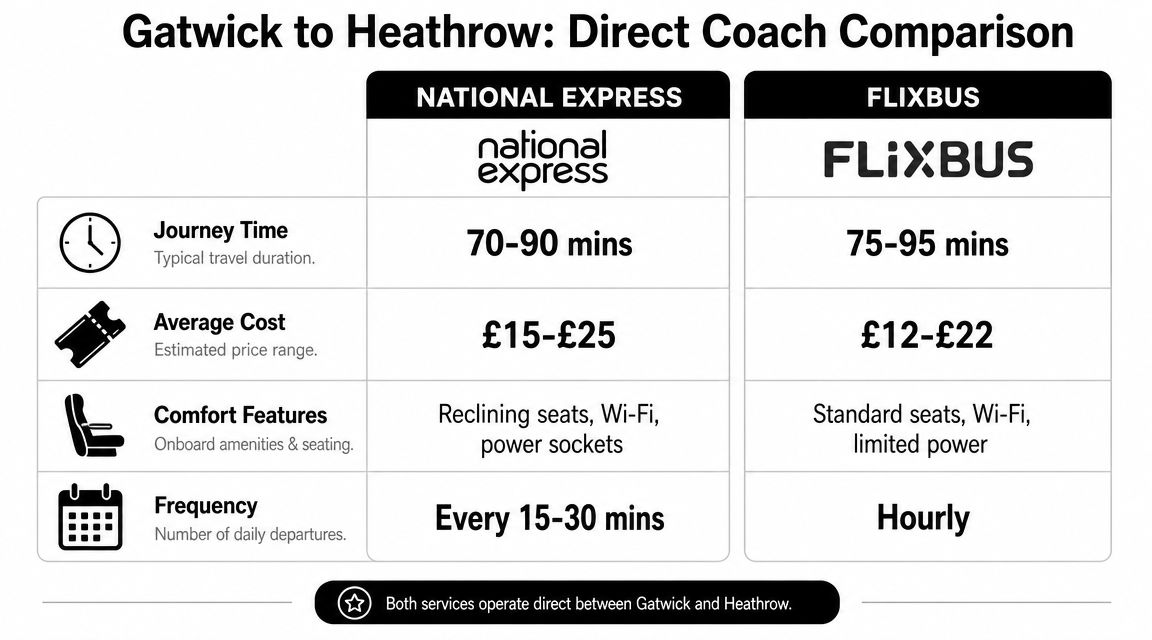
What the main operators actually offer
| Operator | Starting Fare (Approx.) | Journey Time (Advertised) | Frequency | Luggage Allowance |
|---|---|---|---|---|
| National Express | From £13.20 | Around 70 minutes | Frequent daily service | Check operator terms at booking |
| FlixBus | From £11.99 | Around 70 minutes | Daily service | Check operator terms at booking |
| The Airline by Oxford Bus Company | From £15 | Around 75 minutes | Daily service | Check operator terms at booking |
The prices are close enough that you should stop treating this as a fare-only decision. A few pounds saved means very little if you end up with a longer wait, a less convenient stop, or more lifting and shuffling than you expected.
National Express is usually the safest first choice for a first-time visitor. It is familiar, set up for airport passengers, and tends to feel more predictable from booking through boarding. That matters more than people admit. Predictability cuts stress.
FlixBus usually appeals to budget-focused travellers first. Fair enough. If you are travelling alone with one manageable bag and your timing is flexible, it can be a sensible pick. If you are carrying heavy cases or trying to make a tight onward flight, I would not choose it on fare alone. The wrong departure time can wipe out the savings fast.
The Airline belongs on your shortlist if the schedule suits you neatly. I would still put it behind National Express for first-time international travellers, as brand familiarity counts on an airport transfer. When you are tired, the obvious option often becomes the better option.
If you want a broader sense of how shared airport transport compares with pre-booked options, this guide to airport shuttle services is useful background.
What actually changes the experience
Two coach tickets can look almost identical online and feel completely different on the day.
Differences are practical:
- How easy the stop is to find: A cheap fare loses its appeal if you spend twenty stressful minutes hunting for the right bay with luggage.
- How much lifting you need to do: Families, cruise passengers, and older travellers should take this seriously.
- How fixed your timing is: If a missed connection would be expensive, choose the operator and departure that gives you breathing room.
- How comfortable you are with uncertainty: Some travellers are happy to trade convenience for price. Many regret it after a long-haul arrival.
My recommendation by traveller type
I recommend National Express for first-time visitors, families, and anyone who wants the most straightforward public-transfer option. It is usually the least mentally demanding choice, and that has real value on an airport day.
I recommend FlixBus for solo travellers on a tighter budget who are travelling light and can tolerate a bit more compromise on timing or convenience.
I recommend The Airline only if its departure time fits your plans especially well and you are willing to compare the stop details carefully before booking.
My blunt view is simple. Do not chase the absolute lowest fare unless your journey is flexible and your luggage is easy to manage. On this route, the better coach is usually the one that reduces walking, waiting, and second-guessing.
How to Book and Find Your Coach Transfer
Booking the coach isn't the stressful part. Finding it can be. That's why you should sort the ticket before you travel and know where you're heading once you land.
Book before you travel if you want less stress
Pre-book online. That's my advice for almost everyone. It cuts one decision from an already tiring airport day, and it gives you something concrete to aim for when you arrive.
Buying on the day can work, but it leaves you making choices while tired, jet-lagged, and possibly dealing with queues. If your plans are loose, that flexibility may suit you. If your day already has enough moving parts, don't add another.
A good habit is to save three things before you fly:
- Your booking confirmation: Screenshot it. Don't rely on patchy airport data.
- Your terminal details: Gatwick and Heathrow both spread passengers over different terminal areas, and that matters.
- Your operator name: Don't search for “bus” signs alone. Search for your company and stop information.
If you're comparing airport ground transport more broadly, this guide to airport shuttle services gives useful context on how shared and pre-booked transfers differ in practice.
Finding the coach at Gatwick and Heathrow
At Gatwick, the key issue is knowing whether you're at the North Terminal or South Terminal. Don't assume. Check your airline details and follow airport signs for coach services once you've collected bags and cleared arrivals. Give yourself extra time if you need to move between terminals or if you're travelling with children.
At Heathrow, the main thing to understand is that coach drop-off and pick-up points vary by terminal area. Travellers for Terminals 2 and 3 often need the Central Bus Station, while Terminal 4 and Terminal 5 use their own stops. That doesn't make the system difficult, but it does mean you shouldn't wander and hope.
Use this simple travel-day routine:
- Stop and confirm the terminal first: Don't start walking until you know exactly where your coach departs from or arrives to.
- Follow airport wayfinding, not instinct: These airports are large enough that “I'll just head outside and look around” is a poor strategy.
- Allow extra walking time: The route from arrivals to a coach stop can feel longer than expected when you're carrying luggage.
- Keep your ticket handy: You don't want to be digging through emails at the boarding bay.
If you're travelling with multiple bags, the hardest part of the coach transfer often isn't the road journey. It's the airport walking before and after it.
That's the detail most generic travel guides skip, and it's exactly why some travellers should think twice before defaulting to the cheapest public option.
Exploring Alternatives to the Coach
For some people, a coach is exactly right. For others, it's the wrong choice dressed up as a bargain.

When the coach stops making sense
The weak point of the coach isn't only road traffic. It's the whole process around the seat. You still need to reach the stop, load and unload bags, and find your way through whichever Heathrow terminal you're heading to after arrival.
That's why the low published fare can be misleading for some travellers. The EasyBus route page notes that much of the market focuses on fares from £11.99 to £16 and journey times around 50 to 75 minutes, while practical issues such as luggage handling, terminal walking, reduced mobility, and meet-and-greet style flexibility are often left unanswered on standard public-transfer pages on the EasyBus Gatwick to Heathrow route page.
If you're considering something other than a coach, the main alternatives are:
- Train via London: This can appeal to confident travellers who prefer rail over road, but it usually means changes and more handling of luggage.
- Taxi or ride-hailing: More direct in theory, but still exposed to road conditions and not always the calmest option at busy airports.
- Pre-booked private transfer: This is the comfort-first choice. It removes most of the navigation problem because the journey starts closer to where you are.
For travellers who want more detail on the private option, this overview of private car hire in London is worth reading.
Who should seriously consider private transfer
Here's my take: If you're an older traveller, a family, a cruise passenger with multiple cases, or anyone who finds airport wayfinding exhausting, a private transfer isn't indulgent. It's practical.
You're paying to remove friction. That means less terminal wandering, less lifting, less waiting at bays, and less uncertainty about where you're supposed to stand. Some private-transfer services also build their message around meet and greet and flight-delay flexibility, which directly addresses the service-resilience gap public coach pages often ignore.
A London-based option in this category is EC Minibus, which provides private airport transfers and includes meet and greet, flight monitoring, fixed pricing, and luggage assistance according to the publisher information provided for this article. That won't suit every budget, but it is materially different from buying a coach seat.
Here's a useful travel reality check:
A direct coach is a transport solution. A private transfer is often a stress-management solution.
That matters if your day doesn't end at Heathrow. Cruise passengers heading onward to Southampton, Dover, Portsmouth, or Tilbury often have zero appetite for another confusing handoff. In those cases, door-to-door service can be the smarter buy even when the fare is higher.
A quick visual may help if you're still weighing the broader transport experience:
Cost vs Time vs Convenience The Real Trade-Offs
The cheapest option and the best-value option are often not the same thing. This route proves it.
The advertised trip and the real trip are not the same
Trainline's coach listings for this corridor show why so many travellers misjudge it. The route is reported as direct with 0 changes, with the fastest services taking 50 to 57 minutes, but typical journey times can average about 1 hour 20 minutes, and there are about 166 to 168 services per day, according to Trainline's Gatwick Airport to Heathrow Airport bus page.
That gap matters. A best-case run on the motorway and a more ordinary run are two very different planning scenarios. If your onward flight is time-sensitive, planning around the shortest published journey is asking for trouble.
My advice is simple. Treat the fastest coach timing as a bonus, not a promise.
What your fare doesn't include
A low coach fare covers the seat. It doesn't cover the hidden costs that travellers feel:
- Walking effort: Large terminals turn short distances on a map into awkward stretches with luggage.
- Waiting time: Even with frequent service, you may still wait after baggage reclaim, immigration, or terminal transfers.
- Handling stress: Every extra lift of a suitcase matters more when you're tired.
- Connection anxiety: Public transport puts more responsibility on you to recover if something slips.
This is why “convenience” isn't soft or vague. It's physical effort plus mental load. For some passengers, that matters more than the fare difference.
Here's how I think about the trade-off:
| Priority | Usually the stronger option | Why |
|---|---|---|
| Lowest out-of-pocket spend | Coach | Best if you're flexible and travelling light |
| More predictable door-to-door experience | Private transfer | Fewer moving parts and less airport navigation |
| Rail preference over road travel | Train | Better for travellers comfortable with changes |
| Least hassle with heavy luggage | Private transfer | Reduces walking, lifting, and stop-finding |
If you're comparing airport links more broadly, the same logic shows up on other cross-airport routes too. This guide on buses from Heathrow to Stansted Airport is a good reminder that the cheapest public transfer often asks the most from the passenger.
Worth remembering: your transfer cost isn't just the ticket. It's the effort, uncertainty, and time you spend making the trip work.
If you're young, lightly packed, and unbothered by delay risk, the coach is good value. If you're exhausted, carrying more than one substantial bag, or guarding a tight connection, the equation changes quickly.
Our Recommended Transfer for Your Travel Style
This is the information individuals require. Not more theory. A decision.
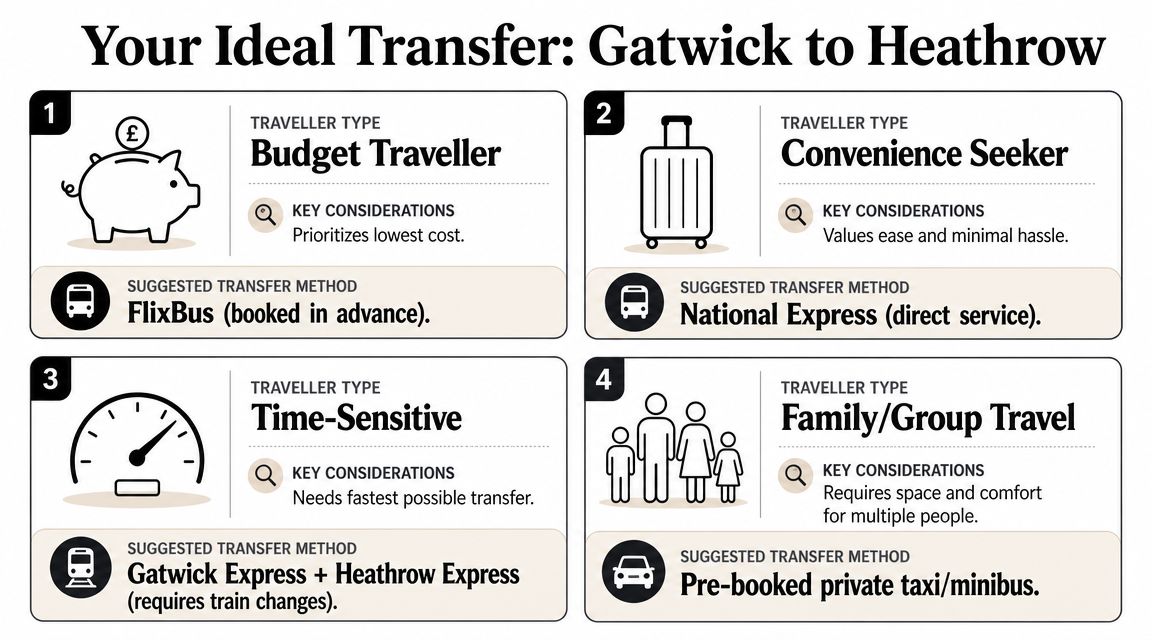
The right choice for four common traveller types
The budget-conscious solo traveller
Take the coach. It's the obvious answer, and in your case it's the right one. If you've got manageable luggage, some patience, and no fragile onward timing, the lower fare is worth it. I'd compare operators, but I wouldn't overthink it.
The family with children and strollers
Book a private transfer. Families pay for every bit of friction twice. Once in time, once in stress. Loading children, folding a stroller, keeping bags together, and finding the correct stop is exactly the kind of airport day that makes a coach feel harder than it looked online.
The cruise passenger with multiple bags
Skip the coach unless budget leaves you no choice. This is the classic case where the headline fare misleads. You're not just changing airports. You're managing luggage for a longer journey chain, and that makes door-to-door handling far more valuable.
The business traveller on a tight schedule
Take the option that gives you the most control over the day. If you're comfortable with rail changes and want to avoid motorway uncertainty, train can make sense. If you value a simpler handoff and a calmer trip, a pre-booked private car is often the safer call.
My short version looks like this:
- Choose coach if your first concern is price and you're travelling light.
- Choose private transfer if luggage, mobility, or family logistics are part of the journey.
- Choose rail only if you're comfortable navigating changes and prefer trains to roads.
There isn't one universal winner. But there is a wrong choice for your travel style, and many travellers only realise it once they're already dragging their bags across the terminal.
Gatwick to Heathrow Transfer FAQs
Quick answers before you travel
Can I usually find a coach even if my flight arrives late?
Yes, this route is heavily served. CheckMyBus reports an average of about 662 daily coach connections, with departures running from 12:55 AM to 11:45 PM, on its Gatwick Airport to Heathrow Airport listings.
What if my flight is delayed and I miss my booked coach?
Check your operator's ticket terms before travel. Policies vary. If your arrival is uncertain, flexibility matters more than getting the absolute cheapest fare.
Can I buy a ticket at the airport?
Often yes, but I wouldn't rely on that if you're tired, carrying luggage, or working to a schedule. Pre-booking is calmer.
Are coaches suitable for older travellers or reduced mobility?
Sometimes, yes. But suitability depends on your ability to walk through the terminal, reach the bay, and manage boarding. That's why some travellers are better served by a pre-booked door-to-door option.
Do coaches have Wi-Fi and charging?
Amenities vary by operator and vehicle. Check the service details when booking rather than assuming.
If you want to remove the hardest parts of the transfer, EC Minibus offers private London airport and cruise-port connections with meet and greet, flight monitoring, and luggage assistance. For travellers who care more about a smooth handoff than the lowest public fare, that's a practical option to compare before you book.