

You land in Abu Dhabi, look at the map, and assume Dubai is a quick transfer up the road. That is where many UK and US travellers misjudge the journey.
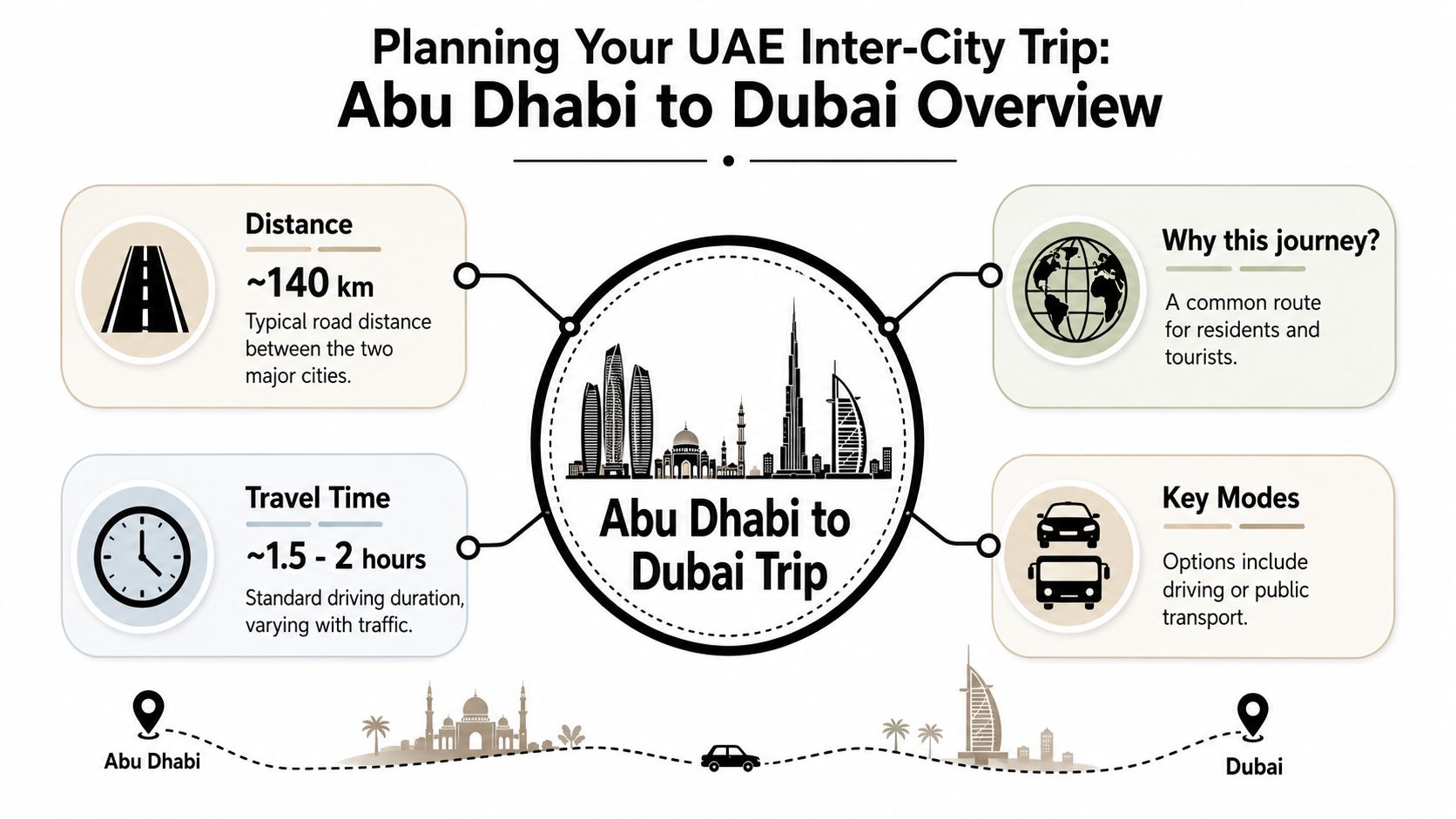
The distance from Abu Dhabi to Dubai is usually around 140 to 150 km by road, but the more useful way to size it up is as a proper inter-city transfer rather than a short city hop. For travellers from Britain, it sits in the same general bracket as driving London to Birmingham or London to Brighton in overall feel. Americans usually find it closer to a straightforward airport-to-city transfer between two major metro areas than a long road trip.
What tends to cause problems is not the mileage itself. It is the way the UAE combines fast highways with large-scale urban sprawl, strict road systems, terminal-specific drop-offs, luggage handling, heat, and timing pressures around flights, hotel check-in, or cruise departures. If you have ever arranged car hire for a cruise terminal transfer, the planning logic is similar. The route is simple on paper, but small timing mistakes can create expensive stress.
For most travellers, the key question is not just how far Abu Dhabi is from Dubai. It is which option fits your arrival time, budget, bags, and tolerance for transfers. That is what makes this journey easier to get right.
Table of Contents
- Planning Your UAE Inter-City Trip
- Driving the E11 Highway What to Expect
- Taking the Intercity Bus A Smart Budget Option
- Using Taxis and Private Hire Services
- Comparing Your Travel Choices Fastest vs Cheapest
- Practical Tips for a Hassle-Free Journey
Planning Your UAE Inter-City Trip
You land in Abu Dhabi in the morning, book dinner in Dubai for that evening, and assume the transfer will work like moving between nearby districts. That is the mistake I see most often with UK and US travellers. This is an inter-city journey with airport procedures, city traffic at both ends, and transport rules that are easy enough once you know them.
The good news is that you do not need to worry about any border or visa check between Abu Dhabi and Dubai. They are different emirates within the UAE, not different countries. If you are lawfully in the UAE, you can travel between them freely. The planning question is not paperwork between emirates. It is timing, pickup point, luggage, and how much room for delay your day can tolerate.
For overseas visitors, the biggest trap is treating a simple city-to-city transfer as if it needs no pre-booking. If you have a cruise embarkation, a same-day flight, a business meeting, or a fixed tour slot, book your transport in advance and keep a time cushion. I give clients the same advice I give for airport transfers in Britain. The same logic behind planning buses from Heathrow to Stansted Airport applies here. Two major transport hubs can look close on paper and still punish a tight schedule.
Season also matters. From late autumn through early spring, the weather is more comfortable and day trips are easier to enjoy, but that is also when visitor numbers are higher and premium transfer services can book up faster. In summer, availability is often better, but the heat makes waits for buses, taxi ranks, or hotel pickups much less pleasant, especially with children or older travellers.
Start with your actual endpoints. "Abu Dhabi to Dubai" is too broad to plan well. Abu Dhabi airport to Downtown Dubai is a different day from Saadiyat Island to Dubai Marina, and a hotel on Palm Jumeirah can add meaningful time after you have already reached the city. If your accommodation has a similar name to another property, send the full address or pinned map location to your driver. That small step prevents a surprising number of missed pickups.
One more practical point. If you are arriving on an international flight, avoid committing yourself to the first departure window after landing unless someone else is handling the transfer. Immigration queues, baggage delays, and SIM setup can eat into your margin. A little caution at this stage usually saves far more stress than trying to claw back time later.
Driving the E11 Highway What to Expect
A lot of first-time visitors see Abu Dhabi and Dubai on a map and assume the drive is a quick hop. In practice, it feels closer to a London to Birmingham run than a short airport transfer, especially once you add car collection, tolls, and the final drive into Dubai traffic.
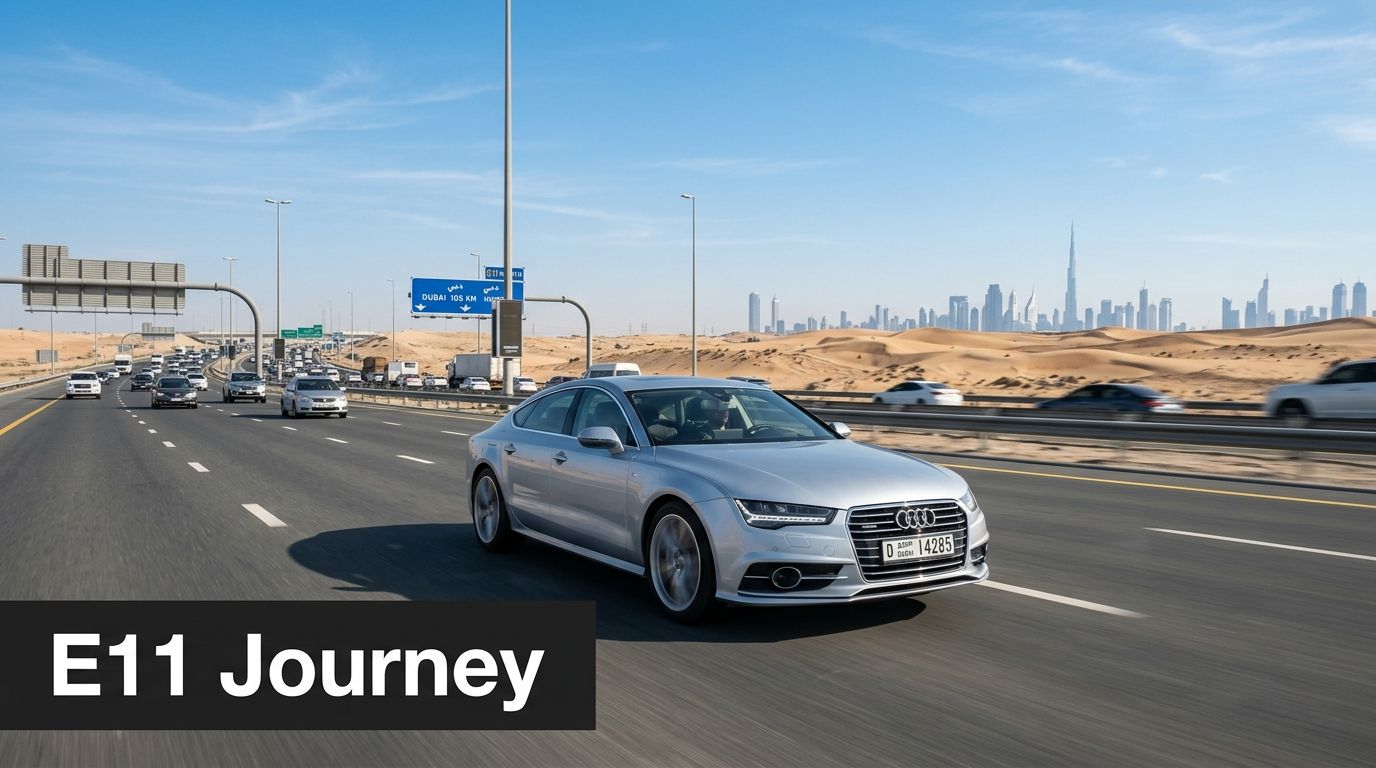
Self-driving works well for travellers who want control over timing, plan to stop in more than one place, or need to reach areas that are awkward by bus. The E11 is the main route and, for most visitors, the middle section is straightforward. The pressure points are at each end. Leaving Abu Dhabi can involve a few early lane decisions, and entering Dubai often takes longer than newcomers expect.
How the drive feels in real terms
This is a modern motorway journey with clear signage, wide roads, and fast-moving traffic. It is not a difficult route in the sense of complex rural driving, but it does reward attention. If you are comfortable on UK motorways, the higher-speed flow may feel brisker than what you are used to. If you are from the US, the scale may feel familiar, but the pace of lane changes and the density around major interchanges can still catch people out.
The common mistake is underestimating the city portion.
Reaching Dubai does not mean you have reached your hotel. Dubai Marina, Downtown, Deira, Palm Jumeirah, and areas near the airport all add their own final stretch, and that last segment can be the part that turns a simple transfer into a tiring one.
A few habits make the drive easier:
- Set the exact destination before you leave: Use the hotel entrance or pinned location, not just the district name.
- Run live navigation the whole way: Google Maps or Waze are helpful for lane guidance around larger junctions.
- Check parking before departure: Valet, basement access, height limits, and paid parking rules vary a lot by property.
- Keep water in the car: This matters more than many UK and US travellers expect, especially for daytime arrivals in warmer months.
Travellers who have handled longer port or airport car hires usually recognise the pattern. The motorway is the easy part. The timing risk often sits in pickup formalities, urban approaches, and parking at the far end, much like arranging a car hire transfer from Southampton Cruise Terminal.
Salik tolls and rental car charges
Dubai uses an electronic toll system called Salik. There are no toll booths to stop at, which is convenient, but it also means visitors sometimes miss the cost until later. In a rental car, tolls are usually added back to your bill by the hire company, sometimes with an admin fee depending on the provider's terms.
Read that part of the rental agreement before you drive away.
This matters most for travellers comparing cheap daily rental rates. A low headline price can look less attractive once tolls, parking, fuel, and any processing charges appear after the trip. If you only need a one-way transfer and do not plan to use the car again in Dubai, a driver can work out better value than it first appears.
A short video can help you judge whether you'd enjoy this kind of motorway run yourself.
On this route, confidence matters more than speed. If unfamiliar motorway driving tends to wear you out, booking a driver is often the smarter call.
Taking the Intercity Bus A Smart Budget Option
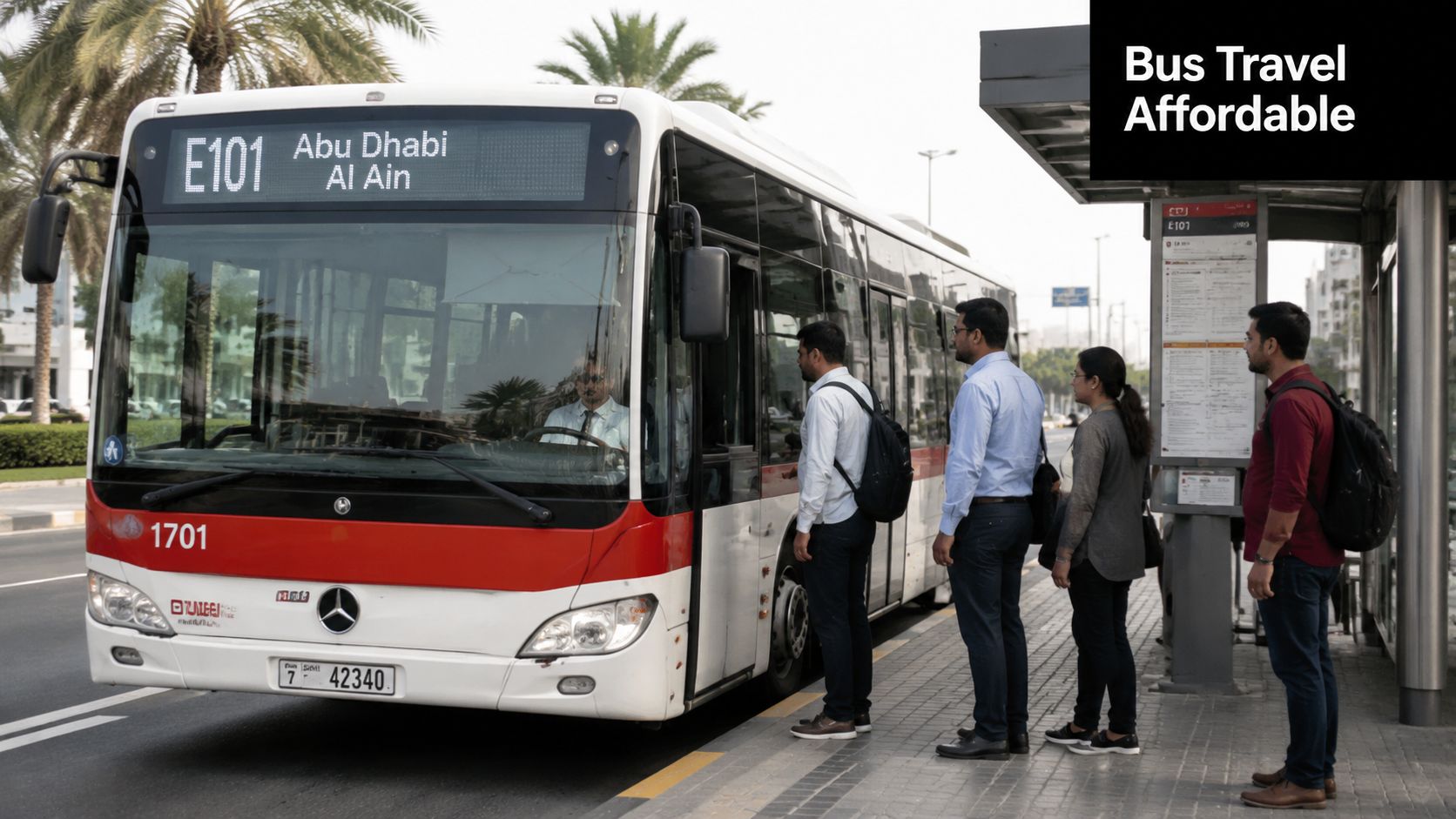
For travellers who want the lowest-cost practical option, the intercity bus is often the sensible choice. It works best when your schedule is flexible, your luggage is manageable, and you don't need true door-to-door transport.
When the bus works well
If you're staying centrally, travelling solo or as a couple, and moving between cities rather than to a specific hotel entrance, the bus can be a very reasonable fit. It removes the stress of driving and avoids the higher cost of a private car.
The main advantage isn't speed. It's simplicity once you're in the system. You travel from a known departure point to a known arrival point, then continue by taxi or local transport at the other end.
- Best for budget-minded travellers: The savings can be worthwhile if your day isn't tightly timed.
- Good for light luggage: A single suitcase and small bag are easier than multiple pieces.
- Useful for daytime transfers: You have more room to absorb small delays and sort the last mile calmly.
For travellers used to airport coach links in Britain, the rhythm feels more familiar than the geography does. Anyone comparing it mentally to a UK airport coach may also find this Heathrow to Stansted bus transfer example a useful way to think about the trade-off between price and directness.
Where travellers get caught out
The key issue isn't whether buses exist. It's whether they're suitable for your specific day. UAE intercity bus schedules may run every 20 to 40 minutes but with variable real-time reliability, which can be a real difference from UK-style punctuality expectations, according to Holidify's Abu Dhabi to Dubai travel overview.
That matters most if you're heading to an airport, joining a cruise, or trying to hit a fixed check-in window. A bus that is perfectly acceptable for a leisure day can be the wrong tool for a time-sensitive connection.
Best use case: Take the bus when being early or a bit late doesn't change the outcome of your day.
Many visitors also underestimate the last-mile problem. The bus gets you between cities. It doesn't solve your exact hotel entrance, cruise terminal kerbside drop, or airport terminal confusion in the way a private transfer does.
Using Taxis and Private Hire Services
You land in Abu Dhabi after an overnight flight from London or New York, clear immigration, collect your bags, and still need to reach a Dubai hotel. In that situation, taxi or private hire usually makes more sense than trying to save the last few pounds or dollars. The Abu Dhabi to Dubai run is not especially long by UK or US standards. It is roughly the sort of inter-city transfer many travellers compare mentally to London to Birmingham. The difference is that in the UAE, the stress point is often not the distance itself but the handoff between airport, hotel, luggage, and timing.
Metered taxi versus app booking
A standard taxi is the easiest choice if you want to leave promptly from an airport, hotel, or taxi rank. You get in, give the destination, and go. The trade-off is that the final fare can vary quite a bit because the meter keeps running in slower traffic, and journey times are less predictable during busy commuting periods.
App-based services such as Uber or Careem solve a different problem. They give you a cleaner booking trail, card payment, and a visible pick-up point in the app. For UK and US visitors who are used to booking rides on their phone, that familiarity helps after a long travel day. The downside is that availability and pricing can shift with demand, especially at peak times or around major events.
The practical choice usually comes down to this:
- Use a metered taxi if you want the quickest departure with the least admin.
- Use an app-based car if tracking, cashless payment, and app confirmation matter to you.
- Allow extra time if you are travelling at commuter hours or heading into a busy part of Dubai.
When private hire is worth it
Pre-booked private hire costs more, but it removes the uncertainty that catches tired travellers out. For this reason, families, older travellers, business travellers, and anyone carrying several bags often prefer it. You know who is meeting you, where to go, and what type of vehicle has been arranged.
That matters more than many first-time visitors expect. A transfer that looks simple on paper can feel less simple after a long-haul arrival, especially if children are involved or your hotel entrance is not obvious from the roadside.
A well-organised transfer works much like a private car hire with driver service. You are paying for clarity as much as transport.
If the day includes immigration, baggage reclaim, a hotel check-in, or a cruise or airport connection, private hire is often the option that keeps the journey straightforward.
Comparing Your Travel Choices Fastest vs Cheapest
The best option depends on what you're optimising. Price, control, comfort, and timing don't all point to the same answer.
| Mode of Transport | Average Cost (AED) | Total Time (Door to Door) | Best For |
|---|---|---|---|
| Self-drive | Varies by rental terms, fuel, tolls, and parking | Usually quickest when traffic is light, but timing depends on collection, navigation, and parking | Travellers who want flexibility and are comfortable driving |
| Intercity bus | Lowest-cost option | Longer overall once station access and last-mile travel are included | Solo travellers and couples with flexible schedules |
| Taxi or private hire | Taxi commonly around 170 to 350 AED where metered pricing applies | Usually the most straightforward door-to-door option | Families, older travellers, business travellers, and anyone with luggage |
The bus is the cheapest choice in practical terms, but it's rarely the best one for a same-day flight or cruise connection. Self-drive gives the most independence, though that only helps if you're comfortable with unfamiliar motorway conditions and urban arrivals.
Taxi or private hire usually wins on effort saved. For many visitors, especially after a long flight, that matters more than shaving the fare.
Practical Tips for a Hassle-Free Journey
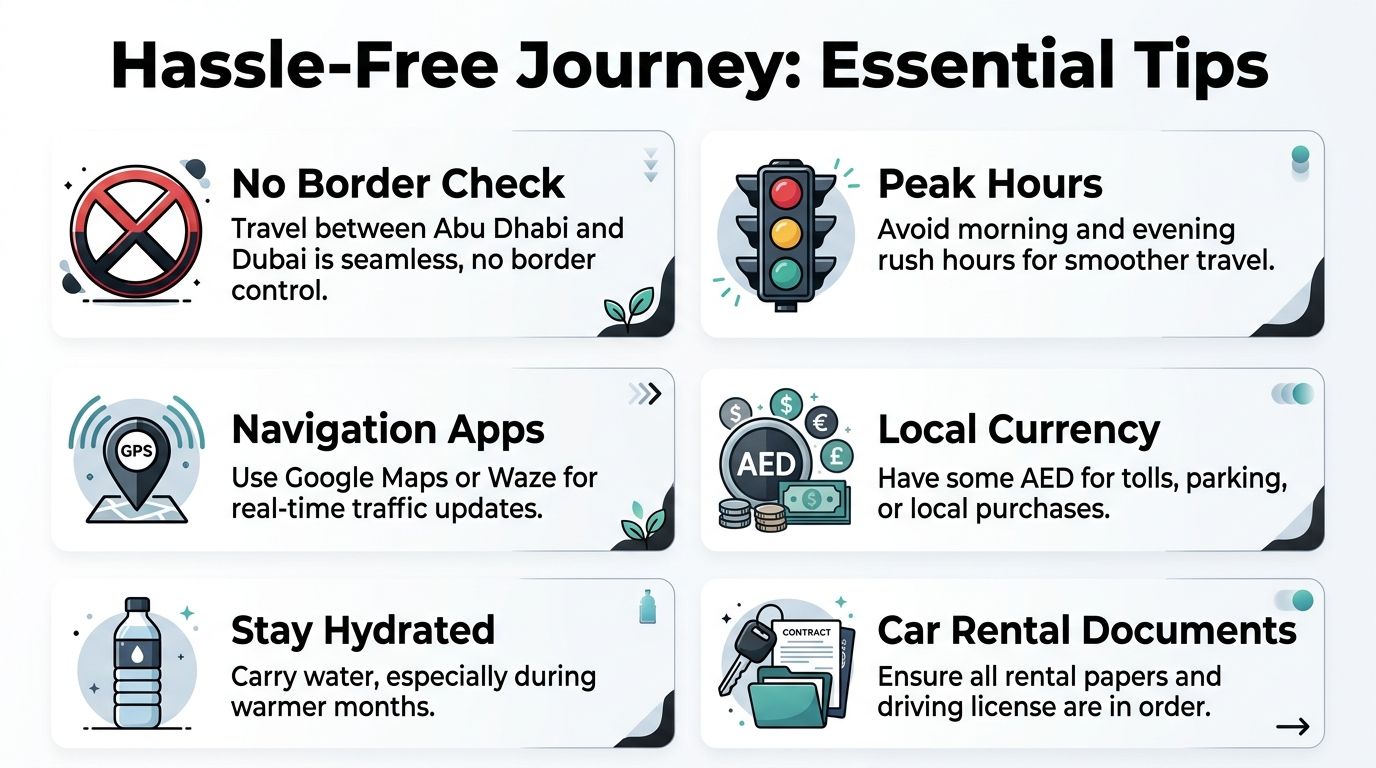
Most problems on this route don't come from the distance itself. They come from timing errors, weak last-mile planning, and treating the trip like a casual local transfer.
Small details that prevent bigger problems
Use this checklist before you set off:
- Travel earlier than feels necessary: Road conditions can change the tone of the day very quickly.
- Carry water: The journey itself is easy enough, but comfort drops fast if you're tired, dehydrated, or waiting outside for pick-up.
- Keep some AED available: It's useful for smaller purchases and transport odds and ends.
- Check your exact drop-off point: A hotel, airport terminal, apartment tower, and cruise-related meeting point all require different planning.
- Don't assume public transport is ideal for fixed deadlines: As covered earlier, service timing can be less predictable than some UK travellers expect.
- Read rental paperwork properly: Tolls, charges, and vehicle return rules are where avoidable surprises usually sit.
There isn't a meaningful border-style interruption between the two emirates for normal tourist travel, so the trip itself is smooth. What matters is being realistic about how long the full door-to-door movement takes once luggage, urban traffic, and arrival formalities are included.
If you're choosing a travel window, avoid busy commuting periods where possible. If you can't, build in more margin and choose the option that gives you the fewest moving parts.
If you prefer the kind of transfer where someone else handles the timing, luggage, and door-to-door logistics, EC Minibus is worth considering for UK airport and cruise connections. Their service is designed for travellers who want fixed pricing, meet and greet support, and a calmer journey between Heathrow, London hotels, and major cruise ports.