

You've just landed at Heathrow after an overnight flight from Toronto, Vancouver, Chicago, or New York. You're tired, your phone battery is lower than you'd like, and you're trying to remember whether your cruise leaves from Southampton, Dover, Portsmouth, or Tilbury. Around you, signs point to trains, coaches, taxis, and terminals you've never used before. Your suitcase is heavy, your carry-on is awkward, and that bottle of wine you packed for the cruise suddenly feels like one more thing to worry about.
That's the moment when door to door service starts to make sense.
Instead of piecing together the trip yourself, you arrange one transfer that takes you from the airport to your hotel, cruise terminal, or another final stop with practical help along the way. That matters in the UK, where road transport still does most of the work. In 2023, the UK recorded 7 billion passenger journeys, with 90% being road-based, and London alone accounted for 1.8 billion of these journeys, according to UK transport statistics on passenger travel. For an international visitor, that means direct road travel isn't a niche option. It's part of how people move.
For many first-time visitors, the appeal is simple. You don't want your arrival to feel like a test. You want someone to meet you, help with the luggage, guide you to the right vehicle, and take you where you need to go without extra decision-making when you're jet-lagged.
This guide walks through what door to door service really means in the UK, how it compares with other transfer choices, and why it's especially useful for North American cruise passengers who want a calmer start to their trip.
Table of Contents
- Your Stress-Free Arrival in the UK Starts Here
- What Exactly Is Door to Door Service for Travellers
- Comparing Your UK Airport and Port Transfer Options
- Who Benefits Most from a Door to Door Transfer
- How EC Minibus Delivers a Smooth Transfer Experience
- Booking Your Transfer and What to Expect on the Day
- Frequently Asked Questions About UK Door to Door Services
Your Stress-Free Arrival in the UK Starts Here
A long-haul arrival rarely feels elegant. Even seasoned travellers can feel off balance after immigration, baggage reclaim, and customs. If you're heading onward to a hotel in London or straight to a cruise port, the biggest challenge often isn't the distance. It's the hand-offs.

A proper door to door transfer removes those hand-offs. You're not figuring out which lift goes to the train platform, whether the taxi rank is the correct one, or if your luggage will fit in a standard car. You follow one plan from the start.
The first hour matters most
Most travel stress happens right after arrival. That's when people are tired, less patient, and more likely to make mistakes such as boarding the wrong service or underestimating how much walking a station connection involves.
A door to door transfer changes the tone of the whole day because it gives you three things at once:
- Clarity: You know who is collecting you and where you're going.
- Continuity: One service handles the entire journey rather than part of it.
- Comfort: You sit down, settle in, and stop troubleshooting.
Practical rule: If your first UK journey includes heavy luggage, a hotel check-in, or a cruise departure, simplify the ground transfer first. Everything else gets easier after that.
Why road travel fits this kind of journey
For travellers, the strongest argument isn't theory. It's how direct the trip feels in real life. Road-based transfers work well because they connect the exact places people need, such as airport terminals, hotels, private addresses, rail hubs, and cruise terminals.
That's why door to door service is often the calmest option for visitors who don't want their arrival day to become a logistics project.
What Exactly Is Door to Door Service for Travellers
The phrase sounds obvious, but travellers often assume it means a private car. In UK travel, it means something more specific. Think of it as the transport version of a hotel concierge arranging your movement from one actual doorway to another, with assistance built in.
More than a ride
A standard ride usually starts at the kerb and ends at the kerb. You get yourself and your bags to the car, then from the drop-off point into the building. Door to door service is a higher-touch model.
In the UK's legal definition, the driver must physically assist passengers from the main accessible door at the point of origin to the main door of the destination. That's a higher standard than curb-to-curb service, and the legal definition of UK door-to-door service states that this level of assistance is associated with a 40% reduction in transit friction.
For a traveller, “transit friction” isn't abstract. It means the awkward parts of the day:
- pulling cases over uneven pavement
- finding the correct entrance
- managing bags while opening doors
- navigating arrivals halls when you're tired
- helping a partner or parent who walks more slowly
Door to door service is less about the vehicle and more about who takes responsibility for the awkward moments.
Why the word door matters
Many visitors hear “door to door” and think only about route, leading to confusion. But the key difference is assistance.
If you're travelling with cruise luggage, shopping bags, a garment bag, mobility aids, or even a stiff back after a flight, that assistance becomes the true value. The driver isn't just transporting you between two postcodes. The driver helps you complete the transfer.
Here's an easy way to tell the difference:
| Service type | What it usually means for you |
|---|---|
| Curb-to-curb | You meet the car outside and handle bags and entry points yourself |
| Door to door | You receive active help from your starting door to your destination door |
That distinction matters even more for older travellers and first-time visitors. A journey can be technically short and still feel exhausting if you have to solve every small problem yourself.
Comparing Your UK Airport and Port Transfer Options
The best transfer choice depends on what you value most. Some travellers want the lowest fare. Others want the least walking, fewer changes, or easier luggage handling. If you're arriving from North America for a cruise, the decision usually comes down to stress, not just price.
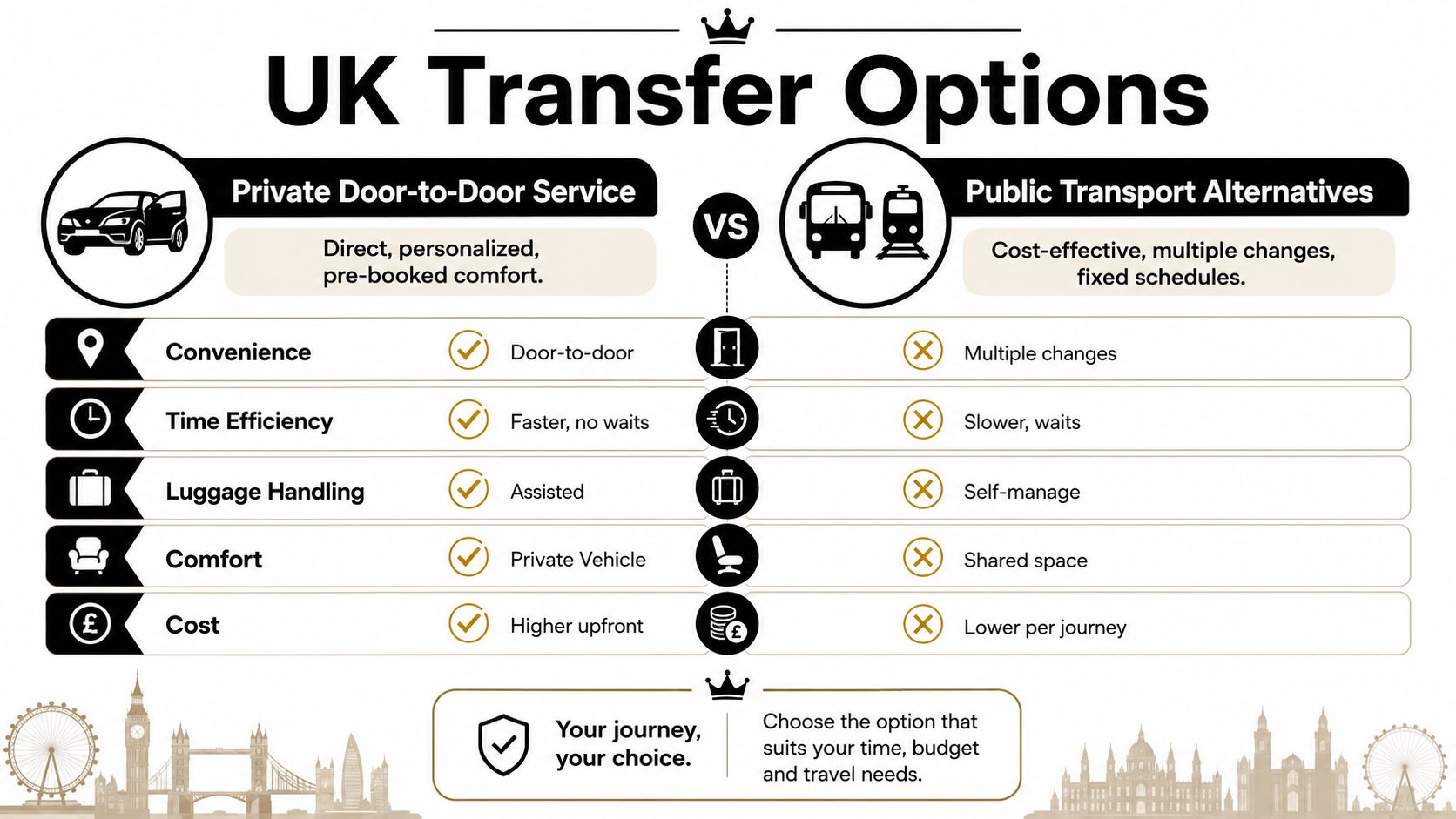
A simple side-by-side view
| Option | Best for | What feels easy | What can become difficult |
|---|---|---|---|
| Private door to door service | Travellers with luggage, cruise passengers, families, small groups | Direct travel, assistance, privacy, pre-arranged pickup | Higher upfront cost |
| Train or coach | Confident travellers with light bags | Predictable routes, no driving needed | Changes, walking, lifts, platform navigation, crowded space |
| Taxi or ride-hailing app | Shorter city trips or flexible local travel | Fast to arrange in some cases | Variable luggage space, unclear assistance, queues during busy periods |
| Car rental | Travellers planning broader touring | Independence once on the road | Driving on the left, parking, navigation after a long flight |
Public transport can work well if you're travelling light and don't mind managing each step yourself. But airport-to-port journeys often include more complexity than people expect. You may need to move between terminals, train platforms, station exits, and taxi pickup points before you even begin the final stretch.
If you'd like a fuller look at private transfer planning, this overview of airport shuttle services for UK arrivals is useful for comparing how pre-booked services differ from improvised same-day options.
Where travellers usually get caught out
The weak point in many travel plans isn't the main leg. It's the transition points.
A train from Heathrow may look simple on paper, but a cruise passenger might still have to:
- get from arrivals to the correct rail connection
- handle multiple bags through lifts or escalators
- change at a station with limited seating or confusing signage
- arrange a final taxi to the port or hotel
That's manageable for some people. It's not pleasant for many.
A standard taxi removes some of that effort, but it doesn't always solve the practical questions. Will the driver wait if baggage reclaim is slow? Is there enough room for large cruise cases? Will someone help from the terminal or just from the pickup point?
The cheapest transport option and the easiest transport option are often not the same thing.
For a first-time visitor, that difference matters more than it seems. The journey you remember most clearly is often the first one, when you're tired and least prepared to improvise.
Who Benefits Most from a Door to Door Transfer
Not every traveller needs the same level of support. But some groups feel the difference immediately. If you've ever found yourself saying, “We can manage, but I'd rather not wrestle with all this,” you're probably the kind of traveller who benefits from a door to door transfer.
Cruise passengers with awkward luggage
This is the group that often gets overlooked in generic travel advice. Cruise passengers don't travel like weekend city-break visitors. They often have larger cases, more formal clothing, extra shoes, medical items, and sometimes fragile purchases or liquids that shouldn't be treated like ordinary courier parcels.
That gap shows up clearly in the complaint pattern around handling. 42% of UK door-to-door courier complaints involve fragile or oversized items like cruise luggage, according to reporting on UK courier complaints and fragile item handling. For travellers, the lesson is straightforward. Standard systems often struggle with bags that are bulky, delicate, or awkwardly shaped.
A couple in their fifties flying into Heathrow before boarding in Southampton is a good example. They may not need luxury. They need a service that understands there could be two large suitcases, two cabin bags, perhaps a garment bag, and no desire to drag everything through a station change.
Other travellers who value practical help
Door to door service also suits people whose trip includes extra moving parts.
- Families with children: Parents already have enough to manage. Add pushchairs, snacks, cabin bags, and tired children, and a direct transfer becomes much easier than a chain of public connections.
- Older travellers: Many people are active and independent but still prefer fewer stairs, less lifting, and a simpler route.
- Business travellers: If you need to arrive composed rather than flustered, a pre-arranged transfer reduces uncertainty.
- Small groups: One vehicle and one plan often works better than splitting across multiple taxis.
These aren't edge cases. They're normal travel situations. The main benefit is that the journey feels organised from the outside, even if your arrival day doesn't.
How EC Minibus Delivers a Smooth Transfer Experience
A high-quality door to door transfer should feel organised before you even leave the airport. After a long international flight, especially if you are heading to a cruise ship on a fixed schedule, small details matter more than flashy promises. You need a driver who is tracking your arrival, a vehicle that can take cruise luggage without a struggle, and a pickup plan that still works if your journey runs late.
For many North American cruise passengers aged 45 and over, that is the difference between starting a UK trip calmly and starting it tired, rushed, and worried about the next connection. A good transfer service works like a well-run hotel check-in. The important parts are managed discreetly in the background, so you are not forced to solve problems while standing in arrivals with two large cases and a phone battery at 12 percent.
What good service looks like in practice
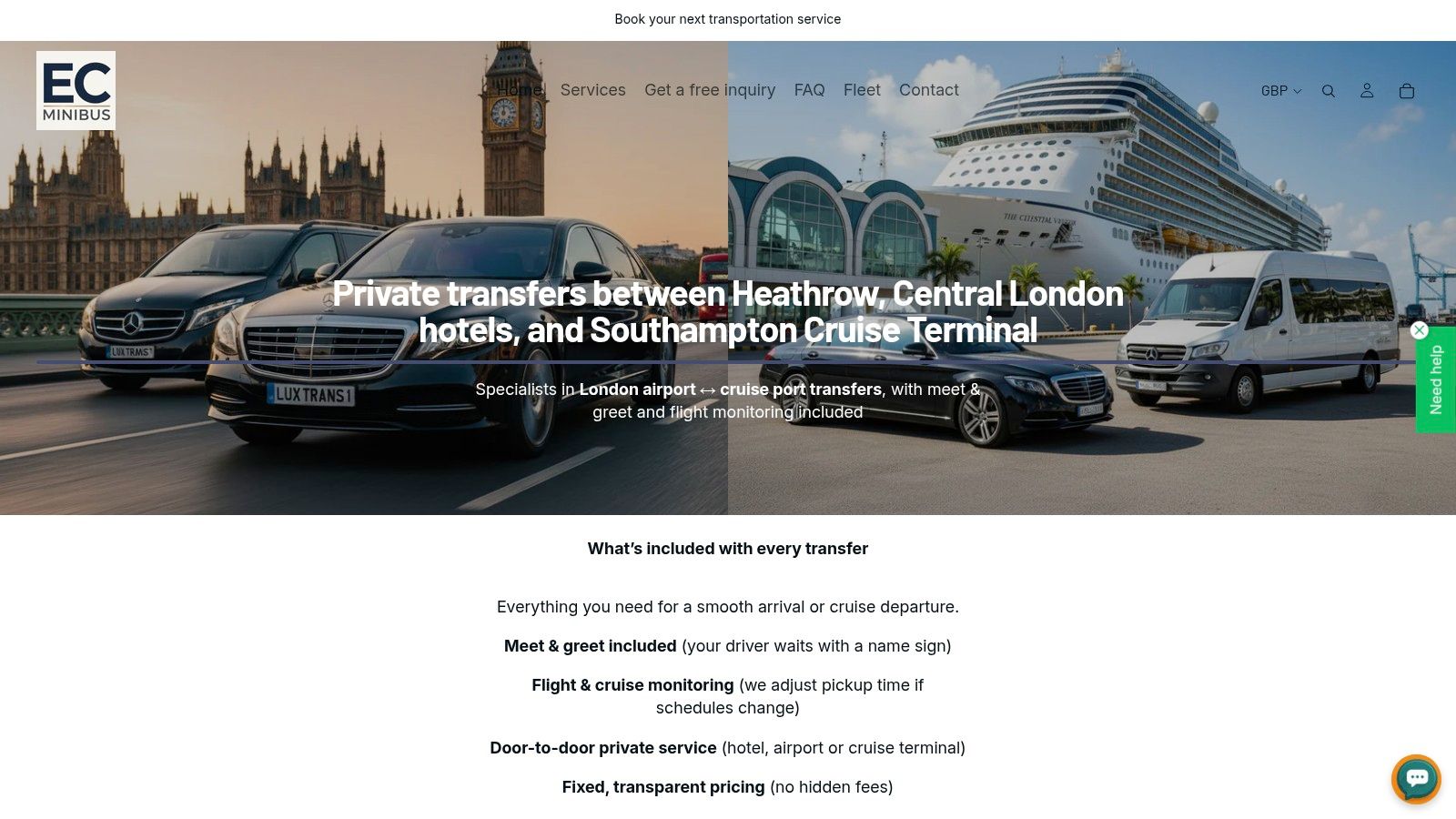
A provider such as EC Minibus and its available vehicle fleet shows what travellers should look for. The useful part is not the brand name. It is the service design. Transfers between Heathrow, London hotels, St Pancras International, and cruise ports such as Southampton, Dover, Portsmouth, and Tilbury reflect how real trips work.
That matters because cruise travel rarely follows one simple line. You might land at Heathrow, stay in London overnight, then travel to Southampton the next morning. Or you may fly in, go straight to the port, and need extra boot space for larger suitcases, a garment bag, or mobility equipment.
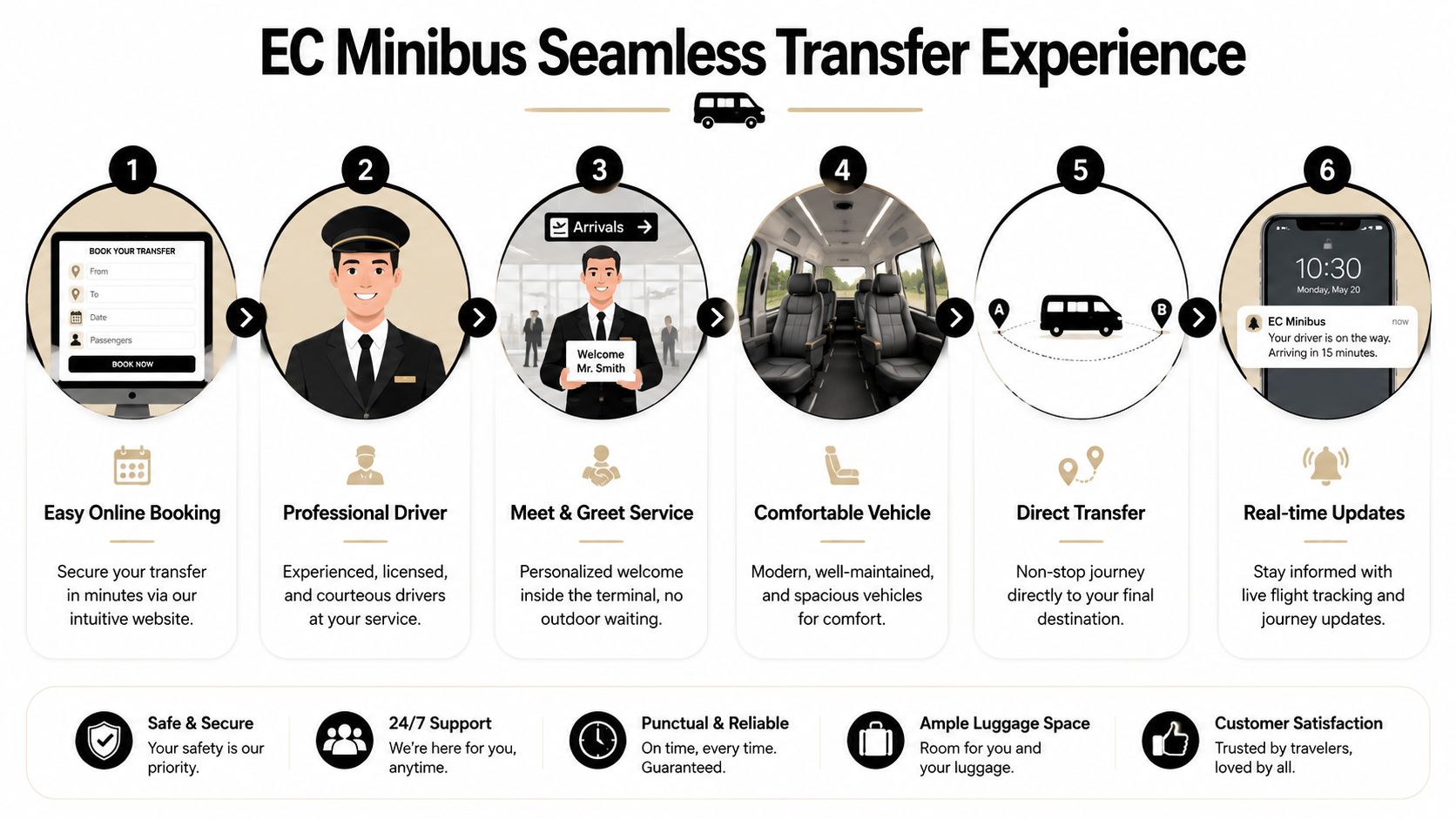
Strong door to door services usually provide a few practical features:
- Meet and greet inside the terminal: You are met in arrivals instead of trying to work out unfamiliar pickup zones outside.
- Help with luggage: Especially useful for cruise cases, shopping bags, or items that are heavy or awkward to lift.
- Direct transport: One vehicle, one route, and no need to manage trains, station changes, or separate taxi queues.
- Fixed pricing: You know the fare in advance, which makes budgeting easier before a cruise.
Why real-time flight monitoring matters so much
This is one of the most overlooked parts of transfer planning.
International arrivals rarely run with perfect timing. A flight can land late. Passport control can take longer than expected. Bags can appear quickly, or not for quite a while. If your transfer only works when every stage happens on schedule, it is a weak plan.
Real-time flight monitoring solves that problem in the background. The provider follows your flight status and adjusts the pickup timing to match your actual arrival. You do not need to start making calls from the terminal or worry that your driver has already left.
That is especially helpful for overseas visitors. Many arrive without mobile data, with limited battery, or with no interest in sorting out transport after eight hours in the air. For cruise passengers, the pressure is even higher because the ship will not wait if road transfer problems eat into the day.
A monitored pickup protects the part of the journey you cannot control.
The result is simple. If your flight is delayed, the transport plan can shift with it. You are far less likely to face confusion about meeting points, surprise waiting charges, or the stress of finding a backup car at the last minute.
Booking Your Transfer and What to Expect on the Day
A good booking should feel less like filling out a form and more like handing a travel professional the pieces of your itinerary so they can line them up properly. For cruise passengers arriving from North America, that matters more than it first appears. A transfer company is not only arranging a car. It is planning around a long-haul flight, UK arrivals procedures, large luggage, and a ship departure time that does not bend.
What to prepare before you book
Having the right details ready makes the process quicker and helps the provider set up the journey correctly the first time.
- Flight information: Arrival airport, flight number, and landing date.
- Cruise details: Port name and ship name, especially if you are travelling to the port on embarkation day.
- Accommodation information: Hotel name or full address if you are staying in London before or after the cruise.
- Luggage notes: Mention oversized suitcases, garment bags, mobility aids, or anything fragile.
- Passenger count: Include children so the right vehicle can be assigned.
If you are comparing providers, this guide to the door-to-door airport transfer booking process shows the kind of information an organised service will usually request.
One small detail can prevent a large problem later. If you are travelling with cruise luggage, say so clearly. Two passengers on a cruise holiday often carry more than two passengers on a city break, and the difference affects vehicle space, loading time, and how comfortably the trip begins.
What happens when you land
After booking, you should receive a confirmation with clear instructions for the pickup. That usually includes where to meet the driver, what to do if your phone does not connect in the UK, and which number to use if you need help.
On arrival day, the best operators do not rely on you to manage every update from baggage reclaim. They track the journey, check the booking details in advance, and arrive prepared for the luggage and destination you have already shared. For international visitors, especially those landing tired after an overnight flight, that removes a great deal of pressure.
Reliability is worth checking before you book. Rather than trusting bold claims, look for a provider with a consistent history of positive reviews, clear communication, and experience with airport-to-port transfers. That track record often tells you more than marketing language ever will.
Once you meet your driver, the rest should feel straightforward. Your bags are loaded, you settle in, and the journey begins without needing to figure out train platforms, taxi ranks, or last-minute route changes.
A quick visual walkthrough can help if you prefer to see what a private transfer looks like before you travel:
Frequently Asked Questions About UK Door to Door Services
What if my flight is delayed
If the service uses real-time monitoring, the pickup should be adjusted to your new arrival time. You shouldn't need to reorganise the journey from the airport because the inbound flight landed late.
What if my flight is cancelled
A cancellation is different from a delay because the original arrival no longer exists. In that case, contact the transfer provider as soon as your replacement flight is confirmed so the booking can be updated properly.
Can I bring large cruise luggage
Usually yes, but you should declare it in advance. This is especially important for oversized cases, garment bags, mobility equipment, or fragile items that need more careful handling.
Are child seats available
Policies vary by operator, so ask when booking. If you're travelling with grandchildren or young children, don't leave this question until arrival day.
Can the journey include more than one stop
Often yes. Many travellers need airport to hotel one day and hotel to cruise port the next, or a stop at St Pancras before continuing elsewhere. Multi-stop planning is best arranged before the travel date.
Is door to door service only for older travellers
Not at all. It suits anyone who wants a direct, assisted transfer. Older travellers often appreciate it most, but families, groups, and business passengers use it for the same reason. It reduces friction.
Is it worth booking in advance
For airport and cruise transfers, yes. Advance booking gives you a confirmed plan, matched vehicle size, and clearer arrival instructions. That's especially helpful when your schedule is tied to a ship departure or hotel check-in.
If you'd like a simpler way to get from Heathrow to your hotel or cruise port, EC Minibus offers private UK transfers with meet and greet, luggage assistance, fixed pricing, and routes that connect Heathrow, London, Southampton, Dover, Portsmouth, Tilbury, and St Pancras.