

You're at Schiphol with a decent connection on paper, but not much margin in practice. You still need to reach Heathrow, then make your way onward to Southampton for a cruise, and somewhere between passport control, gate changes, and carry-on rules, duty free starts to look either like a smart stop or an expensive mistake.
At Schiphol, it can be either. The airport has the scale, stock, and post-security layout to make duty-free shopping useful, especially if you're buying gifts, fragrance, cosmetics, wine, spirits, or last-minute treats for a sailing out of the UK. But timing matters, and so do liquid rules. A bottle bought in the wrong place, or packed the wrong way, can become a problem at transfer security far quicker than most travellers expect.
Table of Contents
- Your Essential Guide to Schiphol Duty-Free Shopping
- Where to Find Duty-Free Shops and Opening Hours
- What to Buy for the Best Value
- Navigating Allowances and Tax Rules for Your Destination
- Rules for Transfers Liquids and Pre-Ordering
- Your Smart Shopping Checklist for Schiphol
Your Essential Guide to Schiphol Duty-Free Shopping
You clear security at Schiphol with a short connection, a Heathrow flight still ahead, and a cruise departure to reach after that. In that situation, duty-free shopping only works if it saves trouble later. The smart approach is to keep it tight: shop after security, stick to items that travel easily, and avoid anything that could create a liquid or baggage problem on the next leg.
That matters even more for UK-bound travellers. A bottle that looks like a good buy at Schiphol can become a nuisance if you face another screening point, need to repack at Heathrow, or are trying to board ground transport with too many bags before heading to Southampton. Cruise passengers feel this first. Every extra purchase has to survive the flight, the transfer, and embarkation day.
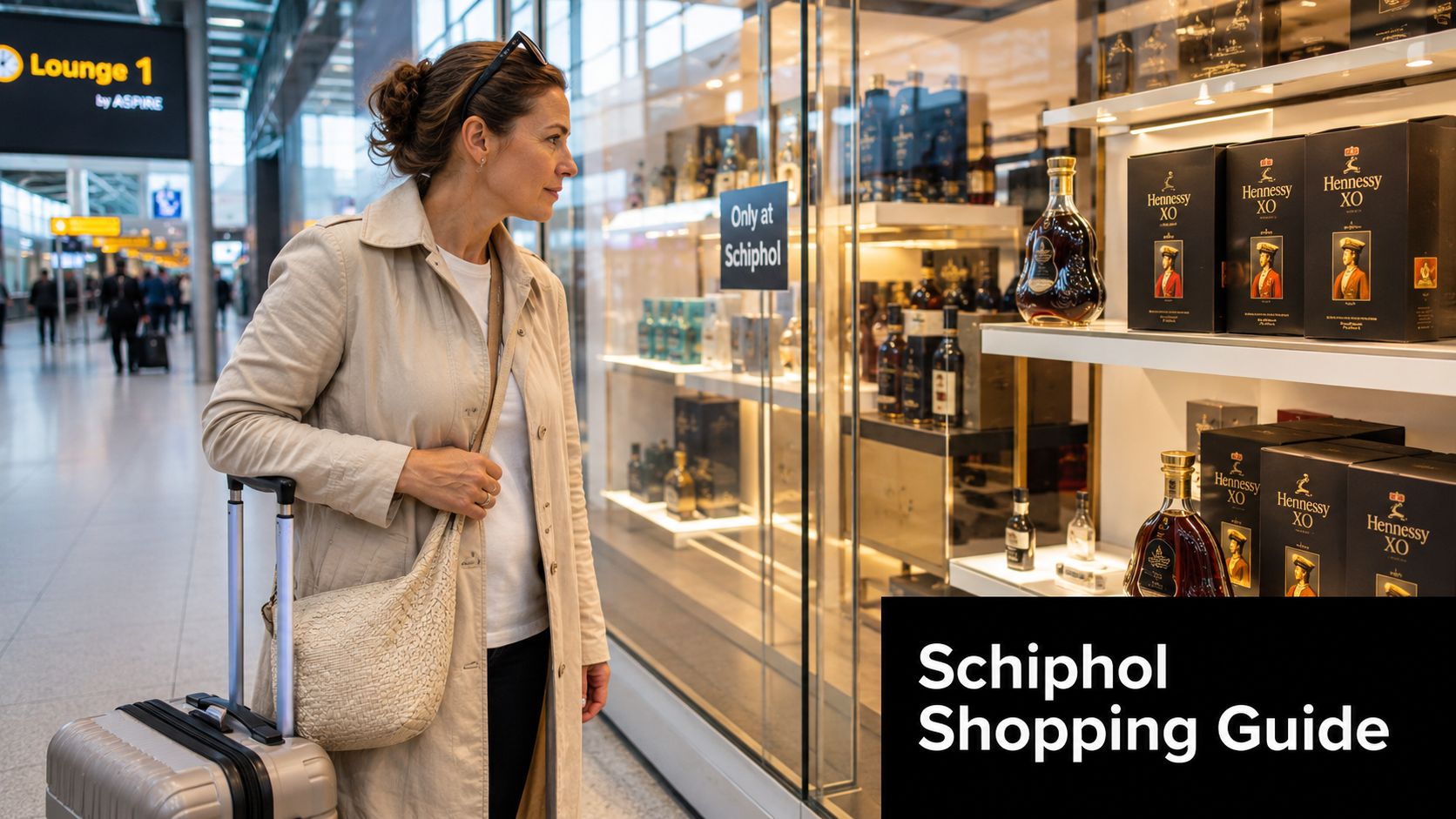
Schiphol's duty-free setup is long established, and it is built around international transit traffic rather than casual last-minute browsing. You can see that in the scale of the retail offer and in how quickly purchases are processed once you are airside. For a connecting passenger, that is the main advantage. Good airport shopping is not about wandering. It is about finding the right category fast, paying quickly, and getting to the gate without creating a problem for the next part of the trip.
My rule is simple. Treat duty free in Schiphol Airport as a practical stop, not part of the holiday.
If your journey continues to the UK and then on to a cruise port, leave room in the plan for what happens after landing too. These airport shuttle planning tips are a useful reminder that onward transfers rarely leave much margin for delays, repacking, or awkward extra hand luggage.
Where to Find Duty-Free Shops and Opening Hours
You clear security at Schiphol with 40 minutes before boarding to Heathrow. You still need to pick up a bottle, avoid problems at the next screening point, and keep your hand luggage manageable for the transfer onward to Southampton. In that situation, shop placement matters more than shop count.
For most international passengers, the key duty-free area is airside, not landside. The main priority is Lounge 1, where Schiphol's largest Today Duty Free store opened in 2025. Schiphol has also expanded and refreshed duty-free space across the airport, so the practical pattern is clear. If you want the best chance of finding fragrance, cosmetics, wine, and spirits in one pass, start airside and start with the larger stores.
That matters for UK-bound travellers in particular. If you buy liquids before security and still face another screening point later, you create your own problem. For cruise passengers, the issue is even more obvious. Every extra bag or bottle has to make it through the flight, the airport arrival, and the trip to the port.
Start airside, then shop with a time limit
Schiphol does have shopping options before security, but duty-free buying usually works better after security. You have cleared the main checkpoint, you know how much time is left, and you can judge whether the purchase is realistic for the rest of the trip.
Use this approach:
- Head to Lounge 1 first if you want the widest duty-free choice in one area.
- Check opening hours on the day because store times can change with flight schedules and airport operations.
- Shop once, not in stages if you are connecting to the UK and do not want extra carrier bags during the transfer.
- Leave buffer time if you are flying to Heathrow or another UK airport and then continuing by rail, coach, or cruise transfer.
A short connection needs discipline. Go in with a list.
What usually works best
The best shopping window is the period after security and before you drift too far toward the gate. That gives you enough range to compare products without forcing a last-minute sprint across the terminal. If I were advising a passenger heading to a UK cruise, I would rather see one quick stop in a major airside store than three smaller stops spread through the terminal.
A few habits save trouble:
- Buy liquids only when you are confident they can stay sealed and accepted for the rest of the journey
- Do not assume every lounge has the same range
- Do not leave shopping until final boarding calls
- Do not treat landside browsing as harmless if another screening point is still ahead
Opening hours are the variable most travellers get wrong. Airport retail does not always follow a simple early-to-late pattern, especially on quieter travel days or at the edges of the operating schedule. Check Schiphol's live shop listings before you rely on a specific store, especially for dawn departures, late arrivals, or tight same-day connections to the UK.
For practical purposes, Schiphol duty free works best when you keep the plan simple. Clear security. Go to the main airside shopping zone. Buy what you came for. Get to the gate with time left.
What to Buy for the Best Value
Not every airport purchase is a bargain. At Schiphol, the best-value categories are the ones the airport itself has positioned most aggressively: perfumes, cosmetics, wine, and spirits. Schiphol's new retail concept states that these categories are, on average, 25% cheaper than regular retail prices at Dutch retailers, and the revamped stores include tasting bars and personal beauty advice, according to Passenger Terminal Today's report on the Schiphol launch.
That benchmark is useful, but only if you use it properly. It doesn't mean every bottle or gift set beats every online price. It means these are the shelves worth checking first.
The categories worth checking first
Fragrance is often the easiest win. Airport fragrance ranges tend to include gift sets, travel-friendly packaging, and familiar brands that are easy to compare mentally if you already know your usual high-street price.
Cosmetics and skincare can also be worth a look, especially if you already use a specific line. If the store offers personal beauty advice, use it only when you have time. If your connection is short, go in knowing the exact product you want.
Wine and spirits make sense when you're buying for a final stop rather than immediate use in transit. Schiphol's tasting bars can help if you're undecided between labels, but keep the liquid rules in mind before you get too enthusiastic.
A sensible value hierarchy usually looks like this:
| Category | Often worth checking | Why |
|---|---|---|
| Perfume | Yes | Easy to compare and commonly stocked in gift sets |
| Cosmetics | Often | Good if you already know the exact item |
| Spirits | Often | Best for final-destination gifting, not casual transit buying |
| Sweets and confectionery | Sometimes | Good for easy gifts, less risky than liquids |
| Wine | Depends | Fine for checked baggage plans or clear final-stop gifting |
What usually needs more caution
Electronics are where people overspend out of convenience. Airports are good at urgency. Urgency is not the same as value. If you need headphones because yours broke, that's a practical purchase. If you're assuming airport electronics are automatically cheaper, that's where mistakes happen.
Local gifts can be excellent, but choose the kind that travel easily. Dutch sweets and non-fragile packaged food usually create less hassle than glass bottles if you've still got another airport step ahead.
Buy what is either clearly cheaper, clearly useful, or clearly difficult to find later. Skip the middle ground.
For cruise passengers, the sweet spot is often a mix of one proper gift item and one low-risk consumable. A fragrance gift set plus packaged sweets is easier to manage than multiple bottles when you still need to clear Heathrow, collect bags, and reach a cruise port.
Navigating Allowances and Tax Rules for Your Destination
Travellers get caught, not because the rules are impossible, but because people mix up three separate questions: where they bought the item, where they're flying next, and where they'll finally enter with the goods.
The rule that matters most
Duty free doesn't remove customs rules at your destination. It only changes the way the goods are sold. Your real checkpoint is the country where your allowance applies.
For UK-bound travellers, that means the UK rules matter, even if the shopping happened in Amsterdam. For cruise passengers flying into Heathrow and then travelling to Southampton, the same logic applies. Your airport receipt doesn't override what UK authorities allow you to bring in.
If you're travelling onward to another non-EU country, rules can differ by destination. The safest approach is to treat any airport allowance table as a starting point, then verify the final country's official customs guidance before you fly.
Allowance guide for UK-bound travellers
The verified information provided for this article doesn't include official quantity limits for alcohol or tobacco by destination, so it would be wrong to list precise numbers here. What you can use safely is a decision framework.
| Product | Allowance for UK | Allowance for other non-EU countries |
|---|---|---|
| Alcohol | Check the UK's current customs allowance before travel | Check the destination country's customs authority |
| Tobacco | Check the UK's current customs allowance before travel | Check the destination country's customs authority |
| Perfume and cosmetics | Usually less about “duty free” quantities, more about customs value and liquid handling | Check local customs rules and hand-baggage rules |
| Gifts and confectionery | Usually simpler, but still subject to import rules in some countries | Check destination guidance for food and gift imports |
A few practical points matter more than memorising a chart from a blog:
- Keep receipts together: Customs questions are easier to answer when you can show what you bought and where.
- Know your final import point: If Heathrow is your UK entry point, that's the customs context that matters.
- Separate tax from security: Customs allowances and liquid screening are different problems.
The expensive mistake isn't usually buying too much perfume. It's assuming a security-sealed airport purchase automatically solves customs limits. It doesn't.
For travellers flying within the EU, tax treatment and pricing logic differ from non-EU journeys, but the airside buying decision still needs to account for your next security point and final destination. For UK travellers after Brexit, that distinction matters more than many people expect because “European connection” and “UK arrival” are no longer the same thing in practical customs planning.
How cruise passengers should think about it
Cruise travellers often have one extra layer of complexity. You're not just entering the UK. You're entering the UK and then continuing to a ship with luggage, timings, and embarkation procedures of your own.
That changes what counts as a smart buy.
A good rule set looks like this:
- Buy gifts you won't need to repack urgently
- Avoid bulky glass unless you're confident about the next handling step
- Think beyond Heathrow because the trip isn't finished when the flight lands
- Check onward transport constraints if you're moving from airport to port with several bags
If your route involves an airport change or a transfer across London, practical planning matters more than retail excitement. Travellers moving between airports often benefit from reading through Heathrow to Stansted transfer considerations because the same timing pressure affects how much shopping is sensible.
Rules for Transfers Liquids and Pre-Ordering
The biggest trap in duty free in Schiphol Airport is still liquids. Not pricing. Not stock. Liquids.
Schiphol's official guidance says the standard hand-baggage liquid rule still applies, with liquids limited to containers of max 100 ml in hand baggage. It also confirms that duty-free liquids bought post-security can pass through transfer security if they're sealed in an official tamper-evident bag, according to Schiphol's passenger guidance.
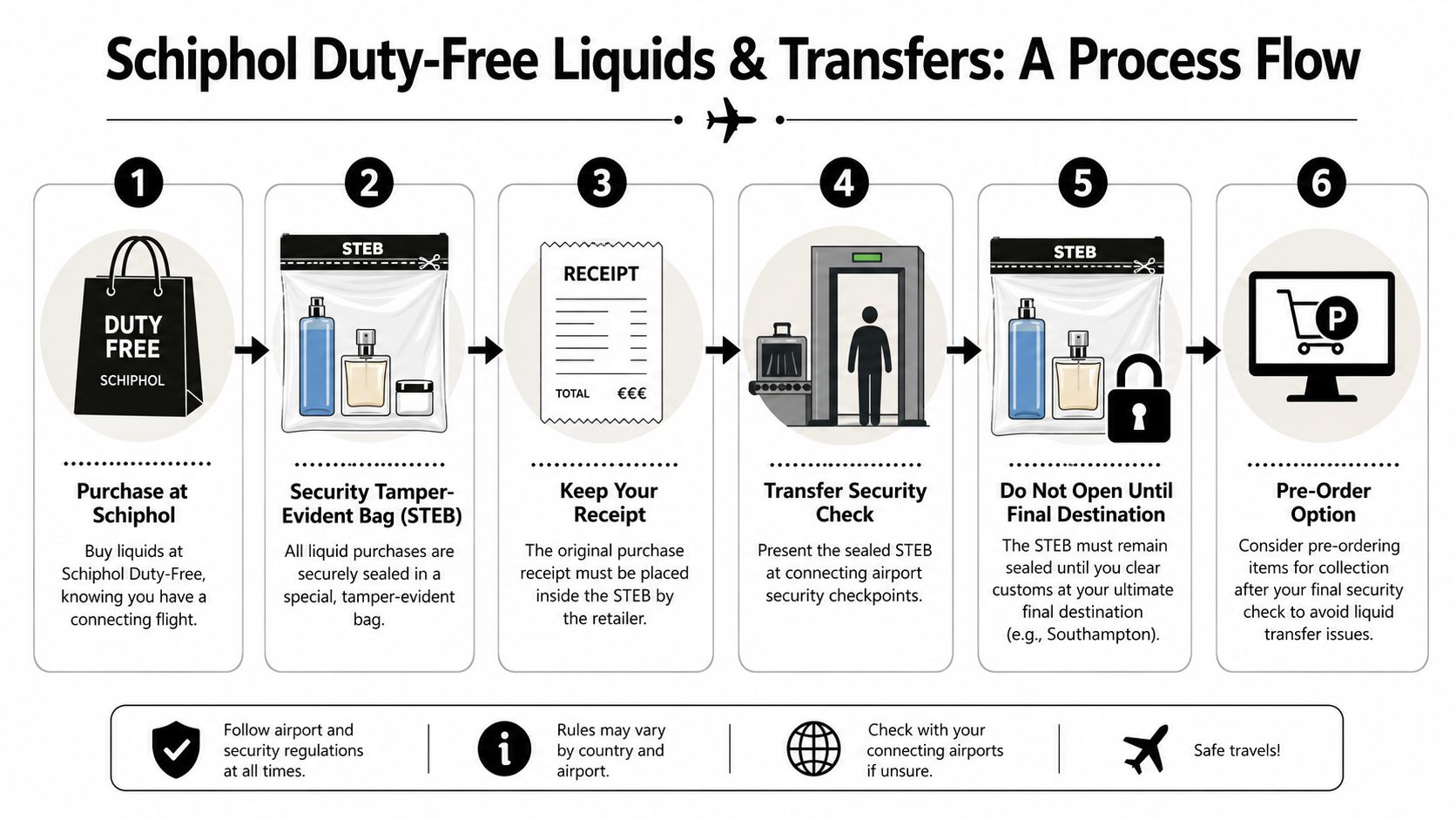
How to handle liquids without trouble
If you're buying perfume, spirits, skincare, or anything else liquid-based, use this sequence.
-
Buy after security, not before it
This reduces the chance that you'll face another screening problem with a fresh purchase. -
Tell the staff you're transferring
Don't assume the bagging process will happen automatically in the exact form you need. -
Check the seal before you leave the till
If the tamper-evident bag isn't properly closed, fix it immediately. -
Make sure the receipt is inside
That detail matters during transfer checks. -
Don't open the bag mid-journey
Once opened, it may no longer qualify for transfer treatment. -
Keep the bag accessible
Don't bury it under coats, chargers, and snacks.
A sealed bag only helps if it stays sealed. Once you open it, you're back in ordinary hand-luggage territory.
This matters even more on UK itineraries with another flight leg or a complicated same-day connection. If you're landing, collecting yourself, and moving on quickly, the best purchase is often the one that causes the least extra handling.
When pre-ordering helps
Pre-ordering is useful when your shopping list is specific. It's less useful when you're still deciding between brands or want to browse categories. The advantage isn't magic pricing. The advantage is time control.
Pre-order if:
- You know the exact product
- Your layover is short
- You want to collect after your final security point
- You're buying liquids and want the cleanest possible process
Don't bother pre-ordering if your trip is flexible and shopping is part of the experience. In that case, the flagship store layout and fast checkout options do the job.
For anyone connecting into the UK and then continuing overland, the cleaner your airport process, the better the whole day goes. If your next challenge is the pickup side after landing, this guide to meeting your driver at Stansted shows the same basic principle. Reduce uncertainty before you travel.
Your Smart Shopping Checklist for Schiphol
The best Schiphol shoppers aren't the ones carrying the most bags. They're the ones who know what to buy, where to buy it, and when to stop.
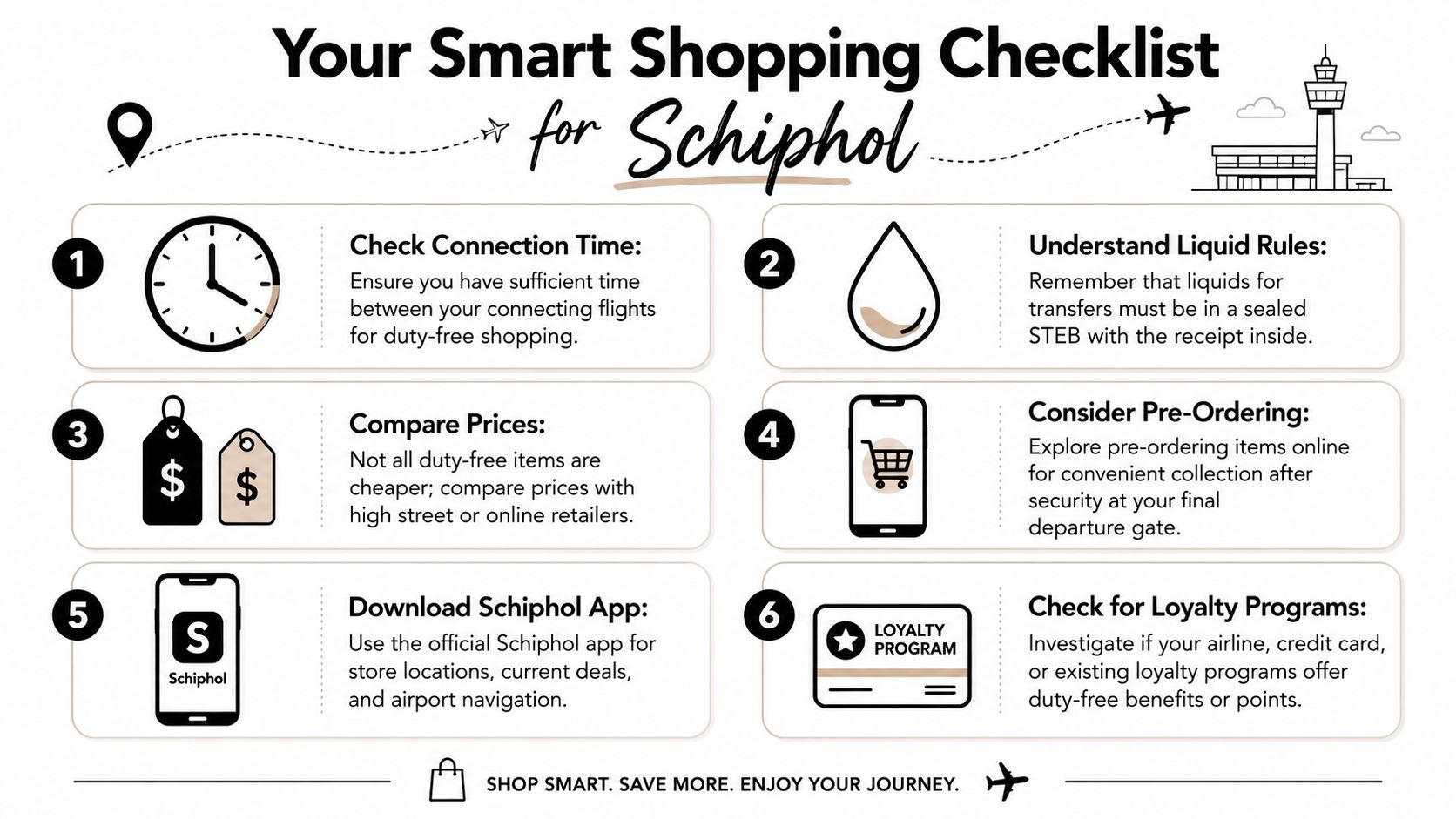
A final airside checklist
- Check your real connection time: Gate distance, passport control, and transfer screening matter more than the time printed between flights.
- Buy liquids after security: That's the cleaner option for almost every connecting passenger.
- Prioritise proven value categories: Fragrance, cosmetics, wine, and spirits are the categories Schiphol has positioned most strongly.
- Keep receipts organised: Customs questions and transfer checks are easier when you can show the paperwork fast.
- Don't assume every “deal” is a deal: Convenience pricing still exists in airports.
- Think to the end of the journey: Heathrow isn't the end if you're still going to Southampton, Dover, Portsmouth, or Tilbury.
- Choose easy gifts when in doubt: Packaged sweets or compact gift sets often travel better than bottles.
- Protect fragile buys early: If you're carrying spirits or glass fragrance bottles, pack around them before the next transport leg.
For families, the low-hassle approach usually wins. Buy snacks, sweets, or one planned gift rather than several breakable items. For cruise passengers, think about embarkation day fatigue. You'll thank yourself later if your purchases are easy to carry, easy to explain, and easy to repack.
For most travellers, the smartest version of duty free in Schiphol Airport is simple. Use it as a practical stop, not an event. Buy what saves money or solves a need. Leave the rest on the shelf.
If your Schiphol connection ends at Heathrow and you still need a smooth trip to your hotel, rail hub, or cruise port, EC Minibus is built for exactly that kind of journey. The service is especially useful for travellers heading on to Southampton, Dover, Portsmouth, or Tilbury with luggage, tight timings, and no interest in wrestling with airport-to-port logistics after a long flight.