

You've just landed at Heathrow, the bag carousel has taken its time, and now Brighton looks close on a map but strangely hard to reach. That's the part most first-time visitors don't expect. Heathrow Airport to Brighton is not a simple straight run, it's a corridor shaped by London's transport network, transfer points, and the time of day you choose to travel.
Table of Contents
- Planning Your Heathrow to Brighton Journey
- Why Heathrow and Brighton Have No Direct Rail Link
- Comparing Train Coach and Road Transfer Options
- Door to Door Steps for Each Transfer Method
- Choosing EC Minibus Private Transfer for Stress Free Travel
- Schedule Reliability Versus Headline Speed
- Practical Booking Tips and Final Recommendations
Planning Your Heathrow to Brighton Journey
A tired family, a couple with oversized cruise bags, or a visitor arriving on an overnight flight all face the same problem. The route from Heathrow to Brighton sounds simple until you realise you're not just choosing a destination, you're choosing how much transfer stress you want to carry with you.
The easiest way to think about it is to separate the journey into two questions. First, do you want the cheapest public option, the quickest road option, or the least stressful door-to-door option. Second, how much do luggage, children, and timing matter on the day you arrive.
For many people, the surprise is not the distance, it's the number of hand-offs. Heathrow's own guidance and independent planners both show that the route usually involves London as the middle point, which means more chances for delays, missed platforms, and awkward luggage changes.
Practical rule: if your arrival already feels tight, choose the option with the fewest changes, not the one with the most optimistic headline time.
This guide breaks the route down in the same way a travel coordinator would brief a family before a transfer. You'll see why the rail option can look neat on paper but feel clumsy in real life, why coaches matter more than most comparison pages admit, and when a private transfer makes the whole trip feel much easier.
Why Heathrow and Brighton Have No Direct Rail Link
The Heathrow to Brighton corridor is a classic example of how UK travel bends around London rather than bypassing it. There is no direct rail service between the airport and the coast, so train passengers usually need at least one change, and often two transfers through London. Heathrow's guidance says the most direct public-transport route is typically via London Victoria or Paddington, and that public transport usually takes about 1 hour 50 minutes to 2 hours 10 minutes depending on terminal and route, while independent planners report train journeys usually requiring 1 change and taking around 1 hour 59 minutes to 2 hours 24 minutes.
That structure matters because it changes the entire feel of the journey. Heathrow isn't linked to Brighton by one clean railway line, it feeds into the capital's network first, then passengers branch out again like roads leaving a roundabout. London is the hub, Brighton is the spoke, and Heathrow sits on the wrong side of the hub for anyone hoping for a straight shot.
What that means in practice
If you're arriving from overseas, a rail journey can look tidy in a booking app and still be messy on the ground. You may need to switch from airport transport to mainline rail, then change again to reach Brighton, all while managing bags and platform timing.
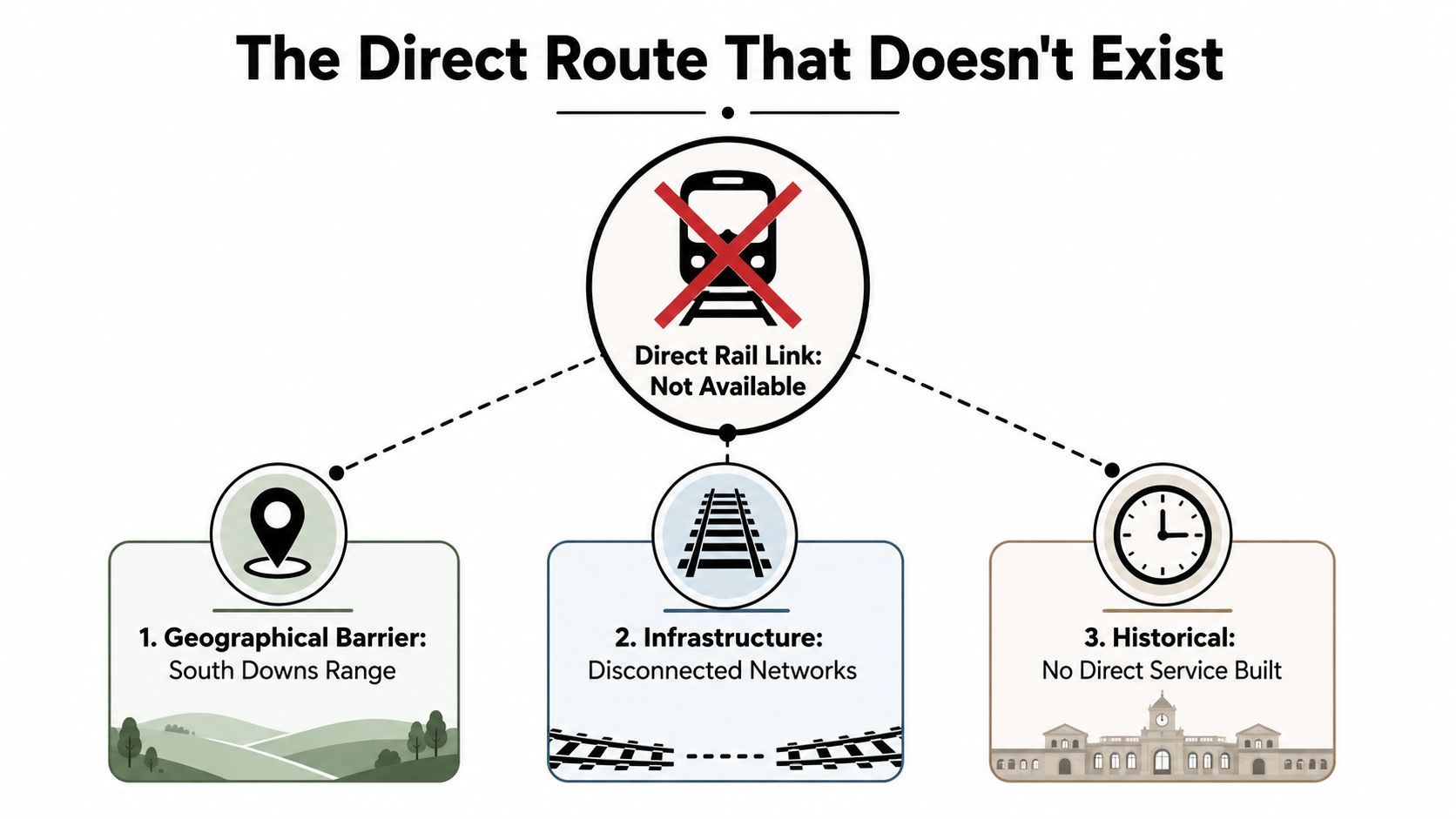
The bigger takeaway is historical as much as practical. This corridor developed around London's rail and coach network, not around a dedicated airport-to-coast line, so transfer complexity is part of the route's identity. That is why many travellers end up comparing not just modes, but how many times they'll have to lift bags, change stations, or cross the city before they even reach Sussex.
Coach services fit that same pattern. National Express runs direct services from Heathrow Central Bus Station, and the route is reported at about 2 hours 2 minutes with hourly departures on some services. In other words, the network is built around moving you through London's transport logic, not around avoiding it.
Comparing Train Coach and Road Transfer Options
The main choices look straightforward once you line them up side by side. Road distance between Heathrow and Brighton is usually reported at about 65 to 66.2 miles, or roughly 105 km, which explains why car and taxi transfers can be quite competitive over total journey time, especially when the road is clear. Rail and coach do different jobs, and the best one depends on whether you value low cost, fewer changes, or pure point-to-point convenience.
| Mode | Time | Cost | Changes |
|---|---|---|---|
| Rail | about 3 hours 16 minutes average, with quickest services around 1 hour 53 minutes to 2 hours 5 minutes | not stated in the verified data | usually 1 to 2 changes |
| Coach | about 2 hours 2 minutes to 2 hours 20 minutes | from £8.40, with fares also reported at £18 to £25 on some planners | 0 |
| Car or taxi | around 1 hour 5 minutes to 1 hour 40 minutes | not stated in the verified data | 0 |
| Private transfer | often 75 to 100 minutes depending on M25 traffic | not stated in the verified data | 0 |
The table shows the basic trade-off clearly. Coach is usually the cheapest public option, rail is the most transfer-heavy, and private road travel often wins when you count the whole journey rather than just the in-vehicle time.
How to read the numbers
A rail journey can look acceptable until you add the changes and platform walking. A coach may take longer than a fast car on paper, but it removes the need to find your way through London stations with luggage. A private road transfer can be the most sensible choice when door-to-door simplicity matters more than chasing the lowest fare.
National Express publishes coach departures from Heathrow Central Bus Station with a one-way fare from £8.40 and journey times around 2 hours 2 minutes to 2 hours 20 minutes depending on the timetable, while one comparison source notes rail averages of 3 hours 16 minutes with 1 to 2 changes. If you want a broader background on airport-shuttle style decisions, this airport shuttle services guide is a useful companion read.
Practical rule: if you've got luggage, a tight cruise check-in, or children in tow, the “cheapest” fare is not always the cheapest trip once the transfer effort is counted.
The simplest way to decide is to match the mode to the traveller, not to the website headline. Solo travellers with light bags may tolerate rail changes. Families and cruise passengers usually feel the hidden cost of transfers much faster.
Door to Door Steps for Each Transfer Method
A route becomes much easier once you can see the actual sequence. For Heathrow to Brighton, each option asks you to do something different, and that difference is what often catches visitors out. The core question is not just how long the journey takes, but how many times you have to stop, reorient, and carry luggage from one system to another.
Rail via London
Start by leaving Heathrow on airport rail or tube services towards central London, then change onto the mainline network for Brighton. The important part is not the ticket itself, it's the station swap, because that's where the walking, platform finding, and timing pressure begin.
This option suits travellers who are already confident using major stations and who don't mind handling bags across more than one service. It is less comfortable for passengers arriving after a long-haul flight, especially if they're unsure which London terminal or platform they need next.
Coach from Heathrow Central Bus Station
Heathrow's coach option is simpler to visualise. You go from the terminal to Heathrow Central Bus Station, board the direct National Express service, and stay on one vehicle until Brighton. The service pattern includes direct departures, and some routes are listed with hourly frequency, so you're not usually planning around a single fragile departure.
A coach is often easier with luggage because you load once and unload once. It also removes the need to manage London rail changes, which is a big deal when a traveller is tired or travelling with children.
Taxi, rideshare, or private transfer
Road travel changes the experience completely. You leave the terminal, meet your driver, and go straight to Brighton without station changes, separate tickets, or a search for the next platform. For families with pushchairs, or cruise passengers with heavy cases, that simplicity can be worth more than shaving a little money off the fare.
This is also where a pre-booked transfer fits naturally, because the driver already knows your landing point and your drop-off address. If you want to see how private minibus travel is typically organised, the private mini bus hire with driver guide gives a helpful overview of the service model.
Booking mindset
The key difference across all three is how much of the journey you're managing yourself. Rail means more moving parts. Coach means one vehicle but a fixed schedule. Private road travel means the route is built around your flight arrival and your destination, which is why many first-time visitors find it easier to trust.
Choosing EC Minibus Private Transfer for Stress Free Travel

A private transfer makes the most sense when the trip needs to feel controlled from the moment you exit arrivals. EC Minibus is a Heathrow-based private transfer service operating since 2006, with licensed and insured drivers, meet and greet at Heathrow, flight and cruise monitoring, fixed pricing, and door-to-door service. That combination matters most when your Brighton drop-off is only one leg of a bigger travel day.
For international visitors, the value is often hidden in the avoided hassle. You don't need to work out which station comes next, you don't need to split the group across seats, and you don't need to gamble on whether a late arrival will still fit the coach timetable. That is why private transfer works especially well for families, older travellers, and cruise passengers carrying more luggage than they want to drag through London.
The booking process is straightforward on the provider's site, and the service model is designed for pre-booked airport collections rather than last-minute improvisation. If you want the practical service description in one place, the Heathrow taxi cost guide is a useful reference for understanding how private road pricing and transfer planning are usually framed.
The main advantage is that the driver waits for your flight, not the other way round. That alone can change the tone of the trip from reactive to calm.
For a family, that means fewer decisions while tired children are already asking where the car is. For a cruise passenger, it means luggage moves once, not multiple times. For anyone arriving late in the day, it means the journey starts when you're ready, not when a timetable happens to line up.
Schedule Reliability Versus Headline Speed
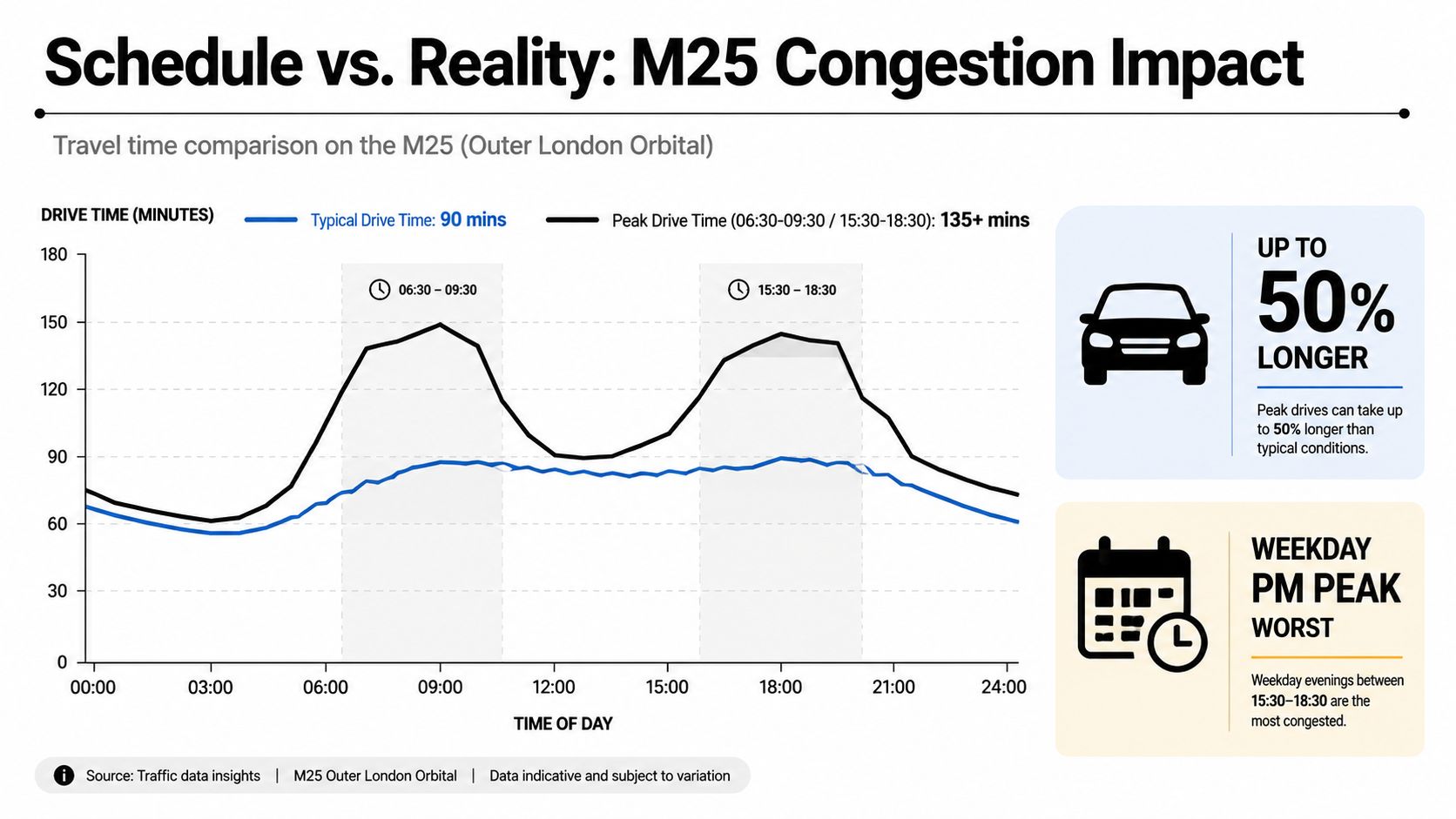
Fast-looking journey times can be misleading on this corridor. A drive or private transfer that looks like 1 hour 40 minutes on a quiet day can stretch when the M25 is busy, and recent transfer guidance highlights peak congestion windows of 06:30 to 09:30 and 15:30 to 18:30, when travel times can increase by 50%. That is a big difference if your flight lands into one of those windows or if a cruise departure leaves you with little room for error. Rome2Rio's Heathrow to Brighton guidance is one of the sources that flags those peak periods.
Rail has its own version of unreliability, just expressed differently. You may not sit in traffic, but you can still lose time to platform changes, interchange walking, or missed connections if one part of the chain slips. The risk is less visible than road congestion, but it's still there.
Why timing matters more than people think
A traveller landing at midday has a very different experience from someone arriving at the tail end of the evening peak. The route itself hasn't changed, but the road conditions and station pressure have. That's why the same Brighton transfer can feel smooth one day and exhausting the next.
Useful shortcut: if your arrival time overlaps with London's busiest road windows, a private door-to-door transfer often beats a “faster” option that depends on multiple transfers.
This is the part comparison articles often skip. They list the shortest ride time but ignore the time you spend waiting, walking, or rebuilding the journey after a delay. For Heathrow to Brighton, the realistic question is whether the transfer is stable enough for the day you're travelling.
Practical Booking Tips and Final Recommendations
Start with the simplest filter. If your priority is price, coach usually remains the lowest-cost public option on this route, and National Express publishes direct fares from £8.40 with journey times around 2 hours 2 minutes to 2 hours 20 minutes. If your priority is fewer changes, private road travel removes the London interchange problem entirely, while rail still asks you to deal with one or two transfers.
The second filter is the clock. If your arrival falls near the peak congestion windows, or if you're travelling with children, cruise luggage, or checked bags you don't want to drag through stations, the door-to-door option starts to look much more practical. That's especially true when your whole day depends on one clean hand-off from airport to hotel, cruise terminal, or Brighton address.
A simple booking checklist
- Check your arrival window first. If you land near busy road times, build in extra margin before committing to a fixed connection.
- Count your bags carefully. One carry-on bag and a suitcase is different from a family stack of cases and pushchairs.
- Decide how much transfer risk you want. More changes usually means more ways for the trip to feel stressful.
- Compare the full journey, not just the headline in-vehicle time. The quickest-looking option isn't always the easiest one.
For travellers who want a direct vehicle, a pre-booked private transfer is often the cleanest fit. A service like EC Minibus can collect you at Heathrow and take you straight to Brighton without the extra hand-offs that make the route harder than it first appears.
What matters most on Heathrow Airport to Brighton is not just getting there, but arriving with your energy intact. Choose the option that matches your luggage, your timing, and your tolerance for transfers, then book it early enough to keep the day calm.
If you want a calmer Heathrow-to-Brighton transfer, book a private door-to-door journey with EC Minibus. It's built for travellers who'd rather skip London station changes and go straight to Brighton with luggage, flight monitoring, and meet and greet included.