

The quickest public route from Heathrow to St Pancras takes roughly 45 to 75 minutes depending on the train and time of day, while a private door-to-door transfer usually runs 45 to 90 minutes for much less hassle. If you've just landed, you're tired, and you've got luggage or a Eurostar to catch, the main question isn't which option exists, it's which one won't unravel on you.
A lot of travellers treat heathrow to st pancras like a simple London hop. It isn't. It's a transfer where terminal location, luggage, crowding, and your onward connection matter more than the map distance.
Table of Contents
- Landing at Heathrow With St Pancras on the Horizon
- Train, Tube and Express Options From Heathrow to St Pancras
- Comparing the Main Routes Side by Side
- Booking a Private Transfer From Heathrow to St Pancras
- Planning a Safe Connection to Eurostar or a Cruise
- Luggage, Accessibility and Travelling With Family
- Which Option Fits Which Traveller
- The Honest Shortlist and When to Bend the Rules
Landing at Heathrow With St Pancras on the Horizon
You've cleared immigration, dragged your case through baggage reclaim, and now you're standing in Heathrow wondering whether to head straight for St Pancras, drop your bags first, or pay for the least painful option and move on with your day. That is the point where people usually choose badly. They treat it like a rail puzzle, then find out it is really a fatigue and connection puzzle.
The decision starts with your next stop
St Pancras International is not a random destination station. It reopened in 2007 as the London terminus for High Speed 1 and has become a major rail gateway, with 38.843 million annual entries and exits in 2024–25 and 2.742 million interchanges in the same year, up from 33.296 million in 2022–23 and 18.995 million in 2021–22 (St Pancras station data). Heathrow passengers are usually heading there for Eurostar, Thameslink, or an Underground connection, not to linger at the station.
The route itself is short on paper. Public planning data put Heathrow to St Pancras at about 15 miles (24 km) by rail-planning estimate, with journeys available from 4:21 am to 10:51 pm, around 24 trains per day, and typically 1 change (Trainline route data). Heathrow's own guidance says the transfer usually takes 45 minutes to 1 hour 15 minutes, while the Underground journey is usually around 1 hour.
Practical rule: if you've got bags, kids, or a fixed departure time, stop thinking in miles. Think in usable minutes after you land.
If you are deciding on the spot, answer three questions before you buy anything. How much buffer do you need, how much luggage are you carrying, and what are you connecting to at the other end. If you want someone else to make that call for you, a Heathrow meet and greet service can be the cleaner answer than trying to sort it out while tired and offline.
Train, Tube and Express Options From Heathrow to St Pancras
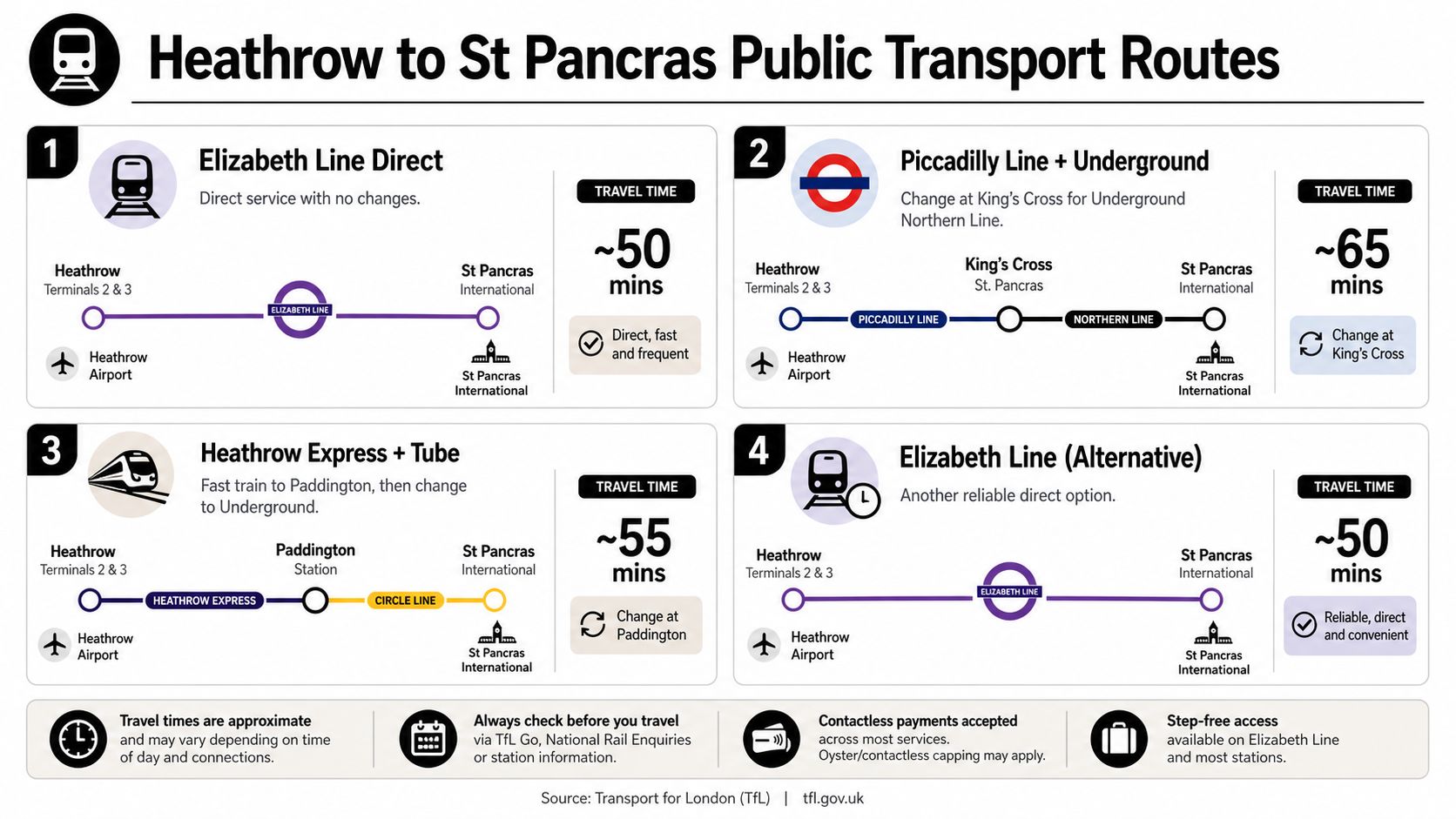
The route planners will show you a few familiar combinations, and each one feels different once you're doing it with a suitcase in tow. The right choice depends less on purity and more on friction. A first-time visitor needs the route that breaks down cleanly under stress.
Elizabeth line
The Elizabeth line is the easiest public option to explain. You board at your Heathrow terminal, ride into central London, then change onto the Underground or another rail link to reach St Pancras. The planner may show it as one of the smoother choices because the train itself is modern, frequent, and less cramped than older Tube stock.
In practice, this works well for travellers who can handle one change and don't mind a bit of central London walking. It's a solid choice if you're reasonably fresh, your bags roll properly, and you aren't on the clock for a rail departure that leaves no room for mistakes.
Piccadilly line
The Piccadilly line is the old standby, but I only recommend it when price matters more than comfort. You board directly from Heathrow and then change in central London, usually around King's Cross, to reach St Pancras. It's simple in theory and rougher in practice, especially when you've got a long-haul flight behind you.
This is the option that makes sense if you're travelling light and don't mind a slower, more crowded Underground ride. It's also the one that falls apart fastest for anyone with kids, multiple bags, or limited mobility.
Heathrow Express and Thameslink
Heathrow Express gets you out of the airport fast, but it drops you into a transfer at Paddington, which means you're still not done. From there, you need another move across London to reach St Pancras. That can work for business travellers who already know the system and value speed out of the airport more than door-to-door ease.
This route feels efficient until you're standing on a platform with luggage, scanning signs, and realising the second leg is the one that decides your arrival time. It's a decent option on paper, less so when the flight has already made you tired.
Direct Thameslink
A direct Thameslink service, when available, is the cleanest public answer because it removes the extra handoff. If your planner shows it, that's the public option I'd look at first. Fewer changes usually mean fewer chances for a tired traveller to lose time, miss a lift, or stand on the wrong platform.
For travellers who hate transfers, that's the point. The ride still isn't private, but it cuts out a lot of the noise that makes London connections feel harder than they should.
If you're arriving after a long-haul flight, one change is manageable. Two changes is where a lot of passengers start making bad decisions.
I'm not going to pretend the rail options are all equal. They're not. The Elizabeth line and a direct Thameslink service usually feel the least punishing, while the Piccadilly line is the one most likely to make you regret saving a little money.
A video example is helpful if you want to see the route logic in motion.
Comparing the Main Routes Side by Side
Use the table below as a filter, not a promise. Public transport can still go sideways if your terminal is awkward, your lift is slow, or you land in the middle of a busy wave of arrivals. But for most travellers, this is the clearest way to separate the “works in theory” option from the one that fits the day.
| Option | Typical time | Approx cost | Changes | Best for |
|---|---|---|---|---|
| Elizabeth line via central London | Around 45 to 62 minutes overall, depending on planner and route | Lower than private transfer | 1 | Solo travellers, light luggage, decent buffer |
| Piccadilly line + Underground | Just over an hour | Usually the cheapest public option | 1 | Budget travellers who don't mind slower travel |
| Heathrow Express + Tube or rail link | About 55 minutes in common route planning | Higher public-transport spend | 1 to 2 | People who want speed out of Heathrow and can handle a transfer |
| Direct Thameslink, when shown | Often the cleanest rail option if available | Varies by fare | 0 to 1 | Travellers who hate changing trains |
The biggest mistake is treating “cheapest” and “best” as the same thing. They're not. The cheapest route is usually the one with the most fatigue attached.
How to read the trade-offs
For a traveller with one cabin bag, one change is fine. For a traveller with two suitcases, one stroller, and a child who's already tired, that same one change becomes a problem. Small delays on paper become real stress in the station.
A private transfer sits outside the table for a reason. It doesn't compete on the same terms. It competes on predictability, baggage handling, and whether someone can drive you straight to the door without making you think about lifts, barriers, or platform changes.
Booking a Private Transfer From Heathrow to St Pancras
A private transfer earns its place when you want the trip to be boring, not adventurous. Booking should be simple, the pickup should be obvious, and the driver should already know whether your flight is late before you've even found your bag. That's the standard you should expect.
What the process looks like
With a service such as EC Minibus, the sequence is straightforward. You book the journey online, receive confirmation, and the pickup is arranged with meet and greet at Heathrow, so you're not left guessing who to call or where to stand. The company says bookings include licensed, insured drivers, flight monitoring, and fixed pricing, which is exactly what matters after a long flight.
That fixed-price point is the one I'd care about most. When you're tired, the last thing you want is a fare that can creep up because traffic is bad or your terminal was slower than expected. If you've got luggage, a driver who helps with bags and takes you straight to St Pancras removes the most annoying part of the transfer.
What to check before you book
Before you pay, read the confirmation carefully. Check the pickup point, the terminal, the passenger name, the luggage allowance, and whether flight monitoring is included. If you're landing into Heathrow and heading to St Pancras for Eurostar, that support matters more than a glossy vehicle photo.
My rule: if your onward connection has a fixed time, book the option that removes the most variables, not the one that sounds smartest in a search result.
A private transfer is also the sensible answer for families, older travellers, and anyone arriving exhausted from an overnight flight. It's not flashy. It's just the option that stops the day from getting harder than it needs to be.
Planning a Safe Connection to Eurostar or a Cruise
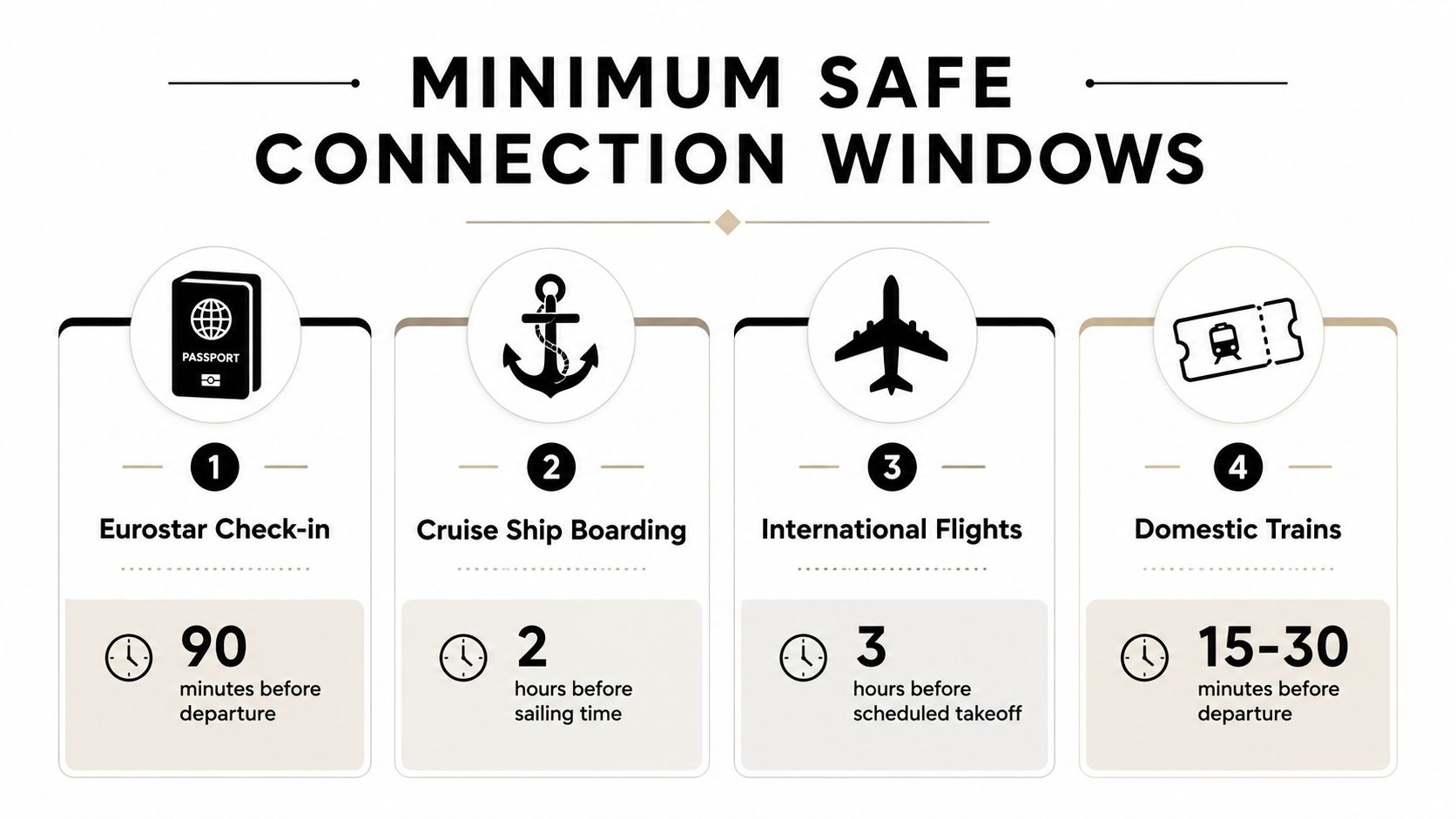
The question is not how to get from Heathrow to St Pancras. It is how much margin you need so the next leg does not fall apart. For Eurostar, that matters more than the transfer time itself. Public journey planning puts the London leg at 45 minutes to 1 hour 15 minutes, and practical forum guidance adds that Eurostar recommends arriving 90 minutes before departure, while travellers still have to land, collect bags, and clear Heathrow before they even start the run into central London (community guidance on Heathrow to St Pancras connections).
What a safe window actually looks like
For a same-day air-to-rail connection, I would not treat the raw transfer time as the answer. It only covers the line on the map. Landing, baggage, walking through the terminal, and finding the right platform all eat into the window, and that is before any delay at Heathrow or on the London leg.
If you are connecting to Eurostar, build in more time than feels comfortable on paper. A flight that lands on schedule can still turn into a scramble once you add passport control, bags, and station movement. That is why I steer travellers away from tight same-day rail connections unless they have a very forgiving schedule and no problem losing the fare if things slip.
Three practical scenarios
- Leisurely same-day air-to-rail connection: workable if you land early, travel light, and can absorb a delay without panic.
- Tight connection at peak time: poor judgement, especially with checked bags or children.
- Cruise passenger heading south the next morning: stay near the station or book a direct transfer, because dragging luggage across London after a flight is unnecessary strain.
If you are linking Heathrow and Paris in one trip, or joining another rail leg, treat St Pancras as the place that needs planning, not just a stop on the way through. The same advice applies if you are building a London day trip to Paris through this Heathrow to Paris planning guide. The station is busy enough that a loose plan gets punished quickly. Hope is not a transfer strategy.
Luggage, Accessibility and Travelling With Family
Most route guides talk about speed and ignore the body doing the travelling. That's a mistake. If you're landing tired, carrying cases, pushing a stroller, or helping an older relative, the “best” route changes quickly.
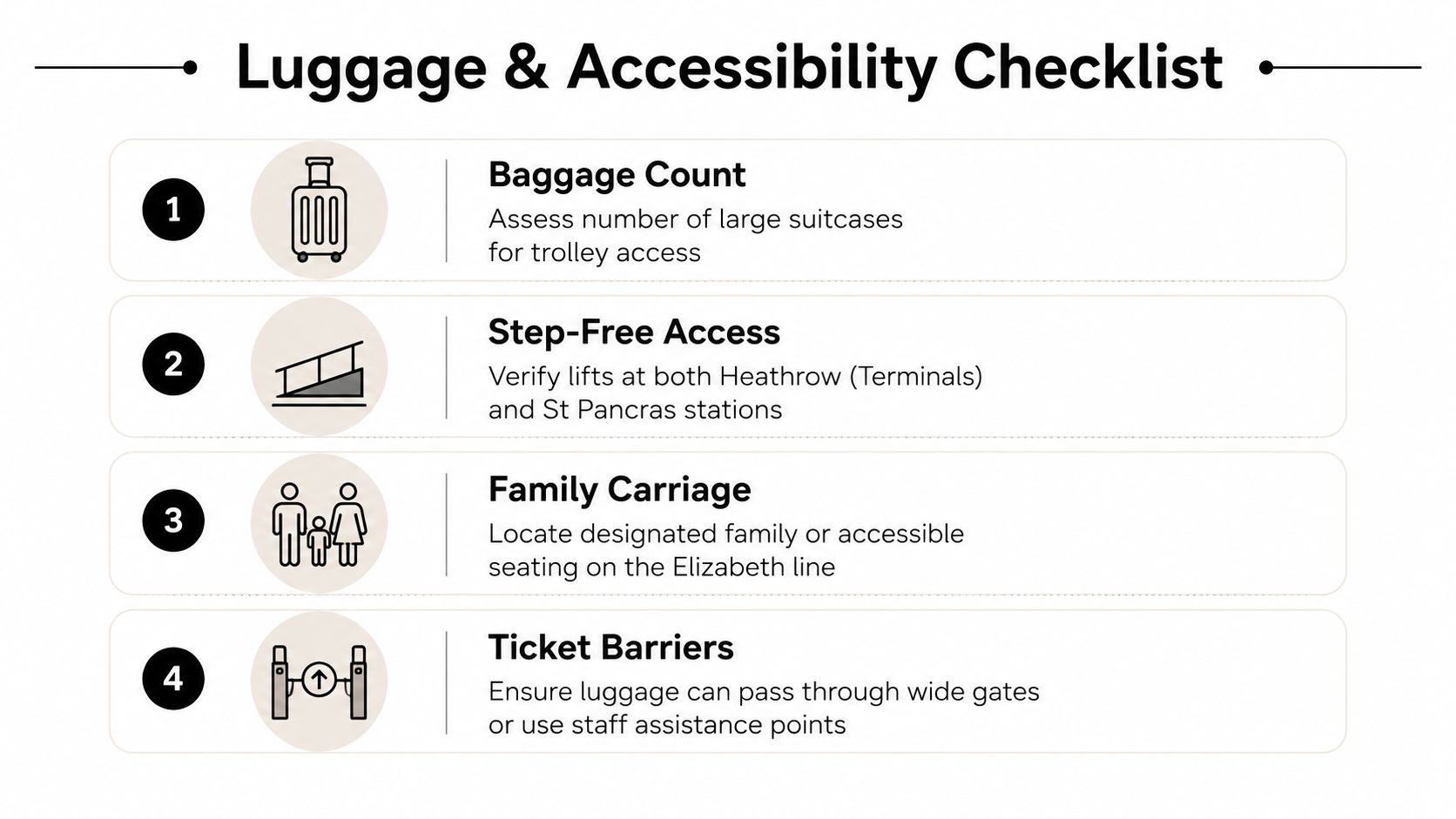
Check these before you commit
- Baggage count: If you've got more than one large suitcase, don't assume stairs and barriers will be painless. Trolleys help at Heathrow, but they don't eliminate the faff once you change modes.
- Step-free access: Verify lift access at both ends before you travel. Heathrow and St Pancras are major stations, but you still want to know the exact path you'll use.
- Family seating: On the Elizabeth line, families and tired passengers tend to do better when they can stay together and keep bags in sight.
- Ticket barriers: Wide gates matter when you're rolling luggage through. If a station's standard barriers look tight, expect friction.
- Fatigue: A traveller who slept badly on the flight won't care that the route was theoretically efficient.
The Heathrow rail environment is not casual infrastructure. Its tunnels and station interfaces are built around a W6a clearance gauge, maximum gradient of 1:42, 25 kV AC overhead electrification, and platform lengths in the 203 m to 217 m range at Heathrow Central (Heathrow technical information). That tells you something important. The system is engineered, but it's still a system with constraints, which is exactly why luggage and mobility planning matters.
When a private car pays for itself
It pays for itself when the alternative is a tiring change with heavy luggage, not when you're comparing it with a light-bag solo ride. That's the blunt truth. Families, older travellers, and anyone arriving on an overnight flight usually feel the difference most.
If you're travelling with children, the station arithmetic gets worse, not better. You're not just moving yourself. You're moving one or more tired people, bags, and a timetable that doesn't care that the flight was long.
Which Option Fits Which Traveller
The right choice depends on who's travelling, not just where they're going. A route that suits a solo regular can be a poor fit for a family of four. A transfer that looks expensive can be the cheapest way to protect a fixed onward plan.
North American cruise passenger
Take a private transfer if you're connecting to Southampton, Dover, Portsmouth, or Tilbury after Heathrow. You've probably already had a long flight, and cruise luggage is never as light as you hoped. A door-to-door vehicle removes the heaviest part of the day.
Family of four on a tight schedule
Book a private transfer or a direct rail option only if you can stay calm under pressure. The default here should be comfort first, because a one-change public journey can turn into a mess the moment one child slows down.
Business traveller with Eurostar to Brussels
Use the cleanest rail option your planner gives you, but only if your arrival buffer is strong. If the connection is same-day and tight, I'd rather see you in a direct car than sprinting through central London with a laptop bag and no margin for error.
Travel agent booking for clients
Choose predictability over assumption. If the client is older, arriving from North America, or carrying multiple cases, a private transfer is the safer default. If they're light, independent, and staying near King's Cross, a rail option can be fine.
Senior couple who prioritise comfort
Skip the cheapest route. It's usually not the one you'll remember fondly. The easier choice is the one that reduces walking, lifting, and platform stress.
The Honest Shortlist and When to Bend the Rules
For a solo budget traveller, the Elizabeth line or the Piccadilly line wins if luggage is light and the connection isn't tight. For a family with bags, I'd push hard towards a private transfer. For a cruise passenger linking to Southampton, private door-to-door transport is the sensible default every time.
The one time I'd bend that rule is a traveller with a same-day Eurostar after a delayed long-haul flight and a solid buffer already in hand. In that case, the cleanest public route or a direct car to St Pancras is the safer play. Don't gamble on a complicated change if the train is fixed and the bags are heavy.
If you want the Heathrow to St Pancras transfer handled without platform changes, guesswork, or luggage drama, book a direct journey with EC Minibus. They offer Heathrow meet and greet, fixed-price transfers, and door-to-door service that fits the airport-to-rail reality this route demands. For Eurostar connections, hotel drop-offs, and cruise links, that kind of calm transport is often the difference between a smooth arrival and a stressful one.