

Hiring a private jet in the UK can cost anywhere from about £4,000 for a short hop on a small aircraft to more than £20,000 for a larger aircraft on a cross-country trip, and that's before the quote picks up the fees that usually matter most in practice. For many UK transfers, the final bill is driven less by the flying time itself and more by landing, handling, positioning, crew, and airport choice.
You're probably not reading this because you're daydreaming about private aviation in the abstract. You're likely arriving at Heathrow after a long-haul flight, looking at a cruise departure from Southampton, Dover, or Portsmouth, and asking a very practical question: is a private jet worth it for the next leg, or is it expensive theatre when a premium car transfer would do the job better?
That's the right question.
The mistake most buyers make is focusing on the headline hourly rate. That number is real, but it's incomplete. In the UK, hire a private jet cost is a modular calculation. Operators quote aircraft time, then add airport charges, handling, fuel, crew costs, taxes, and sometimes repositioning. A short sector can still produce a surprisingly large invoice. On some routes, especially London airport to cruise port transfers, the jet is the wrong tool. On others, it's the fastest and cleanest option available.
If you want the total landed cost, not the fantasy version, read on.
Table of Contents
- The Allure and Ambiguity of Private Jet Travel
- Understanding the Core Cost Hourly Rates by Aircraft Class
- Beyond the Hourly Rate Unpacking Surcharges and Fees
- Putting It All Together Sample UK Trip Cost Estimates
- How to Reduce Your Private Jet Hire Cost
- Private Jet vs Premium Ground Transfer When Each Makes Sense
- Frequently Asked Questions About Private Jet Costs
The Allure and Ambiguity of Private Jet Travel
A familiar scenario. You land at Heathrow from New York, Dubai, or Toronto. You've got luggage, maybe family, maybe a tight ship departure in Southampton, and absolutely no interest in dragging yourself through train changes or queuing for a standard car rank.
A private jet sounds like the elegant answer. Step off one aircraft, transfer to another, and keep moving. If you're connecting onward to Scotland, the Channel Islands, or a European stop, that logic can hold up. If you're going from a London airport to a cruise port by road distance, the answer gets murkier very quickly.
The glamour is real. So is the friction. You still need to move between terminals or airports, clear private facilities, coordinate bags, and absorb the reality that a very short private flight often carries a very inefficient cost profile. That's where people overspend. They buy the idea of private aviation without testing whether it solves the actual transport problem.
Practical rule: If the air segment is short and the road journey is direct, compare the full door-to-door journey, not just the aircraft.
Private aviation works best when it removes serious time loss, avoids airline schedules, or lets you reach an airport that materially improves your arrival. It's less compelling when the destination itself is most easily reached by road, especially for cruise terminals where the final handoff matters as much as speed.
That's why the sensible way to assess hire a private jet cost is to think like an operator, not a brochure. Start with the aircraft class. Then ask what airports are involved, where the aircraft is based, whether the crew needs to wait or overnight, and whether the routing creates dead time you'll still be billed for.
Luxury buyers don't need romance. They need clean arithmetic and good judgement.
Understanding the Core Cost Hourly Rates by Aircraft Class
A client leaves Mayfair for Southampton cruise terminal with four cases, two children, and a firm boarding time. The instinct is to ask for a jet. The smarter first question is simpler. How much aircraft do you need, and does the time saved justify the full door-to-door spend?
Private jet charter is priced by aircraft, not by seat. Fill the cabin and the per-person cost improves. Fly half-empty and you are paying for range, baggage capacity, and airport performance you may not use.
What you're actually buying
Aircraft class determines far more than appearance. It sets the hourly rate, the airports you can use, the baggage you can carry, and how sensible the trip looks once you add the car transfers at both ends.
For short UK sectors, a turboprop or light jet is usually the disciplined choice. Turboprops work well on shorter runways and keep operating cost lower. Light jets buy you speed and privacy without jumping into a much larger bill. Midsize and super-midsize aircraft start to make sense when luggage grows, the passenger list expands, or the journey continues into Europe after the UK leg. Heavy jets are rarely the rational answer for a short domestic hop unless schedule, baggage, or onward routing clearly demands one.
Hourly rate guides vary by operator and aircraft type, but class-based pricing bands are consistent across the market. Jettly's overview of private jet charter pricing by aircraft category shows the same broad pattern seen in live quotes. The bigger the aircraft, the faster the cost rises.
Typical private jet hourly hire costs
Use these figures as planning bands, not promised quotes.
| Aircraft Class | Typical Passenger Capacity | Average Hourly Rate (GBP) |
|---|---|---|
| Turboprop | Small group | Approx. £1,000 to £1,400 |
| Light Jet | Small group | Approx. £1,700 to £2,400 |
| Midsize Jet | Small group to executive team | Approx. £2,200 to £3,000 |
| Super-Midsize Jet | Executive team | Approx. £3,000 to £4,000 |
| Heavy Jet | Larger group | Approx. £4,000 to £6,300 |
The table is only the starting point. UK clients often overfocus on the airborne hour and underprice the ground reality around it. If your party is travelling from central London to a London-area airport, then from the arrival airport to a cruise port or final address, the total landed cost can move sharply against the aircraft option on short routes. In many cases, a well-run chauffeur or Heathrow meet and greet transfer service solves the problem more cleanly and at a fraction of the price.
One rule is reliable. Match the aircraft to the mission, not to the ego.
A light jet for three or four passengers on a short UK routing can be perfectly sensible. A super-midsize for the same trip is usually money wasted unless you need the baggage hold, a specific airport pairing, or onward range beyond Britain. Clients overspend here more than anywhere else in private aviation because the upgrade feels minor in the booking stage and looks expensive only when the final invoice arrives.
For practical UK travel, keep your buying logic strict. Short sector, light luggage, small group, direct road access at destination. Stay small or stay on the ground. Larger jet, larger group, complex schedule, poor airline options, or an onward international leg. Then private aviation starts to earn its keep.
Beyond the Hourly Rate Unpacking Surcharges and Fees
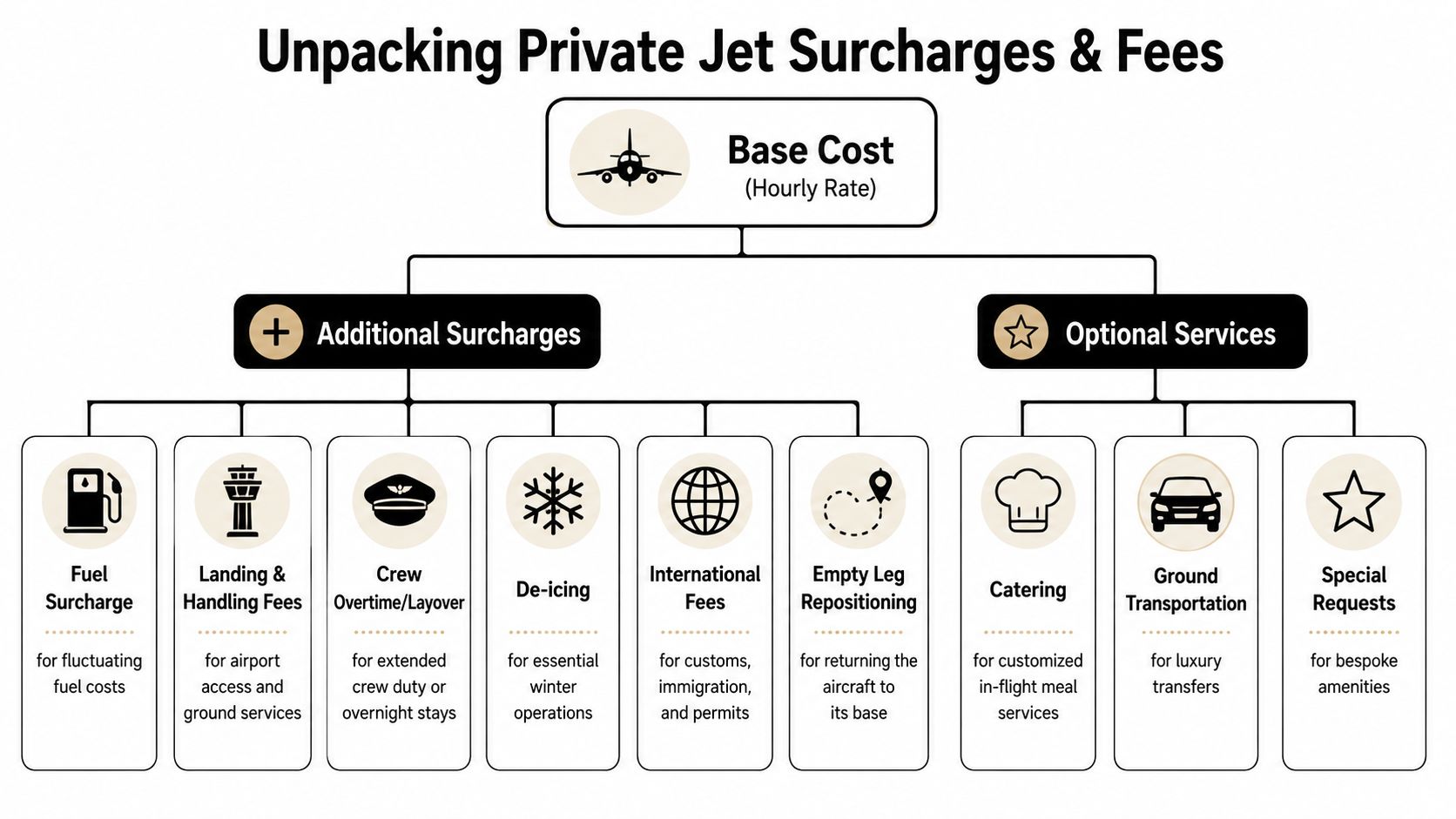
A client sees a light-jet hourly rate for a short UK hop and assumes the total will stay close to that figure. It rarely does. On a London airport to South Coast routing, the aircraft can be only one part of the bill, while airport handling, positioning, parking, crew time, and ground connections decide whether the trip still makes financial sense.
Airport costs change the quote fast
Airport selection is one of the biggest price levers in Britain. A premium London-area departure point can raise the bill before the aircraft even leaves the ground. Landing fees, handling charges, parking, and passenger fees vary by airport and are often charged separately rather than folded neatly into the charter price, as explained in Air Charter Service's guide to private jet charter costs.
That matters most on short sectors. If you are flying from a London airport to a nearby UK destination, fixed airport charges can take up a disproportionate share of the invoice. In plain terms, the shorter the flight, the less forgiving those fixed costs become.
This is also where many UK travellers misjudge the last mile. If the purpose of the trip is to get off a long-haul flight and reach a ship, hotel, or residence without airport friction, a well-run Heathrow meet and greet transfer service often solves the problem at a far lower total cost than adding a private air leg.
Operational extras are where the invoice widens
The quote can also expand because of how the aircraft is operated, not just where it flies. Industry pricing guidance from PrivateFly's charter cost overview notes that charter costs commonly sit on top of flight time in the form of repositioning, crew expenses, de-icing where required, and airport-related service charges.
For a buyer, the practical implications are straightforward:
- Repositioning: If the aircraft is not already based near your departure airport, you may pay for the ferry sector.
- Crew waiting or overnight costs: Same-day turns are cheaper. Late returns, schedule changes, and overnight stops add crew and hotel charges.
- Parking and handling: These are routine at many airports and can become expensive at high-demand locations.
- Fuel surcharges or seasonal operating costs: These appear more often in volatile fuel periods or winter operations.
- Baggage constraints: Extra cases, golf clubs, or cruise luggage can force you into a larger aircraft class, which raises the base charter cost as well as some operating fees.
One recommendation matters more than any other. Ask for an all-in quote that lists aircraft charge, positioning, airport fees, crew costs, tax, and any waiting time assumptions on one page.
If a provider cannot show you that clearly, do not approve the booking. That lack of detail is where overspend starts.
For UK clients comparing a short private hop with a premium road transfer, this is the crossover point to watch. Once fixed airport charges and operating extras stack up, the private jet may save little time door to door, while a top-tier chauffeur transfer keeps the journey simpler and dramatically cheaper. On routes such as London airport to Southampton, private aviation only earns its place when the schedule is tight, the group size supports the spend, or the flight connects into a wider itinerary.
Putting It All Together Sample UK Trip Cost Estimates
A client lands at Heathrow at 8:30am, wants to reach a Southampton cruise terminal with family and luggage, and assumes a private jet is the premium answer. On this route, that assumption is often wrong.
The smart way to judge hire a private jet cost is to price the whole journey, not just the flying time. For UK travellers, the main question is simple. What is the total landed cost from arrival point to final destination, and how does that compare with a high-end chauffeur transfer that goes directly to the terminal?
Example one London to Edinburgh return
London to Edinburgh is a route where private aviation can make sense. The distance is long enough, the commercial alternatives are less flexible, and the time saving can be real if the schedule is tight and the passengers value control.
As noted earlier, a UK business trip of this type can span a wide charter range depending on aircraft class, operating pattern, and airport choice. A light or midsize jet on a clean same-day itinerary sits at the sensible end of the market. A larger cabin, premium airport access, or awkward timing pushes the bill up fast.
What matters here is not the headline charter rate. It is the usable outcome.
A private return to Edinburgh tends to justify itself when you are doing at least one of the following:
- carrying several senior passengers whose time has a high commercial value
- needing same-day meetings with little tolerance for airline disruption
- departing from and arriving at airports that cut total transfer time
- fitting the flight into a wider multi-stop itinerary
In that case, the higher spend can buy something concrete. More control, less wasted time, and a day that runs to your schedule instead of the airline's.
Example two London airport to Southampton cruise connection
Now look at the route many UK travellers ask about. London airport to Southampton cruise terminal.
People often overspend.
The airborne segment is short, but the journey is not. You still need to leave the commercial arrivals area, transfer to the private terminal or a suitable departure airport, board, fly a very brief sector, land, clear handling, and then complete the last road transfer to the ship. The aircraft may save minutes in the middle while adding cost at every step around it.
That is why a short private charter on this route can end up in low five figures once the fixed operating charges are included, as noted earlier. The flight is only one line on the invoice. The rest of the bill is what changes the decision.
A realistic comparison looks like this:
- Private jet option: charter charge, airport handling, possible repositioning, passenger ground transfer at both ends, and the final road leg to the cruise terminal
- Premium ground transfer: one vehicle or a small convoy, direct collection, luggage handled once, and one continuous journey to the port
For Heathrow, Gatwick, or central London to Southampton, premium ground transport usually gives better value. It is simpler, cheaper, and often more predictable door to door, especially for families, cruise passengers, and anyone carrying substantial luggage.
Private aviation earns its place on this route only in narrower cases. For example:
- you are arriving on a long-haul private or commercial connection and need to continue immediately on a protected schedule
- your group size and onward itinerary make the aircraft part of a larger day of flying
- you place a very high premium on privacy, control, and schedule protection, even when the cost efficiency is weak
My advice is straightforward. For a London-to-Southampton cruise transfer, book the best chauffeur service you can find and spend the difference elsewhere. For London-to-Edinburgh and other longer domestic sectors, private charter can be a rational purchase if the time saved is real and the passenger value supports it.
That is the crossover point UK travellers should watch. Once the last mile is added properly, the best-value option is often on the road, not in the air.
How to Reduce Your Private Jet Hire Cost
Start with the full journey, not the aircraft.
The clients who overspend on private aviation usually make the same mistake. They focus on the flight hour and ignore the expensive choices wrapped around it. If you want to cut the bill, strip out waste before you ever ask for a quote.
Buy the mission, not the fantasy
A private jet should match the trip. Nothing more.
For a short UK sector, a larger cabin, a prestige badge on the tail, or a rigid departure slot can add cost without improving the outcome. If the route is London to a port or a regional city, choose the smallest suitable aircraft, accept a practical departure window, and use the airport that works best operationally rather than socially.
That single change often matters more than any broker negotiation.
Use empty legs only when your schedule can bend
Empty legs can offer real value, but only for travellers with genuine flexibility. The aircraft is moving because of someone else's itinerary. If their trip changes, your option can disappear with little notice.
Use an empty leg when all three of these points are true:
- your travel day can shift
- your departure time is flexible
- arriving near your final destination is good enough
If your cruise embarkation, board meeting, or family schedule is fixed, treat an empty leg as a bonus opportunity, not a plan.
Control the hidden extras
The fastest way to reduce your hire cost is to challenge every line outside the base charter price. Ask for an itemised quote and review it like a buyer, not an admirer.
Focus on these cost drivers:
- Repositioning flights. If the aircraft has to come in empty from another base, you may be paying for that movement.
- Airport choice. Some airports are more expensive to use. A sensible alternate can lower handling and operating charges.
- Waiting time. Keeping aircraft and crew on standby costs money. If a drop-and-go schedule works, use it.
- Over-specifying the cabin. Do not pay for range, baggage space, or cabin height you will not use.
- Last-mile duplication. Two separate chauffeur bookings, one to the airport and one from the arrival airfield, can wipe out part of the time-saving benefit.
That last point is where many UK travellers lose discipline. If the route ends at a cruise terminal, country house, or city centre address, compare the air itinerary against one well-planned private car hire in London arrangement before you commit.
Choose the right buying model for your habits
Occasional flyers should usually stay with ad hoc charter. It keeps your options open and avoids paying in advance for benefits you may not use.
Frequent flyers need to be stricter. Compare on-demand charter with a jet card or membership only if you fly often enough to value fixed pricing, guaranteed availability, or a predictable service standard. If your travel pattern is irregular, those programmes can become an expensive comfort blanket.
My practical cost-cutting checklist
Use this before approving any booking:
- ask for a fully itemised quote
- request more than one aircraft category
- compare at least two airport options
- remove unnecessary waiting time
- confirm baggage needs before selecting the aircraft
- price the full door-to-door journey, not just the flying segment
The smartest private jet buyer is not chasing the lowest headline number. They are cutting the avoidable cost around the aircraft and booking private aviation only when the total landed price still makes sense.
Private Jet vs Premium Ground Transfer When Each Makes Sense
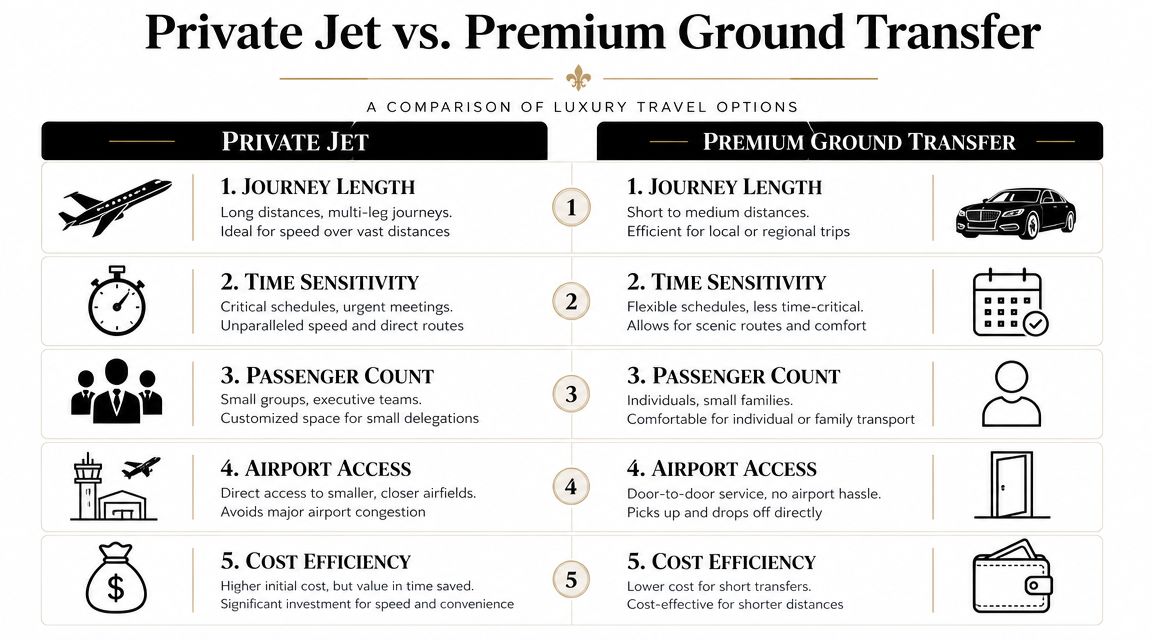
This comparison matters more than most charter brokers admit. For some UK journeys, private air travel is outstanding. For others, premium ground transport is the adult decision.
Where the value crossover happens
A private jet is strongest when the route is long enough to justify aircraft mobilisation and airport handling. Think cross-country UK itineraries, multi-stop schedules, or situations where access to smaller airfields sharply improves arrival time.
A premium ground transfer wins when the route is direct by road, the passengers have substantial luggage, and the destination itself isn't an airport. That's exactly the profile for Heathrow to Southampton, Dover, Portsmouth, or Tilbury.
Here's the practical comparison:
| Decision factor | Private jet | Premium ground transfer |
|---|---|---|
| Best for | Longer sectors, multi-leg days, urgent executive schedules | Airport-to-port, hotel-to-port, regional transfers |
| Cost logic | High base cost plus airport and operating fees | Fixed journey pricing and simple planning |
| Luggage handling | Can be restrictive by aircraft type | Usually easier for cruise bags and family luggage |
| Journey flow | Fast in the air, but still involves airside process | Direct door-to-door |
| Stress level | Excellent when the route suits aviation | Excellent when the route suits road travel |
The better choice for cruise port transfers
For most London airport to cruise port journeys, premium ground transport is the better-value tool. Not because it's glamorous, but because it removes the most friction. You leave the airport, your luggage stays with you, and you arrive at the terminal entrance without adding another aviation layer to a road-based problem.
If you're comparing your options for a London arrival, this guide to private car hire in London is closer to the actual decision many travellers should be making.
If your destination has a gangway, not a runway, start by proving the aircraft adds value. Often it doesn't.
My opinion is simple. Use the jet when speed across meaningful distance changes the day. Use premium ground transfer when the destination is regional, the luggage is heavy, and the main priority is a smooth handoff from airport to ship or hotel.
That's the crossover point.
Frequently Asked Questions About Private Jet Costs
A client lands at Heathrow at 7:30 a.m., boards a cruise in Southampton that afternoon, and asks whether a private jet for the onward leg is “worth it.” Usually, no. For a route like that, the smart comparison is total landed cost against a premium car transfer, not jet charter against commercial aviation.
Is catering included in a charter quote
Sometimes. Sometimes not.
Ask for the catering line in writing. You want to know whether the quote covers basic drinks and snacks, a plated meal, special dietary requests, alcohol, and any last-minute uplift charges. Small catering upgrades can turn into an irritating add-on if nobody pins them down early.
Can I split the cost with other passengers
Yes, because the aircraft is priced as a whole, not by seat.
That can improve the value materially on a route where everyone is travelling together anyway. It stops making sense once you start forcing different schedules, different luggage volumes, or separate drop-offs into one booking. Shared cost only works when the trip itself is shared.
Are empty-leg flights worth chasing
Only if your schedule is flexible and your expectations are realistic.
Empty legs can be cheaper than a standard charter, but they are opportunistic. The route, timing, airport pair, and baggage allowance may not suit you. If you need certainty for a ship departure, board meeting, or family handoff, book a confirmed solution and move on.
Why do short flights still seem expensive
Because you are not buying airtime alone. You are buying aircraft positioning, crew time, airport charges, handling, taxes, and sometimes minimum daily usage.
This is why a short UK hop often looks poor on value once you calculate the full journey. A London airport to cruise port transfer may sound exclusive by air, but the last-mile reality usually favours a premium vehicle that takes you directly to the terminal with all luggage in one move.
What should I compare before booking
Compare door-to-door cost, time, and friction.
For many Heathrow-area journeys, the alternative is not another aircraft. It is a chauffeured road transfer with fixed pricing and simpler luggage handling. If you want a practical benchmark, review typical Heathrow taxi cost estimates for private airport transfers and compare that against the full charter quote, including every airport and handling fee.
When is a private jet the right call
Use it when it changes the day in a meaningful way. Multiple meetings in different cities, urgent executive travel, remote airfields, or a routing commercial carriers handle badly. That is where private aviation earns its price.
For short regional transfers inside southern England, it usually does not. If the destination is a cruise terminal, hotel, or central London address, premium ground transport often gives the better result for less money and less complexity.
What is the biggest mistake buyers make
They compare the jet headline rate with a car fare and stop there.
Compare the full mission. Include transfer time to the private terminal, check-in procedures, baggage limits, handling fees, and the road segment that still happens after landing. On many UK routes, that exercise answers the question quickly.
If you're arriving at Heathrow and need the sensible option for Southampton, Dover, Portsmouth, Tilbury, or Central London, EC Minibus offers the kind of transfer most travellers need: fixed pricing, meet and greet, luggage help, and direct door-to-door service without the cost inflation of an unnecessary air leg.