

A pre-booked private car service from Heathrow to Central London typically costs £90 to £150, while a metered taxi can be far less predictable once traffic, route changes, and airport pickup realities are in play. If you searched how much does a car service cost in the UK, you're probably trying to price an airport ride, not an oil change, and that distinction matters straight away.
You've landed at Heathrow, you're tired, your luggage feels heavier than it did when you packed it, and now you need one simple answer. In the UK, “car service” can mean two completely different things. It can mean a mechanical service for a vehicle, or it can mean a private transfer service with a driver.
Most visitors mean the second one. They want a car waiting, a fixed price, help with bags, and a clean handoff from airport to hotel, station, or cruise terminal. That's what this guide focuses on. I'll clear up the maintenance meaning quickly, then get into the transfer costs and practical booking advice that travellers need.
Table of Contents
- Arriving in the UK What Does a Car Service Mean
- Mechanical Service vs Private Transfer Service Costs
- Factors That Affect Your UK Transfer Cost
- Example UK Car Service Prices for Popular Routes
- Car Service vs Black Cab vs Train A Cost and Convenience Comparison
- Booking Checklist and Money Saving Tips
- Frequently Asked Questions for International Travellers
Arriving in the UK What Does a Car Service Mean
A lot of international visitors trip over this one immediately. You search “car service UK”, expecting airport transport, and half the results talk about brake fluid, spark plugs, and annual servicing. That's not helpful when you're standing in Arrivals looking for a ride into London.
In British English, car service often means mechanical maintenance. A garage services your car. They check fluids, inspect parts, and deal with routine wear. But in travel planning, many people use “car service” to mean a private transfer, usually pre-booked, with a driver meeting you and taking you door to door.
That difference matters because the booking process, the pricing, and the expectations are completely different.
The meaning most travellers actually want
If you're arriving at Heathrow, Gatwick, or a cruise terminal, the phrase you want in practical terms is private transfer service or private car hire with driver. That means:
- You pre-book the journey before arrival
- The price is usually fixed
- The driver collects you at a set point
- You go straight to your hotel, port, or station
For airport and cruise travel, that's usually the least confusing option. No queue guessing. No figuring out train changes with luggage. No metered fare ticking upward while traffic clogs West London.
Most first-time visitors don't need “car servicing”. They need a properly booked airport transfer.
If you want a clearer overview of how airport pickups work in practice, this guide to airport transfer service options gives a useful travel-focused explanation.
Why the wording causes so much confusion
A tired traveller types one phrase. Google serves two industries. Garages talk about maintenance. Transport firms talk about transfers. Both use the same words.
So let's settle it cleanly. If your question is how much does a car service cost UK, and you're travelling with suitcases or heading to a cruise port, you're almost certainly asking about private transfer cost. That's the version worth budgeting for. The rest of this guide sticks to that real-world travel meaning.
Mechanical Service vs Private Transfer Service Costs
Let's deal with the garage meaning first so there's no confusion left.
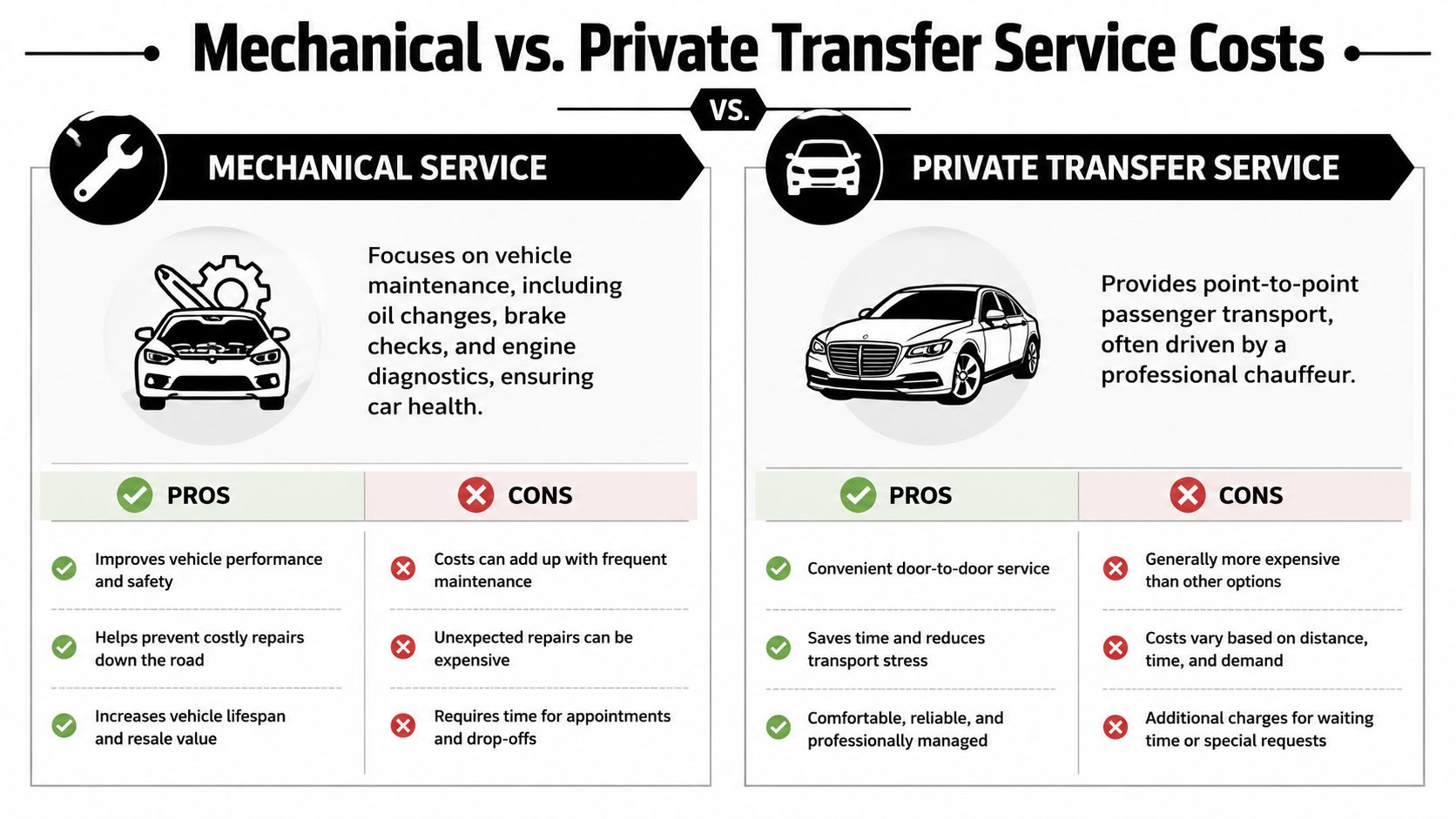
A mechanical car service in the UK is routine vehicle maintenance. That's oil and filter changes, brake checks, inspections, and the usual work that keeps a car roadworthy and running properly. According to ClickMechanic's guide to UK car servicing prices, a full car service in the UK typically costs between £150 and £300, with premium brands such as BMW at £280 to £440 and mass-market brands such as Ford at £210 to £370.
That's useful information if you own a car here. It's irrelevant if you've just flown in from Toronto or Miami and need to get from Heathrow to your hotel.
What a mechanical service includes
A garage service is all about the vehicle itself. Common items include:
- Oil and filter work for routine engine care
- Brake and safety checks to catch wear before it becomes a bigger issue
- Fluid inspections covering things like coolant and brake fluid
- General diagnostics if the mechanic spots warning signs
For travellers, the important bit is simple. If a page talks about engine size, labour rates, or annual maintenance schedules, you're reading about the wrong kind of car service.
What a private transfer service actually is
A private transfer service is pre-arranged passenger transport. You book a driver and vehicle for a specific journey. Common examples include:
- Heathrow to a Central London hotel
- A London hotel to Southampton Cruise Terminal
- St Pancras to Heathrow
- Dover or Portsmouth transfers after a cruise
The price isn't based on spark plugs or workshop time. It's based on the trip itself, the vehicle size, pickup conditions, and service level.
If you want the travel version rather than the garage version, look for terms like private car hire with driver. That's the language that matches what visitors usually mean.
Practical rule: If the service comes with a driver, it's transport. If it comes with a mechanic, it's maintenance.
The right question to ask before you book
Don't ask only “how much is a car service?” Ask what kind of car service am I pricing?
For travel, the better questions are:
- Is the fare fixed?
- Does it include airport pickup?
- How much luggage fits?
- Is waiting time covered if my flight is delayed?
- Will I be dropped at the door, or still need to find my way through the last part myself?
That's where transfer costs become more useful than generic “UK car service” averages.
Factors That Affect Your UK Transfer Cost
Private transfer pricing in the UK isn't random. If one quote looks much higher than another, there's usually a reason. The problem is that many companies don't explain the reason clearly enough.
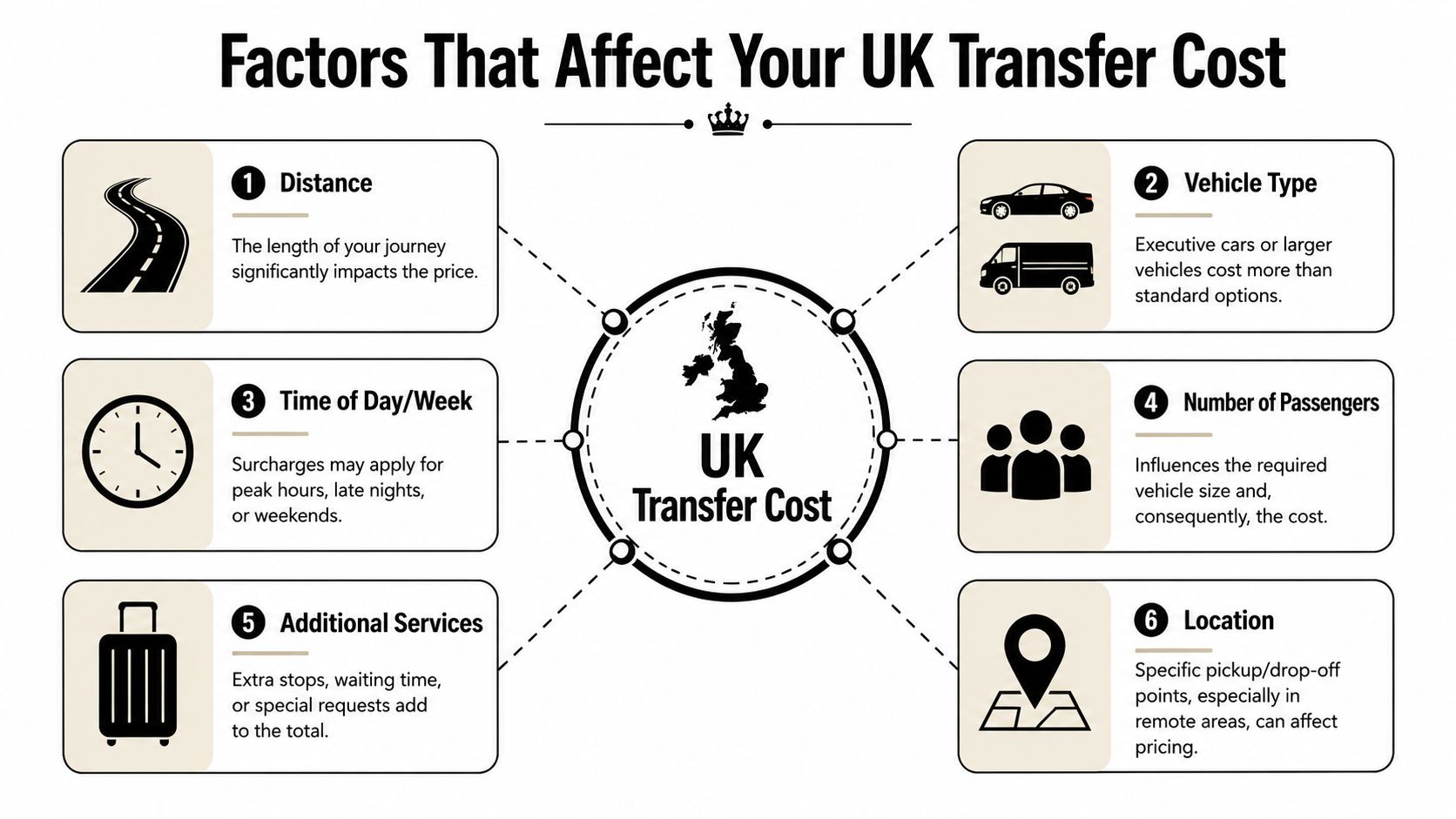
This is the short version. Distance, vehicle size, timing, location logistics, luggage, and extras drive the cost.
Distance and route complexity
Longer trips cost more. That sounds obvious, but the expense often comes from how awkward the route is, not just how far it is. Heathrow to a hotel in Central London may be a shorter journey than London to Southampton, but city traffic, terminal pickup rules, and road congestion can make short routes surprisingly expensive.
A direct motorway run is usually easier to price than a city-centre drop-off with restricted access, hotel forecourts, and slow-moving traffic around Paddington, Kensington, or Westminster.
Vehicle size changes the price fast
A saloon for one or two people costs less than an MPV or minibus for a family group. That's normal. Bigger vehicles cost more to run, take more organising, and are in shorter supply.
Often, visitors make a mistake. They book too small, then realise too late that four adults with four large suitcases don't fit comfortably in a standard car. Then they end up paying to fix the booking.
Book for luggage first, passengers second. That's the sensible rule.
London pushes prices up
Location profoundly changes the bill. Even in the mechanical servicing world, the Bumper overview of annual servicing costs highlights a sharp London premium, noting that independent garages in London charge £56 to £90 per hour, while dealerships in London can reach £230 per hour. That's maintenance data, but the underlying lesson applies neatly to transfers too. Operating in London costs more.
Airport pickups in and around the capital are rarely the cheapest journeys in the country. Congestion, access fees, parking arrangements, and simple time lost in traffic all push quotes upward.
A London quote should never be judged against a generic national average. London plays by pricier rules.
Timing and extras matter more than people expect
A transfer quote can also move because of the details around the journey.
- Time of day affects traffic and driver availability
- Weekend or holiday travel can tighten supply
- Airport waiting time may or may not be included
- Child seats need to be requested in advance
- Extra stops turn a direct transfer into a more complex booking
The fixed quote only works if it's actually all-inclusive
This is the bit to watch carefully. Some operators give a headline fare that sounds good until parking, waiting, or terminal pickup charges appear later. The best transfer quotes are blunt and complete.
Ask for confirmation that the price includes:
- Airport pickup
- Meet and greet if offered
- Waiting time terms
- Luggage allowance
- Any extra stop or child seat requirement
If they can't explain the quote in plain English, don't book it.
Example UK Car Service Prices for Popular Routes
Let's get to the part you need. Real-world route examples make budgeting much easier than reading vague claims about “competitive pricing”.
The table below uses the travel meaning of car service, meaning a private transfer with driver, not mechanical maintenance. These are estimated private transfer costs from London airports and city points for common traveller routes in 2026, using the same style of pricing most international visitors shop for.
Estimated private transfer costs from London airports 2026
| Route | Standard Saloon (1-3 passengers) | Minibus (4-8 passengers) |
|---|---|---|
| Heathrow to Central London | £90 to £150 | £120 to £220 |
| Gatwick to Central London | £110 to £170 | £145 to £240 |
| Heathrow to Southampton Cruise Terminal | £180 to £260 | £230 to £360 |
| Central London to Southampton Cruise Terminal | £170 to £250 | £220 to £340 |
| Heathrow to Dover Cruise Terminal | £210 to £320 | £270 to £420 |
| Central London to Dover Cruise Terminal | £190 to £290 | £250 to £390 |
| Heathrow to Portsmouth Port | £180 to £270 | £240 to £370 |
| Heathrow to Tilbury Cruise Terminal | £140 to £220 | £190 to £300 |
| St Pancras International to Heathrow | £80 to £140 | £110 to £210 |
How to read these ranges properly
These are not “one price fits all” fares. They're budgeting ranges. The exact amount usually depends on pickup time, number of bags, where exactly you're staying, and whether the company includes waiting and airport access costs upfront.
The Heathrow to Central London route is often the first route considered. £90 to £150 is a sensible range for a pre-booked standard private transfer. If you're travelling as a couple with manageable luggage, that's often the simplest choice. If you're a family or small group, a minibus can make much better sense than splitting into multiple vehicles.
The cruise port routes need more planning
Cruise transfers are where visitors get caught out. Heathrow to Southampton or Dover is not a quick hop. It's a proper intercity journey with luggage, fixed embarkation times, and little room for improvisation.
For that reason, I'd strongly recommend private transfer over trying to patch together train changes, station taxis, and bag handling on the same day. It's not the cheapest possible route. It's usually the least stressful one.
Why saloon vs minibus isn't just about group size
A saloon works best for one to three passengers with standard luggage. The moment you add large cruise cases, mobility needs, or a family setup, the bigger vehicle starts to look less like a luxury and more like the obvious answer.
Here's the blunt advice:
- Couples on a city break should usually book a saloon
- Families with children should strongly consider a larger vehicle
- Cruise passengers should prioritise luggage space over shaving a little off the fare
- Groups of four or more should compare one minibus against two smaller cars. The larger vehicle often wins on convenience alone
If you're heading to a ship with full-size luggage, don't gamble on a tight boot. That's how simple transfers turn into arguments in the pickup lane.
Car Service vs Black Cab vs Train A Cost and Convenience Comparison
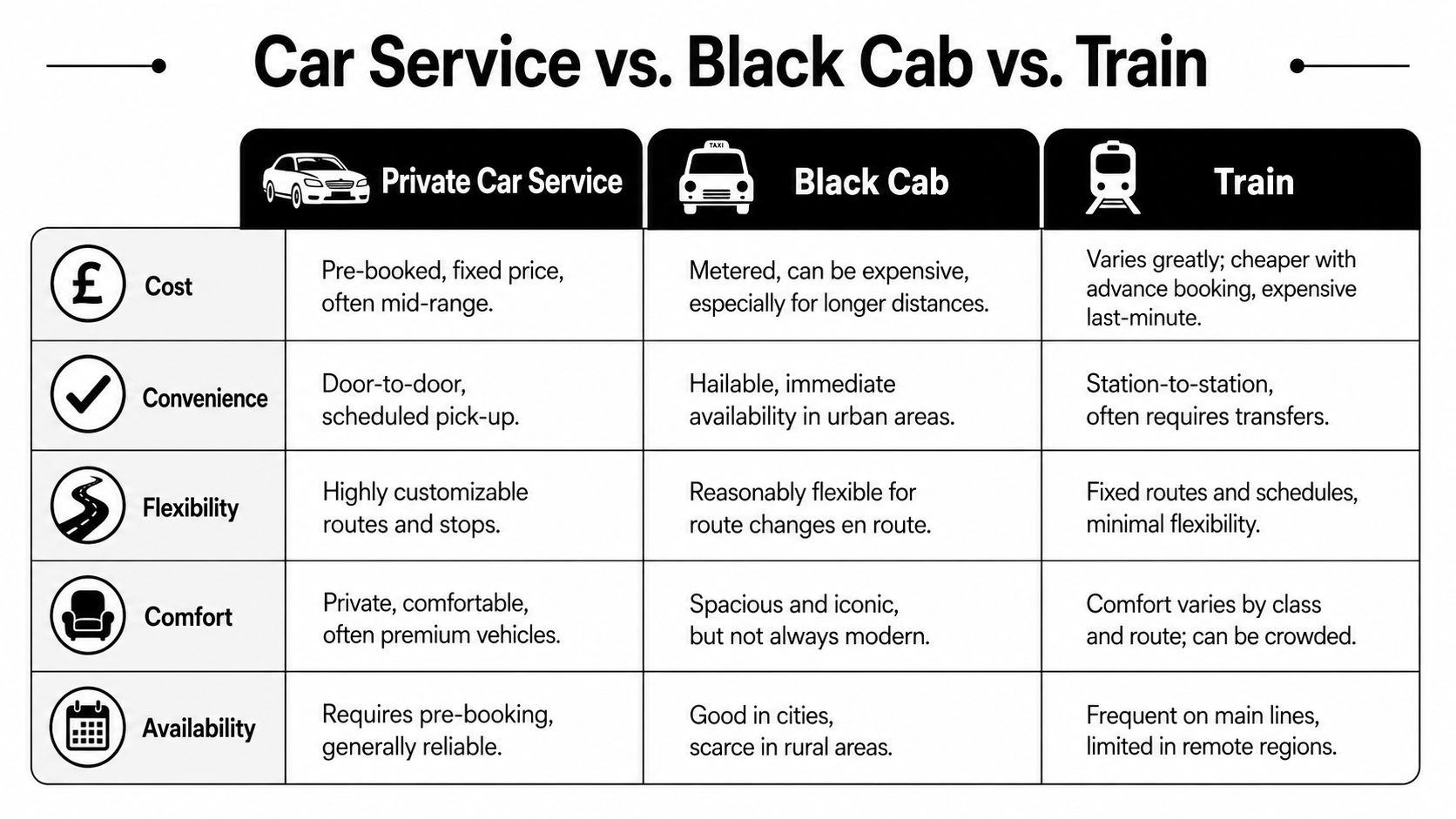
You've got three realistic options for a typical airport arrival into London. Pre-booked private car service, Black Cab, or train. Each works. They're not equally good.
The right choice depends on what you value more. Price certainty, speed, simplicity, luggage handling, or flexibility.
Side by side comparison
| Option | Cost style | Door to door | Best for luggage | Stress level |
|---|---|---|---|---|
| Private car service | Fixed when properly booked | Yes | Strong | Low |
| Black Cab | Metered | Yes | Good | Medium |
| Train | Ticketed fare | No | Mixed | Medium to high |
Private car service
This is the most controlled option. You know who's collecting you, where you're going, and what you're paying if the booking is properly set up. It's especially useful after a long-haul flight or before a cruise departure where delays and faffing about are the last thing you need.
It also gives you the cleanest door-to-door experience. No station transfers. No hunting lifts with heavy bags. No trying to decode UK rail signage while jet-lagged.
Black Cab
London's Black Cabs are iconic and professionally driven. For spontaneous city travel, they're excellent. For airport budgeting, they're less attractive because the metered fare is less predictable.
Traffic changes the maths. So does the route and the timing. If you're happy paying for immediacy, fine. If you want a set cost before leaving the terminal, a pre-booked car service is the better tool.
If you're weighing airport taxi options specifically, this breakdown of Heathrow taxi cost comparisons is worth reviewing.
Train
The train can be a smart choice for confident travellers with light luggage. It can also become annoying very quickly if your hotel isn't near the arrival station, you've got children, or you're carrying cruise baggage.
This is the usual train problem. The rail fare may look cheaper at first glance, but it often isn't the full journey cost. You still need the last leg from station to hotel or port. You still need to move bags yourself. You still need to work around timetables.
Cheap on paper and easy in reality are not the same thing.
My honest recommendation
If you're travelling solo with one small case and staying near a major rail hub, train can work well. If you're a family, an older couple, a cruise passenger, or anyone arriving tired after a transatlantic flight, book the private transfer and be done with it.
For context on UK vehicle running and size-based servicing differences, Checkatrade's car service cost guide notes that mechanical service costs rise by vehicle size, with small cars averaging £170, medium cars £210, and large cars £395, while the MOT is capped at £54.85. Different category, same lesson. Bigger vehicles and more involved logistics usually cost more.
Booking Checklist and Money Saving Tips
Most transfer problems happen before the journey starts. People book the cheapest-looking option, skip the small print, and then act surprised when the actual total is higher or the pickup turns messy.
A good booking should feel boring. Clear quote. Clear meeting point. Clear luggage plan. That's what you want.
Booking checklist
Use this before you pay anything.
- Confirm the fare is fixed. Ask whether airport pickup, parking, and standard waiting time are included.
- Check the pickup method. Meet and greet is far easier for first-time visitors than trying to find a random pickup bay.
- Match the vehicle to your luggage. Don't assume a standard car fits cruise suitcases.
- Verify licensing and insurance. This shouldn't be optional.
- Ask what happens if the flight is delayed. Serious operators should have a clear answer.
- Read the cancellation terms. Plans change. Know the rules before you book.
- Get written confirmation. Verbal promises are useless when you're standing in Arrivals.
How to save money without booking badly
The cheapest quote isn't always the lowest-cost trip. It only looks that way until add-ons appear.
The RAC's look at service pricing makes an important point in the maintenance context. A quoted service fee can be only the baseline, and the final bill can grow if extra parts or repairs are needed, as explained in RAC's guide to service costs and what's included. The transfer version of that lesson is obvious. A headline fare means very little if key extras are missing from the quote.
Smart ways to trim the total
- Book in advance. Last-minute bookings usually give you fewer choices.
- Travel outside the busiest periods if you can. The roads will still be busy, but not equally awful at all times.
- Avoid oversizing the vehicle. Don't book a minibus for two people unless your luggage demands it.
- Bundle the group into one suitable vehicle. One properly sized transfer can be better value and much simpler than splitting everyone up.
- Choose the most direct route. Multiple stops always push the price up.
The best value booking is the one that includes what you actually need on the first quote.
Frequently Asked Questions for International Travellers
Do I need to tip the driver in the UK
Tipping isn't as automatic in the UK as some visitors expect. For private transfers, many people tip if the driver is punctual, helpful with luggage, and the ride is smooth. It's appreciated, not mandatory.
Can I request a child seat
Yes, usually, but request it in advance. Don't assume it will be in the vehicle unless it's confirmed on the booking.
How do I find my driver at Heathrow
That depends on the company. Many use a meet and greet arrangement inside arrivals, while others direct you to a pickup point outside. If you're new to Heathrow, meet and greet is the easier option by miles.
What happens if my flight is delayed
A proper airport transfer company should ask for your flight number and monitor arrival changes. Still, don't assume. Check the policy before booking so you know whether waiting time or re-timing is included.
Is a Black Cab better than a private transfer
For instant, on-demand travel, sometimes yes. For fixed-price airport or cruise travel, usually no. If you care about certainty, the private transfer wins.
How much luggage is too much for a standard car
If you're travelling with large cruise cases, pushchairs, or more than a couple of big bags, ask before booking. Don't guess. One of the easiest ways to ruin an arrival is to under-book the vehicle size.
Is train travel worth it from Heathrow
It can be, especially if you pack light and your hotel is close to the station you arrive into. If you've got children, heavy luggage, or you're heading to a cruise port later the same day, private transfer is usually the easier move.
If you want the simple option, EC Minibus is built for exactly this kind of journey. They handle Heathrow, Central London hotels, and major cruise ports with fixed pricing, meet and greet, luggage help, and drivers who understand that tired international travellers don't want surprises.