

You've probably looked at your cruise itinerary, seen “Florence/Pisa (Livorno)”, and realised the actual question isn't whether Tuscany is worth seeing. It is. The question is how to get the most out of the day without spending half of it figuring out buses, shuttles, stations, and return times.
That matters more in Livorno than in many Mediterranean ports. You're not stepping off the ship into a postcard harbour with cafés outside the gangway. You're arriving in a working port where logistics shape the day. Get the plan right and you can have a brilliant Tuscan shore day. Get it wrong and you can burn time, energy, and patience before you've even started.
Table of Contents
- Welcome to Livorno Your Gateway to Tuscany
- Arriving at Livorno Cruise Port What to Expect
- Your Transfer Options from Livorno Port
- Popular Shore Excursions Pisa Florence and Beyond
- Sample One-Day Itineraries for Cruisers
- Essential Tips for a Smooth Day Ashore
- Planning Your Livorno Transfer A Summary and Checklist
Welcome to Livorno Your Gateway to Tuscany
Your ship docks in Livorno at 7:00 a.m. By 7:15, many passengers are already talking about Florence. A few want Pisa. Some plan to stay local. The right choice is not just about what looks best on paper. It is about how much time you want to spend in transit, how much uncertainty you can tolerate, and how close to all-aboard time you are comfortable cutting it.
Livorno matters in its own right. It grew as a Medici port, and its historic waterfront still reflects that past, including the Fortezza Vecchia and Porto Mediceo, as noted in this Livorno history overview. For cruise passengers, though, the city usually works as the front door to a much bigger Tuscany day.
That changes how you should plan it.
Frustration in Livorno often starts with underestimating the transfer. The port gives you access to excellent places, but access is not the same as arrival. Florence takes more commitment than many cruisers expect. Pisa is easier to fit into a shorter port call. Staying in Livorno can be the smartest choice if you want a relaxed day and a wide safety margin.
Cruise passengers who have used ports with simpler walk-off access often assume this one will feel similar. It usually does not. If you know ports where town is close and onward transport is straightforward, such as Southampton cruise port transfer setups, Livorno often feels more like a logistics day first and a sightseeing day second.
The day starts with one practical choice
Before choosing museums, piazzas, or the Leaning Tower, choose your trade-off:
- Lowest cost: public transport usually saves money, but it adds connections, waiting time, and less room for delays
- Most flexibility: arranging your own day gives you control, but you carry the timing risk
- Lowest stress: ship tours and well-planned private transfers cost more, but they simplify the return plan
- Best option for families or small groups: private transport often costs more than DIY, yet it can be better value once you factor in walking distance, pace, and time saved
Start there, and the rest of your Livorno day becomes much easier to get right.
Arriving at Livorno Cruise Port What to Expect
Livorno is one of Italy's major seaports, with reported annual traffic capacity of around 30 million tonnes of cargo and about 700,000 TEU, while throughput in 2007 reached 32,934,594 tonnes and 745,557 TEU. The port also serves over 7,000 ships every year and has more than 15,000 employees, according to the Port of Livorno overview. That scale explains a lot about the passenger experience. Cruise ships share space with serious commercial activity.
Why the port feels different
This isn't a port where you stroll off the ship and wander into town. Livorno is a mixed-use industrial port, and independent descriptions note that active cargo traffic affects cruise movement, berth choice, and onward transfer timing, as described by UNISCO's Livorno port profile. Passenger flow has to be kept separate from container, ro-ro, and bulk operations.
That's why the first impression can feel more functional than scenic. Cranes, roadways, secured areas, and long internal distances are normal here.
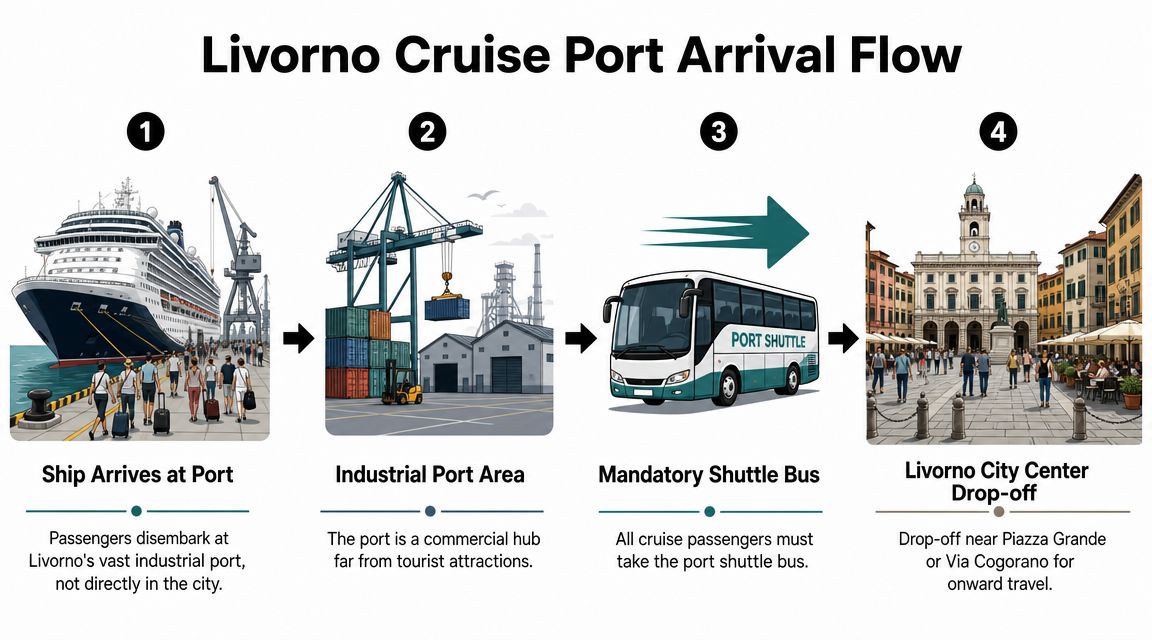
What the arrival flow usually looks like
The process is straightforward once you know it:
- Disembark the ship You'll leave the vessel into a secured port environment, not the city.
- Follow signs or staff to the port shuttle Some berths sit deeper inside the industrial area than others, so the walk and bus timing can vary.
- Ride to the city-side drop-off area This is the point where independent travel usually begins.
- Switch to your real onward transport That could be a taxi, a pre-booked driver, a train plan, or a ship excursion coach.
CruiseMapper notes that Livorno can handle up to 8 cruise ships simultaneously across all piers, with some berths positioned deep in the industrial area, which is why the shuttle system matters so much for passenger flow management in practice, according to CruiseMapper's Livorno port page.
What catches people out
The biggest mistake is assuming the clock starts when the ship docks. In reality, your day starts when you've cleared the port system and reached the point where your chosen transfer begins.
Practical rule: In Livorno, don't measure your shore day from gangway to destination. Measure it from gangway to shuttle, shuttle to pickup, and pickup to destination.
That sounds small, but it changes everything. A DIY rail day that looks easy on a map can feel much tighter after shuttle time, queueing, and finding the correct onward connection.
If you've cruised from the UK, this setup feels closer to a mixed passenger-freight environment than a leisure harbour. There's a similar logic in how movement has to be managed around active operations, which is why planning-minded travellers often prefer the same kind of pre-arranged structure they use for Southampton cruise port transfers.
Your Transfer Options from Livorno Port
The right option depends less on destination and more on your tolerance for friction. If your ideal day involves solving transport as you go, one set of choices works. If your ideal day is getting into Tuscany with as little uncertainty as possible, another works better.
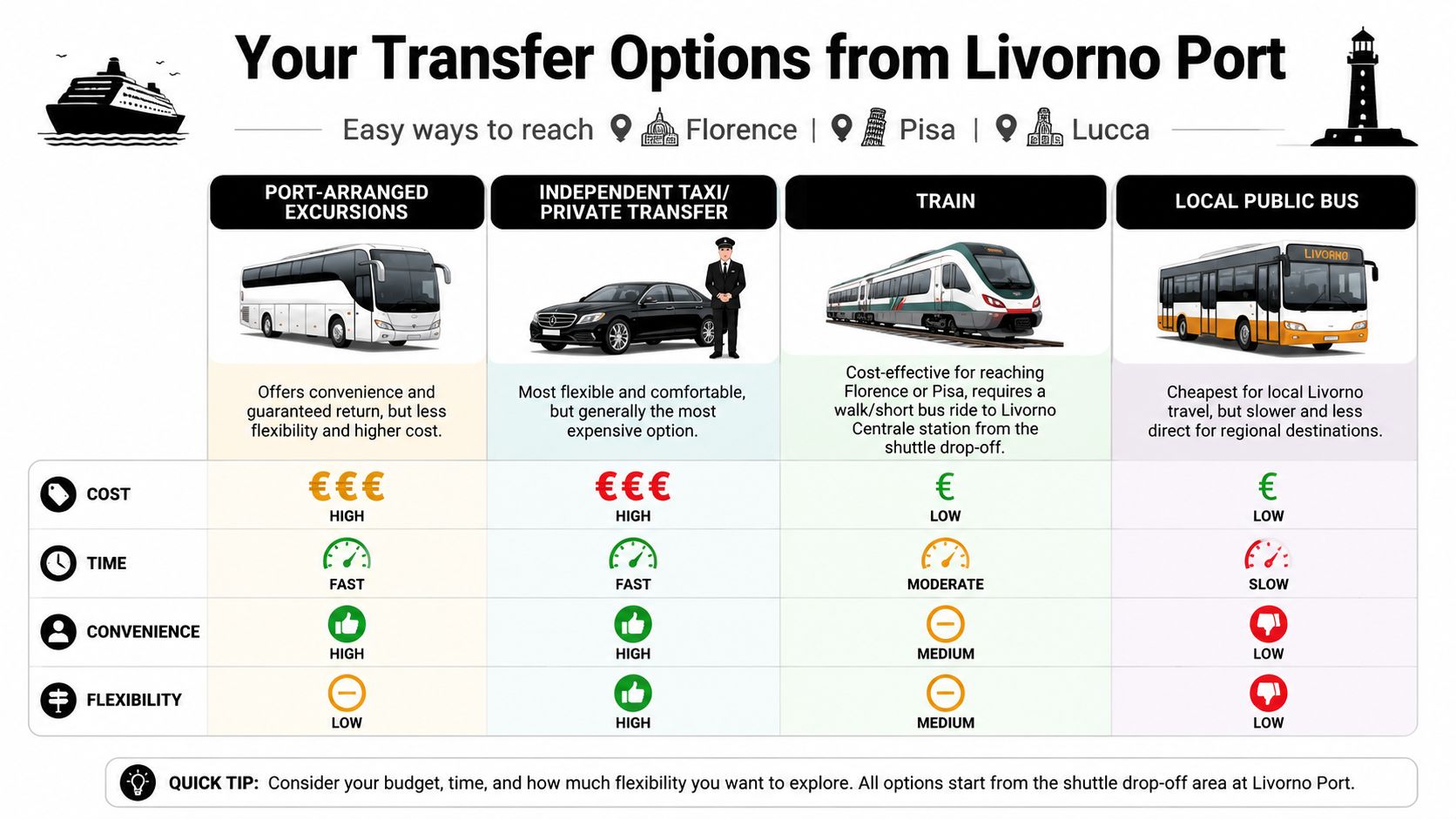
A quick comparison
| Option | Cost | Stress level | Flexibility | Best for |
|---|---|---|---|---|
| Taxi | Medium to high | Medium | Good | Couples and small groups going direct |
| Public bus and train | Low | High | Medium | Confident independent travellers |
| Ship-sponsored excursion | High | Low | Low | First-timers and anyone risk-averse |
| Pre-booked private transfer | High | Low to medium | High | Families, groups, mobility needs |
A useful way to think about it is this. You're not only buying transport. You're buying either certainty or exposure to moving parts.
Later in the day, this video context can help visualise how port days in Italy often hinge on transfer choices and timing.
Taxis
Taxis are often the simplest independent option once you've reached the shuttle drop-off. They remove at least one layer of complexity because you're not juggling local buses before the main journey even starts.
What works well:
- Directness: Good if you want to reach a station, Pisa, or a specific city point without extra steps.
- Simplicity: Easier than decoding local transport after disembarkation.
- Shared value: For two to four people, the convenience can make sense.
What doesn't:
- Queue risk: When several ships arrive, demand compresses quickly.
- Less control over total day structure: Unless you hire the taxi for longer use, it's still just one leg of the day.
- Not always ideal for accessibility: Vehicle suitability can vary unless arranged in advance.
Public bus and train
This is the classic DIY route. It usually appeals to travellers who are comfortable with station changes, ticketing, and a bit of improvisation. It can be the cheapest way to get to Pisa or Florence, but the cheap part is only one side of the story.
A cited example from a travel video suggests that getting to Pisa independently can cost about £60 for two, compared with a £130 ship excursion, as referenced in this YouTube example about Livorno DIY versus ship tours. That price difference is real enough to tempt people.
But the saving comes with conditions:
- You must clear the port first
- You still need to bridge the gap to rail
- You need enough buffer on the return
- Any small delay compounds later in the day
The true DIY question in Livorno isn't “Can I do it cheaper?” It's “How many connection points can go wrong before I'm watching the clock all afternoon?”
If you enjoy independent travel, this can still be a strong option. Pisa is usually the more forgiving choice. Florence asks more of your timing discipline.
Ship-sponsored excursions
These are rarely the cheapest option, and they're often the least flexible once the day starts. But they do one thing very well. They convert a complex transport chain into a managed process.
That matters in Livorno because the port itself already creates friction. A ship excursion usually removes the need to figure out the shuttle-plus-transfer puzzle on your own. For many passengers, especially first-timers, that convenience is worth paying for.
Best fit:
- travellers who want clear structure
- people nervous about return timing
- anyone trying to see Florence without transport stress
Less ideal for:
- independent travellers who hate fixed schedules
- passengers who want to linger, detour, or build their own pace
Pre-booked private transfers
This is the middle ground between full DIY and a ship tour. You pay more than public transport, but you gain control over pickup, route, pace, and return timing.
It's especially useful for:
- families
- small groups
- travellers carrying luggage
- passengers with mobility concerns
- people combining more than one stop
The hidden advantage is energy, not just time. If the day starts with a clean handoff from shuttle area to driver, you preserve mental bandwidth for Tuscany instead of spending it on local logistics.
For travellers who routinely value fixed pickup arrangements on cruise and airport days, the logic is similar to using organised airport shuttle services for timed transfers. You're paying to remove uncertainty from a day that already has a deadline.
Popular Shore Excursions Pisa Florence and Beyond
Once you've chosen your transport style, the destination choice becomes clearer. The mistake I see most often is trying to turn one port call into three different Tuscan trips. It nearly always leaves people rushed.
Pisa for a shorter cleaner day
Pisa is the easiest “headline sight” option from livorno cruise port. If your main goal is to see the Field of Miracles, get the Leaning Tower photos, walk the square, and still return without a frantic finish, Pisa is usually the better fit.
It works especially well for:
- first-time visitors who want a recognisable landmark
- travellers who don't want an exhausting day
- families who'd rather keep transit lighter
- anyone leaning towards DIY but wanting a less punishing test case
A sensible Pisa day focuses on the square and its immediate surroundings. Don't overcomplicate it. The win here is efficiency.
Florence for a full commitment
Florence is absolutely possible, but it needs honesty. This is not a casual pop-in. It's a full-day decision, and the city rewards a narrow plan much more than an ambitious one.
Choose two or three core priorities. For many cruise passengers, that means:
- Piazza del Duomo and the cathedral exterior
- Piazza della Signoria
- Ponte Vecchio
- a proper lunch, coffee, or gelato stop
- one pre-booked attraction only if you're disciplined with time
Trying to “do Florence” in one port day by adding multiple museums, long lunch plans, and shopping usually backfires. The city is dense, busy, and tempting. It's better to see less and enjoy it than spend the whole day hustling between pins on a map.
Florence rewards focus. If you try to fit in everything, you end up experiencing mostly queues and pavements.
Staying in Livorno
Not everyone needs to chase the big-ticket names. Staying local can be the smartest option if you want a calmer day with less transport risk.
Livorno has its own appeal, especially if you prefer a more grounded port-city feel. A relaxed day can include:
- Venezia Nuova: canals, bridges, and a quieter atmosphere
- Mercato Centrale: a good stop if you enjoy food-focused wandering
- Seafront time: better for a breather than a checklist day
This choice makes the most sense if you've already been to Florence or Pisa, you're travelling with someone who tires easily, or you want one day on a cruise where you're not racing the clock.
Sample One-Day Itineraries for Cruisers
A good port plan should fit your energy level, not just your wishlist. These three templates are practical rather than heroic. Adjust them to your ship's hours, but keep the overall pacing intact.
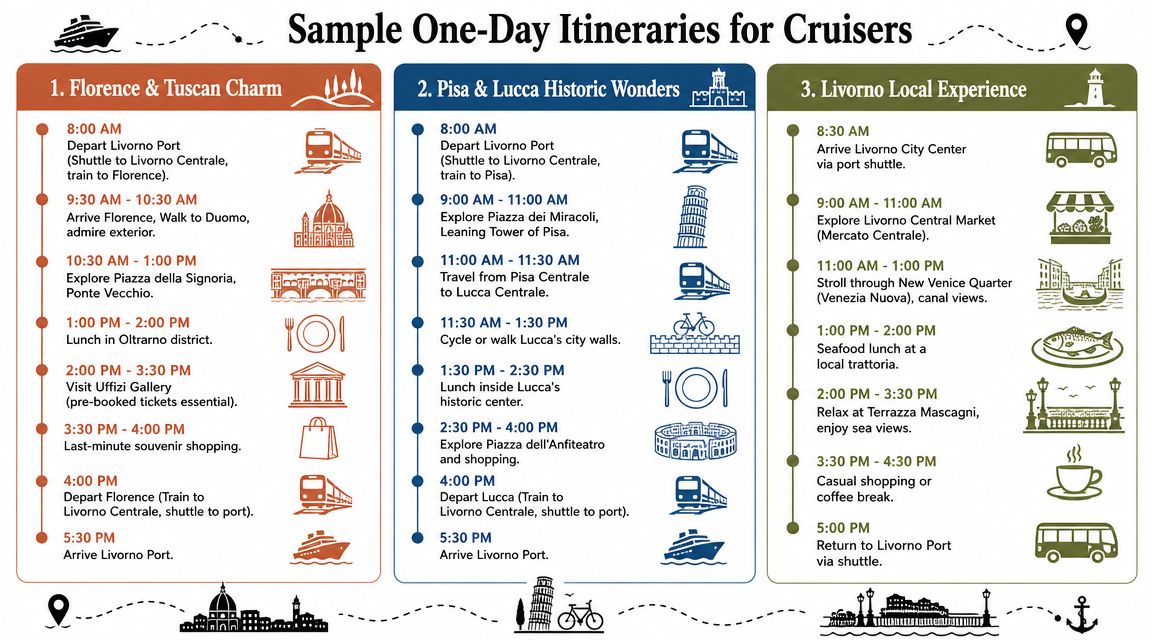
The Pisa express
This is the safest strong-value day for most independent travellers.
Morning
- Disembark early
- Use the port shuttle efficiently
- Move straight into your chosen onward transport
- Head directly for Pisa without adding extra stops
Late morning Spend your sightseeing time around the main square. Take the classic photos, walk the open spaces, and keep the visit tight rather than wandering too far.
Lunch Eat after the main sights, not before. That way, if the morning transfer takes longer than expected, you haven't lost your priority stop.
Afternoon Leave yourself a comfortable return window. This is not the day to squeeze in a second ambitious destination unless everything has run perfectly and you know exactly what you're doing.
The Florence immersion
This one suits travellers who know they're choosing experience over ease.
A workable approach looks like this:
| Part of day | Focus |
|---|---|
| Early departure | Get moving as soon as you can |
| Mid-morning | Duomo area and first city walk |
| Midday | Piazza della Signoria and Ponte Vecchio |
| Lunch | Keep it simple and central |
| Early afternoon | One pre-booked attraction or a focused walking route |
| Mid-afternoon | Start return discipline early |
Florence works best when you build the day around one anchor. That could be architecture, art, shopping, or walking the historic centre. If you don't set that anchor, the city can scatter your time.
The low-stress Livorno day
This is the plan I'd recommend to anyone who wants to feel on holiday.
Start with the shuttle into town, then keep the day local and loose:
- slow morning coffee
- market browsing
- a wander through the Venezia Nuova area
- a proper seafood lunch
- time by the waterfront later in the day
This is also the easiest itinerary to adapt on the fly. If the weather shifts, if someone in your group tires early, or if you just don't fancy another museum-heavy sprint, Livorno gives you room to breathe.
A successful port day doesn't have to be the most ambitious one. Sometimes the best choice is the one that gets you back onboard relaxed.
Essential Tips for a Smooth Day Ashore
The details that ruin port days are usually the unglamorous ones. Not the famous sight. Not the postcard moment. It's the missing cash, the wrong shoes, the underestimated walk, or the return plan that looked fine until one step took longer than expected.
Accessibility and luggage change the equation
This matters more in Livorno than many people expect. Independent cruise guidance confirms passengers can't walk out of the port and need a shuttle or taxi, while accessibility-focused advice notes that wheelchair access and the bus-train sequence can be difficult without planning, according to Anchor's Up's Livorno cruise port guide.
If you have:
- mobility limitations
- a foldable wheelchair or scooter
- children and lots of bags
- luggage because you're embarking or disembarking nearby
then DIY stops being a simple money-saving exercise. It becomes a chain of small physical tasks that can add up quickly.
Worth deciding early: if anyone in your group struggles with distance, uneven surfaces, or carrying bags, pre-arranged transport is usually the smarter choice.
For travellers who regularly prefer a cleaner handoff between pickup points, hotels, terminals, and airports, the same logic applies to door-to-door airport transfer planning. Fewer transitions usually means fewer problems.
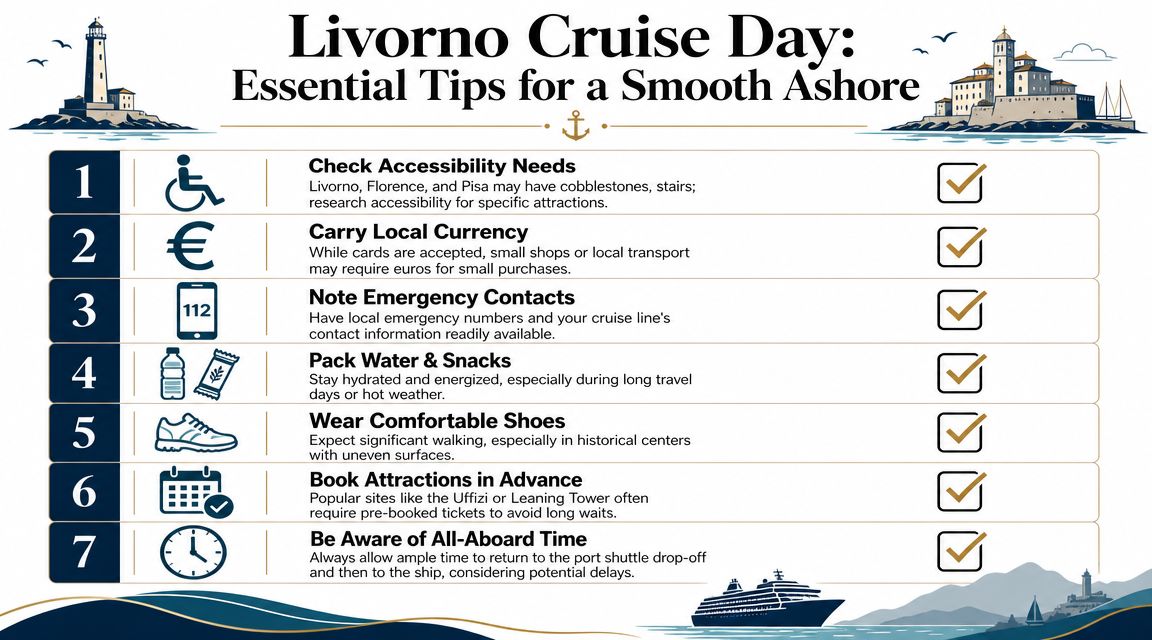
What to carry and book ahead
A few practical habits make the day smoother:
- Wear proper shoes: historic centres are beautiful, but they're not gentle on flimsy footwear.
- Carry water: especially if your day involves transfer time plus city walking.
- Bring some euros: cards are widely useful, but small purchases are easier when you're not relying on perfect card acceptance.
- Pre-book major attractions: if Florence is your goal, don't leave headline entries to chance.
- Keep your ship details handy: screenshot the all-aboard time and emergency contact information.
Return planning
The return is where disciplined travellers save themselves trouble. Don't aim to get back “just in time”. In Livorno, your final journey includes the port side of the process too, not just the city-to-port leg.
Use this mental checklist before you leave your destination:
- Have I allowed for delays?
- Do I know my exact pickup or station plan?
- Do I still need to rejoin the shuttle flow?
- Am I leaving early enough that one small problem won't matter?
That last question is the one that keeps the day enjoyable.
Planning Your Livorno Transfer A Summary and Checklist
The best Livorno plan is rarely the cheapest one on paper or the most ambitious one on Instagram. It's the one that matches your group, your confidence level, and your appetite for uncertainty.
If you're still deciding, use this checklist:
- What matters more today, saving money or saving hassle?
- Are you travelling solo, as a couple, or in a group?
- Do you want one famous sight or a fuller city experience?
- Will anyone struggle with walking, luggage, or repeated transfers?
- Are you comfortable managing rail timing on a cruise deadline?
- Would a fixed pickup and return feel worth paying for?
For most passengers, the pattern is straightforward. Pisa suits a lighter, simpler day. Florence suits people willing to commit to a longer, more structured outing. Livorno itself suits travellers who want a low-stress day that still feels rewarding.
The one bad strategy is leaving the decision too loose. Livorno cruise port rewards planning because the port mechanics shape everything that follows. Once you decide how you want to trade cost against comfort and certainty, the rest falls into place.
If you're flying into London before or after your cruise and want the ground transport sorted properly, EC Minibus is a practical choice for door-to-door transfers between Heathrow, Central London hotels, and major UK cruise ports. Their service is built for cruise travellers who care about timing, luggage handling, fixed pricing, and a smooth handoff between flight, hotel, rail hub, and ship.