

You're probably looking at a map of Europe, seeing London and Paris sitting close together, and wondering whether this is a smart use of a day or a recipe for exhaustion. That question usually comes up when the UK itinerary is already packed. You may have a London hotel booked, a cruise sailing soon from Southampton, or a Heathrow arrival that leaves just enough room for one bold extra experience.
A london day trip to paris is possible. It's also stricter, longer, and more logistics-heavy than most glossy guides admit. The train itself is the easy part. The primary challenge is everything around it: getting to St Pancras early enough, clearing immigration without stress, using your hours in Paris well, and getting back to London late at night without your final transfer turning into the worst part of the day.
Handled properly, it works. Not as a casual wander-anywhere day, but as a focused, well-timed city hit.
Table of Contents
- Is a London to Paris Day Trip Really Possible?
- Choosing Your Transport Eurostar vs Flying for a Day Trip
- Your Hour by Hour Day Trip Blueprint
- Solving the First Mile Problem London Transfers to St Pancras
- Paris in a Flash A Realistic 9 Hour Itinerary
- Pro Tips for a Flawless Trip Packing Passports and Plans
Is a London to Paris Day Trip Really Possible?
A workable London to Paris day trip starts before sunrise and ends late. From a planning point of view, that is the honest answer.
The trip is absolutely doable, but only for travellers who treat it as a full day of logistics as well as sightseeing. The Eurostar part is the easy headline. The true challenge is door to door timing: getting yourself to St Pancras with enough buffer, clearing departure formalities without stress, using your hours in Paris carefully, then getting back across London after a long return journey.
That door to door view is what decides whether the day feels efficient or punishing.
On paper, the schedule is strong enough to make a same day return realistic. In practice, the margins depend on where your day begins. A hotel near King's Cross gives you breathing room. A Heathrow arrival, a South Kensington hotel, or luggage still sitting at a cruise terminal can turn a good train schedule into a rushed start. Travellers in that position usually do better when they pre-book a London transfer to St Pancras instead of hoping the Underground, traffic, and bags all cooperate at the same time.
The Paris side is usually simpler than people expect. The London side is where the trip is won or lost.
A successful day trip also depends on restraint. Pick two or three priorities in Paris, not seven. Build around one neighbourhood or one major sight plus a good lunch. Leave space for queue times, station exits, and the fact that you will be operating on an early start by mid-afternoon.
Practical rule: A day trip to Paris works best when you plan for a long day and a short sightseeing list.
Done properly, this is not a frantic stunt. It is a long, well-structured day that gives you real time in Paris, provided you respect every stage of the journey, not just the train.
Choosing Your Transport Eurostar vs Flying for a Day Trip
Leave a central London hotel at dawn, reach St Pancras on time, step off in Paris near the city core, and still have a real day ahead of you. That is why Eurostar is usually the right transport choice for a same-day return.
The decision is not really train versus plane in the abstract. It is door-to-door time, number of handoffs, and how much of your energy gets spent before you even start sightseeing. Eurostar keeps the day in one continuous line. You travel from London St Pancras International to Paris Gare du Nord, both central stations, so you avoid the extra airport transfer on each side that makes flying harder to justify for a one-day plan. Eurostar's own London to Paris route page shows the route, timing, and city-centre arrival pattern that make this work.
Flying can look competitive if you only compare flight time with train time. That is the wrong comparison for a day trip. Airports sit outside the part of London and Paris you want to use, and each airport segment adds another check-in window, another queue, and another transfer. For a weekend or longer stay, that trade-off can be acceptable. For one day, it usually strips too many useful hours out of the middle.
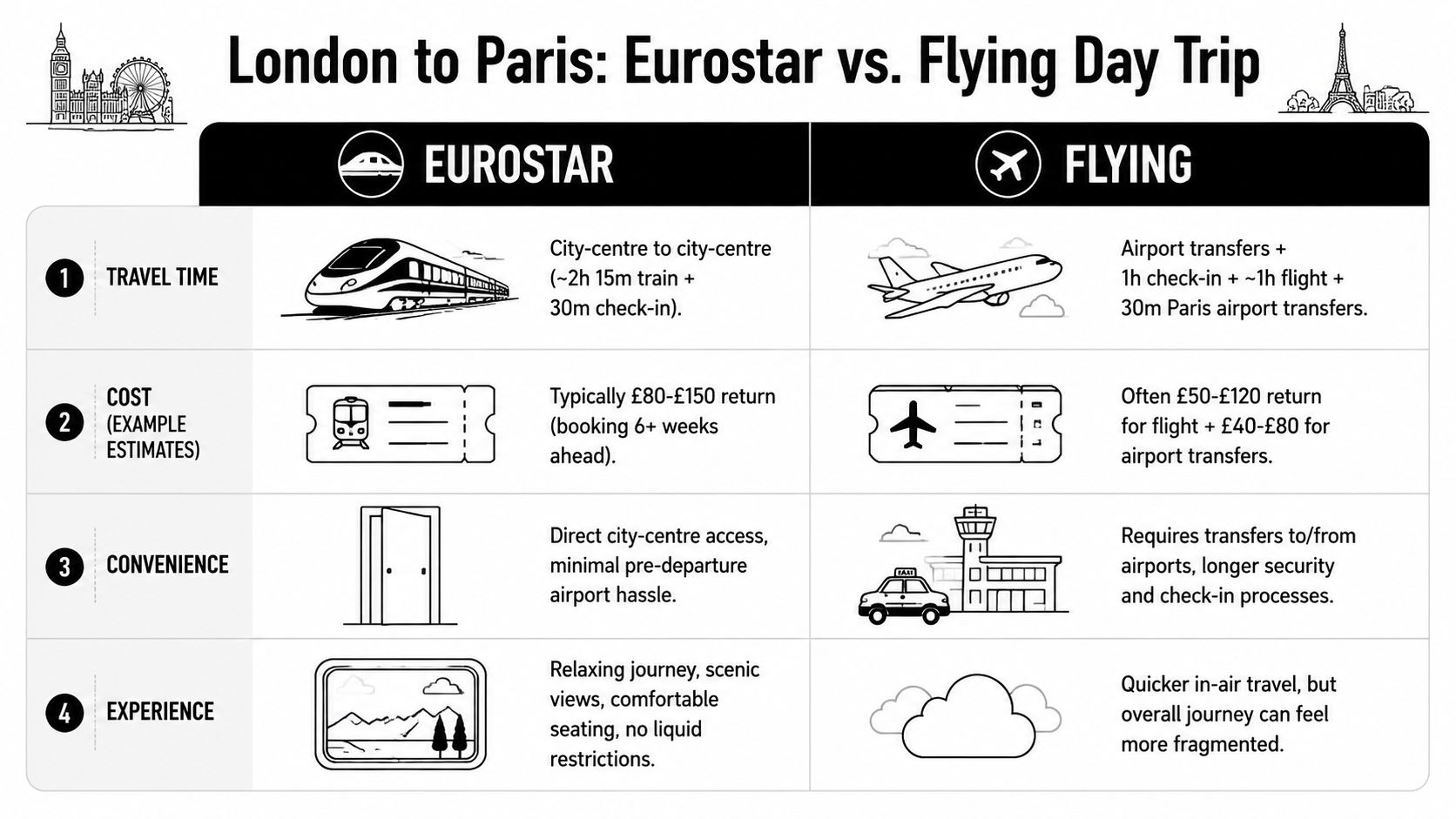
Price matters too, but timing matters first. Eurostar can be good value if you book early, and it becomes much less attractive if you leave it late. Rail Europe's Eurostar booking guide makes the same basic point. Advance booking gives you the best chance of a fare that still makes sense for a long single day. Last-minute booking often turns an efficient plan into an expensive one.
There is also a practical point many guides skip. Reaching St Pancras for an early departure can be harder than the Paris side of the trip, especially for visitors staying far from King's Cross, landing at Heathrow, or moving with luggage from a cruise or hotel. In those cases, pre-booked London transfers to St Pancras and other rail hubs can protect the whole plan better than trying to improvise before sunrise.
Transport comparison at a glance
| Metric | Eurostar | Flying | Organised Tour |
|---|---|---|---|
| Best use case | Independent same-day trip | Longer stays, not ideal for one day | Travellers who want structure |
| Departure point | Central London | London airport | Usually central meeting point |
| Arrival point | Central Paris | Paris airport | Varies by operator |
| Time efficiency | Strongest option for a day trip | Weaker once transfers are added | Moderate, depends on schedule |
| Flexibility in Paris | High | High, but time is tighter | Lower |
| Stress level | Moderate, but predictable | Often higher | Lower during the day, less personal control |
Eurostar usually feels easier than its timetable suggests because the journey stays in one system from start to finish.
When an organised tour makes sense
Organised tours suit travellers who want the framework handled for them. Tickets, timing, and the basic route are usually taken care of. The cost of that convenience is reduced freedom once you arrive.
Independent travellers usually get more from Paris by taking Eurostar and limiting the plan to one area or a short list of priorities. Travellers who would rather avoid booking decisions may prefer a tour. For a same-day return, flying rarely offers the best balance of time, cost, and effort.
Your Hour by Hour Day Trip Blueprint
A london day trip to paris succeeds or fails before you ever see the train doors close. Your actual schedule starts at your hotel, not at St Pancras, and it ends when you are back through your London front door late that night.

The timing that makes the day work
The pattern is simple, but it only works if each handoff is planned in advance. Book one of the first Eurostar departures out of London, aim to reach St Pancras around 75 minutes before departure, and choose a return train late enough to give you a worthwhile day in Paris without leaving the final London transfer to chance. Handled well, that usually means a full sightseeing window in Paris rather than a rushed lunch and photo stop.
A workable rhythm looks like this:
-
Pre-dawn departure from your accommodation
Set your wake-up time from the station arrival target, then work backwards. If you are staying far from King's Cross, or arriving from an airport hotel, book your transfer from central London to St Pancras International the night before instead of hoping public transport lines up cleanly that early. -
Arrival at St Pancras with margin
That buffer gives you time for ticket checks, security, passport control, and the small delays that show up on busy travel mornings. Queues are usually manageable, but same-day trips leave no room for casual timing. -
Morning Eurostar to Paris
Use the train well. Eat breakfast, charge devices, confirm your first destination from Gare du Nord, and check the return platform and ticket details while you are still fresh. -
Arrival in Paris and immediate transfer to your first stop
Decide this before leaving London. Travellers lose more time in Paris by hesitating outside the station than they do on the train itself. - One focused sightseeing block Day trips work best with limits. Pick one neighbourhood, one booked attraction, and one meal stop you want, rather than trying to cross the city several times.
-
Return to Gare du Nord earlier than feels necessary
Build in extra time for the Metro, a taxi delay, or a slow café bill. Missing the return departure is the one mistake that can turn an ambitious day into an expensive problem. -
Late arrival in London and final trip home
Door-to-door planning matters again at this stage. After a long day, the last thing you want is to start figuring out night transport outside St Pancras.
What happens at St Pancras
For this route, the important border checks happen in London before boarding. That is why the station arrival time needs to be treated as part of the trip, not as optional spare time.
The process is straightforward. You scan your ticket, clear security, pass through exit and entry border controls, then wait in the departure lounge until boarding is called. Once you are on the train, the hard part is done. In Paris, you step off and start the city portion of the day immediately.
Protect the train first. Museums, cafés, and photo stops can be adjusted. Your departure time cannot.
A few habits make the schedule hold:
- Keep your passport and ticket easy to reach: Do not pack them under cables, snacks, and shopping.
- Carry one light day bag: It speeds up station checks and makes Paris transfers much easier.
- Download everything in advance: Train tickets, museum bookings, offline maps, and your hotel address in London.
- Choose your first Paris movement before departure: Metro, taxi, or walking route. Decide in London, not on the concourse at Gare du Nord.
- Plan the last mile home before breakfast: Tired travellers make slower decisions, and late-night London connections can feel much longer than they look on a map.
The trip is completely doable in one day. The difference between a sharp, enjoyable run and an exhausting scramble usually comes down to how well you handle the first hour in London and the final hour back.
Solving the First Mile Problem London Transfers to St Pancras
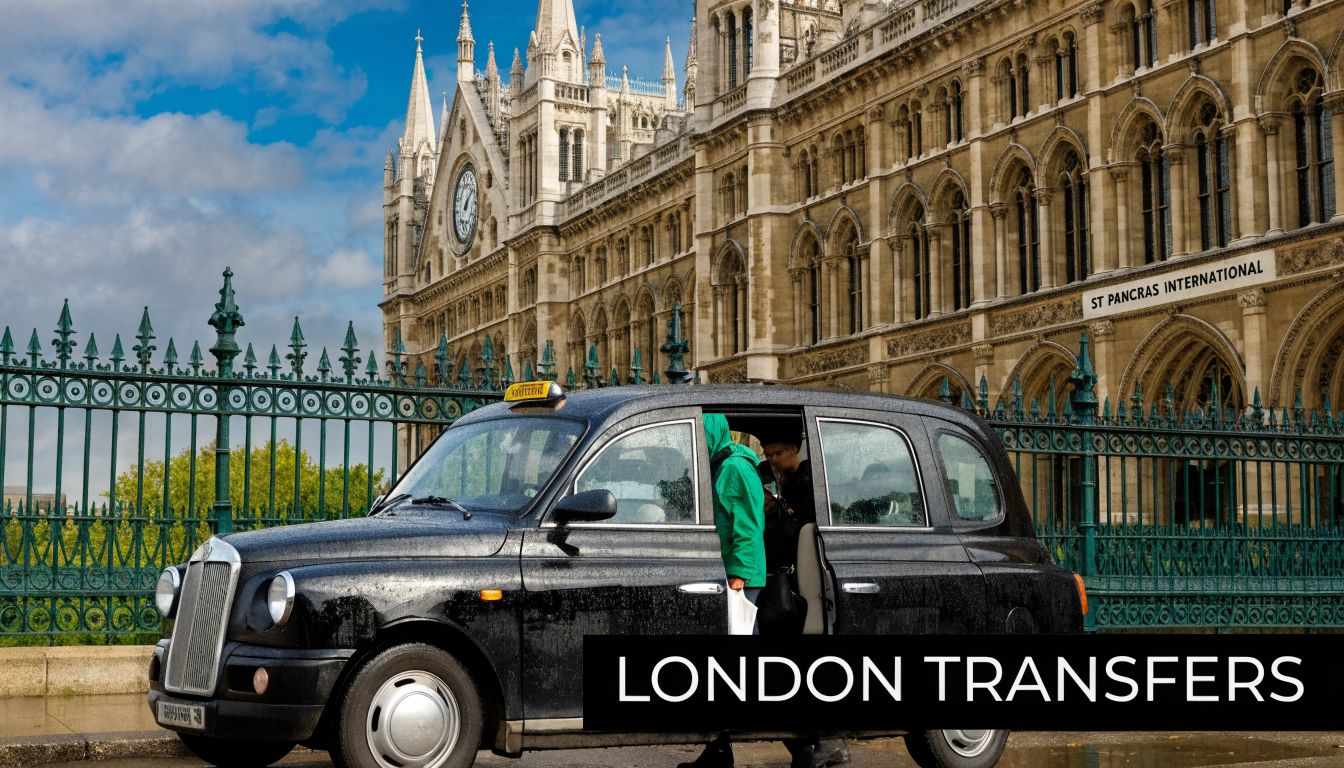
A 7:01 a.m. Eurostar can still be the easy part of the day. The harder part often starts 60 to 90 minutes earlier, when you are leaving a hotel, airport, or cruise stay and trying to reach St Pancras on time with no margin for drift.
For international travellers, that first London transfer often decides whether the whole trip feels sharp or rushed. Articles about a london day trip to paris usually start at the station. Real days do not. They start with lifts that are slow, roads that are busy, family members who are half awake, and bags that felt light the night before.
Why the first mile decides the whole day
The door-to-door maths matters. A transfer between Heathrow and St Pancras can easily take 1.5 to 2 hours once you include walking inside terminals and stations, waiting time, and the final approach into the departures area. Costs can also swing quickly depending on whether you use rail, a taxi, or a pre-booked car.
Ground transport coordination is a known stress point for time-sensitive travel, as noted in Jetpac's discussion of the first-mile problem. That rings true in practice. If the London leg is clumsy, you reach St Pancras already spending time, attention, and patience that you wanted to use in Paris.
The effect is strongest for four groups: travellers arriving from long-haul flights, cruise passengers, families with children, and anyone carrying more than one bag. A route that looks simple on a map can turn awkward very fast once stairs, line changes, and platform walks are added.
Best transfer options for different travellers
The right choice depends on where you are starting, how much you are carrying, and how much uncertainty you are willing to accept.
-
Underground and rail
Best for travellers who know London stations, pack light, and are comfortable making quick decisions early in the morning. It is usually the cheapest option. It is rarely the simplest one. -
Black cab or ride-share
Best for central London pickups where directness matters more than price. You avoid station changes and cut down the physical effort. The trade-off is traffic, surge pricing, and occasional pickup delays. -
Pre-booked private transfer
Best for airport arrivals, cruise hotels, older travellers, and anyone working with a tight schedule. A fixed pickup removes the part of the morning that goes wrong most often. If you want a direct station run, pre-booked transfers to St Pancras International are often the cleanest answer.
I usually advise travellers to choose the transfer that protects the train, not the one that looks cheapest at first glance. Missing a departure or arriving flustered costs more than the fare difference.
The same rule applies as the evening draws to a close. St Pancras late in the evening can feel much farther from your hotel than it did at dawn. If the return leg is undecided, the last hour in London often becomes the most tiring part of the entire Paris day.
Paris in a Flash A Realistic 9 Hour Itinerary
A 9 hour Paris window feels generous on paper. Door to door, it is tighter than many travellers expect.
The train journey is only one part of the day. By the time you have arrived at Gare du Nord, made your first city transfer, and left enough margin to get back for the return check-in, the smartest plan is usually the one that keeps you in one part of Paris and keeps your last move simple.

I plan these days around two questions. What do you most want to feel you did in Paris? And how easily can you get back to Gare du Nord without stress?
Option one Right Bank classics
This is the strongest route for first-time visitors who want famous sights without burning time on cross-city transfers.
From Gare du Nord, head into the Louvre and central Seine area and stay there. That gives you a realistic mix of big-name Paris and walkable streets. You can pre-book one major sight, then let the rest of the day happen on foot. If Notre-Dame matters to you, treat it as a stop on a walking route rather than the centrepiece of the day.
A practical version looks like this:
- Hour 1: arrive, get into the centre, and start walking before the station delay mindset follows you
- Hours 2 to 4: one pre-booked major sight
- Hour 5: quick lunch nearby
- Hours 6 to 7: Seine walk, gardens, or one secondary stop
- Hour 8: begin working back north
- Hour 9: arrive near Gare du Nord with breathing room
This plan works because it protects your return, not because it squeezes in the most stops.
Option two Left Bank and Eiffel Tower
Choose this if the priority is atmosphere, views, and photos rather than museum time.
Go straight towards the Eiffel Tower area, then build the day around the Seine, a Left Bank walk, and one relaxed meal. Families and couples often find this easier because the day flows better outdoors and there is less pressure to hit a timed indoor visit. A short cruise can also work if you book it carefully and do not force extra stops around it.
A good version of this day usually includes:
- one headline view
- one stretch of walking that feels like Paris
- one meal you enjoy without watching the clock every minute
- one simple journey back towards the station
If you want a more comfortable station run at either end of the day, especially with luggage or a family group, it helps to know what kind of vehicle setup is available in advance. A quick look at the private transfer fleet options for station and city pickups makes it easier to judge what will save energy versus what will just add cost.
Here's some visual inspiration for how that kind of day can feel in practice.
How to keep Paris enjoyable instead of frantic
Use public transport for longer hops across the city, and pre-book anything that can create a queue. That is the simplest way to protect a short day. Taxis can be useful for a direct move, but in daytime Paris they are not a reliable answer if you are trying to cover ground quickly.
The bigger mistake is overbuilding the itinerary. A day trip works best when each choice supports the next one.
A few habits make a real difference:
- Choose one core theme: landmarks, art, food, or neighbourhood wandering
- Book timed entries in advance: decision-making on the day wastes good hours
- Keep lunch efficient: a boulangerie or simple café is often the better trade-off
- Stay aware of the return clock: getting back to Gare du Nord is part of the itinerary, not an afterthought
- Treat the final Paris transfer seriously: the last-mile run back to the station is where rushed day trips usually start to wobble
If the day feels slightly unfinished, that is often a sign the plan was right. The goal is to have a full Paris day and still make it back to London without the return leg turning into the hardest part.
Pro Tips for a Flawless Trip Packing Passports and Plans
The difference between a smooth london day trip to paris and an exhausting one usually comes down to a handful of small decisions made the day before. Keep them simple.
The final checklist
- Passport first, always: Put it somewhere you can reach instantly at St Pancras. Don't pack it in the bottom of a day bag.
- Dress for movement: Comfortable shoes matter more than perfect photos. You'll walk, stand, queue, and change platforms.
- Travel light: One compact day bag is ideal. You want hands free and quick station movement.
- Charge everything: Phone, portable charger, earbuds, and any e-tickets saved offline.
- Use cards, but carry a little backup: Card payment is usually straightforward, but a small amount of Euros can still be useful for minor purchases.
- Protect your return leg: Keep your return train details easy to open without hunting through email.
A good day trip kit fits in one bag and leaves your shoulders free enough to enjoy the city.
What to do if the day goes slightly off plan
Even well-built itineraries wobble. A station queue moves slower than expected. A museum entrance gets crowded. A lunch spot takes longer than you'd hoped. The fix is usually not to speed up. It's to cut something.
If the morning runs late, drop a secondary sight. If Paris feels busier than expected, stay in one district and enjoy it properly. If you're tired by mid-afternoon, choose a café and reset rather than forcing one more cross-city dash.
For the London side, your end-of-day transport should be as clear as your morning one. If you're travelling with luggage or need a comfortable vehicle after a long return, it helps to review vehicle options for London transfers before the day, so you know what type of transfer suits your group.
A final point matters more than any packing tip. This trip works best when you treat it as one memorable Paris day, not a test of endurance. Build in margin, protect the station timings, and let the day breathe a little.
If you want the travel day to feel organised from the moment you land in London to the moment you reach St Pancras or your cruise port, EC Minibus offers door-to-door private transfers designed for exactly these tight, high-value itineraries. For international visitors, cruise passengers, families, and anyone who doesn't want to gamble on the first or last mile, that kind of planning support can make the difference between a stressful dash and a smooth day out in Paris.
Written with Outrank tool