

You've booked the cruise. The hotel is sorted. Your flights are in the diary. Then the awkward question lands: how exactly are you getting from London to Tilbury Cruise Terminal without turning embarkation day into a stressful scramble?
That worry is completely normal. First-time visitors often assume that a port serving London must be simple to reach, then discover that London to Tilbury Cruise Terminal is one of those journeys that looks easy on paper and gets more complicated once luggage, traffic, station changes, and timing pressure enter the picture.
My advice is simple. Don't judge this transfer by ticket price alone. Judge it by the total journey experience. On cruise day, comfort, certainty, luggage handling, and getting dropped at the right place matter more than saving a small amount and arriving flustered.
Tilbury isn't some obscure outpost. It's widely described as the principal cruise port for London, on the north bank of the Thames in Essex, about 25 miles east of central London, and the terminal has served cruise passengers since 1930 according to CruiseMapper's Tilbury port guide. That means you're travelling to an established port. You still need a plan that works in real life.
Table of Contents
- Your London Cruise Adventure Starts Now
- Understanding the Journey from London to Tilbury
- Option 1 The Public Transport Route by Train and Bus
- Option 2 On-Demand Travel with Taxis and Rideshares
- Option 3 The Stress-Free Solution with a Private Transfer
- Comparing Your London to Tilbury Transfer Options
- Final Checklist and International Traveller FAQs
Your London Cruise Adventure Starts Now
It's common to reach this stage of planning in exactly the same mood. They're excited about the ship, slightly tired from organising flights and hotels, and suddenly uneasy about the final transfer. That's sensible. Missing a museum booking is annoying. Cutting it fine for a cruise check-in is expensive and miserable.
I've seen the pattern often. A couple stay in Central London the night before, assume they'll “just get a train”, then realise late in the evening that the station nearest the port isn't the terminal. A family lands at Heathrow and thinks a taxi rank will solve everything, until the amount of luggage makes that choice feel less clever than it did on the booking screen.
Practical rule: Treat the transfer to Tilbury as part of the holiday, not a separate errand. If the journey is calm, the whole day feels better.
The good news is that this trip is manageable. You do have options. Some are cheaper. Some are simpler. Some look convenient until you factor in luggage and timing. The right choice depends less on your budget in isolation and more on how much friction you're willing to accept before boarding.
If you're a first-time cruise visitor, I'd make one recommendation straight away. Choose the option that removes the most moving parts. Embarkation day already has enough of them.
Understanding the Journey from London to Tilbury
Tilbury sits about 25 miles east of Central London, but that distance is deceptive. The route is close enough to look easy and far enough to become awkward once London traffic, luggage, and cruise timing enter the equation. The Telegraph's Tilbury port guide notes that this geography makes transfer planning sensitive to the M25 and A13 corridors, so road-time variability can affect punctuality even when the distance seems moderate.

Why the route feels harder than it looks
The phrase I use with clients is this: Tilbury is not far, but it is operationally awkward.
If you're travelling by road, your transfer depends heavily on how smoothly the main corridors are moving. If you're travelling by rail, the train solves only most of the problem, not all of it. That's why people get caught out. They plan for mileage instead of planning for the full chain of events.
Here's what matters more than pure distance:
- Your starting point: Heathrow, a Central London hotel, or another airport all create different levels of complexity.
- Your baggage load: Cruise luggage changes everything. A trip that feels easy with one cabin bag can feel ridiculous with large cases.
- Your tolerance for uncertainty: Some travellers don't mind adapting on the fly. Most cruise passengers regret that approach on departure day.
For travellers who want door-to-door planning rather than piecing the route together themselves, this Tilbury Cruise Port transfer page is a useful reference point for what a pre-arranged service looks like in practice.
Why Tilbury matters for cruise passengers
Tilbury's importance also explains why this route gets so much attention. Forth Ports describes it as the only deep-sea cruise terminal close to London, part of the Port of Tilbury on the Thames, which matters because deep-water access supports larger ocean-going cruise calls without the draft and tidal limits that affect shallower facilities, as noted on the Port of Tilbury London page.
That operational role matters to you for one simple reason. This is a serious working port, not a decorative riverside pier built around casual visitors. You need to arrive organised, at the right place, with a transfer method that matches the reality of the route.
Option 1 The Public Transport Route by Train and Bus
Public transport is usually the first option people investigate, and for some passengers it works fine. If you're travelling light, comfortable with London rail travel, and not easily rattled by a bit of extra navigation, it can be a reasonable budget choice.
How the journey usually works
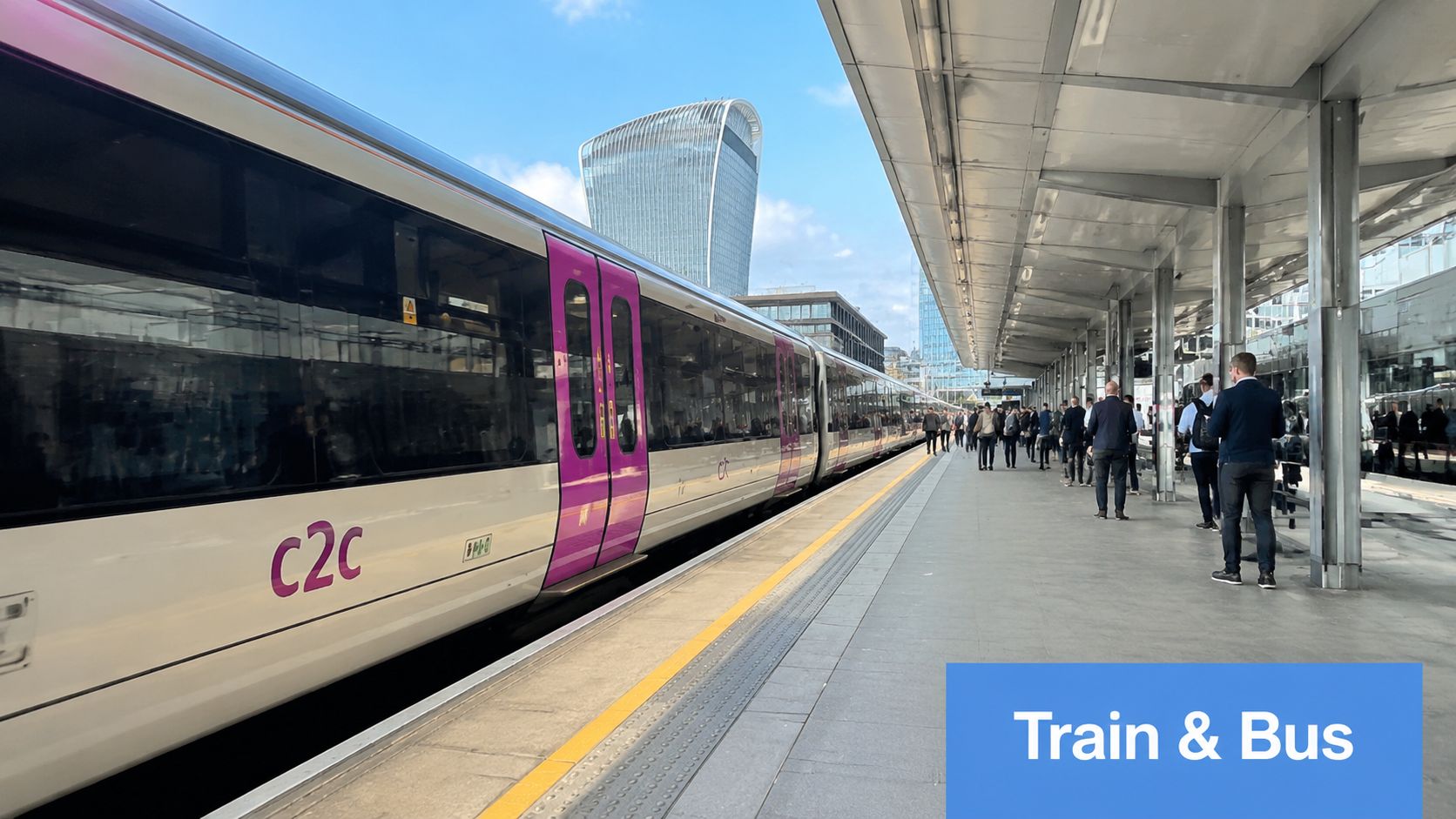
The standard approach is straightforward in outline. You make your way into London rail services, then head to Fenchurch Street for the c2c train towards Tilbury Town. From there, you continue on to the cruise terminal by local connection.
In theory, that sounds efficient. In practice, you need to think through the whole sequence, not just the train leg.
A sensible public transport user should plan for:
- Getting to the correct London departure station from hotel or airport.
- Handling suitcases through station entrances, platforms, and possible crowding.
- Arriving at Tilbury Town and then finishing the journey properly.
That last point is where many first-time visitors get an unpleasant surprise.
The part most guides gloss over
The train does not deliver you directly to the ship. Independent guidance points out a frequently missed planning gap: from Tilbury Town Station you still need a 20-minute walk, a short taxi, or a local bus, and the walk goes through an industrial area that isn't ideal with luggage or mobility limits, according to Emma Cruises' guide to getting from London airports to Tilbury.
That changes the value calculation completely.
The train is often sold as the simple answer. For many cruise passengers, it isn't the simple answer at all. It's only the first part of the answer.
If you're young, travelling solo, and packing lightly, you may shrug that off. If you're carrying formalwear, medication, cruise paperwork, and two large cases in wet weather, it's a different experience.
A few situations where I would not choose public transport:
- You have mobility concerns: The station-to-terminal gap is the wrong place to discover you've overestimated your comfort.
- You're travelling with children: Managing bags, people, and timings together raises the stress sharply.
- You've just landed from a long-haul flight: Decision fatigue is real. Simple matters more than cheap at that point.
If you want a feel for the route environment before deciding, this short walkthrough can help.
My honest view: public transport is viable, but it's rarely the smartest option for a first-time cruise passenger with proper luggage.
Option 2 On-Demand Travel with Taxis and Rideshares
Taxis and rideshares sit in the middle. They remove the station problem and usually feel easier than rail. You get picked up where you are and dropped much closer to where you need to be. For many travellers, that sounds like the ideal compromise.
Sometimes it is. Sometimes it isn't.
Where this option works well
If you're in Central London, travelling as a pair, and want a direct ride without pre-planning every detail, a black cab or app-based car can be perfectly workable. You avoid platform changes, local buses, and dragging cases through stations.
This option is also useful for passengers who value flexibility. If your morning plans change, or you decide to leave your hotel earlier than expected, booking on demand can feel refreshingly simple.
That simplicity is real. So are the weak points.
Why cruise passengers should be careful
The first issue is cost certainty. On-demand travel may start with a rough estimate, but the final amount can become less predictable when roads are slow or demand is high. Cruise passengers usually prefer certainty because embarkation days already involve enough variables.
The second issue is vehicle suitability. Not every car that appears in an app is a good match for cruise luggage. A standard saloon may be fine for airport hand luggage and a very different story for larger suitcases, garment bags, and carry-ons.
Then there's the final arrival experience. A driver who mostly handles ordinary city rides may not know the cruise terminal routine as well as you'd hope. That doesn't mean disaster. It does mean one more thing to manage when you should be focusing on check-in documents and boarding.
If you choose a taxi or rideshare, confirm the pickup point, luggage capacity, and exact cruise terminal destination before the car arrives.
I'd consider this option if you want direct travel but don't want to pre-book. I wouldn't rely on it if your priority is a calm, highly predictable start to an expensive holiday.
Option 3 The Stress-Free Solution with a Private Transfer
If your goal is the smoothest possible London to Tilbury Cruise Terminal journey, book a private transfer and move on with your life. That's my opinion, and I don't think it needs much softening.
This option works because it removes the weakest parts of the other choices. No station changes. No last-mile improvising. No uncertainty about whether the car can handle the luggage. No haggling with the day.
What you're actually paying for
A proper private transfer isn't just a car. It's a service structure.
That usually includes:
- A fixed booking arranged in advance: You know what's been booked and where you're being collected from.
- A planned pickup: Hotel, airport, or address details are already in the system.
- Luggage support: You're not wrestling cases on and off trains or hoping for boot space.
- A direct run to the terminal: That matters more than people admit.
Here's the practical appeal. On cruise day, the best transfer is often the one that demands the least from you.
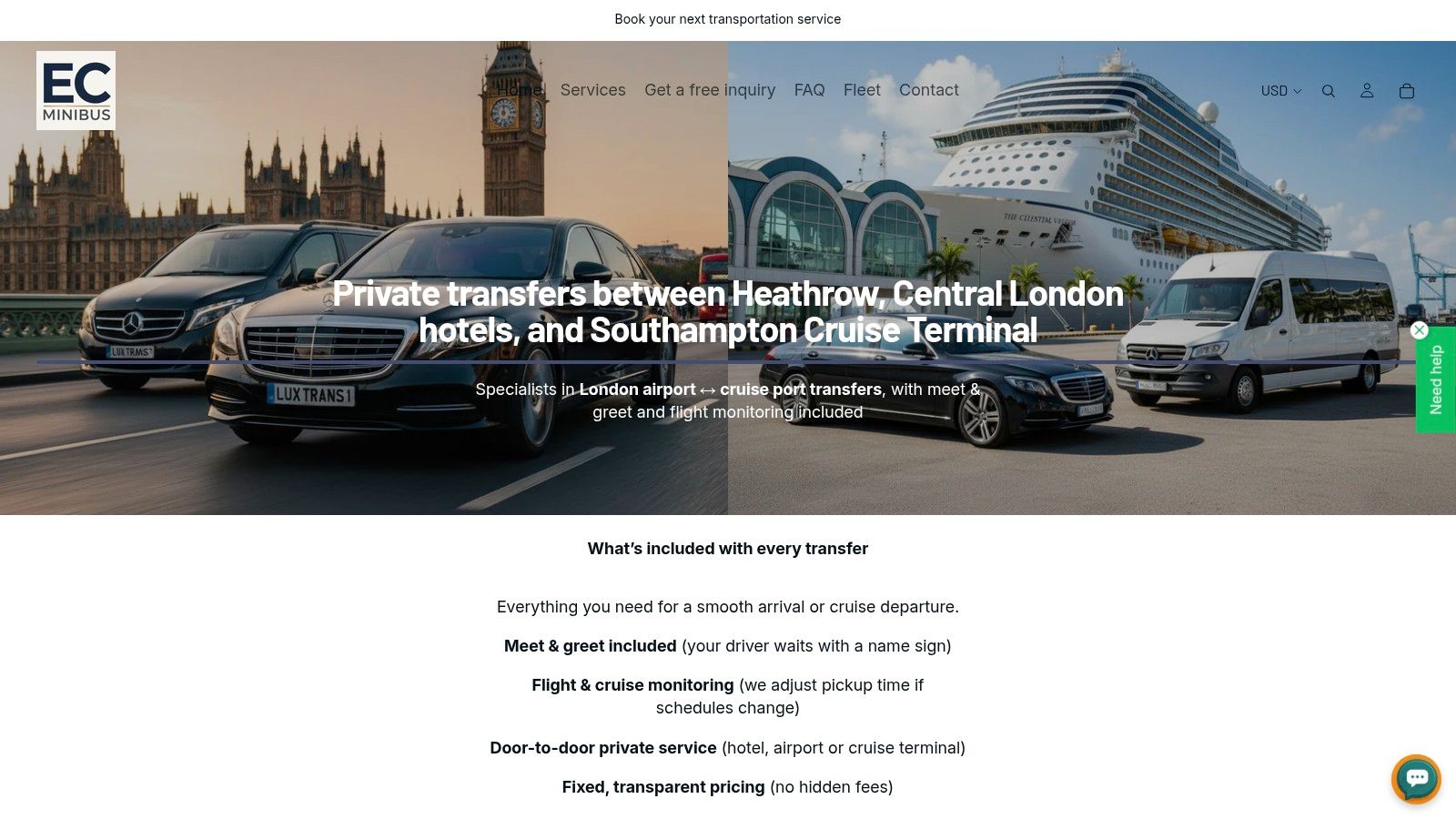
For example, EC Minibus offers Central London to Tilbury Cruise Terminal transfers with pre-booked door-to-door service. Based on the publisher information provided, bookings include fixed pricing, licensed and insured drivers, meet and greet where relevant, and luggage assistance. Those are practical features, not luxuries, when you're boarding a ship on a schedule.
Who should book this option
I'd choose a private transfer without hesitation if any of these apply:
- You're arriving from overseas: After a long flight, fewer decisions is the right decision.
- You're travelling as a family or small group: Shared private transport often feels far more organised than splitting yourselves across public options.
- You value punctuality over penny-pinching: Cruise embarkation isn't the moment for experimentation.
My blunt advice is this. If you can afford private transfer, book it. It buys peace, not just transport.
Comparing Your London to Tilbury Transfer Options
Price is the wrong starting point for a cruise transfer. Start with risk, effort, and what happens in the final stretch to the terminal. That is where first-time visitors get caught out.
A practical comparison
A London to Tilbury journey is not just a fare. It is your hotel checkout, your luggage, your timing, your confidence with London transport, and the last mile into the port. That final part is what changes the mood of the day. A route that looks cheap on paper can feel expensive once you add stress, delay risk, and the effort of getting cases through stations or into the right vehicle.
Here is the comparison I use for first-time cruise passengers.
| Travel Option | Est. Cost (per group) | Est. Time | Convenience | Luggage Suitability |
|---|---|---|---|---|
| Public Transport | Lower than private car options | Variable, with extra transfer steps | Lowest. Requires route changes and a final local connection | Weakest option for large cruise luggage |
| Taxi or Rideshare | Variable | Direct, but traffic-dependent | Fair to good. Better than trains, but less predictable at pickup and vehicle size | Mixed. Depends on the car you get |
| Private Transfer | Pre-booked and typically fixed in advance | Direct, planned, and straightforward | Highest. Door-to-door with a clear pickup plan | Best fit for cases, carry-ons, and assisted loading |
My advice is simple.
- Choose public transport only if you are travelling light, know London reasonably well, and are comfortable handling the last-mile problem yourself.
- Choose a taxi or rideshare if you want a direct car but can tolerate some uncertainty around pickup timing, price, and luggage space.
- Choose a private transfer if you want the journey handled properly from start to finish.
That last point matters more than many travellers expect. Cruise day is not just about reaching Tilbury. It is about arriving calm, organised, and early enough to deal with check-in without feeling rushed.
If you are still weighing up Tilbury against other UK departure points, this guide to UK cruise ports helps put the transfer question into context.
Judge each option by friction. Fewer decision points, fewer changes, and fewer chances for something to go wrong usually make for the better start to a holiday.
Final Checklist and International Traveller FAQs
Before you leave for Tilbury, get the basics right. That matters more than endlessly comparing transport options.
Your embarkation day checklist
Use this checklist the evening before:
- Confirm your pickup or route: Don't assume you'll “sort it in the morning”.
- Keep cruise documents together: Passport, boarding paperwork, and any required confirmations should stay in one easy-to-reach folder.
- Tag your luggage clearly: That helps from hotel lobby to terminal drop-off.
- Wear manageable embarkation-day clothing: You want comfort, pockets, and no faffing with extra layers.
- Leave earlier than your optimistic self wants to: The calmer version of you will be grateful.
For broader planning around UK cruise departures, this guide to UK cruise ports is a useful starting point if Tilbury is one leg of a larger trip.
My rule for first-time passengers is simple: aim to arrive with breathing room, not with a dramatic story. Your cruise line's instructions should guide your check-in timing, and you should build your transfer around that rather than around convenience for breakfast or hotel checkout.
Questions international travellers usually ask
Do I need cash in pounds for the transfer?
Not always. Many pre-booked services take payment in advance, which is one reason they're easier for overseas visitors. It's still sensible to carry a small amount of UK currency for incidental expenses.
What happens if my flight is delayed? That depends entirely on how you booked your transport. In such circumstances, pre-arranged services are usually stronger than improvised ones, because the journey has already been scheduled and linked to your arrival details.
Can I book the return from Tilbury after the cruise?
Yes, and I strongly recommend thinking about both directions together. The return leg is often when people are more tired, more heavily laden with shopping, and less interested in solving transport puzzles.
Is tipping expected in the UK?
Tipping for drivers isn't mandatory in the way some North American travellers expect. If a driver is helpful, punctual, and handles luggage well, a modest tip is appreciated, but it isn't an obligation.
Is public transport a bad idea in every case?
No. It's just often a poor fit for first-time cruise travellers with substantial luggage. If you're experienced, lightly packed, and comfortable with local transport, it can be absolutely fine.
The smartest choice is usually the one that lets you arrive at Tilbury feeling like your holiday has started, not like you've already completed an obstacle course.
If you want the simplest London to Tilbury Cruise Terminal journey, book a door-to-door service with EC Minibus before you travel. It's a practical option for cruise passengers who'd rather spend embarkation day checking in calmly than solving luggage, traffic, and station logistics on the fly.