

You've landed at Heathrow after an overnight flight, or you've stepped off a ship at Southampton with one free day before the next leg of your trip. Paris sounds temptingly close. Then the practical questions arrive all at once. How do you get from airport or port to the right departure point? What do you do with luggage? How much buffer is enough if your incoming flight or ship timing shifts?
That's where most Paris day trip advice falls short. It assumes you're already settled in Central London, travelling light, and working with a simple station-to-station plan. Many international travellers aren't in that position at all. They're stitching together airport arrivals, hotel pickups, port transfers, rail check-ins, and a return deadline that can't slip.
A Paris day trip can work beautifully, but only when you treat it as one connected transport chain, not a romantic idea with the details left for later. The smartest plans are calm, pre-booked, and realistic about how long each handoff takes. Done properly, you can have breakfast in England, spend the day in Paris, and return without that low-level panic that ruins the experience.
Table of Contents
- Introduction The Parisian Dream on a Tight Schedule
- Your Starting Point Planning Your UK Departure
- London to Paris Transport The Definitive Comparison
- A Realistic One-Day Paris Itinerary
- Master Your Logistics Luggage Transfers and Timing
- Pro Tips for Bookings Tickets and Tours
- FAQ Your Paris Day Trip Questions Answered
Introduction The Parisian Dream on a Tight Schedule
A good Paris day trip doesn't begin at St Pancras or Gare du Nord. It begins wherever you wake up in the UK, and that starting point changes everything.
If you're in a hotel near Hyde Park, your problem is mostly timing. If you've just arrived at Heathrow, your problem is uncertainty. If you're coming off a cruise at Southampton or Dover, your problem is connection risk. That's why generic advice often feels slightly useless. It gives you Paris ideas before it solves the awkward bit, which is how to leave the UK without losing half the day to confusion.
For travellers working on tight schedules, the win isn't seeing every landmark. The win is building a plan that still works when check-out runs late, immigration takes longer than expected, or you're carrying more luggage than a city break guide assumes.
Practical rule: If any leg of your journey depends on a same-day airport arrival or port disembarkation, pre-book the ground transport first and fit the Paris plan around that, not the other way round.
Paris rewards people who arrive with a clear route, one or two priorities, and a return plan already settled. That approach feels less glamorous on paper, but it's exactly what makes the day enjoyable once you're there.
Your Starting Point Planning Your UK Departure
A Paris day trip succeeds or fails long before you see the Eiffel Tower. It depends on whether your UK departure point is simple, predictable, and matched to the kind of arrival you have.
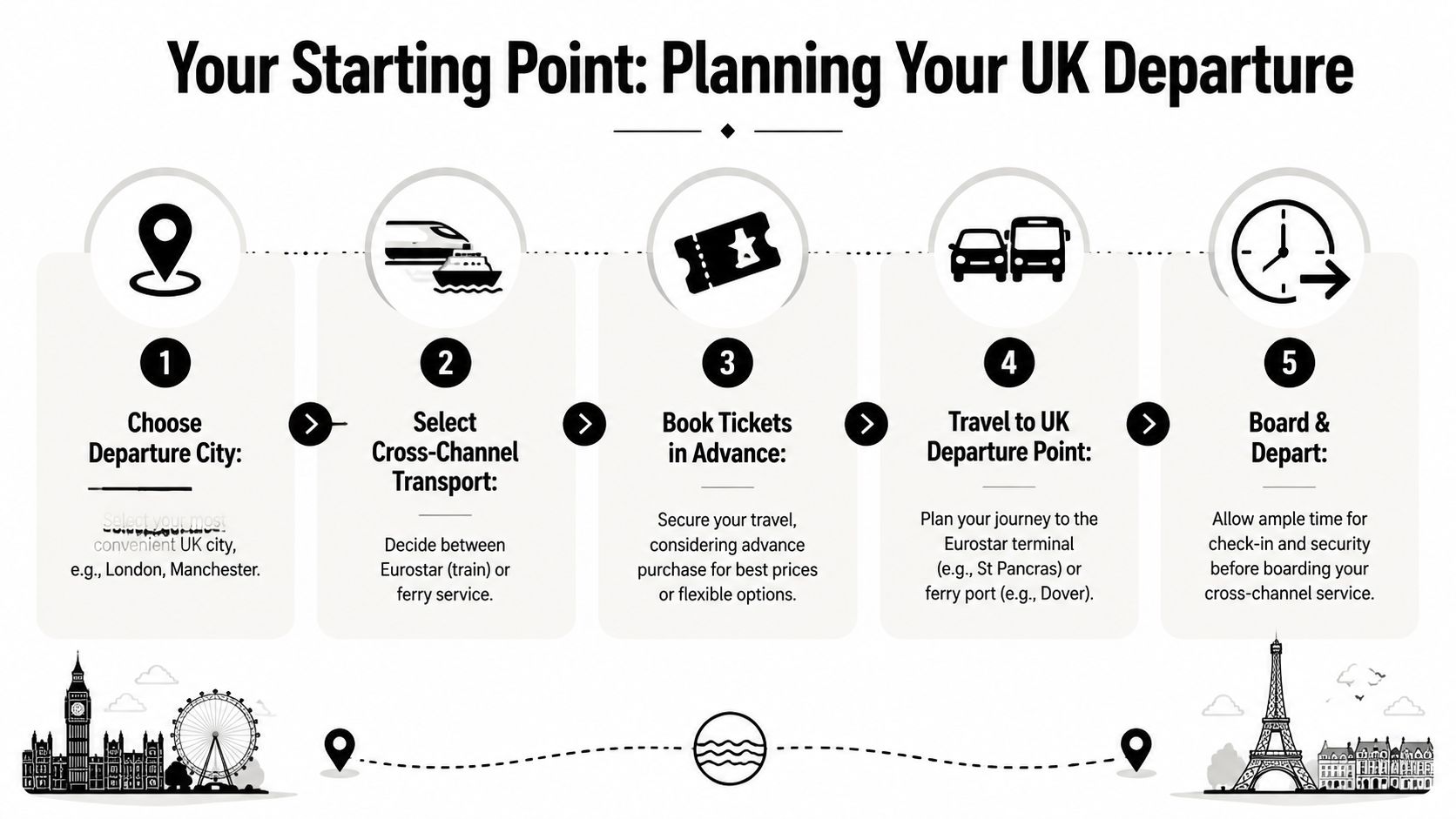
Generic guides usually assume you are already settled in London with no luggage problem and no timing pressure. That is rarely true for international visitors. If you have just landed at Heathrow, or stepped off a ship at Southampton or Dover, your first job is to reduce handoffs. Fewer decisions in the morning usually means more time in Paris and less chance of missing the return.
Starting from a Central London hotel
A hotel departure is the easiest version of this trip, but only if you keep it boring. Boring is good here. One pickup. One station. One clear leave time.
I usually advise travellers to avoid building a clever plan around the Underground if they are carrying cases, travelling with children, or trying to make an international train. The savings are small, and the failure points add up fast.
Use this checklist:
- Pack for movement: A small day bag is easier to handle through ticket gates, lifts, and platform changes.
- Set a hard departure time: Work backwards from your booked train, then add margin for the hotel lift, checkout, and traffic.
- Keep the first leg direct: One vehicle is easier to control than a taxi followed by public transport.
- Keep documents together: Passport, rail booking, and return details should be accessible in seconds.
If you need a door-to-door option from a hotel or airport, this guide to airport shuttle services for London arrivals and onward transfers gives a practical overview of monitored pickups and transfer planning.
Starting from Heathrow
Heathrow introduces uncertainty that can derail a same-day Paris plan. The problem is not only the airport itself. It is the full chain after landing: immigration queues, baggage delivery, terminal exit times, and road traffic into London.
For air travellers, the smart question is not, "Can I make Paris today?" It is, "What is my latest workable departure if the arrival runs slowly?" That change in mindset prevents bad decisions, especially after a long-haul flight when people tend to underestimate how much time simple tasks will take.
A safer Heathrow setup looks like this:
- Book a monitored pickup based on your live arrival, not only the scheduled landing time.
- Choose your first stop in advance. Decide whether you are going straight to the station or first to a hotel to reset and store bags.
- Split luggage from day essentials. Keep passports, chargers, medication, and Paris tickets in one small bag.
- Allow for terminal and road delays. Heathrow to central London can be straightforward, but it is rarely something to leave to chance on a tight schedule.
The travellers who enjoy this kind of day trip are usually the ones who remove unnecessary choices before they land.
Starting from a cruise port
Cruise passengers need a stricter plan than hotel guests because the schedule is partly controlled by the ship and the port. Disembarkation windows shift. Luggage collection can be slow. The distance to your rail departure point is often longer than first-time visitors expect.
Southampton is the clearest example. Many passengers arriving there are international visitors who do not know UK rail routines, station layouts, or how much margin they need between port pickup and train departure. That gap matters because standard Paris day-trip advice almost never explains how to connect a port handoff to a realistic same-day France itinerary.
Treat the port transfer as the foundation of the day, not a side detail. In practice, that means:
- Use one accountable transfer plan: Avoid mixing ad hoc taxis, uncertain station changes, and last-minute ticket decisions.
- Protect the return window: Cruise timings leave much less room for error than a hotel stay.
- Plan door to door: Port gate, luggage handling, station arrival, boarding time, and return all need to work together.
- Respect fatigue: Travellers coming off a ship often move more slowly than they expect, especially with luggage.
Dover follows the same rule, although the routing is different. The pressure point is the handoff from port to onward transport. Get that part right and the rest of the day becomes much easier to manage.
London to Paris Transport The Definitive Comparison
For most travellers, there are three ways to think about a Paris day trip from the UK. Take the train. Fly. Or try to combine private road travel with sea crossing logistics. Only one of those is routinely efficient for a true day trip.
Eurostar for most travellers
If your aim is to spend the maximum possible time in Paris itself, rail usually wins. The reason is straightforward. You leave from Central London and arrive in central Paris. That cuts out the long airport approach on both sides.
For travellers coming in from elsewhere in London, a direct pre-booked transfer to St Pancras International from Central London often makes the whole chain cleaner than trying to improvise with luggage on the Underground.
Here's how the main options compare in practice:
| Option | Best for | Main advantage | Main drawback |
|---|---|---|---|
| Train | Classic Paris day trippers | City-centre to city-centre travel | Requires tight station timing |
| Flight | Rarely ideal for one day | Useful only if tied to a wider itinerary | Airports absorb too much time |
| Car plus ferry or shuttle combinations | Special cases with unusual routing | Control over luggage and group travel | Too many moving parts for most day trips |
The train also helps with energy management. You start and finish in practical locations, and you don't spend the day feeling as if you're commuting between outlying terminals.
Flying and why it rarely works for a day trip
Flying sounds quick until you calculate the full chain. You need airport transfer time in the UK, check-in and security, the flight itself, arrival procedures, and then another transfer into Paris. By the time you're free to start sightseeing, the best part of the morning has usually gone.
This doesn't mean flying is wrong. It means it's wrong for the specific goal of a same-day Paris experience where time in the city matters more than the transport itself.
Decision guide: If two transport methods look similar on paper, choose the one with fewer handoffs. Every extra handoff introduces delay, confusion, and walking you didn't budget for.
Private car and ferry combinations
These are useful in niche cases, especially for groups, unusual departure points, or travellers who prioritise luggage control above all else. But they're not the default answer for a Paris day trip. They involve more variables, more timetable coordination, and usually more fatigue.
I'd only favour a private road-and-sea style plan when the day trip is really part of a larger transfer need. For example, you're repositioning between a port, a hotel, and onward travel, and Paris is one stop within a broader route. In that situation, convenience may outweigh speed. For a straightforward one-day visit, rail remains the cleaner choice.
A Realistic One-Day Paris Itinerary
A workable Paris day trip is about sequence, not ambition. The city is full of places worth seeing, but trying to conquer too much turns a pleasant day into a long rush between metro lines.
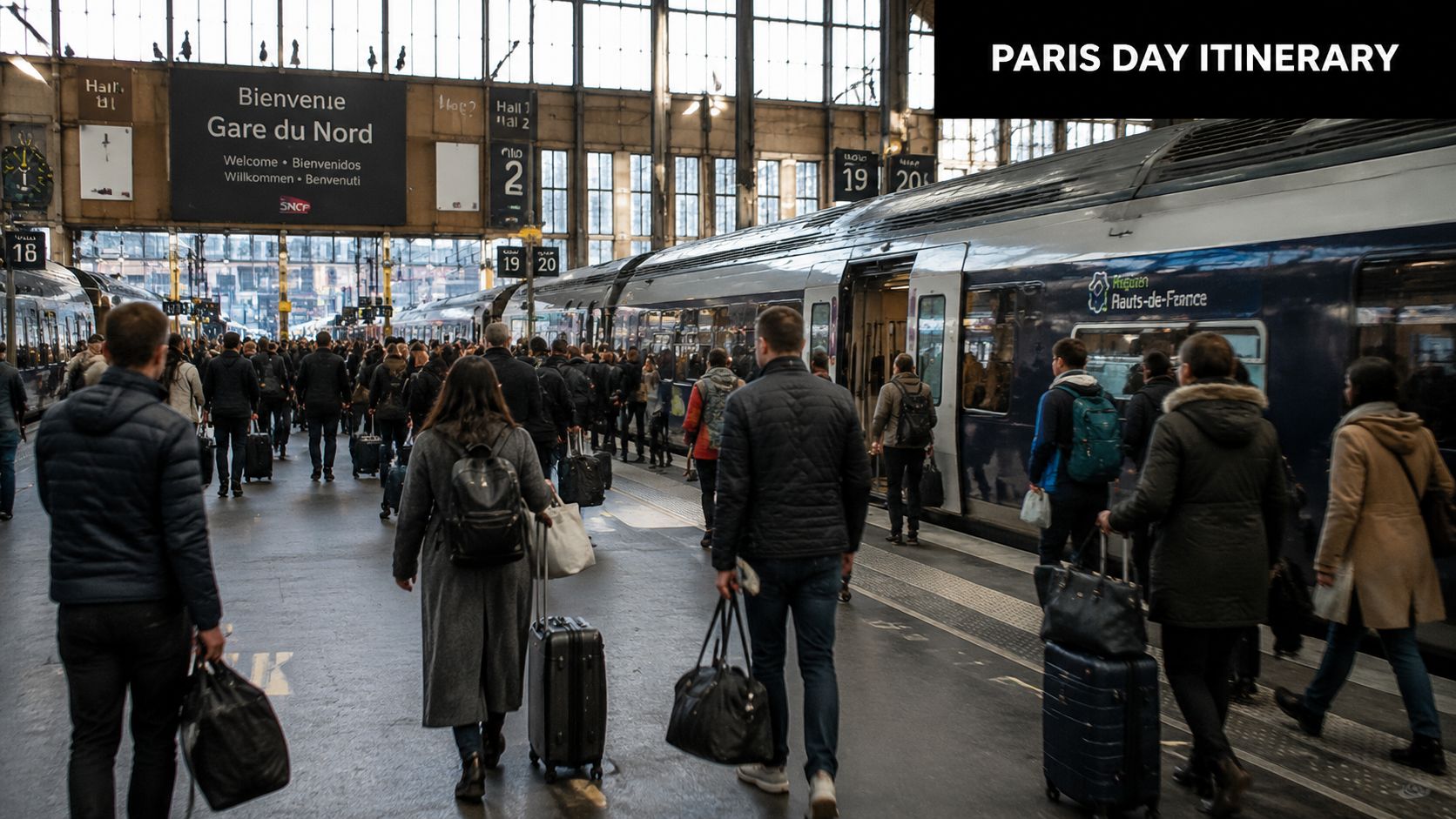
Near the start of the day, this is the atmosphere most travellers meet on arrival.
Morning arrival and first stretch of the city
Assume you arrive at Gare du Nord in the morning. Don't linger in the station unless you need lockers, tickets, or coffee. Move with purpose. For a single day, I prefer starting with one broad visual sweep of Paris rather than diving straight into a museum queue.
A practical order is:
- Begin with a Metro or taxi transfer to a central scenic area.
- Walk through the Tuileries rather than trying to cover several neighbourhoods at once.
- Take in the Louvre exterior unless you've pre-booked one specific timed entry and are willing to make that your main stop.
- Keep the pace steady: Paris rewards walking, but not power-walking.
This kind of start gives you the satisfaction of being in the city immediately. You see architecture, gardens, and street life before administrative details eat into your mood.
Midday choices that don't waste energy
By lunchtime, travellers usually split into two types. Some want one major sight. Others want the Paris feeling more than a formal attraction. Both approaches work, but neither works well if you overload the middle of the day.
A realistic midday plan might be:
- Lunch in a simple café or bistro, somewhere you can sit down without turning the meal into a long reservation event.
- Choose one headline experience, not three. That could be a river cruise, one museum stop, or a focused area such as the Left Bank.
- Leave recovery time between major moves. Even confident travellers lose time navigating exits, crossings, and ticket machines.
A Seine cruise is often a strong use of limited time because it gives you a broad visual sense of Paris without adding more walking. For travellers who want the city without overexertion, it's efficient.
Later in the day, video can help with orientation and expectations before you set off between districts.
Afternoon views and a sensible finish
I like ending a Paris day trip with a strong final viewpoint rather than a tired final errand. Trocadéro works well for Eiffel Tower views because it feels conclusive. You get the postcard moment without needing to commit to a lengthy tower visit.
A calm afternoon structure looks like this:
| Time of day | Good use of time | What to avoid |
|---|---|---|
| Early afternoon | Scenic walking, one focused stop | Jumping across the city for minor sights |
| Mid afternoon | River view or neighbourhood pause | Large unscheduled museum visits |
| Late afternoon | Final landmark view and return setup | Last-minute shopping far from your departure point |
Leave Paris before you feel forced to. The best day trips end with a little time in hand, not a sprint to the station.
The mistake I see most often is a late-afternoon attempt to squeeze in “one more thing” on the opposite side of the city. That final detour is usually what makes the return feel frantic. A better finish is one clear last stop, then a direct run back to Gare du Nord with enough margin to settle, find the platform, and travel home in a decent mood.
Master Your Logistics Luggage Transfers and Timing
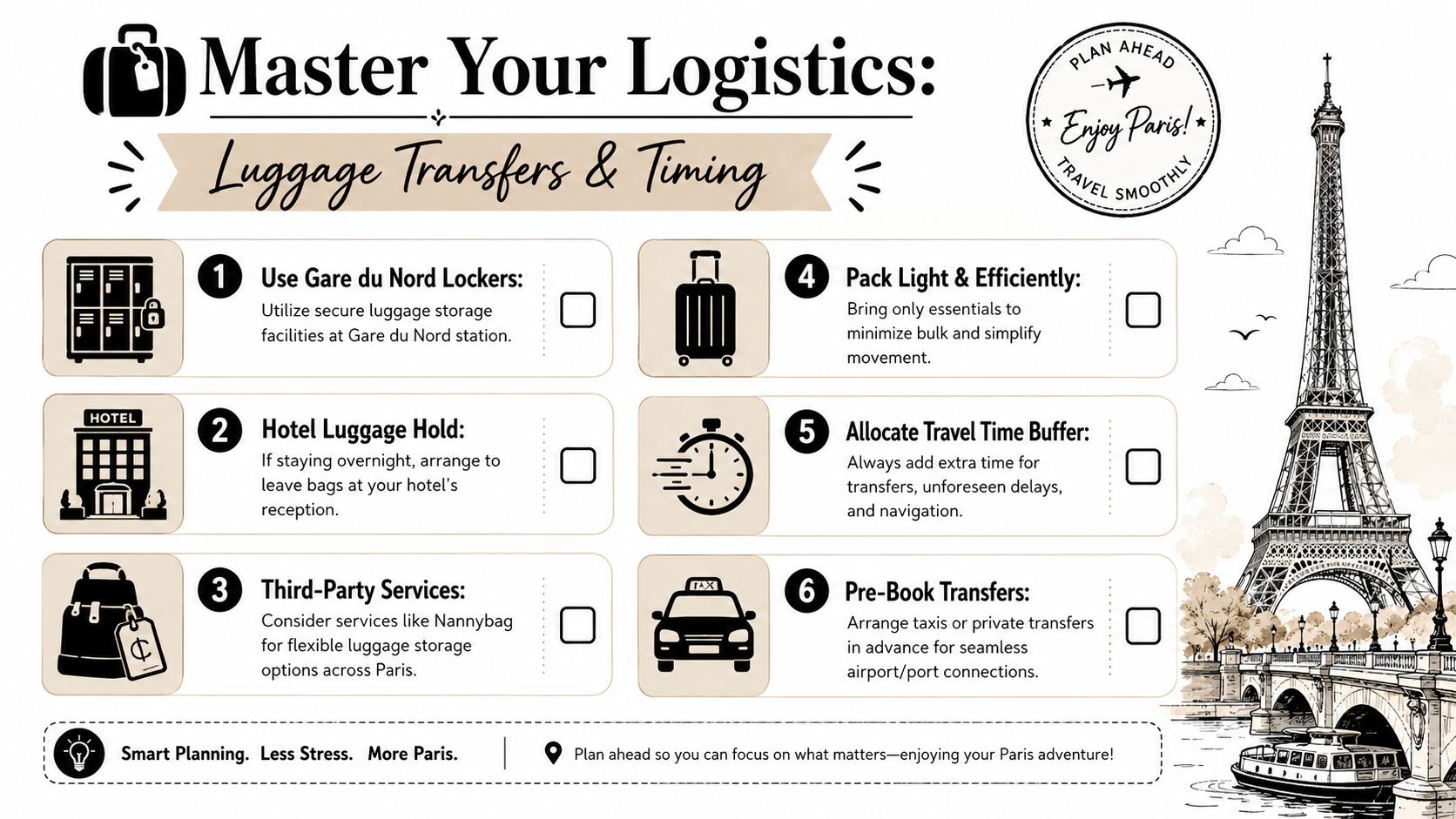
The trip usually falls apart long before Paris. It happens on the UK side, when a traveller coming off a cruise at Southampton or landing at Heathrow tries to force full-size luggage, tight connection times, and an overambitious rail plan into one day.
Luggage strategy before you leave the UK
For a true day trip, the best bag is the one you do not bring. A large suitcase slows every stage: getting off the ship, finding the right platform, boarding Eurostar, using the Paris Metro, and getting back to your UK departure point without stress.
The practical options are straightforward:
- Leave larger bags at your London hotel if you are returning there that night.
- Use left luggage only with a fixed collection plan and only if the storage point sits on your actual route back.
- Carry one compact day bag with passport, medication, phone charger, wallet, and a light layer.
- Book a transfer with proper luggage capacity if your Paris day sits between a port arrival and an airport or hotel drop-off.
Cruise and flight passengers feel the effect most sharply. They are often dealing with UK rail, border timing, and baggage handling all on the same day. Generic Paris guides rarely account for that. They assume you are already in central London with your suitcase problem solved.
That assumption is expensive. I have seen travellers lose an hour because they stored bags at the wrong station, then had to backtrack before even starting the Paris portion of the day.
Return timing for cruise and air travellers
Your return plan deserves more care than your sightseeing list. If you miss a café stop, nothing serious happens. If you miss a port check-in window or airport cutoff, the whole day becomes a recovery exercise.
For cruise passengers, build the day backwards from the all-aboard time, not from the attractions you want to fit in. For air travellers, work back from the airline's bag-drop and security deadlines, then add margin for rail delays and station transfers. That extra time is not wasted. It protects the rest of the itinerary.
A sensible rule is simple. Keep one firm return target from Paris and avoid stacking multiple risky connections after it. If your onward journey involves Gare du Nord, a UK terminal, and then a port or airport transfer, each handoff needs breathing room.
Versailles is where many people get caught out because the local rail leg looks short on paper but becomes unreliable when trains are busy. If that side trip is tempting, book it only if the transport chain is already secure. Otherwise, stay within central Paris and keep the day easier to control.
What works and what goes wrong
The best logistics plan is slightly boring. That is a compliment.
It usually has three features: one clear luggage plan, one protected return time, and as few transport changes as possible. That setup works especially well for travellers arriving from Southampton, Dover, Heathrow, or Gatwick, because they are already managing enough variables before Paris even starts.
The common mistakes are predictable:
- Bringing too much and then struggling through stations and stairs
- Treating luggage storage as an afterthought instead of part of the route
- Leaving Paris too late because one last stop feels harmless
- Adding extra modes of transport that create more failure points than value
Save your decision-making for the parts of the day you will enjoy. Standardise the return.
Clothing matters more than people expect on a transport-heavy itinerary. Shoes that are fine for a museum day can become miserable across terminals, platforms, and long station corridors. If you want a practical packing check, this guide on what to wear in Paris for a long day of walking and transfers is useful before you set off.
Pro Tips for Bookings Tickets and Tours
A Paris day trip starts to go wrong at the booking stage, not on the platform.
I see the same pattern with cruise passengers and air travellers. They lock in a Louvre slot or a long guided tour first, then realise their UK-side transfer, station arrival, security buffer, or luggage handoff leaves no margin at all. Book in the opposite order. Secure the transport chain first, then add Paris around it.
The booking order that causes the fewest problems is simple. Reserve your main rail ticket first. Then decide whether you want one timed attraction, an untimed stop, or no paid entry at all. If you are coming in from Heathrow, Gatwick, Southampton, or Dover on the same day, keep the Paris side lighter than you think you need. A shorter plan usually delivers a better day.
Versailles is the classic overbooking mistake. On paper, it looks close enough to add. In practice, it adds another rail leg, another timed entry, and another decision point on a day that may already involve a flight arrival or port transfer in the UK. As noted earlier, that extra suburban train leg is exactly where delays and crowding can start to erode the plan. If Versailles matters more than central Paris, make it the headline destination. Do not try to squeeze both into a tightly timed international travel day.
A few booking habits help consistently:
- Use one anchor booking. In most cases, that should be your London to Paris rail ticket.
- Cap timed entries at one. Two can work, but only if your UK departure is very controlled and you are travelling light.
- Treat tours carefully. Small private tours can save time. Large group tours often move at the wrong pace for a one-day schedule.
- Download what you need the night before. Tickets, maps, confirmation emails, and station directions should be available offline.
- Check cancellation terms before you pay. This matters more for travellers connecting from airports and cruise ports, where upstream delays are outside your control.
Museum passes are often oversold for day trips. They suit travellers who plan to enter several paid sites over multiple days. For one day in Paris, a single well-chosen booking usually works better than racing between attractions just to justify the pass.
One final rule. Leave some empty space in the middle of the day. That gap gives you room for a slower lunch, a queue that moves badly, or a late arrival from the UK side without turning the whole plan into damage control.
FAQ Your Paris Day Trip Questions Answered
Is one day in Paris worth it?
Yes, if you accept that the goal is a well-shaped sample of Paris, not total coverage. One day is enough for atmosphere, major views, good food, and one or two signature experiences.
Should I carry cash?
A small amount can be handy, but most travellers can manage the day largely by card. Keep payment simple and avoid carrying more than you need.
How much French do I need?
Very little. Basic politeness goes a long way. A greeting, a thank you, and a courteous tone matter more than perfect pronunciation.
Can I do Paris and Versailles in the same day?
You can try, but it usually weakens both experiences. For most travellers, choosing one gives a better day.
What's the biggest planning mistake?
Treating the trip as if Paris is the only moving part. For international visitors, the primary challenge is often the UK-side transfer chain before and after the city visit.
If your Paris day trip depends on a smooth connection between Heathrow, Central London, St Pancras, or a cruise port, EC Minibus is built for exactly that kind of travel day. Their London-based private transfer service focuses on door-to-door journeys for international travellers who need reliable pickups, luggage help, and monitored timing between airports, hotels, rail hubs, and major cruise terminals.