

You're probably reading this because a transfer, shift rota, or new contract is already live, and the driving side has to be right now, not after a messy start. Maybe you're sending a minibus to Heathrow, maybe you're organising a cruise port run, or maybe you've just taken on passengers and realised the driver paperwork is more than a licence check and a handshake. Professional driver training sits right at that pressure point, where safety, compliance, and the traveller's first impression all meet.
For passenger carriers, the job isn't just to move people from A to B. It's to make the journey feel calm, predictable, and well handled, from the moment a driver lifts a name board at arrivals to the second the luggage is loaded and the route is confirmed. UK professional driver rules for HGV and bus drivers are built around an initial qualification and then five-yearly refresher training, which means competence is treated as an ongoing duty, not a one-off event (European Commission road safety training paper).
That matters because good training changes what the passenger experiences. A driver who knows when to slow early, how to help with luggage, and how to keep a cabin tidy and reassuring is doing customer service as much as road safety. For a lot of readers, that's the central question, not whether the driver has sat in a classroom, but whether the training shows up in the minute-by-minute journey.
Table of Contents
- What Professional Driver Training Looks Like in the UK
- Legal and Certification Requirements Explained
- Core Modules That Make Up a Professional Driver Course
- Training Providers, Formats, and Typical UK Costs
- How to Evaluate a Training Course Before You Book
- A Sample Training Timeline for a New Passenger Driver
- Periodic CPC and Ongoing CPD for Working Drivers
- Why Training Standards Matter for Airport and Cruise Transfers
What Professional Driver Training Looks Like in the UK
A Heathrow arrivals hall tells the whole story. A tired family comes through customs, spots a driver holding a name board, and within minutes they are into a clean vehicle, luggage stowed, route confirmed, and the mood shifts from frazzled to settled. That handover does not happen by chance. It usually comes from professional driver training that treats the journey as a customer experience, not just a box to tick for licensing.
In the UK, that training sits between several jobs at once. It touches road safety, employment practice, licensing, and the small details passengers remember later. On a cruise transfer, for example, the driver may be dealing with time pressure, port entry rules, suitcases, accessibility needs, and the simple fact that a traveller does not want to feel rushed or uncertain after a long flight.
The shared language operators need
People new to the sector often hear a tangle of terms and stop asking questions because the jargon sounds fixed and legalistic. The ideas are simpler than they first sound. The main terms are CPC, category licence, periodic training, and refresher.
- CPC means the Driver Certificate of Professional Competence for the drivers who need it.
- Category licence tells you what type of passenger vehicle the driver can legally handle.
- Periodic training keeps the qualification current.
- Refresher is the practical reminder that skills fade if they are not maintained.
That is why a good training programme is never only about passing a test. It is also about how a driver handles a late flight, a wet kerb, a passenger with reduced mobility, or a coach load of people who want to get on the road quickly. If you book services that include airport meet-and-greet, the difference shows up straight away in the driver's confidence and in the travellers' calm. For a practical airport-transfer example, the airport transfer service workflow shows how transport quality depends on more than the vehicle itself.
Practical rule: if a passenger can tell at the kerb whether the driver has been trained well, the operator has already done half the job.
The strongest operators treat training as part of service design. The syllabus, the vehicle, the route, and the front-of-house tone all need to line up. If one of them drifts, passengers notice it fast.
Legal and Certification Requirements Explained
A passenger transfer can look tidy at the kerb and still be unlawful underneath. That is why the legal side has to be clear before anyone is sent out on work.
For commercial HGV and bus work, professional driver training sits within Driver CPC, and the structure is an initial qualification followed by five-yearly refresher training to keep the legal status current (European Commission road safety training paper). The purpose is not to prove someone once knew the rules. It is to keep competence live, so the driver who turns up at an airport stand or cruise terminal still knows how to work safely and legally.
Passenger carriers also need the right licence category. Category D1 covers smaller minibuses, while Category D is for full-size buses and coaches. If the vehicle and the licence do not match, the risk is immediate, so the operator should check the category before the driver is given the job. If you are buying a transfer service, ask which category the assigned driver holds, not just whether they have “a licence”.
What to check for common passenger jobs
Start with the vehicle, then the entitlement, then the training status. That order is the quickest way to avoid confusion.
| UK Licence Categories and CPC Requirements for Passenger Carriers | |||
|---|---|---|---|
| Category | Vehicle type | CPC required | Use case |
| D1 | Minibus | Yes, where the work falls within CPC-covered commercial passenger driving | Airport minibus and smaller group transfers |
| D | Bus or coach | Yes, for commercial passenger transport | 16-seat cruise transfer and 49-seat coach work |
| Other non-commercial cases | Depends on the exact driving arrangement | Not always, depending on exemptions and use | Private use or situations outside commercial CPC rules |
For an operator, the checks must happen before the vehicle leaves the depot. That means the licence category, the CPC status where it applies, and the company's own rules on medicals, vetting, and route authorisation all need to line up.
Simple check: if the job is passenger transport for hire or reward, do not assume the licence alone is enough.
A good compliance file works like the manifest at the check-in desk. If one item is missing, the whole journey slows down. The same applies to driver records. The UK system keeps legal driving status current through structured refresher training, so operators need a diary system that flags expiry dates early. That back-office discipline is part of the customer experience, because passengers notice the calm, punctual handover long before they notice the paperwork behind it.
Core Modules That Make Up a Professional Driver Course
A passenger can spot the difference between a trained driver and an untrained one in the first few minutes. The door closes without fuss, the vehicle pulls away cleanly, and the driver sounds confident without sounding rushed. A solid course builds those habits in order, from safe control of the vehicle to the way the driver treats the person in the seat behind.
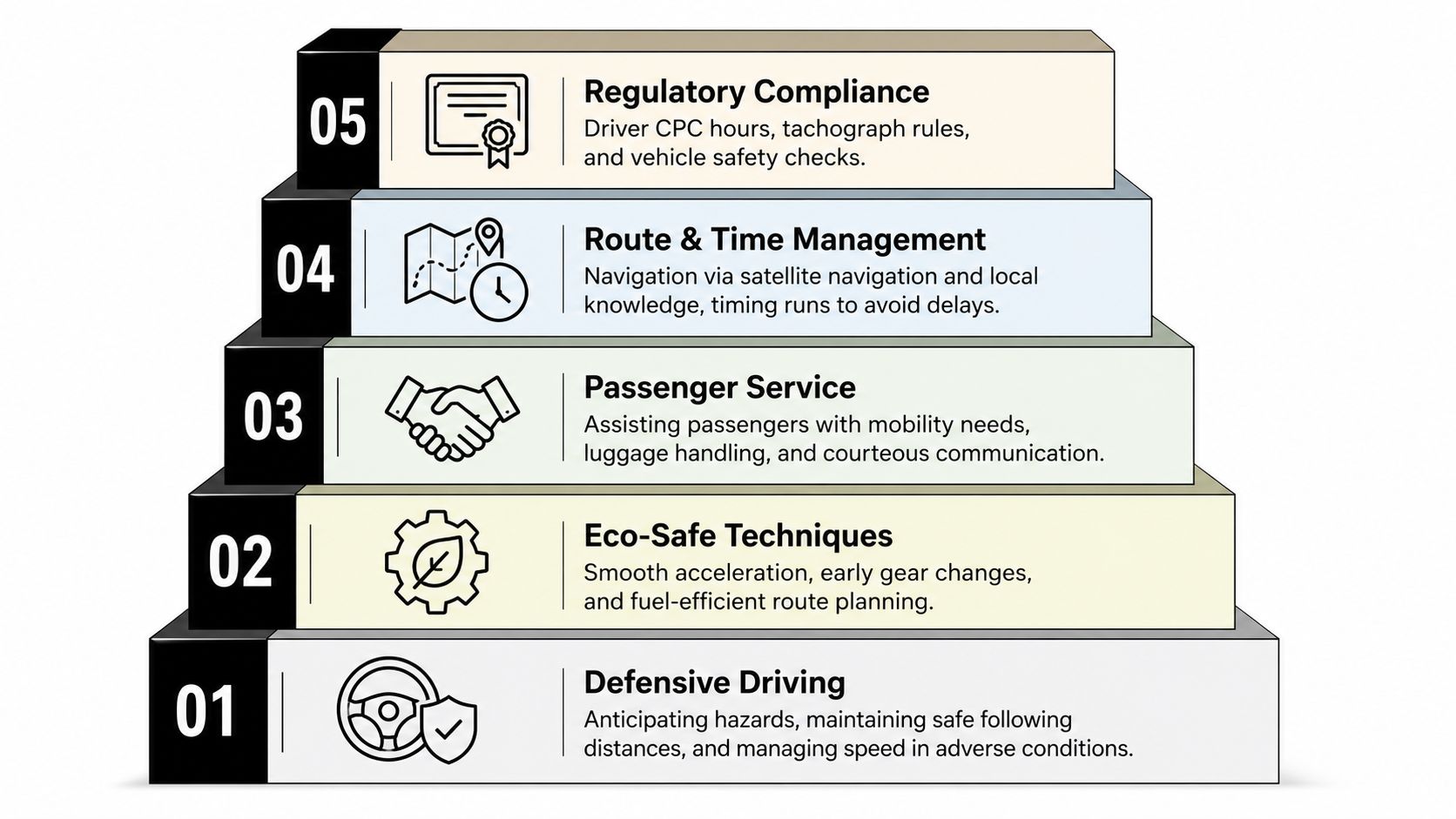
The modules that matter most
Defensive driving sits at the base of the course because it shapes every other part of the job. UK and European safety guidance points towards coaching on speed, gear selection, acceleration, lane position, and hazard recognition, since those are the controls a driver can manage to reduce collision risk and cut wasteful driving (VTTI coaching guidance). In plain terms, that means easing into a wet roundabout instead of grabbing the brakes at the last second, which is exactly the kind of moment a traveller notices through the seat and the steering.
Eco-safe techniques sit close behind it because smooth inputs usually create a smoother trip. Early gear changes, steady acceleration, and sensible route planning do more than reduce fuel use, they reduce the little jolts and pauses that make a transfer feel tiring. Passengers rarely ask for “eco-driving”, but they do notice whether the ride feels settled or restless.
Passenger service turns driving into part of the customer experience. A driver practises polite introductions, luggage handling, seat guidance, and the timing of boarding so the passenger does not feel hurried at the kerb. If you run a private hire or minibus operation, the practical standards are easy to see in services such as private car hire with driver, where the handover at the vehicle is as visible to the customer as the journey itself. A wheelchair user, for example, should never feel that the stop is being made up as it goes along.
Accessibility awareness has to be specific, because passengers with different needs notice detail quickly. Drivers need to know how to assist passengers with mobility needs, how to secure wheelchairs correctly, and how to behave around assistance dogs. That is the difference between saying the right things and handling the trip properly.
First aid and emergency response prepare the driver for the unexpected. A good course gives drivers the confidence to deal with distress, minor injury, or a passenger medical issue without making the situation worse. In passenger work, a calm voice and a clear sequence of actions matter as much as the first aid kit in the cab.
Vehicle checks, hours, and route planning keep the job grounded in the real world. Pre-use inspections, tachograph awareness where relevant, and route timing protect the operator as well as the passenger. A driver who checks the cab before departure is less likely to be the reason a transfer starts late or breaks down halfway through a shift.
How the training comes together on a real job
A clean kerbside stop, a careful lift of a case, and a clear explanation of where the vehicle is going all show the training working in practice. The passenger probably will not comment on compliance paperwork. They will say the driver was calm, helpful, and easy to trust.
The Road Safety Observatory's UK review on driver training also notes evidence that formal defensive training, when delivered in the workplace and reinforced with incentives, can reduce crash involvement (ROSPA road safety observatory review). That matters for safety, and it also shapes the customer experience, because fewer sharp inputs and fewer avoidable mistakes make each journey feel steadier and more professional.
Training Providers, Formats, and Typical UK Costs
The training market looks messy until you sort it into a few familiar buckets. Some operators use further-education colleges, some rely on private tuition centres, some build in-house academies, and others blend classroom, in-cab, and online CPC delivery. Each has a different balance of price, pace, and flexibility.
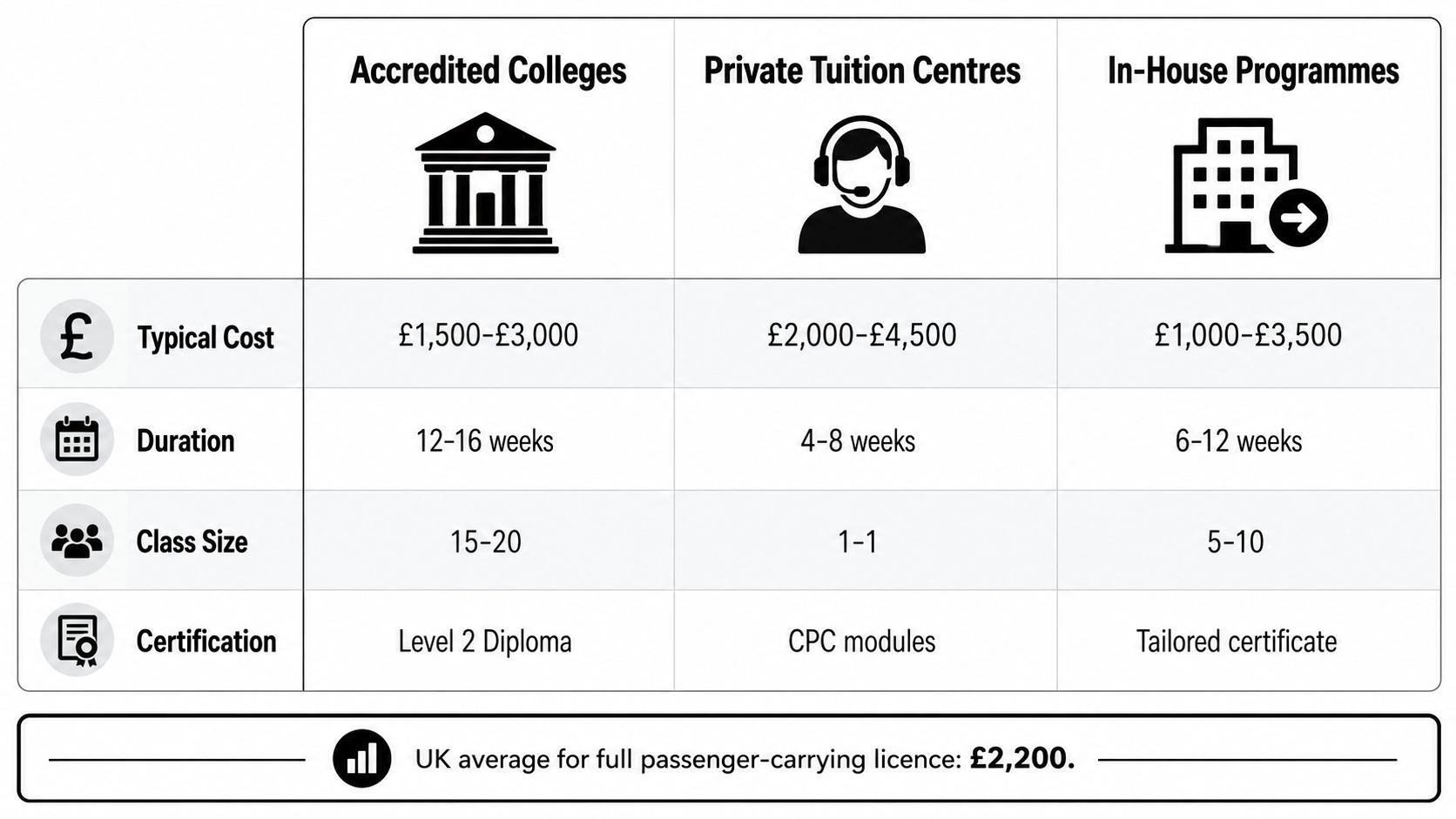
How the formats usually differ
A college route usually suits operators who want a more formal, slower-paced programme. It can be a tidy option for learners who need structure, especially where the driver is new to commercial passenger work and needs time to build confidence. Private tuition centres tend to compress the learning window, which is useful if the operator can't afford to keep a vehicle off the road for long.
In-house academies make sense when the fleet is large enough to justify internal standards, internal mentors, and repeatable processes. They're often better at matching the exact vehicle type and route pattern the driver will face on day one. Blended and online CPC options are useful for theory elements, but they still need to be carefully checked for approval status and practical relevance.
The visual comparison below gives a quick sense of how the market is often presented, but the buying decision should still come down to what's included.
| Training format | Typical use | Main trade-off |
|---|---|---|
| Accredited college | Structured entry and periodic study | Slower pace, more classroom time |
| Private tuition centre | Fast-track practical training | Cost can rise if you need extra sessions |
| In-house programme | Fleet-specific induction and repeat coaching | Needs strong internal oversight |
| Online or blended CPC | Theory, refresher content, flexible scheduling | Must still be properly approved |
The phrase “cheap training” can be misleading. A low fee isn't useful if the course doesn't match the vehicle, the licence category, or the CPC requirement. That's why the safer question is not “What's the cheapest?”, but “What does the fee include, and who is signing off the competence?”
If you're comparing service-side transport options rather than training providers, the private car hire with driver overview is a useful reminder that the passenger still experiences the whole package, not just the driver's qualification.
Buying note: a good provider should be able to explain the route from first lesson to final sign-off without hiding behind vague course labels.
How to Evaluate a Training Course Before You Book
A decent brochure can still hide a weak course. A new operator soon learns that glossy course names do not tell you whether the training will help a passenger at the kerb, on board, or at the point of handover. The safer approach is to ask the same set of questions every time, then compare the answers side by side.
You are checking for proper approval, the right vehicles, and support after the course ends. A provider may sell confidence well, but if they cannot show how that confidence is built, the course may leave gaps the driver will notice on day one.
Seven checks that separate solid providers from weak ones
- Awarding body and approval status. Ask which body backs the course and whether the CPC element is properly approved. A provider should be able to name the route clearly, not just talk about “certificates” in general terms.
- Instructor experience. Ask whether the trainer has recent fleet or passenger work experience, not just teaching experience. A trainer who has worked the same type of vehicle recently will spot the habits that matter in real service, such as safe loading, calm movement, and clear communication.
- Vehicle match. Ask what type of vehicle you will train in and whether it reflects your real job. A minibus driver should not be learning everything in a model they will never use, because the controls, sightlines, and passenger routine can all feel different in practice.
- Pass and completion transparency. Ask for the provider's own completion data, where available, and how they handle retakes. If they will not talk about outcomes at all, that usually means the course is being sold on promise rather than evidence.
- Modern technology coverage. Ask whether the course covers ADAS, telematics, and driver-monitoring tools, because a modern cab is not the same as an old one. The SAFED research guidance also makes clear that drivers need to understand the purpose, capabilities, limitations, and failure modes of systems such as ACC, LKAS, AEB, radar, cameras, and sensor placement. That matters on the road because a driver who knows what the systems can and cannot do is less likely to overtrust them in traffic or at the station forecourt.
- Post-training support. Ask whether there are refresher sessions, coaching, or reassessment after the course. Once the test is over, a good provider still has a role if the driver needs help turning training into consistent passenger service.
- Transparent pricing. Ask for the total price in writing, including tests, admin, and extra practice if needed. Add-ons that only appear after a deposit has been paid are a bad sign, because the actual cost of training should be clear before anyone signs up.
Practical rule: if the provider cannot answer these questions clearly, they are probably not set up for commercial passenger work.
A simple scoring sheet helps. Give each category a score out of five, then compare the total across two or three providers. The best course is not always the cheapest one, it is the one that helps a new driver stay calm, stay safe, and give passengers a smoother experience without leaving the operator to fill in the gaps later.
A Sample Training Timeline for a New Passenger Driver
A new driver's first week should feel structured, not improvised. The paperwork comes first, then the route work, then the passenger-facing practice that shows whether the driver can keep people calm, on time, and comfortable. That sequence matters because travellers notice the difference at the kerb, in the saloon, and at the point where a delay would otherwise turn into a complaint.
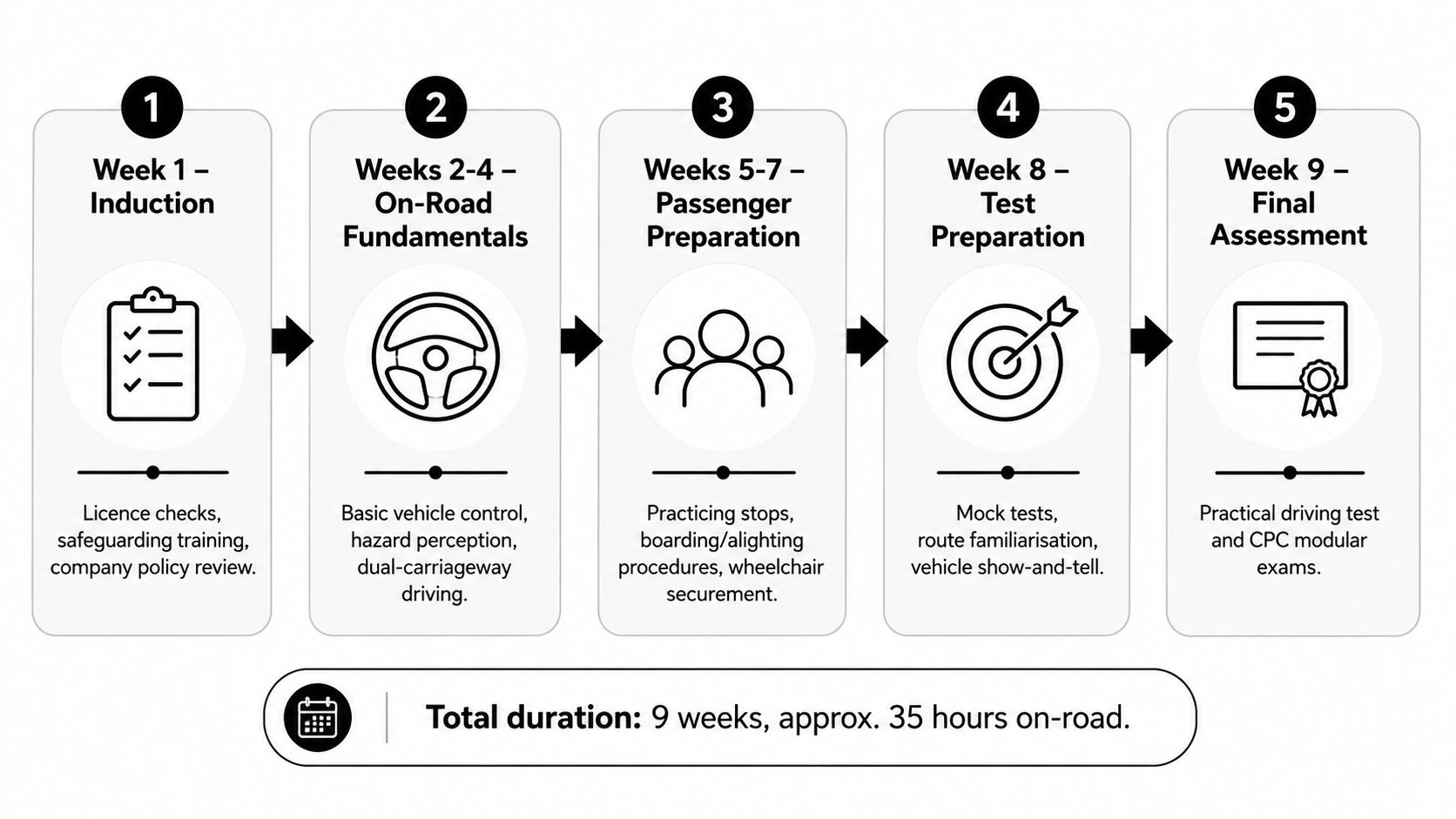
A realistic nine-week shape
Week one is induction. The driver checks licences, completes safeguarding, learns company standards, and gets introduced to the route patterns and passenger expectations. If vetting or records need chasing, the timetable can slip straight away, so operators need to clear those items early.
Weeks two to four are on-road fundamentals. The trainer covers basic vehicle control, hazard perception, and dual-carriageway driving. A nervous new driver learns to keep the vehicle smooth rather than correcting every small mistake, which is the sort of control passengers notice before they ever think about the paperwork behind it.
Weeks five to seven move into passenger preparation. The driver practises stops, boarding and alighting, wheelchair securement, and the kind of polite communication that settles a traveller who has already been delayed by flights or port queues. That stage matters because passengers judge confidence much faster than they judge theory, and a calm hand at the door often matters more than a tidy answer in the classroom.
The final stretch to independent work
Week eight is test preparation. Mock assessments, route familiarisation, and vehicle show-and-tell help the driver connect the classroom details to the actual job. Week nine brings final assessment, practical sign-off, and CPC-related registration where relevant.
A typical full programme runs around 35 hours on-road over a 9-week structure, matching the visual schedule for this guide. That gives enough time to build safe habits without stretching induction so long that the operator loses momentum.
| Stage | Main focus | Common pinch point |
|---|---|---|
| Induction | Documents, policy, safeguarding | Vetting and DBS delays |
| Fundamentals | Vehicle control and road craft | Motorway confidence |
| Passenger prep | Boarding, luggage, accessibility | Wheelchair securement practice |
| Assessment | Mock test and sign-off | Nerves on the day |
A driver who finishes this process should know the vehicle, the route style, and the passenger expectations well enough to work without constant supervision. That is the point where training stops feeling theoretical and starts showing up in the service the traveller receives.
Periodic CPC and Ongoing CPD for Working Drivers
A driver does not stay sharp because they passed a test once. They stay sharp because the job is reinforced, corrected, and refreshed over time. For commercial HGV and bus drivers in the UK, that means keeping up with 35 hours of periodic Driver CPC training in each five-year cycle, so the qualification stays live and the standard does not drift.
For operators, the main job is to plan those hours sensibly. If several drivers all need refreshers in the same month, rotas get tight fast, especially during peak summer demand, cruise turnarounds, or airport congestion. Spreading the hours across the cycle is easier on staffing and causes less disruption to service.
A driver who has just had a refresher on luggage handling, wheelchair securement, or calm communication will often show the benefit the first time a traveller steps aboard. The passenger may not know the module name, but they notice the difference in the way the journey starts.
CPC hours and everyday CPD aren't the same thing
Periodic CPC is the formal requirement. Ongoing CPD is the wider habit of keeping skills current through short refreshers, coaching, and topic-based updates. That can include customer-service reminders, accessibility awareness, mental-health awareness, or other short modules that support the role even when they are not part of the formal CPC record.
Telematics makes that easier. If a coach shows repeated harsh braking on one route, or too much idling at a particular hotel pickup point, the next refresher can focus on that actual behaviour rather than on generic advice. That helps the driver, and it shows up in the passenger experience too, because a steadier ride feels more controlled and less tiring.
Micro-learning has a place here as well. Short blocks are easier to fit around live work than long classroom sessions, especially in a small fleet. A ten-minute briefing on meet-and-greet standards or a short module on Luxury Chauffeur Service in London can be enough to correct the small habits that travellers notice straight away, such as greeting style, luggage handling, or the handover at the kerb. The key is to keep the training approved where approval is required, and to record what has been done so nothing gets lost in the rush.
Good habit: treat refresher training as rota planning, not as a last-minute compliance fire drill.
Working drivers improve fastest when the feedback is specific. “Slow down” is weak advice. “Take the bend in second gear and keep the passenger load steady” is useful. That is how periodic training stays connected to the road rather than turning into paperwork.
Why Training Standards Matter for Airport and Cruise Transfers
Airport and cruise transfers expose every weakness in a training programme. A passenger arriving at Heathrow after a long-haul flight doesn't care about internal process charts. They care whether the driver looks organised, communicates clearly, handles luggage properly, and gets the journey moving without unnecessary stress. The same is true at cruise ports, where timing, courtesy, and accessibility can make the difference between a rushed connection and a relaxed start to the trip.
That's why the modules covered above matter so much in the world. Defensive driving keeps the transfer smooth. Passenger service keeps the mood calm. Accessibility training helps the traveller feel respected. Route planning prevents avoidable delay. Regulatory compliance protects the operator from avoidable trouble.
The customer never sees most of the training, but they do see its results. They see whether the driver knows the terminal layout, whether the vehicle is ready, whether the luggage goes in without drama, and whether the handover feels professional from the first greeting. For an operator, that's not a small detail, it's the whole brand.
If you're choosing a transfer partner or reviewing your own fleet standards, the best question is simple. Does the driver look trained for the passenger's actual journey, or just licensed to move the vehicle? The answer shows up in tone, timing, and trust.
For a luxury-style passenger experience, the London chauffeur service perspective is a useful reminder that travellers notice polish, punctuality, and calm communication long before they notice anything else.
FAQ
How can I check a driver's CPC status?
Ask the operator for confirmation before booking, and check that the driver's qualification is current for the job they're doing. For commercial passenger work, the paperwork should be ready before the vehicle arrives.
What should I expect from a new driver on a first solo run?
The driver should already know the route, the vehicle, the pickup routine, and the passenger handover. A first solo run should feel supervised in the background, not improvised on the day.
How often does a working driver refresh training?
For CPC-covered commercial HGV and bus work, the formal refresher cycle is every five years, with 35 hours of periodic training in that period (European Commission road safety training paper).
If you're reviewing passenger transfer standards, comparing driver training options, or planning a better handover between Heathrow and the port, speak to EC Minibus today and book a service that treats training, punctuality, and traveller comfort as one job.