

If you're searching for the Queen Elizabeth cruise terminal in Southampton, you're probably doing it for one reason. You want to make sure you turn up at the right place, at the right time, without dragging luggage through the wrong dock or gambling on a connection that cuts it too fine.
That's the right instinct.
I've seen the same mistake catch international travellers again and again. They book the cruise correctly, fly into Heathrow correctly, and then treat the final leg to Southampton as if it's simple. Sometimes it is. On embarkation day, that's not good enough. You need the right terminal, a realistic transfer plan, and enough buffer to absorb the delays that always seem to hit when you can least afford them.
Table of Contents
- Your Essential First Step Starting Your Cruise Journey
- Finding The QEII Terminal Location and Layout
- Navigating Arrival and Departure Procedures
- Transport Options To and From The Terminal
- Parking Drop-Off and Luggage Handling
- Nearby Hotels and Pre-Cruise Planning Advice
- FAQs and Recommended Southampton Transfers
Your Essential First Step Starting Your Cruise Journey
The first job is simple. Confirm that “Queen Elizabeth cruise terminal” means the Queen Elizabeth II Terminal, often shortened to QEII or QE2.
That sounds obvious, but it trips people up all the time. Southampton's official cruise FAQ lists five different terminals, and it specifically warns travellers to rely on the terminal shown on their cruise ticket or confirmation because generic Southampton directions can send you to the wrong gate or street. It also identifies QEII as the terminal at Berth 38, Dock Gate 4 in contrast to other terminals spread across the port, which is why sloppy directions cause real problems on embarkation day. You can check that in the official Southampton cruise FAQ.
Use the right terminal name
If your booking documents say QEII Terminal, that is your working term for every part of your travel plan. Use it when you:
- Book transport: Drivers need the exact terminal, not just “Southampton cruise port”.
- Check cruise paperwork: Don't assume all Cunard, P&O, or other sailings leave from the same place every time.
- Ask for directions: Terminal-specific directions are far more useful than city-level directions.
Practical rule: Never leave Heathrow, your London hotel, or your Southampton hotel until you've checked the terminal name on the actual cruise documents.
Southampton isn't a small one-ship port. It's a major embarkation point with dedicated cruise operations, and that scale is why precision matters. If you want broader context on how Southampton fits into UK cruising, this guide to UK cruise ports is worth a look.
Why this matters more in Southampton
Southampton handles cruise traffic at a scale that rewards organised travellers and punishes vague planning. Once you understand that, your choices become clearer. You don't “head to Southampton and figure it out”. You head to QEII Terminal, through the correct dock access, with timing that allows for a busy port and fixed ship procedures.
That's the mindset that prevents missed check-in windows, frantic taxi changes, and those miserable phone calls from the roadside asking where the ship leaves from.
Finding The QEII Terminal Location and Layout
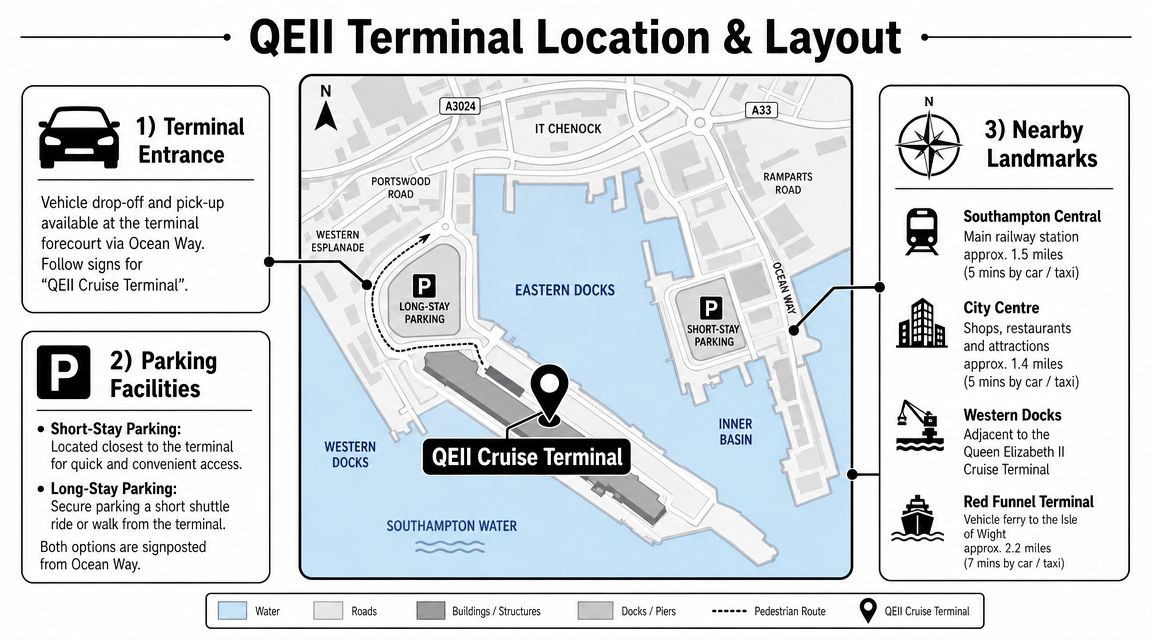
The Queen Elizabeth II Terminal sits in Southampton's Eastern Docks at berth 38/39, and the practical access point is Dock Gate 4. Cruise Britain also notes that the Port of Southampton welcomes around three million passengers annually across its five cruise terminals, with 24/7 access for passenger vessels on deep-water berths. That tells you something important. This is a purpose-built cruise environment, not an improvised passenger stop at a mixed-use dock. You can verify that on Cruise Britain's Southampton port page.
Use the right terminal name
When passengers tell me they're going to the “Queen Elizabeth terminal”, I immediately ask one question. “Do your documents say QEII?” If they haven't checked, we stop there and fix that first.
The terminal has history behind it as well. Historical listings place it at berth 38/39, with an opening date of 1966 and later modernisations in 2003 and 2016. That matters because the building feels like what it is: a long-established terminal that has been adapted for modern cruise handling, not a brand-new glass box with endless intuitive wayfinding.
Know the access point before you travel
For most passengers, Dock Gate 4 is the detail that saves time. Southampton has terminals in different parts of the port, so if your driver, taxi, or sat-nav isn't aiming for the correct gate, you can lose time in exactly the wrong part of the day.
Keep these details together in one note on your phone:
- Terminal name: Queen Elizabeth II Terminal
- Berth reference: Berth 38/39
- Dock access: Dock Gate 4
- Port area: Eastern Docks
If your transfer provider can't repeat your terminal and gate details back to you, don't assume they've logged it properly.
A lot of embarkation-day stress comes from poor visual expectations. Travellers expect a single central cruise building. Southampton doesn't work like that. It's a spread-out port with dedicated terminal zones. Once you understand that layout, you stop treating the last mile as casual and start treating it as operational. That's the right approach.
Navigating Arrival and Departure Procedures
The QEII experience is usually smoother than nervous first-time passengers expect. The trouble rarely starts at the terminal door. It starts before that, when people arrive flustered, late, overpacked, or at the wrong terminal.
Once you pull up at the right building, the process becomes much more straightforward.
What the arrival flow usually looks like
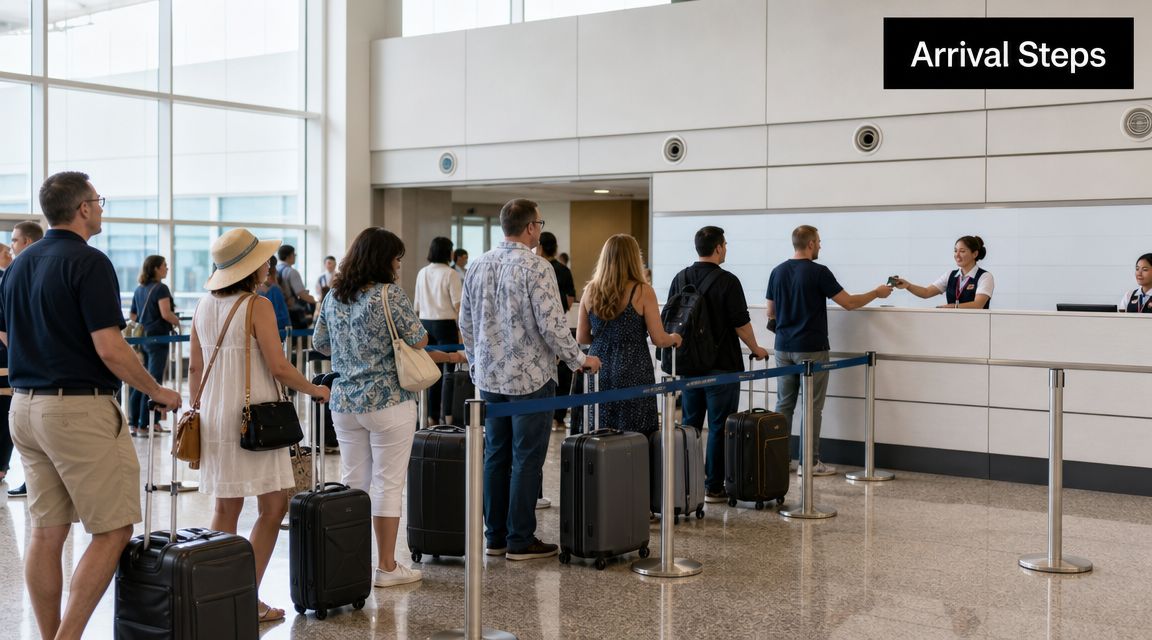
You arrive kerbside, unload checked luggage, and hand it over to the port team handling bags for embarkation. Keep your essentials with you. Passport, cruise documents, medication, valuables, phone charger, and anything you need for several hours should stay in your hand luggage.
Then you go inside for the standard sequence:
- Bag handoff outside
- Security screening
- Check-in or document verification
- Waiting area
- Boarding call
Passengers who struggle here usually make one of two mistakes. They either bury important documents in checked luggage, or they pack hand luggage so heavily that every step becomes a nuisance.
What boarding feels like at QEII
ADELTE reports that the QEII terminal uses a Seaport Passenger Boarding Bridge (SPBB) with the latest safety provisions, and that system improves accessibility and passenger flow by reducing reliance on steps or ground transport to board at berth 38/39. That matters for older travellers, wheelchair users, and anyone who wants a less awkward boarding experience. The technical details are outlined on ADELTE's QEII terminal project page.
In plain English, it means boarding is usually more controlled and less cumbersome than old-style gangway arrangements.
Arrive calm and the terminal feels orderly. Arrive rushed and every queue feels twice as long.
A few practical habits make the whole thing easier:
- Keep documents accessible: Don't repack them after check-in.
- Use a manageable cabin bag: You may be carrying it for a while before cabins are ready.
- Assume some waiting: Seating and Wi-Fi availability can vary, so don't rely on the terminal as if it were an airport lounge.
- Wear layers: Terminal temperatures and ship boarding areas can change through the day.
Most passengers don't need complicated embarkation advice. They need a predictable sequence and the discipline not to sabotage it by arriving under pressure.
Transport Options To and From The Terminal
Here, most cruise days are won or lost.
The route from London Heathrow to Southampton is about 77 miles and typically around 2 hours by road in normal conditions, according to port guidance. The same guidance also makes it clear that the estimate does not account for disruption on the M25/M3 corridor, which creates obvious risk for anyone trying to make a fixed embarkation schedule. The reference is on Oceania's Southampton port information page.
International travellers often underestimate that risk because the map doesn't look dramatic. A straight-looking journey can still unravel if motorway traffic turns ugly, a flight lands late, baggage takes time, or an airport pickup goes wrong.
What works best for different travellers
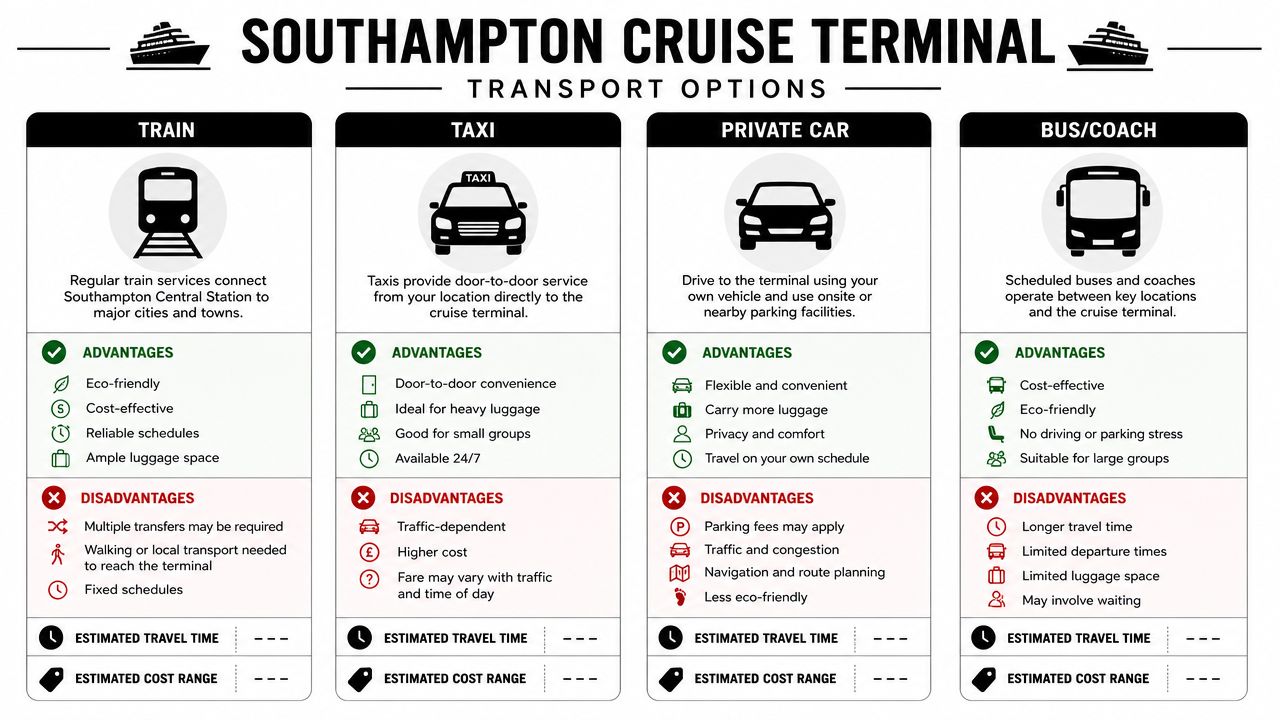
You've got four realistic choices: train, taxi, private car transfer, or coach. Each can work. They do not offer the same level of control.
- Train: Fine for confident UK travellers with light luggage and time to spare. Less appealing after a long-haul flight, especially if you're juggling customs, station transfers, and platform changes.
- Taxi: Convenient from a local hotel or station. Less reliable as an airport plan if you're assuming you'll just sort it out on arrival.
- Private car transfer: Best fit for international arrivals, families, and travellers with multiple cases. One vehicle, one pickup, one direct handover at the terminal.
- Bus or coach: Usually the lowest-stress option only on paper. In real life, luggage limits, schedules, and indirect arrival points make it a poor match for cruise embarkation day.
For airport-to-port connections, I'd strongly favour a pre-booked vehicle over piecing together rail and road on the spot. If you're weighing options, this page on airport shuttle services gives useful context on how pre-arranged ground transport differs from improvised airport travel.
A realistic comparison looks like this:
Heathrow to QEII Terminal Transport Comparison
| Transport Mode | Average Time | Estimated Cost | Key Benefit |
|---|---|---|---|
| Train | Variable | Variable | Avoids driving yourself |
| Taxi | Variable | Variable | Direct if immediately available |
| Private car | Variable | Variable | Door-to-door with luggage control |
| Bus or coach | Variable | Variable | Can suit budget-focused travellers |
The table is deliberately qualitative because prices and timings move with traffic, season, booking conditions, and pickup point. What doesn't change is the planning logic. More moving parts means more chances to lose time.
A short visual overview can help if you're comparing options for your group:
My recommendation for airport arrivals
If you're flying into Heathrow and joining a ship the same day, book a private transfer and be done with it. Don't turn embarkation into a chain of separate decisions.
One example is EC Minibus, which offers private cruise transfers between Heathrow, London hotels, and Southampton terminals, including meet and greet, flight monitoring, luggage help, and fixed pricing. That setup suits cruise passengers because it reduces handoffs and limits the number of things that can go wrong between airport arrivals and dockside drop-off.
That's the core issue. Reliability beats theoretical savings when the ship won't wait.
Parking Drop-Off and Luggage Handling
Driving yourself to the Queen Elizabeth cruise terminal in Southampton can work perfectly well. It just needs a cleaner plan than is usually devised.
The mistake drivers make is treating terminal access, luggage unloading, and parking as one fuzzy task. They're separate decisions, and they should be handled in that order.
Drop-off without chaos
If you're dropping off passengers rather than parking for the cruise, keep the stop short and organised. Have passports, cruise papers, and cabin bags ready before the vehicle reaches the terminal approach.
Use this sequence:
- Approach with luggage sorted Checked bags should be easy to remove first. Don't bury large cases behind loose items.
- Unload only what the passengers need The terminal kerb isn't the place to reorganise wardrobes or debate which bag stays in the car.
- Hand over checked luggage efficiently Port staff and porters are there to keep the line moving. Be ready for them.
Driver's rule: The smoother your unloading, the less likely you are to block traffic or create stress for everyone in the car.
Parking decisions to make before the day
If you're leaving your vehicle for the duration of the cruise, don't wait until the morning to figure out parking. Sort that in advance. Southampton cruise parking works best when you arrive knowing whether you're using short-stay access for a handoff or a booked long-stay arrangement for the full trip.
A few practical points matter:
- Pre-book if possible: Embarkation days are busy, and uncertainty wastes time.
- Separate driver and passenger roles: One person manages documents and hand luggage while the other handles the vehicle.
- Keep one small essentials bag visible: Medications, chargers, travel papers, and valuables should never disappear into the boot shuffle.
If you're comparing driving with other ground options, this guide to Southampton cruise terminal car hire helps frame the trade-offs.
Passengers usually think the terminal is the stressful part. For drivers, the stress comes from poor preparation in the final few minutes outside it. Fix that, and the handover becomes routine.
Nearby Hotels and Pre-Cruise Planning Advice
If you're flying in from North America or connecting through Heathrow, staying overnight before your cruise is the sensible move. Not luxurious. Sensible.
Same-day travel looks efficient until one flight delay, one slow baggage reclaim, or one heavy motorway stretch turns your entire embarkation into a race you never needed to run.
Why the night-before strategy works
A hotel stay near Southampton changes the tone of the whole trip. Instead of measuring every motorway minute from the airport, you reduce embarkation day to a short local transfer with far fewer variables.
You don't need a complicated hotel strategy. You need a practical one:
- Choose convenience over romance: A stylish country stay sounds nice until you add awkward transfer time the next morning.
- Prioritise easy vehicle access: Especially if you're travelling with multiple cases.
- Confirm breakfast timing: You don't want a leisurely hotel schedule clashing with your check-in window.
Good options usually include city-centre hotels, waterfront properties, and chain hotels used to pre-cruise stays. The exact hotel matters less than the transfer logic behind it.
Sleeping near the port buys you something far more valuable than an extra hotel night. It buys you margin.
What to do on embarkation morning
A calm embarkation morning is built the night before. Lay out travel documents, charge phones, separate hand luggage from checked luggage, and confirm your pickup or driving route before you sleep.
Keep your morning simple:
- Eat early and properly: Not because the terminal lacks everything, but because hungry travellers get flustered faster.
- Set one final document check: Passport, cruise papers, medications, phone, charger.
- Leave earlier than feels necessary: Rushed departures create avoidable mistakes.
For international visitors, my strongest advice is this: don't optimise for the cheapest transfer chain or the tightest possible schedule. Optimise for certainty. The ship departure is fixed. Your journey to it isn't.
That's why a nearby hotel and a pre-arranged terminal run work so well together. One removes airport-day volatility. The other removes last-mile uncertainty.
FAQs and Recommended Southampton Transfers
Most lingering questions about the Queen Elizabeth cruise terminal in Southampton come down to a handful of practical concerns. The answers are usually simpler than people expect.
Quick answers travellers usually need
Is QEII the same as “Queen Elizabeth cruise terminal”?
Usually, yes. But never rely on search wording. Rely on your cruise documents.
Is the terminal manageable for passengers with reduced mobility?
In practice, yes, especially because boarding infrastructure is designed to reduce reliance on steps. Even so, mobility assistance should be arranged through the cruise line in advance.
What if I arrive early?
Early is better than late, but extremely early can still mean waiting. Bring essentials in your cabin bag and expect some sitting time.
Should I take the train from Heathrow?
Only if you're comfortable with UK rail changes, luggage handling, and backup planning. For most long-haul cruise passengers, it adds complexity without adding enough benefit.
Can I just get a taxi on the day?
You can. I wouldn't make that my plan from a major airport on embarkation day.
The transfer choice I'd make
For international cruise passengers, especially anyone landing at Heathrow with luggage and a fixed boarding deadline, the strongest option is a pre-booked private transfer. It's the cleanest solution to the part of the trip travelers tend to underestimate.
Why I recommend that approach:
- You remove transfer guesswork: No hunting for rail connections, taxi ranks, or coach bays.
- You keep luggage handling simple: One pickup, one vehicle, one drop-off.
- You protect timing: A pre-arranged road transfer is easier to manage than a chain of separate bookings.
- You start the holiday in a better state: That matters more than people think.
If you want the least stressful route from Heathrow or a London hotel to QEII Terminal, book your road transfer in advance and treat it as part of the cruise, not an afterthought.
If you want a straightforward way to reach the Queen Elizabeth II Terminal without juggling trains, airport taxis, and dockside confusion, EC Minibus offers door-to-door cruise transfers between Heathrow, London hotels, and Southampton. It's a practical fit for travellers who want fixed pricing, luggage assistance, meet and greet at the airport, and one direct plan from arrival to ship.