

You've landed at Stansted, your next flight leaves from Luton, and the route on your phone looks far messier than it should. That's the main problem with this transfer. It isn't just a question of miles between two airports. It's a question of whether you can move between two busy London airports without missing a flight, dragging bags across stations, or getting stranded by a late-night timetable.
Both airports are major parts of London's aviation system. London Stansted was serving about 27 million passengers a year by September 2018 and London Luton handled over 16.5 million passengers in 2018, with both counted among London's six major international airports according to London Stansted Airport facts and figures. So yes, plenty of people need this transfer. The awkward part is that the system still makes you work for it.
Table of Contents
- Navigating Your Stansted to Luton Transfer An Overview
- The Direct Coach The Budget-Friendly Choice
- The Train Route A Puzzle of Multiple Changes
- The Private Transfer The Seamless Door-to-Door Solution
- How to Choose the Right Transfer for Your Flight Connection
- Frequently Asked Questions about the Stansted-Luton Journey
Navigating Your Stansted to Luton Transfer An Overview
You land at Stansted, collect your bags, check the clock, and realise the transfer to Luton is less a quick hop and more a test of patience. There is no direct train. Every option asks you to balance money, time, and the amount of stress you are willing to absorb between flights.
That is the core decision here. Raw journey time matters, but missed connections, dragging luggage through interchanges, and dealing with late-night gaps in service matter more.
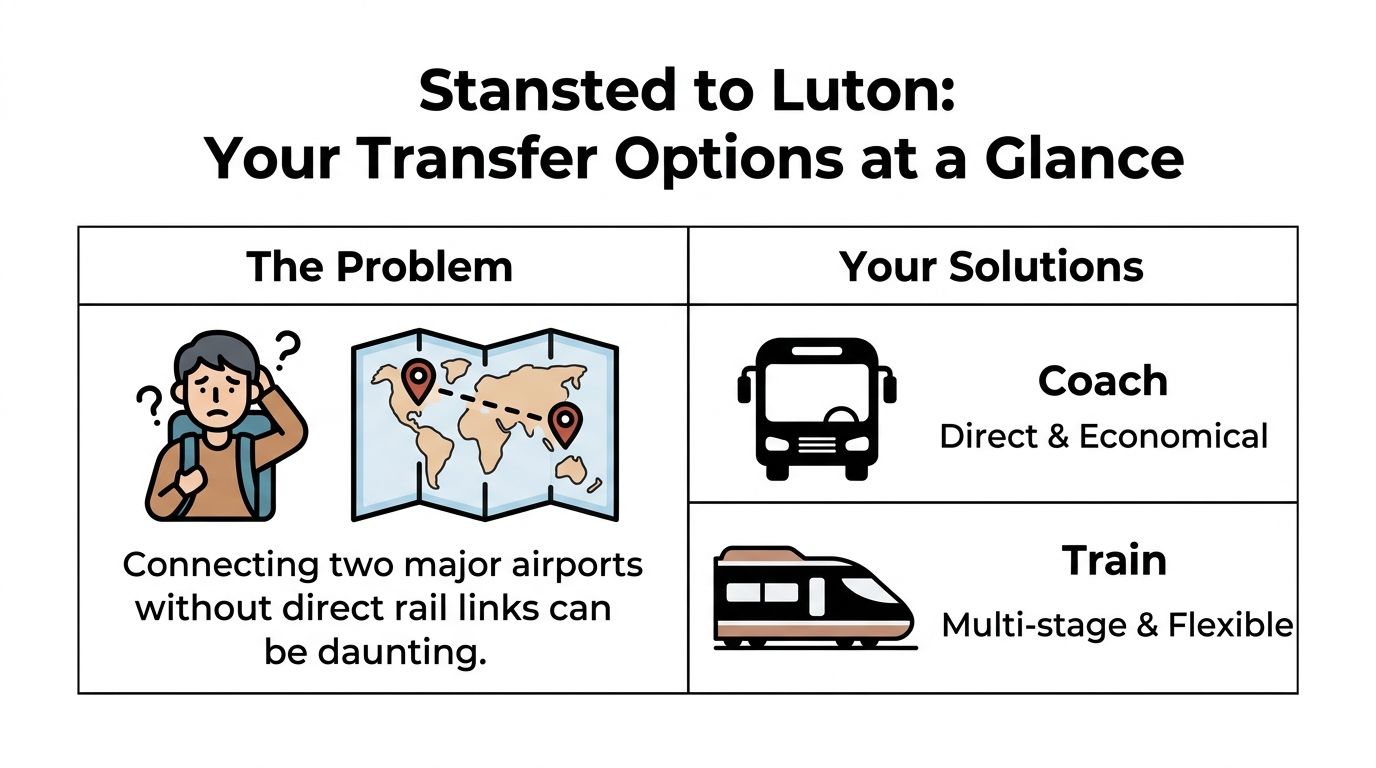
Stansted to Luton transfer options at a glance
| Transfer Option | Average Journey Time | Typical Cost (per person) | Convenience Level | Best For |
|---|---|---|---|---|
| Direct coach | Around 75 to 90 minutes | Lower-cost option | Moderate | Budget travellers with manageable luggage |
| Train with changes | Usually longer and less straightforward | Variable | Lower | Travellers comfortable with station changes and walking between platforms |
| Private transfer | Fastest under clear road conditions | Higher than public transport | High | Families, groups, older travellers, and anyone protecting a tight connection |
If you want context on how shared road transfers compare with other airport ground transport, this overview of airport shuttle services and transfer types is a useful starting point.
What makes this route harder than it looks
This transfer catches people out because the friction starts after the flight, not before it.
Connection risk comes first. If your flights are on separate tickets, no airline is stepping in if the road journey runs long or a rail connection falls apart. You carry that risk yourself.
Luggage handling is the next problem. A backpack and cabin case are manageable. Two large suitcases, a pushchair, or sports gear change the calculation fast, especially if you are moving through stations, lifts, escalators, and crowded platforms.
Late-night travel is where paper plans often break down. Public transport still works for many travellers, but your margin for error shrinks after delays, immigration queues, or a late inbound flight.
My practical view
Choose the coach if price is your priority and you are travelling light.
Avoid the train unless you are comfortable with changes and do not mind the extra handling. On this route, complexity is the primary cost.
Book a private car if your connection is tight, you are travelling with children, or you want the least stressful option. Paying more upfront is often cheaper than missing a flight, hauling bags across multiple stations, or arriving at Luton already exhausted.
The Direct Coach The Budget-Friendly Choice
You land at Stansted, collect your bags, check the clock, and realise the coach is the cheapest option left. For plenty of travellers, that is the right call. On this route, the direct coach is the best public transport choice if you want to keep costs down without dragging luggage through multiple rail changes.
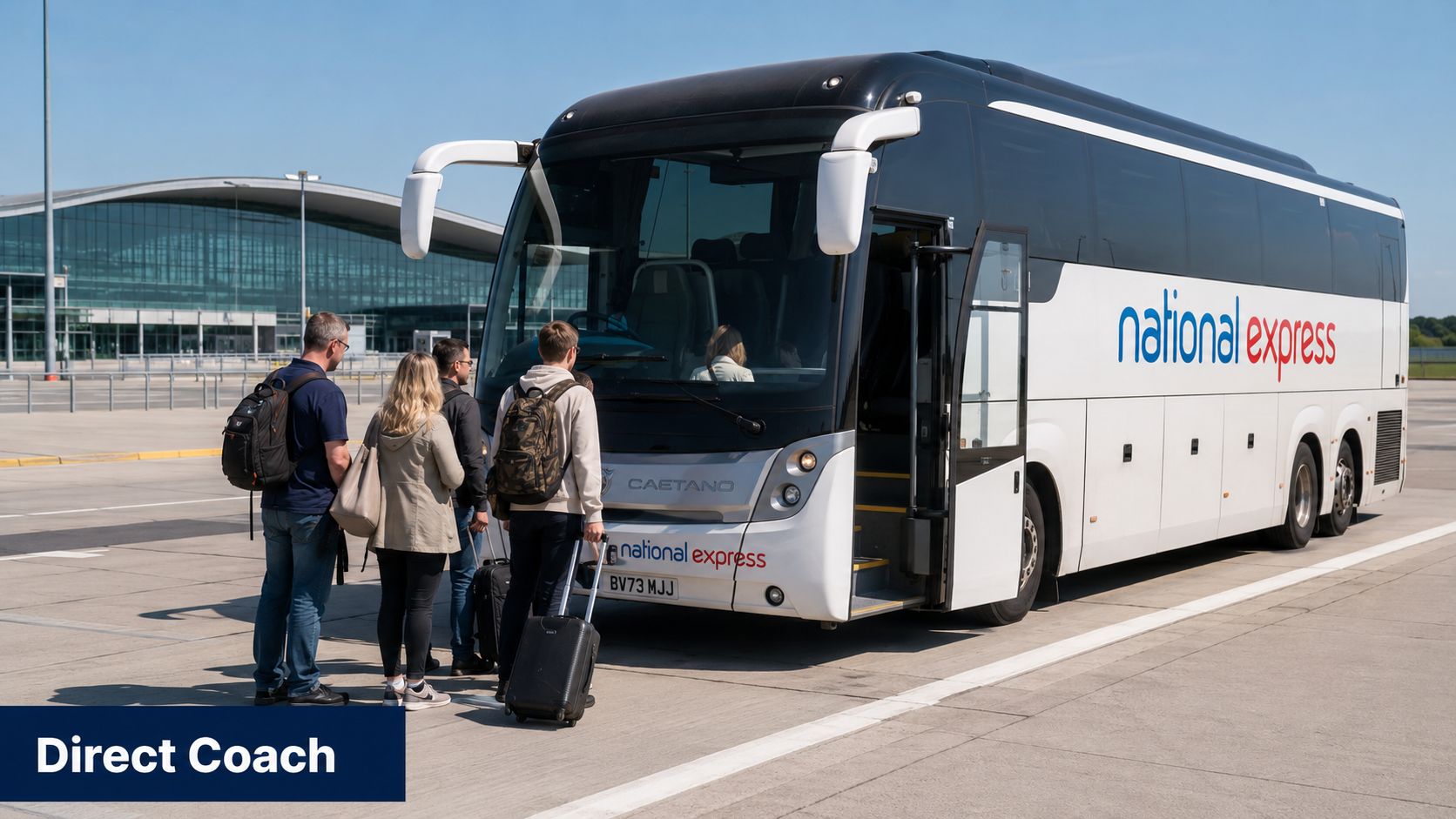
Its main strength is obvious. You board once, stay with your bags, and avoid the station-hopping that makes the train tiring after a flight.
That matters more than people expect. If you are travelling with one cabin bag, the coach feels simple. If you have two large suitcases, a child, or anything awkward like skis or a pushchair, the appeal is still there, but the journey becomes less forgiving because you are handling everything yourself from terminal to terminal. If you want context on how shared airport road transport compares with other transfer types, this overview of airport shuttle services is a useful reference.
Why the coach works well
I recommend the coach for travellers who care about price first and can tolerate some uncertainty.
You skip the rail changes. You avoid central London stations. You get a direct airport-to-airport connection that is usually easier to manage than piecing together trains while tired.
That simplicity reduces one kind of stress. It does not remove the others.
Where the coach starts to feel risky
The trade-off is control. Coaches run on fixed departures and share the road with every other vehicle heading around north London and the motorways. If your flight is late, baggage reclaim drags on, or immigration is slow, you can miss the departure you planned around and lose time waiting for the next one.
Late-night transfers are where this hits hardest. Public transport still exists, but your recovery options narrow fast once services are less frequent and your energy is gone. A cheap ticket can become expensive in practical terms if a missed coach leaves you cutting your Luton check-in window too fine.
Take the coach for value and simplicity. Do not take it if a missed onward flight would cost you more than the savings.
What to expect on the day
Use the coach with a bit of discipline:
- Book ahead. Do not leave the decision until you are standing in arrivals, tired and scrolling.
- Build in airport exit time. Passport control and baggage reclaim often decide whether the coach feels efficient or stressful.
- Travel light if you can. The coach is manageable with luggage, but you still load, unload, and move it yourself.
- Protect your connection. If your onward flight from Luton is tight, give yourself more buffer than the timetable suggests.
Later in your planning, it helps to see the route visually:
My verdict on the coach
Choose the coach if you are price-sensitive, travelling fairly light, and have breathing room before your next flight. Avoid it if you are already under pressure, carrying a lot of luggage, or arriving late at night. On this route, the coach is the sensible budget option. It is not the low-stress option.
The Train Route A Puzzle of Multiple Changes
The train route looks attractive when people want to avoid road traffic. I understand the instinct. But for Stansted Airport to Luton Airport, the rail option is the one most likely to irritate you.
The issue isn't just duration. It's the chain of steps. Stansted's own airport guidance points travellers towards coach and train links, while Luton's airport access guidance requires a train to Luton Airport Parkway followed by the Luton DART into the terminal, as noted on Stansted's travel between airports page.
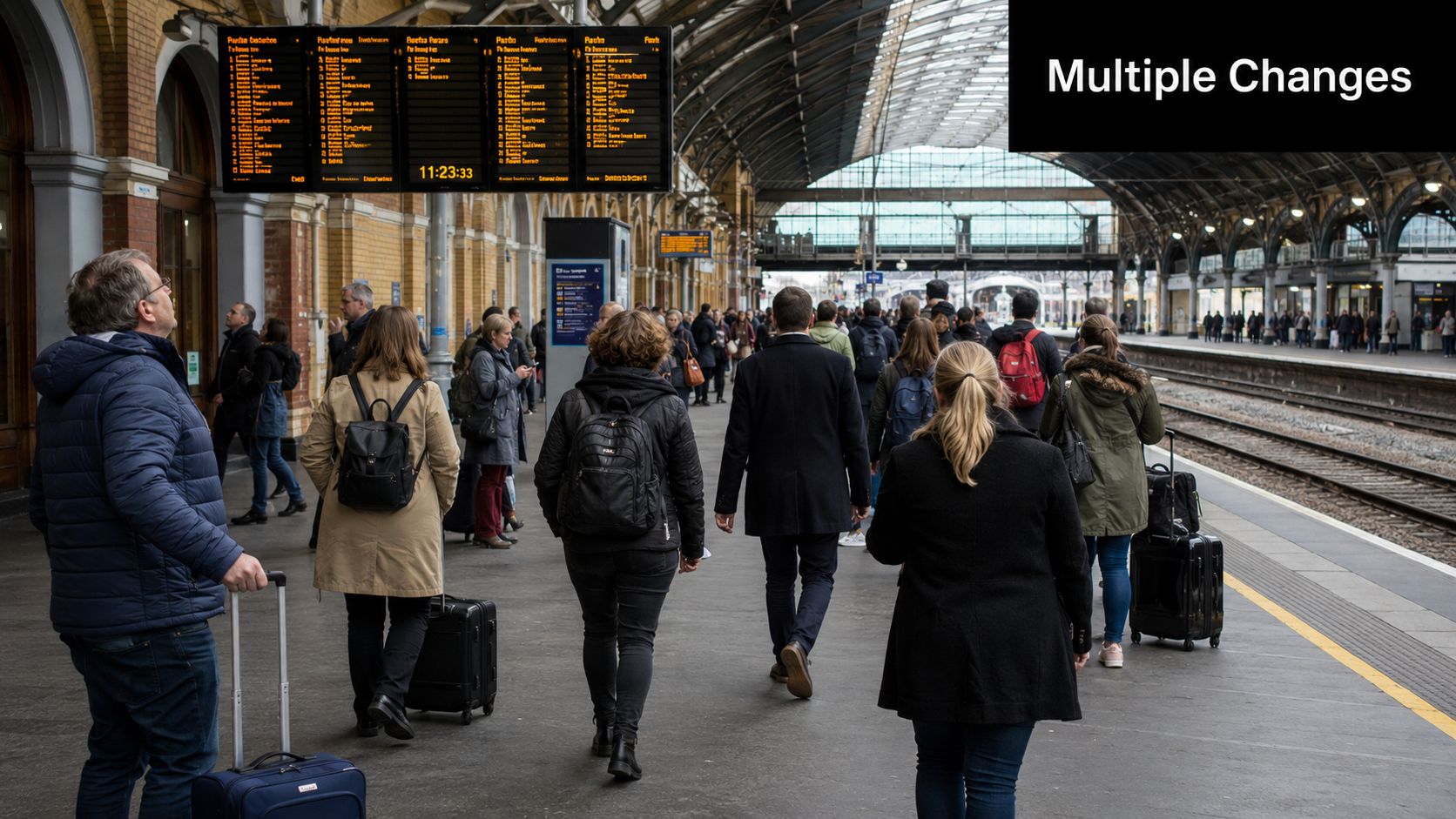
What the rail journey usually involves
You're not boarding one train and relaxing until Luton. You're stitching together a sequence.
- First leg: Train out of Stansted.
- Middle transfer: Change within the London rail and Underground network.
- Next leg: Train towards Luton Airport Parkway.
- Final leg: Luton DART to the terminal.
That's why the rail journey often takes about 1h 52m to 2h 10m with 2 changes, based on the practical routing described earlier from independent transfer guidance. The time is one thing. The effort is another.
Why the train catches people out
Rail works best when you're travelling light and know London stations. It works less well when you've just come off a flight, one child is tired, another bag has a broken wheel, and you're trying to decipher signs in a crowded interchange.
Busy stations create their own kind of delay. You can lose time finding lifts, waiting for space near doors, or moving between platforms with luggage. None of that appears in simple journey planners.
Practical rule: If one missed platform change would make you panic, the train isn't your route.
Who should still consider it
The train can still suit some travellers:
- Confident solo travellers: If you know how to move through London stations quickly, rail is manageable.
- Hand-luggage-only passengers: Less baggage changes the experience completely.
- Travellers avoiding motorway uncertainty: Some people prefer scheduled rail legs to sitting in road traffic.
For everyone else, this option feels more technical than it needs to be. The train is not impossible. It's just easy to underestimate.
The Private Transfer The Seamless Door-to-Door Solution
You land at Stansted late, baggage reclaim drags on, one suitcase is heavier than it should be, and your next flight leaves from Luton. That is the moment private transfer earns its price.
For this airport pair, a private car is the least stressful option. It cuts out the parts of the trip that usually cause problems after a flight: waiting for the next departure, dragging bags across interchanges, and working out what to do if you arrive behind schedule. If your connection matters, or you are carrying more than hand luggage, paying more for a direct transfer is the sensible choice.
Why private transfer changes the experience
The benefit is control.
Public transport can work well enough on paper, but this route becomes awkward when your arrival is delayed, your phone battery is low, or you are travelling after dark. A driver meeting you at Stansted removes several points of failure at once. You are not hunting for the right coach bay. You are not managing station changes with cases. You are not hoping the next leg lines up neatly with your actual landing time.
That matters most for people travelling on separate tickets. If the first flight runs late, every extra handoff increases the chance of stress, confusion, and a costly missed departure.
Who should book it without hesitation
Private transfer makes the most sense for:
- Families with children: Less waiting and less carrying. That alone can save your sanity.
- Travellers with large or multiple bags: Door-to-door beats lifts, platforms, and crowded aisles.
- Older passengers or anyone with limited mobility: Fewer physical demands make the trip much easier.
- Business travellers: A direct car protects your schedule better than a chain of connections.
- Late-night arrivals: After dark, simplicity matters more than shaving a few pounds off the fare.
- Passengers on tight flight connections: Fewer moving parts means less risk.
What the journey actually feels like
A good private transfer is straightforward. Your driver meets you after arrival, helps with luggage, and takes you straight to Luton Airport. No interchange. No timetable juggling. No final airport link to sort out at the end.
If you want to see the kind of meet-and-greet setup available, this guide to Stansted airport pickup services gives a practical example of how these handovers usually work.
One factual option in this category is EC Minibus, which offers airport transfers covering both Stansted and Luton as part of its London airport transport service.
If missing the second flight would ruin the day, book the car.
My view
Private transfer is not the cheap option. It is the low-friction option.
For travellers with heavy luggage, tired children, a late arrival, or any connection that carries real consequences, that trade-off is worth it. You are paying for a calmer journey, easier bag handling, and fewer chances for the trip to come apart between airports.
How to Choose the Right Transfer for Your Flight Connection
You land at Stansted late, your next flight leaves from Luton, and baggage reclaim is already eating into your buffer. That is the moment when the wrong transfer choice starts to feel expensive, even if the ticket looked cheap.
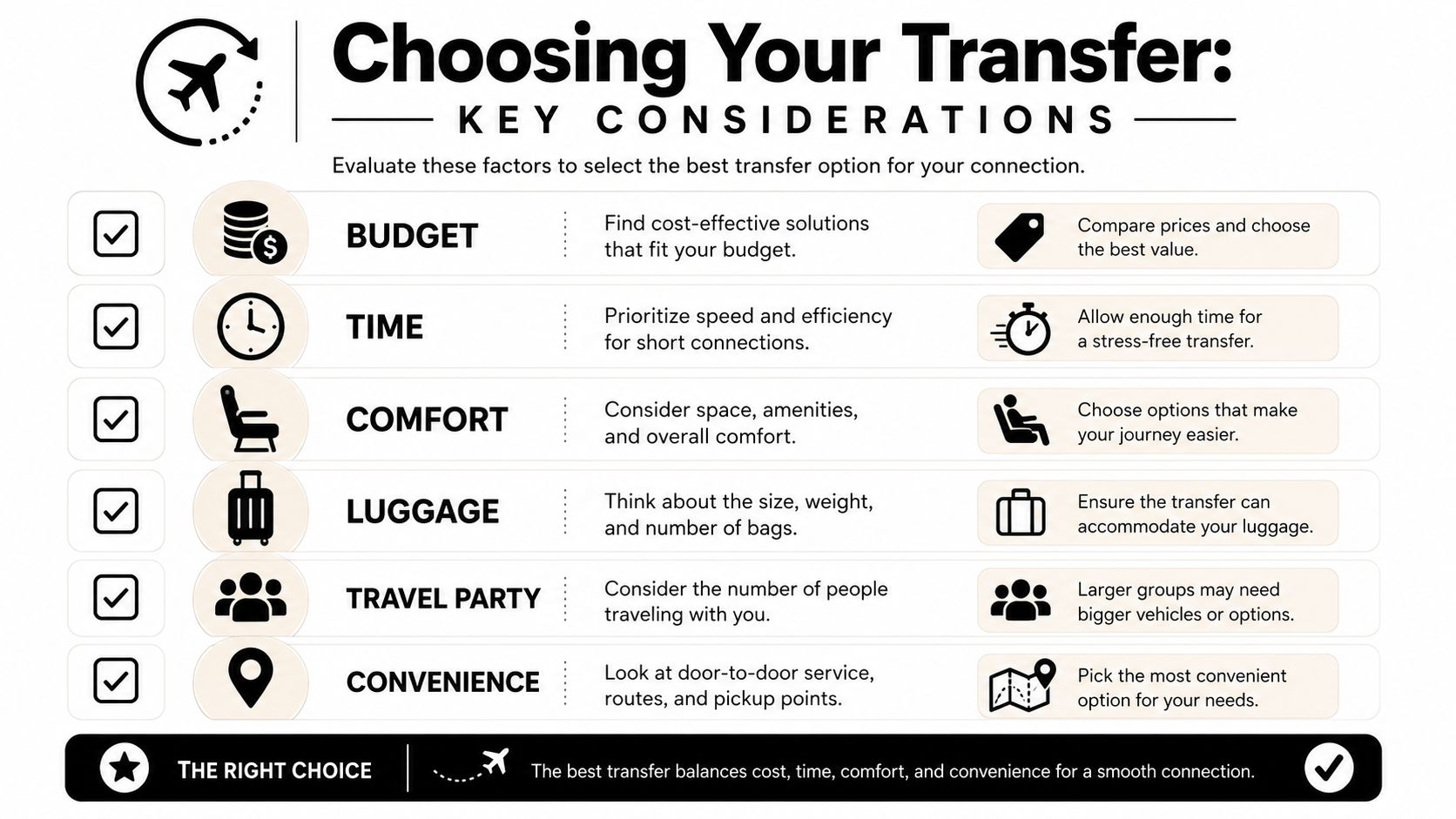
For this airport-to-airport run, judge the trip by stress exposure, not headline journey time. Ask three blunt questions. How much slack do you really have? How many bags are you dragging with you? And what happens if one delay turns into two?
If your connection is tight
Choose the option with the fewest moving parts.
A short connection and public transport are a poor mix on this route. Immigration can run long. Bags can come out late. A missed coach or a slow rail change can burn the margin you thought you had. If the onward flight matters, pay for control rather than hoping every stage runs cleanly.
If price matters most
Take the direct coach.
It is the clearest low-cost choice because it avoids the train route's station changes and platform hunting. You still need patience, especially in traffic, but the journey asks less of you physically and mentally. For budget travellers, that trade-off usually makes sense.
If you have children, bulky luggage, or both
Book a private vehicle and keep the transfer simple.
Families and heavy packers lose time in all the small places. Lifts, queues, coach bays, toilet stops, tired children, and the constant job of counting bags. A pre-booked car removes much of that friction. If you want a clearer sense of how that option works, this guide to private car hire for London airport transfers is a useful starting point.
If you are arriving late at night
Do not be too clever with connections.
Late-night travel makes every weak point worse. Services are less forgiving, staff support can be limited, and one small delay feels bigger when you are tired and carrying bags in the dark. A direct coach can still work. A private transfer is usually the calmer call.
If mobility or stamina is a concern
Avoid the train route unless you already know it and are travelling light.
This is not about confidence. It is about effort. Multiple changes, stairs, platform moves, and bag handling turn a routine transfer into a grind. The coach is the better public option. A private transfer is the easiest option full stop.
Pick the transfer that protects your connection when the day stops going to plan.
A simple decision rule
Use this:
- Choose coach if your budget is tight, your luggage is manageable, and you have enough time to absorb delays.
- Choose train only if you are comfortable with changes, travelling light, and accepting more hassle for little practical gain.
- Choose private transfer if your buffer is limited, you are travelling late, carrying several bags, or cannot afford to miss the next flight.
That is the honest pecking order on this route.
Frequently Asked Questions about the Stansted-Luton Journey
Is there a direct train between Stansted and Luton
No. That's one of the most common misunderstandings on this route. Rail travel involves multiple stages, not a single through service.
What happens if my incoming flight is delayed
If you're using public transport, a delay can knock your whole plan sideways. You may miss the coach you intended to catch, or lose the buffer you needed for the rail route. That's why this transfer needs margin, especially on separate flight bookings.
Is the coach easier than the train
Yes, it generally is. The coach keeps the journey in one main leg and avoids station changes. It isn't always faster in real conditions, but it's usually less fiddly.
How much luggage can I take
Luggage policies depend on the operator and ticket conditions, so check the specific provider before travel. The practical issue is simpler than the formal allowance. The more luggage you carry, the less appealing any multi-stage public route becomes.
Can I use Uber or a black cab
You can look at on-demand car options or taxis, but I wouldn't leave this transfer to chance if the onward flight matters. Availability, pickup friction, and price uncertainty can all become problems at the wrong moment. Pre-booked airport transfer is usually the calmer option.
What's the single biggest mistake people make
They plan this route using headline travel time only. That's the wrong metric. You need to think about flight arrival, baggage reclaim, walking time, waiting time, and the possibility that one delay triggers the next.
What's your simplest advice
If you're relaxed, light on luggage, and have time to spare, use the coach.
If you're worried about missing the next flight, carrying multiple bags, or travelling late, book a door-to-door transfer and remove the uncertainty.
If you want the simplest way to handle a Stansted to Luton airport transfer, EC Minibus offers pre-booked door-to-door airport transport with professional drivers and luggage assistance. It's a practical choice for travellers who'd rather avoid station changes, fixed coach timetables, and the stress of managing a flight connection on their own.