

You're probably looking at a short hop on the map and assuming the train from Southampton to Portsmouth will be straightforward. Often it is. But if you're arriving from abroad, carrying cruise luggage, travelling with family, or trying to connect to a ship, ferry, airport, or hotel at a fixed time, the station-to-station answer isn't enough.
The useful question isn't just how long the train takes. It's whether the full journey works for your day. That includes the right departure station, the right Portsmouth stop, how much walking is involved, what happens if engineering work appears, and whether you'll still feel fine doing it all with suitcases in hand.
Table of Contents
- Planning Your Journey from Southampton to Portsmouth
- Understanding the Train Routes and Operators
- A Guide to Ticketing and Saving Money
- Your Travel Day From Station to Station
- Is the Train Best? Comparing Private Transfer Alternatives
- Frequently Asked Questions About the Journey
Planning Your Journey from Southampton to Portsmouth
If you're leaving a Southampton hotel in the morning and boarding a ship or meeting a ferry connection in Portsmouth later the same day, start with the full chain, not the timetable. The rail leg is only one part of the plan. You still need to get to Southampton Central, manage your bags through the station, ride to the correct Portsmouth station, and then complete the last leg to your terminal or accommodation.
The train is popular because the corridor is frequent and practical. According to Rome2Rio's Southampton to Portsmouth route summary, the Southampton to Portsmouth rail connection is a high-frequency regional service, with some operators running almost 100 direct trains during the day. The same route summary notes that the road journey is about 19.8 miles and around 26 minutes, while local bus options can take about 1 hour 39 minutes, which helps explain why many travellers look at rail first.
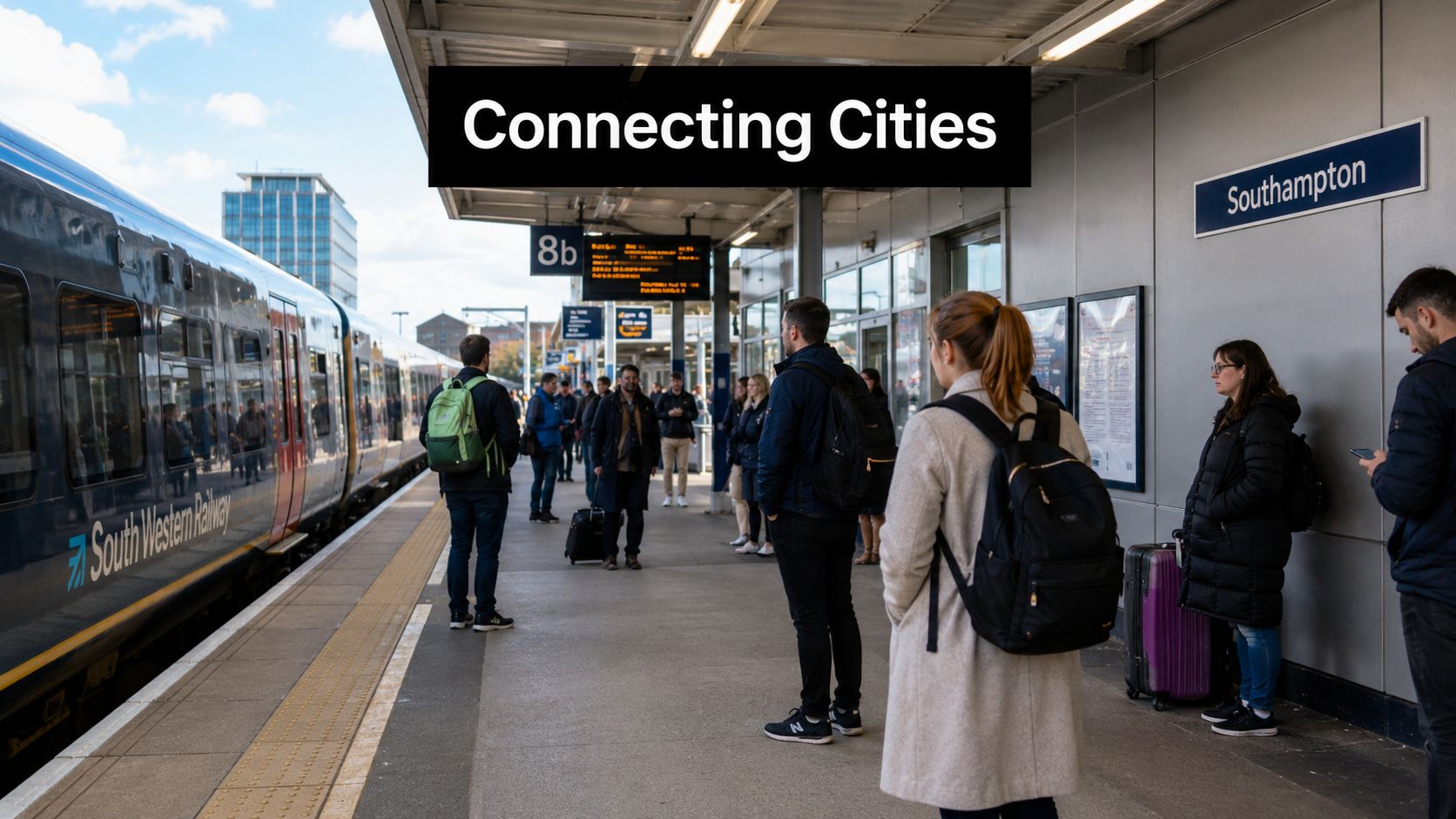
Start with the journey that matters
A common mistake is planning only from Southampton Central to Portsmouth Harbour. That works on paper, but cruise and international visitors usually have a different real route:
- Hotel to station
- Station entrance to platform
- Train ride
- Portsmouth station to final destination
That last segment is where many journeys become awkward. If you're still deciding how to handle the port side of your trip, EC Minibus has a useful guide to Southampton cruise port transfers and connections.
Three questions to answer before you book
- Which Portsmouth station do you need? Portsmouth Harbour and Portsmouth & Southsea are not interchangeable for every traveller.
-
How much luggage are you moving yourself?
A cabin bag is one thing. Two large cases and hand luggage are another. -
Are you travelling on a fixed deadline?
If you're heading to a cruise check-in, ferry departure, or airport link, leave more margin than you think you need.
Practical rule: If a missed connection would seriously disrupt your day, don't plan this as a tight transfer just because the rail journey itself is short.
There's nothing unusual about using the train Southampton Portsmouth route. It's a normal regional journey. What makes it harder for visitors is everything around the train.
Understanding the Train Routes and Operators
This route looks simple until you start seeing different operators, different Portsmouth stations, and a mix of direct and indirect options. That's where visitors often lose time. The main skill here is not just finding a train. It's choosing the right train for your exact destination.
Southern's own journey page shows almost 100 direct trains per day on the Southampton Central to Portsmouth Harbour route, with an average journey time of 48 minutes and a fastest service of 44 minutes. That's why picking the right departure matters. The corridor is frequent, but not every train gives you the same total travel time. You can check those figures on Southern's Southampton Central to Portsmouth Harbour journey page.
Which operators you may see
You may encounter services associated with Southern, South Western Railway, and Great Western Railway on this corridor and its connected routes. For a visitor, the operator matters less than three practical points:
- whether the train is direct
- which Portsmouth station it serves
- whether the stopping pattern is fast or slower
A direct train is usually the easiest option if you're travelling with luggage. Fewer changes means fewer lifts, stairs, platform moves, and fewer chances to miss a connection after a late arrival.
Choosing the right Portsmouth station
Use this quick guide:
| Station | Usually better for | Main consideration |
|---|---|---|
| Portsmouth Harbour | Ferry, harbour area, waterside destinations | Often the more convenient end point if your plans are close to the waterfront |
| Portsmouth & Southsea | City centre stays, some hotels, local onward travel | You may still need a taxi for port or harbour access |
If your booking confirmation mentions a terminal, harbour, dockyard area, or ferry connection, check the exact address before buying a ticket. Many travellers assume “Portsmouth is Portsmouth”. In practice, getting off one stop too early or too late can add hassle when you already have bags.
Direct versus indirect services
Some listings make the journey look like a clean point-to-point ride every time. It isn't always that neat. You may see options that involve another routeing choice or a change.
The fastest train is often worth taking even when the average time looks acceptable. On a short route, a small difference in timetable can matter once luggage and onward transfers are involved.
For travellers who just want the plain answer, this is the one that usually works: depart from Southampton Central, look for a direct train, and choose the Portsmouth stop that matches your actual final address, not just the city name.
A Guide to Ticketing and Saving Money
UK rail fares can feel overcomplicated if you're visiting from North America or arriving after a flight. The good news is that this route doesn't need a complicated strategy. You're mostly balancing price, flexibility, and simplicity.
The three ticket types most visitors notice
You'll usually come across these fare styles when searching UK rail journeys:
- Advance. Usually tied to a specific train. This can suit travellers with a fixed plan, but it's less forgiving if your hotel checkout runs late or your inbound flight has knock-on delays.
- Off-Peak. A middle ground. These tickets are often easier for leisure travellers because they give some flexibility without moving into the highest fare category.
- Anytime. Usually the most flexible and often the least stressful if your day is uncertain.
If you're connecting from a flight, cruise disembarkation, or a private car arrival, flexibility often matters more than squeezing out a small fare saving.
Where to buy
You've got three practical buying options.
-
Operator websites
Good if you want to book directly and avoid extra layers. -
Third-party apps such as Trainline
Convenient for international users because the interface is familiar and easy to follow. -
At the station
Useful if plans are still moving, though queueing isn't ideal when you've just arrived with bags.
Buy in the way that makes changes easiest for you. A slightly tidier booking experience is often more valuable than chasing the perfect fare.
Simple ways to avoid paying more than necessary
A few habits help:
- Book once your plans are real. Don't buy a fixed train too early if the rest of your day is still uncertain.
- Check whether your train is direct. A cheaper ticket isn't always better if it adds a change with luggage.
- Look at the total day cost. Rail fare, taxi to the station, and a final taxi in Portsmouth can change the value calculation.
- Consider visitor railcards if eligible. Some international travellers can use UK railcards, but only if the conditions fit their journey pattern.
What works and what doesn't
What works is choosing a ticket that matches your actual travel day. A solo traveller with one bag and a flexible sightseeing plan can be more price-sensitive. A couple heading to a cruise terminal usually needs a wider time cushion and less friction.
What doesn't work is buying the cheapest ticket first, then discovering it's for the wrong station, the wrong train, or a timing that leaves no room for delay. On this route, convenience often saves more stress than the headline fare.
Your Travel Day From Station to Station
At Southampton Central, the journey usually begins smoothly enough. You enter, check the departure boards, confirm the platform, and wait near the right section of the train if you can. For visitors, the pressure point is rarely finding the station. It's doing all of that while handling luggage, keeping travel documents to hand, and trying to stay flexible if the board changes.
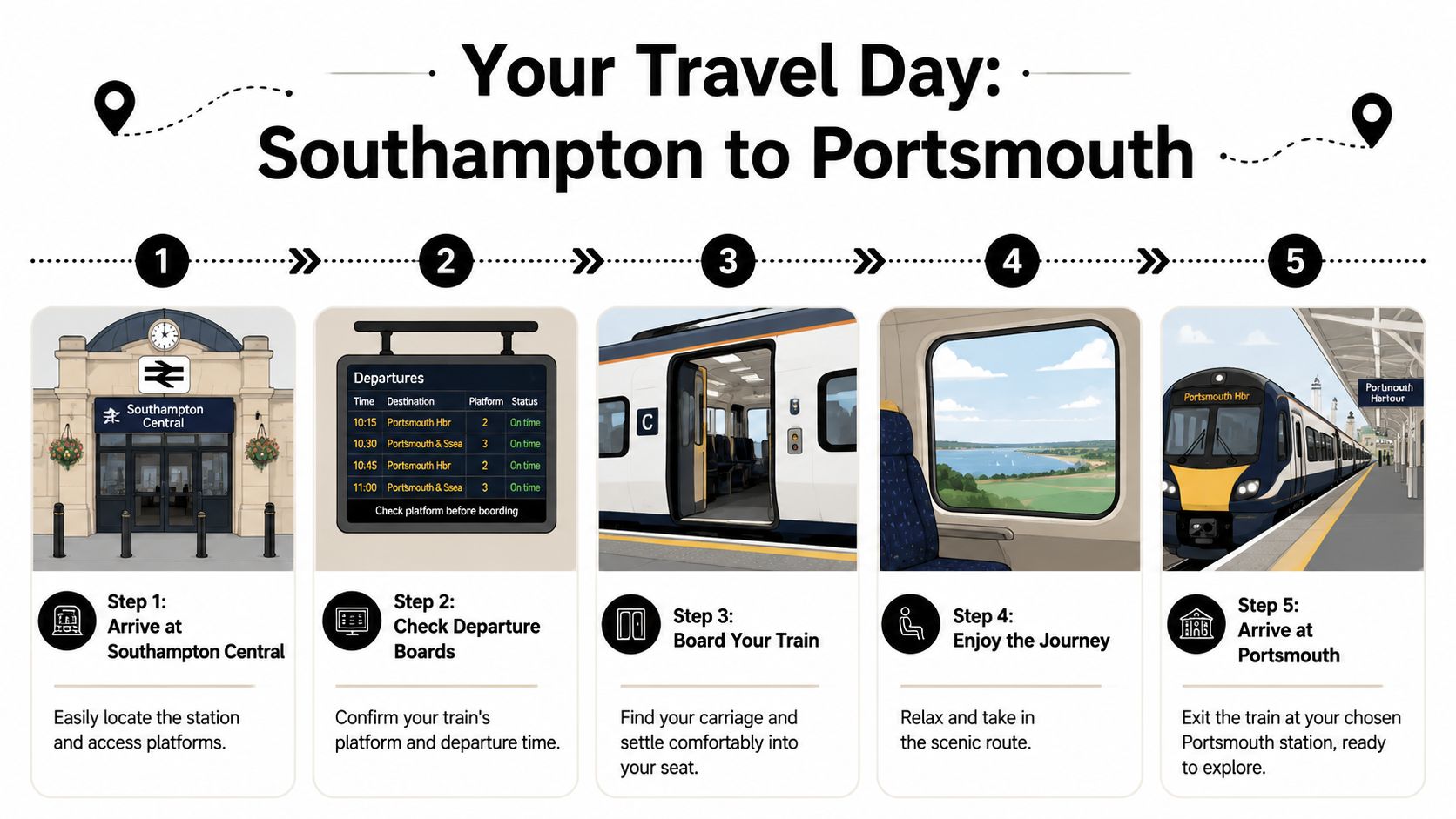
At Southampton Central
Give yourself enough time to move at your own pace. International travellers often underestimate how much slower everything feels with suitcases, coats, printed confirmations, and phones out for tickets.
A calm routine works best:
- Arrive with margin so you're not reading boards while walking quickly with bags.
- Check the exact destination shown on the board, not just the departure time.
- Stand where boarding is easiest for you, especially if you want to avoid rushing through a crowded carriage.
If your broader trip includes an airport connection before or after Portsmouth, it's worth reviewing practical transfer options such as airport shuttle services for UK connections.
On board the train
Once you're on, the trip itself is usually uncomplicated. Store luggage where you can still watch it, keep valuables close, and listen for station announcements rather than relying only on the app.
For a visual sense of the route and station environment, this video is useful:
Passengers used to intercity rail sometimes expect generous luggage handling space. On regional services, that can be less predictable. If the train is busy, large cases can become awkward quickly.
Travel with the mindset that you may need to board, store bags, and get off without much help from staff.
The part most guides skip
The train southampton portsmouth journey can be disrupted by planned works. That matters more than many guides admit, because this corridor serves travellers who often have hard deadlines. RailUK's report on south coast engineering work noted amended services and rail replacement buses between Southampton Central and Fareham on multiple days in April 2025.
For a commuter, that's inconvenient. For a cruise passenger with cases, it can change the whole viability of the journey.
If there's disruption on the day
When delays or alterations appear, the most practical response is usually this:
| Situation | Sensible move |
|---|---|
| Minor delay | Stay with rail if your onward timing still has room |
| Platform change | Move early, especially if lifts are involved |
| Replacement bus announced | Reassess immediately if you have heavy luggage or a fixed check-in |
| Unclear staff advice | Check the operator app and station boards before committing |
The main lesson is simple. Don't assume a short rail route is risk-free. On this corridor, a disruption can affect the whole day more than the published station-to-station time suggests.
Is the Train Best? Comparing Private Transfer Alternatives
The train is often a sensible choice. It's familiar, public, and usually easy to understand once you know the right station pair. But for international visitors, the better question is whether it's the right tool for the full job.
That depends on what kind of traveller you are.
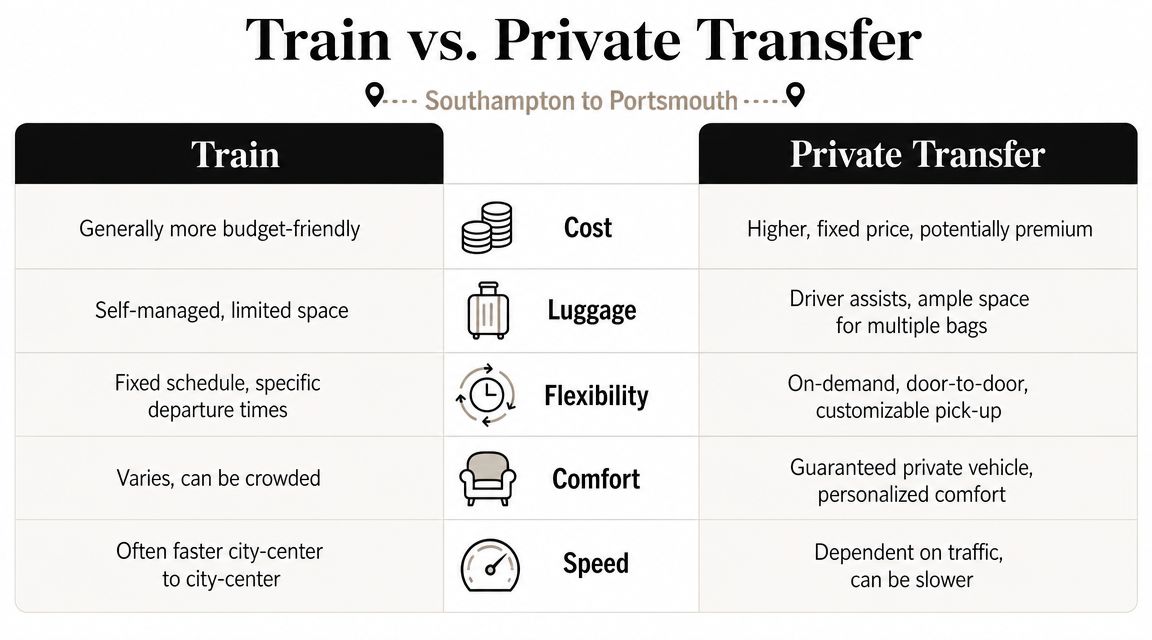
When the train makes sense
Rail works well for travellers who:
- Pack light and can manage their own bags easily
- Don't mind short walks within stations
- Have schedule flexibility if a service changes
- Are going station to station, not door to terminal
For these passengers, the train can be efficient and perfectly reasonable.
When private transfer becomes more practical
The weakness of rail isn't usually the train ride itself. It's the missing middle and last mile. As Omio's route coverage notes, many guides focus on station time and overlook the last-mile problem. For cruise passengers, getting from the station to the specific terminal with luggage can be the hardest part, and a door-to-door private transfer removes that step entirely.
That's especially relevant if you are:
- travelling with multiple cases
- moving with children or older relatives
- dealing with mobility needs
- trying to make a time-sensitive boarding or check-in
A rail journey can be efficient on paper and still be the wrong choice for the actual day.
Side-by-side trade-offs
| Factor | Train | Private transfer |
|---|---|---|
| Door-to-door convenience | No. You manage the station segments yourself | Yes, usually the main reason people book it |
| Luggage handling | Self-managed | Usually easier, especially with larger bags |
| Schedule control | Fixed to train times | Built around pickup and drop-off needs |
| Disruption exposure | Affected by service changes and engineering works | Affected mainly by road traffic |
| Budget fit | Usually lower-cost for many solo travellers | Often more attractive for groups or anyone prioritising ease |
For travellers comparing providers, one option in this space is Southampton cruise terminal car hire and transfer planning through EC Minibus, which focuses on door-to-door port connections rather than station-only travel.
A practical decision rule
Choose the train if you want a normal regional rail trip and your day has slack in it. Choose a private transfer if the whole point is certainty, easier luggage handling, and arriving at the exact address without extra decision-making after the rail leg ends.
Neither option is automatically better. The right answer depends on whether you're buying transport or reducing friction.
Frequently Asked Questions About the Journey
Is this journey suitable for travellers with lots of luggage
It can be, but it's not always comfortable. The rail part is manageable for many people. The harder part is moving through stations and then getting from the Portsmouth station to your final address.
Which Portsmouth stop should I use
Use the stop that matches your real destination. Portsmouth Harbour is often more useful for waterfront and harbour-side plans, while Portsmouth & Southsea can suit city centre stays.
Should I book a fixed train if I'm arriving from elsewhere first
Only if the rest of your day is very predictable. If you're connecting from a flight, disembarking a ship, or relying on another transfer, flexibility is often the safer choice.
Are disruptions something I should genuinely worry about
Yes, especially if you're on a fixed deadline. The route can be affected by planned works or service changes, so checking live status before travel is sensible.
Is the train better than a taxi or pre-booked car
For some passengers, yes. For others, no. If you're travelling light and staying flexible, rail is often fine. If you need a door-to-door journey with easier luggage handling, a private transfer is often the simpler fit.
If you'd rather avoid station changes, luggage handling, and last-mile uncertainty, EC Minibus offers private door-to-door transfers for cruise and airport travellers moving between London, Southampton, Portsmouth, and other major UK connections.