

You've just landed at Heathrow, or you've stepped off a cruise ship at Southampton with luggage, a hotel check-in still ahead of you, and one big question. Can you really do a trip to Bath and Stonehenge in a single day without turning it into a tiring transport puzzle?
Yes, you can. But only if you plan it around logistics first, not wishful thinking.
This route is popular for a reason. Stonehenge reaches back to roughly 3,000 BC and Bath's story begins around 43 CE before rising into its Georgian form in the 18th century, which means one day can cover prehistoric, Roman, and Georgian England in a single corridor from London, with many operators framing it as a 9 to 10 hour day trip from the capital according to this Stonehenge and Bath tour overview. For travellers arriving by air or cruise, that sounds ideal. In practice, the right transport choice decides whether the day feels smooth or rushed.
If you want my blunt advice, start with your real constraints. Are you carrying suitcases? Are you tired from a flight? Do you need to end at a hotel, port, or airport at a fixed time? If the answer is yes to any of those, don't pretend this is a casual hop on public transport.
Table of Contents
- Planning Your Day Trip to Bath and Stonehenge
- Comparing Your Transport Options
- Crafting Your Perfect Day Trip Itinerary
- Booking Tickets and Securing Your Entry
- Essential Tips for a Smooth and Comfortable Day
- Making Your Final Decision
Planning Your Day Trip to Bath and Stonehenge
A client lands early at Heathrow, wants to “see something iconic” before heading into London, and keeps coming back to the same shortlist. Stonehenge for the ancient mystery. Bath for the Roman Baths, elegant streets, and a city that feels unmistakably English. The impulse is right. The planning is where people slip up.
The pairing works because the route is coherent. You're not trying to force together unrelated places. You're moving through a connected part of southern England where two landmark heritage stops make sense in one journey, especially if you want substance rather than a random scenic detour.
That's why this trip appeals so strongly to cruise and airport travellers. You don't need a full countryside holiday to get a meaningful day out. You need one well-run day with realistic timing, sensible entry slots, and transport that matches your energy level.
Practical rule: If you're arriving from a flight or ship, treat the day as a transfer with sightseeing built in, not as an ordinary city day trip.
The three ways people do it
Most travellers end up choosing one of three formats:
- Organised coach tour for a straightforward, fixed plan with other passengers.
- Independent public transport for travellers who like figuring things out themselves.
- Private transfer with sightseeing stops for people who want door-to-door movement, luggage handled, and a more controlled day.
Each option works for the right person. Each fails badly for the wrong one.
The decision that matters most
For a trip to Bath and Stonehenge, history isn't the hard part. Transport is. Stonehenge and Bath are easy to enjoy once you're there. Getting between airport, port, road corridors, timed entry, and end-of-day drop-off is what creates stress.
If you're staying in central London with no luggage and don't mind structure, a coach can be fine. If you're independent, lightly packed, and comfortable with transfers, rail can work. If you're connecting between Heathrow, a London hotel, or a cruise terminal with bags and a clock to watch, private road transport usually makes the day much cleaner.
Comparing Your Transport Options
The wrong transport choice can spoil this route. Not because Bath or Stonehenge are difficult in themselves, but because the combination exposes every weakness in your plan. Delays matter. Transfers matter. Luggage matters.
Start with this visual overview.
Coach tour
A coach tour is the easiest default if you're based in London and want a packaged day. Departure and return windows are usually fixed, and that's both the benefit and the drawback. You don't need to think much, but you also don't control the pace.
This option suits travellers who want clarity more than flexibility. You show up on time, follow the route, and let the operator handle the structure. That predictability is useful if you don't want to figure out roads or stations yourself.
The downside is obvious. A group tour isn't designed around your hotel, your suitcases, or your cruise embarkation timing. If you're moving between transport hubs, the coach may solve sightseeing but still leave you with awkward first-mile and last-mile logistics.
DIY by train and shuttle
A lot of people are tempted by rail because it feels cleaner and more independent. The problem is that there is no direct rail line to Stonehenge. A DIY route typically means train to Salisbury, then a shuttle or bus for Stonehenge, plus another train to Bath, and those linked transfers are widely underestimated according to this review of Stonehenge and Secret England travel planning.
That doesn't make rail impossible. It makes it poor for anyone who is tired, carrying luggage, travelling with older relatives, or working around a cruise departure or airport pickup window.
Public transport rewards confidence and flexibility. It punishes anyone who needs a smooth, guaranteed-feeling day.
If you enjoy transport systems for their own sake, you may find the DIY route satisfying. If your goal is to experience Bath and Stonehenge without friction, it's usually the wrong fit.
Here's a short comparison you can use.
| Method | Best For | Typical Total Duration | Pros | Cons |
|---|---|---|---|---|
| Coach tour | London-based visitors who want structure | Full-day fixed schedule | Simple booking, guided format, no navigation | Fixed timing, limited flexibility, awkward with luggage |
| DIY train and shuttle | Independent travellers travelling light | Varies with connections | Rail-first option, flexible on paper | Multiple transfers, no direct rail to Stonehenge, more stress |
| Private transfer | Airport and cruise travellers, families, small groups | Tailored day on the road | Door-to-door, luggage stays with you, easier pacing | Usually costs more than a group coach |
Private transfer
This is the option many first-time visitors overlook, especially people arriving by ship or flight who instinctively separate “transfer” from “touring”. They shouldn't. Combining them is often the smartest move.
A private road transfer lets you move directly between your real start point and your real end point, while adding Bath and Stonehenge in the middle. That matters if you're going from Southampton to London, from Heathrow to a hotel, or the reverse. One example is a Central London to Southampton transfer via Stonehenge, which shows how sightseeing can be built into a practical transport day rather than treated as a separate excursion.
Here's the advantage. Your bags stay in the vehicle. Your pickup is aligned to your arrival. Your drop-off matches where you need to be. For airport and cruise travellers, that isn't luxury. It's efficiency.
For a quick visual feel of the route, this overview helps:
Crafting Your Perfect Day Trip Itinerary
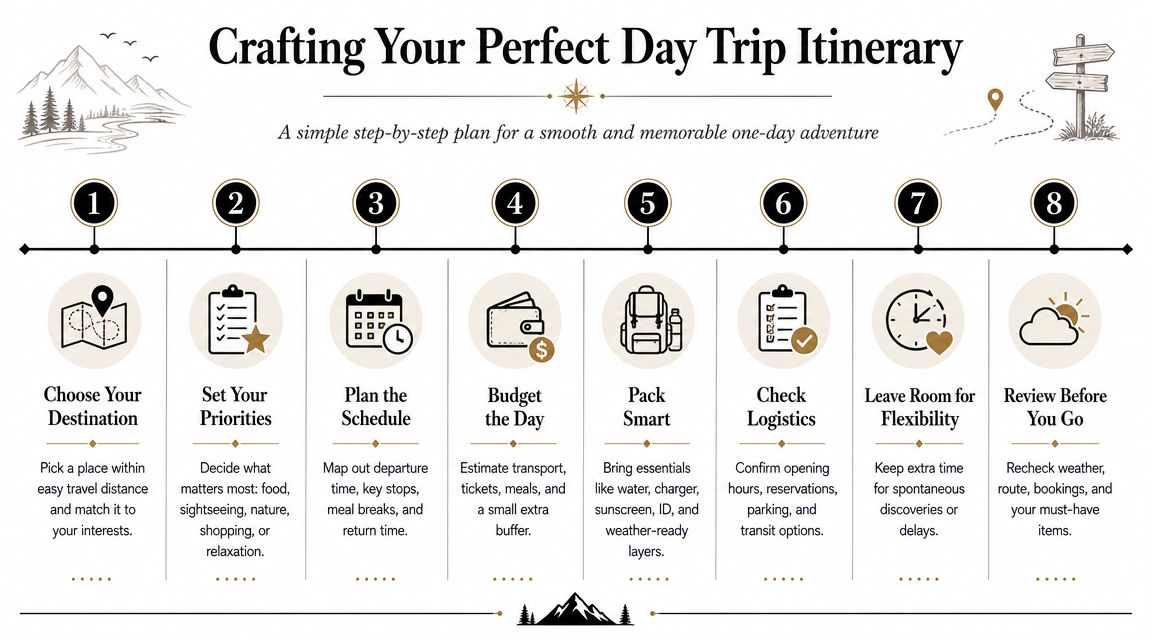
A good trip to Bath and Stonehenge needs a realistic clock. Treat it as a 10 to 12 hour commitment, because with about 4 hours of round-trip driving from London, your useful time for visits and movement between sites shrinks to roughly 6 to 8 hours, as outlined in this private Stonehenge, Bath and Avebury day-tour timing example. Ignore that, and the day starts to feel like a checklist.
This planning graphic is a useful mental model.
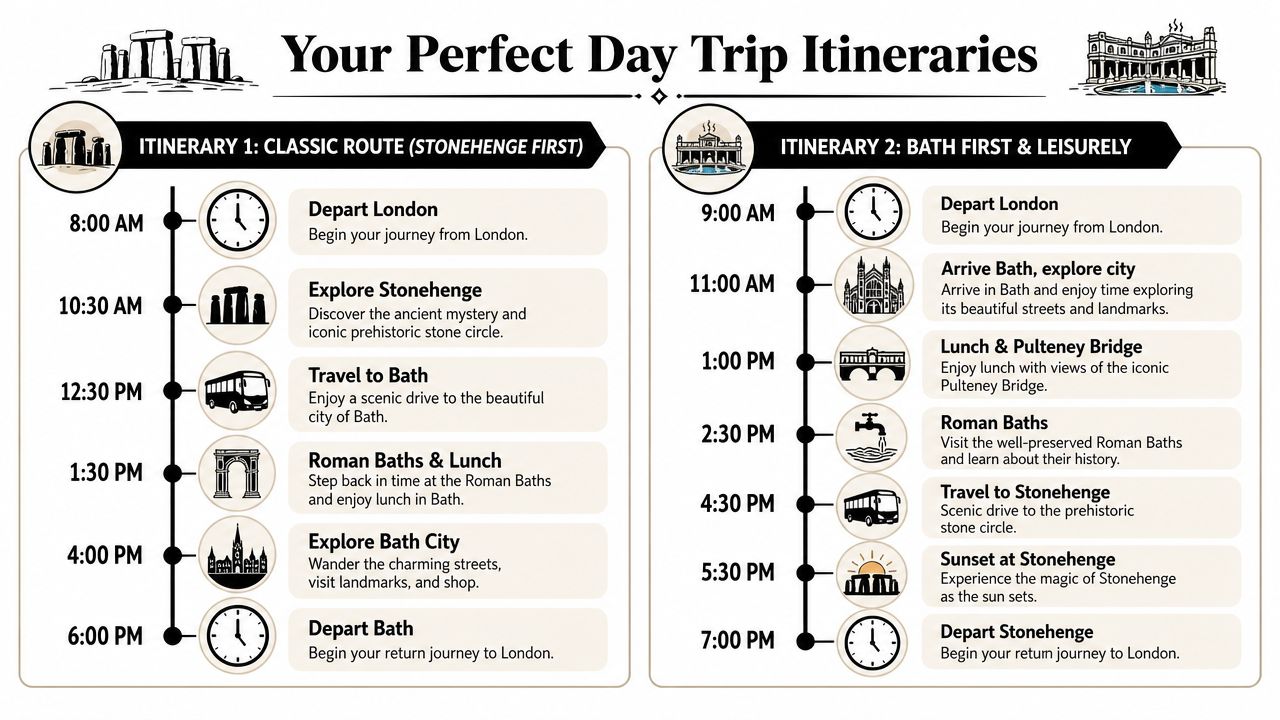
Itinerary one for maximum sightseeing
This is the recommended route. Start with Stonehenge, then move to Bath.
Why? Stonehenge is open-air and more exposed. It generally works better earlier in the day, when traffic and visitor pressure are easier to manage. Bath rewards a later slot because the city gives you more flexibility. You can tour the Roman Baths, have lunch, and still enjoy the streets even if timings shift a little.
A practical structure looks like this:
- Early departure from London or your hotel so the road section is done before the middle of the day.
- Stonehenge first with enough time for the visitor centre transfer, the monument circuit, and basic interpretation.
- Drive on to Bath for lunch and a tighter cluster of city sights.
- Roman Baths timed entry in the afternoon.
- Short walk through central Bath before departure.
If you want the route laid out by another planner, this guide to Stonehenge tours from London gives a good sense of how sightseeing and transfer timing can be balanced on the road.
Itinerary two for a calmer pace
This version suits travellers who care more about Bath than Stonehenge, or who dislike starting the day at full speed.
You begin in Bath, let the city set the tone, and keep Stonehenge for later. That can feel more civilised, especially if you enjoy architecture, lunch stops, and a slower urban stroll before moving to the monument.
The trade-off is that your day becomes more vulnerable to drift. Bath can easily absorb extra time. That's lovely if you've got room in the day. It's not lovely if Stonehenge ends up feeling squeezed.
A workable version looks like this:
- Depart after breakfast rather than at the crack of dawn.
- Spend the late morning in Bath's compact historic centre.
- Have lunch before your Roman Baths entry.
- Leave Bath decisively. Don't keep adding “one more look”.
- Finish at Stonehenge with enough daylight and calm to appreciate the surroundings.
If Stonehenge is non-negotiable, don't leave it to the very end unless your driver schedule and tickets are locked in.
How to choose between them
Choose Stonehenge first if:
- You want the stronger archaeological stop protected
- You're sensitive to crowding and road slippage
- You prefer a more disciplined day
Choose Bath first if:
- You care more about city atmosphere than monument time
- You want lunch and walking to shape the day
- You're comfortable with a little more timing risk
My view is simple. For most first-time visitors, Stonehenge first is the better itinerary. It protects the harder stop. Bath is easier to enjoy after that, even if you simplify the afternoon.
Booking Tickets and Securing Your Entry
Ticketing is where casual planning falls apart. People assume they can “sort it on the day”, then discover that both major paid attractions run on controlled entry.
At Stonehenge, timed reservation thinking is essential. At the Roman Baths, booking ahead matters too, and recent visitor guidance notes entry at around £26 per person with timed reservations that can sell out, as described by Rick Steves's Stonehenge and Avebury guidance. The lesson is straightforward. If you care about seeing the interiors and not just the outside of Bath, pre-book.
What to pre-book first
Book in this order:
- Stonehenge entry time if Stonehenge is your anchor stop.
- Roman Baths slot if Bath is your priority attraction.
- Transport only after you know your ideal visit sequence, unless you're buying a bundled coach tour where entry is included.
This is not a route where vague afternoon intentions work well. Timed entries and road travel need to fit together cleanly.
How transport changes ticket strategy
Coach tours often bundle entry. That's convenient, but it means you accept the operator's timing rather than your own.
Private road travel flips that. You usually keep control of your preferred slot choices, which is useful if you want more time in Bath or if you need the day to begin or end around a flight or cruise. If you already know you want to include Stonehenge admission, this Stonehenge entry ticket option shows the kind of add-on travellers often look for when coordinating transport and attraction access separately.
If you're travelling independently, buy direct from official channels where possible and match every reservation to your actual route. Don't buy an ambitious ticket time and then hope the road or rail network behaves perfectly.
Booking rule: Your ticket times should follow your transport plan, not the other way round.
One more point matters. Not everything in Bath needs a paid ticket. You can walk the city, admire the Georgian streetscape, and enjoy the atmosphere without buying entry to every attraction. That's useful if the Roman Baths are sold out or if you'd rather spend more time outside than in queues.
Essential Tips for a Smooth and Comfortable Day
People usually focus on the postcard image of this route. They think ancient stones, Roman water, pretty streets. They don't think about wind, gradients, queueing, or where the suitcases go. Those details decide whether the day feels easy.
Stonehenge's route is mostly flat but exposed, while Bath's main sights sit in a compact but hilly centre, which is exactly why walking load matters so much for seniors, families, and anyone with limited mobility according to this private chauffeured Stonehenge and Bath accessibility note.
Plan for walking and weather
This isn't a slippers-and-shopping route.
Wear comfortable shoes with grip. Bath's pavements and slopes can tire people faster than expected, especially after a morning at Stonehenge. At the monument, exposure is the issue. If the weather turns, you feel it.
Bring layers rather than one heavy item. You want something easy to remove in Bath and easy to put back on at Stonehenge. A compact rain layer is smarter than hoping for dry skies.
Handle luggage properly
This point matters most for airport and cruise clients. If you're changing hotels, heading to a terminal, or travelling straight from a flight, decide in advance where your bags will be during the day.
Your main options are:
- Leave luggage with a private vehicle if your transport arrangement allows secure storage.
- Travel light on public transport and accept that stations, transfers, and walking become more awkward.
- Avoid joining a sightseeing-heavy day with full luggage unless the operator clearly permits it.
Trying to improvise this mid-journey is a mistake. Bags make every transfer slower and every hill steeper.
A route that feels simple with a daypack can feel exhausting with rolling suitcases.
Keep the day comfortable
A few choices make a big difference:
- Eat lunch in Bath if possible. The city gives you better range and a more relaxed stop than trying to force the meal around Stonehenge.
- Protect your energy early. Don't spend the first half of the day on a stressful chain of connections if you need to be functional later.
- Be realistic about companions. Older parents, children, and post-flight travellers need more buffer than guidebooks imply.
- Don't overpack the day. Adding extra villages or detours sounds attractive, but this route already has enough weight.
If your priority is comfort, simplify. One monument, one city, one clean transport plan. That's enough for a very good day.
Making Your Final Decision

Here's the simplest way to decide.
Pick a coach tour if you're staying in London, travelling light, and want someone else to handle the framework. It's the easiest standard sightseeing format.
Pick public transport only if you are keen on independent travel mechanics and don't mind transfers. This is the least forgiving option once luggage, fatigue, or fixed end times enter the picture.
Pick a private transfer with sightseeing stops if you're arriving from Heathrow, connecting to or from a cruise port, travelling as a family or small group, or want the day to run on your schedule rather than a public one.
That's the key decision. Not “which is best” in the abstract. Which one fits the day you have.
A trip to Bath and Stonehenge is worth doing because it compresses an extraordinary historical range into one manageable route. You go from a prehistoric monument built across a long span of time to a city shaped by Roman foundations and Georgian ambition. Done well, it feels rich, not rushed. Done badly, it feels like too much road and not enough enjoyment.
Choose the transport first. Then book the entries. Then keep the day clean.
If you want a straightforward way to combine sightseeing with a real airport, hotel, or cruise-port transfer, EC Minibus offers private door-to-door transport across London and major cruise routes, with options that can incorporate Stonehenge and Bath into the journey so you don't have to treat the day as a separate logistics problem.