

You're probably at the stage where London still looks simple on paper. Flight booked. Hotel shortlisted. Maybe a cruise departs from Southampton, Dover, Portsmouth or Tilbury a day or two later. Then the practical questions start. Which airport makes the most sense? How much time do you need after landing? Can you trust the Tube with heavy luggage? What happens if your flight is late and your ship won't wait?
That's where most trips to London go wrong. Not because people choose the wrong museum or miss a restaurant booking, but because they treat arrival logistics as an afterthought. London is easy when you're travelling light, staying central, and moving on local time. It gets harder when you're arriving long-haul, carrying cruise luggage, and trying to connect airport, hotel and port without stress.
The calmest London trips are organised backwards. Start with arrival and departure. Then build the sightseeing in between.
Table of Contents
- Your First Steps in Planning a Trip to London
- Navigating Your Arrival at London's Gateways
- Choosing Your Ideal London Transfer Option
- Sample London Itineraries for Every Traveller
- Essential Practicalities for International Visitors
- Your Ultimate London Pre-Travel Checklist
- Your London Trip Questions Answered
Your First Steps in Planning a Trip to London
Start with timing, not attractions
The first decision for trips to London isn't what to see. It's when you want London to feel easiest.
If you want long days, lively streets and the broadest choice of events, late spring through summer feels energetic. The trade-off is obvious. You'll share the city with more visitors, queues are longer, and transfers can feel slower because everyone is moving at once.
If you prefer a calmer pace, the shoulder months usually suit first-time visitors better. You still get a full London experience, but with less pressure to race through your day. Winter can be atmospheric and festive, especially if you enjoy lights, markets and theatre, but daylight is shorter and weather matters more.
Practical rule: Choose your travel month based on energy, not fantasy. If you dislike crowds or get tired after a long flight, don't plan your first London trip around peak-season intensity.
Match your stay length to your energy level
A short stay can work very well in London if you accept its limits. For two or three nights, stay central, keep your schedule compact and group sights by area. Don't spend half your trip crossing the city.
For a longer visit, London becomes much easier. You can mix classic landmarks with slower afternoons, leave room for weather changes, and avoid turning every day into a checklist. That matters even more if your trip includes a cruise connection. A pre-cruise night in London should protect your sailing day, not overload it.
A useful perspective is:
- One night before a cruise: Focus on rest, a simple dinner, and a reliable transfer plan.
- Three nights: See the essentials without rushing everything.
- Five nights or more: Add neighbourhood walks, a museum afternoon, and one day where you don't book much at all.
Build a budget that protects the important parts
Travelers often budget London backwards. They fixate on flights and hotels, then improvise the hard parts after arrival. That's how a manageable trip turns expensive and tiring.
Protect the pieces that remove friction:
- Arrival transport: If you're landing after a long-haul flight, this isn't the place to gamble.
- Accommodation location: A cheaper room far out can cost you time, taxi fares and energy.
- First-day pacing: Overplanning creates avoidable mistakes, especially when jet lag is involved.
- Port transfer planning: If a cruise is involved, this should be booked early and treated as a core part of the itinerary.
For many travellers, the smartest budget move isn't finding the absolute cheapest option. It's avoiding decisions that create stress, missed timings or heavy luggage problems later.
Here's the planning order that works best:
- Lock in your arrival and departure points.
- Choose where you'll sleep based on your first and last movements.
- Reserve the transfer that matters most.
- Only then fill the middle with sightseeing, meals and extras.
That sequence keeps the whole trip stable. London rewards good planning, but it punishes vague assumptions.
Navigating Your Arrival at London's Gateways
A first arrival in London often goes wrong in the same place. Not at immigration or baggage reclaim, but in the 30 minutes after that, when tired travellers have to decide how they are getting to a hotel, rail station, or cruise port.
London handles an enormous share of international tourism to the UK. Over 20 million overnight visits were made to London in 2023, accounting for 53% of all overnight visits to the entire UK, according to the UK Parliament research briefing on tourism trends. That volume explains why the city offers so many arrival routes. It also explains why first-time visitors can lose time quickly if they treat all London entry points as interchangeable.
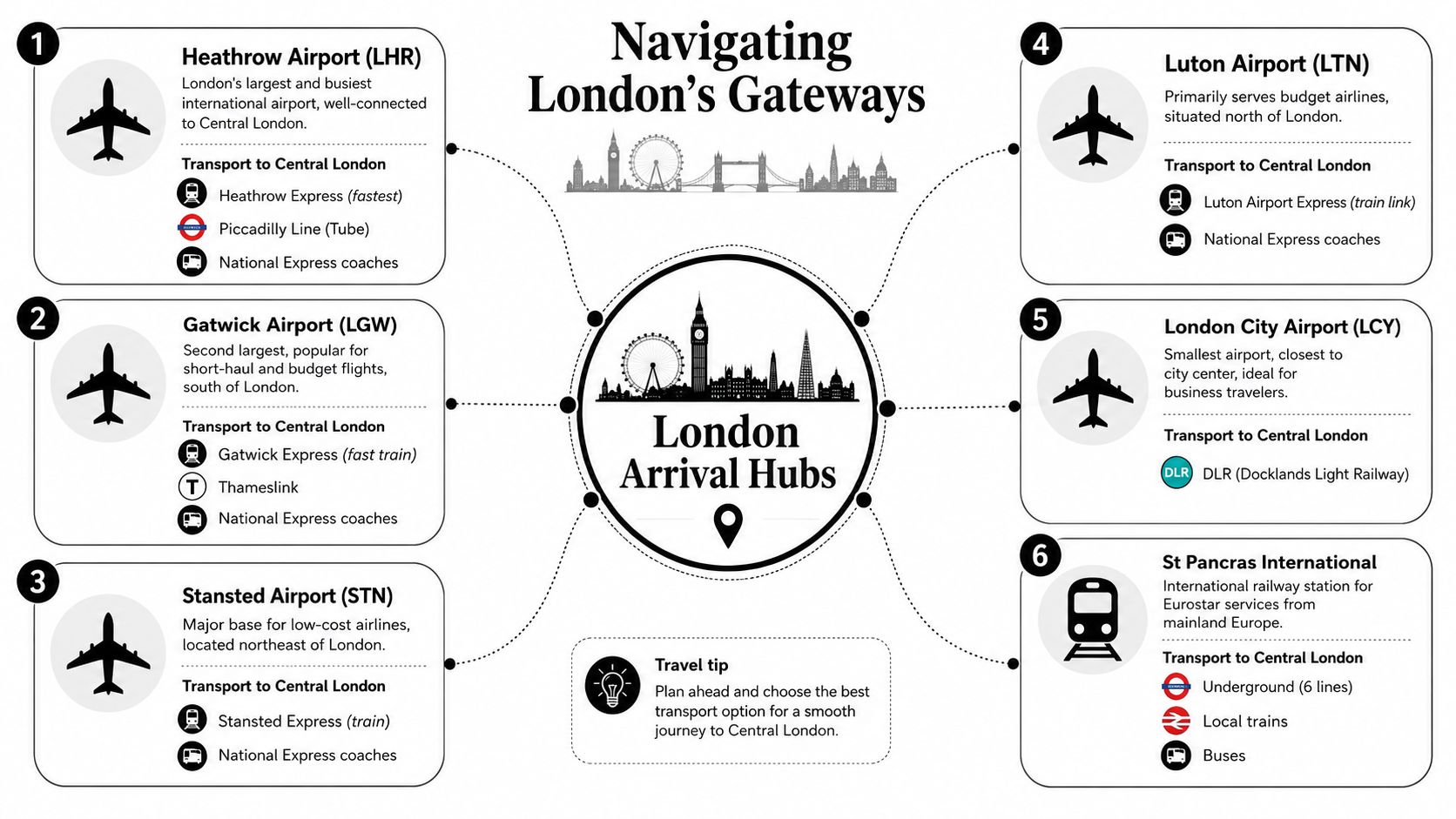
Your arrival point shapes the whole first day
Heathrow is the airport many American and Canadian visitors will use, and it usually works well. It is also large enough that a simple onward journey can start feeling complicated once you add terminal changes, customs queues, luggage carts, and the fact that you have probably just finished a long overnight flight.
That matters most for travellers with a timed next step. A central hotel booking is one thing. A cruise embarkation, a same-day transfer to Southampton, or a hotel stay chosen only because it looked cheap on a map is another.
I advise visitors to judge their arrival gateway by one practical question. What has to happen after you collect your bags, and how much room do you have for delay?
How the main gateways differ in real terms
Heathrow gives you the widest range of onward options, which is helpful if you have planned them in advance. It suits travellers heading into Central London, connecting to national rail, or meeting a pre-booked driver at the airport. The trade-off is scale. Heathrow can absorb time without warning.
Gatwick is straightforward for many central London stays, especially if your hotel sits near a rail connection. For cruise passengers, the route becomes more sensitive because you are usually adding another major leg after the airport.
Stansted and Luton can still work perfectly well, but they tend to be less forgiving for first-time international visitors carrying large cases. If your priority is low airfare, check what that saving means once you add transfer time, train changes, and the possibility of an overnight stay before a port departure.
London City Airport is physically easier to handle and quicker to read on arrival. It is useful for lighter itineraries and shorter city stays. It is less common for travellers building a London-plus-cruise trip from North America.
St Pancras International feels simpler because you arrive in a central location, but central does not always mean convenient. Eurostar passengers with heavy luggage, a hotel switch, or a booked port transfer still need a clear onward plan.
For travellers weighing those trade-offs, this guide to airport transfer options in London helps compare what works after landing, not just what looks good on a map.
Cruise ports change the planning logic
Many general London guides often fall short concerning this aspect. A trip can begin in London and still depend on infrastructure that sits well outside it.
The ports international visitors most often deal with are:
- Southampton, the main departure point for many UK cruises
- Dover, common for some Channel and Northern Europe sailings
- Portsmouth, used on selected itineraries
- Tilbury, which requires a different route strategy from the south coast ports
These are not minor variations. They create different transfer days, different hotel-positioning choices, and different risk levels if your flight lands late or your bags are delayed.
Southampton deserves special attention because it handles a large share of UK cruise departures. In practical terms, that means airport-to-port planning should start long before you think about museums, restaurants, or day trips. If your ship sails from Southampton, your best hotel choice may be the one that reduces transfer stress, not the one nearest a landmark.
A good rule is simple. Base your first London decisions on your next fixed-time commitment. For cruise passengers, embarkation sets the schedule. Everything else fits around it.
Choosing Your Ideal London Transfer Option
A transfer that looks cheap at home can become the hardest part of the trip after you land. The usual pressure points are predictable. You are tired, you are carrying more than city-break luggage, and your next move may have a fixed deadline.
That is why I tell first-time visitors to choose transfers by risk, not by map logic alone.
What works in practice after a long flight
Public transport works well for many London journeys. Inside the city, the Tube and rail network are often the fastest way to cover ground. For an international arrival, especially one followed by a cruise connection, the calculation changes. Many travellers find these journeys frustrating because luggage, station layouts, lifts that are out of service, and tight connection timing turn a simple route into a tiring one.
The question is not whether a train exists. It is whether you want to manage cases, directions, tickets, and platform changes after immigration and baggage reclaim.
For some travellers, the answer is yes. If you are staying near a major station, carrying one manageable bag each, and your plans are flexible, public transport can be sensible. If your trip includes a port departure, larger luggage, or a hotel that requires another cab at the end, the savings often shrink quickly.
London Transfer Options Compared
| Feature | Public Transport (Tube/Rail) | Taxi / Ride-Share | Pre-Booked Private Transfer (e.g., EC Minibus) |
|---|---|---|---|
| Best for | Light luggage, flexible timing, central routes | Shorter city journeys, simple point-to-point rides | Airport arrivals, cruise transfers, families, groups |
| Cost style | Usually lower upfront | Variable, can change with demand and traffic conditions | Fixed in advance |
| Luggage handling | Self-managed throughout | Limited by vehicle size and availability | Planned around passenger and luggage needs |
| Delay protection | You manage missed connections yourself | Depends on when you book and what's available | Usually suited to monitored pickup arrangements |
| Stress level after a long-haul flight | Often highest | Mixed | Usually lowest |
| Suitability for port transfers | Awkward if multiple changes are involved | Possible, but vehicle size can be a constraint | Strong fit for direct door-to-door travel |
Taxi and ride-share services sit in the middle. They are useful for straightforward city hops, especially if you are going from Heathrow to a central hotel with one or two people and moderate luggage. They become less predictable for larger groups. At the airport rank or in an app queue, the vehicle that arrives may not fit four adults and full cruise cases comfortably. Then you are solving the problem on the curb.
A pre-booked private transfer costs more than rail in many cases, but it removes several failure points at once. Pickup is arranged in advance. Vehicle size is matched to the booking. The route is direct. For cruise passengers, that matters more than shaving a little off the transport budget.
Travellers who want to keep one day open for sightseeing before or after a sailing usually do better with compact plans. These easy London day trip ideas for short stays work better than trying to cross the city with bags and a deadline.
When private transfers make the most sense
Private transfers are usually the strongest option if any of the following apply:
- You have cruise luggage. Larger cases are awkward on stairs, escalators, and train changes.
- You are travelling with family or friends. One vehicle is simpler than splitting into two or three.
- Your timing is fixed. Embarkation days and airport departures leave little room for recovery.
- You are arriving from North America. Jet lag makes problem-solving feel harder than it looked on paper.
- You want one continuous journey. Airport to hotel, hotel to port, or port back to Heathrow is easier when one driver handles the full route.
The details matter. A good private transfer should include meet and greet, flight monitoring, clear pickup instructions, and a vehicle sized for your actual luggage count. Fixed pricing also helps, because you know the cost before travel day rather than discovering it during peak demand.
EC Minibus is one example of a service used for London, airport, St Pancras, hotel, and cruise-port transfers. The point is not that every traveller needs a private car. The point is that if a missed or messy transfer would disrupt the whole trip, pre-booking is often the calmer choice.
If your transfer day carries the highest consequence, book the option with the fewest moving parts.
Sample London Itineraries for Every Traveller

The cruise connection
A very common pattern is the one-night London stop before sailing. The smart version is simple.
You arrive, transfer to a central hotel, check in, have an early dinner nearby, and keep the evening quiet. The next morning, leave enough room for a relaxed breakfast and a direct transfer to Southampton or your assigned port. If you do one sightseeing block, make it local and low-friction. Westminster, the South Bank, or a riverside walk works better than trying to cross the city.
For a post-cruise version, reverse the logic. Transfer into London, leave your bags, do one major sight and one easy meal, then stop. The goal is to enjoy London without turning a travel day into a marathon.
The 3 day first timer
This is the classic first visit. You want the landmarks, but you don't want to spend the whole trip underground.
Day 1 works best on foot in one concentrated zone. Start around Westminster for Big Ben, the Houses of Parliament and St James's Park. Continue towards Buckingham Palace if that matters to you, then finish with dinner in Covent Garden or Soho.
Day 2 is better east. Go for the Tower of London area, walk across Tower Bridge, and spend the rest of the day along the river or in Borough Market. You'll see a lot without changing transport modes constantly.
Day 3 should slow down. Pick one museum or one neighbourhood. Notting Hill, South Kensington, or Marylebone all work well. Many first-time visitors enjoy a lighter final day because London can feel larger than expected.
If you want to add nearby excursions after your city stay, this guide to day trips from London is helpful for deciding what belongs inside a short itinerary and what should be saved for a future visit.
The family version
Families usually do better with fewer stops and easier resets.
Start each day with one anchor activity. That might be a museum, a river cruise, a bus-based sightseeing loop, or a major open space such as Hyde Park. Build lunch into the plan early. London gets tiring when children or older relatives are hungry and everyone is standing in queues.
A strong family pattern looks like this:
- Morning: One main activity
- Midday: Sit-down lunch or park break
- Afternoon: One lighter second stop
- Evening: Stay close to the hotel area
This is also where private transport can be worth it even if you use public transport elsewhere. Families with mixed ages often appreciate one easy transfer on the heaviest travel day.
Here's a quick visual overview for pacing a sightseeing day in the capital.
The efficient business trip
Business travellers often underestimate how much time London movement takes. If your meetings are spread across districts, build buffers into the day and avoid promising too much in the evening.
A realistic business trip might look like this:
- Arrival day: Hotel check-in, short local walk, early dinner
- Meeting day: Breakfast meeting, two work blocks, one cultural stop near dinner
- Departure day: Pack early, leave generous transfer time, don't squeeze in a “quick stop” unless it's directly on the route
For business visitors, one carefully chosen London experience is enough. A walk by the Thames, a good meal in a historic district, or a theatre evening can give you the sense of being in London without wrecking the next morning.
Essential Practicalities for International Visitors
Paying, connectivity and small daily decisions
For many international visitors, London is straightforward once a few basics are sorted before departure.
Card payment is widely accepted, and contactless payment is part of everyday life. That means you usually won't need much cash for routine spending. The decision isn't whether to carry a wallet full of notes. It's whether your card works smoothly overseas and whether your bank will flag foreign transactions. If you're weighing public transport payment methods, this overview of daily Travelcard prices and practical fare choices helps clarify when a dedicated transit product makes sense and when contactless is simpler.
Phone data matters more than many travellers expect. Mapping, booking confirmations, live messaging and transfer coordination all depend on having a working connection. If your home roaming package is expensive, sort an eSIM or local SIM before the trip or immediately on arrival. Don't leave yourself dependent on hotel Wi-Fi for your first day's logistics.
The need for clear practical planning is especially strong for North American visitors. London's dominant inbound market remains the United States, and US visitor spending surged by over 70% between 2019 and 2024, according to the Greater London Authority tourism trends report. That reflects how important long-haul travellers are, and it's exactly why details like payment, connectivity and transfer clarity matter.
Safety and accessibility without overcomplicating it
London is a major world city. The sensible approach is the same one you'd use anywhere busy. Keep valuables secure, stay aware in crowded areas, and don't display passports, cash or phones more than necessary.
A few habits make a real difference:
- Keep essentials separate: Don't pack every card and document in one bag.
- Use your hotel address properly: Save it in your phone and keep a written copy.
- Check station access before committing to a route: Some stations are easier with mobility aids or large cases than others.
- Choose convenience over pride: If a route looks awkward with luggage, it probably is.
Travel days are not the time to prove how adventurous you are.
If mobility is a concern, ask practical questions before you travel. Are there steps at the property entrance? Is the bathroom walk-in or over-bath? Can the transfer vehicle accommodate your needs comfortably? The best trips to London feel simple because the awkward details were handled in advance.
Your Ultimate London Pre-Travel Checklist
A short checklist beats a long memory every time.
Three months out
Book the fixed points first. Flights, accommodation, cruise details and the transfer that matters most should be aligned early, especially if you're arriving from overseas and moving onward on a timetable.
Check passport validity and any entry requirements. Review where you'll stay on your first and last nights. If your itinerary includes both London and a cruise port, make sure those handover days are already solved.
One month out
Now tighten the trip.
- Confirm your route logic: Airport to hotel, hotel to port, port to airport.
- Review luggage realistically: Cruise packing often means more cases than a city break.
- Set up payments: Inform your bank and test the card you'll rely on most.
- Sort mobile data: eSIM, roaming package, or local SIM plan.
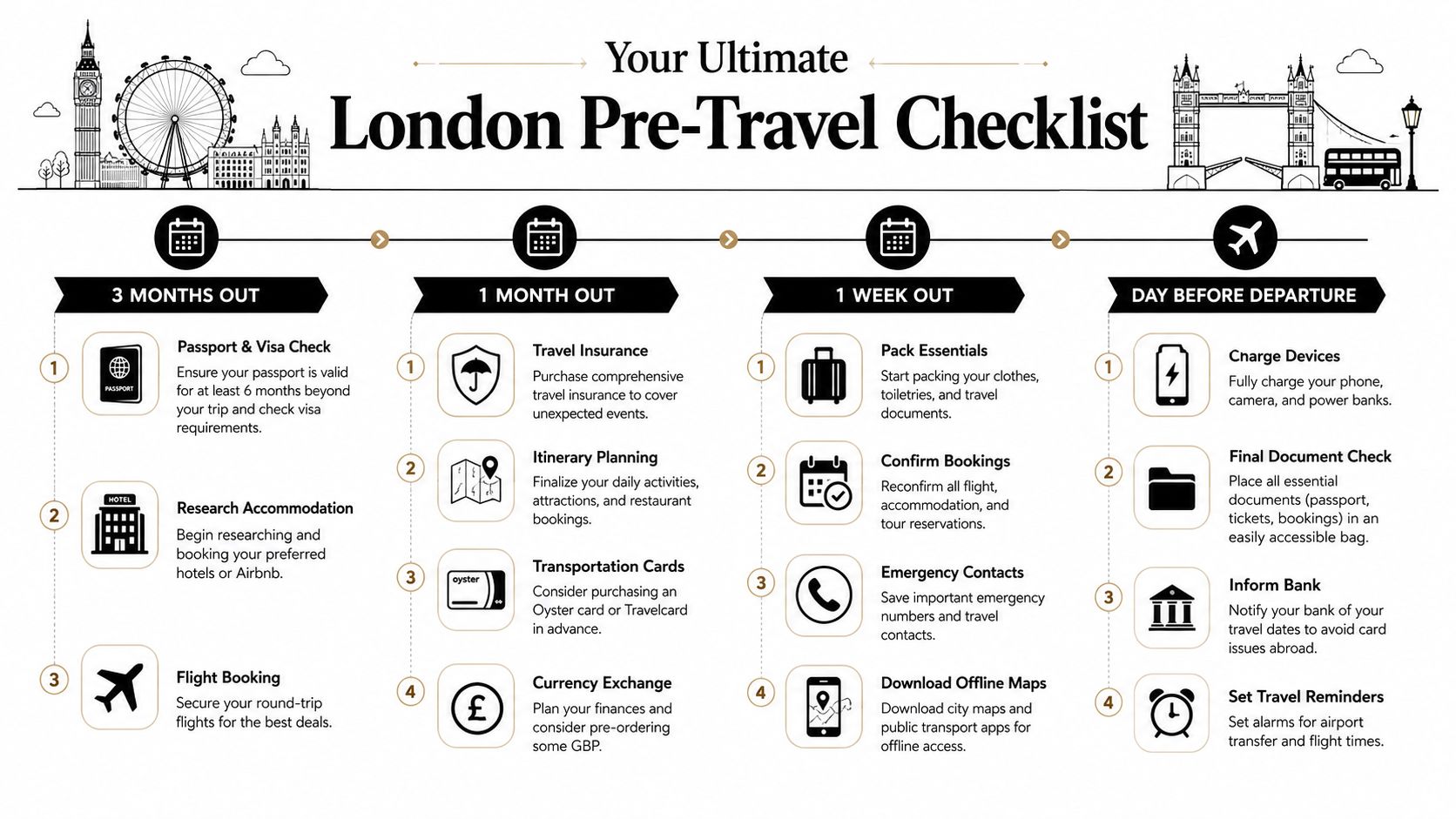
The final week
Here, calm travellers separate themselves from stressed ones.
Reconfirm every booking. Save addresses, booking references and pickup instructions in one place. Download offline maps. Pack layers and a rain-ready outer layer because London weather can change during a single day.
Use this final check:
- Documents ready: Passport, insurance, confirmations.
- Arrival plan clear: You know exactly where you're going after customs.
- Port plan clear: You know pickup time, luggage count and terminal details.
- Phone ready: Charging cable, adapter, battery pack.
- First day realistic: Not overloaded, not vague.
Your London Trip Questions Answered
A first London trip often feels manageable until the handover points start stacking up. Your flight lands late. Bags take longer than expected. You still need to get into the city, sleep properly, and reach a cruise terminal on time a day or two later. These are the points that deserve the clearest plan.
What happens if my flight is delayed?
If you booked a transfer that tracks incoming flights, the pickup time is usually adjusted to your actual landing. That matters most after long-haul arrivals, where late departures, slow disembarkation, and border queues can easily shift your timing by an hour or more.
Check one detail before you travel. Confirm whether the service includes a waiting period after landing, or after the driver first arrives. That small clause affects cost and stress.
How far ahead should I book a cruise terminal transfer?
Book it as soon as your flight and cruise details are firm. Waiting until the final week reduces your vehicle choices, especially if you need extra luggage space or a direct airport-to-port run.
This matters more than many first-time visitors expect. London itself is usually easy to research. The weak point is often the transfer between airport, hotel, and port, particularly for Southampton, Dover, Portsmouth, or Tilbury sailings.
Is it easy to get a large taxi or ride-share at Heathrow?
Sometimes, but I would not build a cruise day around that assumption.
A standard black cab or app car may work for two people with light cases. It is much less reliable for four adults, checked luggage, and cruise bags. You can end up splitting into two vehicles, waiting for a larger car, or paying surge pricing at the worst moment. If your next step is a ship departure or a timed hotel check-in, a pre-booked vehicle is usually the steadier option.
Should I stay near the airport before my cruise?
Often, yes. The right choice depends on your landing time, age and energy level, and how important that first evening in London feels to you.
For many American and Canadian visitors, an overnight flight into Heathrow or Gatwick is followed by poor sleep, heavy luggage, and a body clock that is several hours behind. In that situation, an airport hotel can be the sensible decision, especially if you arrive in the afternoon or evening. If you land early, feel comfortable managing one hotel change, and already have your onward transfer set, a night in central London can work well.
The key is not squeezing in more. It is protecting the next handover.
If you want the transport side of your London trip handled with less guesswork, EC Minibus focuses on the journeys that usually create the most stress for international visitors: Heathrow arrivals, Central London hotel pickups, St Pancras connections, and transfers to Southampton, Dover, Portsmouth and Tilbury. It suits travellers who want one door-to-door plan instead of piecing together separate legs on arrival.