

You've just left a long-haul aircraft at Heathrow. Your passport is in one pocket, your family is tired, and the cruise departure time is fixed whether your suitcase appears quickly or not. Finding the right baggage claim at Heathrow is only the first job. The real test is moving from passport control to the carousel, through customs, and into your onward transfer without losing time or control of your luggage.
Heathrow's own guidance confirms the basic sequence: passport control comes before baggage reclaim, flight information screens identify your belt, and the missing-baggage desk is usually inside the reclaim hall. Ground handlers, rather than Heathrow itself, manage the physical delivery of checked bags. Keep that distinction in mind, because it determines who you speak to when something goes wrong.
Table of Contents
- Arriving at Heathrow and What to Expect
- Terminal by Terminal Baggage Reclaim Locations
- Typical Wait Times and Baggage System Performance
- What to Do If Your Luggage Is Delayed or Lost
- Customs Procedures and Tips for Families and Cruise Passengers
- Streamlining Your Transfer with Meet and Greet Luggage Help
- Your Heathrow Arrival Checklist
Arriving at Heathrow and What to Expect
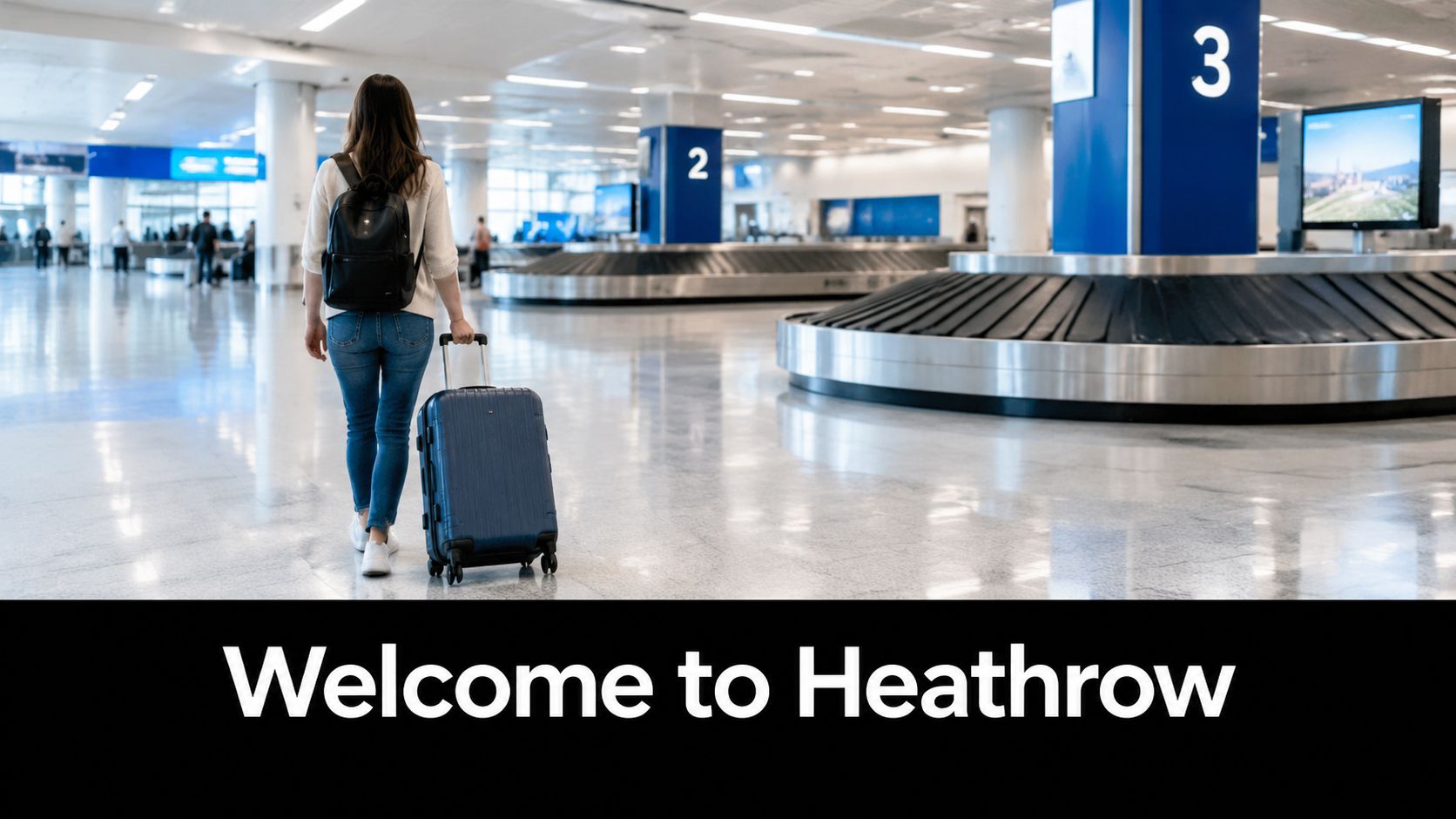
After disembarking, follow the purple and yellow signs towards Arrivals, Passport Control, and Baggage Reclaim. The walk can feel longer than expected, particularly after a wide-body flight that has parked far from the terminal building. Don't stop to organise every document immediately. Keep your passport, arrival information, and mobile phone accessible, then continue with the main passenger flow.
The first part of your arrival
International passengers normally clear passport control before reaching the reclaim hall. Once you're through, check the screens for your flight number and belt assignment. Heathrow specifically advises passengers to use these screens rather than relying on memory or following another group from the same aircraft. Belts can change, and a busy hall makes the wrong turn surprisingly easy.
The reclaim area is landside, so once you leave it through customs, you generally can't return to the belt. That's why you should inspect your suitcase, check every tag, and report a problem before exiting. Families should nominate one adult to watch the belt while another gathers pushchairs or keeps children together.
Practical rule: Don't arrange your onward transport around touchdown time alone. Your driver needs to meet you after passport control, reclaim, and customs, not when the aircraft reaches the stand.
Heathrow's active passenger terminals are Terminals 2, 3, 4, and 5. Your arrival terminal affects the walking route, reclaim layout, available exits, and the place where a pre-booked driver can meet you. If you've arranged a private airport transfer service, share your flight number and terminal in advance, then follow the agreed meeting instructions after customs.
For cruise passengers, the luggage transition deserves extra thought. A family heading to Southampton may have several large cases, cabin bags, medication, and children's equipment. The easiest approach is to keep passports and small valuables in one personal bag, leave cruise luggage tags attached until you reach the port, and avoid repacking in the reclaim hall unless absolutely necessary.
Terminal by Terminal Baggage Reclaim Locations
Heathrow's reclaim halls have different shapes and walking patterns, but the operating principle is the same in every terminal. Clear passport control, read the flight information screens, locate the belt, and stay in the hall until you've checked your luggage and dealt with any issue.
Terminal 2
After immigration, follow signs for the central baggage reclaim area. Terminal 2's reclaim operation is arranged over two levels, so don't assume the first visible belt is yours. Read the screen carefully for the flight number, origin, and belt assignment before walking further into the hall.
The hall can become difficult for families when pushchairs, car seats, and several cases arrive together. Keep one person near the belt and position the group where trolleys can move past without blocking the circulation route. Passengers with reduced mobility should request assistance through the airline or airport support process rather than waiting until the reclaim hall becomes crowded.
Terminal 3
Terminal 3 uses one large reclaim hall. That makes the basic route easier to understand, but the space can feel vast after a long walk from passport control. Follow the overhead signs, then compare your flight number with the screen at the belt.
Don't select a carousel because it's closest to the entrance. Terminal 3's hall gives passengers enough room to spread out, and the correct belt may be several rows away. If your group has heavy luggage, take a trolley before collecting the first case. It's easier to manage the trolley at the belt than to return through a crowded hall.
Terminal 4
Terminal 4's reclaim route is comparatively compact, which helps passengers travelling on smaller carriers or arriving on less crowded services. Follow the signs from immigration directly into the hall and check the information screens immediately.
Connecting passengers should confirm whether their bags are tagged through to the final destination or whether they must collect and recheck them. The airline handling your journey provides that answer. Don't leave the reclaim area based on an assumption, particularly if your next flight departs from another terminal.
Terminal 5
Terminal 5 has the most complex reclaim environment for many passengers because the hall is spread across separate zones. British Airways passengers and families arriving on long-haul services should check the screen before walking towards a belt. A wrong turn at Terminal 5 can mean a long return walk with tired children and heavy luggage.
Keep your group together until you've identified the correct zone. Passengers using wheelchairs or travelling with pushchairs should use the lifts and accessible routes marked by the terminal signs. If a pushchair is delivered at the aircraft door rather than the belt, ask airline staff where to collect it before leaving the reclaim area.
Across all four terminals, the screen is the authority. Belt numbers, carousel positions, and arrival information can change during the reclaim process, so check again if your flight hasn't appeared.
Typical Wait Times and Baggage System Performance
There isn't one reliable Heathrow waiting time. Delivery depends on the terminal system, ground handler, aircraft type, arrival bank, and whether bags were loaded correctly for the flight. Heathrow-specific guidance gives typical first-bag windows of around 15 to 25 minutes for domestic flights, 20 to 30 minutes for short-haul European flights, and 35 to 50 minutes for long-haul flights, with wide-body arrival banks sometimes extending to 75 minutes or more. These figures come from Heathrow baggage timing guidance, and they're useful for planning a transfer rather than promising a result.
| Terminal | Average Wait Time | Peak-Hour Wait Time | Number of Carousels | Key Notes |
|---|---|---|---|---|
| Terminal 2 | Varies by flight and aircraft | Can extend during busy arrival banks | Check the live screen | Two-level reclaim arrangement |
| Terminal 3 | Varies by flight and aircraft | Can extend when several wide-body flights arrive together | Check the live screen | Large single hall |
| Terminal 4 | Varies by flight and aircraft | Can extend during concentrated arrival periods | Check the live screen | Compact passenger flow |
| Terminal 5 | Varies by flight and aircraft | Can extend across separate reclaim zones | Check the live screen | Confirm the correct zone before walking |
What the performance figures mean
Heathrow reported overall baggage connection performance of 98.3% in 2024 and 98.8% in 2025, as recorded in the Civil Aviation Authority airline-community response document. That's strong system-wide performance, but a high percentage doesn't make an individual missed bag less disruptive. At a hub handling very large passenger volumes, a small failure rate can still affect many travellers.
The same document recorded 38 significant baggage-system incidents affecting 88,523 bags across the months shown from December 2024 to July 2025. Heathrow defines a significant incident as one involving more than 100 bags that failed to fly with the passenger because of a baggage-system issue. The lesson is practical: most passengers receive their bags, but you should still protect your schedule with a sensible buffer.
If you're travelling to a cruise port, use your estimated arrival time as an operational planning tool, not a guess based only on landing. Tell your transfer provider whether you have checked luggage, mobility equipment, or children's items. A driver who knows your flight and luggage situation can plan more effectively than one expecting you at the kerb immediately after touchdown.
What to Do If Your Luggage Is Delayed or Lost
A silent carousel doesn't mean the bag is permanently lost. It does mean you should act before leaving the reclaim hall. Heathrow recorded 636 unresolved lost or delayed luggage complaints referred to the Civil Aviation Authority in the report covering 2024, and the figure was reported as 397% higher than the UK airport average. The report also found that UK airport delays in returning delayed luggage averaged nearly eight days, so don't postpone the report until after reaching your hotel or ship.
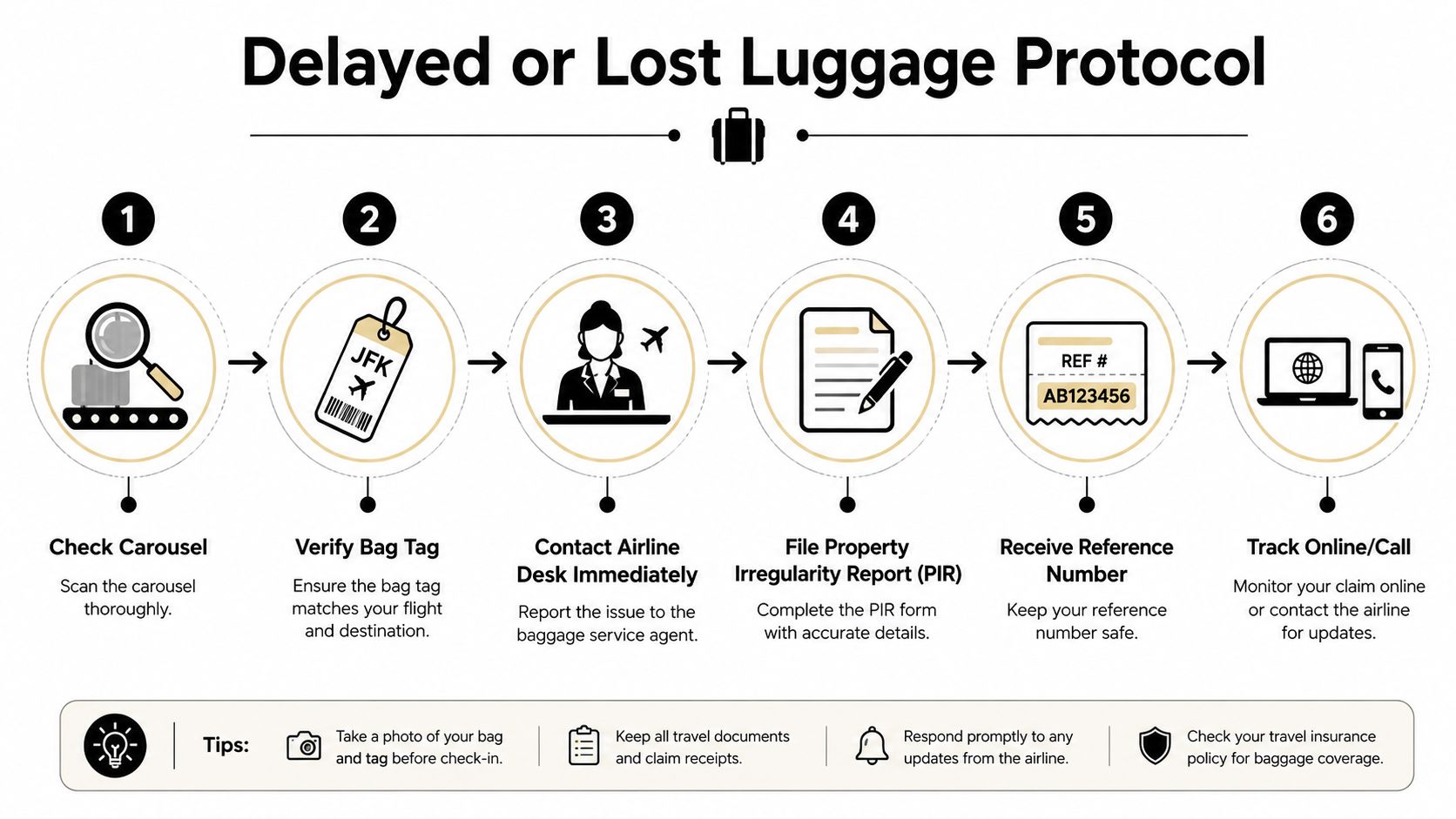
Follow this order
- Check the belt again. Look around the carousel, adjacent belts, and the oversize-luggage area. Bags can be placed separately because of their size, shape, or handling requirements.
- Verify the tag. Compare the baggage tag number with your receipt and inspect similar cases. Photograph the bag, tag, and any visible damage before moving away.
- Find the airline's baggage desk. Heathrow states that the missing-baggage desk is typically in the reclaim hall. Ground handling manages delivery, so start with the airline or its appointed handling agent, not a general airport information desk.
- File a Property Irregularity Report. Provide your flight details, baggage-tag number, contact information, accommodation or cruise-port details, and a clear description of the bag. If you're sailing soon, give the representative the ship's name, port, and boarding deadline.
- Keep the reference number. Photograph the report and save the reference in your phone, email, and travel documents. You'll need it when tracking the case or speaking to the airline again.
- Ask about delivery and essential expenses. The airline can explain its process for delayed, damaged, or permanently missing baggage. Keep receipts for necessary replacement items and check the airline's claim instructions before buying anything beyond essentials.
Delayed, damaged, or lost
These categories require different evidence. A delayed bag is missing but may still be located through the airline's tracing system. Damaged luggage should be reported while you're still in the hall, with photographs of the case and the damage. A bag that remains unlocated after the airline's tracing process may move into a lost-baggage claim, where the carrier will request further documentation.
Cruise passengers should be especially direct. A ship won't wait for a suitcase, and delivery to a moving vessel can be harder than delivery to a fixed hotel. Ask whether the airline can deliver to your first port, then keep the PIR reference and every message available throughout the journey.
Customs Procedures and Tips for Families and Cruise Passengers
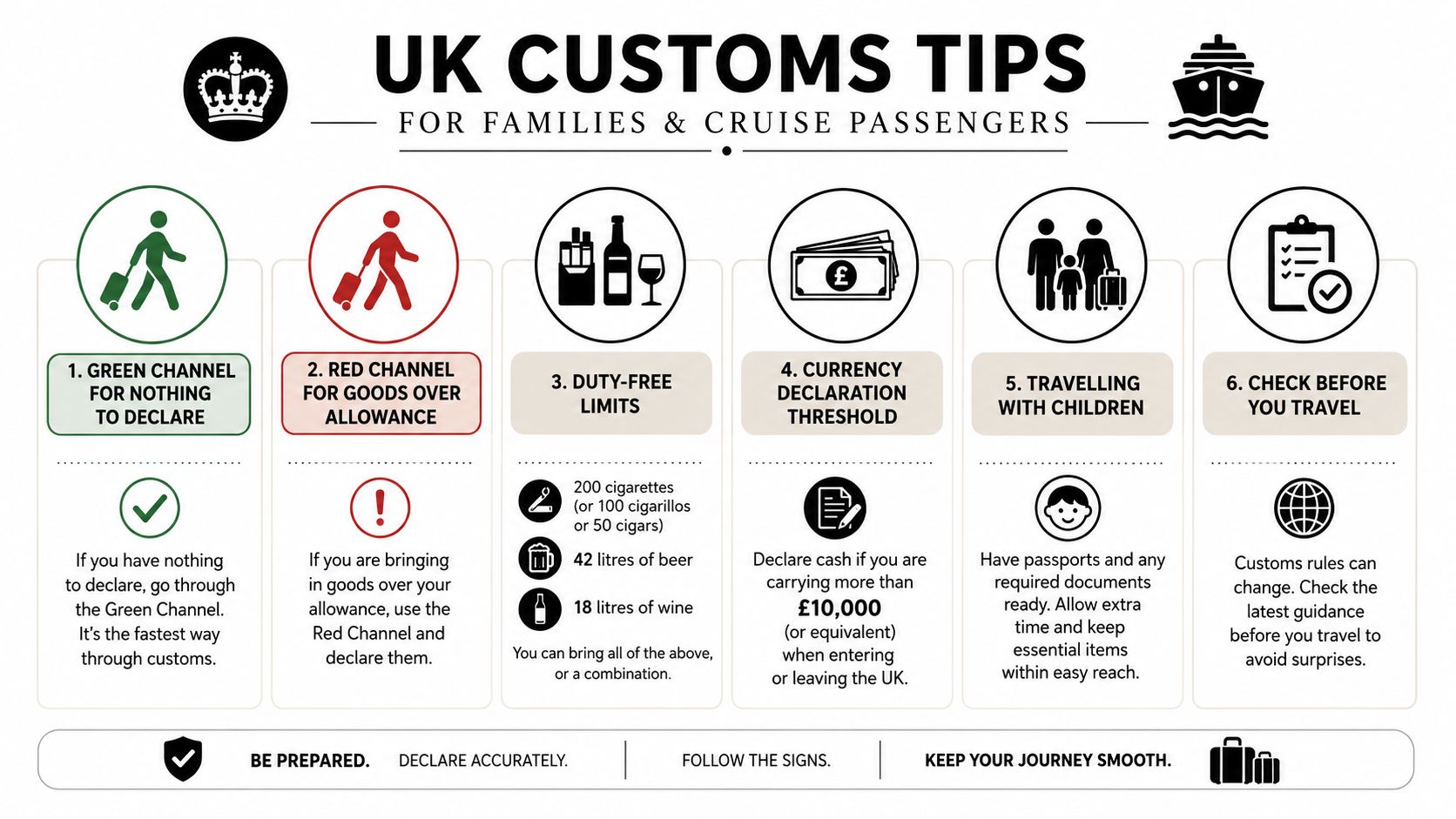
After reclaim, you'll pass through UK customs. Use the green channel only when you have nothing to declare. If your goods exceed the permitted allowance, or if you're carrying restricted or prohibited items, use the red channel or speak to an officer. Don't choose green because the queue looks shorter.
The customs decision belongs to the traveller carrying the goods. Parents should make sure children understand that adults are responsible for the contents of shared luggage. If you're uncertain about alcohol, tobacco, commercial goods, food, medication, or equipment, stop and ask before exiting.
Make the family exit orderly
Keep passports together until every member of the party has cleared the relevant checks. One adult should handle documents while another manages the trolley, pushchair, and children. Don't distribute passports among several coat pockets, especially after an overnight flight when everyone is tired.
For cruise groups, attach clear luggage labels showing the passenger name and ship details, but don't display sensitive information openly. Keep the cases grouped by family or cabin so the driver can load them efficiently and you can identify anything missing before departure.
A pushchair, wheelchair, musical instrument, or sports case may follow a different collection process. Ask airline staff where to collect oversized items before you head towards customs. If an item hasn't arrived, report it before leaving the controlled area.
For cruise passengers: Treat customs as the final checkpoint before the transfer, not as a place to reorganise your entire luggage collection. Sort bags at the port or hotel, where you have more room and less pressure.
Families should also keep medication in hand luggage, together with prescriptions or supporting documentation where appropriate. That prevents a delayed checked case from creating an immediate health problem and makes questions from officials easier to answer.
Streamlining Your Transfer with Meet and Greet Luggage Help
The difficult part of Heathrow arrivals often starts after the carousel. You've collected the bags, cleared customs, and now need to find transport while managing cases, children, mobility equipment, and an unfamiliar terminal. Public transport may involve lifts, platforms, changes, and a separate journey from station to hotel or cruise terminal. A standard taxi rank removes some planning, but it doesn't guarantee that the vehicle has enough luggage capacity for a cruise party.
A pre-booked private transfer solves the coordination problem before you land. The service should have your flight details, terminal, passenger count, destination, and luggage requirements. The driver waits at the agreed arrivals meeting point after customs, rather than expecting you to locate a vehicle outside the terminal.
What the handover should look like
A proper meet and greet is more than a name board. The driver should identify the booking, help move heavy or oversized luggage, and guide the group to the vehicle. That matters at Heathrow because the party often reaches the arrivals hall in stages. One person may still be collecting a pushchair while another is dealing with a delayed suitcase or a tired child.
Heathrow meet and greet service arrangements are particularly useful for passengers travelling from the airport to Southampton, Dover, Portsmouth, or Tilbury. The essential question isn't whether a vehicle is available. It's whether the provider has planned for your actual luggage and destination.
EC Minibus offers Heathrow meet and greet pickup after customs, assistance with luggage, and private transport for airport, hotel, rail, and cruise-port journeys. It also provides flight and cruise monitoring, fixed pricing, and online booking through EC Minibus. Treat it as one option to compare with other pre-booked transfer providers, and confirm vehicle capacity before payment.
Book for the real group
Give the provider the number of adults and children, the number of checked cases, cabin bags, pushchairs, wheelchairs, and any unusual equipment. A vehicle that fits passengers may not fit a cruise party's luggage. Ask where the driver will wait, what name will appear on the board, and what contact number you should use if the group exits through a different door.
For a family, door-to-door travel removes several handling points. For cruise passengers, it protects the fixed connection between Heathrow and the port. The best transfer is the one that continues the arrival plan instead of forcing you to start a new logistics exercise outside the baggage hall.
Your Heathrow Arrival Checklist
Save this before departure and send it to every adult in your group.
- Confirm the terminal and flight number. Use the live Heathrow screens to find the correct reclaim belt.
- Follow signs to passport control and baggage reclaim. Keep passports and essential documents accessible.
- Collect every item. Check the belt, oversize area, pushchair collection point, and baggage tags before leaving the hall.
- Inspect and photograph luggage. Record damage while you're still in reclaim, not after reaching the vehicle.
- Report missing bags immediately. Visit the airline's baggage desk, file the PIR, and save the reference number.
- Choose the correct customs channel. Declare goods when required, and ask an officer if you're unsure.
- Regroup after customs. Count cases, keep cruise tags attached, and make sure children and pushchairs are together.
- Find the agreed meeting point. Check the driver's name, booking details, and contact number before moving away from arrivals.
- Load methodically. Put passports, medication, phones, and cruise documents in the passenger area, not buried in the luggage compartment.
Heathrow baggage claim becomes manageable when each person has a role. One adult watches the screens, one collects bags, one manages children or mobility equipment, and one handles the driver contact. Share this checklist before landing so the group can move together instead of making decisions while tired.
EC Minibus provides private Heathrow transfers with meet and greet assistance, luggage help, flight monitoring, and direct connections to Southampton, Dover, Portsmouth, Tilbury, London hotels, and St Pancras. Visit EC Minibus to check your route, vehicle requirements, and booking options before you fly.