

You've landed at Heathrow, your flight tracker says “on time”, and your cruise departure is still ahead. Yet the question that matters isn't when the aircraft touches down. You need to know when you'll have your luggage, clear the terminal, find your driver, and begin the journey to Southampton, Dover, Portsmouth, or Tilbury.
That's the practical meaning of estimated arrival time for a transfer passenger. It's a planning window, not just a flight timestamp. Once you separate aircraft arrival from passenger exit and onward road travel, your pickup arrangements become much easier to judge.
Table of Contents
- What Estimated Arrival Time Really Means for Transfer Passengers
- The Two-Stage ETA Model Every Traveller Should Understand
- Key Factors That Shift Your Estimated Arrival Time
- How EC Minibus Determines and Updates Your ETA
- Real-World ETA Scenarios for Cruise and Airport Transfers
- Practical Preparation Tips to Reduce ETA Uncertainty
- Frequently Asked Questions About Estimated Arrival Times
What Estimated Arrival Time Really Means for Transfer Passengers
A cruise passenger can watch the flight status change from “approaching” to “landed” and still be nowhere near the arrivals curb. The aircraft may have reached the runway, but passengers still need to taxi to a stand or gate, leave the aircraft, pass through border control where applicable, collect bags, and walk to the agreed meeting point.
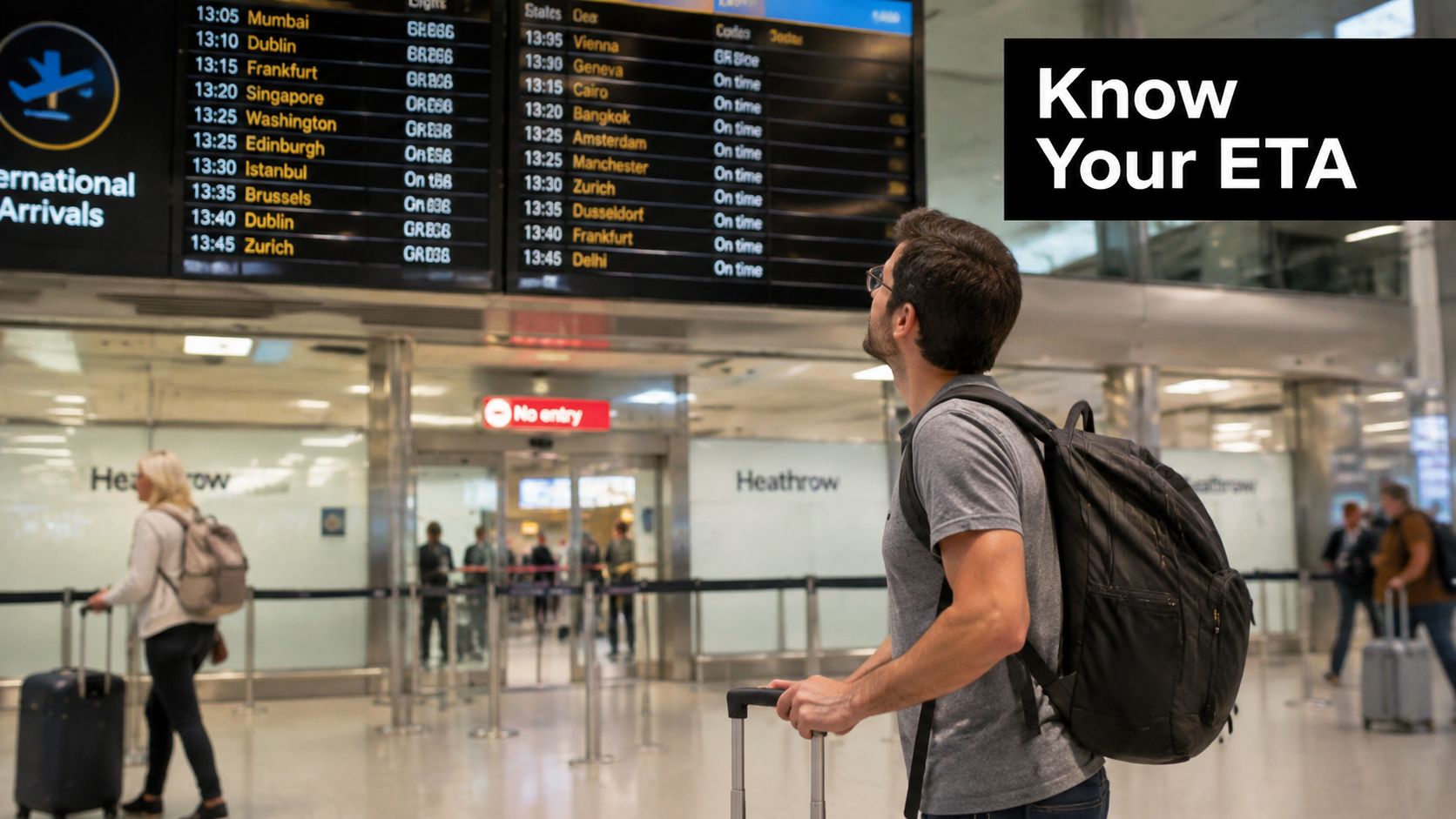
For transfer planning, it helps to use two different timestamps:
- Aircraft arrival time, the point associated with landing or reaching the airport terminal.
- Transfer-ready time, the point at which you're outside the arrivals process and ready to meet your driver.
The first is what most airline apps display. The second is what a private transfer needs.
Why the distinction affects your journey
Suppose a booking shows an aircraft arrival in the morning. That doesn't automatically mean the driver should meet you at that exact minute. If you've checked luggage, travelled with children, or need assistance through the terminal, your usable pickup time comes later. A journey to a cruise port also needs road-travel time after the airport stage has finished.
The same principle applies to a hotel transfer. A business traveller may land at Heathrow and still need a realistic window before reaching a Central London hotel, especially if the road journey falls during a busy period. A single flight ETA can't represent every stage of that movement.
Practical rule: Ask, “What time should I expect to be ready at the pickup point?” rather than, “What time does my plane land?”
A pickup window gives the driver and passenger room to manage normal variation without treating every minute as a failure. Buffer time protects the next commitment, such as cruise check-in, a meeting, or a train connection. A professional operator uses the flight time as an input, then interprets it alongside the airport exit process and onward route.
That's why the arrival time on a booking confirmation should be treated as the start of a coordinated plan, not the final answer. For international passengers, the useful ETA is the time you can leave Heathrow.
The Two-Stage ETA Model Every Traveller Should Understand
The two-stage model separates the journey into flight arrival and passenger readiness. This avoids the common mistake of treating wheels-down time as the moment a transfer can begin.
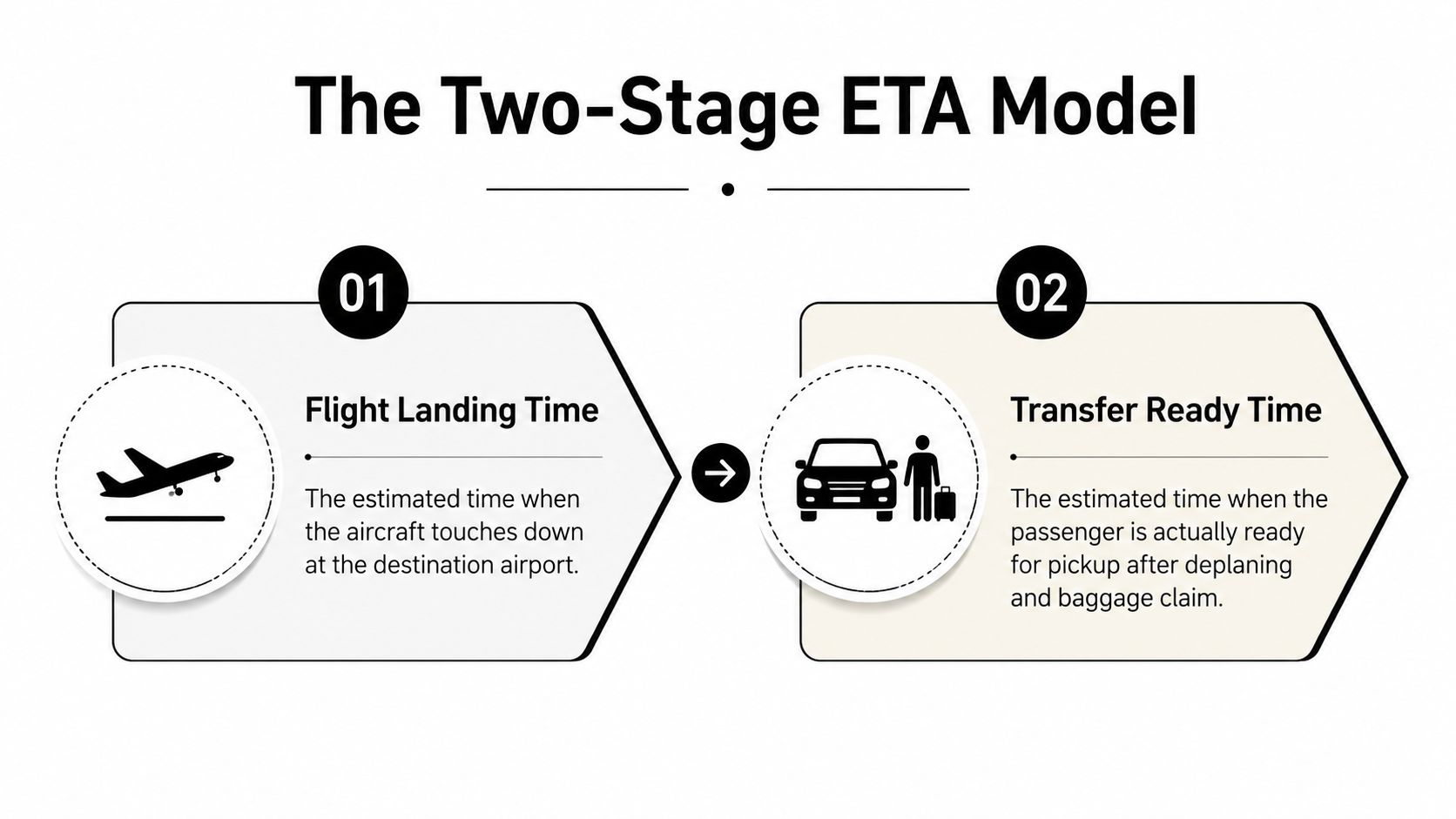
Stage one is the aircraft movement
Stage one begins with the aircraft reaching the airport and continues through taxiing and the final arrival at the terminal area. Public punctuality figures can use different definitions for these moments. The UK Civil Aviation Authority methodology publishes punctuality information for major UK airports using runway-reach times, then converts those results to terminal times with average taxiing durations. The methodology behind UK airport punctuality reporting therefore helps with broad network planning, but it can't describe the exact experience of one passenger at one gate.
A flight app may update rapidly after landing, while the aircraft is still moving through the airport. That information is useful, but it isn't the same as a confirmed curbside meeting time.
Stage two is the airport exit
Stage two begins when passengers leave the aircraft. It includes several activities that don't appear in a basic flight ETA:
- Walking from the aircraft to border control or the baggage area.
- Waiting for border processing where required.
- Collecting checked luggage.
- Finding the arrivals hall and walking to the pickup location.
- Locating the driver or contacting the transfer team if the meeting point changes.
Heathrow's latest operations reporting states that 99% of measured passengers had an actual queue time under 5 minutes according to its measured queue-time reporting. That figure describes a specific queue measure, not the entire airport-exit journey. Other parts of the process, particularly baggage delivery and terminal walking, can still determine when you're ready to leave.
Airport guidance and UK taxi-industry explainers commonly describe an exit window ranging from 20 to 45 minutes with hand luggage, and 60 to 120 minutes during peak periods. These are planning ranges rather than guarantees, so passengers should use them as a way to compare luggage and timing conditions, not as a promise for an individual arrival.
A transfer provider's airport shuttle service information should therefore be read with this question in mind: does the operator plan around the passenger's readiness, or only the aircraft's landing time?
Key Factors That Shift Your Estimated Arrival Time
An estimated arrival time changes because several clocks are running at once. The aircraft has its own schedule, the terminal has its own processes, and the road journey has conditions that can change during the day.
Flight-side variables
A late departure usually moves the arrival prediction, but it isn't the only influence. Air-traffic holding, route changes, weather, and time spent taxiing can all alter the point at which the aircraft reaches its gate. At Heathrow, historical punctuality data from June 2025 to May 2026 indicates that about 22% of departures arrived at least 15 minutes late, and when a departure was late, the average delay was about 50 minutes. The same dataset reports roughly 0.5% of departures arriving 3 or more hours late. Heathrow delay information shows why a pickup plan needs a response to disruption rather than a fixed assumption.
Ground-side variables
The road portion introduces a different type of uncertainty. UK government reporting put average strategic-road-network delay at 11.0 seconds per vehicle per mile in 2025, down 6.0% from 2024. The government's 2025 strategic-road-network travel-time report provides national context, but a particular Heathrow-to-Southampton or Heathrow-to-London journey can still encounter local congestion, roadworks, incidents, or a slower airport exit.
Rail connections have their own timing profile. Commuter-travel analysis reports that the average morning commuter train was delayed by 2 minutes 33 seconds, with nearly 15% delayed by at least 5 minutes, and later morning arrivals becoming progressively worse. That matters if a passenger plans an airport-to-station connection instead of a direct vehicle.
| Time Window | Flight Delay Risk | Road Delay Risk | Recommended Buffer |
|---|---|---|---|
| Early morning | Check the incoming aircraft and overnight disruption history | Allow for commuter movement on key roads | Use a wider pickup window before a cruise or fixed appointment |
| Around the morning commute | A late departure can compound the ground delay | Heathrow-to-central London and onward routes may be less predictable | Add meaningful time between airport exit and the next commitment |
| Late morning | Flight conditions still depend on the operating day | Road conditions may be more stable, but incidents remain possible | Keep a buffer for baggage and terminal processing |
| Afternoon and evening | Monitor the live flight rather than relying only on the timetable | Local congestion and event-related traffic can affect routes | Protect cruise, hotel, or rail deadlines with extra flexibility |
The table isn't a substitute for live monitoring. It's a reminder that 8am and 11am are different planning problems, even when the route and scheduled flight time look similar.
How EC Minibus Determines and Updates Your ETA
A reliable transfer plan starts with accurate booking information. The flight number, arrival date, terminal details, passenger count, luggage needs, destination, and any mobility requirements all help the operations team interpret the arrival correctly.
The monitoring process
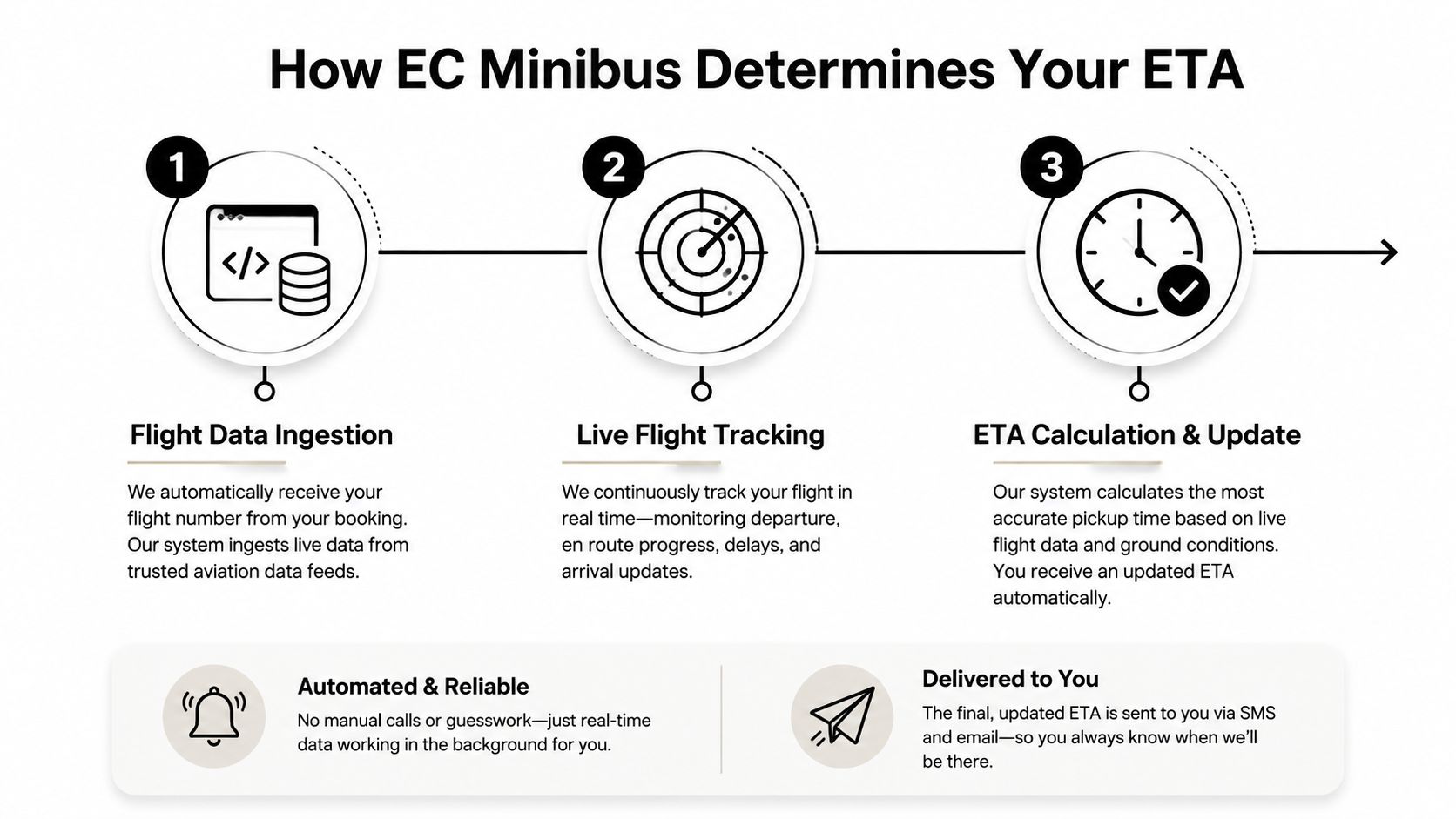
EC Minibus uses flight monitoring to follow the incoming aircraft rather than treating the original timetable as permanent. If the flight is delayed, the expected airport-arrival stage changes. The team can then reassess the passenger-ready window and the driver's planned meeting time.
Cruise monitoring adds another operational reference for port transfers. A ship's docking schedule can change, so the transfer plan needs to account for the actual port timetable as well as the passenger's flight. This is particularly relevant for Southampton, Dover, Portsmouth, and Tilbury journeys, where the vehicle destination has a fixed operational purpose.
The workflow can be understood as:
- Receive the travel details. The booking connects the passenger, flight, destination, and requested service.
- Monitor the live movement. Flight information indicates whether the aircraft is operating close to schedule.
- Recalculate the pickup plan. The team considers the updated flight position, airport exit stage, route conditions, and destination timing.
- Coordinate the meeting. The driver follows the meet-and-greet arrangement and waits at arrivals in line with the service terms.
- Communicate changes. Passengers receive updated information when the expected timing materially shifts.
The mobile app tracking service can give passengers another way to follow the transfer information while they travel. The important distinction is that tracking supports coordination, but it doesn't eliminate the variable time required to leave the terminal.
What happens if the flight runs late
A flight delay shouldn't automatically turn into a missed pickup when the operator has the flight details and monitors the incoming aircraft. The planned meeting time can move with the flight, while the driver and operations team use the updated information to coordinate the arrival.
For the onward journey, the team also needs to consider current road conditions between Heathrow and the destination. A transfer to Central London has a different route profile from a Southampton cruise transfer, and a journey to Dover, Portsmouth, or Tilbury requires its own route planning.
EC Minibus states that its transfer pricing is fixed and transparent, with no hidden fees or surge charges when a flight runs late. Passengers should still provide accurate details and follow the meeting instructions, because monitoring works best when the booking data matches the actual journey.
Real-World ETA Scenarios for Cruise and Airport Transfers
The two-stage model becomes easier to use when applied to an actual travel day. The following examples use planning times to show how the process works, rather than claiming outcomes for named customers.

A delayed family arrival before a Southampton cruise
A family of four has booked a Heathrow-to-Southampton transfer. Their aircraft was originally expected to reach Heathrow at 8:00am, but a departure delay changes the live flight prediction to 8:45am.
At 8:45am, the aircraft lands. That is Stage 1, not the family's pickup time. They still need to leave the aircraft, complete the airport process, collect several bags, and reach the arrivals meeting point. If they're ready at 9:45am, the transfer provider can treat that as the practical start of the road journey rather than pretending the vehicle journey began at landing.
The important decision is whether the revised timing still protects the cruise plan. A monitored transfer service can update the pickup coordination around the new flight information, while the family avoids repeatedly booking a new vehicle every time the aircraft status changes.
For cruise passengers, the useful deadline is not touchdown. It's the time you must be at the port with enough margin for the ship's embarkation process.
A business traveller going to Central London
A business traveller lands at Heathrow with hand luggage and needs to reach a Central London hotel before an evening meeting. The aircraft arrives at 10:30am, but the traveller doesn't reach the meeting point until after leaving the terminal and orientating themselves in arrivals.
Because the airport stage is relatively simple, the passenger may be ready sooner than someone with several checked bags. The road journey still needs its own assessment. A live route check can identify whether the direct trip is moving normally or whether a slower period calls for an earlier departure.
The traveller should avoid using the scheduled landing time as the hotel arrival promise. A better plan has three points: aircraft arrival, transfer-ready time, and hotel arrival estimate. That format makes it clear where uncertainty sits and gives the passenger a sensible point at which to contact the operator.
Practical Preparation Tips to Reduce ETA Uncertainty
A few accurate details can make the entire transfer easier to coordinate. Use the two-stage model before departure, then update your assumptions when the live flight information changes.
Before leaving home
- Share the correct flight number: A booking with an incorrect number can prevent effective monitoring.
- Describe your luggage accurately: Hand luggage and several checked cases create different exit expectations.
- Provide the actual destination: A hotel, cruise terminal, rail station, and private address may require different meeting and routing instructions.
- Build in a buffer: Don't schedule a critical cruise or rail commitment immediately after the flight's published landing time.
- Mention assistance needs: Families with young children, passengers with reduced mobility, and groups with bulky luggage may need more time and clearer instructions.
Review last-minute availability if your plans change close to travel. Availability isn't the only concern, because a late booking can also leave less time to confirm flight, luggage, and port details.
During the flight
Keep the transfer confirmation and contact details accessible. Check the airline's flight updates, but remember that the aircraft status only addresses part of the journey. If the predicted arrival moves, pass the change to the operator when possible.
After landing
Follow the signs for arrivals and baggage reclaim, then use the agreed meeting instructions rather than choosing a random exit. If you can't see the driver, contact the transfer team before leaving the terminal so everyone works from the same location.
Families should keep essentials easy to reach, while passengers with mobility requirements should allow the operator to plan suitable assistance. Groups should stay together where possible, because splitting up at baggage reclaim can make the transfer-ready time harder to identify.
Frequently Asked Questions About Estimated Arrival Times
Does a delayed flight mean I'll miss my pickup?
Not necessarily. A flight-aware transfer service can monitor the incoming aircraft and revise the meeting plan when the flight timing changes. You should provide the correct flight number and follow the operator's instructions after landing.
The delay still matters if you have a cruise, meeting, or train to catch. The operator can adjust pickup coordination, but no transfer service can remove the time needed for disembarkation, baggage, terminal processing, and the road journey.
How early should I book a Heathrow-to-cruise-port transfer?
Book as soon as your flight and cruise details are confirmed. Early booking gives you time to provide accurate passenger, luggage, terminal, and destination information, and it gives the operator a clear record against which to monitor changes.
Choose the service around your real destination and deadline. Southampton, Dover, Portsmouth, and Tilbury each require different route planning, so a generic airport pickup estimate isn't enough.
What happens if the cruise ship docks earlier or later?
A change to the ship's docking schedule can affect the practical pickup plan. Cruise monitoring allows the operator to compare the updated port timing with the booking details and coordinate the vehicle accordingly.
Passengers should keep their phone available and follow the meeting instructions issued for the port. If disembarkation changes, communicate the new information rather than assuming the original time remains valid.
Are flight-tracking apps accurate enough for transfer planning?
Flight apps are useful for seeing broad status changes, such as departure, airborne progress, and landing. They don't normally calculate your complete airport-exit time, luggage wait, meeting-point walk, or road journey to the hotel or cruise terminal.
Professional transfer monitoring combines live flight information with passenger details, airport procedures, destination requirements, and route conditions. Treat the app's flight ETA as Stage 1, then plan a separate Stage 2 before committing to a pickup or onward deadline.
What should I ask about an ETA on my confirmation?
Ask whether the displayed time refers to landing, terminal arrival, or the point when the driver expects you to be ready. Also confirm the meeting location, waiting procedure, luggage assumptions, and how delays or cruise-schedule changes will be communicated.
EC Minibus coordinates private Heathrow transfers to Central London hotels and UK cruise ports, using meet-and-greet service, flight and cruise monitoring, and fixed transparent pricing. Visit EC Minibus to arrange a transfer based on your passenger-ready time, not just the aircraft's landing time.