

You've just landed at Heathrow, your phone battery is low, and the ship closes its doors in a few hours. Or you're stepping off a cruise in Southampton and you need a car to Heathrow, London, or a hotel now, not tomorrow. Last minute availability stops being a vague travel phrase and turns into a straight operational question: can someone confirm a vehicle, a driver, and a pickup window before your schedule slips away?
UK travellers are booking later than they used to. Loveholidays reported that next-day holiday bookings from British travellers rose 26% year-on-year, bookings within two days of departure rose 19%, and bookings within three days were up 15% in the same period, which shows how much demand now sits in the final 72 hours before travel, not weeks ahead (industry reporting on last-minute British travel demand). For transfers, that matters more than it does for casual shopping around. A transfer isn't a sofa or a hotel room. It's a time-specific move with luggage, terminals, and a hard cutoff.
The right way to think about late booking is blunt. Price-based last-minute booking is about hunting unsold inventory. Capacity-based last-minute booking is about getting a real vehicle committed to a real pickup time when the clock is already working against you. If you're moving between Heathrow and a cruise port, or you've got a family arriving on different flights, price is secondary. Confirmation is the product.
Table of Contents
- When You Need a Transfer and Time Has Run Out
- What Last Minute Availability Actually Means for Transfers
- Why Last Minute Transfer Demand Has Become Structural
- Comparing Your Last Minute Transfer Options
- How to Secure a Last Minute Transfer Without Losing Your Nerve
- EC Minibus Last Minute Booking Services and Policies
- Smarter Last Minute Decisions for Heathrow and Cruise Travellers
When You Need a Transfer and Time Has Run Out
A delayed bag carousel at Heathrow can turn a sensible plan into a scramble. Your hotel is waiting, your cruise terminal check-in time is fixed, and the transfer you meant to sort later is suddenly the only thing standing between you and a missed connection. I've handled enough of these calls to know the pattern. People do not usually panic because they cannot find a cheap ride. They panic because they need a driver now, and they need someone who answers like a human being.
The core problem is time, not browsing
That is why the consumer idea of “last minute availability” is too vague for transfers. A traveller can keep checking hotel sites or flight fare pages because those products are broadly interchangeable until they are booked. A transfer is different. The route, pickup point, luggage load, and arrival window all have to line up, and if one piece does not fit, the booking falls apart.
Practical rule: if your journey has a fixed departure window, treat the transfer like part of the travel plan, not an optional extra.
That is especially true around Heathrow arrivals and cruise turnaround days. Heathrow is one of Europe's busiest airports, and Southampton is the UK's leading cruise port by passenger volume, so late changes happen inside very crowded, schedule-sensitive systems (publisher research note). When travellers land late, disembark late, or miss a handover, the question is not whether a bargain is still available. It is whether a provider can still commit capacity without guessing.
Late booking behaviour has moved from unusual to normal in UK travel. SiteMinder reported that 35% of hotel reservations are made less than one week before arrival, and half of all hotel reservations are made within 10 days of the stay (SiteMinder late booking data). That pressure spills into ground transport because people leave transfers until the same short window they use for rooms.
For Heathrow and cruise passengers, the rule is simple. The later you wait, the fewer vehicles are free, and the more likely the provider is already juggling airport runs, terminal timing, and driver rest windows. If you are reading this with a flight already landed or a ship already docked, stop shopping like you have unlimited time. You do not.
If you need a quicker route into the booking side of things, use a direct airport transfer service rather than wasting time on broad comparison tabs.
What Last Minute Availability Actually Means for Transfers
For transfers, last minute availability means a provider can still confirm a vehicle, a driver, and a pickup that matches your actual travel window. It does not mean a random car happens to be nearby. It means the operator has the spare capacity to absorb your booking without breaking its schedule for existing passengers.
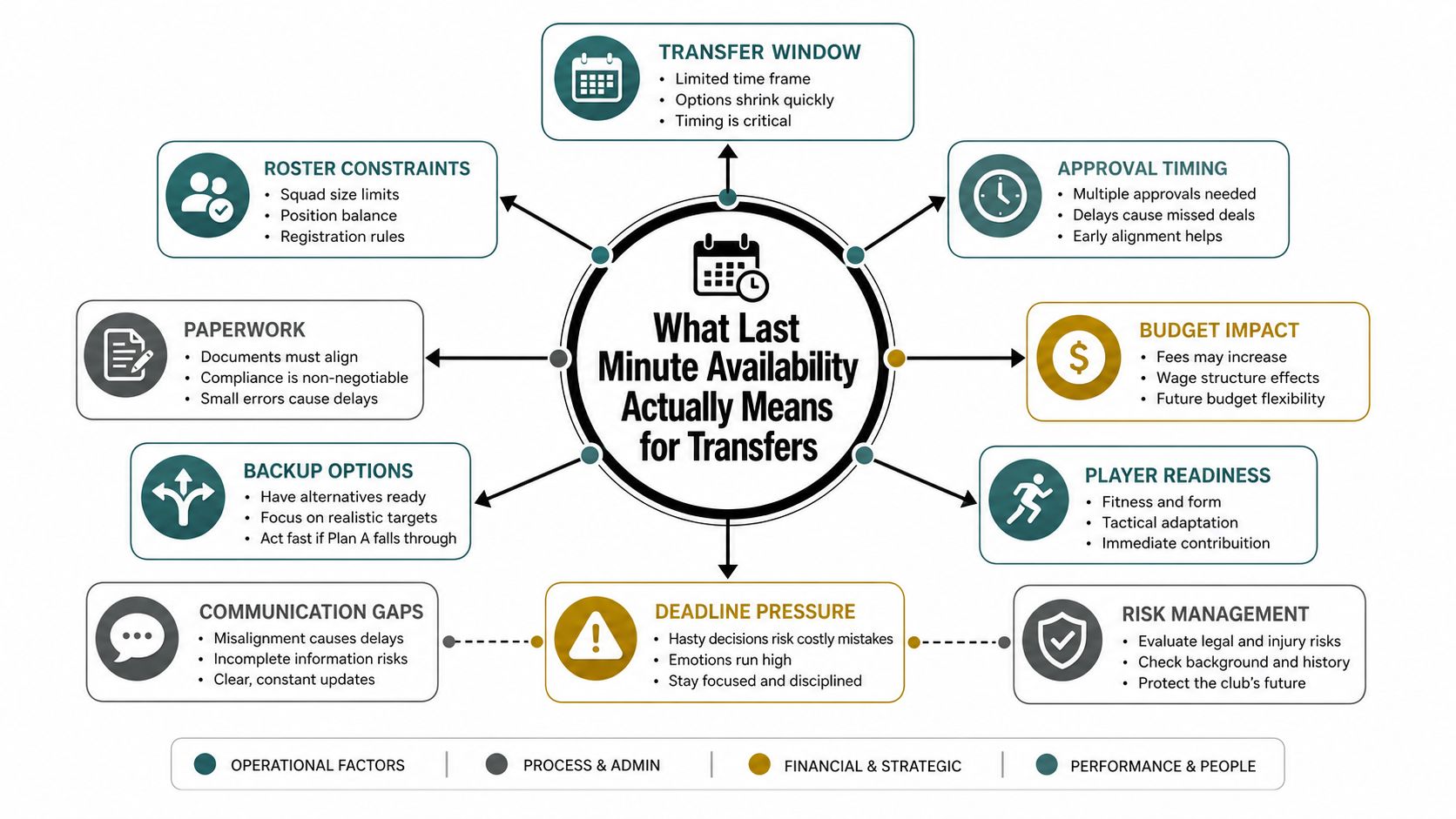
The useful window is shorter than most people think
In lodging, people often talk about the 24 to 72 hour zone because rooms can be reassigned quickly. Transfers are tighter. A vehicle and driver have to be in the right place, with the right licence, enough seats, enough boot space, and enough margin for traffic or terminal delays. That's why transfer availability behaves more like a schedule slot than a hotel room.
The strongest practical window for late transfer booking is still roughly the final 24 to 72 hours before travel, but that doesn't mean every hour inside that range is equal. Same-day bookings are the hardest when the journey involves Heathrow arrivals, cruise embarkation, or a cross-London move with luggage. Next-day bookings are easier, but only if the operator can revalidate timing before dispatch.
Price-based and capacity-based booking are not the same thing
The mistake most travellers make is assuming a discounted last-minute fare equals real availability. That logic works for unsold hotel rooms. It's weaker for transfers. A provider can lower a rate because a slot is empty, but it can also refuse a booking because the vehicle count doesn't fit the route, the driver's hours don't work, or the pickup timing clashes with a more urgent run.
A transfer quote that looks cheap but stays “pending” is not the same as a confirmed pickup.
That difference matters more in transport than almost anywhere else. For Heathrow and cruise routes, the safest late-booking product is a confirmed, monitored, route-specific transfer, not a generic ride that may or may not be available after you click through. If you're comparing your options, judge them by confirmation speed, luggage handling, and whether the booking includes a live pickup plan. That's the true meaning of availability.
Why Last Minute Transfer Demand Has Become Structural
Late transfer demand keeps rising for a straightforward reason. Travellers are booking later, schedules keep shifting, and operators are managing capacity far more tightly than they used to. Loveholidays showed British next-day bookings rising 26% year-on-year, while bookings within two days and three days also climbed, which tells you demand is concentrating inside the final three days before travel (industry reporting on last-minute British travel demand). Expedia also reported that searches for flights departing within 48 hours rose 20% from July 2024 to July 2025, and Hopper found international flights were being booked an average of 10 days closer to departure than before the pandemic. That is booking compression, plain and simple.
Yield-managed capacity changes the game
Rail and airport capacity are not fixed in the way people like to assume. Avanti West Coast says fares and seat availability can change depending on demand, and National Rail guidance shows many tickets are released in controlled booking windows before departure (Avanti West Coast and National Rail guidance). Transfers follow the same pressure. The closer you get to departure, the more volatile remaining capacity becomes because the operator is constantly rechecking what it can still allocate.
For a dispatcher, that means spare vehicles are not sitting there waiting. They are already being sold, held back, or reassigned. A car that looks free this morning can disappear by lunch if another passenger's flight changes or a higher-priority route opens up.
That is why last minute availability is a live operational question, not a static inventory question. If you want a practical example of how operators think about late airport work, airport shuttle services show the same pattern. Capacity, timing, and dispatch control matter more than a headline fare.
Peak periods tighten the window further
Holiday departures, weekend handovers, and cruise turnaround days squeeze the available pool even more. Booking pressure is strongest when lots of passengers want the same limited set of routes at the same time. In those periods, a same-day Heathrow pickup can be straightforward one week and nearly impossible the next, even if the mileage is identical.

The operational lesson is blunt. Last-minute availability depends on revalidated capacity, not wishful thinking. If a provider cannot tell you exactly what vehicle is available, when it can pick you up, and how it handles live flight or ship changes, it is not offering a usable late-booking service. It is offering a maybe.
Comparing Your Last Minute Transfer Options
If you're moving between Heathrow, London, and a cruise port, the comparison is not between “cheap” and “expensive.” It is between confidence, comfort, and how much nonsense you can tolerate while carrying bags. For late bookings, the field usually narrows to four choices, private minibus, taxi or black cab, shared shuttle, and rail plus taxi.
Last Minute Transfer Options Compared
| Option | Confirmation Speed | Pricing | Luggage Handling | Best For |
|---|---|---|---|---|
| Private minibus | Fast when capacity is reserved in advance of dispatch | Fixed and transparent | Strong for families and groups | Heathrow arrivals, cruise transfers, door-to-door travel |
| Taxi or black cab | Usually quick in urban areas | Metered or variable | Good for light to moderate luggage | Solo travellers or short city hops |
| Shared shuttle | Can be slower because seats must be matched | Often cheaper upfront | Less flexible with luggage and timing | Budget travellers with flexible schedules |
| Rail plus taxi | Depends on train availability and station access | Split across two services | Awkward with large bags | Travellers with lighter luggage and more time |
What works when the clock is ticking
A private minibus makes the most sense for international cruise and Heathrow travellers because it solves the two things that matter most, confirmation and baggage. You are not trying to stitch together two or three separate legs and hope each one stays on time. You are booking one pickup, one driver, one route, one destination. That matters far more when you have just landed long-haul or you are dragging cruise luggage through a terminal.
Taxis have their place, but they are still a compromise for groups and larger bags. Shared shuttles can work if the schedule is loose, but they are not what I would choose for an international arrival with a hard handover. Rail plus taxi looks tidy on paper. In practice, it brings station changes, queue risk, and one more place for a delay to bite you.
If you want a clearer look at shuttle-style trade-offs, this guide to airport shuttle services is worth reading before you assume any shared option will suit a time-critical trip.
Bottom line: when the itinerary is fixed, choose the option that removes uncertainty first, not the one that promises the smallest fare.
For Heathrow and cruise transfers, that usually means a private minibus if you are travelling with family, carrying a lot of luggage, or working to a schedule you cannot afford to improvise around.
How to Secure a Last Minute Transfer Without Losing Your Nerve
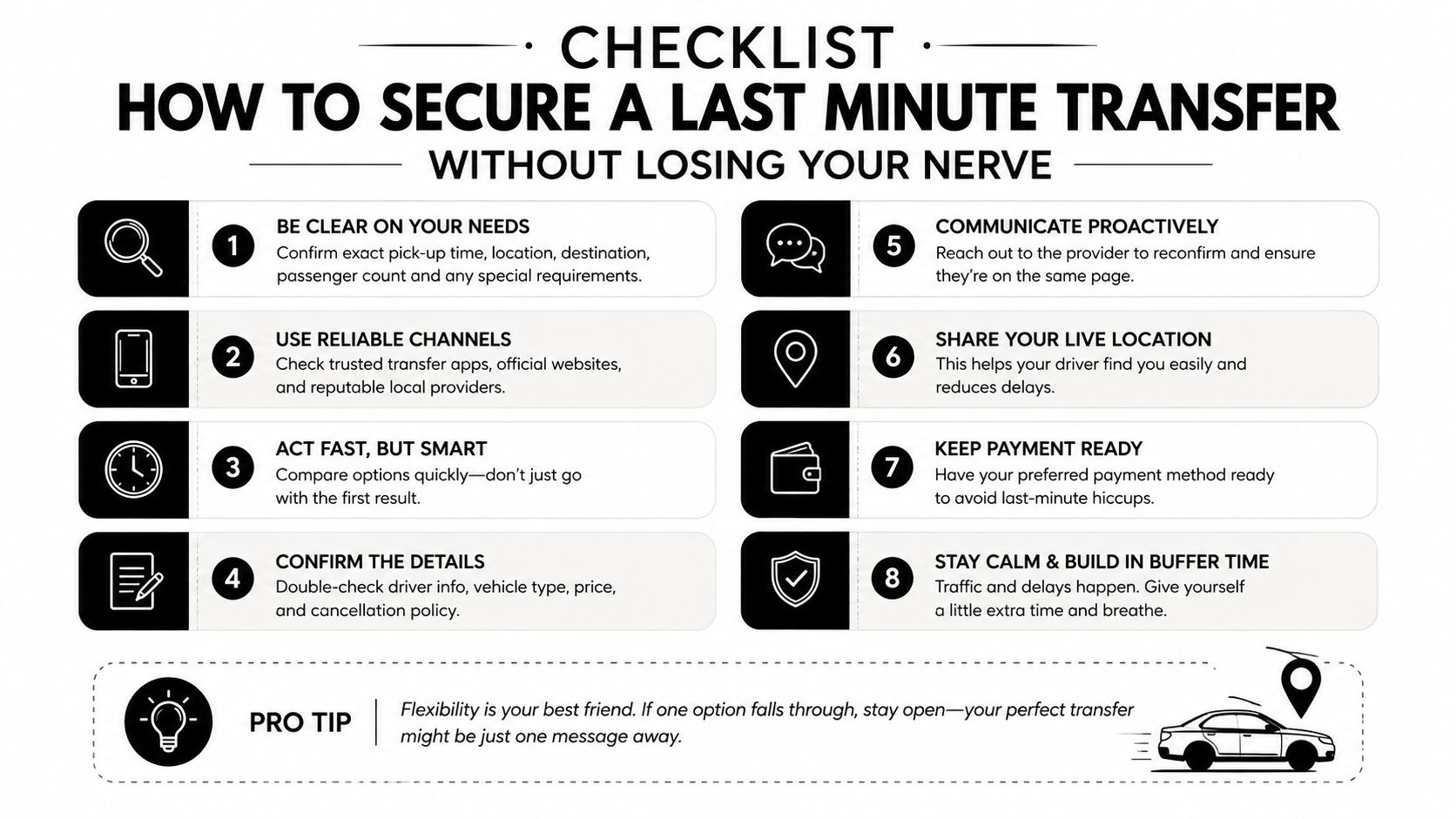
The fastest way to get a late booking accepted is to stop making the operator guess. Give them everything they need in the first message, and give it cleanly. Flight number, ship name, terminal, passenger count, luggage volume, pickup address, and final destination. If you leave those out, the provider has to chase you for basics while the clock keeps moving.
What you should have ready before you enquire
The details that help most are the boring ones. They're boring because they let a dispatcher answer quickly.
- Flight or ship number: This lets the provider track timing and avoid guessing at arrival windows.
- Terminal and port name: Heathrow terminal details and cruise terminal names remove confusion immediately.
- Passenger count: A car that fits three people is not the same booking as one that fits six.
- Luggage volume: Big suitcases, cabin bags, pushchairs, and golf cases all change vehicle choice.
- Exact pickup point: Hotel name, apartment address, arrivals hall, or port gate, spelled out clearly.
When a provider asks for these details up front, it isn't bureaucracy. It's trying to confirm whether your booking can be completed. If the operator sends you an instant confirmation, that's a good sign. If it sends you a vague “we'll check and come back”, you're already in a slower lane.
When to stop searching and book
The decision rule is simple. If your travel is inside the late-booking window and the journey is fixed by flight or cruise timing, stop comparison shopping once you've found a provider that can confirm the vehicle, monitor the timing, and state the pickup plan clearly. Waiting for a slightly better price is a bad trade if it risks the trip itself.
Practical rule: book the first provider that can prove it understands your timing and your luggage, then move on with your day.
That's especially true in peak periods, when the market is already tight. A good late-booking provider should also explain how it handles changes at short notice, not leave you to discover the rules after payment. If the reply is fast, specific, and consistent, you're on the right track. If it's slow or vague, keep moving.
EC Minibus Last Minute Booking Services and Policies
EC Minibus handles short-notice transfer requests as a fixed-price, door-to-door booking rather than a loose enquiry. The service includes meet and greet at Heathrow, licensed and insured drivers, luggage assistance, and flight or cruise monitoring so pickup times can adjust if your arrival shifts. That matters because late bookings fail most often when timing changes and nobody is watching the flight or ship.
How the booking flow works
A same-day or next-day request works best when you send the essentials in one go. EC Minibus supports routes tied to Heathrow, Central London hotels, Southampton, Dover, Portsmouth, Tilbury, and St Pancras International, which makes it a practical fit for airport-to-port and rail-to-port moves. The fixed price removes the worst part of late booking anxiety, the fear that short notice automatically means an ugly surprise at checkout.
If you want to compare how live tracking changes the handoff in practice, see the company's mobile app tracking details. That kind of setup is useful when your flight lands late or your ship timing shifts and the pickup needs to move with it.

Why the service model fits late travellers
For international travellers, the value is operational rather than flashy. You get a confirmed transfer, a monitored pickup, and a route that's set up for luggage and handover timing instead of ad hoc improvisation. That's the right model when you're arriving at Heathrow after a long-haul flight or connecting from a cruise terminal to a hotel, because the booking has to survive real-world delays.
The strongest last-minute bookings tend to be the ones with the fewest loose ends. Tell the operator your exact terminal or cruise port, the number of passengers, and the amount of baggage, and you improve your odds of a clean confirmation. Leave those details vague, and you force the dispatcher to slow down.
EC Minibus also keeps the price structure transparent, which is valuable when you're booking under pressure. In a late booking, certainty is worth more than squeezing out a small saving that could vanish in the handoff.
Smarter Last Minute Decisions for Heathrow and Cruise Travellers
Use one rule and you'll make fewer bad calls. If the trip has a fixed flight or ship window, book for confirmation, not for the cheapest quote. That's the right approach for Heathrow arrivals, Southampton cruise turnarounds, and family groups carrying enough luggage to make public transport a poor fit. Price matters, but it comes after the booking is secured.
When you're within a short window, capacity-based availability is the only version that counts. If a provider can confirm vehicle, driver, and pickup monitoring, you've got a real transfer. If it can only offer a maybe, keep looking or change the plan. Don't confuse an empty calendar slot with a reliable pickup.
The best late bookings are the ones that remove decision points from your day. Give complete details, choose a fixed-price service, and stop shopping the moment you have a solid confirmation. That's how you turn a time crunch into a manageable transfer instead of a missed connection.
If you need a short-notice Heathrow or cruise transfer, EC Minibus arranges fixed-price door-to-door journeys with meet and greet, luggage help, and live timing support. Visit EC Minibus to check availability and send your trip details before the window closes.