

You've landed, you're tired, your phone battery is fading, and the signs outside arrivals point you towards taxis, app pickups, hotel shuttles, trains, and people offering “best price” rides. That's the moment most travellers stop shopping carefully and start paying for convenience, confusion, or both.
If you're trying to find the cheapest airport taxi, the right question isn't “What's the lowest quote on the screen?” It's “Which option gives me the lowest total cost for this exact trip?” For a solo traveller with hand luggage, that answer can be very different from the right choice for a family of four, a couple heading to Southampton for a cruise, or a group with large cases after a long-haul flight.
The cheapest-looking transfer often stops being cheap once you add terminal fees, traffic-based metering, waiting time, or the hassle of splitting into two vehicles. The best-value option usually becomes obvious when you compare the whole journey instead of the headline fare.
Table of Contents
- Why Your Airport Transfer Costs More Than It Should
- How to Compare Airport Transfer Fares Like a Pro
- Smart Booking Tactics to Secure the Lowest Price
- Exploring Cost-Saving Alternatives to a Private Taxi
- When a Private Transfer Is the Smartest Choice
- Uncovering and Avoiding Hidden Airport Taxi Fees
Why Your Airport Transfer Costs More Than It Should
At Heathrow, this happens every day. A traveller walks out of customs with two cases, checks a rideshare app, glances at the black cab rank, then opens three browser tabs looking for a minicab. Ten minutes later, they're more confused than when they started.

Part of the problem is that airport transport pricing in the UK isn't uniform. The average cost of a one-way airport transfer in the UK in 2025 is £60, but regional differences are sharp. The average amount spent in South West England is £250, while London averages £85, according to Bark's UK airport transfer pricing data. That means the cheapest airport taxi depends heavily on where you start, where you're going, and what type of vehicle the journey needs.
The headline fare rarely tells the whole story
A fare can look cheap and still be poor value.
A metered cab may be fine for a short, simple run when traffic is light. It's far less attractive after a delayed arrival, during a busy terminal rush, or on a longer route where every extra minute adds cost. App-based rides can also look competitive until pickup delays, airport access rules, and live pricing kick in.
Practical rule: Judge the transfer by the final door-to-door cost, not the first number you see.
Different travellers need different maths
A solo business traveller might care most about speed. A family usually cares about luggage space and not dragging children through stations. Cruise passengers care about reliability because missing a sailing is a much bigger problem than paying a slightly higher base fare.
That's why broad averages don't solve the decision. You need a framework. If you want a broader look at pricing factors beyond airport runs, this guide on car service costs in the UK is a useful companion.
How to Compare Airport Transfer Fares Like a Pro
A common misstep in comparing airport transfers involves merely collecting three prices, choosing the lowest one, and assuming due diligence. This overlooks the details that decide whether the ride is cheap, punctual, and suitable for the trip.
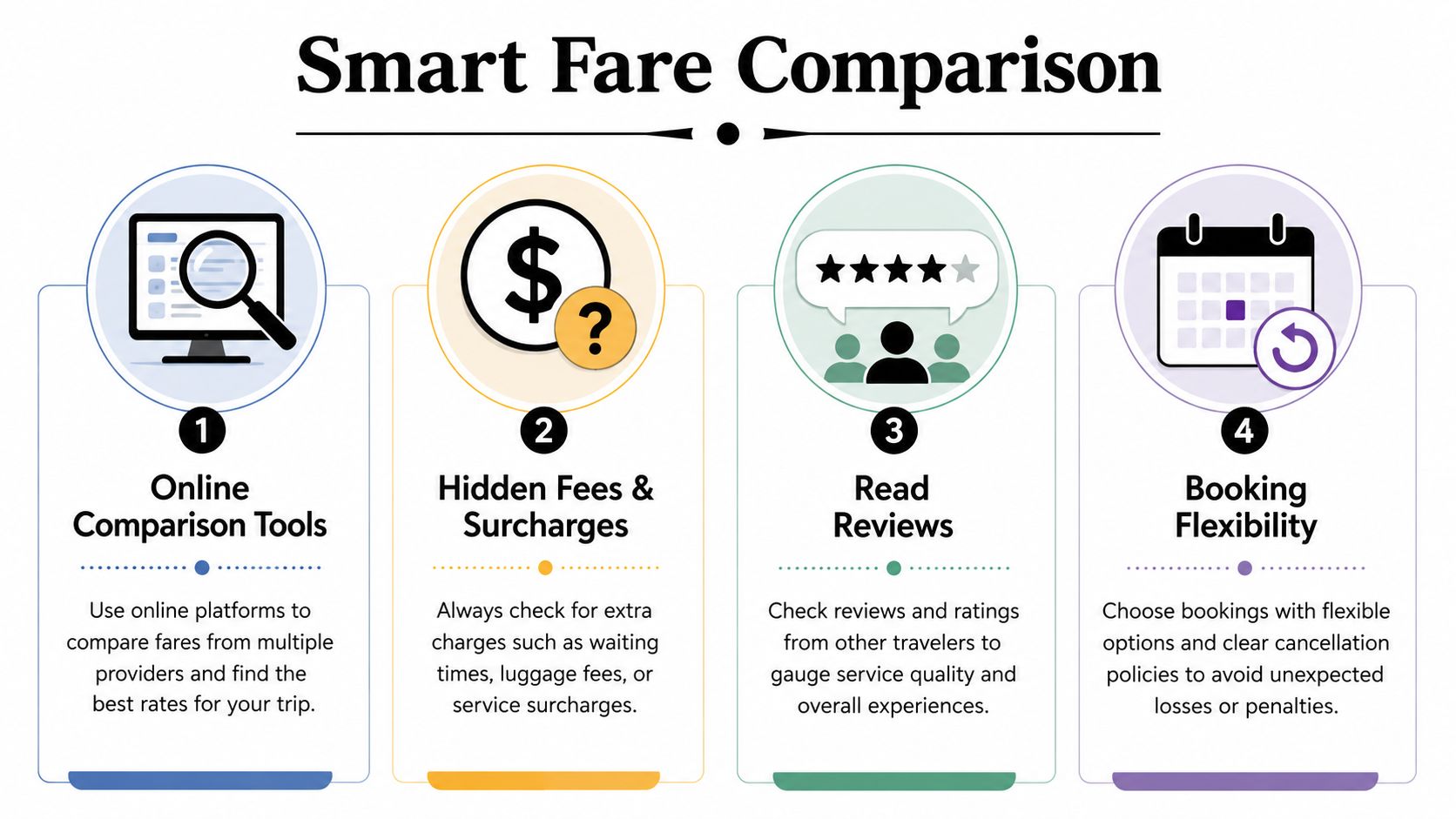
Start with three quote types
Use three channels and compare them side by side.
-
Aggregator results
These are useful for getting a rough market range quickly. They help you spot whether one provider is clearly out of line. What they don't always show well is whether parking, waiting, meet and greet, or airport charges are included. -
Direct fixed-price minicab quotes
With direct fixed-price minicab quotes, you often find the best value on airport runs, especially from Heathrow into London or out to cruise ports. A direct quote also makes it easier to confirm luggage allowance, pickup procedure, and what happens if your flight is late. -
On-demand options at arrival
These include black cabs and app bookings. They work best when flexibility matters more than budget, or when your trip is short and straightforward. They're usually the weakest choice for anyone who wants cost certainty.
Use a real route as your benchmark
For Heathrow to Central London, a pre-booked private minicab with a fixed-price provider averages £60 to £85, while on-demand black cabs average £70 to £100, according to Airport Pickups London. The same source says this pre-booked method has a 94% success rate for on-time pickups when flight monitoring is included.
That tells you something important. On a common UK airport route, the cheapest airport taxi often isn't the taxi rank at all. It's the fixed-price booking made before you fly.
Compare the whole offer, not just the fare
Use this quick filter before booking:
| Checkpoint | What to look for |
|---|---|
| Price type | Fixed fare or metered fare |
| Flight delays | Whether the driver monitors arrival changes |
| Airport pickup | Meet and greet or kerbside only |
| Vehicle fit | Enough room for people and luggage |
| Booking terms | Clear confirmation and support if plans change |
A cheap fare that fails when your flight arrives late isn't cheap. It's just incomplete.
What usually works and what usually doesn't
Works well
- Pre-booked fixed fare: Best for most airport journeys where you want certainty.
- Direct provider confirmation: Better for special requirements, large luggage, child seats, or cruise timing.
- Flight tracking included: Reduces the risk of arrival-time mismatches.
Often disappoints
- Rank-first decision-making: Easy, but rarely the sharpest value.
- Last-minute app booking in a busy pickup zone: Too much uncertainty for tired travellers.
- Comparing by base fare alone: That's how hidden extras slip through.
Smart Booking Tactics to Secure the Lowest Price
If you want the cheapest airport taxi, spontaneity usually works against you. Airport transfers reward planning.
The strongest move is simple. Book ahead. According to the UK Airport Taxi fare calculator, pre-booking is one of the most effective ways to secure lower quotes, with fixed-price saloon fares to Heathrow starting from £40 when booked in advance. The same source puts the typical airport taxi cost at £25 to £150, depending on route, vehicle size, and time of day.
Why advance booking matters
Airports create the perfect conditions for inflated pricing. Flights bunch together. Bad weather causes delays. Arrivals halls get crowded. Drivers prioritise high-demand jobs. If you book on the day, you're negotiating from the weakest position.
A fixed fare changes that. You know the price before you travel, and you remove a lot of the uncertainty tied to live demand.
Booking habits that save money
Not every cost-saving tactic is equally useful. These are the ones worth your attention:
- Book as soon as your flight is set: The earlier you arrange the transfer, the easier it is to compare providers calmly instead of booking under pressure.
- Book direct with the operator: That usually gives you cleaner communication, clearer inclusions, and fewer misunderstandings than relying entirely on a middleman.
- Choose the right vehicle first time: Over-ordering a larger vehicle than you need wastes money. Under-ordering can force a costly last-minute change.
- Pair airport and return legs if your schedule is fixed: It won't always reduce the fare, but it can simplify logistics and lower the chance of booking a poor return option later.
Timing matters more than travellers expect
An airport transfer isn't just a route. It's a route at a specific moment. Early morning departures, peak arrivals, school holiday weekends, and cruise turnaround days all change the market. The cheapest airport taxi quote in a quiet booking window can disappear if you wait and try to sort it after landing.
Book the transfer while you still have time to think clearly. The worst airport transport decisions happen after a long flight.
The mistake I see most often is treating the transfer as the last item on the travel list. It should be handled much earlier, especially if you're travelling with family or connecting to a ship.
Exploring Cost-Saving Alternatives to a Private Taxi
A private taxi isn't always the right answer. Sometimes the cheapest airport taxi isn't a taxi at all. If your budget is tight, or your trip is short and simple, it's worth looking at the alternatives.
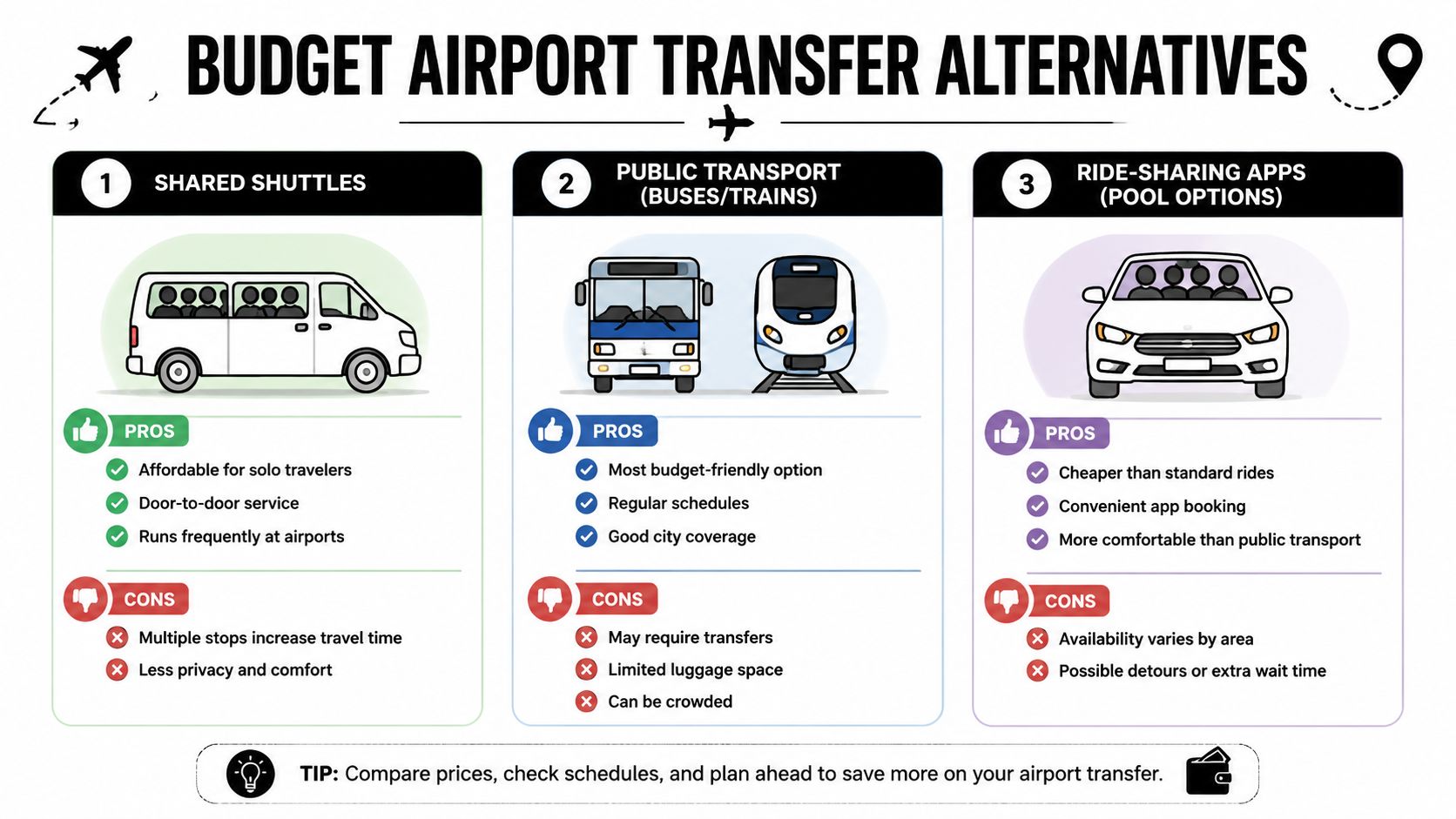
Shared shuttles
Shared shuttle services can be a sensible middle ground. They're often cheaper than a private vehicle and easier than figuring out a full public transport route after a long flight. They suit solo travellers and couples best, particularly when luggage is light and the destination is on a common hotel corridor.
The trade-off is control. You may wait for other passengers, make multiple stops, or have less flexibility if your arrival changes.
For travellers comparing this option in more detail, this overview of airport shuttle services helps clarify where shuttles fit best.
Public transport
Public transport can be the outright budget winner, especially into central London. But budget winner and best option are not the same thing.
If you're comfortable managing cases on lifts, escalators, platforms, and crowded trains, it can work well. If you're arriving from a long-haul flight with children, mobility concerns, or several bags, it can become a tiring false economy very quickly.
A practical comparison
| Option | Best for | Main drawback |
|---|---|---|
| Shared shuttle | Solo travellers and couples | Less control over timing |
| Train or Tube | Light packers going into well-connected areas | Awkward with heavy luggage |
| Bus or coach | Travellers focused on keeping spend low | Slower and less direct |
| Ride-sharing app | People willing to trade certainty for convenience | Variable pickup experience |
Public transport is cheapest when your destination is easy. It gets expensive in effort when your hotel, port, or family situation makes every transfer harder.
Ride-sharing apps
Ride-sharing sits in an awkward middle position. It can be convenient, especially if you already use the app and want a familiar interface. It can also be frustrating at airports where pickup points are poorly marked or busy.
For airport journeys, app bookings are usually strongest when all of these are true: you're travelling light, your destination is ordinary rather than specialised, and you don't mind waiting a bit if the pickup process is messy. They're weaker for cruise passengers, older travellers, and groups who need certainty.
The honest takeaway
If your only goal is spending as little as possible, public transport may win. If your goal is balancing cost, ease, luggage handling, and arrival-day stress, alternatives start to lose ground fast.
That's why transfer planning should match the trip type, not just the budget line.
When a Private Transfer Is the Smartest Choice
For cruise passengers and groups, the cheapest airport taxi often turns out to be a larger private vehicle booked properly, not the smallest car at the lowest advertised rate.
A standard airport comparison doesn't capture what changes when you're going beyond Central London. If your route is Heathrow to Southampton, Dover, Portsmouth, or Tilbury, the question isn't just “What's the fare?” It's “Will this service get everyone and all the luggage there smoothly, on one booking, without a scramble at the kerb?”
Groups change the value equation
For groups heading from Heathrow to cruise ports such as Southampton, a 6/8-seater minibus costs £145 to £220, compared with £125 to £175 for a sedan, according to Heathrow Shuttle's transfer data. The same source says the minibus can offer up to 20% better value per passenger.
That's the point many travellers miss. A sedan may look cheaper at first glance, but that comparison breaks down if you need more than one car, can't fit all the cases, or end up managing split arrivals.
Why cruise passengers should think differently
Cruise travel makes airport transfer mistakes more expensive in practical terms. You're not just trying to reach a hotel eventually. You're trying to arrive at a terminal with luggage, documents, and enough time to check in without friction.
That's where transfer features matter:
- Meet and greet: Useful when you're arriving after a long-haul flight and don't want to hunt for a pickup point.
- Flight monitoring: Important when delays would otherwise create waiting charges or a missed handoff.
- Luggage help: More valuable than people think when several large cruise cases are involved.
- Single-vehicle coordination: Better than splitting a family or group between separate rides.
Here's a closer look at how this type of journey works in practice:
Reliability matters more on longer runs
The same Heathrow Shuttle source reports a 96% success rate for minibus bookings that include flight monitoring, with drivers waiting up to 90 minutes after landing, and says that reduces cancellation risk to under 4%.
Those details matter far more on a port transfer than on a short city hop. If your pickup is misaligned at Heathrow, the knock-on effect on a cruise day can be significant.
For families and cruise groups, the right transfer isn't the one with the lowest sticker price. It's the one that keeps the whole party moving together.
When private transfer is the clear winner
A private transfer is usually the strongest choice when any of the following apply:
- You're travelling as a family or group: Cost per person often improves once everyone is in one vehicle.
- You're heading to a cruise port: Direct routing and luggage handling matter more than shaving a small amount off the fare.
- You're arriving after a long-haul flight: Simplicity beats improvisation.
- You have bulky luggage: Cases for cruises, children, or longer tours make station changes and small vehicles less practical.
Uncovering and Avoiding Hidden Airport Taxi Fees
The biggest trap in the cheapest airport taxi search is assuming the quoted fare is the final fare. Very often, it isn't.
One of the most commonly missed costs is the airport terminal access charge. According to this guide to airport taxi pricing and fees, mandatory terminal drop-off fees at major UK airports can range from £5 to £13. The same source notes that pre-booked fixed-price transfers typically save travellers 20% to 40% compared with rank or on-demand bookings, largely because these charges are often absorbed rather than added at the end.
The fees that catch people out
Travellers usually focus on the vehicle price and ignore the add-ons. That's where the budget starts leaking.
- Terminal charges: Often unavoidable at major airports and easy to miss in a casual quote.
- Waiting time exposure: If the provider doesn't track your flight properly, a delay can become your problem.
- Access and pickup complexity: Airport pickup rules can force awkward meeting points or extra time on site.
- Poor quote transparency: Some services look cheap because they strip out the extras until the booking is underway.
How to protect yourself before booking
Use a short verification checklist. Ask whether the fare is fixed, whether airport charges are included, whether flight delays are monitored, and what happens if baggage reclaim is slow.
If you're pricing Heathrow routes specifically, this breakdown of Heathrow taxi cost factors is worth reviewing before you book.
The cheapest airport taxi is the one that arrives at the agreed price, not the one that wins the first screen comparison.
Transparent pricing is what separates a good deal from a low headline number. If you're travelling to a cruise port, with children, or after a transatlantic flight, that distinction matters more than ever.
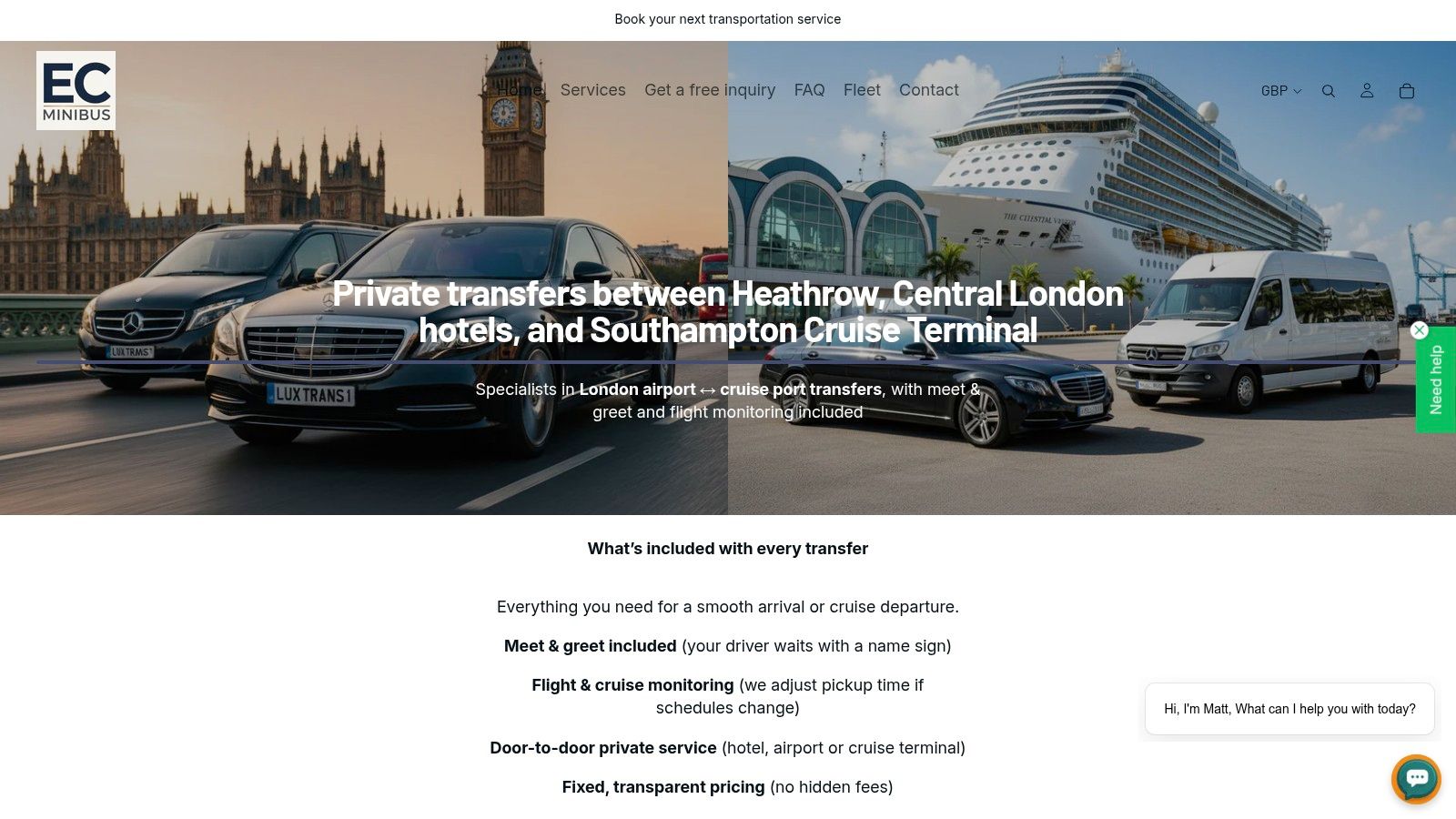
If you want a transfer that's priced clearly from the start, EC Minibus specialises in Heathrow, London hotel, and UK cruise port journeys with fixed pricing, meet and greet, flight monitoring, and vehicles suited to families and groups. For travellers who'd rather book once and avoid surprises on arrival day, it's a practical option to have on your shortlist.