

A common transfer customer lands at Heathrow, clears arrivals, sees the driver with their name board, reaches the cruise port smoothly, and feels relieved. Then the same thing happens on the next trip. And the next. The service works, but nothing signals that the company recognises the pattern or values the repeat booking.
That gap matters more in private transfers than many managers realise. Travellers in airport and cruise journeys aren't buying a casual extra. They're buying certainty, timing, help with luggage, and the confidence that one missed pickup won't derail a whole itinerary. A customer loyalty program for this kind of service has to reward reliability and trust, not just spend.
If you already offer airport transfer service, the question isn't whether loyalty matters. It's how to design it so repeat passengers feel seen without forcing a retail-style points system onto a high-stakes travel experience.
Table of Contents
- Introduction to Loyalty in Private Transfers
- Understanding Key Concepts
- Why Loyalty Matters for EC Minibus
- Types of Loyalty Programs for Airport and Cruise Transfers
- Design and Implementation Considerations
- Communication and Promotion Strategies
- Sample Program Ideas with KPIs
-
Frequently Asked Questions
- Does a transfer company need points to have a customer loyalty program
- Should rewards focus on discounts or experiences
- What if passengers forget they've joined
- How should unused credits or benefits be handled
- Do staff need special training
- How can passengers check their balance
- What's the biggest cause of failure
Introduction to Loyalty in Private Transfers
Private transfer loyalty often gets treated like a copy-and-paste version of supermarket rewards. That's the first mistake. A supermarket shopper may respond to frequent small discounts. A transfer passenger is usually asking a different question: can I trust this company when my flight is delayed, my luggage is late, and my ship won't wait?
That changes the design brief. In private transfers, the strongest rewards often aren't flashy. They are practical, calming, and easy to use. Priority support, faster booking, included wait-time flexibility, and recognised customer status can feel more valuable than abstract points sitting in an account.
Managers sometimes get confused here because “loyalty” sounds like a marketing layer added after operations. In travel services, it's the opposite. Loyalty starts by rewarding the behaviours and service moments that already define a good journey, such as early booking, complete travel details, repeat round-trips, or use of meet-and-greet support.
A good transfer loyalty scheme should feel less like collecting stickers and more like being recognised by a dependable travel partner.
Understanding Key Concepts
In the UK, 88% of adults belong to at least one loyalty scheme, making loyalty programs a near-universal feature of British consumer behaviour, according to UK loyalty programme statistics compiled by Loyalty Pass. That matters because customers don't arrive as blank slates. They already know what a loyalty offer looks like, and they've learned to judge whether it feels worthwhile.
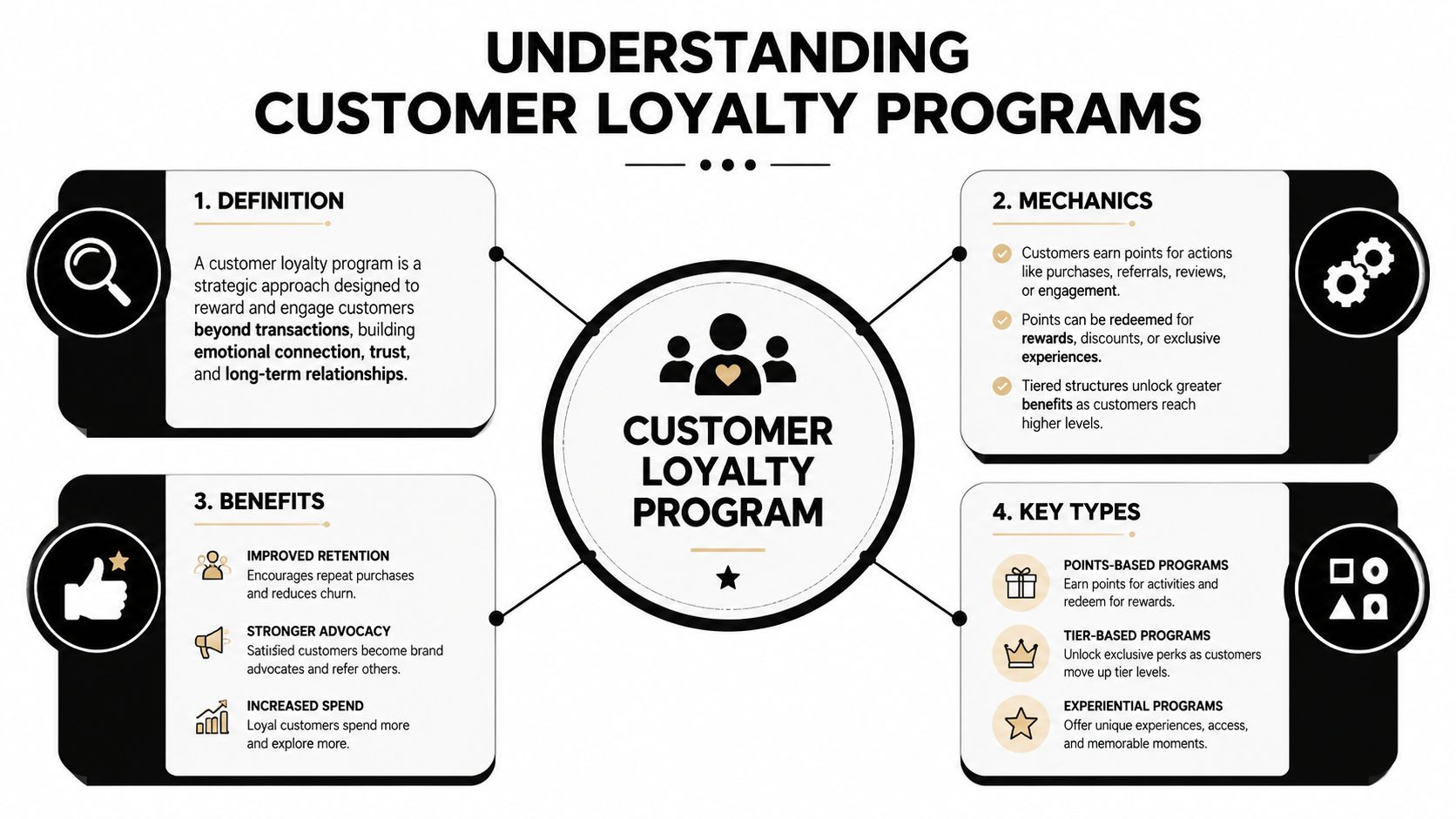
What a customer loyalty program actually does
A customer loyalty program is a structured way to reward repeat behaviour. In plain language, it tells customers, “If you keep choosing us, you'll get something useful back.”
That “something” can take different forms. In retail, it's often points. In private transfers, it may be easier to understand as access, convenience, reassurance, or credit towards future travel. The core idea stays the same. The business recognises repeat value and gives customers a reason to come back.
The confusion usually starts when managers assume loyalty only means “earn points per booking.” That's only one format. If the reward feels too slow, too vague, or too complicated, customers stop paying attention.
The four moving parts
Think of a loyalty program as a four-part system:
-
Entry
The customer joins. This should be friction-light. A booking checkbox, post-booking email enrolment, or account signup often works better than a long form. -
Tracking
The system records useful actions. In transfers, that might include completed rides, return bookings, profile completion, or use of add-on services. -
Reward
The customer gets a benefit they can understand quickly. This could be a fixed discount, a service upgrade, or a practical perk on a future journey. -
Reminder
The business prompts the customer before the next booking or before a benefit expires, so rewards don't disappear into the background.
A useful analogy is a hotel concierge. The concierge doesn't just hand out generic coupons. They remember preferences, reduce friction, and make the next stay easier. Service-based loyalty should do the same.
Why Loyalty Matters for EC Minibus
Private transfer companies don't win loyalty just by being cheaper. They win it by lowering stress at moments when passengers are vulnerable. That makes loyalty strategically important in a different way from retail.
The visual below captures the business case often used in boardroom conversations, but managers should read it carefully as a design prompt rather than as a promise.
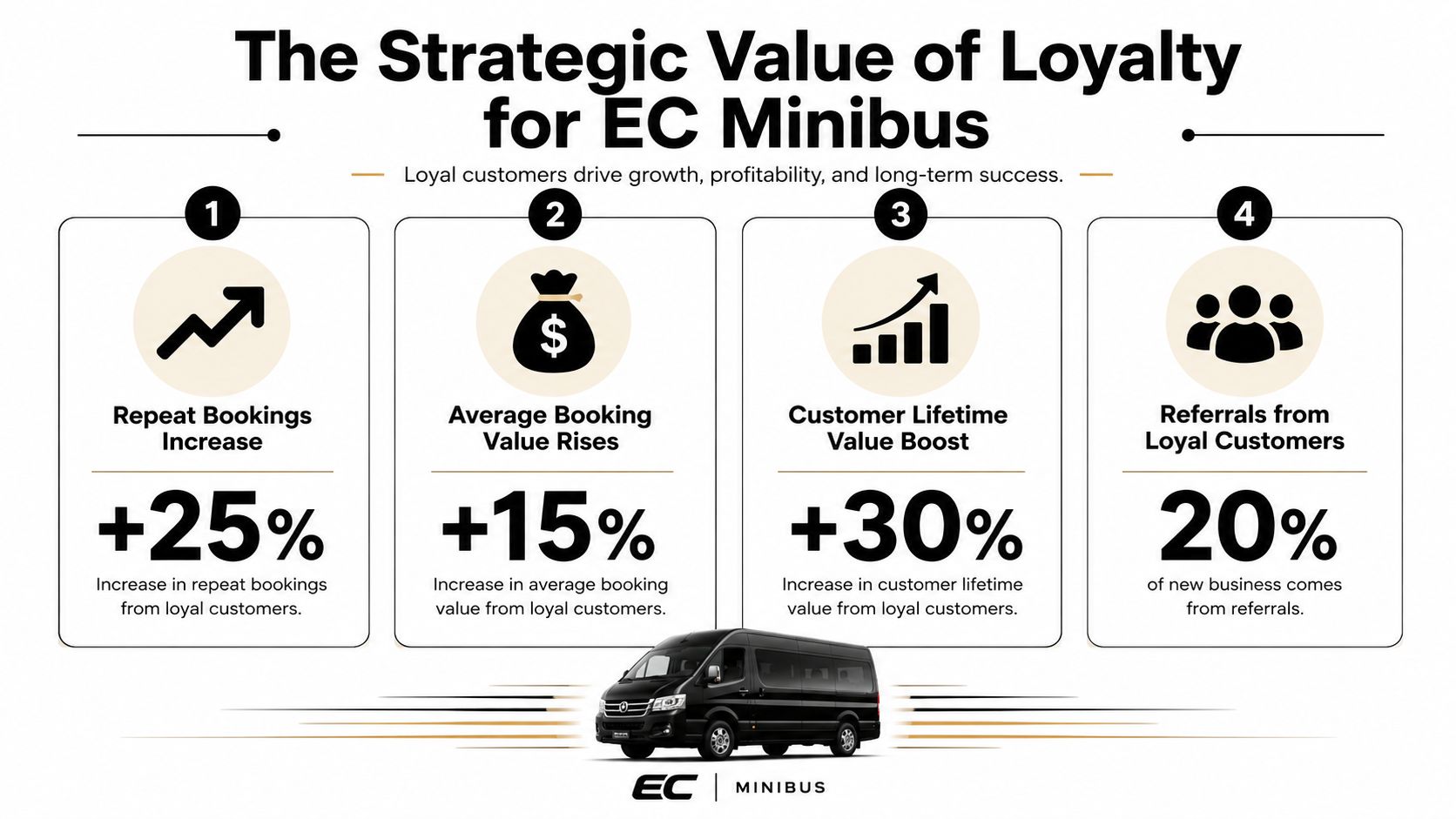
Travel customers judge value differently
For passengers aged 45+ on cruise journeys, 10 to 20% reward value drives behaviour change while preserving margins, and experiential benefits such as priority boarding resonate more than simple discounts, according to UK customer loyalty guidance from eDesk. That's especially relevant for airport and cruise transfers because this audience often values smooth handling over gamified earning.
A manager may ask, “Why not just offer points for every pound spent?” Because points alone don't solve the traveller's real anxiety. They want to know who will help if the flight lands late, where to meet the driver, and whether the transfer to the port will still feel orderly when plans change.
A strong loyalty benefit in this category might be a dedicated contact path, preferred pickup handling, or a pre-trip confirmation workflow that feels more personal.
Later in the same decision cycle, some travellers will compare providers for vehicle comfort and booking confidence. That's where a service promise tied to private mini bus hire with driver can support retention more naturally than a generic discount badge.
A useful explainer for teams is below.
Trust is part of the reward
Many loyalty schemes fail because they separate reward from service quality. In transfers, customers don't separate them at all. If a loyal passenger gets a discount but still has to repeat arrival details every trip, the experience feels careless.
Managers should treat trust markers as loyalty assets:
-
Verified consistency
The same reliable meet-and-greet process each time builds memory and confidence. -
Recognised preferences
If a customer usually travels with extra luggage or needs slower boarding support, remembering that matters. -
Reduced uncertainty
Clear pickup instructions, monitoring, and proactive messages feel like rewards because they remove friction.
Practical rule: In high-stakes travel, the best loyalty perk often isn't “more value later.” It's “less stress now.”
Types of Loyalty Programs for Airport and Cruise Transfers
Not every loyalty format belongs in a transfer business. Some look attractive on paper but create more confusion than retention. The best model is the one a tired traveller can understand in seconds.
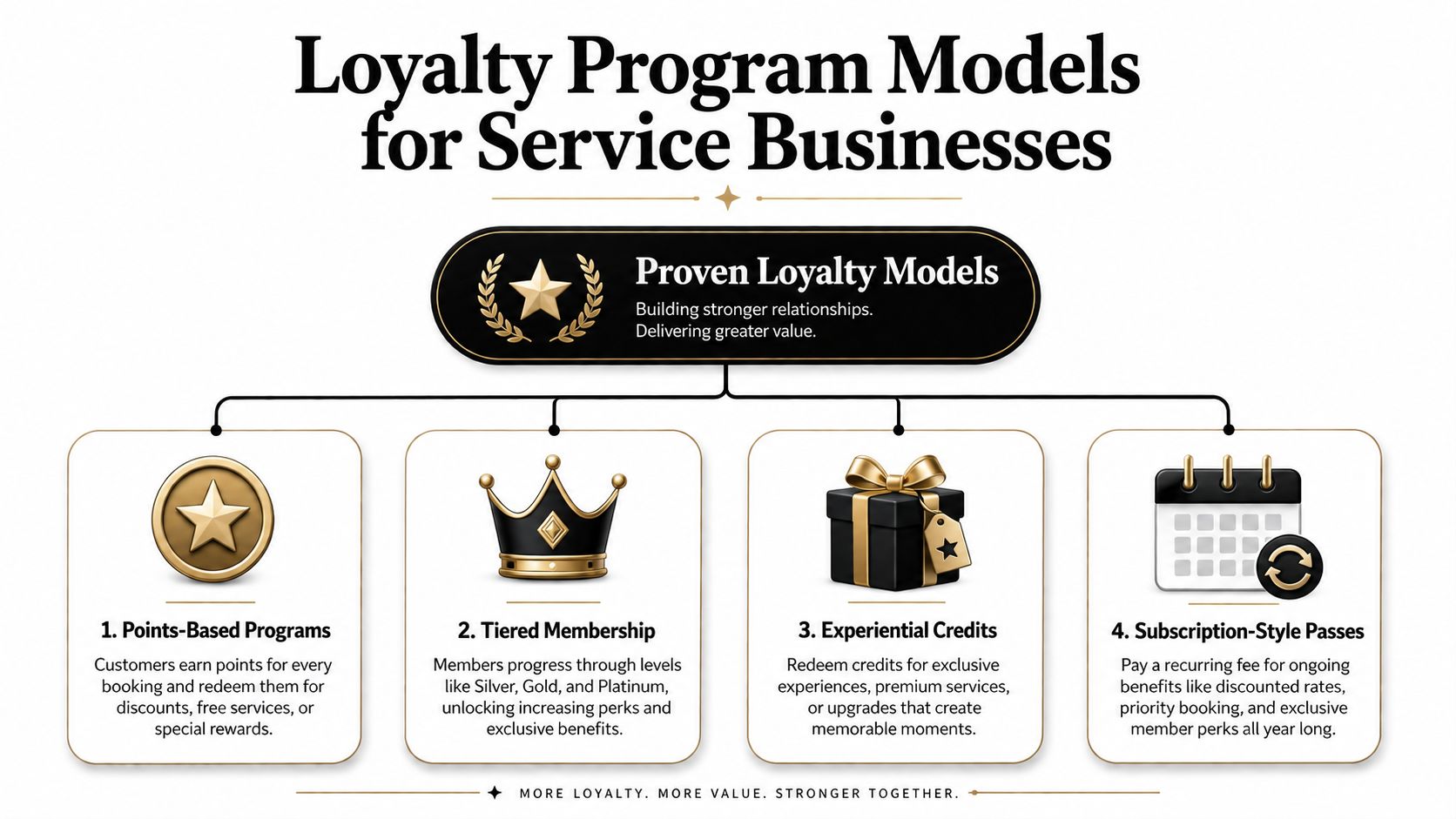
Comparing the main models
While 47% of UK customers who join loyalty programs make repeat purchases, service-based rewards such as free upgrades or VIP meet-and-greet outperform generic point accumulation, according to Reapp's discussion of loyalty program benefits.
Here's how the main models compare for airport and cruise transfers:
| Model | How it works | Best use in transfers | Main risk |
|---|---|---|---|
| Points-based | Customer earns points per booking | Simple for broad audiences | Can feel vague or slow |
| Tiered membership | Benefits improve with repeat use | Good for frequent flyers, agents, repeat cruisers | Rules can become hard to explain |
| Experiential credits | Customer unlocks service perks or credits | Strong fit for premium and high-trust travel | Needs careful fulfilment |
| Subscription-style pass | Customer pays for ongoing advantages | Useful for regular routes and repeat travellers | Harder to sell to occasional users |
Points-based systems are familiar, which helps adoption. But they often work best when bookings are frequent and low-stakes. Airport-to-port transfers are less frequent and more important per trip, so customers may care more about immediate utility than long accumulation.
Tiered membership works better when you have a recognisable group of repeat bookers. It also suits business accounts and travel planners because status can enable faster service.
What fits transfer services best
For most transfer operators, experiential credits are the strongest match. They reward what customers remember.
Examples include:
- Journey support credits that can be used for upgraded assistance or a more flexible pickup window
- Recognition perks such as faster rebooking or a named service preference saved in the profile
- Comfort upgrades tied to milestone use, where operationally possible
- Partner-facing benefits for travel organisers who manage repeat client journeys
Subscription-style passes can also work, but only when the route pattern is predictable. A traveller who flies into London several times a year may understand the value. A one-off cruise passenger probably won't.
The key test is simple. If the customer asks, “What do I get?” your answer should fit into one sentence.
If the reward needs a long explanation, it's probably too complex for a travel day.
Design and Implementation Considerations
The biggest design mistake is starting with the reward catalogue. Start with behaviour instead. Decide what customer actions help the business run better and improve the journey, then reward those actions in a way passengers find fair.
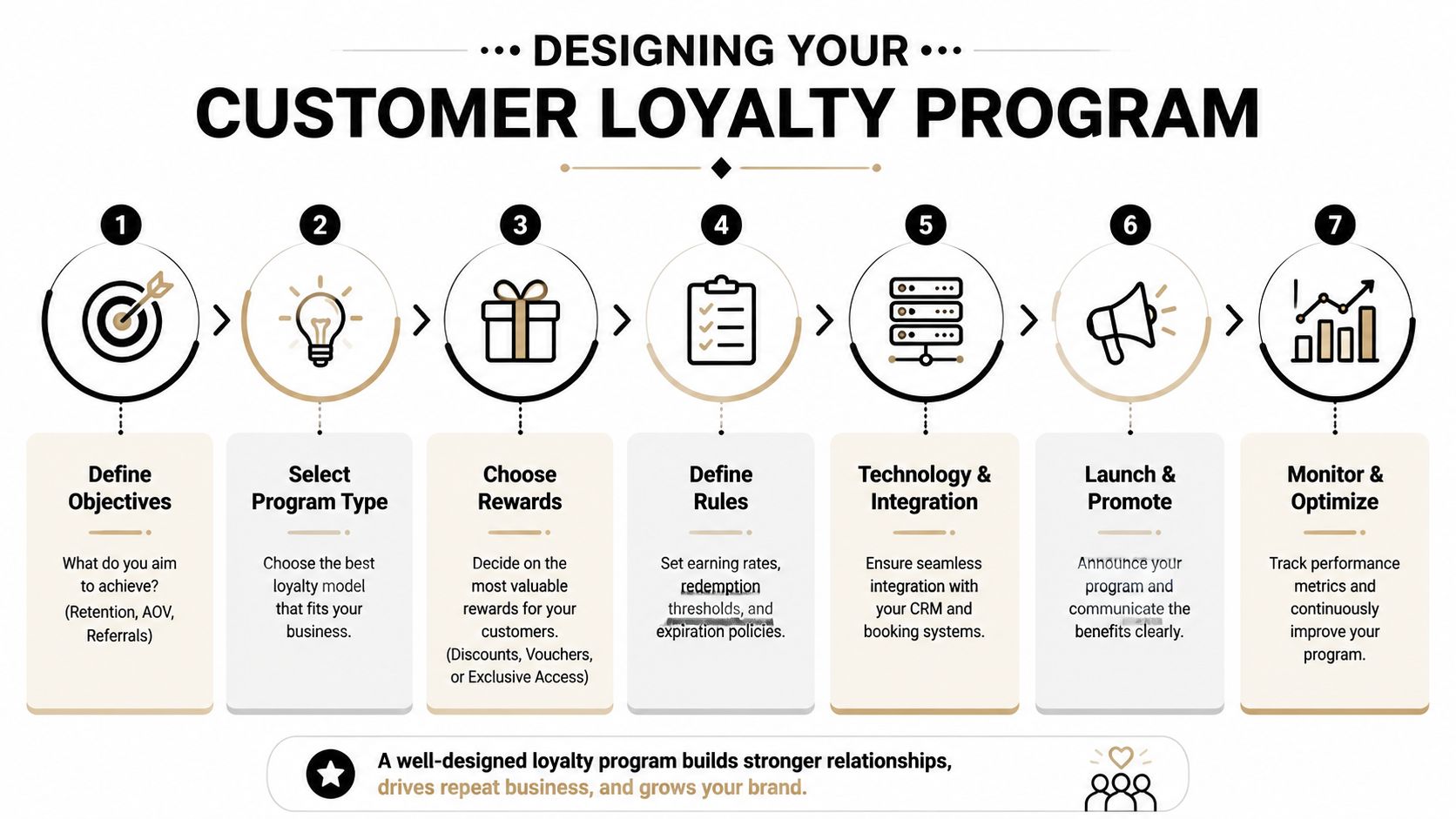
Start with behaviour not discounts
Map the behaviours you want more of. In a transfer operation, useful behaviours are not limited to repeat purchases. They may include complete passenger details, earlier bookings, return journey bookings, or account creation.
Then choose rewards that match those actions. Don't reward everything. Too many earning rules make the programme feel arbitrary.
A practical starting set might include:
-
Joining the programme
Give a small but immediate benefit so signup feels worth it. -
Completing a first successful transfer
This is when trust has been proven. A future-use benefit works well here. -
Booking a return or onward journey
Reward continuity, because it reflects stronger intent than a one-off ride. -
Using profile features correctly
Passengers who add flight details and special requirements reduce avoidable service issues. Recognise that.
The reward itself should fit the service. In UK loyalty research, the top consumer preferences highlighted are discounts with 85% appeal and monetary vouchers with 82% appeal, and 67% of UK consumers disengage due to unclear value accumulation, according to The Loyalty Club's UK loyalty statistics. That means clarity beats cleverness.
Build rules customers can understand
The easiest way to lose momentum is to launch with complicated thresholds. Customers shouldn't need a calculator. They should know, after one glance, how the programme works.
Use simple design principles:
-
Name the benefit plainly
“Transfer Credit” is clearer than “Journey Achievement Token”. -
Show progress visually
If someone is close to a reward, they should see it immediately in email or account view. -
Limit exclusions
A page full of exceptions creates suspicion. -
Define expiry carefully
If rewards disappear too quickly, members feel tricked. If they never expire, finance and fulfilment become harder to control.
A good transfer loyalty rulebook often fits on one screen. If your internal team needs a long briefing document just to explain redemptions, the customer experience will likely break at the frontline.
Use technology to prevent forgotten rewards
In the UK, 80% of adults are loyalty members, yet 30% forget to use rewards without automated nudges, making app or digital triggers important for recovering lost engagement, according to The Loyalty Club's UK loyalty statistics. For managers, this is one of the most important operational lessons.
People don't ignore rewards because they dislike them. They often ignore them because they're busy, tired, or unsure what they've earned.
Your system should send reminders at the moments that matter:
-
After booking confirmation
Remind members what this trip will earn or qualify them for. -
Before travel date
Prompt them to apply any eligible benefit. -
After a completed journey
Confirm what changed in their balance or status. -
When close to a threshold
Messages like “You're close to your next travel credit” are easier to act on than generic newsletters.
These nudges can go by email, app notification, or SMS, depending on your setup and consent model. The important point is timing. Generic monthly blasts won't do the job as well as event-triggered messages.
Loyalty doesn't fail only at enrolment. It often fails in the silence between one booking and the next.
Keep privacy and operations aligned
Managers often treat compliance as a separate legal checkbox. In loyalty programmes, it affects trust directly. Passengers are sharing contact details, travel dates, and often route patterns. If your messaging feels intrusive or your data use feels unclear, the programme weakens even if the reward is attractive.
Keep the structure clean:
| Area | Good practice |
|---|---|
| Data collection | Ask only for details needed to run the programme and journey |
| Consent | Separate service notifications from promotional messaging where required |
| Access | Make sure staff can see only what they need to serve the booking |
| Transparency | Explain how balances, status, and communications work in plain English |
| Support | Give customers a simple way to ask about benefits, balances, or account changes |
Operational alignment matters just as much. Drivers, customer support staff, and booking agents must understand what a member receives. If the website promises one thing and the live team explains another, loyalty turns into friction.
A sensible rollout often happens in stages:
- Pilot first with a narrow audience such as repeat airport-to-port travellers
- Review support tickets to see where language causes confusion
- Check redemption patterns before expanding the reward menu
- Train frontline staff using real booking examples, not abstract policy notes
Communication and Promotion Strategies
A loyalty programme can be well designed and still underperform if customers don't grasp it quickly. Communication has one job. Make the benefit obvious before the traveller loses interest.
Match the message to the traveller
Different segments care about different outcomes. A new cruiser may want reassurance and a simple welcome reward. A returning passenger may care more about speed, saved preferences, and a smoother repeat booking path. A travel organiser may want easier administration and visible client value.
That means your launch messages shouldn't all say the same thing. Split them by audience and moment:
- New passengers need a short explanation, a reason to join, and a clear first-use benefit.
- Repeat leisure travellers respond to convenience, recognition, and money-saving language.
- Travel agents and organisers need operational clarity they can explain to their clients.
- Past customers should receive a reactivation note tied to future travel planning.
If partnerships are part of your channel mix, a structured rollout through a travel agent partnership programme can help agents explain benefits consistently.
Promote savings clearly and early
The UK loyalty market is projected to grow at a 12.2% CAGR from 2025 to 2029, and 80% of consumers believe loyalty schemes save them money, according to the United Kingdom loyalty programs market intelligence report summary. The practical lesson is straightforward. Lead with tangible value.
For transfer services, strong promotion usually includes:
- Booking-page prompts that explain the immediate benefit of joining
- Post-booking emails that confirm what the customer now has access to
- Pre-travel reminders that encourage reward use before the journey
- Customer service scripts so the benefit sounds the same across channels
Avoid vague claims like “exclusive member rewards.” Say what the member gets and when they can use it.
Sample Program Ideas with KPIs
Theory becomes useful when it turns into a workable offer. Below are three models that fit service-based travel better than a generic “earn points on spend” approach.
Program idea one hosted transfer pass
This is a subscription-style programme for repeat travellers or frequent organisers. Members pay for access to ongoing perks rather than waiting to earn them.
The offer could include priority booking handling, a recurring member fare advantage, and a simple support path for itinerary updates. This works best for passengers who make similar journeys more than once and want predictability.
Best use case: repeat airport-to-port travellers, returning cruise passengers, and planners arranging multiple trips.
Program idea two service credit wallet
This model gives customers credits for valuable behaviours, not just spend. Credits can be earned after completed rides, return bookings, or profile completion, then redeemed for practical benefits.
Those benefits might include a future transfer discount, an upgrade option where available, or a premium support feature attached to the next trip. This model suits service operations because it rewards engagement that improves delivery.
Best use case: mixed customer base with both one-off and repeat users.
Design credits around moments passengers remember. They remember being met smoothly. They rarely remember how many abstract points they collected.
Program idea three partner voucher circle
This is a coalition-style light model built around related travel services. Instead of trying to create every reward in-house, the operator offers partner vouchers or reciprocal benefits that complement the journey.
Examples could include a hotel-related perk, a travel planning bonus, or a service voucher that feels relevant to arrival or departure. Keep it tightly curated. Too many unrelated partners weaken the message.
Best use case: operators with strong referral relationships and a broad international audience.
Key Performance Indicators for Loyalty Programs
The table below gives managers a practical KPI framework. Because transfer-specific benchmark data isn't provided here, the benchmark column uses qualitative targets rather than invented numbers.
| KPI | Definition | Benchmark |
|---|---|---|
| Enrolment rate | Share of eligible customers who join the programme | Strong when signup is steady across booking channels |
| Active redemption rate | Share of members who actually use rewards | Healthy when customers understand benefits and redeem without support friction |
| Repeat booking lift | Change in repeat bookings among members compared with non-members | Positive when members book again more consistently over time |
| Net Promoter Score | Customer willingness to recommend after using the service | Strong when loyalty members report trust, not just price satisfaction |
| Member lifetime value | Total long-term value of a loyalty member relationship | Improving when retention, add-on use, and repeat journeys trend upward |
| Reward breakage review | Share of rewards earned but never used | Acceptable only if non-use comes from choice, not confusion |
| Support contact rate | How often members contact support about programme rules | Lower is better if clarity is high |
| Partner contribution | Value generated through partner-led loyalty activity | Strong when partners help acquire or retain quality bookings |
A useful management habit is to review these KPIs in two groups. First, commercial outcomes such as repeat bookings and member value. Second, friction indicators such as confusion, low redemption, or support volume. A programme can look good on signups and still falter in day-to-day use.
Frequently Asked Questions
Does a transfer company need points to have a customer loyalty program
No. Points are only one format. In private transfers, service credits, member fares, priority handling, and convenience perks often fit better because customers value certainty and ease.
Should rewards focus on discounts or experiences
Usually both, but not equally for every audience. Some travellers want visible savings. Others care more about practical travel benefits such as smoother handling, added flexibility, or recognised preferences.
What if passengers forget they've joined
That's common. The fix is timely digital reminders connected to booking events, not more complicated rewards.
How should unused credits or benefits be handled
Set the rules in plain language before launch. Customers should know whether benefits expire, whether they can be transferred, and what happens if a booking changes or is cancelled.
Do staff need special training
Yes. Drivers don't need a long policy manual, but booking and support teams do need a clear script, examples, and an easy way to verify customer status.
How can passengers check their balance
The simplest options are an account page, booking confirmation emails that show current status, and support replies that use the same terminology as the website. Consistency matters more than fancy design.
What's the biggest cause of failure
Confusion. If customers can't tell what they've earned, when to use it, or why it matters, the programme becomes background noise.
A well-built loyalty programme can turn a one-time airport or cruise transfer into a repeat relationship built on recognition, trust, and smoother travel. If you want a transfer provider that already understands those service moments, explore EC Minibus for Heathrow, London hotel, and UK cruise port connections.