

A client lands at Heathrow after an overnight flight. Their cruise departs from Southampton the same afternoon. The transfer was “arranged”, but nobody can confirm the driver, the pickup point, or what happens if the flight lands late. That's the moment a weak supplier relationship stops being a back-office problem and becomes your problem.
This is why a travel agent partnership in ground transport can't be informal. In the UK cruise and airport transfer market, the difference between a dependable partner and a casual booking source shows up in missed pickups, commission disputes, and lost repeat business. If you sell cruise holidays, airport arrivals, hotel stays, or rail-to-port connections, you need a working model that protects the client journey and your margin at the same time.
Table of Contents
- Why a Strong Travel Agent Partnership Is Non-Negotiable
- Laying the Groundwork for a Powerful Alliance
- How to Find and Approach Your Ideal Partners
- Structuring Commissions and Service Level Agreements
- Sealing the Deal with a Clear Partnership Agreement
- Activating and Nurturing a Profitable Partnership
- Frequently Asked Questions About Travel Agent Partnerships
Why a Strong Travel Agent Partnership Is Non-Negotiable
The weakest part of many itineraries isn't the cruise, the hotel, or the airfare. It's the handoff between them. Ground transfer failures are painfully visible because the client is already travelling, already tired, and already expecting someone to take control.

That's why a travel agent partnership with a transfer provider has to be structured, not casual. When an agent has a named contact, agreed booking rules, clear service standards, and a defined escalation path, disruption becomes manageable. When those things are missing, every late flight turns into improvisation.
The urgency is real. Projected UK travel agency service demand is expected to grow from USD 65.5 billion in 2026 to USD 185.1 billion by 2036, and phone booking holds a 49.0% share, which reinforces how much travellers still value human support for complex trips such as cruise transfers, according to Future Market Insights on the UK travel agency services market. More demand sounds positive, but it also means more pressure on fulfilment.
What a real partnership changes
A proper partnership changes three things immediately:
- Operational certainty: The agent knows who monitors arrivals, who updates pickup times, and who the client calls first.
- Commercial predictability: The provider knows what type of bookings are coming through and how commission will be handled.
- Brand protection: The traveller experiences one joined-up service, not three separate suppliers blaming one another.
Practical rule: If you'd be uncomfortable putting a supplier's name into your client documents, you don't have a partnership yet. You have a risk.
For agents, the benefit is reliability you can sell with confidence. For transfer firms, the benefit is recurring demand from a channel that already understands the traveller's wider itinerary. The best relationships sit in that middle ground where both sides make life easier for the customer and more profitable for each other.
If you're assessing what a dedicated supplier programme can look like in practice, review a specialist travel trade transfer setup for agents and use it as a benchmark for what should already be in place before you recommend any operator.
Laying the Groundwork for a Powerful Alliance
The biggest mistake in partnership building is starting with “Who should I contact?” instead of “Why would the right partner say yes to us?” If you can't answer that cleanly, your outreach will sound generic and your negotiation will stay reactive.

The commercial stakes are high. The UK travel agency market reached £29.4 billion in 2024, and 78% of travel agents' revenue comes from commissions paid by service providers, which makes supplier choice a financial decision, not just an operational one, based on UK travel agency statistics compiled by Condor Ferries.
Start with your own commercial case
Before you vet anyone else, write down what you bring.
If you're an agent, that might be cruise passengers arriving into Heathrow, hotel guests moving into Central London before embarkation, or older travellers who prefer a door-to-door transfer rather than rail changes with luggage. If you're a transfer provider, your value might be licensed drivers, fixed pricing, strong communication, and clean handling of delayed arrivals.
Keep it practical. A useful value statement usually answers these questions:
- Who do you bring? Cruise passengers, FIT travellers, family groups, premium clients, escorted groups.
- What bookings do they need? Airport to hotel, hotel to cruise port, port to airport, station to hotel.
- What problem do you remove? Late arrival confusion, luggage handling, language barriers, pickup uncertainty.
- What makes your side easy to work with? Fast confirmations, one point of contact, clear invoicing, simple amendment handling.
A short preparation exercise often reveals whether you want a broad network arrangement or a focused niche partner.
Later in your evaluation, it helps to watch how others explain the basics of partner readiness and channel relationships:
Use a vetting checklist before any conversation gets serious
A transfer company can look polished online and still be difficult in live operations. An agent can promise volume and still have weak processes. Vet both sides with the same discipline.
Here's the checklist I'd use for UK airport and cruise transfer partnerships:
- Check trading stability: Confirm the business is active, reachable, and able to handle regular enquiries without disappearing when things get busy.
- Verify insurance and licensing: Don't assume. Ask for proof and keep a dated copy on file.
- Review reputation in context: Read Trustpilot and Tripadvisor with a sceptical eye. Look for patterns in lateness, communication, refunds, or driver conduct.
- Test the booking journey: Submit a live enquiry. See how quickly you get a useful answer and whether the quote is clear.
- Ask about disruption handling: Flight delays, missed baggage, terminal changes, ship timing changes. Weak operators usually reveal their shortcomings during these disruptions.
- Inspect admin discipline: Confirm how amendments, cancellations, no-shows, and payment queries are recorded and acknowledged.
A glossy website doesn't rescue a poor handover at Terminal 5 or a missed pickup at Southampton.
For cruise work, I'd also ask one specific operational question: how do you handle itinerary-linked timing changes when flights and sailing plans shift on the same day? If the answer is vague, expect trouble later.
How to Find and Approach Your Ideal Partners
Most good partnerships don't begin with a cold pitch to a general inbox. They begin where booking pain is already obvious and where the decision-maker understands the value of fixing it.
Where good partners usually surface
For UK ground transfer and cruise work, the strongest prospects usually come from four places.
First, look at your own booking trail. Which suppliers already appear repeatedly in your files? If you're an agent, that may be the transfer firms you keep returning to when a Heathrow arrival needs to connect cleanly to Southampton or Dover. If you're a transfer operator, it may be agencies that repeatedly request quotes for pre-cruise hotels and port runs.
Second, use trade events and consortium circles well. You're not there to collect business cards. You're there to identify operators or agencies whose service model already matches yours. If they handle similar clients, work similar routes, and speak clearly about support, they're worth a follow-up.
Third, use LinkedIn to find the actual person who owns supplier relations, trade sales, or operations. A generic contact form can work, but named outreach is usually sharper and easier to progress.
Fourth, ask for quiet referrals from people who understand the route complexity. Hotel concierges, inbound operators, and cruise specialists often know which providers are reliable when plans change.
An outreach email that gets replies
The first message should do three jobs. Show relevance, show commercial sense, and suggest an easy next step.
Here's a simple template.
Subject: Partnership enquiry for UK cruise and airport transfers
Hello [Name],
I'm reaching out because we regularly handle travellers who need reliable transfers between Heathrow, London hotels, and cruise ports such as Southampton or Dover. We're reviewing a small number of supplier relationships for a more formal travel agent partnership and your operation looks aligned with the type of client journey we manage.
We're interested in discussing booking process, service coverage, live update handling, commission structure, and who would own day-to-day support.
If this is of interest, I'd welcome a short call next week. If useful, I can send a summary of our typical booking patterns in advance.
Best regards, [Name]
[Role]
[Company]
[Direct details]
That works because it's specific. It names the route type, signals intent, and avoids sounding like a bulk sales email.
A few rules make a difference:
- Lead with fit: Mention the route, traveller type, or problem you both understand.
- Avoid false urgency: Don't pretend there's a deadline if there isn't one.
- Offer useful context: Booking patterns, client type, or expected operational needs.
- Ask for one action only: A short call is enough. Don't attach a full contract on first contact.
If they reply with broad marketing language and no operational detail, take that as information. Strong partners usually answer practical questions directly.
Structuring Commissions and Service Level Agreements
A partnership becomes real when money and service obligations are written in a way both sides can operate. In UK ground transfers, that means the commercial model must reflect how bookings happen, how changes happen, and who carries the burden when travel plans move.
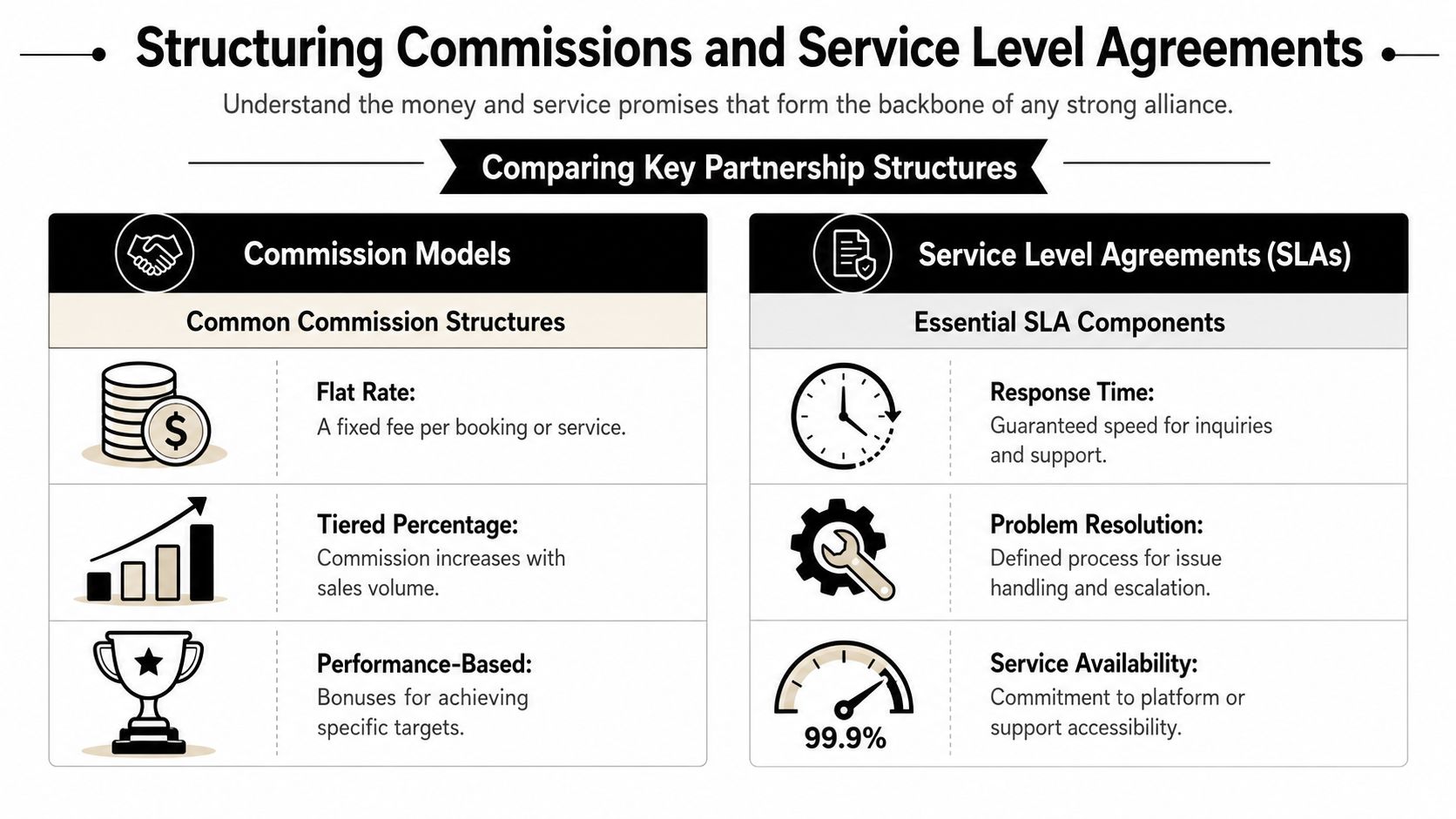
The benchmark matters here. In this segment, the standard methodology uses a 15% commission baseline, and 35% of partnership disputes arise from missed real-time pickup adjustments caused by delayed data sharing between the transfer operator and the agent's booking system, according to Major Travel partner guidance. That tells you two things straight away. Commission is important, but coordination rules are what stop revenue leaking back out through complaints and reversals.
Choose a commission model that matches the booking reality
Not every transfer booking should sit under the same structure. The right model depends on volume, route complexity, and how much admin each side carries.
| Model | Best use | Upside | Risk |
|---|---|---|---|
| Percentage commission | Standard airport, hotel, and cruise transfer bookings | Easy for agents to understand and scale | Margin pressure if pricing isn't controlled |
| Flat fee per booking | Repetitive, standardised journeys | Clean accounting and easy forecasting | Can feel unfair when booking values vary widely |
| Tiered commission | Agencies with repeat volume | Rewards growth without renegotiating each file | Can create disputes if volume counting isn't defined |
In practice, percentage models work well when journeys vary in value and complexity. Flat fees suit standard transfers with limited variation. Tiered arrangements make sense only when both sides agree exactly what counts as a completed booking, a cancelled booking, and a moved booking.
Operator discipline matters more than headline commission. A generous rate loses value quickly if amendments are mishandled or payment timing is fuzzy.
If you're comparing private transfer categories before deciding how to package your ground product, this overview of private car hire with driver is a useful reference point for matching service type to client expectation.
SLA terms that prevent avoidable conflict
The service level agreement is where most partnerships either become durable or fragile. It should answer operational questions before the first disrupted journey forces someone to improvise.
I'd insist on these SLA points for cruise and airport transfer work:
- Booking confirmation standard: What information must be confirmed, and how quickly?
- Arrival monitoring rule: Who monitors the flight or cruise status, and how often is timing refreshed?
- Pickup procedure: Exact meeting point, signage expectation, and client contact process.
- Change management: How terminal changes, delays, and client amendments are logged and acknowledged.
- Escalation route: Named contacts for live-day issues.
- Complaint window and evidence: What counts as a service failure, and what proof is required.
A short clause is better than a polite assumption. For example, don't write “supplier will monitor delays where possible”. Write exactly who monitors, what triggers an adjustment, and who tells the client.
That level of detail is what turns a travel agent partnership from a referral arrangement into a dependable trading relationship.
Sealing the Deal with a Clear Partnership Agreement
A handshake can start goodwill. It can't settle a commission query, a no-show dispute, or a branding problem six months later. For that, you need a written agreement that ordinary people can read without calling a lawyer every ten minutes.
Clauses that matter in practice
Most partnership agreements become messy because they skip operational detail and over-focus on boilerplate. In ground transport, the useful clauses are usually the plain ones.
Start with scope of services. List the journey types covered. Airport to hotel, hotel to cruise port, port to airport, rail station to hotel, and any exclusions. If the partnership only applies to private transfers and not shared shuttles, write that down.
Then deal with commission trigger and payment timing. Don't rely on “payment will be made in due course”. State when commission becomes payable, what booking status triggers it, how cancellations are treated, and how disputes are raised. If the provider pays on confirmation rather than after travel, say so directly. If not, say that too.
Next comes liability and insurance. The point isn't to dump every risk on the other side. The point is to make sure both parties know where responsibility begins and ends. Ground transport often intersects with flight delays, cruise check-in timings, and client-caused changes. Your contract should reflect that reality.
A solid agreement should also include:
- Confidentiality: Protect rates, client data, and internal process notes.
- Branding rules: Specify whether the agent can use the provider's logo, images, or service descriptions.
- Service reporting: Clarify whether booking summaries, issue logs, or monthly statements will be shared.
- Termination terms: Define notice period, immediate termination triggers, and treatment of bookings already accepted.
Sample wording you can adapt
Use plain wording. Fancy language rarely improves a supplier agreement.
Service Level Guarantee
The Supplier will provide booking confirmation, client pickup instructions, and live-day contact details for each accepted booking. The Supplier will maintain a documented process for handling delayed arrivals, terminal changes, and missed client contact. Where a service issue occurs, the Supplier will acknowledge the issue promptly and provide a written account of the incident on request.
That clause works because it describes duties without overpromising outcomes no operator can guarantee.
For exclusivity, keep the scope narrow unless both sides already have strong trust.
Exclusivity
The Parties agree that this arrangement is non-exclusive unless otherwise stated in writing. Either Party may work with other suppliers or agencies, provided that confidential pricing, client information, and internal commercial terms are not disclosed.
If you want route-based or segment-based exclusivity, define it precisely. “Exclusive partner for transfers” is too vague. “Preferred provider for private Heathrow to Southampton cruise transfers booked through the Agency” is much safer.
One more clause deserves special attention in this niche: data and communication responsibility. If the agent collects the flight number and cruise details, the contract should say when those details must be passed over and in what format. If the supplier depends on those details to monitor arrival changes, that dependency belongs in writing.
Put every repeated point of friction into the contract once. It's easier than arguing about it on a Saturday morning while the client is standing outside Arrivals.
Activating and Nurturing a Profitable Partnership
Many partnerships look good on paper and then fall flat in the first month because nobody designed the handover from agreement to daily use. Activation should be simple enough that a busy agent can use it correctly on the first booking.
Recent trade reporting shows UK travel agent and tour operator registered companies rose 17% since July 2024, which signals a larger pool of independents looking for models they can scale into, as noted by Travelweek coverage of a UK travel equity partnership. That makes clean onboarding more important, not less.
A clean launch beats a complicated one
The best launch process is short and repeatable. One document with booking rules. One contact list. One pricing method. One escalation route.
A practical activation sequence usually looks like this:
- Confirm commercial terms in one final version, not via scattered email threads.
- Set booking workflow so both sides know what details are mandatory before a transfer is accepted.
- Create client-facing wording for confirmations, vouchers, and pre-travel notes.
- Test one live booking before rolling the arrangement out broadly.
- Review the first few files for amendment handling, communication speed, and reporting quality.
If your partnership involves door-to-door travel for cruise guests or airport arrivals, this overview of door-to-door service expectations is a useful benchmark for how client-facing transfer language should read.
How strong partnerships stay productive
The most profitable relationships aren't always the ones with the highest booking count first. They're the ones with the lowest friction.
A good operator gives the agent clean materials to work with. Clear service descriptions. Realistic pickup instructions. Booking confirmations that don't require rewriting. A good agent does the same in reverse by sending complete itinerary details and not treating live travel day changes as if the supplier can read minds.
Use a basic review rhythm. Discuss recent issues, client comments, routes that create confusion, and whether the current commission model still fits the booking mix. Keep those calls short and evidence-based.
Track performance qualitatively if you don't yet have a formal dashboard. Ask:
- Are bookings easy to place correctly?
- Do clients understand the handoff?
- Are amendments creating admin drag?
- Do both sides resolve problems professionally?
- Is the partnership producing repeat confidence, not just one-off sales?
When those answers stay positive, the relationship is worth expanding. When one side keeps creating avoidable uncertainty, fix it quickly or replace the partner.
Frequently Asked Questions About Travel Agent Partnerships
What should I do when a transfer goes wrong
Deal with the client first, then the paperwork. Confirm where the traveller is, what immediate solution is available, and who is taking ownership of the next step. After that, request a written incident summary from the supplier and compare it against the booking record. Keep the tone factual. Don't start with blame if you want the relationship to survive.
Does a small agency need advanced tech to partner with a larger transfer provider
No. A small agency doesn't need a complex stack to run a good travel agent partnership. It needs clean data entry, quick communication, and a repeatable way to capture flight, cruise, hotel, and contact details. Most failures come from incomplete information or delayed updates, not from lack of flashy software.
When should commission terms be renegotiated
Renegotiate when the booking mix changes, when one side is doing materially more admin than expected, or when the original model no longer matches the workload. Don't renegotiate after every successful month. Do it when the facts support a reset and both sides can see why.
Should exclusivity ever be agreed
Sometimes, but only in a tightly defined area. Route-based or client-segment exclusivity can work if the partner has already proven reliable. Broad exclusivity often creates complacency and limits flexibility.
What's the biggest warning sign in a new partner
Vagueness. If they can't explain who handles live-day issues, how changes are recorded, or how disputes are reviewed, you're being asked to trust a process that doesn't exist.
If you're arranging Heathrow, Central London, and cruise port transfers for clients, EC Minibus offers a specialist private transfer service built around the details that matter to travel professionals: fixed pricing, licensed and insured drivers, meet and greet, flight and cruise monitoring, and dependable door-to-door journeys to Southampton, Dover, Portsmouth, Tilbury, hotels, and rail hubs.