

You've just landed at Heathrow after a long flight. Your luggage is with you, your hotel is waiting, and a cruise departure may be the next morning. The last thing you want is to watch a taxi meter climb while traffic slows, or discover extra charges only after the journey ends. A clearly stated fixed fare changes that experience. You know the price before you travel, understand what the booking covers, and can plan your budget without guessing.

For international visitors, families, business travellers and cruise passengers, that certainty matters. A transfer from Heathrow to a Central London hotel has different practical needs from a journey to Southampton, Dover, Portsmouth or Tilbury. You may have several suitcases, a strict check-in time, children in the group, or no local knowledge of London traffic and taxi fares.
This guide explains what fixed pricing really means, how it compares with metered and tariff fares, and how to identify hidden costs before paying. You'll also see how UK pricing rules relate to transparent travel bookings and what a genuine fixed transfer quote should say about waiting time, luggage, delays, tolls and changes to your route. For general background on booking an airport transfer, you can also review this airport transfer service guide.
Table of Contents
- Introduction to Fixed Pricing for Peace of Mind Travel
- What Fixed Pricing Really Means for Private Transfers
- How Fixed Pricing Compares with Metered and Tariff Fares
- Why Transparent Fixed Pricing Protects You From Hidden Fees
- Fixed Pricing in Action for Airport to Hotel and Cruise Routes
- How EC Minibus Delivers Fixed Pricing With No Surprises
- Booking With Confidence and Your Next Steps
Introduction to Fixed Pricing for Peace of Mind Travel
A fixed transfer price works like agreeing the cost of a meal from a set menu before ordering. You're not paying separately for every minute spent waiting for the kitchen, every ingredient used or every movement around the dining room. The agreement has boundaries, but the main price is clear from the start.
A private transfer works in a similar way. You provide the pickup point, destination, travel date, passenger details and luggage information. The operator then gives you a quoted amount for the agreed journey. If the journey stays within that agreed scope, the price should remain the same rather than changing because traffic is heavy or the route takes longer.
That certainty has become more valuable during periods of changing costs. UK inflation was 7.92% in 2022, 6.79% in 2023, 3.27% in 2024 and 3.883% in 2025, compared with 0.99% in 2020 and 2.52% in 2021, according to the Office for National Statistics consumer price index dataset. Those figures help explain why buyers and sellers use fixed prices as a way to manage uncertainty, although a quoted fare is only reassuring when its conditions are visible.
The useful question isn't simply “Is this fixed?” It's “Fixed for exactly what?”
A traveller should be able to check whether the fare includes the vehicle, driver, standard route, agreed waiting arrangements, taxes and unavoidable booking costs. You should also know what happens if your flight is delayed, your cruise arrival changes, you add another stop or your group brings more luggage than originally stated.
The rest of this guide treats fixed pricing as something you can verify, not just a phrase used in an advert. That approach gives you a calmer booking experience and a clearer basis for comparing a private transfer with a black cab, a local taxi or another pre-booked service.
What Fixed Pricing Really Means for Private Transfers
Fixed pricing means that the agreed journey has an agreed total price. It doesn't mean every possible change is free, and it doesn't remove the need to read the booking conditions. It means the operator shouldn't recalculate the fare merely because normal travel conditions make the journey slower or less convenient.
Think of the difference between a set menu and paying for every item separately. With a set menu, you know the main cost before you order. With a meter, the price builds as distance, time or other applicable charges accumulate. A private transfer can use fixed pricing by agreeing the route and service scope before the vehicle arrives.
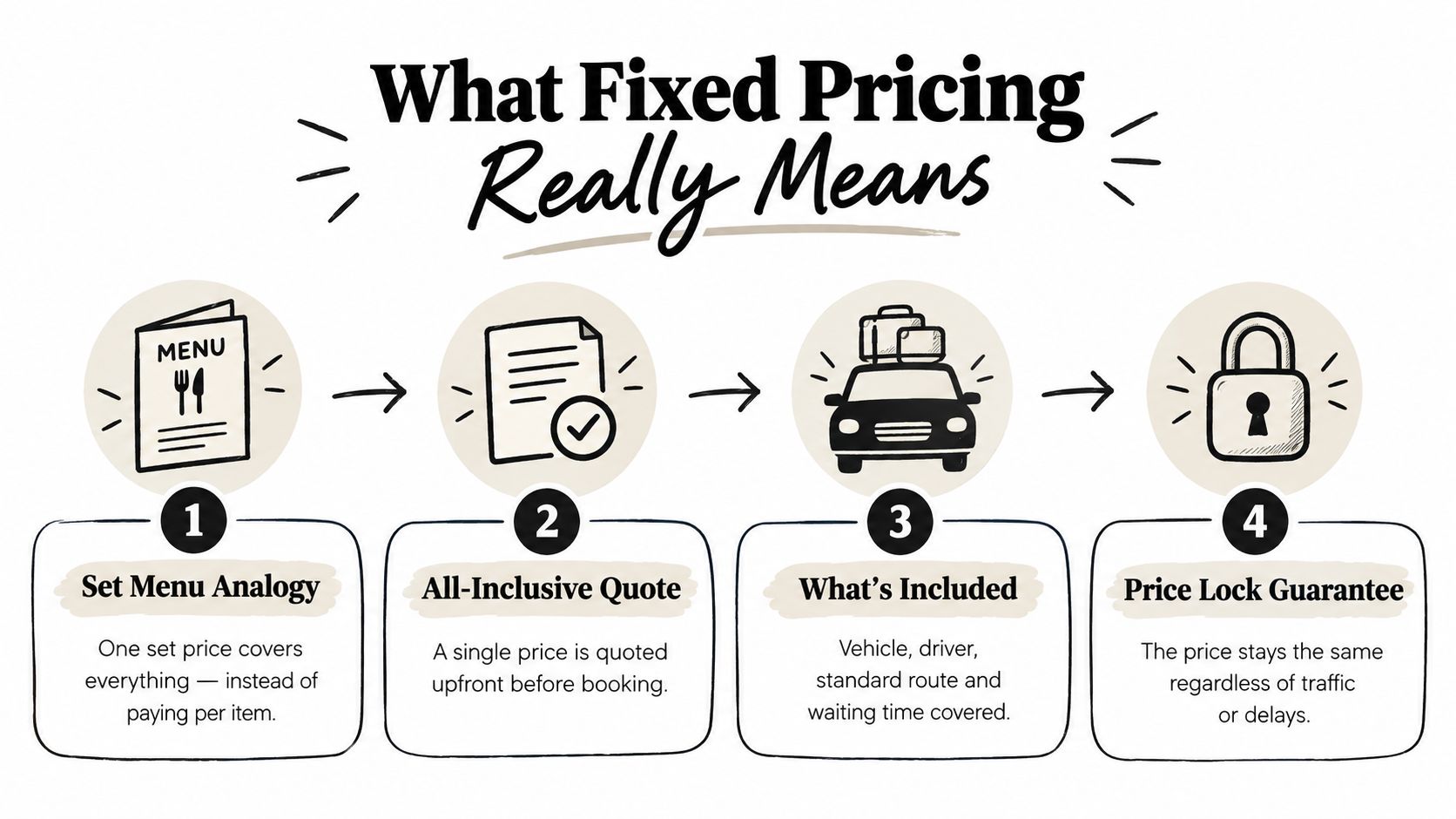
The three parts of a dependable quote
First, look for a price lock. The quoted total should be tied to the booking details, not left as an estimate that can be replaced later. “From” pricing or an approximate range needs further clarification because it may not provide the same certainty.
Second, check scope clarity. The booking should identify the pickup and destination, passenger count, vehicle type or capacity, date, time and any relevant stops. A Heathrow to Southampton journey isn't the same service as a Heathrow to Central London hotel, even if both are airport transfers.
Third, require upfront disclosure. The total should explain whether taxes, tolls, standard waiting, meet and greet, luggage assistance and payment charges are included. If something can be added automatically, it shouldn't appear as a surprise at checkout or arrival.
A practical explanation of how transfer costs are formed is available in this guide to car service costs in the UK. The important distinction is between a genuine agreed fare and a low starting price that becomes higher as separate items are added.
What a fixed price doesn't cover automatically
A quote can remain fixed while the journey itself changes. For example, adding a second destination, requesting an extra stop, changing the vehicle requirement or substantially extending the waiting arrangement may create a different service. The operator should explain that adjustment before providing it, rather than presenting it after payment as an unexpected charge.
A fixed fare protects the agreed journey. It doesn't automatically cover an amended journey.
For a first-time visitor, the safest habit is simple. Read the written confirmation, look for the full amount, and ask about anything described as optional, conditional or subject to change.
How Fixed Pricing Compares with Metered and Tariff Fares
London's regulated taxi system shows why two passengers travelling along a similar route may not receive the same final fare. Transport for London publishes different pricing bands for journeys up to 6 miles. The listed rate is £4.00 per mile in Tariff 1, £4.83 per mile in Tariff 2 and £5.12 per mile in Tariff 3. For journeys over 6 miles, TfL lists £4.83 per mile at all times in the cited fare structure, as shown on its official taxi fares page.
These bands are linked to timing and conditions, so the departure time can affect the fare. A fixed private transfer approaches the same uncertainty differently by agreeing a price before the journey begins.
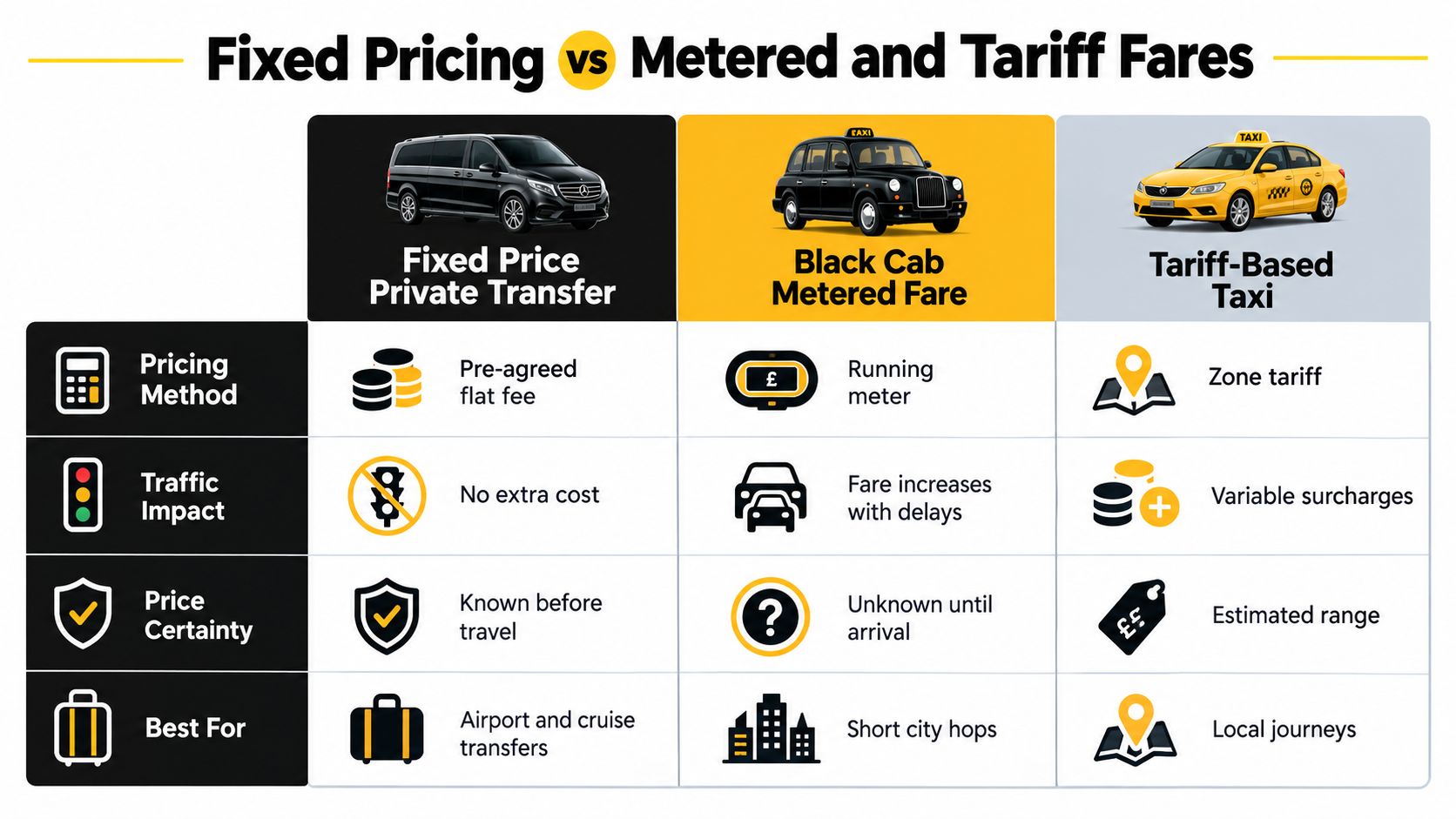
Fixed price versus a metered London taxi
| Feature | Fixed Price Private Transfer | Metered London Taxi |
|---|---|---|
| Pricing method | Pre-agreed fare for the booked journey | Running meter based on the applicable rules |
| Traffic impact | Normal traffic conditions shouldn't change the agreed fare | Delays can increase the final amount |
| Price certainty | Total is available before travel | Final amount is known at the end |
| Best suited to | Airport, hotel and cruise-port journeys | Shorter city journeys and immediate street travel |
| Booking style | Reserved in advance with journey details | Hailed, ranked or booked for immediate travel |
A black cab may be convenient when you're already in central London and need a short trip. It can also be familiar to visitors because the regulated system is visible and established. The trade-off is that the final cost may depend on the tariff and the time taken.
For a longer journey, especially Heathrow to Southampton, Dover, Portsmouth or Tilbury, a fixed quote can be easier to budget. You're not trying to predict how congestion, route decisions or waiting will affect a meter while also managing luggage and a departure timetable.
Tariffs aren't the same as a guaranteed quote
UK taxi regulation adds another layer of complexity. A government-backed review states that about 95% of local authorities regulate taxi fares, and explains that fares in England and Wales are legally maximum fares rather than guaranteed fixed fares. London is identified as the exception because it uses a mandatory tariff. The review is available in this government-backed report on taxi and private hire vehicle regulation.
That distinction matters. A regulated maximum gives passengers a framework, but it isn't identical to a private transfer quote that confirms one total for one specified journey. If you're comparing options, this guide to Heathrow taxi costs can help you understand why the booking method matters as much as the vehicle.
Why Transparent Fixed Pricing Protects You From Hidden Fees
A fixed price is useful only when you can see the full cost before payment. A booking that displays a low base fare and adds unavoidable charges later may look fixed at first, but the customer still lacks a reliable total.
This issue is known as drip pricing, where costs appear in stages instead of being presented clearly at the beginning. In August 2026, the Competition and Markets Authority opened investigations into Virgin Atlantic and Trainline after complaints about customers not seeing the total price upfront. Reuters reported that the regulator can impose fines of up to 10% of global turnover if firms breach consumer law, as described in this Reuters report on UK pricing investigations.
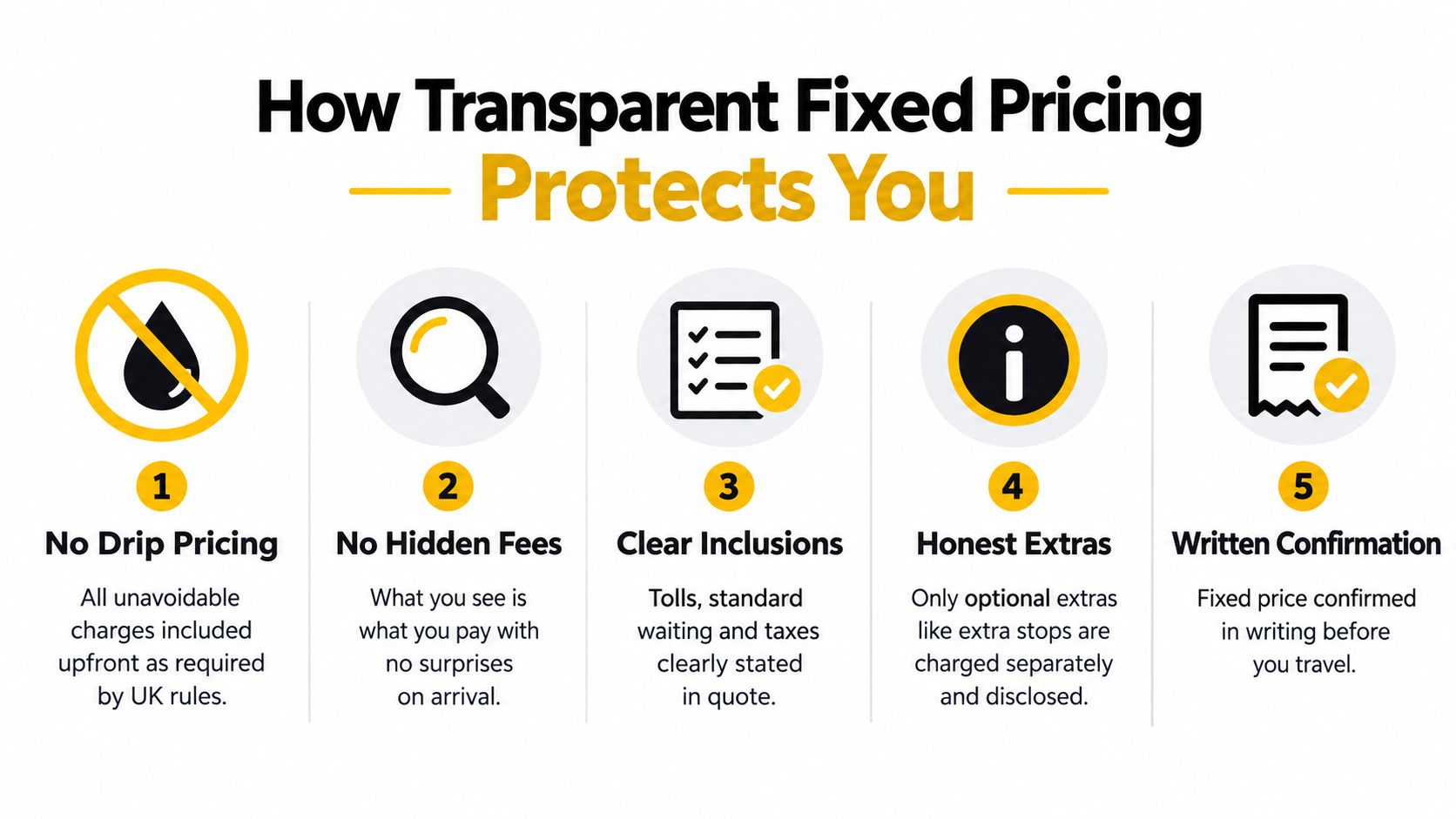
What to check before you pay
Use the booking screen and confirmation email as a practical audit. You don't need specialist knowledge. You need enough detail to understand whether the displayed amount is the amount you'll pay.
- Total fare: Confirm that the quoted price is the complete amount for the stated journey, not a starting price.
- Mandatory charges: Check whether taxes, booking fees, payment fees and tolls are already included.
- Waiting arrangements: Ask what happens if your flight or cruise is delayed, and whether the quoted waiting period has conditions.
- Meet and greet: Confirm whether the driver meets you inside the terminal, where the meeting point is, and whether this service costs extra.
- Luggage: Make sure the vehicle can carry your group and bags, particularly when travelling to a cruise terminal.
- Journey changes: Find out how the operator treats extra stops, revised destinations, additional passengers or a different vehicle requirement.
UK government guidance says unavoidable charges should be shown upfront. That makes “fixed price” a testable promise. If the operator can't explain the total in writing, you don't yet have enough information to compare the offer fairly.
Optional extras should look optional
An extra stop, special child seat request, additional luggage service or changed destination may legitimately alter the price because the requested service has changed. The important point is disclosure. You should see the cost and approve it before the change is accepted.
A trustworthy quote separates the agreed service from optional additions.
The same principle applies to airport delays. A clear policy may allow the operator to monitor a flight and adjust the pickup time within the booking terms. That isn't the same as an unlimited promise to provide extra services at no cost. Ask for the boundary before you book.
Fixed Pricing in Action for Airport to Hotel and Cruise Routes
Consider a family arriving at Heathrow with several suitcases and a reservation at a Central London hotel. They book a private transfer in advance, giving the operator their flight details, passenger count, luggage information and hotel address. The written quote identifies the journey and shows one total, so the family can include the transfer in its travel budget before boarding the aircraft.
After landing, the family collects its bags and meets the driver at the agreed point. London traffic may make the drive slower than expected, but the normal route and service have not changed. Under the fixed arrangement, the quoted fare remains the reference price, subject to the booking's stated waiting and change conditions.
A metered journey creates a different experience. The final amount depends on the applicable meter rules and the time taken, so the family can't know the precise total at the beginning. That doesn't make a metered taxi unsuitable, but it makes it less convenient for travellers who want a definite transfer budget.
A Heathrow to Southampton example
Now consider cruise passengers travelling from Heathrow to Southampton Cruise Terminal. Their needs are more specific than those of a traveller going to a nearby hotel. They have luggage for a longer trip, a terminal deadline and a destination where arriving at the wrong entrance or losing time can create unnecessary pressure.
A fixed quote should state the pickup location, Southampton destination, vehicle capacity, passenger details and the handling of flight delays. It should also make clear whether meet and greet, luggage assistance, standard waiting and unavoidable charges are included. When these details are confirmed before payment, the passengers can focus on the handover from airport to ship instead of calculating a running fare.
The same logic applies to Dover, Portsmouth and Tilbury. The route may be longer or the operational details may differ, but the consumer question stays the same: what service has been agreed, and what amount covers it?
How EC Minibus Delivers Fixed Pricing With No Surprises
A fixed fare needs an operational process behind it. The booking details must be accurate, the driver needs useful arrival information, and the customer should know how delays or changes are handled. Without those elements, the word “fixed” describes only the price label, not the whole transfer experience.
EC Minibus presents fixed, transparent pricing for private journeys linking Heathrow, Central London and UK cruise ports. Its stated service includes meet and greet at Heathrow, flight and cruise monitoring, luggage assistance, licensed and insured drivers, modern vehicles, instant confirmation and customer support. Those features matter because a reliable transfer involves more than sending a vehicle to an address.
What stays within the agreed fare
For a standard booking, the fare is connected to the journey details supplied at the time of reservation. That normally means the named pickup and destination, the agreed passenger and luggage requirements, the selected vehicle and the service conditions shown in the booking confirmation.
Flight and cruise monitoring can help the operator respond when the expected arrival time changes. The key point for the traveller is to check how that monitoring works and whether waiting for a delay is included under the stated terms. A clear policy should tell you when the operator adjusts the pickup and when a longer or different service may require review.
When the journey scope changes
A genuine change can justify a revised price. Examples include adding another destination, requesting an unplanned stop, increasing the group size beyond the vehicle's capacity, changing the final destination or asking for assistance that wasn't part of the original booking.
Those circumstances differ from ordinary congestion or a routine variation in driving time. The quote should not become a surprise bill because the roads are busy. If a change is needed, the operator should explain what has changed and obtain your agreement before applying an additional amount.
For travellers comparing providers, the practical test is straightforward. Read the confirmation, check the inclusions, keep the support details available and ask about delays before travel day. EC Minibus also states that customers can book online and receive support through live chat and FAQs, which gives passengers a way to clarify the fare before committing.
Booking With Confidence and Your Next Steps
Fixed pricing gives you a useful form of control, especially when you're arriving in a country you don't know well or travelling towards a cruise departure. It lets you compare a quoted total with other options instead of guessing how distance, time bands or delays may affect a metered fare.
The protection comes from the details. A fare isn't fully reassuring because the word “fixed” appears beside it. You should be able to verify the route, passenger details, luggage capacity, waiting arrangements, meeting point, included services and complete amount before payment.
A quick verification checklist
Before confirming any Heathrow, hotel or cruise-port transfer, check these points:
- Read the total: Make sure the displayed amount includes unavoidable charges.
- Confirm the route: Check the exact pickup and destination, including the terminal or hotel entrance where relevant.
- Ask about delays: Find out whether flight or cruise monitoring changes the pickup time and how waiting is treated.
- Review luggage needs: Make sure the selected vehicle suits your group and bags.
- Separate changes from extras: Confirm the price process for additional stops, altered destinations or changed passenger numbers.
- Keep the confirmation: Save the written fare, booking reference and support details.
For Southampton, Dover, Portsmouth, Tilbury and St Pancras, route details can be just as important as the price itself. A door-to-door service should give you practical information that helps you arrive at the right place with less uncertainty.
EC Minibus offers private transfers between Heathrow, London hotels, rail connections and major cruise ports, with fixed pricing, meet and greet, monitored arrivals and assistance with luggage. Visit EC Minibus to review your route, confirm what the fare includes and book a secure, punctual and straightforward transfer for your UK journey.