

You've just landed at Heathrow after a long flight, your bag feels heavier than it did at check-in, and Cambridge is still an hour or more away by road. That's the moment when most travellers make a bad decision. They chase the cheapest fare on paper, then spend the next few hours juggling bags, stairs, tickets, and missed connections.
Heathrow to Cambridge is not a simple point-to-point hop. It's a transfer problem, and the right answer depends on how much friction you're willing to tolerate after a flight.
Table of Contents
- Arriving at Heathrow and Planning Your Cambridge Journey
- Comparing Transit Options from Heathrow to Cambridge
- The Hidden Costs and Friction of Public Transport
- How to Book and Prepare for a Private Transfer
- When a Private Transfer Makes the Most Sense
- Luggage, Accessibility, and Arrival Tips for a Smooth Journey
- Choosing the Right Option for Your Heathrow to Cambridge Trip
Arriving at Heathrow and Planning Your Cambridge Journey
You step off the aircraft, clear passport control, and the first decision is simple: how much friction do you want between Heathrow and Cambridge? The two are roughly 70 to 74 miles apart, and that is far enough to turn a long-haul arrival into a messy connection if you pick a transfer that does not fit your luggage, energy level, or schedule.
The route is not as direct as most travellers expect
There is no direct rail link from Heathrow Airport to Cambridge, so rail travel means at least one change through London. Cambridge's own travel guidance points passengers towards Heathrow Express or the Piccadilly line into central London, then a Cambridge-bound train from King's Cross, which is the practical reality for anyone using the railway on this corridor (Cambridge venue and travel guidance). Rail planners also state that direct train services do not run on this route, so the connection through London is built into the trip.
That matters because the transfer burden lands on you. A solo traveller with one small bag can usually handle a change or two without much trouble. Families, cruise passengers, and anyone arriving with checked luggage face a different problem, because every extra platform, lift, and ticket gate adds effort at the worst possible moment.
Practical rule: if your arrival already feels complicated, do not add another transfer chain unless you have a clear reason to do so.
Timing is the other trap. The fastest-looking option only works if the airport leg, the station transfer, and the final Cambridge train all connect cleanly. That is why the cheapest fare is often the most expensive choice in practice, because it asks for more energy, more attention, and more patience when you have the least of all three.
For travellers who want to compare the rail leg with other long-distance UK intercity journeys, this Cambridge-to-Oxford rail guide gives a useful sense of how connection-heavy British rail travel can be outside direct city pairs.
Comparing Transit Options from Heathrow to Cambridge
The three realistic choices are rail via London, direct coach, and private transfer. Each one solves the journey differently, and each one shifts the burden somewhere else. Rail moves the burden onto interchange logistics, coach keeps the route simpler but slower, and private transfer removes the public-transport choreography altogether.
The trade-off is speed versus simplicity
Rail services from Heathrow to Cambridge run through London rather than directly. Published journey data shows rail trips are about 56 miles and average around 4 hours 2 minutes, while the fastest services can be about 1 hour 53 minutes to 1 hour 56 minutes depending on the planner used. Train frequency is also reported very differently, with sources describing either about 80 trains per day or 313 trains per day depending on how services and split-ticket combinations are counted, which tells you the network is dense but indirect (Heathrow traffic statistics).
Direct coach services are much simpler. National Express lists a Heathrow to Cambridge coach journey with a fastest time of 2 hours 15 minutes, a cheapest fare from £14.70, a distance of about 112 km, and a timetable window from 7:35 am to 11:30 pm, with 2 stops on the highlighted service (National Express Cambridge service). Other UK travel sources describe direct coach journeys at around 2 hours 20 minutes to 3 hours 34 minutes depending on traffic and routing, with fares often starting around £15 to £25.
Private transfer sits in a different category. Neutral route guides place taxi-like private rides around £120 to £180 and treat them as especially relevant for groups or late arrivals, because the vehicle meets you at the airport and goes straight to your address (Rome2Rio route guide).
| Option | Typical Travel Time | Cost Range | Changes Required | Best For |
|---|---|---|---|---|
| Train via central London | About 1h53m to 4h2m | Advance fares can start around £50.50 to £52.02 | At least 1 change in London | Travellers comfortable with rail changes |
| Direct coach | About 2h15m to 3h34m | About £14.70 to £25 | 0 changes, direct service with stops | Solo travellers and budget-conscious passengers |
| Private transfer | About 1h16m by road in the fastest drive reference | Around £120 to £180 for taxi-like private rides | 0 changes, door to door | Families, groups, late arrivals, heavy luggage |
The advance rail fare range above comes from published journey information on The Trainline, which also stresses that there are no direct trains and that rail travel requires at least one change in London (The Trainline Heathrow Airport to Cambridge).
Bottom line: if you want the lowest cash outlay, coach wins. If you want the cleanest arrival, private transfer wins. If you want to optimise for the rail network, you still have to accept the London interchange.
For travellers comparing onward rail patterns elsewhere in the UK, this Cambridge to Oxford rail context guide is useful, but Heathrow to Cambridge is much more complicated because the airport leg changes everything.
The Hidden Costs and Friction of Public Transport
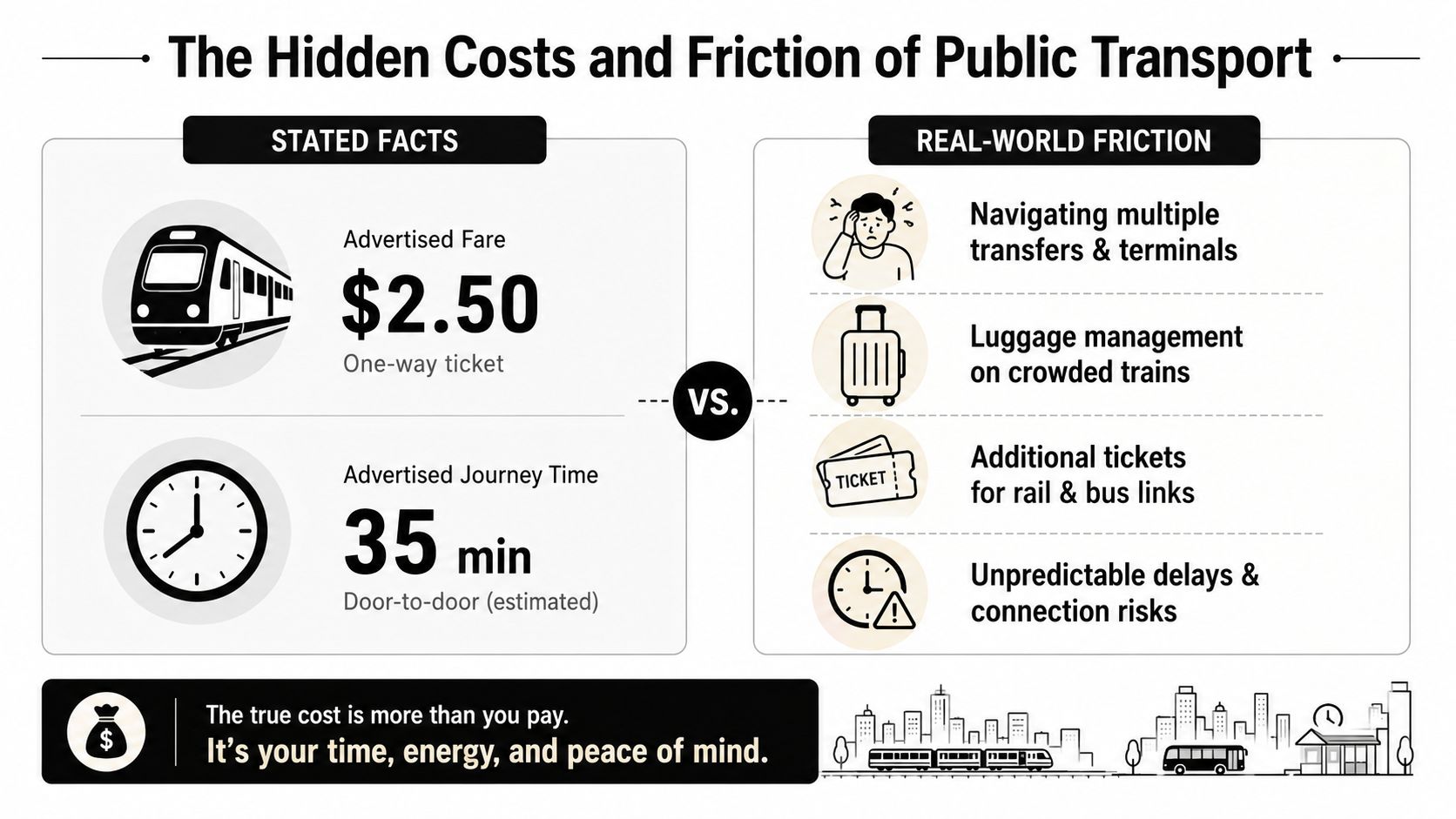
The fare you see first is never the full cost of the journey. On Heathrow to Cambridge, the actual expense is the friction that starts the moment you switch between systems. A train ticket, an Underground segment, a mainline platform, and the final arrival in Cambridge all create chances for delay, confusion, and fatigue.
Interchange risk is the primary concern
The Heathrow-to-central-London leg is the weakest part of the rail journey. Once you are on the Cambridge-bound train from King's Cross, that part is straightforward. The hard part is getting there on time, with the right ticket, in the right station, and with luggage you can move without a fight.
International arrivals feel that pressure first. A late landing can make the coach departure awkward. A missed rail connection can throw the whole plan off. If you are unfamiliar with UK rail travel, ticket checks, platform changes, and station wayfinding can eat through the margin you thought you had.
Luggage changes the equation fast
A route that looks cheap with one backpack can feel punishing with two suitcases and cabin bags. Underground stairs, crowded carriage space, and platform transfers all become more difficult when one traveller is helping a child or handling heavy luggage. That is why families and older travellers often find that the “budget” option only looks budget on paper.
Rule of thumb: every change multiplies the chance of delay, confusion, or exhaustion. On this route, that matters more than a small fare difference.
The hidden problem is reliability. The gap between the fastest rail timings and the slower average shows that connection quality matters more than raw speed. The timetable is not the trip, the interchange is.
For readers comparing airport-side transfer logistics more broadly, the same practical logic appears in airport shuttle services, where the handoff often decides whether the journey feels smooth or chaotic.
How to Book and Prepare for a Private Transfer
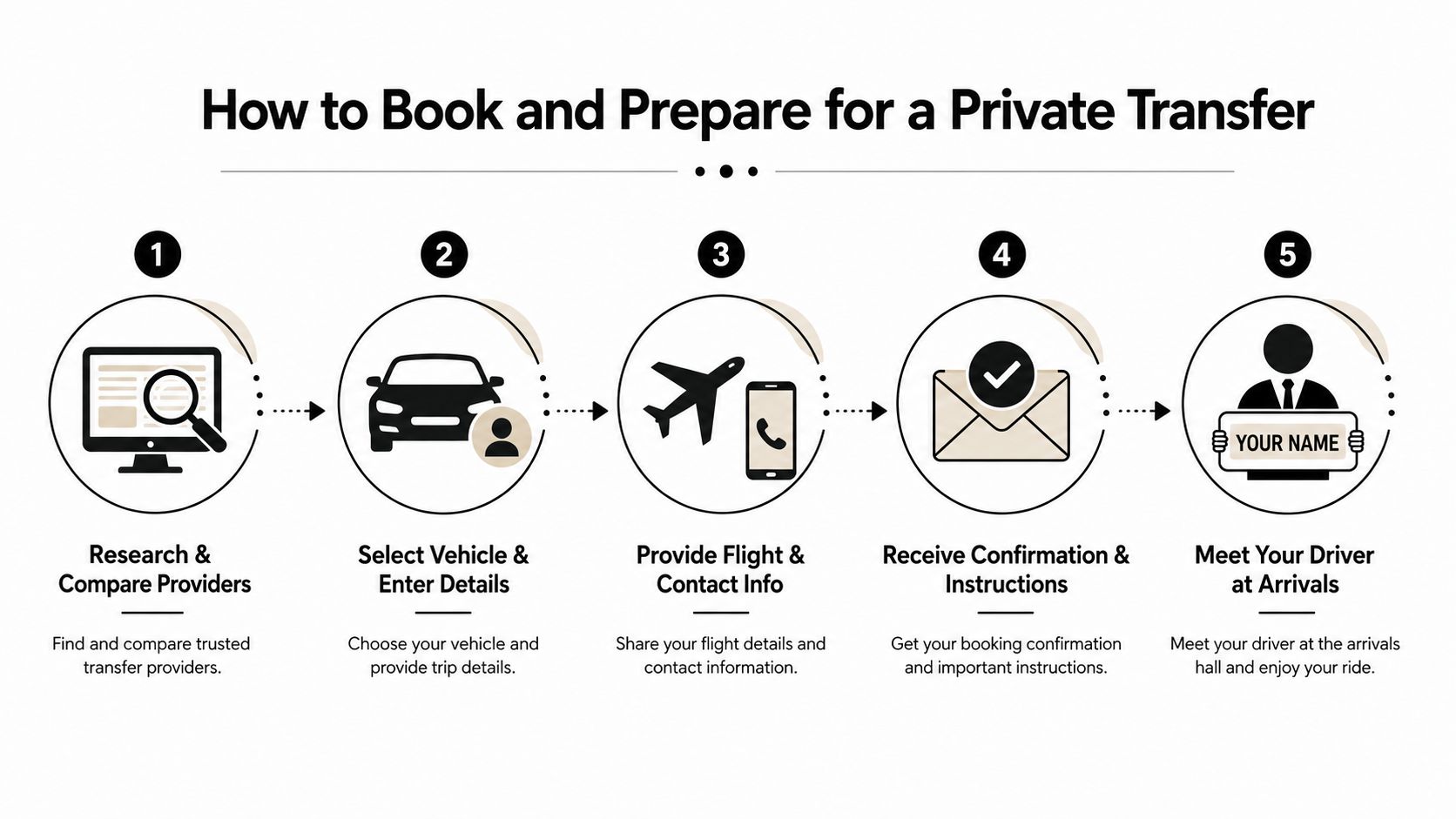
A private transfer works best when you treat it like a service, not a taxi you grab at the last second. You book it before you fly, give the operator the details that matter, and let the driver handle the arrival-side logistics. That simple shift removes the need to decode train corridors or carry luggage through London stations.
Book with the right details the first time
When you reserve, provide your flight number, landing time, destination in Cambridge, passenger count, and luggage volume. If you're travelling with a child seat requirement, mobility aid, or oversized bags, say so at booking, not after landing. That matters because the vehicle choice and meet-and-greet instructions depend on it, and a good operator will use those details to match the right car or minibus to your party.
If you want a simple booking flow, a service such as private car hire with driver usually follows the same logic, select the transfer, enter the pickup and destination, and confirm the travel details before arrival. EC Minibus is one example of a provider that includes meet and greet, flight monitoring, and fixed pricing in its booking model.
Know what happens on the day
At Heathrow, the driver meets you in the arrivals area with a name board, then helps with luggage and escorts you to the vehicle. That is the point of a private transfer, no station changes, no platform guesswork, no hauling bags onto an Underground escalator. The journey itself is straightforward road travel to Cambridge, which is why road distance matters more than public transport schedules once you have booked.
You should also expect clarity on delays. If your flight changes, a monitored booking can adjust pickup timing automatically. If your price is fixed, the fare shouldn't change after you confirm, which is the whole reason private transfer appeals to travellers who dislike surprise charges.
Good private-transfer bookings remove decision-making after landing. That is what you pay for, not just the car.
When a Private Transfer Makes the Most Sense
A private transfer earns its place when the trip is more complicated than the fare suggests. It is not the cheapest way from Heathrow to Cambridge, and it should not be judged on price alone. It works best when you are moving tired travellers, dealing with heavy luggage, or trying to avoid a messy arrival after a long-haul flight.
The strongest use cases are clear at ground level
Families with children usually need more room, more patience, and fewer moving parts. A coach can still work, but only if everyone can keep to a fixed schedule and manage shared space without extra stress. A private vehicle gives the group one pickup point, one drop-off point, and one driver handling the transfer from door to door.
Cruise passengers connecting through Heathrow often need certainty more than anything else, especially if the onward journey leads to ports such as Southampton. In that kind of itinerary, the transfer sits inside a wider chain of travel, so a delay has a bigger impact than an extra hour on the road. Business travellers read the same pattern quickly. If you need to arrive rested, prepared, and on time, a direct car beats a cheaper option that adds friction.
Late-night arrivals are another strong fit. Some public transport services still run, but the options thin out and the margin for error gets smaller once you land exhausted. A fixed private transfer removes the need to wait for the next departure or piece together a London connection after dark.
Cost only matters if you ignore the full journey
The public-transport bargain disappears fast once you add multiple tickets, interchanges, and the risk of missing a link. A lower fare buys a seat, not control. For many international travellers, especially older passengers and families with luggage, control is the value.
If you want door-to-door service with meet and greet, luggage help, and monitored pickup timing, a provider like EC Minibus that includes meet and greet, flight monitoring, and fixed transparent pricing fits that brief. That is the kind of service that pays off when you want a clean arrival, not a complicated transfer chain.
Luggage, Accessibility, and Arrival Tips for a Smooth Journey
Luggage is where Heathrow to Cambridge stops being theoretical. The right option depends on how many bags you're moving, whether you can handle stairs and crowded platforms, and how much effort you want to spend once you reach the terminal. The smaller and lighter you travel, the more public transport makes sense. The more baggage or mobility support you need, the stronger the case for a direct vehicle becomes.
Pack for the transfer, not just the flight
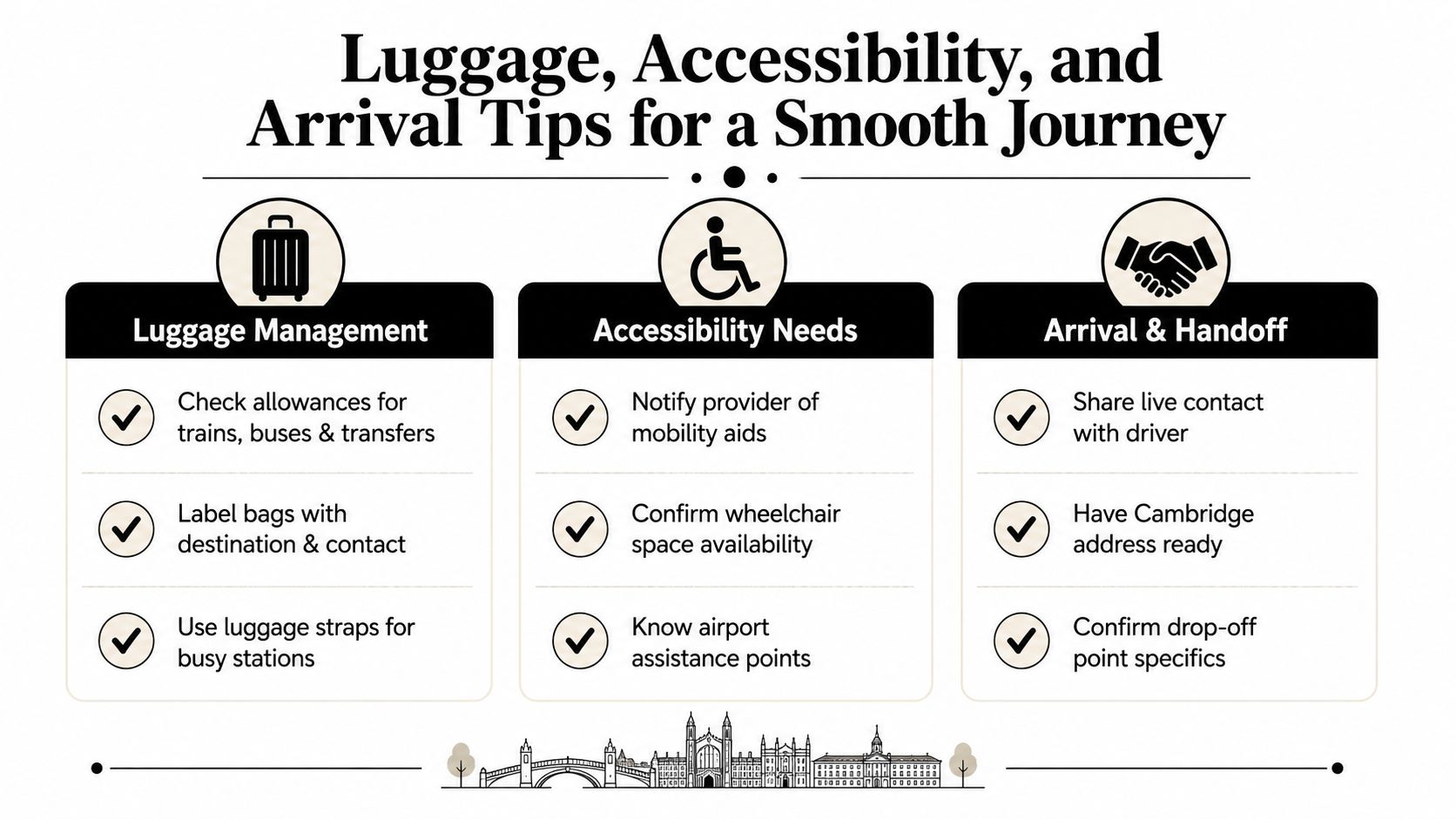
If you're using rail or coach, keep the bag count realistic and make sure every item is easy to lift. Large suitcases, sports equipment, and awkward carry-ons become a nuisance once you have to change stations or board a crowded service. Label your luggage clearly with your destination and contact details, and use straps or organisers if you expect a busy station environment.
Accessibility needs deserve a straightforward answer, not vague reassurance. If you use a wheelchair, a walker, or any mobility aid, tell the operator before booking and confirm space availability before you travel. Heathrow has assistance points, but they help most when the onward transport has already been arranged to suit your needs.
Make the arrival side easy
Have your Cambridge address ready in a note on your phone and on paper, because jet lag makes simple things harder. If you've booked a private transfer, share a live contact number so the driver can reach you if your arrival flow changes. If you're meeting someone at the airport, agree the drop-off point in advance rather than improvising at the curb.
Peak-hour arrivals magnify every mistake. Off-peak arrivals are easier, but they still benefit from preparation, especially if you need currency exchange, a UK SIM, or a quick terminal exit before getting on the road. The less you decide after landing, the smoother the day goes.
Best habit: finish the travel decision before you fly. Once you land, your job should be to walk out and go, not solve the route from scratch.
Choosing the Right Option for Your Heathrow to Cambridge Trip
Use one question first. Do you care most about price, or do you care most about removing hassle? If the answer is price, coach is the obvious starting point. If the answer is convenience, privacy, or arriving without a London transfer, a private transfer is the stronger choice.
A simple way to decide
- Choose the coach if you are travelling light, watching every pound, and happy to work around a schedule.
- Choose the train if you know London stations well and don't mind a change in the middle of the trip.
- Choose a private transfer if you have children, multiple bags, late arrival timing, mobility needs, or you just don't want to manage interchanges after a long flight.
That's the cleanest framework. The train is the most networked option but not the simplest. The coach is the cheapest direct option but still has limits. The private transfer is the most expensive, but it solves the parts of the journey that usually cause the most stress.
The best travellers book early and think in terms of the whole trip, not just the fare. If you want meet and greet, flight monitoring, and fixed transparent pricing, a provider such as EC Minibus fits that use case without turning the airport arrival into a logistics project.
If you want Heathrow to Cambridge handled without the station changes, luggage drag, or late-night guesswork, EC Minibus offers private door-to-door transfers with meet and greet, flight monitoring, and fixed pricing. Visit EC Minibus to arrange a transfer that gets you from arrivals to Cambridge with less friction and no unnecessary detours.