

Most duty-free advice is lazy. It repeats the same line: no tax means lower prices. That sounds good in an airport queue. It's not good enough when you're staring at a bottle of whisky at Heathrow or a perfume gift set before a cruise and trying to work out whether you're getting a bargain or just paying for convenience.
Here's the blunt answer to is duty free cheaper. Sometimes. Often not. The tax break is real, but the saving isn't automatic. In the UK, the only sensible way to judge duty free is to compare the airport or cruise terminal price with the standard retail price you'd pay at a supermarket, Boots, John Lewis, Currys, or a normal online retailer. If the airside price isn't clearly better, skip it.
Table of Contents
- The Great Duty-Free Myth
- How Duty-Free Pricing Really Works
- Airport vs Cruise Port What to Expect
- Product Showdown Alcohol Perfume Electronics and More
- UK Duty-Free Allowances and Rules for Travellers
- Your Smart Shopper Decision Checklist
- Duty-Free Shopping FAQs
The Great Duty-Free Myth
The biggest mistake travellers make is assuming the airport tag must be better because it says duty free. That label gets people to stop comparing. Once that happens, the shop has already won.
For UK travellers, that myth matters because duty free is not always a bargain, and prices can vary widely by airport and country, as noted by N26's guide to what duty free really means. The same guidance also points out that the strongest savings are usually on heavily taxed goods like alcohol and tobacco, not across every category sold airside.
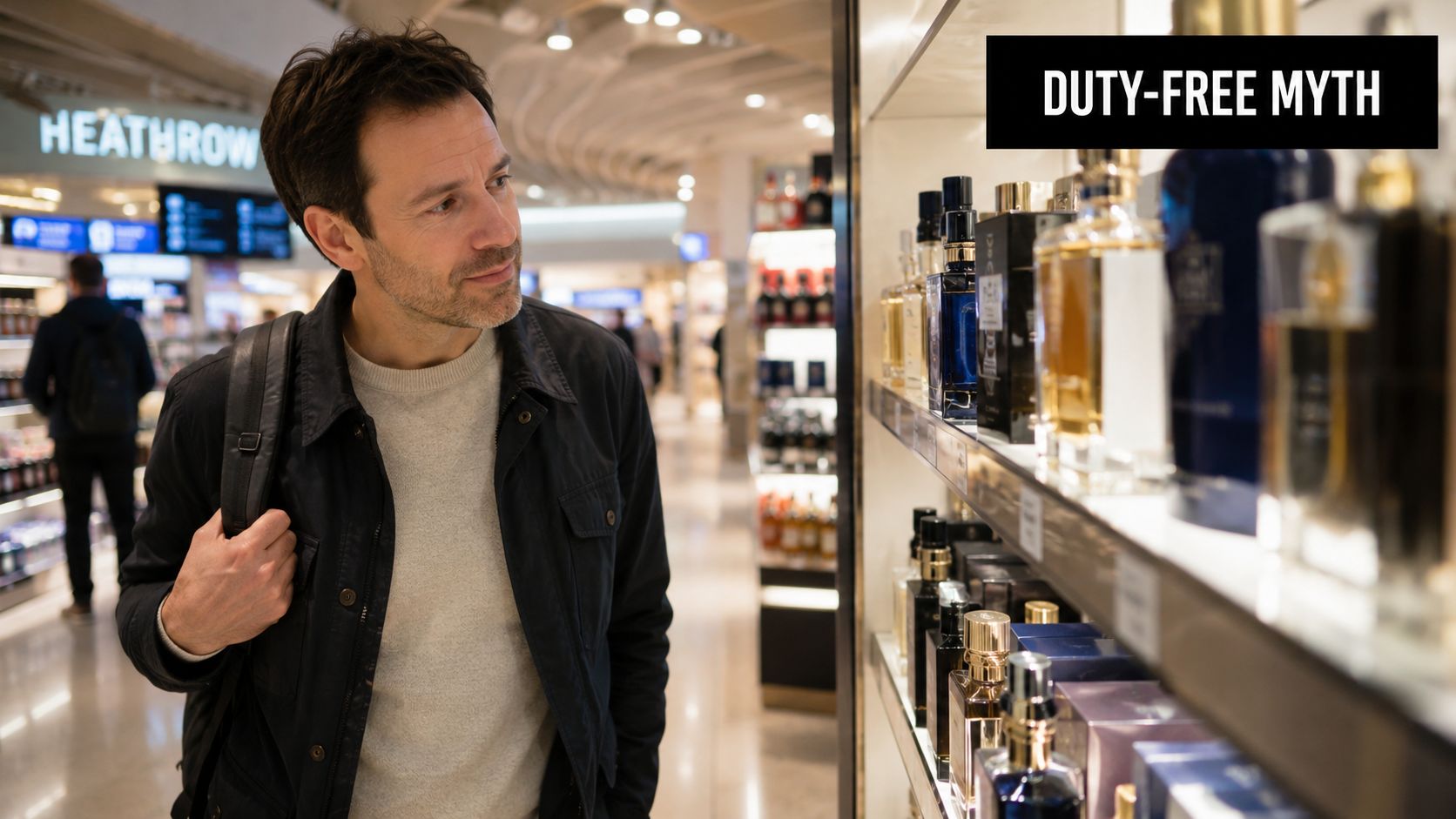
A typical Heathrow trap looks like this. You spot a premium whisky, a designer fragrance, or some “travel exclusive” skincare set. The branding is polished, the packaging looks special, and the shelf signs hint that you're avoiding tax. But if Tesco, Boots, or a normal online shop sells the same item for less, the airport version isn't a deal. It's just easier to carry to the gate.
The real comparison that matters
Don't ask, “Is this tax free?” Ask, “Is this cheaper than buying it outside the terminal?”
That one question cuts through almost all the marketing. It also stops you from overvaluing flashy airport promotions like bundle offers, multi-buy discounts, or “exclusive” packaging that makes like-for-like comparison harder.
Plain rule: If you don't know the normal retail price of the exact item, you don't know whether duty free is cheaper.
Why travellers overpay
People overspend in duty-free shops for three simple reasons:
- They're rushed: Security, boarding times, and queue pressure make quick decisions feel necessary.
- They trust the label: “Duty free” sounds like guaranteed value when it isn't.
- They compare badly: They compare to a city-centre convenience shop, not to the cheapest normal UK retailer.
The smart move is boring. Check the exact bottle size, exact brand, and exact edition against standard retail prices. If the airport wins, buy it. If it doesn't, keep walking.
How Duty-Free Pricing Really Works
Duty free isn't magic. It's just retail pricing with certain taxes removed. That's useful, but it's not the same as a promise that the shelf price will be lower.
What duty free removes
In the UK, the main pricing advantage comes from removing VAT at 20% and excise duty on qualifying goods, according to CurrencyTransfer's explanation of how duty-free works. That sounds like a built-in saving. It isn't, because the retailer still decides the base price.
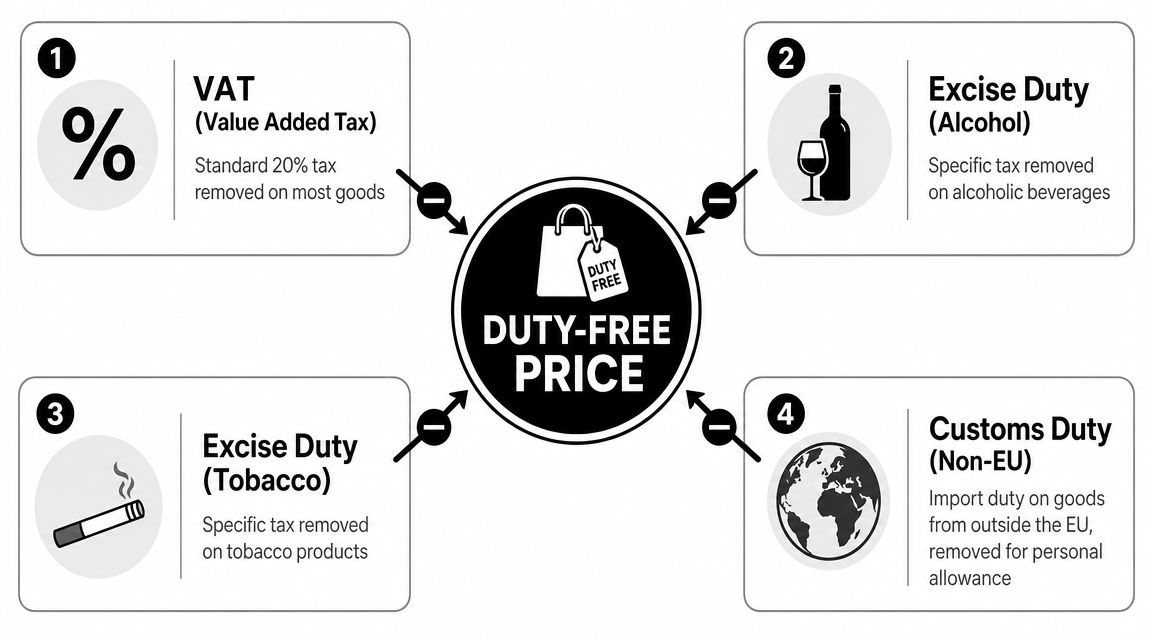
Consider the example of coffee. Remove tax from a £3 coffee and you should pay less. But if the airport café decides the coffee is worth more because you're trapped behind security, it can raise the base price. You still avoided tax, but you didn't save money.
That's why duty-free shelves often mix genuine bargains with mediocre deals and outright rip-offs. The tax break creates room for lower prices. It doesn't force the shop to pass the saving on to you.
Why the final price can still be bad
Airport retailers know three things. You've got limited time. You probably won't walk to another shop. And you might assume the price is special just because you're travelling internationally.
Later, if you're passing through Amsterdam as well, it's worth reading how duty-free works at Schiphol Airport because airport pricing logic is similar across major hubs, even when product mixes differ.
Here's the practical formula:
- Tax removed: good for the buyer
- Base price increased: good for the retailer
- Confusing exclusives or bundles: good for the retailer
- Like-for-like comparison: good for your wallet
A quick reality check helps. If a “travel exclusive” gin set can't be compared to the supermarket bottle you usually buy, treat it as a convenience purchase, not a saving.
A short explainer can help if you want the basics in video form:
Airport duty free removes some taxes. It does not remove retailer greed.
Airport vs Cruise Port What to Expect
A Heathrow duty-free shop and a cruise terminal shop don't feel the same, and they don't price the same either. If you want to know whether duty free is cheaper, the location matters almost as much as the product.
Airports sell convenience first
Airports have captive customers. Once you're through security, your alternatives shrink fast. That gives shops room to push higher margins, especially on impulse buys and gift-friendly items.
The worst categories for lazy buying are the ones people grab because they forgot something or want an easy present. Think headphones, sunglasses, boxed chocolates, travel adapters, premium snacks, and glossy cosmetics sets. Those are the shelves where convenience often beats value.
Cruise ports are different, but not magic
Cruise terminals can feel less frantic than airports, but don't assume that means better pricing. Selection is usually narrower, stock can be more seasonal, and offers may be geared towards holiday spending rather than strict value.
If you're sailing from Southampton, practical planning matters more than chasing a last-minute terminal bargain. Getting there smoothly, with time to check prices before boarding, matters far more than buying in a rush at the port. This is especially true for anyone travelling through Southampton Cruise Port transfer routes.
A useful way to think about it:
| Location | What usually drives pricing | Best buying attitude |
|---|---|---|
| Major airport | Convenience, captive demand, impulse gifting | Compare ruthlessly |
| Cruise terminal | Limited range, holiday mindset, narrow stock | Buy only if pre-checked |
| Off-airport retail | Normal competition | Usually your benchmark |
If you pay in another currency, do the maths
This catches a lot of American and Canadian travellers. A shelf price can look fine in pounds, then feel less attractive once your card converts it and your bank adds whatever fees apply on your side.
Use your phone before you buy. Check the same item at a UK supermarket or high-street retailer, then compare the total in your home currency. Don't rely on instinct. Exchange rates make poor judges.
Buy when the airport price beats normal retail after conversion. If it only feels close, it's not a deal.
Product Showdown Alcohol Perfume Electronics and More
Some duty-free categories are worth checking. Some are mostly theatre. If you want a clear answer on is duty free cheaper, the practical aspects come into play.
Alcohol has the best chance of being worth it
Alcohol is the category with the strongest case for duty free in the UK. Duty-free shopping mainly removes VAT at 20% and excise duty, and after the August 2023 Alcohol Duty changes, tax is based on strength, which means higher-ABV spirits can offer stronger savings potential, according to this independent duty-free alcohol analysis.
But don't get carried away. The same reporting found that airport duty-free alcohol is often more expensive than supermarket prices, with worthwhile savings usually limited to selected premium bottles or specific promotions.
So the verdict is simple:
- Premium spirits: worth checking
- Standard supermarket whisky, gin, vodka, or rum: compare first, often skip
- Wine: less exciting than people expect
- Beer or ready-to-drink buys: usually not where the best value sits
Perfume and cosmetics need a hard comparison
Perfume can go either way. Gift sets, larger bottle sizes, and travel exclusives can look attractive, but they also make comparison harder. If the exact same bottle is sold at Boots, John Lewis, or an online beauty retailer for less, the airport tag means nothing.
Cosmetics are even more dangerous because bundles blur the value. A three-piece skincare set may sound cheaper than buying separately, but if you didn't want all three items, you haven't saved. You've just bought more.
A quick buying test for fragrance and beauty:
- Same SKU available outside the airport: compare exact price
- Travel exclusive bundle: value only if you'd buy every item anyway
- Seasonal promotion: check whether the discount is on your desired item, not on filler products
Electronics, snacks, sunglasses, and luxury extras
Electronics are where many travellers talk themselves into nonsense. The logic usually goes like this: no tax, international terminal, must be a deal. Wrong. Electronics and accessories often carry airport convenience pricing, and the high street is usually better for returns, support, and straightforward comparison.
Snacks are even easier. Don't buy airport confectionery or crisps because you think duty free is helping you. It usually isn't. You're paying for location.
Sunglasses and fashion accessories sit in the same danger zone. Nice presentation. Weak value. Strong impulse-buy energy.
Here's the no-nonsense table.
UK Duty-Free Savings Potential by Product Category
| Product Category | Typical UK Tax Burden | Airport Markup Factor | Savings Verdict |
|---|---|---|---|
| Spirits | VAT and excise duty | Medium to high | Best chance of a real deal, but compare to supermarkets |
| Wine | VAT and alcohol duty | Medium | Possible, but often underwhelming |
| Tobacco | VAT and excise duty | Varies | Can be worth checking if allowances suit your trip |
| Perfume | Mainly VAT impact in theory | Medium to high | Only buy after exact like-for-like comparison |
| Cosmetics | Mainly VAT impact in theory | Medium to high | Usually promotion-driven, not automatically cheaper |
| Electronics | Mainly VAT impact in theory | High | Usually skip |
| Snacks and confectionery | Low savings potential versus markup | High | Skip |
| Sunglasses and accessories | Limited tax edge versus markup | High | Skip unless pre-priced elsewhere |
Best use of duty free: targeted purchases in heavily taxed categories, not random browsing.
UK Duty-Free Allowances and Rules for Travellers
A cheap bottle becomes expensive very quickly if you blow past the allowance and get stopped. Before you buy, know what you're allowed to bring into the UK.
Know the limits before you buy
For travellers entering the UK from outside the UK, the standard allowances commonly used by travellers are:
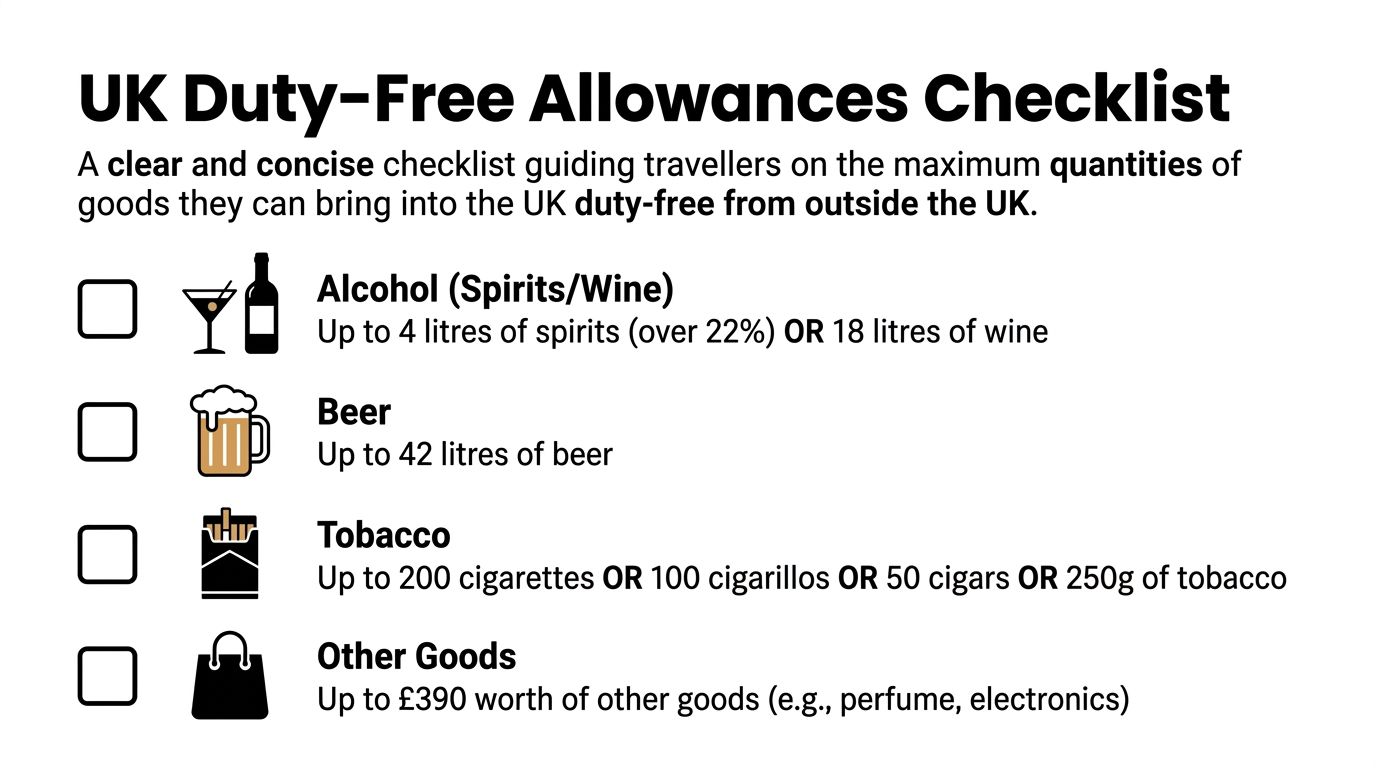
- Spirits or strong alcohol: up to 4 litres of spirits over 22%
- Wine: up to 18 litres
- Beer: up to 42 litres
- Cigarettes: up to 200 cigarettes
- Cigarillos: up to 100
- Cigars: up to 50
- Tobacco: up to 250g
- Other goods: up to £390 worth of goods such as perfume or electronics
Those are the numbers travellers need at the point of purchase. Treat them as shopping limits, not something to figure out after landing.
The mistakes that cost people money
The most common errors aren't complicated. People either buy first and think later, or they assume a couple travelling together can ignore the details and sort it out at customs.
Don't do that. Keep your receipts. Know who owns which goods. If you're arriving after a cruise with shopping picked up across more than one port, organise your purchases before you disembark.
A few practical rules make this easier:
- Check your route: Cruise itineraries can create confusion about where you bought an item versus where you enter the UK.
- Keep packaging sensible: Sealed, clearly labelled items are easier to explain than loose bottles and half-open cartons.
- Don't guess on value: If you're bringing back perfume, watches, or electronics, know whether you're staying inside the £390 limit.
- Treat alcohol and tobacco separately from gifts: Different categories matter for different limits.
Receipts don't just prove what you paid. They prove what the item is and where you bought it.
If you're near the limit, stop buying. Saving a bit airside isn't worth the hassle of arguing over allowances on arrival.
Your Smart Shopper Decision Checklist
You don't need a spreadsheet in the terminal. You need a fast filter that kills bad purchases before they reach the till.
Use this at the shelf before you pay
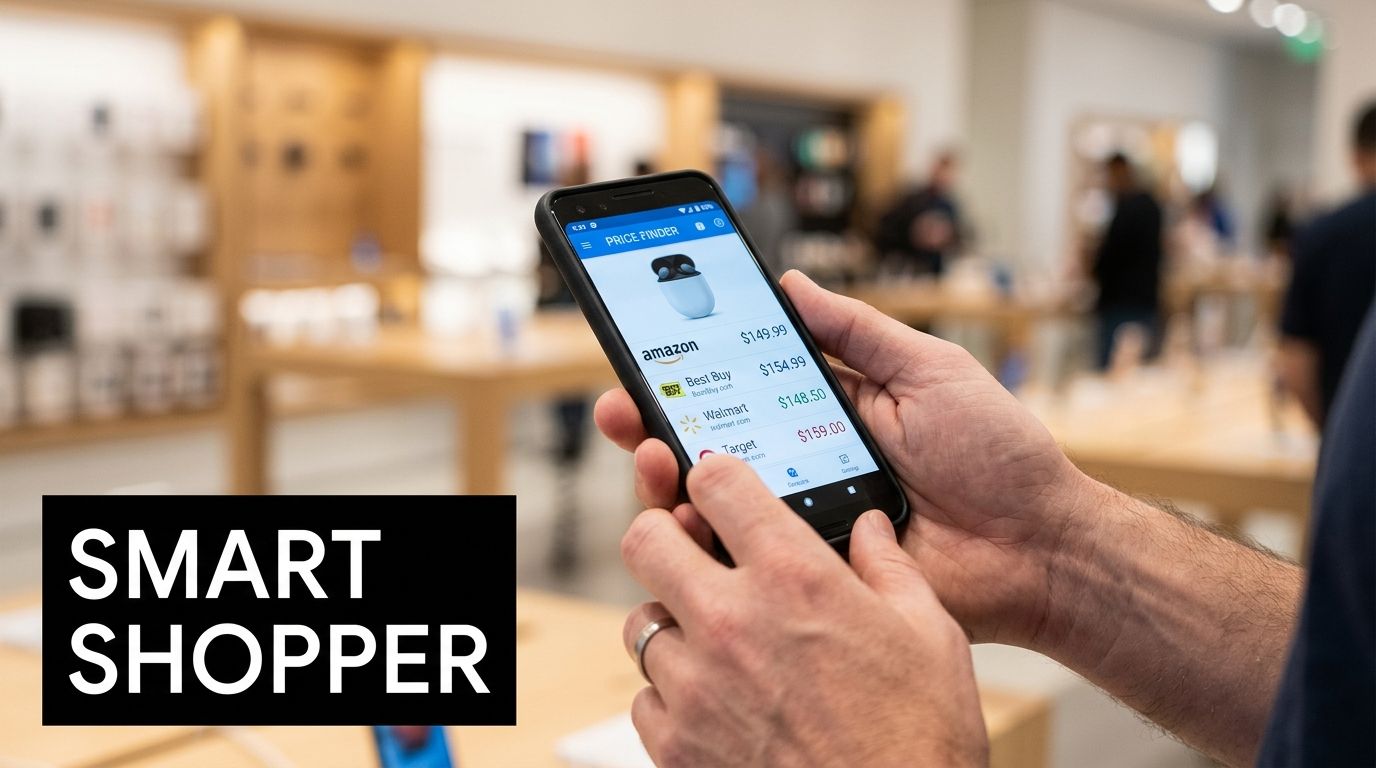
Run through these questions:
- Is this a high-tax item? Spirits and tobacco deserve a look. Most snacks and electronics don't.
- Do I know the exact normal retail price? Not roughly. Exactly. Same bottle size, same fragrance, same model.
- Is this a fake comparison product? Travel exclusives and bundles often hide weak value.
- Would I buy this outside the airport today? If not, you're probably impulse buying.
- Am I still inside my allowance? If the answer is fuzzy, stop.
- What's the home-currency cost? Especially important for visitors using non-UK cards.
If you've booked transport and have a smooth transfer sorted, you're far less likely to panic-buy at the terminal. That's one reason proper airport shuttle services for UK travellers make airport shopping decisions calmer. More time and less stress usually lead to better choices.
The best duty-free shoppers aren't flashy. They're disciplined. They already know what they want, what it costs outside, and the maximum they'll pay.
Duty-Free Shopping FAQs
Can I buy duty free when I arrive in the UK
Sometimes, depending on the route and airport setup, but don't assume arrival shopping will be available or cheaper. If you're counting on buying after landing, check the airport's current retail options before you travel.
Is pre-ordering better than buying on the day
Often, yes. Pre-ordering gives you time to compare prices calmly instead of making a rushed gate-area decision. It also helps you avoid the trap of browsing without a plan.
What's the difference between duty free and tax free
Duty free usually refers to goods sold without certain local taxes and duties in a travel context. Tax free often refers to reclaim schemes for taxes paid on regular retail purchases, subject to the rules of the country involved. They're not the same thing.
Do domestic UK flights get duty-free prices
No. Duty-free shopping is tied to eligible international travel, not domestic journeys inside the UK.
So, is duty free cheaper or not
The honest answer is still sometimes. It can be good for selected spirits, tobacco, and occasional premium items. It's often poor for snacks, electronics, accessories, and anything you haven't checked against a normal UK retailer. Compare first, then buy.
If you're travelling through Heathrow or heading to Southampton, Dover, Portsmouth, or Tilbury for a cruise, EC Minibus makes the day easier with private door-to-door transfers, fixed pricing, meet and greet, and dependable connections between airport, hotel, rail station, and port. A smooth transfer won't make duty free cheaper, but it will give you the time and headspace to shop properly instead of buying in a rush.