

You're at the booking stage, or maybe you're already standing on the kerb with a suitcase in one hand and a cruise folder in the other, trying to work out whether the transfer company in front of you is compliant or just good at sounding professional. That's the right instinct. In this industry, the service looks simple, but the legal requirements sit behind the scenes in layers, and the passenger only notices them when something goes wrong.
A proper transfer is not “just a car”. It's a chain of licences, insurance cover, driver checks, vehicle records, data handling, and pricing evidence, all of which have to line up before the luggage even goes in the boot. UK statistical and legal frameworks have long been built as layered systems rather than one neat code, and transport compliance works in much the same way, with overlapping duties rather than one magic certificate that covers everything UK Statistics Authority review of the UK statistical legislation framework. If you're booking airport or cruise transfers, the question isn't whether a company looks polished. It's whether it can prove it's lawful.
Table of Contents
- A Day in the Life of a Compliant UK Transfer
- Operator Licensing and Permits Explained
- Insurance and Passenger Liability Essentials
- Driver Qualifications and Background Checks
- Vehicle Safety and Accessibility Standards
- Passenger Documentation and Immigration Considerations
- Data Privacy, Consumer Rights and Pricing Transparency
- Compliance Checklist for Operators and Travellers
A Day in the Life of a Compliant UK Transfer
A couple lands at Heathrow, clears arrivals, and sees a driver holding a name board. That looks routine. Under the surface, that single handoff depends on a stack of legal requirements that started long before the plane touched down.
The operator should already have the right vehicle and dispatch permissions in place, because UK transport law does not treat a private transfer as an informal favour. For official statistics and public services, the UK has historically relied on a layered legal framework rather than one unified statute, and the same idea applies here, with separate duties for licensing, insurance, records, and confidentiality UK Statistical Service review, UN statistical legislative frameworks handbook. On the ground, a compliant operator needs the paperwork to match the promise.
Practical rule: if a company can't show you the basics on request, assume the rest of the operation is shaky too.
The driver greets the passenger, loads bags, and heads towards Southampton. That calm ride hides the checks that should already exist, including the booking record, the vehicle file, the driver file, insurance evidence, and the operator's internal proof that it can handle delayed flights and changed pickup times without improvising the rules. For international travellers, this point marks where service quality and compliance intersect, because good communication only matters if the business can evidence what it did and when.
The same journey also tests accessibility and consumer transparency. If the passengers had requested a wheelchair-accessible vehicle, that request should already have been logged and matched to a vehicle that can meet it, not just “take” it in theory. If the fare was quoted as fixed, the booking confirmation should say so plainly. If the passenger needed documents for cruise boarding, the company should have been clear about what it can ask for and what it cannot.
By the time the car reaches the terminal, the legal work should be invisible because it was done properly in advance. That is the standard in this sector. A lawful transfer is not one certificate on a wall, it's a chain of small, auditable proofs from the first quote to the final drop-off.
Operator Licensing and Permits Explained
A simple test starts with separating the layers. In UK private transfers, licensed does not mean one thing, it means several separate permissions that have to line up.
The vehicle may need one type of licence, the driver another, and the company that takes the booking another again. For private hire work, council-issued or TfL-linked permissions matter because licensing is location-sensitive, especially around Heathrow and London work. For larger vehicles carrying groups to cruise ports, operator permissions matter even more, because carrying passengers for hire is not the same thing as owning a minibus.
A driver's badge is not the same as a vehicle inspection certificate, and neither of those is the same as the company's trading permission. A proper operator should answer two questions without hesitation, what licence covers the vehicle, and what licence covers the booking company. If the answer is vague, walk away.
A badge on the dashboard does not prove the whole chain is legal. You need the operator, the vehicle, and the driver to line up.
The public often gets distracted by branding, clean uniforms, and a professional website. None of that replaces the actual permissions that let the service operate. The government's technical specification guidance on public procurement is useful here because it stresses equal access, neutral wording, and outcome-based requirements rather than vendor hype UK Government procurement technical specifications guidance. The same logic applies to transport bookings. If a firm can only describe itself in marketing language, not legal language, you have a problem.
A good test is simple. Ask for the operator licence details, ask which authority issued them, and ask how the vehicle is licensed for the exact route you need. If the company works transparently, it will answer directly. If it hedges, you've learned something useful before your luggage leaves your hand.
UK Private-Transfer Licence at a Glance
| Licence | Issued by | Covers | What to ask for |
|---|---|---|---|
| Private hire vehicle permission | Local licensing authority, or TfL for Heathrow-linked work | The vehicle's right to carry booked passengers | Ask for the licence number and plate details |
| Operator permission | Local authority or relevant transport authority | The company that takes and dispatches the booking | Ask who holds the operator licence |
| Passenger-carrying operator licence for larger vehicles | Relevant transport authority | Minibus or coach-style work, especially group transfers | Ask whether the company is licensed for the capacity it sells |
If you want a plain-English comparison of hire-with-driver structures, this guide helps check the difference between vehicle licensing and booking-company permissions: private car hire with driver guidance.
Insurance and Passenger Liability Essentials
Cut-price operators most often fall apart in this area. A car insurance policy for personal use is not enough the moment money changes hands for passenger carriage. The vehicle needs the right commercial cover, and the operator needs to be able to show it.
The key phrase is hire and reward. In plain English, that means the vehicle is insured to carry paying passengers, not just family members or friends. If a driver is taking a fare to Southampton, Dover, Portsmouth, Tilbury, or Heathrow, the cover has to match that paid service. A standard social-and-domestic policy won't do the job, and if the insurer discovers the vehicle was being used commercially outside the policy terms, the claim can be rejected.
That is the danger for passengers. If there is a collision and the vehicle was underinsured or insured for the wrong use, the operator may not have the financial backing to deal with injuries or losses properly. The passenger might still pursue a claim, but the practical route becomes much harder, slower, and more expensive because the paperwork did not match the job.
The operator should also be able to produce evidence of public liability insurance, and where staff are employed, employer's liability insurance. These are not decorative extras. They are part of proving that the business can absorb the risks of meeting passengers, handling luggage, and moving people in and out of vehicles every day.
Operational reality: if an operator can't show its insurance certificate, don't assume it has the right cover. Assume the opposite until proved otherwise.
A useful habit is to ask for three documents before you pay a deposit, the hire and reward insurance evidence, the public liability certificate, and the operator's booking confirmation that matches the vehicle and route. A company that has prepared properly will have these ready. A company that stalls, blames admin, or sends half answers is telling you it has not got its house in order.
For operators, the lesson is blunt. Cheap cover that doesn't fit the actual work is not a saving. It's a liability waiting to surface the moment something goes wrong.
Driver Qualifications and Background Checks
A compliant transfer service starts with the driver file, not the bonnet of the car. The driver must be legally entitled to drive that vehicle, legally entitled to carry passengers for hire if applicable, and checked properly before they ever take a paying booking.
The basic starting point is a valid driving licence, but that's not enough on its own. Operators should validate the licence, check the correct entitlement for passenger-carrying work, and verify that the driver is fit for the role. In London, local knowledge tests and licensing standards matter because the environment is dense, regulated, and unforgiving when a driver doesn't know the rules. A badge does not prove competence. It only proves one layer of authorisation.
Background checks are equally important. A proper hiring process should include enhanced DBS screening where the role requires it, right-to-work verification for non-UK nationals, and any local safeguarding or medical checks that apply to the role and vehicle type. Where children are carried, the operator needs stronger internal controls than a generic adult-only transfer.
A driver who has passed all the right checks should also be able to show a badge or licence card that matches the booking record. That matters because the passenger should never be left guessing whether the person opening the door is the actual licensed driver assigned to the job.
If you need a practical benchmark for driver standards and training, this resource gives a useful operator-side overview: professional driver training guidance.
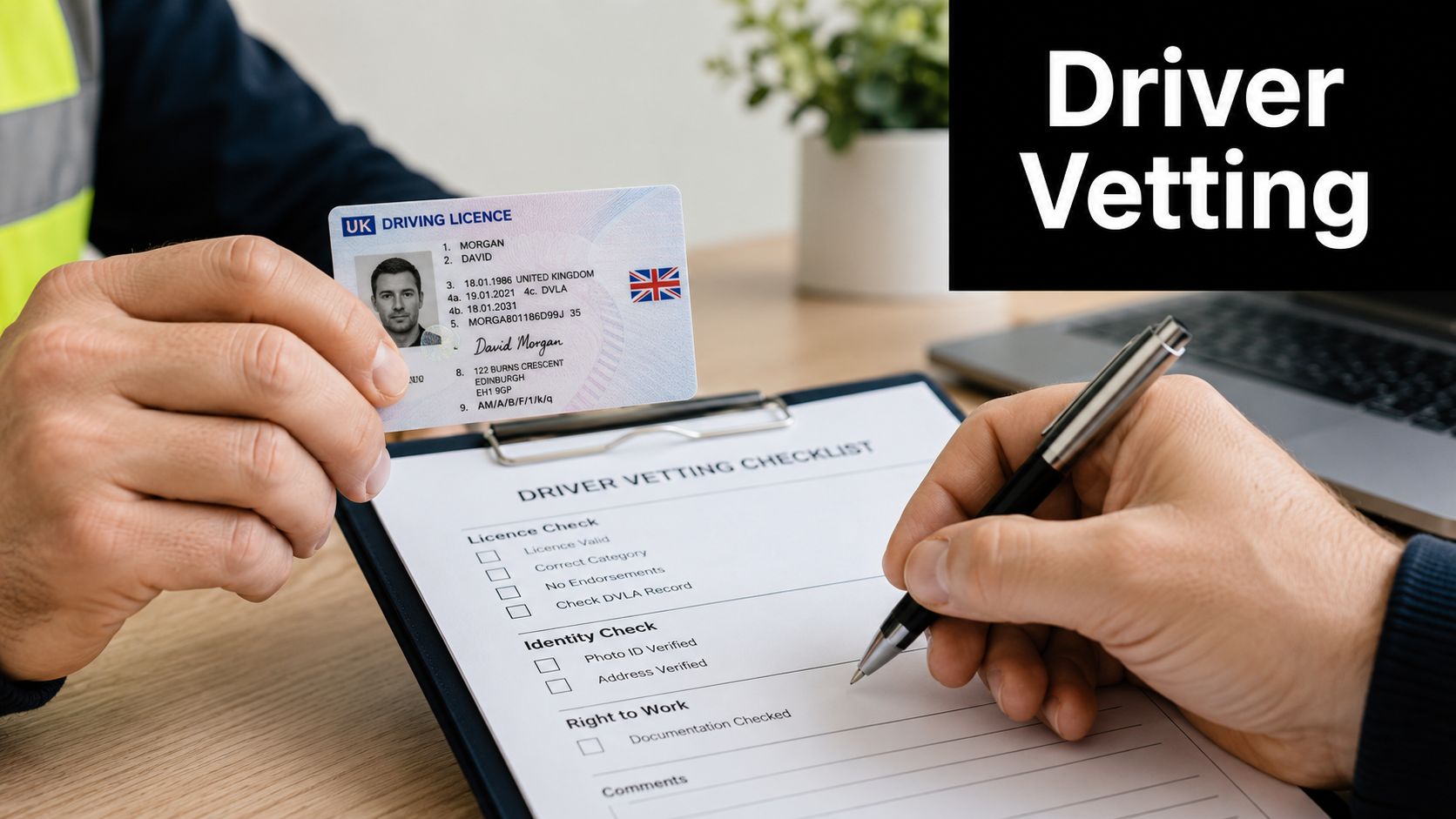
A smart hiring checklist looks like this:
- Licence validation: Confirm the driving licence is current and suitable for the class of vehicle being used.
- Passenger entitlement: Check that the driver is allowed to carry passengers for hire where the job requires it.
- Background screening: Keep DBS evidence on file when the role demands it.
- Right to work: Verify work eligibility before the first shift.
- Local competence: Use route knowledge or location-specific checks where the operating area is complex.
- Medical or safeguarding checks: Add them where the role or passenger profile makes them necessary.
The passenger's side is simpler. Ask to see the driver's badge and make sure it matches the booking name and vehicle. If those details do not align, do not board until they do.
Vehicle Safety and Accessibility Standards
A clean-looking vehicle can still fail a compliance check. Roadworthy and legally fit for passenger work are different standards, and travellers who care about safety should treat them that way.
Operators should be able to show the paper trail, not just make claims. That means current MOT evidence where it applies, plus any extra inspection regime tied to higher-capacity passenger vehicles. For larger vehicles, a PSV-style maintenance culture is what separates serious operators from casual ones. Regular checks, defect reports, and repair records matter because they show the vehicle is being managed as a commercial passenger asset, not just driven until something rattles.
Accessibility is where many firms talk better than they deliver. Under the Equality Act 2010, operators must be ready to handle wheelchair-accessible requests properly, not just say “we can take wheelchairs” and leave the passenger to work out the rest. The difference between a promise and compliance is evidence. If a passenger needs step-free access, a ramp, or space for a wheelchair, the operator should confirm the actual vehicle being sent, not offer a vague reassurance.
Here's the practical comparison.
| Minimum legal position | Strong operator evidence |
|---|---|
| Vehicle is roadworthy and properly tested | MOT record, maintenance logs, defect reports |
| Accessibility request is acknowledged | Written confirmation of the vehicle type and loading method |
| Driver can assist safely | Documented training and loading procedure |
| Passenger's needs are considered | Booking notes that match the assigned vehicle |
Good operators also keep the vehicle specification clear in the booking record. That is the point regulators and auditors test, because vague wording does not prove anything on the day. A sensible benchmark is the official UK government guidance on vehicle accessibility and disability regulations, which shows the kind of detail a passenger should expect to see reflected in the operator's own records.
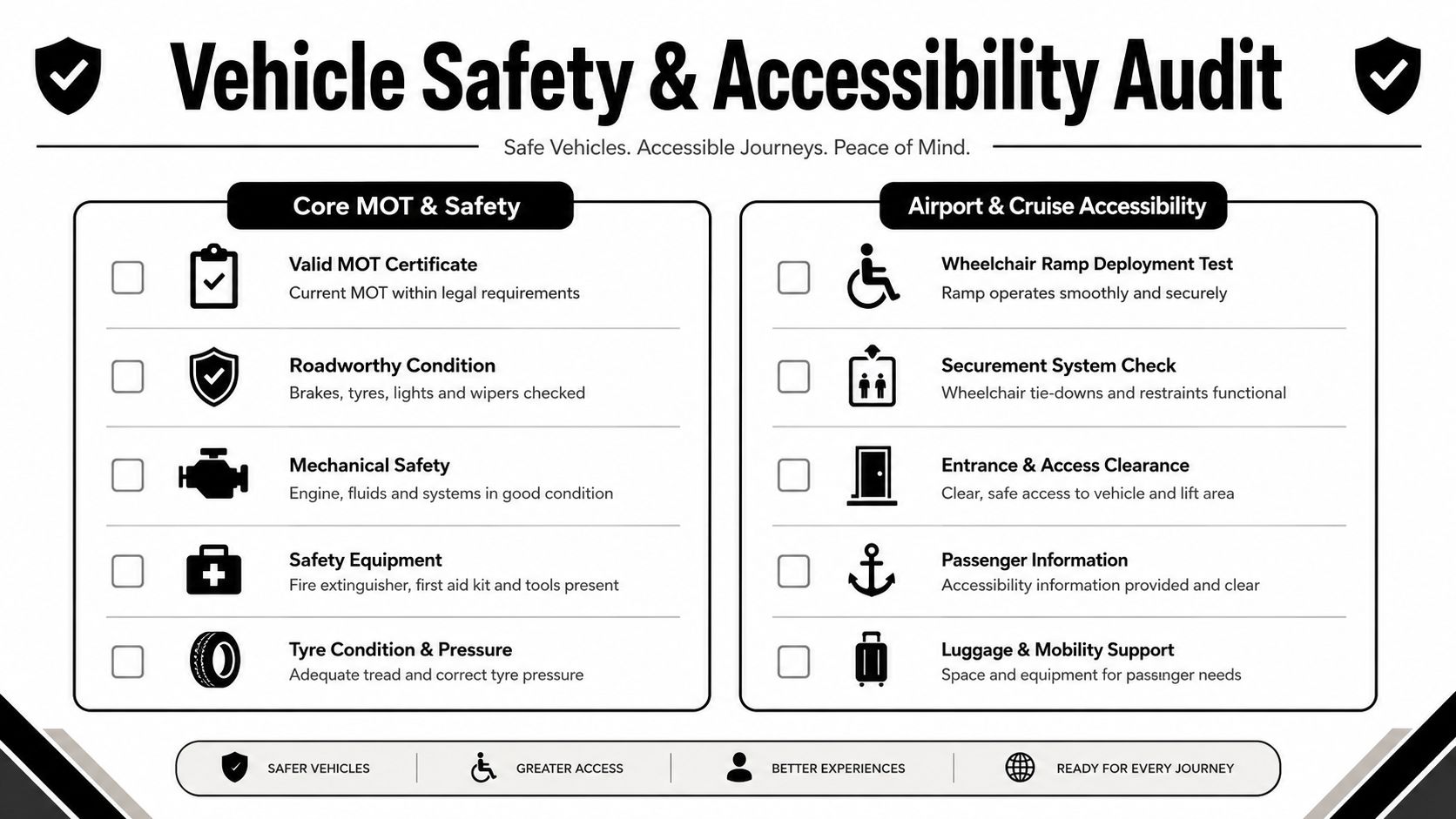
If you are booking for older travellers, families, or anyone with mobility needs, insist on the vehicle details in writing. “Accessible” means little unless the operator can prove the specific vehicle and equipment were assigned to your trip.
Passenger Documentation and Immigration Considerations
Cruise and airport transfers sit close to border control, but they are not border control. That boundary matters. The operator can help with travel logistics, yet immigration decisions remain with the relevant authorities at the port or airport.
A driver may legitimately need to check documents that support the booking, such as a passport, photo ID, cruise boarding pass, or visa where applicable. That isn't the same as doing an immigration inspection. It's about making sure the passenger is travelling on the correct booking and can enter the cruise terminal or onward flight process without preventable delays. The company should stay within its role and avoid pretending to make legal judgments about entry rights.
For unaccompanied minors or mixed-nationality groups, the booking file should be tighter, not looser. The operator should know who is travelling, who is responsible, and what handover point applies. If the group has members with different document needs, the passenger should expect the operator to be organised about timing and luggage handling, not casual about it.
A calm pre-trip checklist is enough for most journeys:
- Passport or photo ID: Keep it in your hand luggage, not buried in the hold bag.
- Visa or travel authorisation: Carry it if your route or nationality requires it.
- Cruise boarding pass or confirmation: Have it ready for terminal entry.
- Booking reference: Match the transfer to the passenger name.
- Emergency contact: Keep the lead traveller's contact visible.
For passengers who want to control data sharing around travel details, this opt-out page is useful context: data sharing opt-out information.
The line is simple. A driver can check that your documents match the trip. They should not pretend to act as border officials. If an operator blurs that line, it's a sign they do not understand their own compliance boundaries.
Data Privacy, Consumer Rights and Pricing Transparency
This is the part most operators underplay, and it's the part regulators increasingly care about. A transfer company handles names, phone numbers, flight details, hotel addresses, cruise references, and sometimes accessibility information. That is sensitive operational data, even before you get to payment records.
Under UK GDPR and the Data Protection Act 1998, the business has to justify what it collects, protect it properly, and keep records that show it made proportionate decisions. A booking form that asks for more than it needs is a warning sign, not a convenience. If a passenger is only booking a transfer, the company should not hoard irrelevant information just because it can. Evidence matters here. The stronger operator keeps a record of processing, a DPIA where risk justifies it, a complaints log, and proof of any marketing consent it relies on.
The tricky bit is that many businesses think a privacy policy is enough. It isn't. What matters in an audit or dispute is whether the operator can show it followed the policy in practice. That distinction is a common weakness in enforcement, where regulators tend to look for documented proof of proportionate, risk-based decisions rather than polished statements. The same logic appears in the NHS's treatment of research transparency, where the emphasis is on registration, publication, and retained evidence rather than claims of good intent NHS research transparency guidance. The legal lesson is simple, prove it, don't just say it.
Pricing transparency works the same way. A fixed fare should be fixed. “From” pricing, hidden supplements, and surprise add-ons are the habits of firms that want the sale first and the explanation later. Consumers should be able to see the full cost before they commit, and if the operator later changes the price without a clean contractual reason, that is exactly where complaints start.
A properly run company can also explain its complaints route without hesitation. If it can't tell you how to raise a complaint, how long it keeps records, or who handles data requests, it isn't serious about compliance.
Rule of thumb: a glossy privacy page means very little if the operator cannot produce the underlying records when challenged.
Compliance Checklist for Operators and Travellers
A good audit starts with paperwork, not promises. If you're running the operation, hold the file. If you're booking the journey, verify the basics before you pay.
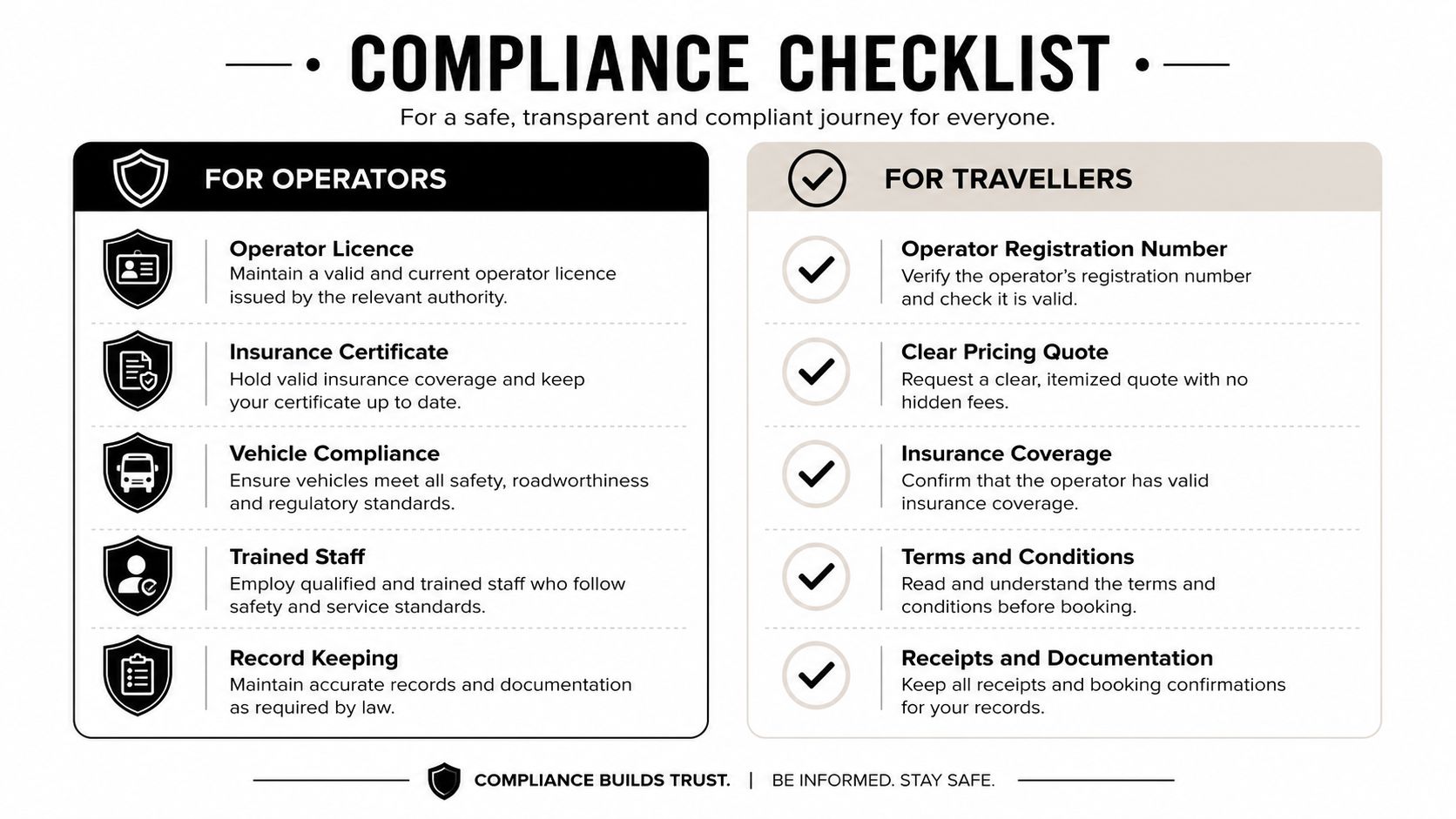
What operators must hold
- Operator licence: Keep the booking company's authorisation current and traceable to the correct authority.
- Vehicle permission and test evidence: Hold the vehicle licence, MOT record, and any additional inspection logs that apply.
- Insurance certificates: Keep hire and reward, public liability, and employer's liability evidence where relevant.
- Driver file: Store licence checks, right-to-work verification, DBS evidence if required, and any role-specific competence records.
- Booking records: Match the passenger name, vehicle, pickup time, and route in one auditable file.
- Accessibility evidence: Keep written proof of how wheelchair-accessible requests are fulfilled.
- Data and complaints records: Retain the DPIA or risk assessment where needed, the records of processing, and the complaints log.
- Customer transparency evidence: Keep the fare quote, confirmation, and any changes in writing.
What travellers should verify
- Driver badge and name: Confirm the person at the kerb matches the booking.
- Vehicle plate or booking reference: Make sure the vehicle sent is the one confirmed.
- Fixed fare in writing: Don't rely on a verbal price.
- Insurance confidence: Ask if the vehicle is insured for paid passenger work.
- Accessibility confirmation: Get the exact vehicle type in writing if you need step-free access or space for mobility aids.
- Payment trace: Use a payment method that leaves a record.
- Complaints route: Check that there is a real contact point if the service fails.
The first document an audit will ask for is usually the one that proves the business had authority to do the work in the first place. After that, they'll ask for the evidence trail. That's why compliant operators keep records as if they expect a challenge, and why travellers should only book firms that answer compliance questions without flinching.
If you want a transfer company that treats compliance as part of the service, not an afterthought, book with EC Minibus. It's built for travellers who care about licensed drivers, clear pricing, and proper meet-and-greet on airport and cruise routes. If you're planning Heathrow, Southampton, Dover, Portsmouth, or Tilbury travel, start there and ask the same questions this guide does.