

You've landed after a long flight. Everyone is tired, phones are on low battery, baggage trolleys are wobbling, and half the group wants coffee before anyone has even worked out which exit to use. If you're heading onward to a Central London hotel, Southampton cruise terminal, Dover, Portsmouth, or Tilbury, this is the point where a good plan matters most.
For international visitors, the awkward part of the journey usually isn't the flight itself. It's the handoff after arrival. Heathrow, Gatwick, and the other major London airports are well organised, but they're still large, busy, and unfamiliar if you've just stepped off a long-haul service with family, friends, or cruise luggage. One wrong assumption about pickup point, vehicle size, or pricing can turn a simple transfer into a drawn-out hassle.
That's why minibus hire for airport transfers works so well when it's booked properly. One vehicle. One driver. One plan from the arrivals hall to the hotel entrance or cruise terminal drop-off. No splitting the group, no juggling multiple taxis, and no guessing what happens if the flight lands late. The calmer your ground transfer is, the better your first day in the UK starts.
Table of Contents
- From Tarmac to Terminal Stress-Free
- Choosing Your Vehicle and Matching Luggage
- Understanding Costs and What Is Included
- The Smooth Booking and Confirmation Process
- Navigating Pickup and Drop-Off Logistics
- Real-World Scenarios and Tips for International Visitors
From Tarmac to Terminal Stress-Free
A typical arrival looks the same in one important way. People underestimate how much decision-making is waiting for them after landing.
A family arrives at Heathrow with grandparents, two children, and cruise luggage for a sailing out of Southampton. They clear immigration at different speeds, one checked bag comes out late, and the person who made the booking is now trying to compare transport options while standing in arrivals. That's when the stress starts. Not because London is difficult, but because the transfer was left too loose.
A pre-booked minibus changes the feel of the whole journey. Instead of deciding on the spot, the group already knows who's collecting them, what vehicle they're getting, where they're going, and how the luggage will be handled. For visitors who haven't used UK ground transport before, that certainty matters more than people expect.
The easiest airport transfer is the one that removes choices on arrival.
Cruise passengers benefit most from this. Airport, hotel, station, and port connections often involve more baggage than a normal city break. There may also be older travellers in the party, children who need more space, or guests who don't want the strain of moving through London with several separate taxis.
The same applies to a hotel transfer after a long-haul flight. A direct private minibus keeps the group together, gives the driver a full destination in advance, and avoids the confusion of trying to explain multiple drop-offs at the kerb after everyone is already exhausted.
Here's what usually works best for first-time visitors:
- Keep the journey single-stage: Airport to hotel, or airport to cruise port. Avoid improvising extra stops unless they're necessary.
- Book for the actual group setup: Count adults, children, large cases, cabin bags, and any mobility equipment.
- Use a service built around arrivals: Airport work is different from general chauffeur work. Timing, waiting arrangements, and pickup instructions need to be clear.
Once those basics are right, the rest becomes much simpler.
Choosing Your Vehicle and Matching Luggage
Vehicle choice usually goes wrong at the luggage stage. A group can match the seat count on paper and still arrive at the terminal with too many large cases, cabin bags, and extras for the vehicle booked.
For international visitors heading to a London hotel or straight on to a cruise port, that matters more than it does on a short city transfer. Cruise luggage is often bulkier, formalwear takes space, and families arriving from long-haul flights rarely travel light. If the minibus is too tightly matched, loading takes longer, the cabin feels cramped, and the first hour in the UK starts badly.
Start with the full load
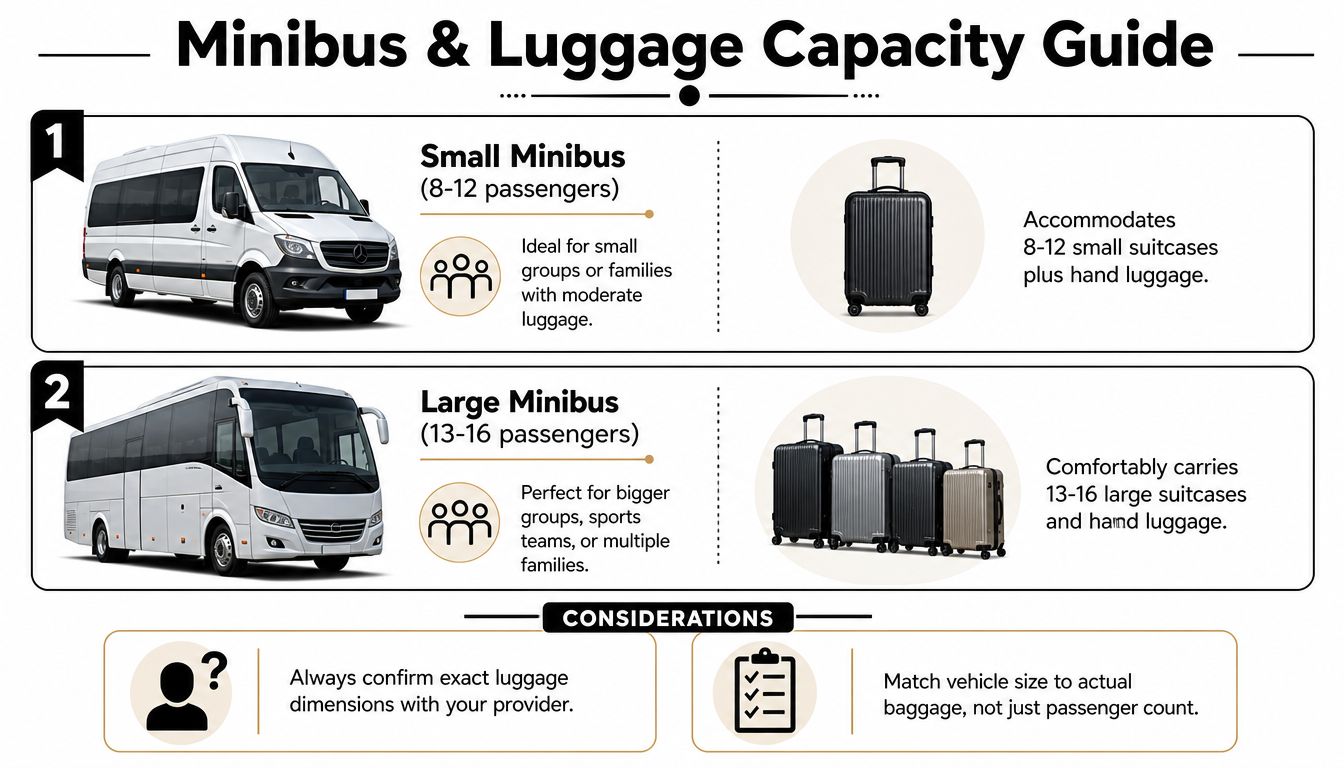
The practical way to assess this is simple. Count passengers first, then count large suitcases, then add cabin bags and any awkward items that cannot be stacked easily. Foldable wheelchairs, walkers, pushchairs, sports equipment, instrument cases, and cruise garment bags should all be declared at the quote stage.
A quick look at the different minibus vehicle classes in the EC Minibus fleet helps first-time visitors judge space more realistically than seat numbers alone.
Here is the rule I give clients.
| Vehicle type | Best fit in real travel terms |
|---|---|
| 8-seater | Smaller family or friend groups travelling with moderate baggage and no bulky extras |
| 12-seater | Groups that want more room for large cases, hand luggage, or a more comfortable ride after a long flight |
| 16-seater | Larger parties, multi-family bookings, and transfers with heavy luggage loads or mobility equipment |
An 8-seater can be the right answer for six passengers with sensible luggage. The same vehicle can be the wrong answer for six cruise guests carrying full-size cases, hand luggage, and two garment bags.
That is the trade-off. Booking too large can cost more than you need. Booking too tight creates the kind of airport delay that feels avoidable the moment the bags come off the belt.
When to move up a size
If the booking sits right on the edge of the vehicle's stated capacity, choose the next class up.
Practical rule: If the luggage plan depends on bags fitting “just about,” book the next size up.
Extra space pays for itself in comfort and loading time. Cases stay out of passenger footwells, older travellers get in and out more easily, and the driver can load the vehicle properly instead of repacking at the kerb while the group waits.
This matters even more on airport to port or airport to hotel transfers. A party arriving at Heathrow for Southampton, Dover, or a Central London hotel before embarkation often has more luggage than they expected when they booked the flight.
A larger vehicle is usually the safer choice in these situations:
- Cruise embarkation or disembarkation days: Cases are heavier and more numerous than standard leisure travel.
- Multi-generational groups: Child seats, walkers, and slower loading all benefit from extra space.
- Pre-cruise hotel stays: Guests often carry one more case than they would for a direct port transfer.
- Longer onward journeys: More room matters on routes beyond the airport, especially after an overnight flight.
Special requirements should be confirmed before the vehicle is assigned. Child seats, step access, and wheelchair-related details are manageable when the operator knows about them in advance. Problems usually start with a booking that lists only passenger numbers and leaves out everything else.
Understanding Costs and What Is Included
A common point of confusion for first-time bookers is the difference between an hourly vehicle rate and a fixed airport fare.
For an airport arrival in London followed by a hotel stay or a cruise port run, fixed pricing is usually the safer structure. The journey has a clear start point, a clear destination, and a group that wants to get out of arrivals, load up, and continue without discussing how the clock is being counted. Hourly hire makes more sense for flexible sightseeing, several planned stops, or a day where the schedule may change.
Fixed fare versus hourly booking
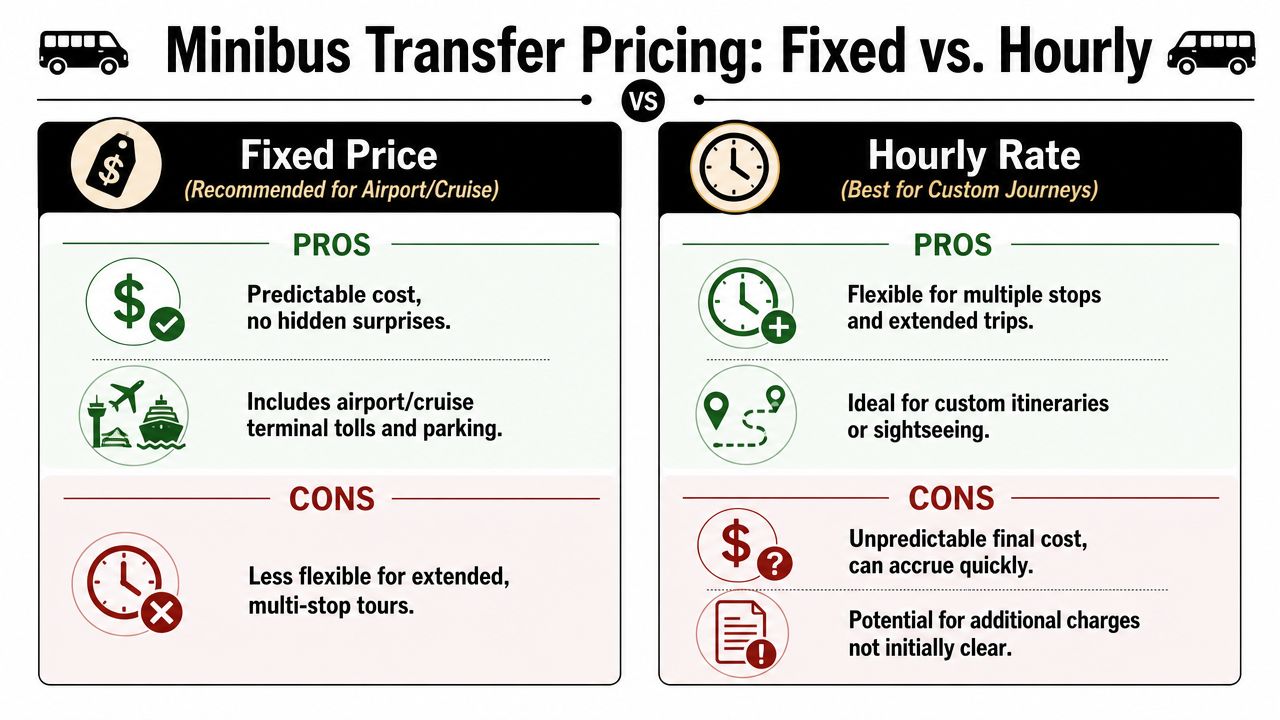
The practical issue is simple. A low hourly rate can look attractive on a quote form, but airport transfers often become more expensive that way once minimum hours, waiting time, and loading time are added.
I advise overseas visitors to ask one plain question before paying. Is this a fixed transfer from my arrival terminal to my hotel or cruise terminal, or is it billed by time?
That matters even more for Heathrow or Gatwick arrivals going on to Southampton, Dover, Portsmouth, or Tilbury. After a long-haul flight, the group usually wants one agreed price for the transfer as booked. That keeps the airport leg, the hotel drop-off, or the port run easy to budget before the trip starts.
If you want a broader sense of how operators price private transport, this guide to UK car service costs for different journey types helps set expectations.
What should be included in the quote
A proper quote should tell you exactly what you are paying for, not leave the important bits to be sorted out by email later.
Look for these points in writing:
- Meet and greet: Whether the driver comes into arrivals or waits at a stated meeting point.
- Correct terminal and destination details: Airport terminal, hotel address, private address, or cruise terminal should be listed clearly.
- Baggage allowance as booked: The quote should reflect the cases and hand luggage the group is travelling with.
- Waiting time terms: The operator should explain what is included for flight delays, immigration delays, and passenger-caused delays.
- Road charges if relevant: Parking, drop-off fees, or port access charges should be identified clearly if they apply.
Waiting time is where confusion often starts. A flight delay and a slow baggage reclaim are not always treated the same way, and a good operator will explain the difference before the travel day. That matters for international arrivals because immigration queues can vary a lot, especially for larger family groups or cruise passengers collecting several large cases.
The final price is usually shaped by four things. Vehicle size, route length, pickup timing, and how specific the booking is. A Heathrow to Central London hotel transfer is priced differently from a Heathrow to Southampton cruise terminal run, even with the same group size, because distance, traffic exposure, and driver time are different.
This is also where first-time visitors can make a costly mistake. They compare quotes line by line without checking whether both operators are pricing the same job. One may include flight monitoring, airport parking, and terminal pickup. Another may quote only the vehicle and add the rest later.
The best quote is not the cheapest line on the page. It is the one that shows, in plain terms, what happens from touchdown to hotel or port drop-off.
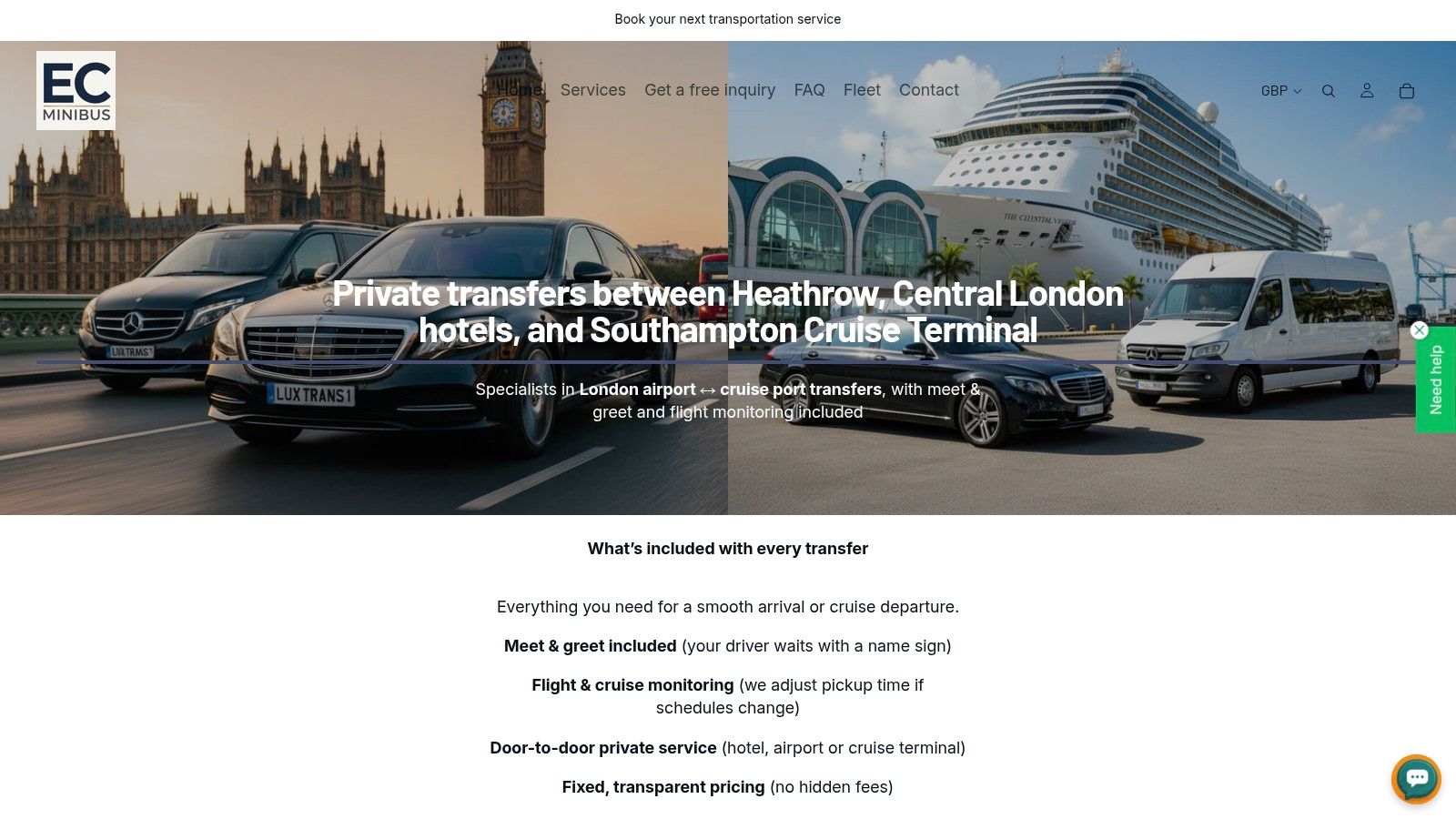
Some providers, including EC Minibus, present airport and cruise transfers as fixed-price, all-inclusive services with meet and greet included. For international visitors arriving in London and continuing straight to a hotel or ship, that model usually creates fewer misunderstandings on the day.
The Smooth Booking and Confirmation Process
The booking itself should feel routine. If it feels unclear before you've even paid, that's usually a warning sign.
Start by getting your travel details in one place before you request a quote or complete an online reservation. That saves time and reduces booking errors, especially if different family members are handling different parts of the trip.
What to prepare before you book
Keep the following details ready:
- Flight information: Airline, flight number, arrival date, and scheduled landing time.
- Destination details: Full hotel address, private address, or cruise terminal location.
- Passenger setup: Adult count, children, and any child seat requirements.
- Baggage summary: Large cases, hand luggage, and anything oversized.
- Cruise information if relevant: Ship name and terminal details for embarkation or disembarkation day.
Flight numbers matter because they let the operator follow the service properly instead of relying on a rough estimated arrival time. Cruise details matter for the same reason. A booking that only says “Southampton port” is incomplete. The exact terminal and sailing context make a difference on busy turnaround days.
A clean online booking form should ask for these details directly. If it doesn't, send them anyway in the notes or by follow-up message.
What your confirmation should show
Once the booking is accepted, the confirmation should be specific enough that another person in your group could read it and understand the plan immediately.
Check for these items:
- Date and time of service
- Pickup location and destination
- Booked vehicle type
- Named or reference-based booking ID
- Price and payment status
- Any special notes about luggage, child seats, or accessibility
- Instructions for meeting the driver
If any of that is missing, ask for an updated confirmation while there's still time to correct it.
For a visual sense of how professional transfer services present themselves online, this short video is worth watching before you finalise your arrangements:
Booking goes smoothly when the operator has enough detail to run the journey without guessing.
One final point. Put the booking confirmation somewhere easy to access offline. Screenshots help. Airport Wi-Fi is usually available, but after a long flight it's better not to depend on finding a signal before you can locate your driver.
Navigating Pickup and Drop-Off Logistics
After a long international flight into London, the mistake I see most often is simple. Passengers leave the arrivals hall too quickly, head for the wrong exit, and end up a phone call away from the driver with three suitcases and no clear landmark. A good airport transfer avoids that by giving you one clear handoff point from terminal to vehicle, then one direct plan onward to your hotel or cruise terminal.
That matters even more if London is only the first leg. Visitors heading to Southampton, Dover, Tilbury, or a Central London hotel before embarkation need the airport pickup arranged with the final stop in mind, not treated as a separate job.
How meet and greet works on the day
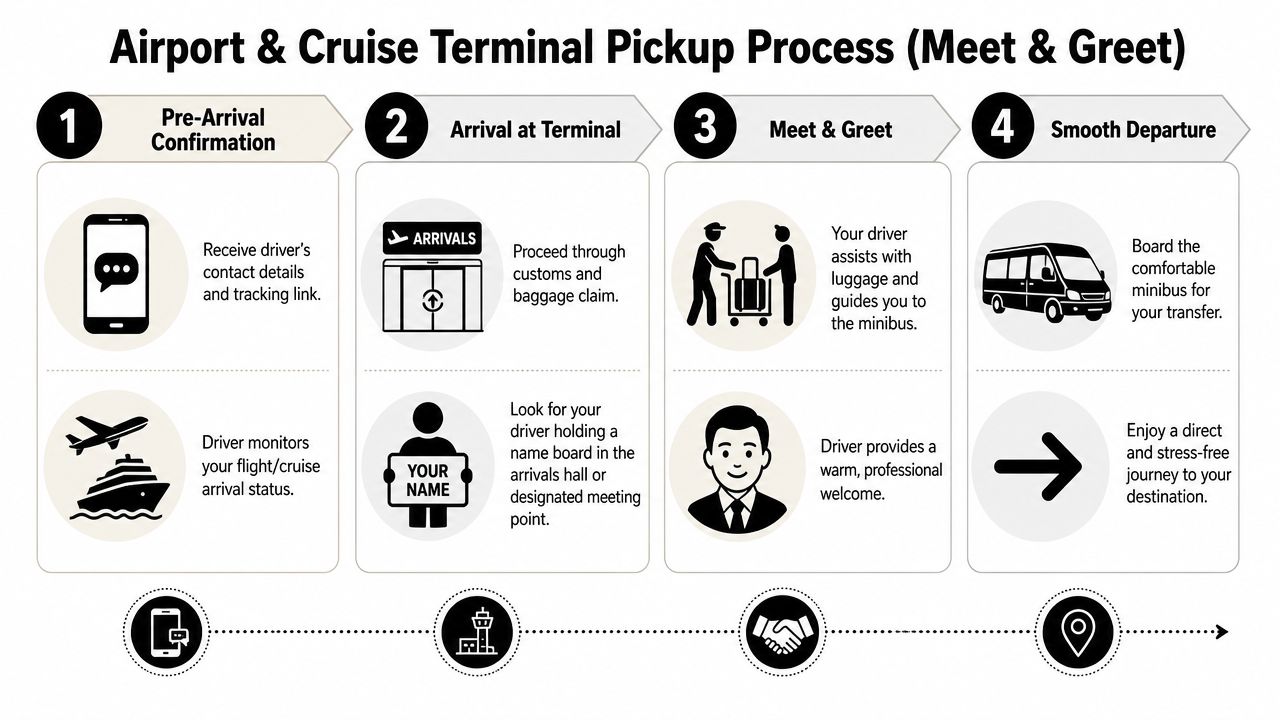
At Heathrow, the usual pattern is straightforward. You land, clear immigration, collect bags, and walk into public arrivals where the driver waits in the agreed meeting area with your name or group reference. At a cruise terminal or hotel, the handoff is different because access rules vary by site. Some ports allow collection close to the building, while others use designated lanes or short-stay pickup points that change with traffic control on busy ship days.
If you have not used it before, this Heathrow meet and greet service guidance gives a useful customer-side view of what the process looks like.
The best pickups follow a simple sequence:
- Clear the formalities first: immigration, baggage reclaim, customs.
- Go to the agreed meeting point: do not choose an exit at random.
- Check your phone before walking off: the driver may have sent a live location note or terminal update.
- Load once, then leave: cases go straight into the vehicle and the group sets off together.
For international visitors, one detail makes a big difference. The drop-off point should be the exact hotel entrance, apartment reception point, or cruise terminal building, not a broad area name. "Central London" is not precise enough if your group has children, elderly relatives, or heavy cruise luggage. The same applies at ports. Saying "Southampton docks" is not enough on embarkation day when several terminals may be operating at once.
If something goes wrong
Small delays are normal. Immigration can run slowly. Bags can come out late. One passenger may stop to buy a SIM card or use the restroom while the rest of the group keeps walking.
Stay in the agreed place.
If you cannot see the driver, check the confirmation first, then call or message the contact number you were given. Do not start moving between car parks, bus stations, and terminal exits unless the operator tells you to. Drivers can reach you quickly when you stay put. They lose time when passengers keep changing location.
The same principle applies at drop-off. A professional driver should already know whether your hotel has a coach restriction, whether the entrance is on a side street, and which cruise terminal lane is active that day. That local knowledge saves time and avoids the awkward last-minute stop where a group is unloaded with luggage in the wrong place.
For departing journeys, build in margin. Cruise check-in windows, airport security, and London traffic are much easier to handle when the transfer plan allows for a delay without turning the whole day into a rush.
Real-World Scenarios and Tips for International Visitors
The best way to judge minibus hire for airport transfers is to look at the journey as a whole, not as a single pickup.
A good booking starts before the flight. It carries through arrivals, baggage reclaim, loading, and the final handoff at the hotel or cruise terminal. When that chain is joined up properly, the journey feels easy. When one part is vague, the whole transfer becomes harder than it needs to be.
Three common journeys
A family arriving at Heathrow for a hotel stay in Central London usually needs more space than they first assume. Children's bags, cabin luggage, pushchairs, and tired travellers all make a tight vehicle feel tighter. The sensible move is to book around luggage volume and comfort, not just headcount. If they're cruising a day or two later, that extra room matters even more.
A group of friends flying in for a Southampton cruise has a different priority. Their key decision is usually pricing structure. They don't need a flexible touring vehicle. They need one direct, fixed transfer from airport or hotel to port, with a meeting arrangement that still works if the flight lands late or the group takes time to collect cases.
Business travellers are often the most punctual and the most exposed to small booking errors. They tend to travel lighter, but they notice immediately if the pickup instructions are vague, the destination isn't precise, or the vehicle type doesn't match the reservation. For them, a clean confirmation and a driver who knows the exact hotel or meeting venue makes the difference.
Useful tips if you're arriving from the US or Canada
A few details catch North American travellers off guard, especially on a first UK trip.
- Keep your phone ready: Make sure it can receive messages on arrival, whether through roaming, eSIM, or airport Wi-Fi.
- Save addresses exactly as used in the booking: Hotel names can be similar. Street-level precision helps.
- Check bag measurements carefully: UK operators may think in centimetres. If you think in inches, convert before you confirm oversized luggage.
- Allow for jet lag in your planning: Tired groups move slowly. That's normal. Build in extra patience for baggage reclaim and regrouping.
- Carry the lead passenger's details with everyone else: If one person has all the booking information and gets held up, the rest of the group can lose time unnecessarily.
- Use one shared message thread: Family or group chats help everyone know the driver name, meeting point, and destination.
The smoothest arrivals happen when one person isn't carrying the whole plan alone.
For cruise guests in particular, I'd add one more point. Treat the transfer as part of the holiday, not as an afterthought. Your airport-to-port or hotel-to-port connection is the bridge between two complex travel days. If it's arranged clearly, the whole trip begins in a much calmer way.
If you want a straightforward door-to-door option between Heathrow, Central London hotels, and UK cruise ports, EC Minibus provides private transfers with fixed pricing, meet and greet, and online booking designed around international arrivals.