

You've booked the cruise. The exciting part is done. Then the practical worry kicks in. You land at Heathrow after an overnight flight, you're tired, your bags are heavier than they looked at home, and now you've got to get yourselves from a busy airport to a cruise port that isn't in London.
That's the part first-time UK cruise passengers underestimate.
The ship feels simple. The ground transfer doesn't. You start wondering whether the train is easy enough, whether a taxi rank is a safe bet, whether your driver will show up, whether you'll be late for check-in, and whether one delay will unravel the start of the whole holiday.
It doesn't have to.
An ocean cruise terminal is more than a building where you board a ship. It's the gateway to your holiday, and your experience there is shaped long before you step inside. Get the transfer right, arrive at the correct time, and understand the flow of the terminal, and the day feels smooth. Get it wrong, and embarkation becomes a stressful slog.
Table of Contents
- Your Stress-Free Start to a UK Cruise Holiday
- What Exactly Is an Ocean Cruise Terminal
- A Closer Look at the UKs Main Cruise Terminals
- Getting To and From Your Cruise Terminal
- Your Arrival and Departure Day Process
- Essential Tips for Luggage Accessibility and Timing
- Frequently Asked Questions About UK Cruise Terminals
Your Stress-Free Start to a UK Cruise Holiday
If you're flying in for a UK sailing, don't think about the cruise day as one big blur. Break it into three parts. Airport arrival, ground transfer, terminal processing. That's how you stay in control.
The first part is straightforward enough. You clear the airport, collect your luggage, and get your bearings. The second part is where most travellers make life harder for themselves, because they treat the trip from Heathrow to the port as an afterthought. It isn't. It's the handover between your flight and your ship, and that handover needs to be organised.
Practical rule: Book your cruise first, your flight second, and your port transfer immediately after that.
The third part happens at the ocean cruise terminal itself. Once you know how the building works, it stops feeling intimidating. You aren't walking into chaos. You're moving through a sequence. Drop bags. Check in. Clear security. Wait briefly. Board.
That's why understanding the terminal matters before you travel. It helps you pack properly, time your arrival properly, and avoid the classic mistakes, such as turning up too early, dragging too much in hand luggage, or assuming a last-minute taxi will sort itself out.
For first-time UK cruise passengers, especially those arriving from North America, my advice is blunt. Keep the day simple. Remove as many moving parts as you can. A holiday should start with someone meeting you, loading your luggage, and taking you directly to the correct terminal. Not with you studying rail platforms while jet-lagged.
What Exactly Is an Ocean Cruise Terminal
An ocean cruise terminal is basically an airport terminal for ships. That comparison helps because the same logic applies. You don't just stroll onto a vessel. You go through a controlled passenger process designed to move large numbers of people safely and in the right order.
Think of it as an airport for ships
When you arrive, the terminal acts as the buffer between land transport and the ship. Staff direct vehicles, porters handle tagged luggage, cruise line teams verify documents, security screens passengers and hand baggage, and then passengers move into a waiting area before boarding begins.
That's why the building can feel busy even when operations are running well. A terminal isn't there to create atmosphere. It's there to process people and bags efficiently.
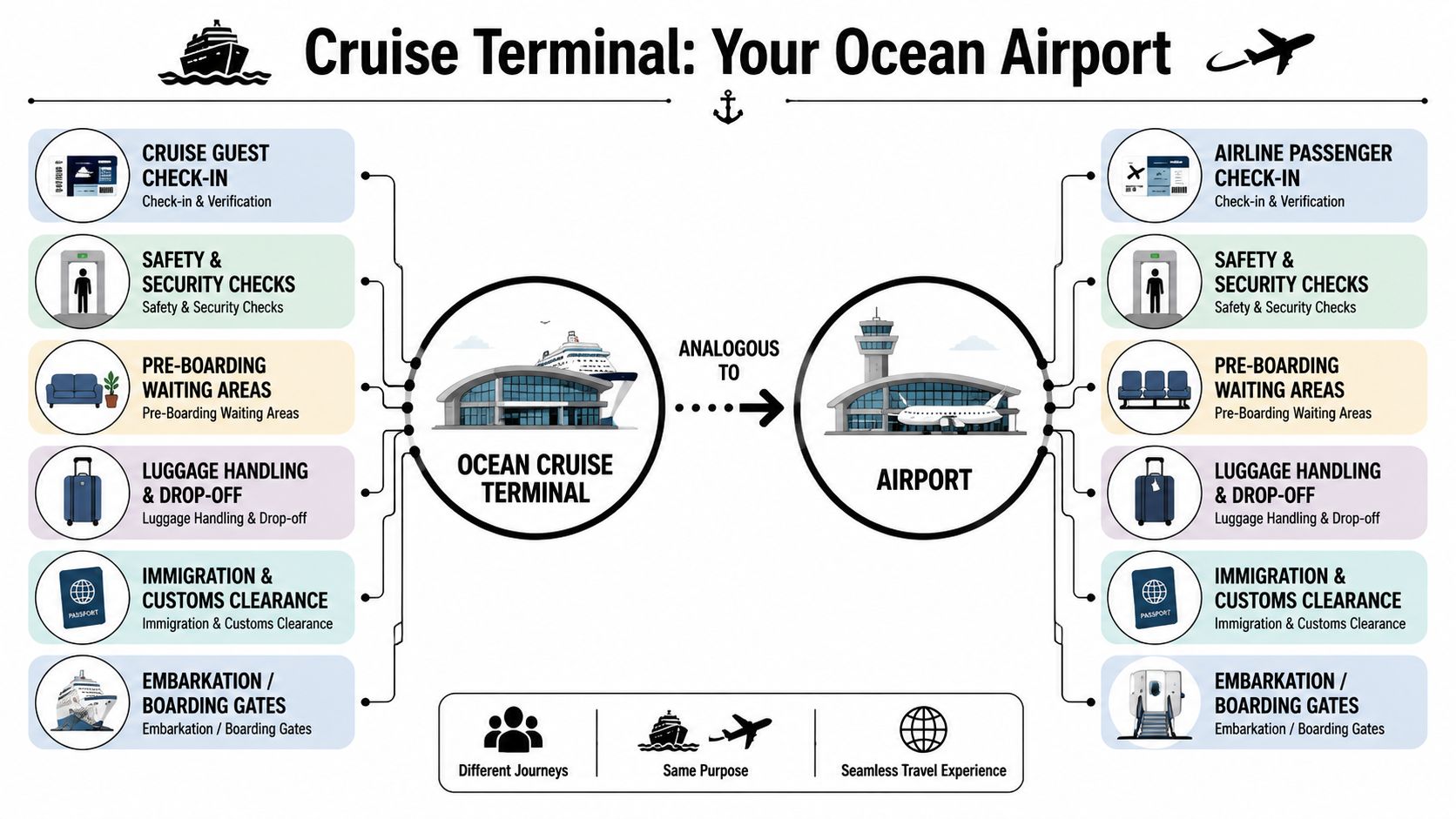
The four jobs every terminal handles
Here's the mental map you want in your head before embarkation day:
-
Passenger processing
This is your check-in stage. Staff verify your passport, cruise documents, and any boarding details required by your line. If your documents are organised and easy to reach, this part is quick. If they're buried in a suitcase pocket, you'll hold yourself up. -
Security screening
This works much like airport security, though usually faster and less drawn out. Your hand luggage is screened and you pass through the security area before entering the departure lounge. -
Baggage handling
Your main luggage is usually handed over before you board. It's tagged for your cabin and delivered later by the ship's crew. That means you must keep essentials with you, not in the cases you hand over. -
Embarkation and disembarkation
This is the final movement between terminal and ship. It might be via gangway or enclosed boarding bridge depending on the port and vessel.
| Terminal function | What you do | What matters most |
|---|---|---|
| Check-in | Show passport and cruise documents | Keep paperwork accessible |
| Security | Screen hand luggage | Pack liquids and valuables sensibly |
| Bag drop | Hand over tagged cases | Keep medication and essentials with you |
| Boarding | Wait for your call, then board | Follow your assigned timing |
A cruise terminal feels much easier once you stop treating it like a mystery and start treating it like a sequence.
A Closer Look at the UKs Main Cruise Terminals
The UK has several cruise departure points, but they don't all feel the same. If you're sailing from one of the main hubs, it helps to know the character of the port before you even think about transfer plans.
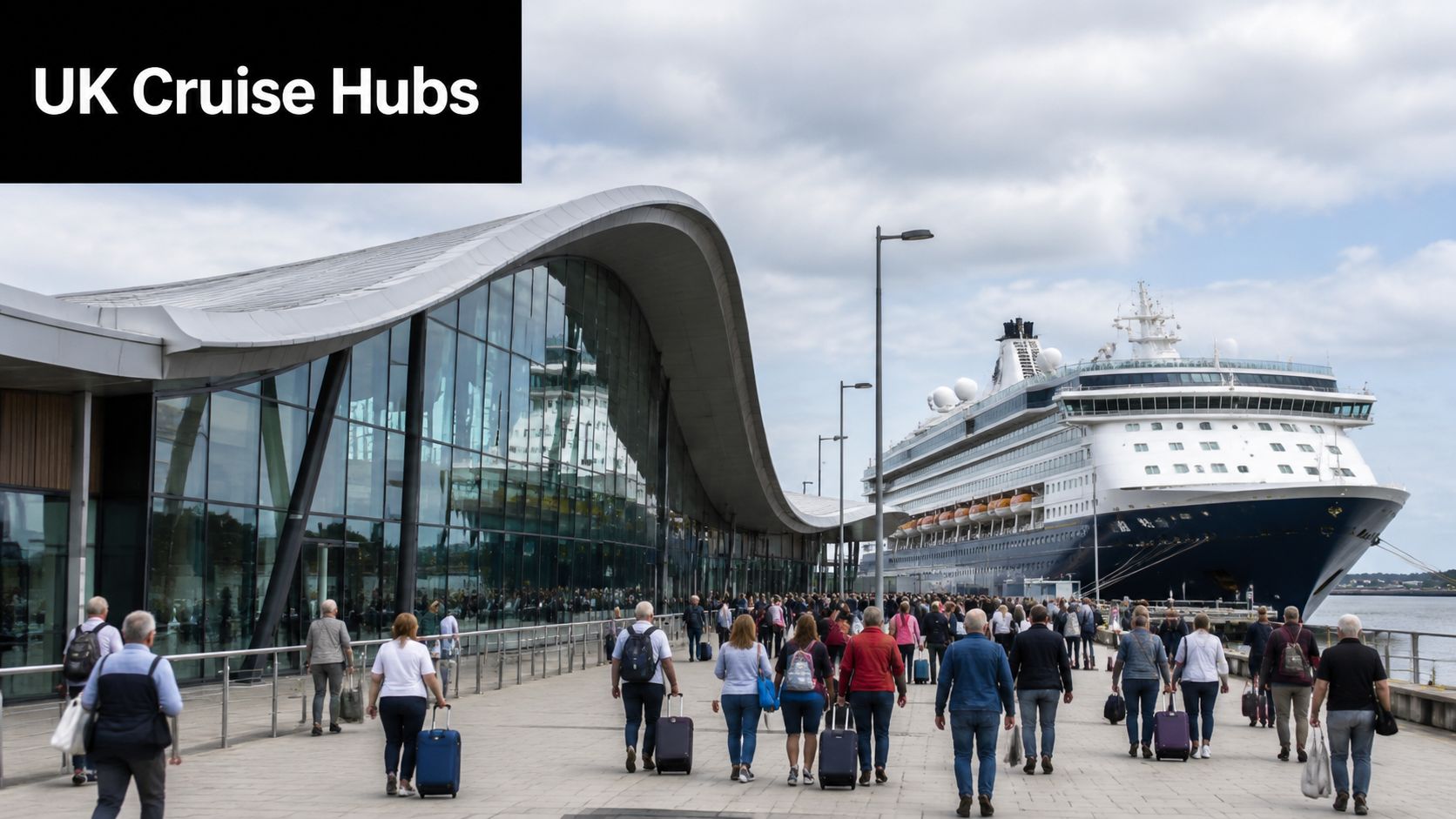
Southampton sets the benchmark
Southampton is the big one. If you're researching UK cruising for the first time, this is the port you'll encounter most often, and for good reason. The Ocean Cruise Terminal in Southampton was inaugurated in 2009, and in 2024 the port handled 448 cruise ship calls, serving approximately 1,443,406 passengers across 15 cruise lines, as part of the nearly 3 million passengers welcomed annually across Southampton's terminals, according to CruiseMapper's Southampton port profile.
That scale matters. It tells you Southampton is well used, well organised, and busy enough that you shouldn't rely on improvisation. You'll find multiple terminals in the port, not just one building, so your transfer needs to take you to the correct one.
If you want a wider overview of the main British departure points, this guide to cruise ports in the UK is a useful starting point.
How Dover Portsmouth and Tilbury differ
Dover feels classic and recognisable. Many travellers know it for the White Cliffs, and it's a natural fit for itineraries into Northern Europe. The port works well for passengers who want Kent access rather than a route through Southampton, but it can be less intuitive for overseas visitors who are also trying to manage London airport logistics.
Portsmouth has a different feel altogether. It's a historic naval city, and the cruise experience there often feels a little more contained. For some passengers that's appealing. It can feel less overwhelming than a giant hub.
Tilbury is the practical London-area option. If your priority is being closer to the capital rather than sailing from the south coast's main cruise city, Tilbury makes sense. Just don't mistake “London cruise port” for “minutes from central London”. Ground transport still needs planning.
Here's the simple comparison:
- Southampton: Best if you want a major, purpose-built cruise hub with broad ship choice.
- Dover: Strong option for certain Northern Europe sailings and travellers combining Kent with a cruise.
- Portsmouth: Suits passengers who prefer a smaller port feel.
- Tilbury: Convenient for London-based stays, but still needs proper transfer planning.
My opinion is simple. First-time passengers should never choose a port based only on the cruise fare. Choose based on the whole journey. The right sailing from the wrong port can create a miserable embarkation day.
Getting To and From Your Cruise Terminal
Most stress starts. Not at the check-in desk. Not at security. On the road and rail journey between airport and port.
Why the transfer choice matters more than people think
Southampton is Northern Europe's busiest cruise port with over 3 million guests annually, and 45% of international passengers report stress related to ground transfers due to unclear pricing and unreliable scheduling. The same source notes that a door-to-door private transfer from Heathrow takes 90–120 mins, while train and taxi combinations can exceed 150 mins with multiple changes, according to World of Cruising's guide to England's ports.
That should tell you everything you need to know. The cheapest-looking route isn't always the easiest route. And for international travellers, “easy enough” usually stops feeling easy the moment luggage, delays, or platform changes get involved.
Your real options from Heathrow
Let's be direct about the three usual choices.
| Option | What it looks like in practice | My view |
|---|---|---|
| Train plus taxi | Airport transfer, rail connection, then local taxi at the port end | Fine for experienced UK rail users travelling light |
| Standard taxi | Simple in theory, but price and availability can be uncertain | Better than rail with bags, but not ideal if you want fixed costs |
| Pre-booked private transfer | Meet at arrivals, direct vehicle, luggage help, terminal drop-off | The most sensible option for first-time cruise passengers |
Train works for confident travellers who don't mind navigating stations. If that's not you, skip it. The UK rail network is manageable when you know it. It's annoying when you don't.
Taxi ranks can look tempting after a long flight because they're visible and immediate. But immediate isn't the same as predictable. If you care about knowing the cost in advance, who is collecting you, and where you'll be dropped, a rank taxi is a weak plan.
For passengers who want a door-to-door option, Southampton cruise transfers usually make the process simpler because the pickup, route, and destination are set before you travel. EC Minibus is one example. It offers Heathrow meet and greet, flight and cruise monitoring, fixed pricing, and direct transfers to major cruise ports.
If your cruise leaves the same day you land, remove every unnecessary connection. That isn't indulgent. It's sensible travel planning.
A short visual overview helps if you want to see the route and transfer context before you book:
My recommendation for first-time passengers
If you're flying long-haul, carrying cruise luggage, and heading to Southampton, Dover, Portsmouth or Tilbury for the first time, pre-book a private transfer. Don't overcomplicate this.
You want four things:
- Fixed pricing: So there's no anxiety about what the final fare will be.
- Flight monitoring: So delays don't leave you stranded.
- Meet and greet: So you aren't hunting for your driver after immigration.
- Correct terminal drop-off: So you arrive where your ship departs.
That combination removes the most common failure points in one decision.
Your Arrival and Departure Day Process
Embarkation feels much easier when you know the order of events. Once your vehicle turns into the port, the day becomes procedural.
What happens when your vehicle pulls up
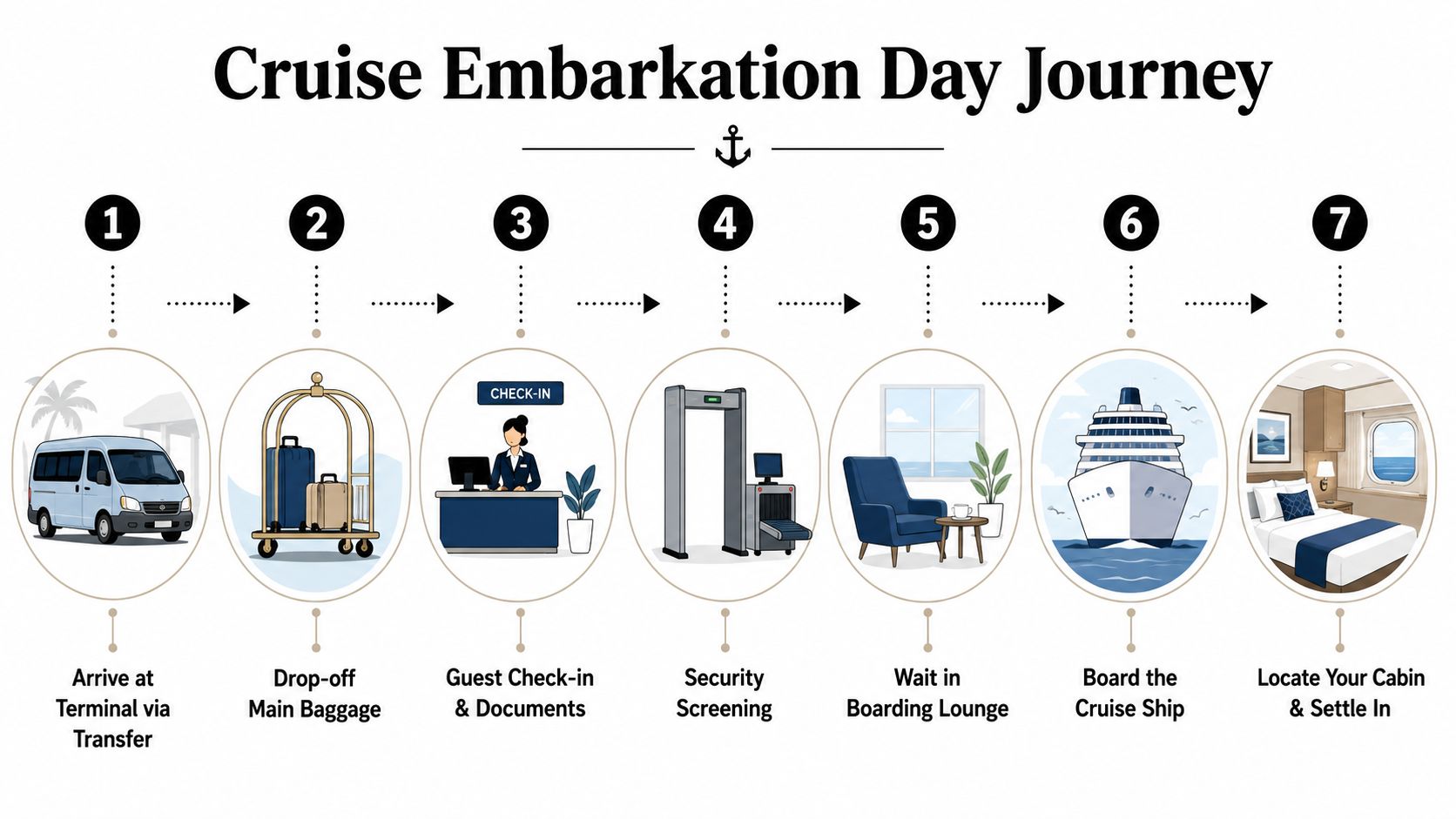
You arrive at the correct terminal and your driver pulls into the designated drop-off area. Staff direct traffic, and there's usually no reason to linger. This is not the point to start reorganising passports, hunting for luggage tags, or debating whether one suitcase should stay with you.
Your main cases go to the porter once they're tagged for the ship and cabin. Keep your documents, medication, valuables, chargers, and anything you'll need for the first few hours in your hand luggage.
If you're sailing from Southampton and want terminal-specific context, this page on the Queen Elizabeth Cruise Terminal in Southampton gives a useful reference point for what the port setup looks like.
From check-in desk to ship
Once inside, you follow the check-in flow for your cruise line. Staff verify your documents and move you onward to security. The pace can vary, but the process itself is straightforward if your paperwork is ready.
After security, you usually enter a waiting lounge until your boarding group or general boarding call is announced. This is the calmest part of the experience if you've arrived at the right time. Sit down, keep your passport handy, and stop worrying. At this stage, the difficult part is over.
Modern terminals like Southampton's use movable passenger boarding bridges with fixed entrance tunnels. That setup can reduce boarding time by an estimated 35% compared to static gangways and gives passengers a safe, climate-controlled walk to the ship even in poor weather, according to Cruise Blog's Southampton cruise port guide.
That matters more than people realise. You aren't trudging up an exposed gangway in the rain hoping your hat stays on. At a modern ocean cruise terminal, boarding is usually far more comfortable and far more orderly than first-time passengers expect.
For disembarkation, the logic runs in reverse. Leave the ship when called, collect baggage if your cruise line requires it, and head to your arranged onward transport. If you've pre-booked your transfer, departure day is just as clean as arrival day.
Essential Tips for Luggage Accessibility and Timing
Large UK terminals are built to handle substantial ships and heavy passenger flow. Southampton, for example, is part of a purpose-built deepwater facility with up to 16.5m water depth, allowing it to service the world's largest cruise ships. For passengers, that scale means terminals are set up to process thousands of people at once, which makes pre-arranged support and proper timing essential, as noted in the Port of Southampton overview.
Luggage considerations
Don't pack as if you'll see your suitcase again immediately after handing it over. You might not.
- Keep essentials with you: Medication, travel documents, valuables, chargers, and one change of clothes belong in your hand luggage.
- Label every bag clearly: Use the cruise line's tags exactly as instructed. If a tag comes loose, your own identification still helps.
- Expect a gap before delivery: Your cases will usually reach your cabin later, not the moment you board.
Carry what you can comfortably manage yourself. Embarkation is smoother when your hand luggage is practical, not ambitious.
Accessibility support
If you need mobility assistance, don't leave it until the week before sailing. Arrange it with the cruise line well in advance. That includes wheelchair support, step-free assistance, and any boarding help you may require.
Big terminals can process large volumes efficiently, but they still work best when assistance requests are in the system ahead of time. Staff can only act quickly if they know what you need.
A few basics matter:
- Notify the cruise line early: Don't assume the terminal can improvise on the day.
- Bring any essential mobility equipment details: Especially if something needs special handling.
- Allow extra time without arriving absurdly early: Early support works better than rushed support.
Timing and check-in
The right arrival time is the one your cruise line gives you. Not earlier because you're nervous, and not later because traffic looked light on the motorway.
Passengers often think early arrival means being organised. It often means standing around with luggage while the terminal works through timed boarding windows. Follow your assigned check-in time and aim to be punctual rather than premature.
My standard advice is simple:
- Build in road margin: Traffic can be unpredictable.
- Don't cut it fine: A relaxed arrival beats a dramatic one.
- Don't arrive hours early: You won't board faster just because you reached the kerb first.
Frequently Asked Questions About UK Cruise Terminals
A smooth cruise holiday starts long before the gangway. Sort the transfer, know the terminal flow, and keep embarkation day simple. That's the formula.
Do green terminal features change anything for passengers
Usually, no. Sustainability features such as solar-powered terminals don't currently make a meaningful difference to check-in procedures, queuing times, or private transfer pickup zones. Passengers should be aware that ports are investing more in shore power and related infrastructure, which may alter terminal layouts over time, according to BBC reporting on Southampton port sustainability developments.
What facilities should you expect
Expect the basics rather than a luxury lounge. Most cruise terminals provide seating, toilets, check-in areas, and security processing. Some may have limited refreshments or vending, but don't plan on a full airport-style retail experience. Eat beforehand, keep water with you if allowed, and assume the terminal is functional, not fancy.
What if you arrive too early
If you're very early, you may wait. Sometimes that wait is comfortable. Sometimes it isn't. You won't improve the boarding sequence by arriving far ahead of your slot, so don't build your whole day around unnecessary waiting time.
What's the one decision that makes embarkation easier
Pre-arranged transport. Not because it's glamorous, but because it removes uncertainty at the exact point travellers are most vulnerable to stress. When someone meets you, handles the luggage side sensibly, and takes you directly to the right ocean cruise terminal, the holiday starts properly.
If you want the journey between Heathrow, London and your cruise port handled in one clean step, EC Minibus provides door-to-door private transfers with meet and greet, fixed pricing, and direct service to major UK cruise terminals. For first-time passengers, that kind of planning makes the whole day calmer.