

You've probably got one of two situations on your mind right now. You've either just stepped off a cruise in Portsmouth with cases, hand luggage, and a flight to catch at Heathrow, or you're finishing a stay in the city and trying to work out which transfer won't unravel halfway through the day.
That's the core issue with Portsmouth to Heathrow. Most travel pages obsess over the cheapest fare or the fastest journey on paper. That's useful up to a point. It's not enough if you're tired, carrying luggage, travelling with family, or working to a firm airline check-in deadline.
Portsmouth isn't a minor starting point. It's a major port city with a population of 208,100 and sits within the wider South Hampshire urban area of about 860,000 residents, around 74 miles (119 km) south-west of London, which helps explain why this route is so busy for international travellers and cruise passengers alike, as noted in Portsmouth's location and population overview.
Table of Contents
- Planning Your Journey from Portsmouth to Heathrow
- Your Travel Options at a Glance
- The Public Transport Route Coach vs Train
- The Private Transfer Solution for a Direct Journey
- Sample Itineraries Planning Your Trip
- Booking Your Transfer Key Tips for 2026
- FAQs for Portsmouth to Heathrow Travellers
Planning Your Journey from Portsmouth to Heathrow
Cruise passengers usually make the same mistake. They look at the timetable first and the transfer experience second. That's backwards.
If you're leaving Portsmouth International Port, your travel day already has friction built into it. You've got disembarkation timing, luggage, passports, airline check-in, and often a bit of jet lag on top. By the time you start your Portsmouth to Heathrow transfer, you don't need a clever itinerary. You need one that won't force you to drag bags through multiple stations and hope every connection behaves.
What matters on this route
The right choice typically comes down to four things:
- Luggage load: One cabin bag is one trip. Two large cases plus hand luggage changes the day completely.
- Connection pressure: A same-day long-haul flight needs a different level of caution than an evening hotel check-in.
- Travel party: Solo travellers can absorb more inconvenience. Families and older passengers usually shouldn't.
- Door-to-door simplicity: The fewer moving parts, the lower the risk.
Practical rule: If a missed connection would damage the rest of your trip, don't choose based on headline fare alone.
My advice before you book anything
Start with your deadline, not your budget. Ask yourself one blunt question: what happens if this transfer runs awkwardly, not perfectly?
If the answer is “we'll still be fine”, public transport may be enough. If the answer is “we could miss a flight, lose our nerve, or spend the whole day stressed”, you should treat reliability as the main product you're buying.
That's how experienced coordinators look at Portsmouth to Heathrow. Not as a simple route, but as a chain of small risks. Your job is to remove as many as possible before the day begins.
Your Travel Options at a Glance
Most travellers choosing Portsmouth to Heathrow are really choosing between coach, train, and private transfer. Each can work. Each also fails in a different way.
The simplest comparison is this. Road travel is direct. Rail is flexible but broken into stages. Coach is cheaper but slower and less forgiving if timing matters. According to Rome2Rio's Portsmouth to Heathrow route summary, the road distance is about 66 miles, with a drive time of around 1 hour 8 minutes in ideal traffic, while the fastest rail journeys take about 2 hours 12 minutes and require changes.
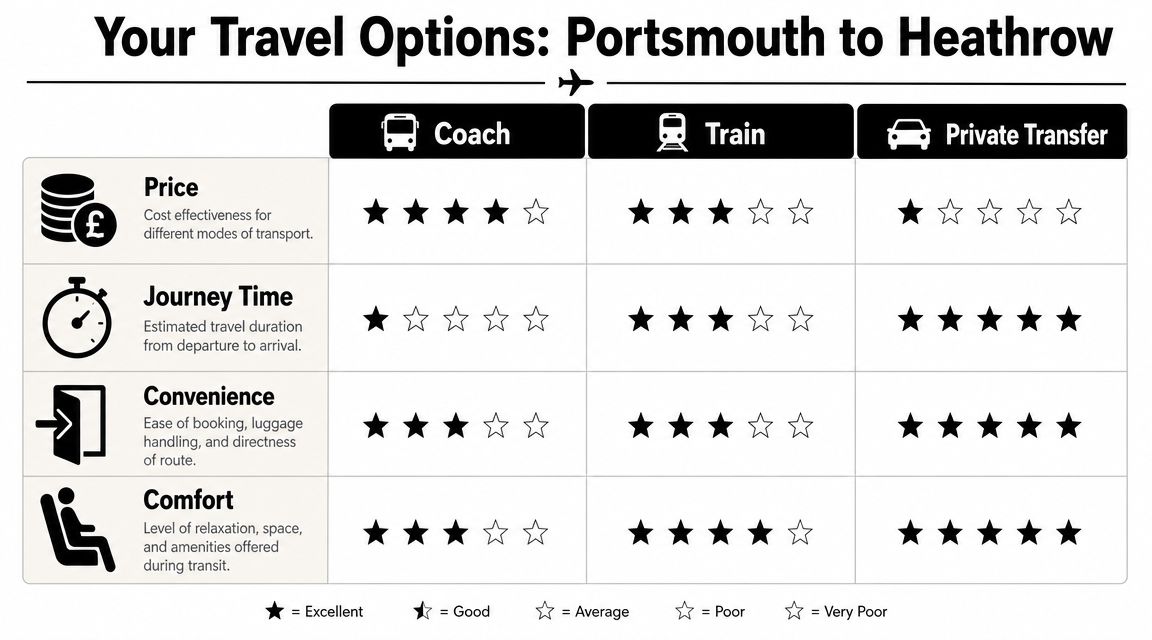
Portsmouth to Heathrow transport comparison
| Option | Avg. Cost (per person) | Avg. Journey Time | Convenience | Best for Luggage |
|---|---|---|---|---|
| Coach | Lower cost | Usually slower and variable | Simple if departure point suits you | Fair if you're travelling light |
| Train | Varies by booking and route | Faster on paper than coach on some itineraries | Lower convenience because of changes | Poor to fair with multiple bags |
| Private transfer | Higher upfront cost | Direct and usually the cleanest door-to-door option | Highest convenience | Best option for heavy or multiple bags |
How I'd rate them in real life
The coach works best for travellers who are price-led and flexible. If you're not carrying much and you can tolerate a longer journey, it's reasonable.
The train suits people who are comfortable navigating stations and don't mind changes. If you travel regularly in the UK, this may feel normal. If you've just come off a ship with luggage, it often feels like work.
Private transfer is the option for people buying certainty, space, and a calmer travel day. That's especially relevant for cruise guests, families, and anyone who values the same logic behind door-to-door airport shuttle services, where the transfer itself is meant to remove hassle rather than add to it.
The cheapest journey can still be the most expensive one if it creates the highest chance of disruption.
My short recommendation
- Choose coach if budget matters most and your schedule has slack.
- Choose train if you're confident with London station changes.
- Choose private transfer if your priority is arriving without drama.
That's the honest version.
The Public Transport Route Coach vs Train
Public transport from Portsmouth to Heathrow isn't impossible. It's just often presented too neatly. On paper, the route looks manageable. In practice, the difference between coach and train comes down to how much inconvenience you're willing to carry yourself.
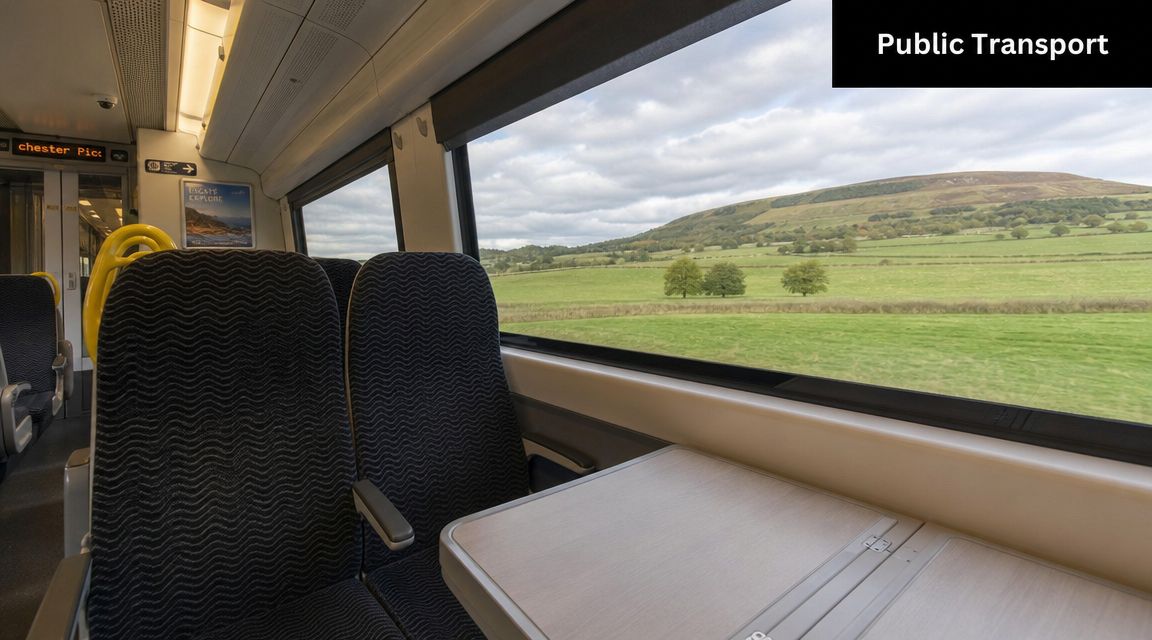
Train is the more tempting option if you only compare advertised speed. But there's a key operational problem. There is no direct train from Portsmouth to Heathrow. Rail journeys usually require one or two changes, often via London Waterloo and Paddington, with a fastest travel time of 2 hours 27 minutes, while a direct coach service does operate, as shown in Trainline's Portsmouth to Heathrow route page.
Taking the coach
The coach wins on one important point. It stays in one piece. You board, stow your luggage, sit down, and stay with the same service until Heathrow.
That's valuable if you're tired or unfamiliar with UK stations. It also reduces the mental load. You don't have to work out whether the lift is operating, whether your platform changed, or whether your suitcase can be hauled across a concourse quickly enough.
The downside is obvious. Coaches can be slower, and road conditions can stretch the trip. If your day has generous margins, that may be perfectly acceptable. If your flight timing is tight, the slower profile becomes harder to justify.
Taking the train
The train asks more from you. Not just money or planning. Physical effort.
A typical rail trip means getting yourself to the departure station, boarding with your bags, managing at least one interchange, crossing London in some form, and then navigating Heathrow at the end. If all you've got is a backpack, fine. If you've got cruise luggage, it can become a slog.
For travellers comparing nearby south coast rail options, guides on routes like Southampton to Portsmouth by train are useful for understanding how quickly a simple timetable can become a more involved station-to-station exercise once luggage enters the picture.
The real pain point is the change, not the train
Travelers don't miss flights because the rail timetable looked bad. They get caught because the transfer felt manageable until they were doing it with actual bags, on tired legs, in a busy station, with the clock moving faster than expected.
Here's the practical sequence you need to picture:
- Get from your accommodation or port to the station
- Board the first train with all luggage
- Make your interchange without delay
- Handle the London transfer element
- Reach the correct Heathrow terminal area
- Walk from there to check-in or bag drop
That's a lot of stages for one airport run.
This video gives a useful sense of rail travel context before you commit to that kind of journey:
Which public option would I choose
If I were advising a solo traveller with one manageable bag and a flexible afternoon flight, I'd say the coach is often the simpler public option. It's slower, but it avoids the station choreography.
If I were advising someone with multiple suitcases, children, mobility concerns, or cruise disembarkation stress, I wouldn't push either public route unless budget left no room for anything else.
When a journey has several handoff points, each one becomes another chance for the day to go off-script.
That's the core coach versus train decision. Not speed alone. Friction.
The Private Transfer Solution for a Direct Journey
If you're heading from Portsmouth to Heathrow for a long-haul flight or straight off a cruise, this is the option I trust most. Private transfer cuts journey risk better than any public route because it keeps the day simple: one pickup, one vehicle, one arrival point.
That matters for international travellers. The primary problem is rarely the mileage between Portsmouth and Heathrow. It's what can go wrong around the edges. Delays between stages, heavy cases at the wrong moment, terminal confusion, and the slow drain on your energy before you even reach bag drop all raise the odds of a bad airport day.
With a private car, your trip stays controlled. You leave from your hotel, home, or port. Your luggage is loaded once. You travel directly to the right Heathrow terminal area.
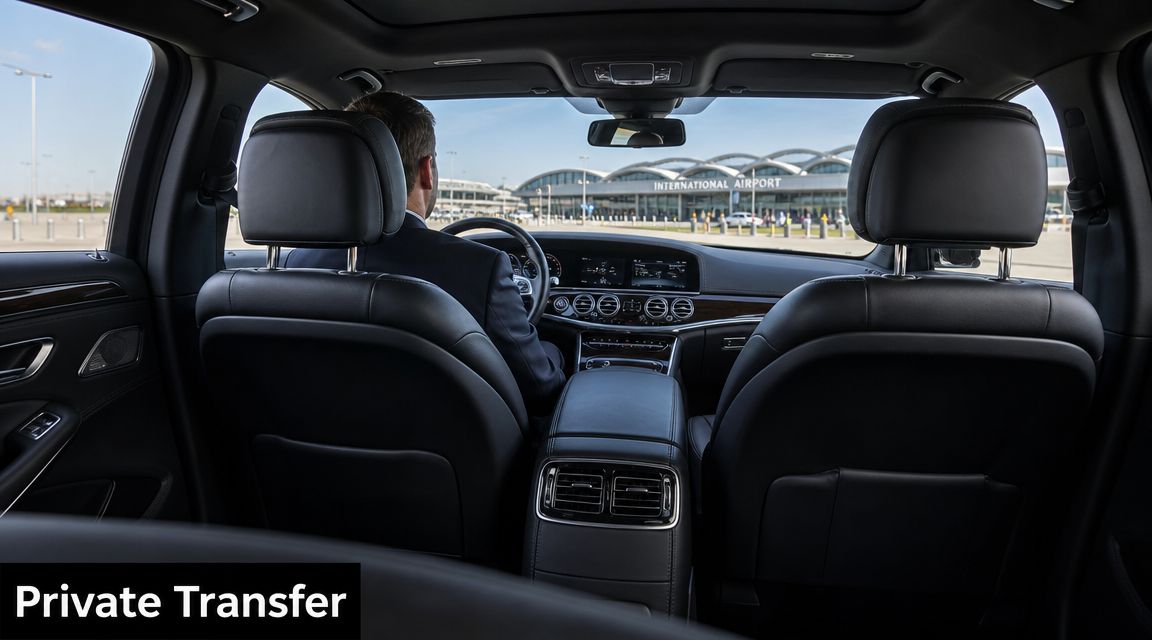
Why private transfer is the low-risk choice
Price alone gives a distorted view of this journey. Total journey risk is the better test.
A private transfer reduces the points where things commonly fall apart. You do not need to manage platform changes with suitcases. You do not need to work out the least awkward London connection while tired. You do not need to split your attention between children, documents, and bags in a crowded station. For many travellers, that is the difference between arriving composed and arriving already worn out.
I recommend private transfer first for these groups:
- Cruise passengers leaving or joining a ship
- Families with multiple cases, pushchairs, or tired children
- Older travellers who want to avoid stairs, platforms, and standing around
- Business travellers with fixed check-in or meeting times
- Anyone flying long haul and carrying enough luggage to make changes a nuisance
What good service looks like
Do not book on price alone. Book on reliability.
The provider should give clear pickup instructions, realistic luggage capacity, fixed pricing, and support if timing changes. If your sailing runs late or your flight details matter to the booking, the company should be set up to monitor that properly. This guide to door-to-door airport transfer planning covers the details worth checking before you confirm anything.
EC Minibus is one example of this type of service. It offers licensed, insured door-to-door transfers with fixed pricing, meet and greet, and flight or cruise monitoring for Heathrow and major UK cruise-port connections.
A good private transfer protects more than the clock. It protects your attention, your energy, and your margin for error.
My recommendation
If the flight matters, book the car.
That applies to cruise connections, long-haul departures, family travel, and any day where a missed step would be expensive or exhausting. The cheapest fare is not the smartest comparison. Compare the full journey. Luggage handling, number of handoffs, door-to-door simplicity, and how much can go wrong before you reach the terminal. On that basis, private transfer is usually the strongest choice.
Sample Itineraries Planning Your Trip
Abstract advice only gets you so far. It's easier to decide when you can see yourself in the day.
Family of four with cruise luggage
A family leaves a ship in Portsmouth with several cases, hand luggage, and children who are already tired. They could take public transport, but every step gets harder once bags are added. One adult ends up moving luggage while the other watches the children. If there's a change, the stress doubles.
For this group, I'd choose a private transfer without hesitation. They need one vehicle, one pickup point, and one arrival. The value isn't just convenience. It's keeping the group together and avoiding a messy handover through stations.
Budget-conscious solo traveller
A solo traveller with one medium case and no urgent same-day long-haul connection has more freedom. This person can tolerate a longer ride and doesn't need door-to-door simplicity in the same way.
For them, the coach often makes the most sense. The pace is slower, but the structure is straightforward. If they're comfortable with more active travel and know London rail well, the train may still appeal. I'd only push rail if they're relaxed about making changes with luggage.
Couple heading to Heathrow after a short Portsmouth stay
This is the middle case. Two adults, a couple of larger bags, and a flight that matters. They're not as logistically stretched as a family, but they still have enough luggage for station changes to become annoying fast.
My advice here depends on personality. Confident, experienced rail users may accept the train. Most couples travelling internationally are happier in a pre-booked car because it reduces decisions on the day. That alone is often worth it.
Business traveller with a tight connection
This one is easy. Don't gamble.
A business traveller with a fixed flight time shouldn't choose an option that depends on multiple handoffs if those handoffs can be avoided. The point isn't luxury. It's control.
If you're travelling for work, every unpredictable stage steals attention you should be using elsewhere.
The simplest way to identify your own fit
Ask which statement sounds most like you:
| Traveller type | Best fit |
|---|---|
| I'm travelling light and can absorb delays | Coach |
| I know UK rail well and don't mind changes | Train |
| I have luggage, deadlines, or low tolerance for hassle | Private transfer |
That framing usually gets people to the right answer quickly.
Booking Your Transfer Key Tips for 2026
The booking decision should be boring. If it feels complicated, you're already choosing the wrong setup.
Too many travellers lock onto the cheapest fare and stop there. That's exactly how transfer risk creeps in. As noted in National Express's Portsmouth to Heathrow page, many guides focus on the cheapest direct coach fare from £16 or the shortest car journey time of 1h 18m, but that leaves out the bigger issue of total journey risk, including luggage complexity, station interchanges, and the cost of a missed flight.
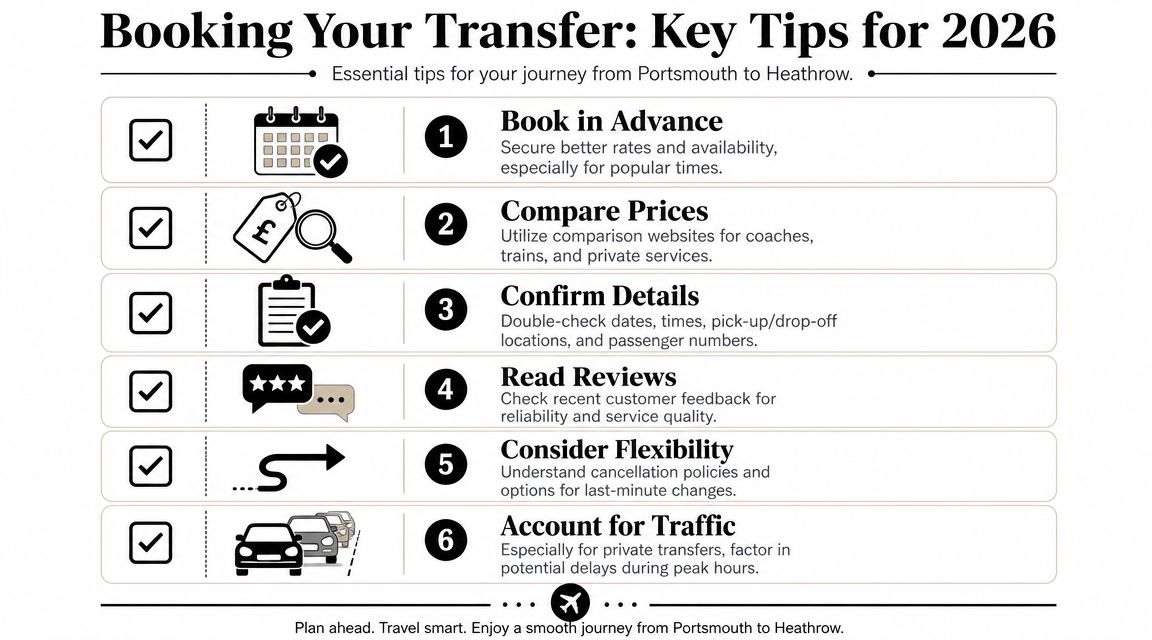
The booking checklist I'd use
- Book for the day you expect to have, not the day you hope to have: If you'll be tired, loaded with bags, or under time pressure, choose the option with fewer steps.
- Check exact pickup and drop-off points: A coach to Heathrow is useful. A coach that still leaves you with awkward terminal handling may be less useful than it first appears.
- Look at changes, not just duration: A shorter trip with station changes can feel longer and more fragile than a direct one.
- Be honest about your luggage: People consistently under-estimate how much luggage changes the day.
- Read the flexibility terms: Delays happen. You want to know what can be adjusted and what can't.
My decision framework
If your priority is saving money, book the coach and build in extra margin.
If your priority is speed on paper, rail may look attractive, but only choose it if you're comfortable managing the full journey yourself.
If your priority is arrival certainty, book a private transfer and be done with it.
What international travellers often overlook
The biggest oversight isn't travel time. It's energy.
By the time you reach Heathrow, you still have airline procedures ahead of you. That's why I think total journey risk is the right lens. A transfer should leave you capable of handling the airport calmly, not feeling as though the day has already gone wrong.
Booking rule: Buy the transfer that leaves you with the most margin for error, especially if your onward journey is long-haul.
FAQs for Portsmouth to Heathrow Travellers
These are the questions people usually ask when they stop comparing fares and start thinking properly about the journey.
FAQ table
| Question | Answer |
|---|---|
| Is there a direct train from Portsmouth to Heathrow? | No. Rail journeys require changes, so train is rarely the simplest choice for travellers with significant luggage. |
| Is the coach easier than the train? | Usually, yes. It's a single-leg public transport option, which makes it easier to manage than a rail journey with changes. |
| Which option is best if I have large suitcases? | Private transfer is usually the cleanest choice. If you're using public transport, coach is generally simpler than train for luggage-heavy trips. |
| Should I take the train if it looks faster? | Only if you're comfortable with interchanges and station navigation. Paper speed and real-world ease are not the same thing. |
| What's the safest option for a cruise passenger going to Heathrow? | A private transfer is usually the safest operational choice because it avoids changes and reduces luggage handling. |
| Is Portsmouth to Heathrow a common route? | Yes. Portsmouth is a major transport gateway serving a substantial coastal population, so this is a well-used airport connection. |
| When does a coach make sense? | When you're travelling light, want to keep costs down, and have enough schedule flexibility to absorb a longer or variable trip. |
| When should I avoid public transport? | Avoid it if you have several bags, children, mobility concerns, or a flight that leaves little room for delay. |
Final advice
If you're still torn, strip the decision down to one question. What level of disruption can you comfortably absorb?
If the answer is “not much”, don't overcomplicate Portsmouth to Heathrow. Book the most direct option you can manage and protect the rest of your trip.
If you want a straightforward door-to-door option, EC Minibus provides private transfers between Portsmouth, Heathrow, London hotels, and major cruise ports, with fixed pricing, luggage assistance, and flight or cruise monitoring built into the booking.