

The Rhodes to Symi ferry is a short hop, usually around an hour on the faster vessels, and tickets start from €5.50. If you're in Rhodes wondering whether Symi is realistic as a day trip or a smooth overnight stop, the answer is yes. It's one of the simplest island crossings in this part of Greece when you plan it properly.
Many travelers don't get stuck on the sea crossing itself. They get stuck on the small decisions around it. Which operator should you choose. Which port in Rhodes does your boat leave from. If you're arriving from a cruise, can you trust a same-day return. And if you're a UK, US, or Canadian traveller, do you need your passport for what looks like a domestic Greek ferry.
That last point causes more confusion than it should. International travellers often assume an island-to-island Greek ferry works like a local shuttle. It doesn't always feel that simple in practice. If you're piecing together a wider holiday that starts with flights, hotels, or even UK cruise connections such as those covered in these UK cruise port transfer planning tips, the best approach is to treat Rhodes to Symi as a proper transport segment and organise it with the same care.
Table of Contents
- Your Dream Trip from Rhodes to Symi Starts Here
- Choosing Your Ferry Operator and Vessel
- Booking Your Tickets The Smart Way
- Navigating Departure and Arrival Logistics
- Essential Tips for International Travellers
- Frequently Asked Questions About the Journey
Your Dream Trip from Rhodes to Symi Starts Here
You dock in Rhodes on a cruise morning, glance at the map, and Symi looks like an easy add-on. Then the practical questions start. Which port do you leave from, how much buffer do you need, and if you hold a UK, US, or Canadian passport, do you need to treat this like a domestic hop or carry documents as if you are changing countries?
That uncertainty is what trips people up. The crossing itself is straightforward. The planning around it is where time gets lost.
For international travellers, especially cruise passengers with one fixed window in Rhodes, the job is to remove avoidable friction before the day starts. That means checking your return options before you book your outbound seat, confirming the exact departure point in Rhodes, and carrying the passport you used to enter Greece even though Symi is part of the same country. Ferry staff may only do a quick check, but "it should be fine" is not a plan I would trust with a ship departure hanging over the day.
The trip is simple if you make the right choices
The main mistake is assuming every sailing serves the same kind of traveller. Some crossings suit a tight day trip. Others make more sense if you are staying overnight, travelling with luggage, or building in more margin because your cruise line will not wait for late returns.
Use these four decisions to shape the day properly:
- Match the sailing to your timetable: A short crossing matters more if you have limited shore time.
- Treat the return as part of the first booking: An outbound ticket without a workable return is how people create stress for themselves.
- Confirm the port setup in Rhodes: "Rhodes port" is too vague if you are arriving by taxi or transfer and working against the clock.
- Carry proper ID and booking records: Non-EU travellers should keep passport, ferry confirmation, and cruise timings easy to show.
This matters even more for passengers who are already used to tight port logistics in other itineraries. If you have sailed from British ports before, the timing discipline is similar to what travellers deal with at UK cruise departure ports. The difference in Rhodes is that island ferries can feel informal right up until they are not, so it pays to have everything settled early.
Why this route works well for cruise and independent travellers
Rhodes to Symi works because it can be either a focused day trip or a low-effort overnight. You can leave in the morning, spend a few good hours around Gialos, and get back to Rhodes without turning the whole day into a transport exercise. If your schedule is looser, staying one night gives you the island at a better pace once the busiest daytime visitors thin out.
The trade-off is simple. Flexibility feels good until you are the one trying to solve a missed return, a passport query, or a taxi drop-off at the wrong part of the harbour.
Planned properly, this is one of the easiest island add-ons from Rhodes. Planned casually, it becomes harder than it needs to be.
Choosing Your Ferry Operator and Vessel
A rushed choice here is how a simple island hop turns awkward. International travellers, especially cruise passengers arriving on a fixed timetable, usually need the operator that gives them the cleanest day plan, not the cheapest fare on the screen.
On this route, the practical choice is usually between a faster passenger service and a slower conventional ferry. The crossing itself is short either way, but the difference matters once you add port check-in, transfer timing in Rhodes, and the return window back from Symi. For UK, US, and Canadian travellers, that margin matters even more if you are already fielding passport questions from cruise staff, port agents, or ferry crews and want a straightforward boarding process.
What the route looks like in practice
Fast vessels are the better fit for day trips. They give you more usable time in Symi and more protection if the rest of your day is fixed around a cruise all-aboard time, a pre-booked transfer, or a flight connection later in the trip.
Standard ferries suit travellers staying overnight or anyone who is not trying to squeeze Symi into a narrow window. They can be perfectly reasonable, but the lower fare only helps if the sailing times line up properly on both legs.
That is the point many visitors miss.
A low fare can still be the wrong booking if it creates a weak return option, drops you into the wrong part of the day, or leaves too little room for check-in and boarding. For non-EU passengers, I also advise choosing the operator and sailing that feel easiest to document. If one booking shows clear passenger details, straightforward departure info, and an obvious return plan, it is usually the safer option than shaving off a few euros.
Rhodes to Symi Ferry Operator Comparison 2026
| Operator | Vessel Type | Typical Fit | Best For |
|---|---|---|---|
| ANEK SUPERFAST | Fast ferry | Quicker passenger crossing | Travellers who want a relatively quick trip with a recognised operator |
| BLUE STAR FERRIES | Standard ferry | Conventional ferry service | Passengers who prefer a steadier, less time-sensitive crossing |
| DODEKANISOS SEAWAYS | Fast catamaran / high-speed service | Usually the strongest fit for short stays | Day trips, cruise calls, and tighter schedules |
| SAOS FERRIES | Standard ferry | Slower-paced option | Overnight stays and travellers with more flexibility |
Treat that table as a shortlist, not a final answer. Operators, vessel types, and timings can vary by date and season, and the best choice is the one that protects your full itinerary.
What usually works best
For a same-day return, I usually steer international visitors toward the faster services. The extra time on Symi is useful, but the main benefit is reducing pressure. If your ship leaves Rhodes that evening or the next morning, or you are working around a paid transfer, the safer plan is to keep the sea crossing efficient and the day easy to manage.
For an overnight stay, speed matters less. Departure time, baggage handling, and arrival convenience matter more. A slower ferry can work well if it gets you in at a sensible hour and removes the stress of forcing everything into one day.
Vehicle options only matter for a small slice of travellers on this route. Most cruise passengers and short-stay visitors should ignore them and keep the booking simple.
One more point for non-EU travellers. Ferry staff do not usually create problems where none exist, but they may ask for identification details to match the booking, and cruise passengers sometimes assume a ferry ticket works like an informal excursion boat pass. It does not. Choose the operator and vessel with the same mindset you would use for any timed international connection. Clear booking, clear ID details, clear return plan. That approach saves far more trouble than fare hunting ever does.
Booking Your Tickets The Smart Way
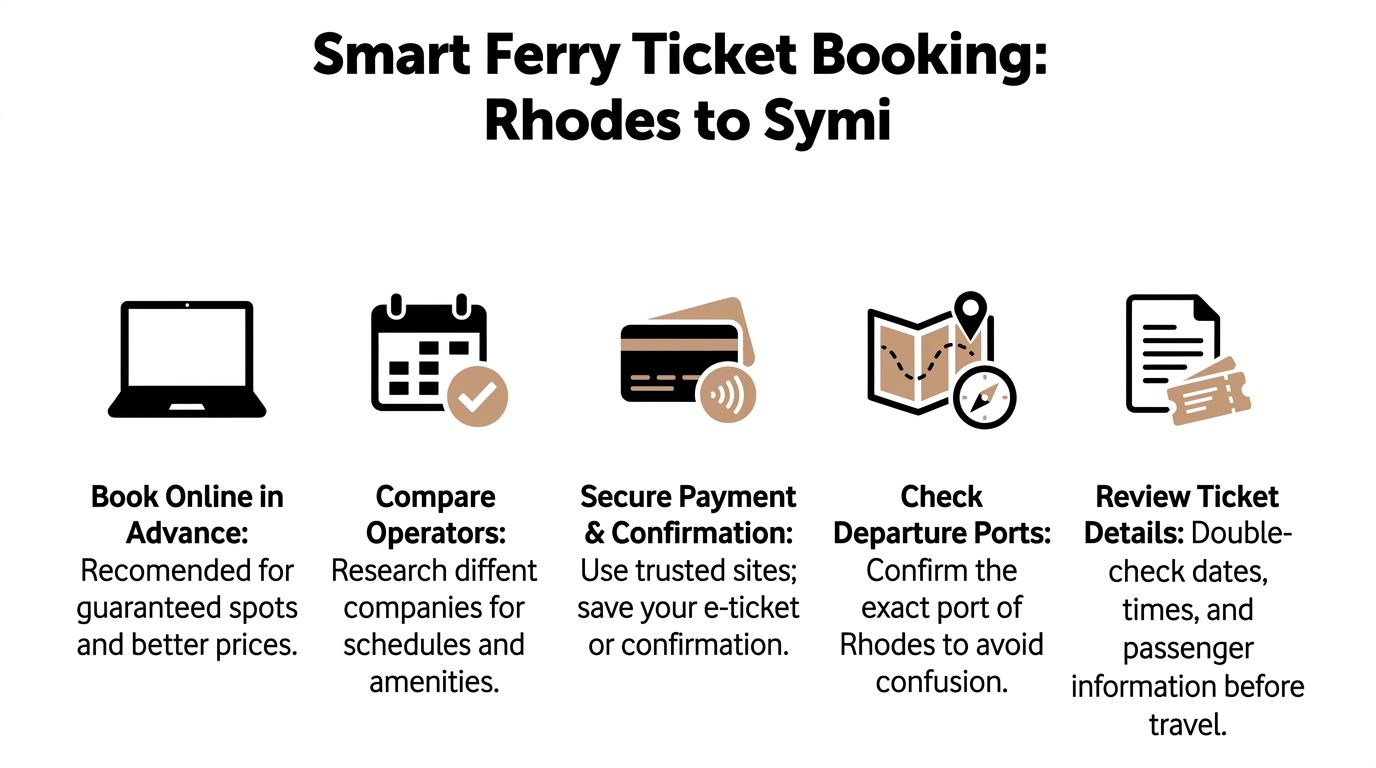
The booking stage is where a manageable trip either stays manageable or starts to wobble. Travellers often focus on the outbound sailing because it's the exciting part. The return is where the risk lives.
According to Ferryhopper's Rhodes to Symi route guidance, return availability drops from 54 weekly crossings in summer to 16 in winter, and failing to check return schedules immediately after booking an outbound trip creates a 70% higher risk of misalignment. The same guidance recommends a 45-minute buffer at Akandia port for a smoother departure day.
Book the return before you commit
This is the single most useful habit on the route. Don't book Rhodes to Symi as if you're buying a one-way scenic transfer. Book it as a round-trip transport problem.
A sensible booking sequence looks like this:
- Check the return first. If the return doesn't work, the outbound is irrelevant.
- Compare sailing times, not just operators. The operator name matters less than how the schedule fits your day.
- Decide whether you want a day trip or overnight before you pay. Don't try to force the decision afterwards.
- Save your confirmation in more than one place. Keep it on your phone and in your email.
- Verify the departure port listed on the ticket. This avoids one of the most common travel-day mistakes.
Buying at the port can work in quieter periods, but it's reactive. Online booking gives you control, especially when your Greece trip is only one part of a larger international itinerary.
Day trip or overnight
A day trip works well when your sailing times give you enough breathing room on the island. An overnight stay works better if you want a relaxed dinner, an early walk before the harbour gets busy, or a cushion against same-day schedule pressure.
Here's the practical difference:
- Choose a day trip if: you have a good fast sailing, a reliable return, and you're happy keeping the island visit focused.
- Choose overnight if: your return options are awkward, your arrival is later than expected, or you don't want your whole visit ruled by the clock.
- Avoid forcing a day trip when: the last return leaves too early for comfort or your wider schedule already feels tight.
If you need everything to run cleanly, don't build your itinerary on the assumption that “something will probably be available later”.
One more point matters for cruise passengers and international flyers. If your onward movement depends on a fixed check-in, transfer, or ship boarding time, leave slack in the plan. Ferry travel is enjoyable when it's not carrying the entire weight of your schedule.
Navigating Departure and Arrival Logistics
The travel day usually goes smoothly when you remove ambiguity before breakfast. Most of the stress comes from uncertainty, not complexity. If you know where to go, what to carry, and what the port flow feels like, the Rhodes to Symi crossing becomes routine.
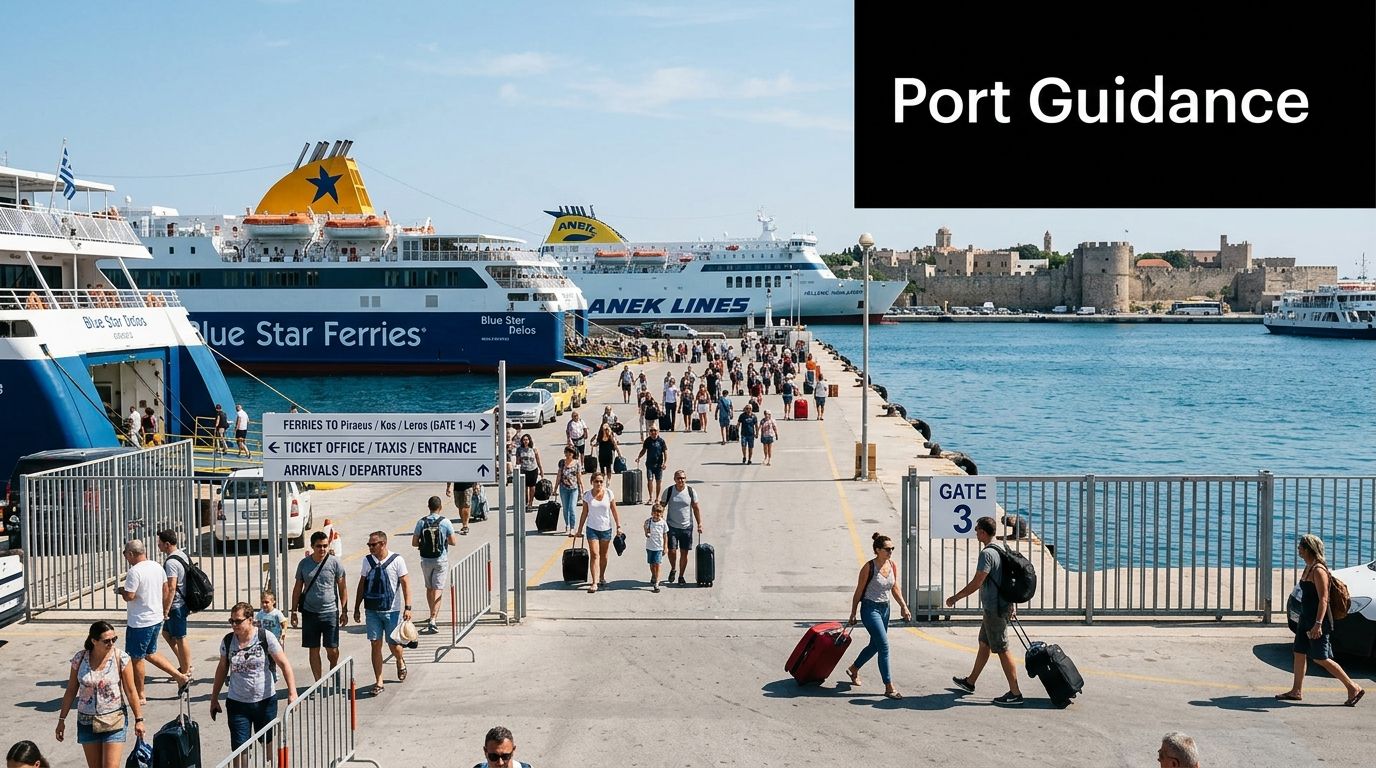
Getting to the right port in Rhodes
Travellers often say “the Rhodes port” as if there's no room for confusion. In reality, the useful question is this: what exact departure point is printed on your ticket, and how early can you get there without rushing?
If you're arriving in London before a cruise or using private ground transport elsewhere in your trip, you already know the value of clear pickup points and timed connections. The same mindset helps here, and the same discipline that makes services like Southampton cruise transfers work well also applies to a Greek ferry day. Confirm location first. Then move.
A practical departure routine looks like this:
- Read the ticket carefully: Don't rely on memory from a blog, hotel desk, or casual conversation.
- Aim to arrive with margin: Port areas feel slower when queues form.
- Keep documents easy to reach: Don't bury them in a large suitcase.
- Travel with manageable luggage: You'll appreciate that on the gangway and again in Symi.
What boarding usually feels like
Boarding is usually straightforward. Staff check tickets, passengers move through in waves, and seating fills quickly on busy departures. If you care about where you sit, don't linger too long on the quay taking photos.
For luggage, the practical rule is simple. Bring what you can move confidently without help. Even when assistance is available, you don't want to depend on it while also managing tickets, phones, and documents.
Keep your passport, phone, wallet, and ferry confirmation on your person. Don't stash them in the case you plan to leave by the luggage area.
If you're prone to overpacking for short island hops, this route is a good place to stop. One compact case or backpack is easier at every stage.
A useful visual of the journey helps if it's your first time on the route:
What arrival in Symi actually feels like
Arrival into Gialos is part of the appeal. The harbour is the centre of first impressions and, practically speaking, the point from which most visitors orient themselves. Once you step off, the immediate question is what kind of visit you're having.
If you're on a day trip, keep your first hour efficient. Know whether you're staying in the harbour, heading uphill, or moving on to another part of the island. If you're overnighting, slow down and get your bags settled before trying to “do” Symi properly.
On arrival, most travellers choose one of three next moves:
- Stay in Gialos: Best for a short visit, easy wandering, harbour cafés, and keeping logistics simple.
- Move onward by local transport or taxi: Better if you've booked accommodation away from the immediate harbour.
- Walk with purpose: Fine if you packed light and know where you're heading.
The island rewards spontaneity once you're there. The transport side doesn't.
Essential Tips for International Travellers
For UK, US, and Canadian travellers, the most important Rhodes to Symi advice isn't about views, food, or even which operator to choose. It's documentation. That's the point most likely to catch out international passengers who assume a domestic Greek ferry doesn't require the same discipline as a flight day.
According to Omio's Rhodes to Symi ferry guidance, a valid passport is mandatory for UK, US, and other non-Schengen travellers on intra-Greek ferries, because Greece enforces Schengen border controls for non-EU nationals. That point is easy to miss in broad travel advice and often isn't spelled out clearly enough for people making quick island plans.
Passport confusion needs a clear answer
If you are not an EU or Schengen traveller, bring your passport. Not a photo of it. Not a hotel copy. The actual passport.
This matters especially for post-Brexit UK travellers, but the practical lesson is wider than that. If you're entering Greece as a non-Schengen national, carry the document that proves your legal travel status whenever you're boarding transport where checks may be required.
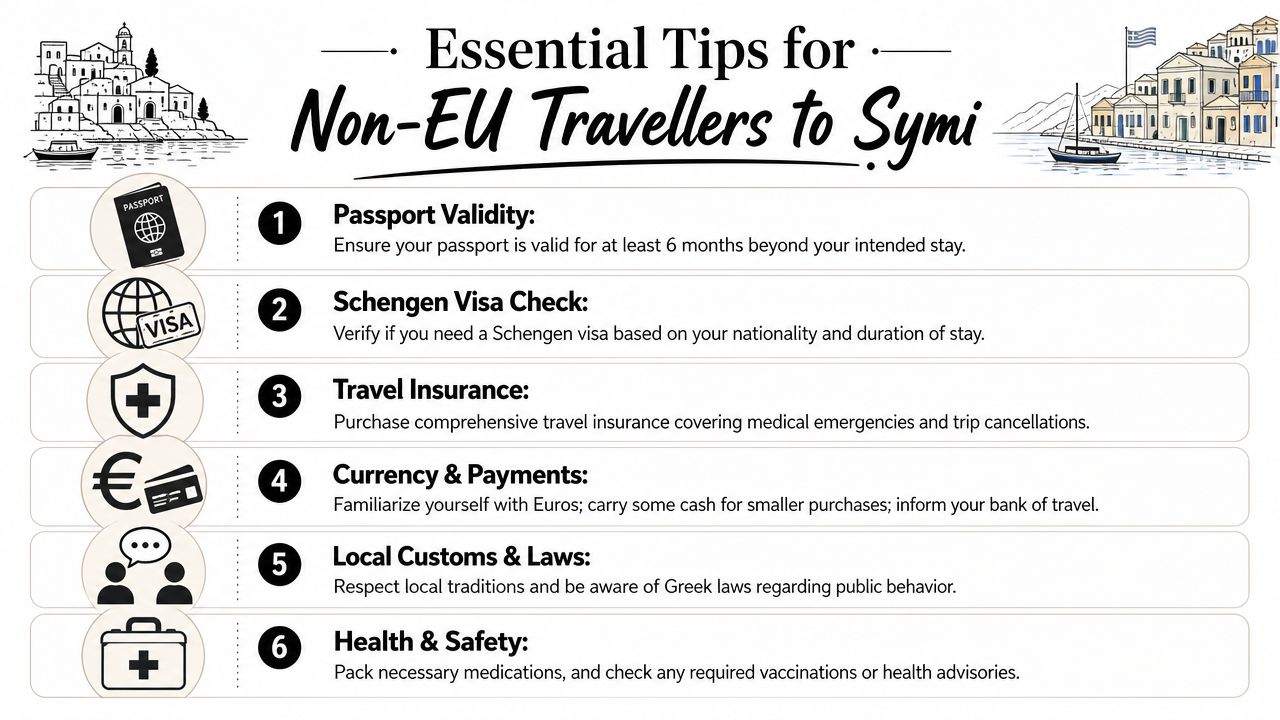
A few habits make the day easier:
- Carry the passport in a secure, accessible place: You may need it quickly at the port.
- Keep your ferry confirmation with it: Digital is fine, but don't depend on patchy battery life.
- Use the same name across all bookings: Small name mismatches create unnecessary friction.
- Don't assume a domestic route means domestic rules: For non-Schengen travellers, that assumption is where trouble starts.
For broader pre-trip habits that help cruise and ferry travellers alike, these tips for first-time cruisers are useful because they reinforce the same discipline around documents, timing, and carrying what you need.
What to carry and what to keep simple
Non-EU travellers often overcomplicate island travel by packing as if every stop is remote. Symi doesn't require that. What it does reward is portable, sensible packing.
Bring items that solve real travel-day problems:
- Comfortable shoes: Harbour strolling is easy. Steps and uneven routes are less forgiving.
- Sun protection: Even short exposure adds up when you're moving between port, cafés, and viewpoints.
- Some cash in euros: Handy for smaller purchases and low-friction spending.
- A compact bag: Better than dragging oversized luggage through a busy harbour.
- Swimwear only if you'll use it: Don't carry beach gear all day out of vague optimism.
Travel light enough that you can change plans without resenting your own luggage.
Mobile service, cards, and day-trip basics are usually manageable, but international travellers should still plan for self-sufficiency. Charge your phone before departure, screenshot anything important, and keep your ferry confirmation available offline.
The best version of this trip feels almost effortless. That only happens because the preparation is tight.
Frequently Asked Questions About the Journey
A few questions come up repeatedly because they affect real-world plans, not just curiosity. These are the ones worth settling before you travel.
What if the ferry is cancelled
Weather and operational changes can affect island ferry services. When that happens, the right move is practical, not dramatic.
First, check the operator's communication channels and your booking confirmation. Then contact the booking platform or ferry company directly for rebooking or refund options. If you built the day with no margin at all, a cancellation becomes painful. If you built in flexibility, it's an inconvenience.
For international travellers, this is why same-day connections should be handled carefully. Don't place a ferry return too close to an airport check-in, cruise embarkation, or any transfer you cannot miss.
Can you take large luggage
Yes, but the better question is whether you should. On ferries, large suitcases are possible. They're just less pleasant than travellers expect.
If you're staying overnight and need a proper case, keep it sturdy and easy to move. If you're visiting Symi as a day trip, large luggage is usually a sign that the day has been planned inefficiently. A small roller or backpack is far easier on the gangway, on the quay, and during arrival.
A simple rule works well here:
- Day trip: Use one compact bag.
- Overnight: One manageable suitcase plus a small day bag is enough.
- Avoid: Multiple loose bags, oversized hard cases, and anything you can't carry up a short incline or along a busy harbour edge.
Is Symi workable for travellers with limited mobility
It can be, but only with realistic expectations. The harbour area is the easiest part to enjoy. Once the itinerary involves steep streets, steps, or moving beyond the immediate waterfront, the island becomes more demanding.
The key is to match the plan to your mobility needs. If walking on uneven surfaces or climbing is difficult, focus on Gialos and avoid building a schedule that depends on reaching upper areas on foot. Choose accommodation and transport decisions that reduce transitions, not increase them.
Three practical questions help:
- Can you board via a gangway without stress or assistance uncertainty?
- Are you booking accommodation close to where you'll arrive?
- Does your day still work if you limit yourself to the harbour and nearby waterfront?
If the answer to the third question is yes, Symi can still be a worthwhile visit. If your idea of “doing Symi properly” depends on a lot of vertical movement, the island may feel harder than expected.
The Rhodes to Symi route is easy when your plan matches your reality. Most transport mistakes happen when travellers build for an ideal day instead of the day they're equipped to manage.
If your wider journey includes Heathrow, a London hotel, or a UK cruise port, EC Minibus is worth considering for the ground transport side. They specialise in door-to-door transfers for international travellers who want fixed pricing, luggage help, and a straightforward connection between airport, hotel, rail hub, and cruise terminal without adding another layer of travel stress.