

From Land Ahoy to All Aboard: Your First Cruise Starts Here
Planning your first cruise is exciting right up until the practical questions start piling up. How early should you get to the port? What counts as hand luggage on embarkation day? Which extras are worth paying for, and which ones inflate the bill with hidden costs? For many first-timers, the biggest stress point isn't the ship at all. It's getting from the airport or hotel to the terminal on time, with luggage, passports, and no margin for confusion.
That matters even more on UK sailings. If you're flying into Heathrow and joining a ship in Southampton, Dover, Portsmouth, or Tilbury, your holiday depends on a chain of logistics working properly. Generic cruise advice often talks about packing cubes and formal nights. Useful, yes. But it often skips the part that can derail the whole trip before you've even stepped on board.
This guide keeps things practical. These tips for first time cruisers focus on what causes problems, what's worth booking early, and what usually works better in real life than it does in theory. The aim is simple. Reduce avoidable stress, protect your budget, and help you board feeling organised instead of frazzled.
Table of Contents
- 1. Coordinate Ground Transportation
- 2. Pack Smart
- 3. Arrive at Cruise Ports Early
- 4. Understand Cruise Pricing
- 5. Know Dress Codes and Dining Expectations
- 6. Plan and Pre-Book Shore Excursions Strategically
- 7. Master Ship Navigation
- 8. Engage with Ship Community
- 8 Essential Cruise Tips Compared
- Set Sail with Confidence
1. Coordinate Ground Transportation
If you're arriving through Heathrow or central London, airport-to-port planning isn't a side task. It's one of the most important tips for first time cruisers because a missed transfer can mean a missed sailing.
The practical risk is simple. AARP advises travellers to arrive in the departure city a day or more before the cruise, and notes that passengers are usually required back on board 30 minutes before departure. Once that window closes, the ship won't wait. That rule hits differently when you're dealing with luggage, flight delays, motorway traffic, and a terminal you've never used before.

Why transfer planning matters more than most first-timers expect
For UK sailings, I'd treat the journey from airport to ship like a protected connection, not like a casual taxi ride. If you land at Heathrow on cruise day, every handoff matters. Meet point, luggage loading, traffic awareness, and direct routing all affect whether you arrive calm or already behind.
A specialist provider such as EC Minibus fits this kind of trip because the service is built around cruise connections rather than short urban hops. Their door-to-door airport transfer service focuses on meet and greet, direct routing, luggage help, and pre-booked collection, which is what most first-time cruisers need.
Practical rule: If you're flying in on the same day, don't leave your port transfer to chance. Pre-book it, confirm the pickup details, and keep cruise documents and medication in your carry-on.
One verified UK market claim points the same way. A BCTA study cited by Blue Bay Travel's first-time cruiser advice says 78% of first-time cruise passengers in the UK book ground transfers through specialised travel agents rather than direct cruise-line add-ons.
That doesn't mean private transfer is the only valid option. Rail can work if you're travelling light, staying overnight, and comfortable managing changes. Shared shuttles can save money, but they give you less control over timing and luggage handling. For first-timers, direct door-to-door transport usually removes the most stress.
2. Pack Smart
First-time cruisers usually make one of two mistakes. They either pack as if they're moving house, or they pack too lightly and end up buying basics on board at inflated prices.
Cruise cabins look generous in photos and compact in real life. Storage is workable, not endless. That means every item should earn its place, especially if you're moving from Heathrow to a UK port with suitcases that still have to be loaded, unloaded, tagged, and manoeuvred through the terminal.
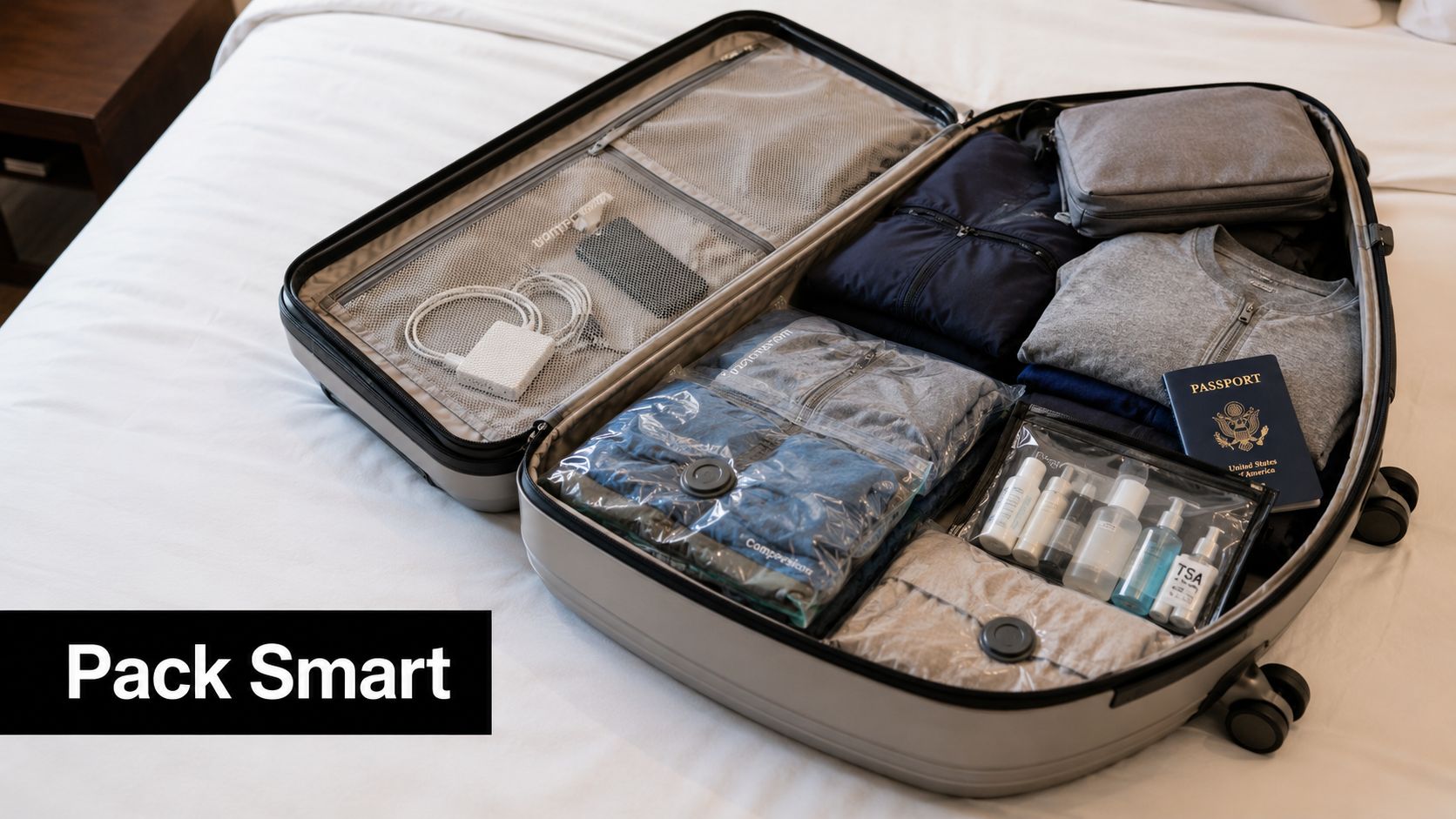
What belongs in your carry-on and what doesn't
The smartest packing choice isn't your biggest suitcase. It's your embarkation-day bag. Keep the items you cannot afford to lose or wait for with you until you're in the cabin.
- Passport and travel documents: Keep them in one easy-access pouch, not split between handbags and outer pockets.
- Medication and medical essentials: Never put these in checked luggage.
- One change of clothes or key items: If your bags arrive later than expected, you can still settle in comfortably.
- Chargers, glasses, and valuables: Treat the carry-on like your personal survival kit for the first day.
- Swimwear or casual deck clothes: Useful if you want to enjoy the ship before your case arrives.
A common planning mistake is packing for every possible scenario. That sounds sensible, but it creates clutter fast. If your cruise includes laundry facilities, or you're happy to rewear daytime basics, you don't need separate outfits for every daylight hour.
What doesn't work well is overloading formalwear, extra shoes, and bulky toiletries. Those are the items that eat cabin space first. If you're also using a private transfer or porter service, lighter luggage speeds up every stage of the journey and reduces the chance of leaving something behind in the vehicle or terminal.
Pack for movement first, photos second. A suitcase that closes easily beats a perfect outfit plan that leaves no room for the return trip.
3. Arrive at Cruise Ports Early
Embarkation day rewards people who are slightly early and punishes people who cut it fine. That's true on every cruise, but especially on UK departures where passengers may be arriving from Heathrow, London hotels, or train stations with different baggage loads and timing pressures.
The wider cruise market supports that learning curve. Industry figures reported by Emergency Assistance Plus cruise statistics say the number of first-time cruisers has grown by 12%, and 75% of previous millennial cruisers said they would book again. To me, that says the basics matter. New cruisers often need one voyage to learn the rhythm, then they become repeat customers once they understand how structured the day is.
Build your day around the ship, not your ideal schedule
Arriving early doesn't mean showing up at the terminal at sunrise. It means building in enough margin for check-in, screening, luggage drop, and the small delays that happen when lots of people travel at once.
If you're sailing from Southampton, it helps to know the local layout before travel day. EC Minibus has a useful Southampton Cruise Port guide that gives first-timers a clearer sense of what the transfer and arrival process involves.
A practical approach for first-time cruisers looks like this:
- Stay overnight when possible: This is the safest option if you're flying long-haul or arriving through a busy airport.
- Aim to be settled in the port area well before final boarding: You want time for mistakes, not just enough time for perfection.
- Assume queues, not instant processing: Even well-run terminals have peaks.
- Keep your essentials with you until the cabin is ready: You may board before your checked bags catch up.
The right mindset for embarkation is airport connection, not hotel check-in.
What doesn't work is planning your arrival around best-case traffic, a perfectly on-time flight, and immediate boarding. First cruises feel smoother when you give yourself room to absorb a problem without turning it into a crisis.
4. Understand Cruise Pricing
Cruises are good value when you know what the fare covers. They feel expensive when you mistake the advertised fare for the final holiday cost.
Your cabin, main meals, and a lot of onboard entertainment are usually included. That's the strong part of cruise pricing. The weak part is that first-timers often underestimate how quickly optional spending adds up once the key card becomes your wallet.
Budget for the extras you actually care about
The practical fix is to decide in advance what kind of spender you are. If you love speciality dining, budget for that and skip the photo package. If you care more about shore days than cocktails, put the money there instead.
Typical extra-cost areas include:
- Drinks beyond the basic included options: Alcohol, premium coffees, bottled water, and soft drinks may be charged separately.
- Speciality restaurants: These can be worth it, but they're not necessary every night.
- Shore excursions: Often the biggest optional spend after the fare itself.
- Gratuities and service charges: Check your cruise line's policy before departure.
- Spa treatments, Wi-Fi, and retail shopping: Easy to buy, easy to overspend on.
What works is setting a daily or trip-wide budget before you board. What rarely works is saying you'll “just keep an eye on it”. The ship makes spending frictionless on purpose. If multiple family members can charge purchases to the cabin, decide the rules in advance.
I'd also separate fixed pre-trip costs from onboard discretionary costs. Transfers, hotels, insurance, and any pre-booked tours belong in one bucket. Drinks, dining upgrades, and impulse spending belong in another. When you split them mentally, the holiday becomes easier to control.
5. Know Dress Codes and Dining Expectations
A lot of first-time cruisers worry too much about getting dressed up and not enough about where they'll be eating. The result is luggage full of “just in case” outfits and not enough practical evening wear they'll use.
Most ships offer a mix of casual daytime dining, smart casual evenings, and some dressier nights. The exact standard varies by cruise line, ship, and restaurant. You don't need a wardrobe built for every social possibility. You need one that matches your dining habits.
Pack for the dining room you will use, not the one in the brochure
If you'll mostly eat in the main dining room and one speciality venue, pack for that. If you prefer buffet dinners and casual lounges, don't devote half a case to formalwear you'll resent carrying.
A simple evening plan usually works best:
- Smart casual core outfits: Trousers, shirts, blouses, dresses, and shoes you can repeat without fuss.
- One dressier option: Enough for formal or elegant evenings without overcommitting.
- Comfortable daytime clothing: You'll spend more time in these than in anything glamorous.
- A light layer: Ships can feel cool indoors even when the weather is warm outside.
What doesn't work is relying on clothes that wrinkle badly, need dry cleaning, or only match one pair of shoes. Cruise cabins aren't built for elaborate outfit management, and first-time cruisers often forget they're also dressing around airport transfers, port days, and limited storage.
The right dress code mindset is confidence, not costume. If your clothes are neat, appropriate to the venue, and comfortable enough for a full evening, you're doing it right.
6. Plan and Pre-Book Shore Excursions Strategically
Shore excursions can make a cruise memorable or make it feel rushed and overpriced. The difference usually comes down to booking strategy, not the destination itself.
For first-timers, the key question isn't “Should I book excursions?” It's “Which days need structure, and which days are better left flexible?” Ports vary. Some are easy to explore independently. Others involve long drives, complex transport, or tight timing back to the ship.
Choose between convenience and flexibility
Cruise-line excursions usually cost more, but they remove a lot of uncertainty. You get a clearer meeting process, and the logistics are tied more closely to the ship's schedule. Independent tours can offer better value and a more personal feel, but you need to vet them properly and leave extra margin for delays.
A helpful way to choose:
- Use ship excursions for high-risk ports: Long transfer times, unfamiliar language, or complicated return routes.
- Go independent for simple ports: Walkable towns or straightforward short tours.
- Pre-book must-do experiences: Popular tours can fill before sailing.
- Leave breathing room: Not every port needs a full-day commitment.
There's also a useful mindset link between shore planning and your embarkation planning. Both reward buffer time. If you're curious about a port logistics example, EC Minibus has a Livorno cruise port guide that shows how ground movement around a cruise stop can shape the day.
If being late back to the ship would ruin the holiday for you, choose the excursion style that gives you the most control or the most protection. Don't choose based on price alone.
What fails most often is overbooking. New cruisers sometimes try to maximise every port and end up exhausted by day three. One slower day can improve the whole voyage.
7. Master Ship Navigation
Large ships can feel confusing for the first day or two. That's normal. The mistake is assuming you'll just “figure it out” later, then wasting half the trip circling the same stairwell and arriving late to things you meant to enjoy.
There's a practical reason this matters beyond convenience. Princess notes that many first-time cruiser resources focus heavily on packing and onboard etiquette, but often give too little attention to trip-critical logistics, especially UK port transfer planning and the realities of moving through concentrated cruise hubs such as Southampton and London-area ports, as outlined in Princess guidance for new-to-cruising travellers. The same blind spot happens on board. People prepare for the concept of a cruise, not the mechanics of using the ship efficiently.

Learn your personal route map on day one
You don't need to memorise every deck. You need to know your route between the places you'll use.
Start with these:
- Cabin to muster station
- Cabin to main dining and buffet
- Cabin to theatre or evening venue
- Cabin to guest services and medical centre
- Nearest lifts and the least-crowded staircase
What works best is doing a calm walkaround early, before evening crowds build. Use the printed deck plan or the cruise line app, but also pay attention to landmarks. Which lift bank is closest to your cabin? Which deck runs straight through and which ones force you to detour around restaurants or theatres?
Learn one reliable route to each important place. After that, the rest of the ship becomes much easier.
Interior corridors often look nearly identical, so don't feel silly checking signs often. Experienced cruisers do it too. Good navigation reduces stress, helps you avoid crowd bottlenecks, and makes the ship feel smaller by the second day.
8. Engage with Ship Community
One of the best surprises on a first cruise is how social or unsocial it can be, depending on what you want. You can have dinner conversations every night, join quizzes and tastings, and stay busy from breakfast to bedtime. Or you can carve out long quiet stretches and still feel you've had a full holiday.
That flexibility matters because first-time cruisers often worry about the wrong thing. Extroverts worry they'll get bored. Introverts worry they'll be trapped in forced fun. In practice, both can tailor the experience.
Use the ship for both connection and breathing room
A useful pattern is to choose one or two recurring social anchors, then protect your quiet time around them. That might be shared dinner, a morning coffee venue, or one evening show every few nights. You don't need to say yes to everything to feel involved.
Options that usually work well:
- Open or shared dining: Good for meeting people without committing your whole day.
- Light organised activities: Trivia, talks, tastings, or low-pressure classes.
- Quiet public spaces: Libraries, observation lounges, and less busy deck areas.
- Solo reset time: Cabin time, balcony time, or walking the ship early in the day.
The trick is not to confuse availability with obligation. Cruises are full of programmes because choice is part of the product. That doesn't mean every activity deserves your time. If a show sounds average, skip it. If your tablemates are lovely, linger over dinner. If you need a quiet afternoon after a busy port day, take it without guilt.
First-time cruisers who enjoy themselves most usually do one thing well. They stop trying to have every version of the cruise and start having their version of it.
8 Essential Cruise Tips Compared
| Item | Implementation complexity 🔄 | Resource requirements ⚡ | Expected outcomes ⭐ / 📊 | Ideal use cases 📊 | Key advantages ⭐ | Tips 💡 |
|---|---|---|---|---|---|---|
| Coordinate Ground Transportation: Integrate Airport Transfers with Cruise Port Arrival | 🔄 Medium, requires advance booking and flight coordination | ⚡ Moderate–High: prepaid transfer fee, reliable provider, luggage handling | ⭐⭐⭐⭐, Punctual arrivals and reduced travel anxiety 📊 | International travellers, families, seniors, heavy-luggage groups | Door-to-door service, flight monitoring, fixed transparent pricing | Book when finalising cruise; provide accurate flight details |
| Pack Smart: Understand Luggage Allowances and Packing Strategies | 🔄 Low, mainly planning and sorting | ⚡ Low: compression bags, carry-on management, time to review policies | ⭐⭐⭐, Avoid fees and streamline embarkation 📊 | All first-time cruisers, particularly organised/mature travellers | Prevents unexpected fees, easier handling, more cabin comfort | Pack essentials in carry-on; use compression bags; check line policy |
| Arrive at Cruise Ports Early to Navigate Embarkation Smoothly | 🔄 Low, scheduling transfers and timing | ⚡ Low–Moderate: extra time buffer, potential earlier transport costs | ⭐⭐⭐⭐, Less stress, on-time boarding and time to settle 📊 | All first-time cruisers, internationals, families | Time for document checks, orientation, explore ship before departure | Aim to arrive ~2.5–3 hours before ship departure |
| Understand Cruise Pricing: What's Included and Hidden Costs to Budget | 🔄 Medium, requires research and itemisation | ⚡ Moderate: time to compare, possible pre-purchases (packages) | ⭐⭐⭐⭐, Better budgeting; fewer financial surprises 📊 | Budget-conscious families, retirees, groups needing transparent costs | Enables prioritisation, potential savings via pre-purchase | Request an itemised breakdown; pre-buy packages if it saves money |
| Know Dress Codes and Dining Expectations to Feel Confident | 🔄 Low, review dress schedules and pack accordingly | ⚡ Low–Moderate: extra luggage space, possible dry-cleaning costs | ⭐⭐⭐, Increased social comfort and appropriate dining experiences 📊 | Travellers attending formal dining, mature cruisers | Prevents packing errors, reduces social anxiety, enhances dining | Pack versatile dressy pieces; request dress code schedule |
| Plan and Pre-Book Shore Excursions Strategically for Best Value | 🔄 Medium–High, research, vetting and timing required | ⚡ Moderate–High: excursion fees, booking time, vetting independent operators | ⭐⭐⭐⭐, Secured spots and potential cost savings 📊 | All cruisers, 45+, budget-conscious and experience-seekers | Balance between guaranteed cruise excursions and cheaper independents | Research ports 3–4 months ahead; compare cruise vs independent |
| Master Ship Navigation: Learn Deck Plans and Key Facilities Before Departure | 🔄 Low, study maps and app information | ⚡ Low: time to download app and review deck plans | ⭐⭐⭐, Faster navigation and better safety readiness 📊 | First-time cruisers, elderly, passengers with mobility concerns | Reduced disorientation, efficient routes, muster preparedness | Download the cruise app; photograph your cabin location and deck plan |
| Engage with Ship Community: Balance Socialising and Personal Time for Optimal Experience | 🔄 Low, choose participation level | ⚡ Low: time investment in activities and events | ⭐⭐⭐, Improved social satisfaction or preserved solitude as preferred 📊 | Extroverts, solo travellers, mature cruisers, introverts seeking balance | Structured activities, meaningful connections, flexible solitude options | Attend first-evening meet-and-greet; select a few activities to avoid overload |
Set Sail with Confidence
A first cruise feels much easier once you stop treating it like a mystery and start treating it like a sequence of manageable decisions. The biggest ones aren't glamorous. They're practical. How you'll get from Heathrow or London to the terminal. What you'll keep in your carry-on. How much margin you'll build into embarkation day. Which extras you'll spend money on, and which ones you can happily ignore.
That's why the best tips for first time cruisers usually have less to do with cruise jargon and more to do with timing, movement, and expectations. A ship runs on deadlines. Ports run on fixed return times. Cabins reward disciplined packing. Onboard spending becomes easier to control when you make a few choices before sailing instead of trying to decide everything in the moment.
If you're departing from Southampton, Dover, Portsmouth, or Tilbury, put transfer planning near the top of your list. It's often the piece first-timers underestimate most. Generic advice tells you to arrive early. Good advice also asks how you're arriving, what happens if your flight is late, and whether your luggage setup matches your transport choice. That's where the trip either starts smoothly or starts under pressure.
The same principle applies across the holiday. Pack for the cabin you'll really have, not the fantasy one. Dress for the dining you'll use. Book excursions with enough caution to protect your return time. Learn your own route around the ship instead of trying to master every deck at once. Give yourself enough social structure to enjoy the atmosphere, but not so much that the trip starts to feel scheduled to death.
Cruising has a learning curve, but it's a rewarding one. The first sailing teaches you how the pieces fit together. Once they do, the whole format makes far more sense. If you want one practical place to reduce stress from the outset, a specialist transfer provider such as EC Minibus can help with the airport-to-port section of the journey, especially if you're arriving via Heathrow and want a pre-booked connection to a UK cruise terminal.
A smooth first cruise rarely happens by accident. It happens because the traveller planned the boring bits well enough to enjoy the fun bits fully.
If you want a straightforward airport-to-port transfer option, EC Minibus offers pre-booked private connections between Heathrow, central London, and major UK cruise ports including Southampton and Dover. For first-time cruisers, that kind of door-to-door setup can remove one of the most stressful parts of embarkation day.