

You're probably doing this trip the sensible way. You've booked the cruise. You may have added a hotel night in London. Your flights are sorted. Then the awkward part appears. How do you get a small group of adults, with proper luggage, from Heathrow to a hotel, then to Southampton or Dover, and back again without turning the first day of the holiday into a transport exercise?
That's where most cruise plans wobble.
For North American travellers aged 45 and over, small group travel works brilliantly in the UK, but only if the ground plan is organised with the same care as the cruise itself. If you leave transfers to chance, the trip starts with queues, confusion, and unnecessary stress. If you structure it properly, the whole journey feels calm, joined-up, and easy.
Table of Contents
- What Is Small Group Travel and Why Is It Perfect for UK Trips
- Why Small Group Travel Is Ideal for Cruise Passengers
- Designing Your UK Pre-Cruise or Post-Cruise Itinerary
- The Critical Link Solving Your UK Ground Transfers
- How to Book a Private Minibus for Your Group
- Your Small Group Travel Questions Answered
What Is Small Group Travel and Why Is It Perfect for UK Trips
You land at Heathrow after an overnight flight. One person wants coffee. Someone else needs a loo. Two people are worried about the bags. Nobody wants to wrestle with train tickets after crossing the Atlantic. That's the moment where small group travel either feels smooth or starts to fray.
Small group travel isn't about packing yourself into a giant coach with strangers. It's a travel style built around your own people. Family, close friends, or another couple you know well. In practice, many UK trips work especially well when the group is compact enough to move together and flexible enough to make sensible choices without long delays.

That matters more in Britain than many visitors expect. The rail network can be useful, but it's not designed around tired cruise passengers with cases, hand luggage, hotel check-ins, and port embarkation times. Small group travel gives you a middle ground. You keep independence, but you remove the faff.
According to UK outbound and inbound tourism figures, UK residents made over 134 million trips to Europe in 2024, with small group travel typically defined as 2 to 8 people representing a significant and growing segment. The same source notes that this pattern is driven by cruise itineraries and multi-destination tours that favour private transfers over public transport, especially among North American travellers aged 45+.
Why it works so well in the UK
The UK rewards organised movement. Distances aren't huge, but logistics are often awkward. Airports, city hotels, ports, and rail hubs rarely line up in a clean straight line.
A small group can do things a large tour can't:
- Leave on your timetable: You don't sit waiting for a full coach to load.
- Stay where you want: Central London, a Heathrow hotel, or near the port all become easier options.
- Carry luggage sensibly: One vehicle, one loading process, one arrival.
- Make the trip feel social: You spend travel time with your own circle, not strangers.
Practical rule: If your holiday includes a flight, a hotel, and a cruise terminal, treat the transfer plan as part of the holiday, not an afterthought.
What small group travel really buys you
The biggest benefit isn't glamour. It's control.
You can arrive, regroup, and move together without splitting the party. You can stop for lunch without a tour manager hustling everyone back on board. You can keep the day simple, which is exactly what most experienced travellers want after a long-haul flight.
That's why I recommend small group travel for UK cruise trips. It gives you the comfort of a private plan without the rigidity of a formal escorted tour. For mature travellers, that's usually the sweet spot.
Why Small Group Travel Is Ideal for Cruise Passengers
Cruise passengers don't need more excitement on land. They need less friction.
The cruise itself is structured. Your cabin is ready. Meals are handled. Once you board, the hard work largely disappears. The weak point is everything around the sailing. Airport arrivals, hotel check-in, port departures, and the final run back to Heathrow are where people get tired, short-tempered, and disorganised.
Travel at Your Own Pace
Large tours move at the pace of the slowest operational process, not the pace that suits you. That's why they often feel rushed and oddly inefficient at the same time.
Small group travel lets you set a realistic rhythm. If you arrive in the morning and want a gentle afternoon in London before the cruise, you can do that. If you'd rather keep the first day quiet and save your energy, that's usually the smarter choice.
For travellers in their forties, fifties, sixties, and beyond, pace matters. Not because you can't do a busy schedule, but because you don't need to prove anything. A good trip feels comfortable.
The Comfort of Your Own Circle
There's a huge difference between travelling with familiar people and spending a week adjusting to strangers' habits.
When you already know your companions, decisions get easier. You know who needs more walking breaks. You know who likes an early dinner. You know who worries about being late. That familiarity cuts down the small irritations that wear people out.
A private small group also means:
- Less waiting around for others
- Easier shared decisions
- More relaxed conversation during transfers
- Better handling of mobility or luggage needs
Travelling with people you know well is often the difference between a pleasant transfer day and a draining one.
It Fits the Way Cruise Trips Actually Work
Cruise travel often creates short windows on land. You may have one night before embarkation, or one night after disembarkation before a flight home. That's not enough time for a sprawling land tour, but it is enough time for a well-planned small group stay.
That makes this style especially useful for:
| Travel moment | Best small group approach |
|---|---|
| Pre-cruise arrival | Heathrow to hotel, easy dinner, rest |
| Embarkation day | Direct hotel to port transfer |
| Post-cruise stay | Port to London or Heathrow hotel |
| Final departure | Hotel to airport with luggage handled |
Small group travel also works well if you want a modest amount of sightseeing without overcomplicating the trip. A short London visit. A drive through the countryside. A stop at Windsor on the way. Keep it selective. Don't cram.
The mistake I see most often is trying to copy a fast-moving holiday style that suits younger independent travellers. That usually means trains, station changes, too much luggage handling, and unnecessary fatigue. Cruise passengers should do the opposite. Reduce decisions. Reduce transitions. Keep the group together.
Designing Your UK Pre-Cruise or Post-Cruise Itinerary
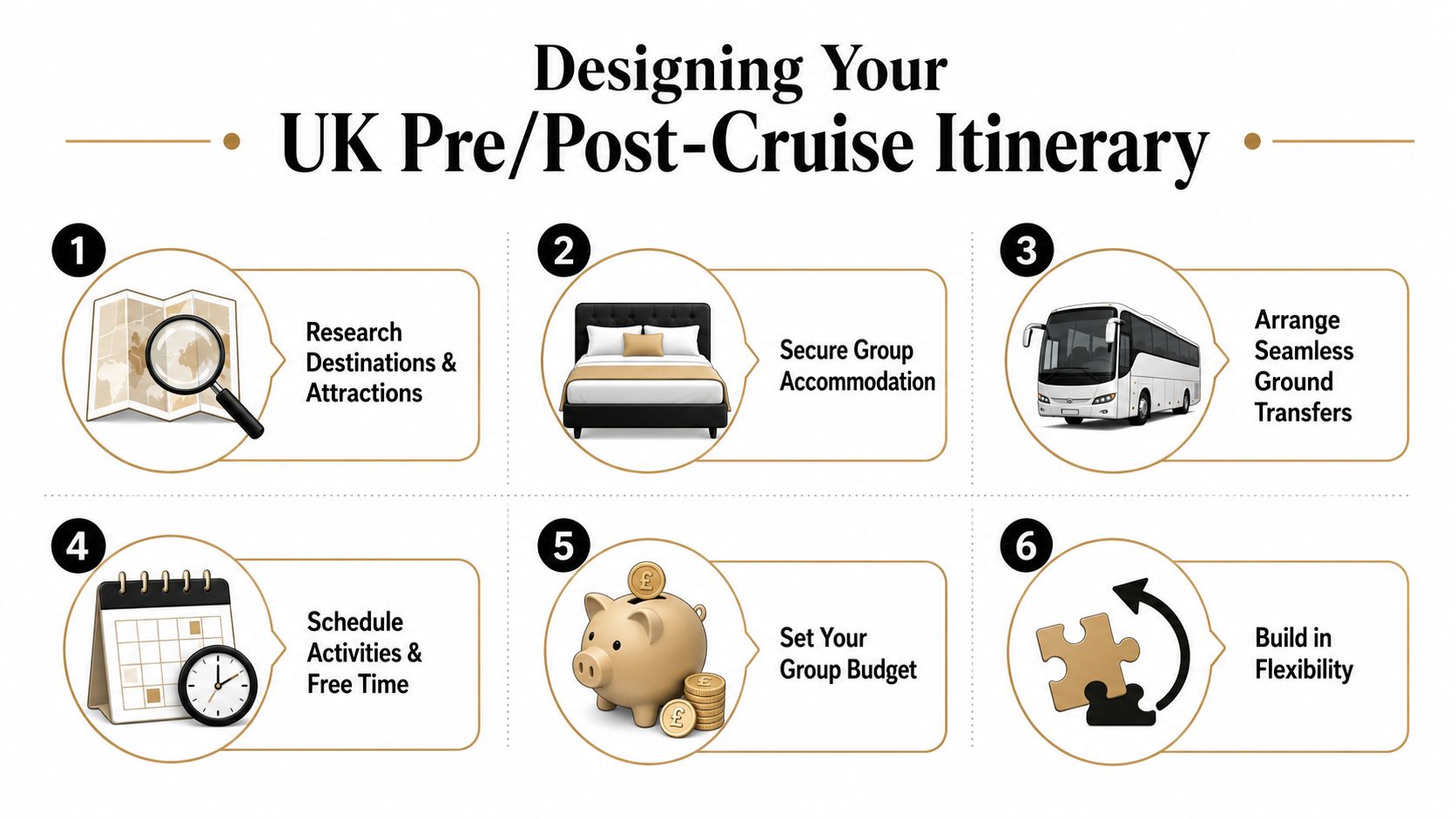
A good UK itinerary for a cruise trip should feel tidy, not ambitious. If you only have a short window before or after sailing, don't build a plan that belongs in a two-week holiday. Build one that respects jet lag, luggage, and embarkation times.
Keep the Plan Short and Purposeful
For most cruise passengers, the best pre-cruise itinerary has one of two shapes.
Option one is the recovery stop. Arrive at Heathrow, transfer to a hotel, eat well, sleep properly, and head to the port the next day.
Option two is the light-touch city stay. Arrive, spend one or two nights in London, see a few places at a civilised pace, then transfer to the ship.
Post-cruise, the same logic applies. Don't promise yourselves a heroic land programme after disembarkation. Most groups do better with a simple final chapter. One overnight stay, one well-chosen outing, then the airport.
If you want ideas for manageable outings, these London day trip suggestions for small groups are the right scale for cruise add-ons.
Build Around Accommodation Transport and Energy Levels
Start with where you'll sleep. That decides most of the rest.
A practical comparison looks like this:
| Base | Works best for | Watch out for |
|---|---|---|
| Heathrow hotel | Late arrivals, early rest, easy next-day departure | Less atmosphere |
| Central London hotel | Sightseeing, restaurants, classic first visit | More traffic, more loading time |
| Serviced apartment | Families or friends sharing space | Access and lift arrangements vary |
| Port-area stay | Very early embarkation comfort | Limited sightseeing value |
Then check the human factors. This matters more than people admit.
- Mobility: Are there stairs, long hotel corridors, uneven pavements, or heavy cases?
- Pace: Does everyone want a full sightseeing day, or only a gentle outing?
- Meal timing: Book dinner sensibly on arrival day. Don't assume anyone will want a late complicated reservation.
- Room layout: For friends or family, adjoining rooms or apartment-style space can make the stay easier.
Use a Simple Planning Checklist
Most small groups get into trouble because too many details stay vague. Fix that early.
-
Choose the land window first
Decide how many nights you want before and after the cruise. One clear night is better than a muddled half-plan. -
Book accommodation that suits the group
Prioritise lifts, step-free access where needed, and easy vehicle pickup. -
Pre-book key activities only
Reserve the one or two things you really care about. Leave the rest flexible. -
Agree the luggage plan
Know who has large suitcases, who has carry-ons, and whether anyone uses mobility equipment. -
Decide the transfer strategy early
This should be booked alongside flights and hotels, not after everything else.
Don't build an itinerary around what looks impressive on paper. Build it around smooth mornings and easy handovers.
A strong small group itinerary feels almost understated. That's the point. You're not trying to win at travel. You're trying to arrive rested, board calmly, and enjoy the cruise from the moment it starts.
The Critical Link Solving Your UK Ground Transfers
Most cruise problems don't start on the ship. They start on the kerb outside an airport, at a hotel entrance, or in the scramble to get from port to plane.
That part deserves more attention than it usually gets.
According to research on UK group travel and cruise logistics, 68% of UK cruise travellers report feeling anxious about missing flight connections due to port transfer delays, and 42% of UK-based cruise operators admit they do not provide guaranteed private group transfer coordination. That tells you exactly where the pressure sits. It's the link between ship and shore arrangements.

Where Cruise Plans Usually Go Wrong
Travellers often assume the UK part will be simple because the country feels familiar, organised, and English-speaking. That's exactly why people underestimate it.
Here's where things go wrong:
- Too many moving parts: Flight arrival, baggage reclaim, hotel timing, port check-in, and traffic all have to line up.
- Too much luggage handling: Each extra transport leg means more lifting, counting, and waiting.
- Split transport decisions: One taxi isn't enough. Two taxis separate the group and create confusion.
- Last-minute booking habits: App-based cars may not be the right fit for a group with cruise luggage and fixed timings.
Why Public Transport and Split Taxis Fail Small Groups
I'm not anti-train. I'm anti-bad fit.
For a solo traveller with one bag, public transport can work. For a cruise group arriving from North America, it usually creates unnecessary strain. You're tired. You may be jet-lagged. You may not know which terminal exit is easiest. Rail changes with cases are awkward, and not every station or platform feels simple when you're managing older travellers and heavy luggage.
Splitting into multiple black cabs or ride-hail cars isn't much better. The group gets divided. People arrive at different times. One driver may know the hotel entrance, another may not. If there's a problem, nobody experiences it together.
A small group should travel as a unit. That's the whole advantage.
What a Private Minibus Actually Fixes
A dedicated private minibus turns the messy middle into one managed movement. That's why I see it as a practical necessity, not a luxury extra.
What it solves:
| Problem | Better transfer approach |
|---|---|
| Group gets split up | Everyone rides together |
| Bags scattered across vehicles | Luggage stays in one place |
| Unclear pickup point | Meet and greet removes guesswork |
| Timing anxiety | Flight and cruise monitoring supports pickup adjustments |
| Budget confusion | Fixed pricing is easier to plan around |
If you're comparing options, look for a provider that offers door-to-door cruise transfers rather than generic airport runs. For example, private door-to-door cruise transfers are designed around the actual route cruise passengers take between Heathrow, hotels, and ports.
EC Minibus is one such option. The service is built around private transfers between Heathrow, London hotels, and cruise ports, with meet and greet, flight and cruise monitoring, and fixed pricing.
The calmest travel days are the ones where nobody asks, “What are we doing now?”
That's the standard to aim for. If your transfer plan keeps the group together, handles the luggage cleanly, and removes timing guesswork, you've solved the hardest part of the trip.
How to Book a Private Minibus for Your Group
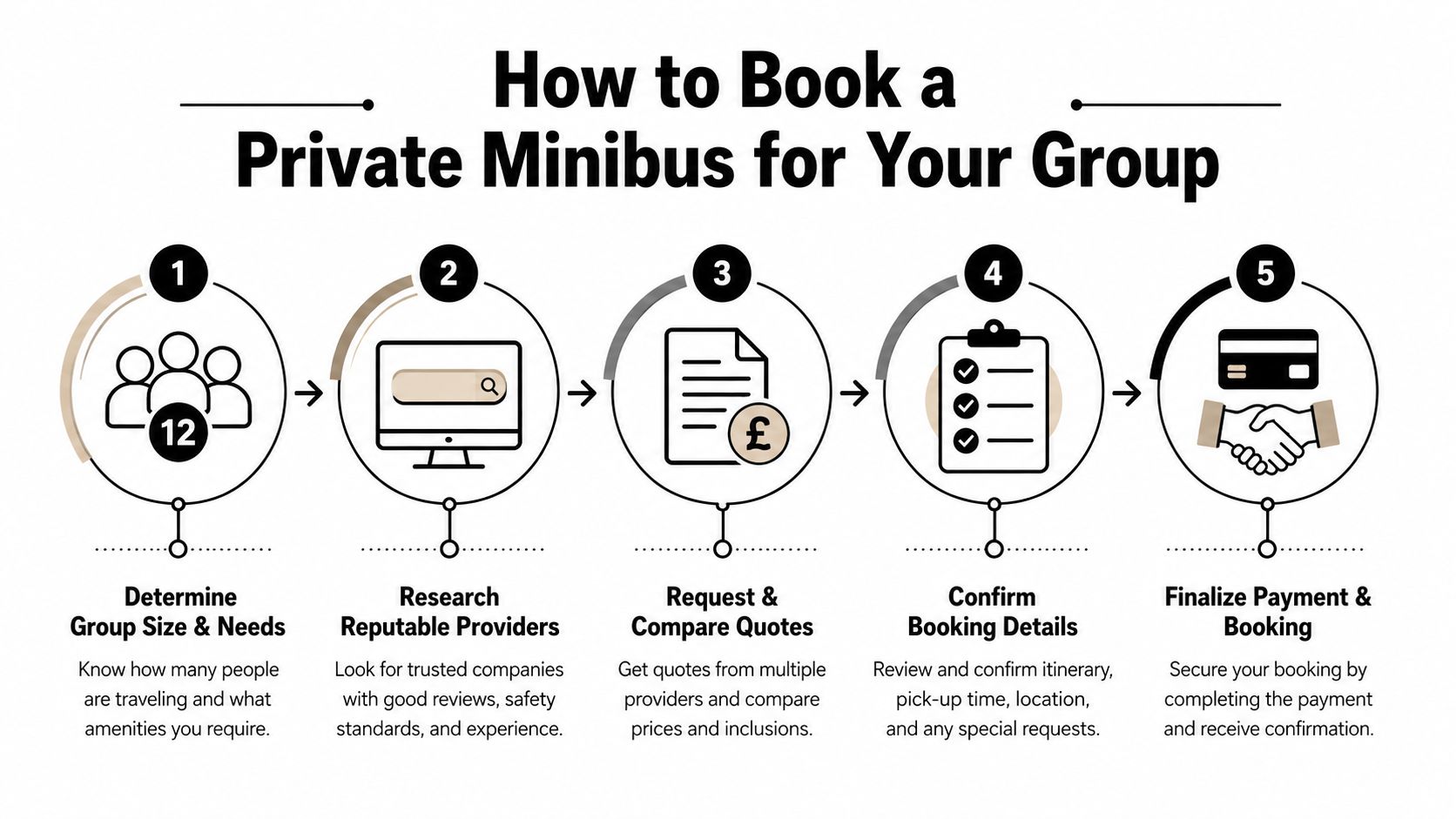
Booking a private minibus shouldn't feel complicated. If it does, either the provider's process is poor or you don't yet have the right details in front of you.
For most cruise groups, the booking itself is the easy part. Clarity is the important part. You want the provider to know exactly who you are, where you're going, and what you're bringing.
Have the Right Details Ready
Before you request or confirm anything, gather these basics:
- Passenger count: Be exact. Don't guess and fix it later.
- Flight details: Arrival airport, airline, flight number, and scheduled landing time.
- Cruise details: Ship name, terminal or port, and embarkation or disembarkation date.
- Luggage outline: Large cases, hand luggage, foldable walkers, or other bulky items.
- Addresses: Full hotel or apartment address, not just the name.
If you're looking at options, this guide to private mini bus hire with driver gives a useful overview of what to check before confirming.
What the Booking Journey Should Look Like
A sound provider keeps the process straightforward.
First, you enter the journey details. Then you confirm the group size and luggage needs. Then you receive a clear booking confirmation showing pickup point, destination, and service terms.
You should not have to chase basic information.
Look for these trust signals:
| What you want to see | Why it matters |
|---|---|
| Clear written confirmation | Prevents misunderstandings |
| Pickup instructions | Reduces airport confusion |
| Flight monitoring mentioned | Helps with delays and early arrivals |
| Named contact method | Useful if plans shift |
| Fixed pricing stated clearly | Helps group budgeting |
Book the vehicle for the group you are, not the group you hope to be. Last-minute changes create avoidable problems.
What to Expect on the Day
At the airport, the smoothest setup is a proper meet and greet. Your driver meets you in arrivals, helps orient the group, and takes you to the vehicle. That removes the wandering and second-guessing that often sours the first hour in the UK.
At the hotel or cruise terminal, the process should be equally plain. The driver arrives when expected, loads the bags, confirms the destination, and gets moving without drama.
That's what people value most. Not theatre. Not sales talk. Just competent handling.
For North American seniors in particular, this is where small group travel pays off. A well-booked minibus keeps the first and last land-based steps of the trip simple, and that changes how the entire holiday feels.
Your Small Group Travel Questions Answered
How far ahead should we book
Book as soon as your flights, hotel, and cruise dates are firm. Don't wait until the final weeks and assume transport will sort itself out. Early booking gives you better clarity, cleaner communication, and fewer moving parts close to departure.
Can we add a stop between the airport hotel and port
Often, yes. A stop for lunch, a short sightseeing detour, or a practical stop at a hotel is usually manageable if agreed in advance. Keep it realistic. One worthwhile stop is pleasant. Too many stops turn transfer day into a slog.
What if our flight is delayed
This is why flight details matter so much at booking stage. A proper transfer provider should use them to track your arrival and adjust pickup timing where the service includes flight monitoring. If a company doesn't ask for your flight number, that's a warning sign.
Is a private minibus only for large groups
No. It suits small groups precisely because it keeps everyone together and handles luggage properly. Families, two couples, and multi-generational groups often benefit more than larger parties because they want convenience without the formality of a full coach arrangement.
Should we stay near Heathrow or in Central London
Choose Heathrow if rest and simplicity matter most. Choose Central London if seeing the city is part of the trip. Don't choose London out of guilt because you feel you “should”. If you arrive tired and board the ship the next day, an airport hotel can be the smarter call.
What matters most when choosing a transfer provider
Keep the checklist tight:
- Licensed and insured service
- Meet and greet availability
- Flight and cruise monitoring
- Fixed transparent pricing
- Experience with Heathrow and cruise ports
- Comfortable vehicle matched to group and luggage
Those are the essentials. Fancy wording on a website isn't.
Choose the provider that makes the day feel predictable. Predictable is exactly what you want before a cruise and before a long-haul flight home.
Small group travel works best when every handoff is clean. Flights to hotel. Hotel to port. Port to airport. If you organise those links early, the UK part of your cruise stops feeling like a puzzle and starts feeling like part of the holiday.
If you want a simple door-to-door transfer plan for your cruise trip, EC Minibus provides private Heathrow, London hotel, rail hub, and UK cruise port transfers with meet and greet, flight and cruise monitoring, and fixed pricing for small groups.