

You've booked the cruise. The cabin is sorted. The flights are in place. Then the awkward part hits: how do you get from a busy UK airport or London hotel to the ship without turning embarkation day into a luggage-heavy obstacle course?
That final leg worries more travellers than they admit. After a long-haul flight, travelers often don't want to decode train platforms, drag cases through stations, or wonder whether a taxi queue will move quickly enough. They want one clear plan, one driver, one vehicle, and one less thing to think about.
That's why door to door cruise transfers matter. For many international visitors, they're less about luxury and more about peace of mind insurance. You're not only paying for transport. You're paying to reduce the chance that confusion, delay, or tired decision-making spoils the first day of your holiday.
Table of Contents
- Starting Your Cruise Journey Before You Reach the Ship
- What Exactly Are Door to Door Cruise Transfers
- The Real Benefits Compared to Other Transport Options
- Your Guide to Major UK Port and Airport Routes
- The Seamless Booking and Pickup Process Explained
- Understanding Your Fixed Price Fare and Inclusions
- Choosing a Trusted Provider for Peace of Mind
Starting Your Cruise Journey Before You Reach the Ship
A common arrival day looks like this. You land at Heathrow after an overnight flight from North America. You're tired, a bit foggy, and keeping half an eye on your passport, phone, and baggage trolley while trying to remember which terminal exit you need.
Then come the practical questions. Will all the cases fit? How far is the train platform? What if the children are tired, or someone in your party doesn't move quickly? What if your flight landed late and everything now feels rushed?

A door to door cruise transfer changes that moment completely. Instead of piecing together the next stage yourself, you walk into the arrivals hall knowing a driver is expecting you. You're met, helped with luggage, and taken straight to the cruise terminal in a vehicle reserved for your party.
Why this matters after a long flight
The biggest benefit is mental, not mechanical. You don't have to make a chain of small decisions while jet-lagged. You don't have to judge which rail ticket to buy, whether a taxi is large enough, or whether a platform lift is working.
Practical rule: If your journey includes long-haul flying, multiple bags, or older relatives, remove as many moving parts as possible before travel day.
This is why first-time cruisers often feel relieved once they understand the option. If you're still planning the rest of your trip, these tips for first-time cruisers help put the transfer into the wider flow of embarkation day.
The holiday can begin earlier
People often think the cruise starts when they board the ship. In practice, it can start much sooner. A calm transfer gives you a soft landing in a new country. You can sit down, drink some water, look out at the English countryside or motorway signs, and arrive.
That's a very different experience from wrestling luggage onto public transport while watching the clock.
What Exactly Are Door to Door Cruise Transfers
A door to door cruise transfer is a pre-booked private vehicle that collects you from a specific place and takes you directly to your cruise terminal. That starting point might be Heathrow, a London hotel, St Pancras, or a private address. The important part is that the journey is arranged around you, not around a public timetable or a queue.
Think of it as a cruise-day chauffeur service. The vehicle is booked for your party, your luggage, and your route.
What the service is
The idea is simple:
- You book in advance.
- You provide your collection details.
- A driver meets or collects you at the agreed location.
- You travel directly to the port.
There's no need to join a shared coach unless you've chosen one. There's no station change unless your itinerary specifically requires it. The aim is a straight, organised handover from airport, hotel, or rail hub to the ship.
According to UK cruise transfer market background from Ports Direct, the dedicated UK door to door cruise transfer market has been maturing since around 2006, and licensed operators now manage over 1,000 vehicles for travellers.
What the service is not
It helps to separate this from other transport choices:
| Option | What it usually means for you |
|---|---|
| Private door to door transfer | One booking, direct route, luggage help, planned pickup |
| Shared shuttle | Lower exclusivity, possible extra stops, less control over timing |
| Train or coach | More self-navigation, luggage handling, timetable dependence |
| Standard taxi or ride-share | Immediate transport, but less cruise-specific planning and less certainty around the overall experience |
The difference isn't only privacy. It's purpose. A cruise transfer is designed around embarkation and disembarkation needs.
Why cruise travellers use them
Cruise passengers tend to carry more than a city-break traveller. Larger suitcases, cabin bags, sometimes mobility aids, and often a strict check-in window all change what “easy transport” really means.
A good cruise transfer doesn't just move people. It removes friction from a day that already has enough logistics.
That's why many travellers see the service as operational support rather than indulgence. It's transport built around the realities of cruise travel.
The Real Benefits Compared to Other Transport Options
Price is usually the first question. It shouldn't be the only one.
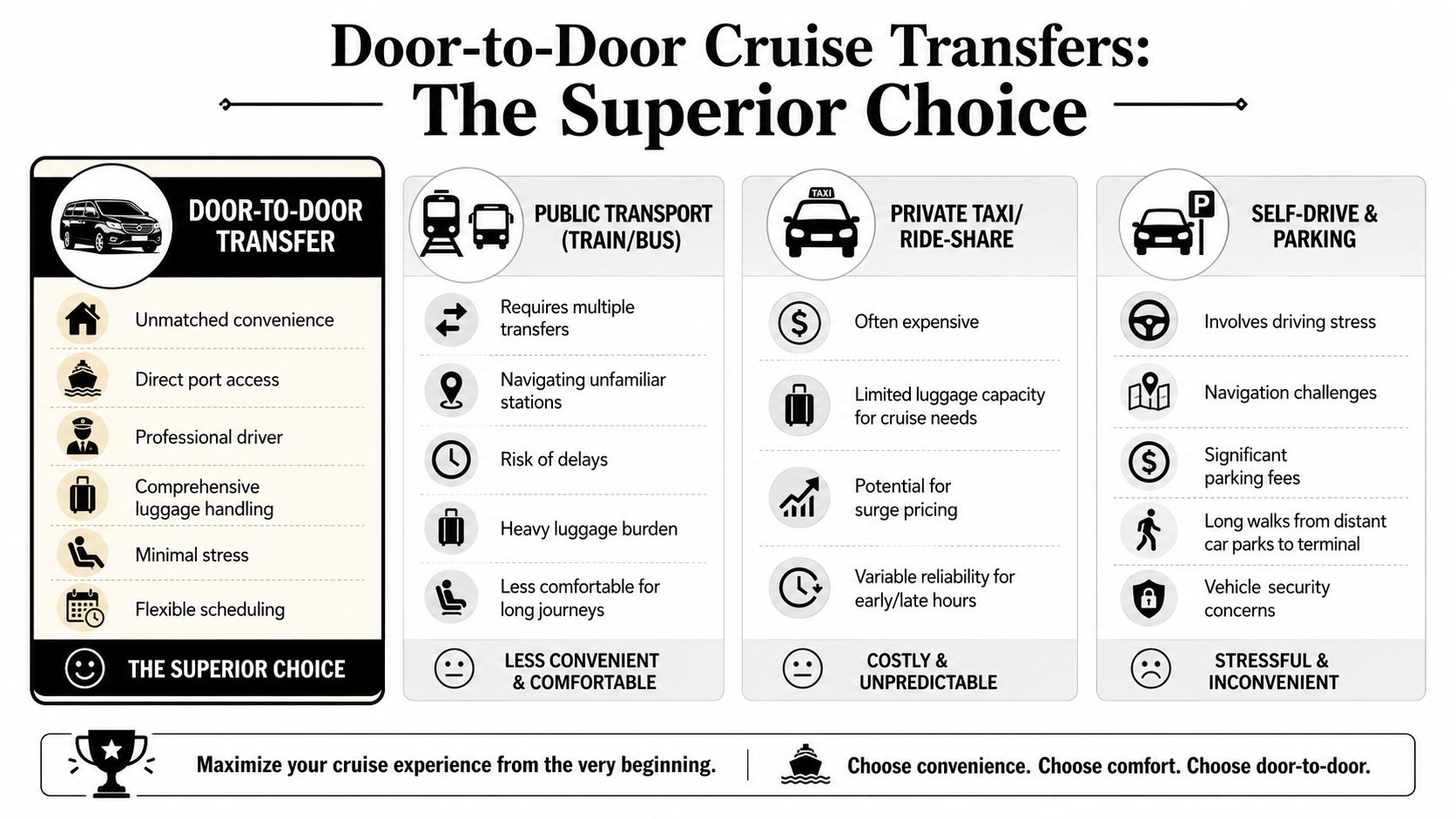
A regular taxi, rail journey, or self-drive plan can look cheaper at first glance. But cruise travellers rarely choose transport on price alone. They choose based on what the journey feels like when they're tired, carrying luggage, and trying to reach a ship on time.
The experiential difference
Here's the clearest way to think about it. A train gets you from network to network. A metered taxi gets you from kerb to kerb. A door to door cruise transfer gets you from your actual starting point to your actual ship day destination with fewer decisions in between.
That difference matters when things aren't perfectly smooth.
- With rail, you may need lifts, escalators, platform changes, and local transport at either end.
- With a standard taxi, you may still need to manage airport pickup confusion, luggage fit, and a meter running in traffic.
- With self-drive, one person in your group becomes the driver, navigator, and parking planner instead of part of the holiday.
Why some travellers accept the premium
A UK seaport transfer pricing overview notes that fixed-fare door to door transfers can carry a 22 to 28% premium over standard metered taxis for similar routes, and that 78% of international cruise passengers prioritise fixed pricing and guaranteed pickup times over small savings.
That preference makes sense. For many people, the premium buys certainty:
- Known fare instead of watching a meter
- Planned pickup instead of hoping for vehicle availability
- Cruise-aware service instead of a generic A-to-B ride
- Space for luggage arranged in advance
When travellers call it expensive, they're often comparing only the base fare. When they call it worth it, they're usually including stress, effort, and risk.
Rail versus direct transfer
Rail can work well for light packers who know the UK system and are comfortable switching trains or adding taxis at either end. It becomes less attractive if your group includes children, older relatives, or anyone who doesn't want to haul heavy cases through a station.
There's also a documented information gap here. Many travellers don't have clear, UK-specific guidance comparing rail from hubs like St Pancras with direct minibus options in terms of real-world hassle, especially with luggage.
A simple comparison helps:
| Factor | Door to door transfer | Rail | Metered taxi |
|---|---|---|---|
| Luggage handling | Driver assistance and one vehicle | You manage all bags yourself | Varies by driver and vehicle size |
| Route simplicity | Direct | Often multi-step | Direct, but less cruise-specific planning |
| Cost certainty | Fixed fare | Varies by tickets and add-on journeys | Metered fare |
| Stress level | Lower for most cruise parties | Higher if unfamiliar with the system | Moderate, depending on timing and traffic |
Later in the journey, seeing how pickup works often makes the difference click for people.
Your Guide to Major UK Port and Airport Routes
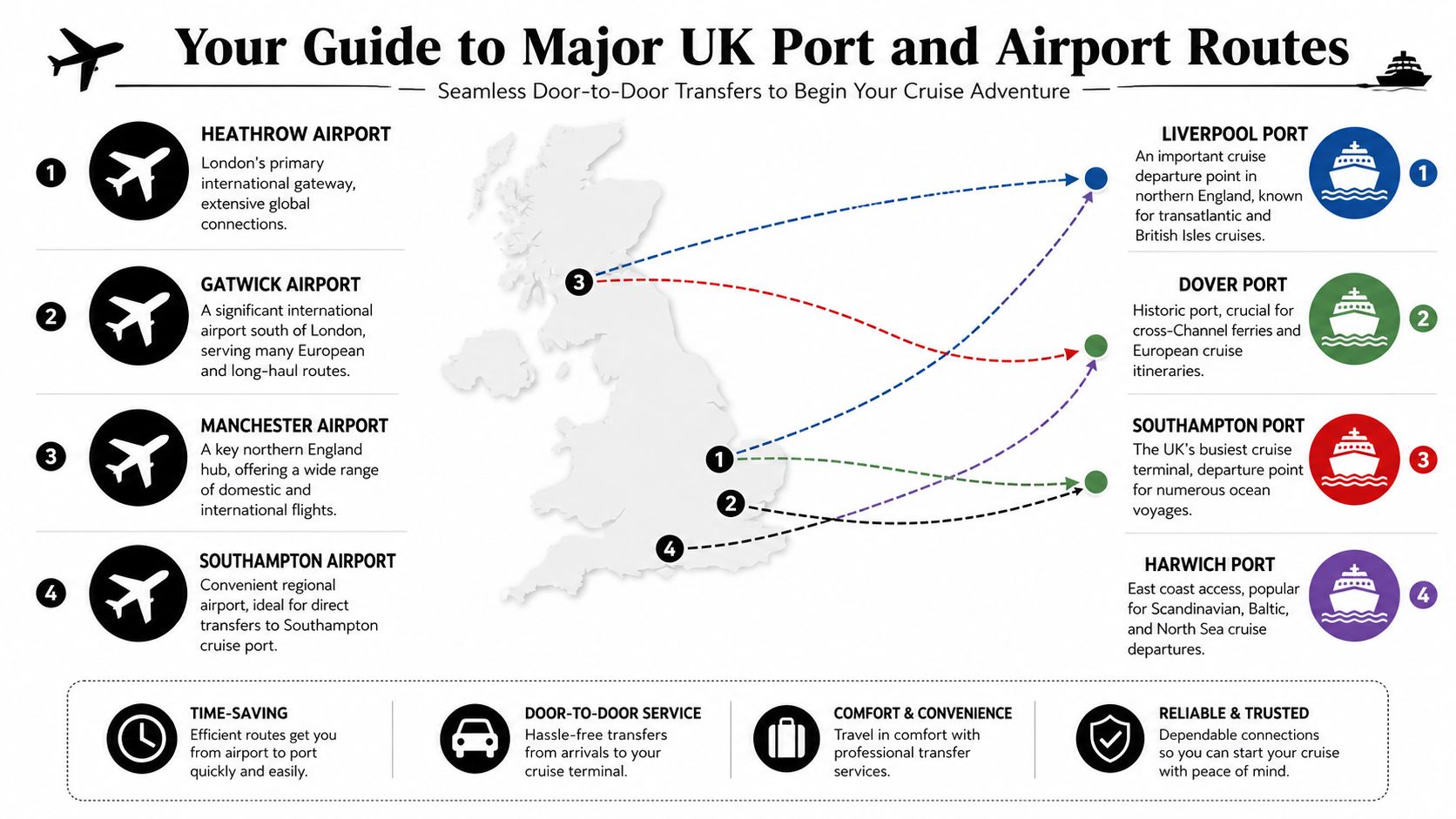
Most international cruise visitors enter the UK through London, then continue to the coast. That sounds simple on paper. In practice, the route shapes the day more than people expect.
Heathrow to Southampton
This is one of the classic cruise routes. Heathrow is a major international gateway, and Southampton is the UK's main cruise departure hub. The road journey is usually straightforward by private transfer, which is a big relief after a transatlantic flight.
For many visitors, this route is where the value of direct travel becomes obvious. Once you've cleared arrivals, the appeal of loading bags once and staying put until the port is hard to overstate.
Heathrow to Dover
Dover has a different feel. It's an important port, but the journey can feel more complicated if you try to build it with rail segments and station connections. A comparison of cruise transfer route logistics from London helps travellers visualise how these port connections work in practice.
A direct transfer simplifies the day because the driver handles the route planning. You don't need to think about ticket machines, train timing, or whether your cases will fit beside you on a busy service.
London hotels and St Pancras to cruise ports
Some travellers arrive a day early and stay in Central London. Others come into St Pancras after rail travel from elsewhere in the UK or Europe. Both situations create the same question: is rail still the sensible option for the final leg?
The answer depends on your appetite for hassle. The discussion of London cruise transfer logistics and rail uncertainty highlights a real knowledge gap around the true inconvenience of rail-based port transfers, especially for travellers with heavy luggage.
If your route requires you to ask, “How many separate steps are in this journey?”, a direct transfer is often the calmer choice.
Portsmouth and Tilbury
These routes matter for travellers whose cruise line departs somewhere other than Southampton or Dover. They're also good examples of why local driving knowledge helps. Ports can have different terminal layouts, traffic patterns, and pickup points.
A private transfer keeps the journey coherent. You don't need to decode which entrance matters or whether your navigation app understands terminal access rules. Your driver does.
The Seamless Booking and Pickup Process Explained
Many first-time users worry that private transfer booking will be complicated. It usually isn't. The process is much easier than trying to improvise on arrival day.
What you provide when booking
Most providers ask for the practical details needed to match the right vehicle and timing to your trip.
Typical booking information includes:
- Arrival details such as airport, terminal, and flight number
- Cruise details so the driver knows which terminal or port area you need
- Passenger count to match the vehicle correctly
- Luggage estimate because cruise luggage is rarely light
- Pickup address if you're travelling from a hotel, home, or rail station
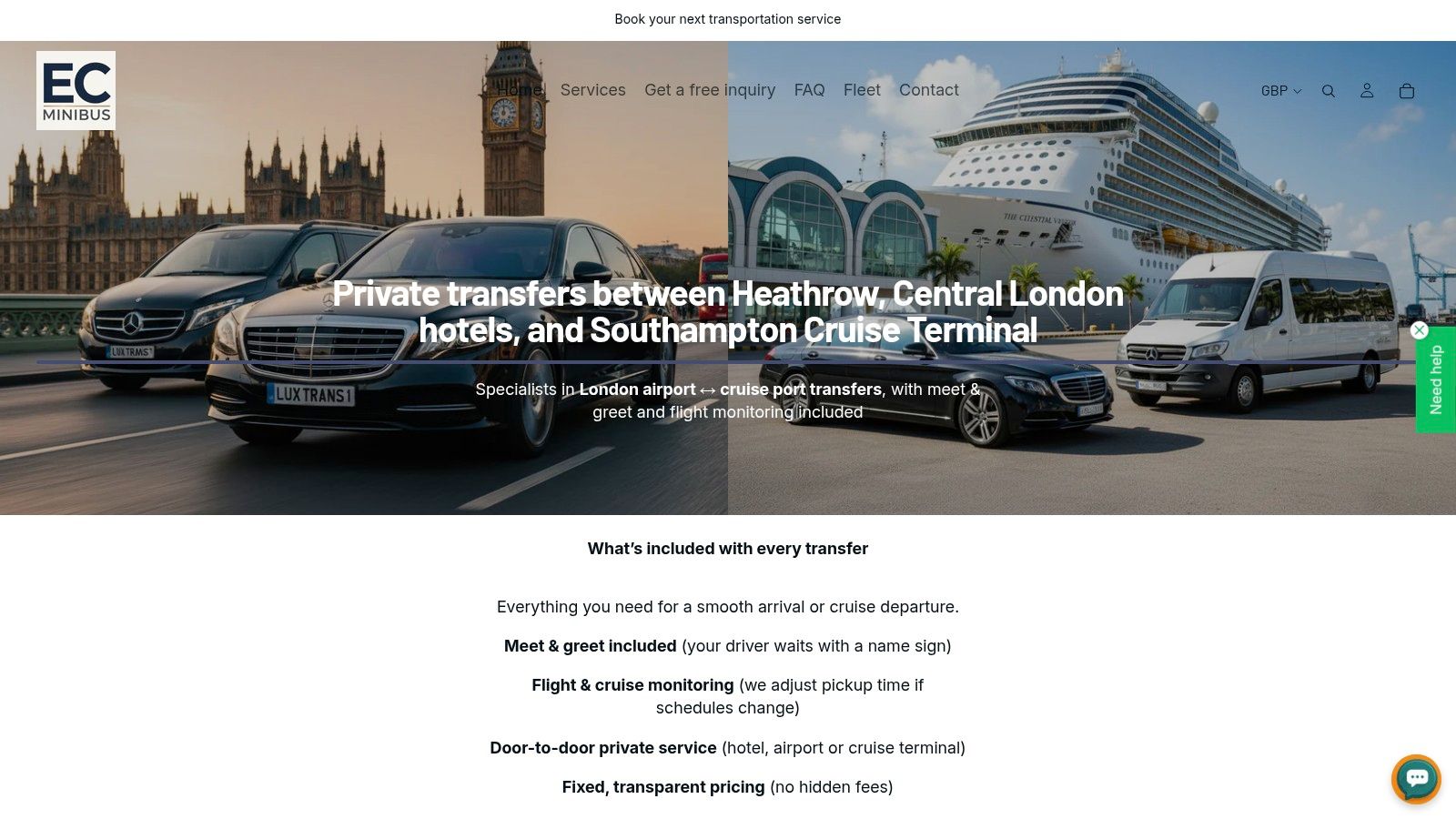
One London-based option, EC Minibus, provides private cruise transfers between Heathrow, London hotels, and UK cruise ports, with online booking, meet and greet, and fixed pricing based on the service information provided by the publisher.
What happens after booking
Once booked, you should receive clear confirmation. That should include the route, date, collection details, and how to contact support if your travel details change.
This matters more than people think. Good confirmation reduces uncertainty before you fly. You know the company has your details, and you know what should happen when you land.
Booking check: Before you travel, make sure your confirmation clearly shows the pickup location, date, lead passenger name, and any flight or cruise details you submitted.
What meet and greet actually looks like
Meet and greet sounds formal, but the experience is simple. You walk into arrivals, look for your driver or name board, and then head together to the vehicle. For tired travellers, that can feel much easier than trying to work out where the taxi rank is or whether you're standing in the right place for a pre-booked car.
Drivers often help with the awkward part too. That means moving the larger suitcases, loading the vehicle, and getting everyone settled before departure.
Why monitoring matters
One of the biggest anxieties is delay. If your plane lands late or your ship timing changes, you don't want to negotiate a new plan while standing in a terminal.
A guide to cruise transfer delay concerns and provider policies notes that travellers often worry about whether companies truly monitor ship schedules and adjust without extra fees. Top-tier providers build that reliability into the service, but it's still wise to verify the policy before you book.
Ask directly:
- Do you monitor flight arrivals?
- Do you monitor cruise schedules where relevant?
- What happens if my arrival time changes?
- Will I be charged extra for delay-related adjustment?
Those four questions tell you a lot about how calm your transfer day is likely to be.
Understanding Your Fixed Price Fare and Inclusions
A fixed fare means the quoted price is agreed before travel. It doesn't rise because traffic is slow, your driver takes a different road, or the meter keeps ticking while you sit on the motorway.
That pricing model matters for cruise passengers because embarkation days already carry enough variables. One part of the journey should feel settled.
What typical quoted pricing can look like
A 2026 comparison of London to UK cruise port private transfer pricing states that private door to door transfers from London start at around £160 for Southampton and £180 for Dover, with meet and greet and flight tracking included. The same source gives typical Heathrow journey times of about 2 hours to Southampton and 1.5 hours to Dover.
Those figures help you set expectations. They also show why comparing only against the cheapest visible taxi fare can be misleading.
What you're usually paying for
A proper fixed quote usually covers more than the seat in the vehicle. It often includes:
- The vehicle and driver
- Meet and greet at the airport
- Flight tracking
- A waiting-time allowance
- Luggage handling
- A direct trip to the terminal
If you're trying to understand how companies structure these quotes, this guide to UK car service costs gives useful context.
What to verify before you confirm
Ask for clarity on the parts that can create nasty surprises later.
- Waiting time: How much is included after landing?
- Luggage policy: How many cases fit the booked vehicle?
- Pickup scope: Is the airport meet and greet part of the fare?
- Delay handling: What happens if the flight timing changes?
A fixed fare works best when it's paired with a clear written description of what's included.
Choosing a Trusted Provider for Peace of Mind
When you choose a transfer company, you're really choosing how much uncertainty you're willing to accept on a key travel day. The right provider should make the journey feel more predictable from the moment you book.
Start with the basics. Check that the company is properly licensed and insured. Then look at how clearly it explains pickup procedures, luggage handling, pricing, and contact options. Vague wording usually creates vague experiences.
A practical shortlist for vetting a provider
Use this checklist before you pay:
- Licensing and insurance: These are mandatory.
- Cruise-specific experience: Airport transfers and cruise transfers aren't always the same thing.
- Clear written terms: You want plain answers on delays, waiting time, and luggage.
- Verified review profile: Look for consistent comments about punctuality, communication, and driver professionalism.
- Responsive support: If a company is difficult to reach before booking, it probably won't become easier later.
The safest booking usually isn't the cheapest one. It's the one where you can clearly see what will happen if travel day doesn't go perfectly.
For international visitors, that clarity is what turns transport into reassurance. A well-planned door to door cruise transfer won't make the airport disappear, but it can remove the most tiring part of the journey. You arrive knowing where to go, who to meet, and how you're getting to the ship. That confidence is often worth more than shaving a little off the fare.
If you want a straightforward option for private cruise-port transport, EC Minibus offers pre-booked door to door journeys between Heathrow, Central London, St Pancras, and major UK cruise ports, with meet and greet, fixed pricing, and cruise-focused pickup planning.