

A taxi from Southampton to Heathrow usually takes 1 hour 15 minutes to 1 hour 45 minutes for roughly 64 to 75 miles, while fixed-price private taxis commonly cost £120 to £300+, depending on vehicle size.
That sounds simple until you step off a cruise ship with several suitcases, a fixed disembarkation window and a flight leaving from a specific Heathrow terminal. The journey isn't just a question of distance or the cheapest fare. It's a logistics problem involving motorway congestion, luggage capacity, terminal access, driver coordination and the consequences of arriving late.
Table of Contents
- Stepping Off the Ship With a Flight to Catch
- Distance and Realistic Journey Time
- Door to Door Versus Shared and Public Options
- What the Fare Includes
- Booking Tips That Protect Your Connection
- Meet and Greet and the Cruise Passenger Reality
- Planning Your Disembarkation Day Buffer
Stepping Off the Ship With a Flight to Catch
At 7:30 in the morning, you leave a P&O or Cunard ship at Southampton with two large suitcases, hand luggage and less than four hours before a flight from Heathrow Terminal 5. The luggage trolley has a wobbly wheel, the port bus queue is already stretching past the terminal and several drivers are watching passengers decide what to do next.
That situation creates three separate timing risks. The ship may release passengers in stages, your cases may take longer to collect than expected, and the road journey can slow sharply once the car reaches the M3 or M25. A scheduled cruise arrival doesn't guarantee that you'll be sitting in a taxi at that exact time.

The real problem is coordination
A reliable pickup needs more than a postcode. The operator needs the cruise line, ship name, terminal, expected disembarkation time, passenger count and luggage volume. The Heathrow terminal matters too, because dropping at the wrong terminal can turn a manageable connection into a stressful internal transfer.
I recommend booking a driver who knows cruise-terminal pickups, not ordering a car after collecting your luggage. A pre-arranged meeting point, a named contact and clear instructions remove decisions at the moment when you're tired and trying to move several cases.
For practical terminal guidance, see this Southampton cruise terminal taxi guide. The useful standard is straightforward: the driver should know where you're coming from, where you're going and how much luggage the vehicle must carry.
Practical rule: Treat the ship's release time as the start of your travel window, not as the time your taxi leaves.
A fixed-price booking also prevents a second worry at the kerb. You should know whether the quote covers the vehicle, the route and airport access before the car arrives. The rest of the decision comes down to choosing enough time and enough space.
Distance and Realistic Journey Time
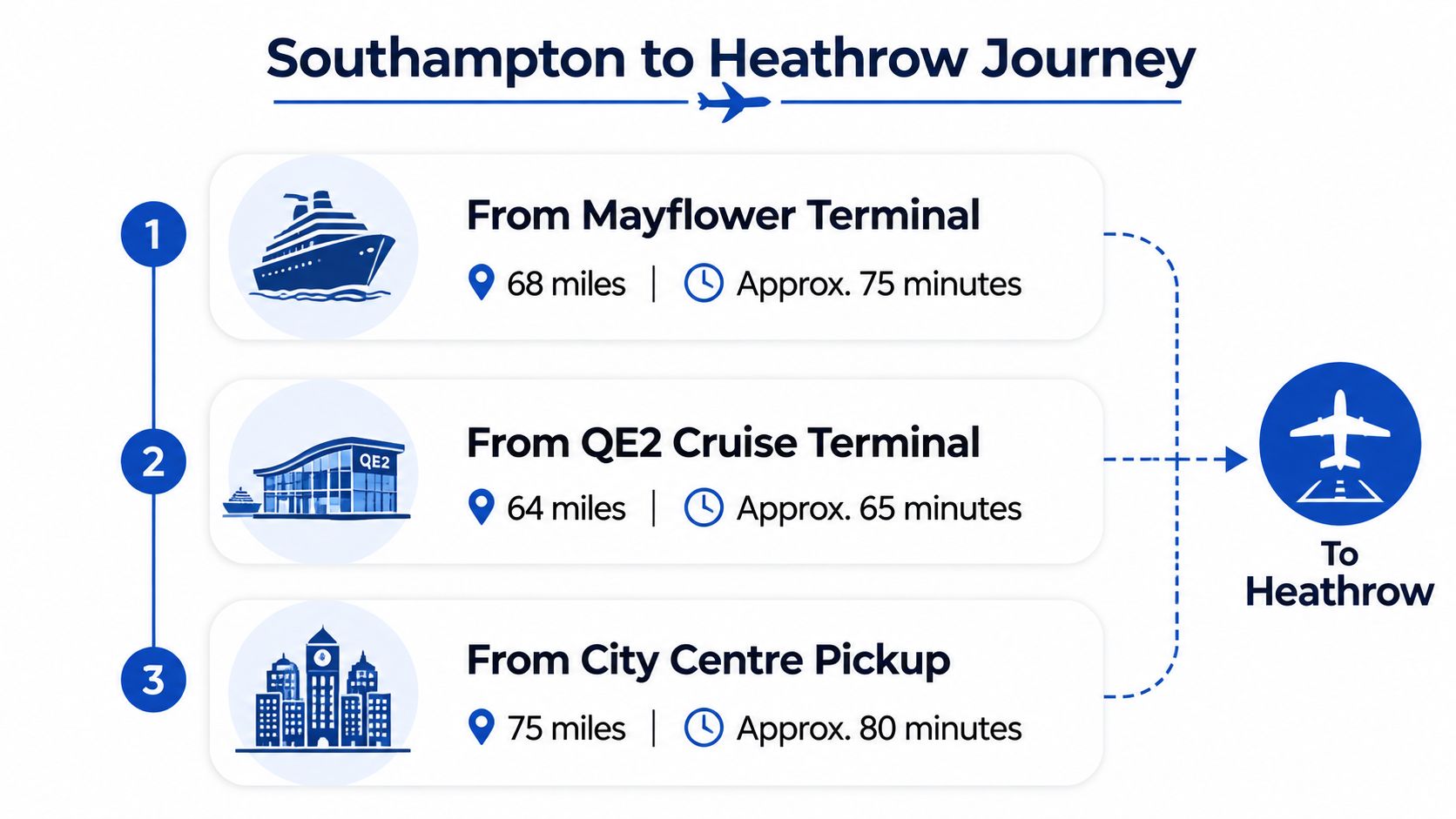
A Southampton to Heathrow taxi is a long intercity transfer, covering roughly 64 to 75 miles. Published estimates put the normal journey at 1 hour 15 minutes to 1 hour 45 minutes, using routes that typically involve the M3 and M25. The published Southampton to Heathrow route estimates show that range, but motorway conditions decide whether your trip lands near the shorter or longer end.
Pickup location changes the mileage and the approach. A vehicle leaving the Mayflower terminal will take a different route from one collecting passengers at the QE2 terminal or a city-centre hotel. Your Heathrow terminal also matters, since airport access and the final internal approach add time.
Coordination, not postcode, drives a reliable pickup
The usual route runs along the M3 towards London before joining the M25. Conditions around the M25 can change quickly, so the operator should check live traffic and choose the practical approach on the day. Ask for that flexibility when booking, rather than insisting on a fixed route that may have become unsuitable.
The normal time band applies in stable conditions. A serious closure or major incident around the M25 can extend the journey to 2 hours 30 minutes. Cruise disembarkation during the morning M3 commuter rush creates a similar risk. The shorter published range is useful for planning, though it cannot guarantee your arrival time.
Friday afternoon deserves extra allowance, and Bank Holiday traffic can tighten the schedule further. A ship releasing many passengers at once adds pressure at the pickup point and on the surrounding roads.
Use the longer realistic journey when setting your airport plan. For a flight connection, I recommend a buffer that covers the longer road estimate plus time for disembarkation, luggage collection and airport check-in. Book a vehicle with enough capacity for every passenger and case, then ask for written confirmation of the pickup arrangement, road allowance and Heathrow terminal. This turns the transfer into a managed logistics plan rather than a fare comparison.
Door to Door Versus Shared and Public Options
Several travel options connect Southampton to Heathrow, but they suit different scenarios. A private taxi or minibus collects you at the cruise terminal and drops you at the airport. A coach, shuttle or train makes you fit disembarkation, luggage and station access around a fixed network.
National Express offers a direct Heathrow to Southampton coach, with reported journey times of about 1 hour 25 minutes to 1 hour 40 minutes and fares from £17.40, according to this coach and private-transfer comparison. That price suits a light traveller with spare time. You still need to reach the coach departure point, move your cases through the terminal and accept the operator's fixed departure.
| Option | Door-to-door time | Luggage handling | Typical cost | Best for |
|---|---|---|---|---|
| Fixed-price private taxi | Direct, subject to road conditions | Driver loads and unloads; vehicle booked for your group | Higher than public transport | Cruise passengers with a flight deadline |
| Private minibus | Direct, with space matched to the group | Best option for multiple cases and several passengers | Higher, depending on size | Families and luggage-heavy groups |
| Metered black cab | Direct, but price depends on time and distance | Usually practical, subject to available vehicle space | Variable | Travellers arranging a car locally |
| Shared shuttle | Route and timing depend on other passengers | Shared loading and possible waiting | Lower than private travel | Flexible travellers with lighter luggage |
| National Express coach | Fixed departure and arrival points | You handle cases between terminal and coach | From £17.40 on the reported route | Budget travellers with spare time |
| Train connection | Requires station access and changes | Difficult with large cases and platform transfers | Variable | Confident rail users travelling light |
Why public transport often fails on disembarkation day
A coach can work when traffic is stable and its departure matches your release time. A late ship, slow luggage collection or a long walk to the coach stop can remove that margin quickly. The fare remains low, but the connection becomes your responsibility.
Rail adds station access, boarding with cases and at least one interchange on the London network. That workload is a poor fit for older travellers, families or groups handling several large suitcases. Book rail only when everyone can manage the cases and the flight leaves ample recovery time.
A metered black cab offers direct travel, though the final price depends on time and distance. For a cruise party with luggage and a flight deadline, choose a pre-booked fixed-price private transfer. A pre-booked fixed-price private transfer covers the entire journey from terminal to airport curb.
The vehicle rule is simple: use a private taxi for a small party with manageable cases, and choose a minibus when several passengers or large cruise bags are involved. A door-to-door cruise transfer guide explains why vehicle space and direct pickup matter on disembarkation day. Shared and public options can save money, but they add handovers, waiting and fixed departure points to a journey already governed by the ship's release time.
What the Fare Includes
The first online fare may suit a small party but fail once you account for cruise luggage. Current UK-facing guidance places a standard saloon or similar Southampton to Heathrow transfer at about £120 to £155, while MPVs and larger vehicles can cost £200 to £300+. The Southampton to Heathrow taxi cost guide explains how vehicle class and luggage requirements affect the price.
That difference is practical, not automatically unfair. A larger vehicle costs more to operate and gives cases room to travel safely. Compare like with like, especially if your group needs an MPV or minibus. For wider context, see this Heathrow taxi cost guide.
| Vehicle Class | Typical Price Range | Passengers | Luggage Capacity | Heathrow Drop-off Included |
|---|---|---|---|---|
| Saloon | £120 to £155 | Small party | Limited boot space | Confirm before booking |
| Estate | Varies by operator | Small party | More flexible than a saloon | Confirm before booking |
| MPV | £200 to £300+ | Larger party | Better for several large cases | Confirm before booking |
| Executive vehicle | Varies by operator | Small party | Depends on model | Confirm before booking |
| 8-seat minibus | £200 to £300+ or more | Larger group | Designed for group luggage | Confirm before booking |
Book the luggage space, not just the seats
Passenger numbers tell only half the story. Two large suitcases plus hand luggage can overwhelm a standard saloon, while rigid cruise cases, garment bags, mobility aids and shopping take more room than travellers expect.
Give the operator the number and approximate size of every case. If the response is vague, book an estate, MPV or minibus. Do not rely on a driver turning up with a larger boot than requested.
Check airport access charges
At least one current guide notes a £7 Heathrow drop-off fee per terminal, which may be added to the quoted fare. Heathrow transfer pricing guidance explains why operators price this as an intercity fixed journey rather than a simple urban meter ride.
Ask for one written total covering airport drop-off, waiting time, parking, tolls and any early or late supplement. A fixed quote should state what is included before payment. EC Minibus presents the all-inclusive approach passengers should look for, with the airport access cost made clear instead of appearing at the end.
Booking Tips That Protect Your Connection
A Southampton cruise pickup tied to an international flight needs a booking that removes decisions on the day. Require a written fixed-price quote naming the pickup point, Heathrow terminal, vehicle class, passenger count, luggage allowance and included charges.
Do not accept an estimate as the final answer. A meter passes traffic and waiting costs to you, whereas a fixed fare gives you a known price. The operator must then manage the motorway risk through sensible timing, live updates and a clear contingency plan.
Give the operator both schedules
Send the cruise ship name and expected disembarkation window, along with the flight number and airline. That information lets the dispatcher plan the terminal pickup around the full connection rather than treating it as an ordinary local journey.
Published ship arrival times are not reliable pickup times. Passengers leave in groups, luggage collection varies and port procedures can delay the handover. Give the operator the ship's schedule, then agree a practical collection arrangement at the terminal.
Your confirmation should cover:
- Meeting instructions: State whether the driver meets you inside, at a gate or at a designated vehicle bay.
- Contact method: Keep a UK-based telephone number or live support channel available if disembarkation changes.
- Driver details: Ask when the driver's name, vehicle and contact information will be sent.
- Payment terms: Check when payment is due and whether the quote changes after booking.
- Cancellation rules: Read the cancellation window before committing.
- Child seats: Request the correct seat in advance rather than assuming one will be available.
- Confirmation message: Look for a final text or email before travel.
Check the operator, not just the app
A licensed, insured private hire operator should explain its cover and dispatch process clearly. App-based gig driving can suit a short local journey, but cruise-to-airport work demands knowledge of terminal access, luggage loading and schedule changes. Those details decide whether the connection runs calmly or becomes a search for a car at the port.
Use the EC Minibus booking service as a comparison benchmark. Look for a fixed quote, cruise and flight monitoring, a named driver before collection and a UK contact number if the ship is late. Those protections matter more than a small reduction in the initial fare.
Meet and Greet and the Cruise Passenger Reality
The wrong vehicle can ruin an otherwise well-organised Southampton to Heathrow transfer. A saloon may technically carry the passengers, but that doesn't mean it can carry the passengers, cases, hand luggage and mobility equipment comfortably.
Older travellers often need more time and less lifting. Families may have pushchairs and child seats. A group with several large cases needs a vehicle where luggage isn't wedged around passengers or placed in a way that blocks access.
What genuine meet and greet looks like
At a Southampton cruise terminal, proper meet and greet should be specific. The driver should know the ship and terminal, meet at the agreed point, help with the luggage trolley and guide the party to the waiting vehicle in a signed or clearly identified bay.
A message saying “text when you're outside” is different. That arrangement may work for a simple city pickup, but it makes tired passengers search for a car while managing cases and navigating a busy port.
Service standard: Meet and greet means the driver takes responsibility for the handover, not that the passenger has to locate the vehicle alone.
Match the vehicle to the group
An MPV suits a family or couple with bulky luggage when easy access matters more than a formal cabin. An executive saloon offers comfortable seating but may not have the luggage capacity of a larger vehicle. A six to eight-seat minibus keeps a group together and gives the dispatcher more flexibility when cases are substantial.
Don't choose a vehicle by seat count alone. Send the operator the actual luggage list, including large cases, cabin bags, foldable wheelchairs and pushchairs. The correct vehicle may cost more, but a cramped cabin or a second car creates more disruption than the original saving is worth.
EC Minibus is one example of an operator offering Southampton cruise-terminal transfers with driver luggage assistance and vehicle options for private groups. Compare those concrete service details with any cheaper quote before booking, particularly if the party includes older passengers or anyone with limited mobility.
Planning Your Disembarkation Day Buffer
Use a simple planning formula instead of trusting one journey-time estimate:
Ship release time + luggage handling + road allowance + Heathrow processing time = the earliest sensible flight window.
For luggage handling, allow 30 to 60 minutes as a working planning range. For the road section, use 1 hour 30 minutes on a good day, but build 2 hours of transfer allowance when the flight matters. Heathrow processing then needs its own space, with 2 hours for short-haul and 3 hours for long-haul as the practical planning figures set out for this route.
That means an earliest ship release around 7:00 a.m. to 8:00 a.m. can push realistic same-day catchability towards noon for short-haul and the afternoon for long-haul. These are planning rules, not guarantees. The road conditions, terminal queue and cruise release process can all move against you.
| Flight Type | Latest Ship Disembarkation, Good Day | Latest Ship Disembarkation, Realistic | Recommended |
|---|---|---|---|
| Short-haul | Early morning release with a stable road journey | Allow a wider morning window because of luggage and motorway risk | Private pre-booked transfer, correct vehicle, written terminal plan |
| Long-haul | Avoid relying on the shortest journey estimate | Prefer a later departure or an airport-area overnight | Stay near Heathrow if the flight is early or the group is large |
When staying near Heathrow is the sensible choice
Don't race from the ship if the flight leaves early, the party is large or anyone has mobility limitations. An overnight near Heathrow is also the safer option for a long-haul departure before midday, a tight onward connection or a group carrying more luggage than one vehicle class comfortably accepts.
For an afternoon or evening flight, same-day travel can work well if the operator has the terminal details, monitors the schedules and sends the right vehicle. For a morning long-haul flight, the overnight option removes the motorway from the critical path.
Make the decision before embarkation
Use this quick test:
- Early flight: Stay near Heathrow the night before.
- Long-haul departure before midday: Don't rely on same-day disembarkation.
- Afternoon or evening flight: Book a private transfer with a proper road buffer.
- Large group or heavy luggage: Choose an MPV or minibus after giving the full case count.
- Mobility restrictions: Prioritise meet and greet and luggage assistance over the lowest fare.
- Uncertain cruise release: Book an operator that can monitor the ship and adjust the pickup.
The right taxi from Southampton to Heathrow is the one that fits the entire chain, from ship release to aircraft check-in. Book the vehicle and buffer together, then confirm the Heathrow terminal and all-in fare in writing.
EC Minibus offers private Southampton Cruise Terminal to Heathrow transfers with fixed pricing, flight and cruise monitoring, meet and greet and vehicle choices for luggage-heavy groups. Visit EC Minibus to request a quote with your ship name, disembarkation window, Heathrow terminal and full luggage details.