

You've just stepped off a long-haul flight at Heathrow, or climbed down from a coach beside a busy cruise terminal. Your legs feel stiff, your skin is warm, and the dry, recycled air of the terminal still clings to your clothes. The luggage is in the boot, but the journey hasn't really become comfortable yet.
That's where air conditioning comfort matters. A transfer cabin should feel prepared before the engine pulls away, with balanced temperature, fresh air, controlled airflow, and enough quiet for passengers to recover. A hot, stale vehicle carries airport fatigue into the next part of the trip, while a calm cabin helps you reset during the first miles of the journey.
Table of Contents
- Why Comfort Matters the Moment You Land
- What Air Conditioning Comfort Really Means
- Temperature, Humidity, Airflow, and Cabin Feel
- How Different Vehicles Shape the Comfort Experience
- Smart Passenger Habits for a Cooler Cabin
- How EC Minibus Engineers Comfort End to End
- Comfort Is a System, Not a Setting
Why Comfort Matters the Moment You Land
The first few minutes after arrival often decide how the rest of the transfer feels. Passengers have already dealt with aircraft temperature changes, queues, luggage handling, bright terminals, and unfamiliar surroundings. If the vehicle is warm when the doors open, the body has to work harder to cool down before the journey has even started.
Good preparation begins when the luggage reaches the boot. The cabin should have had time to settle, rather than relying on maximum blower speed after passengers sit down. That distinction matters because a powerful blast of cold air can feel harsh on the face and neck, while a pre-cooled cabin can maintain a gentler, more even flow.

The transfer starts at the kerb
A driver has several practical jobs before departure:
- Prepare the cabin: Cooling should begin before passengers are seated, especially after the vehicle has been parked in direct sun.
- Check the rear rows: The front seats can feel comfortable while the back remains warm, so air distribution needs attention throughout the cabin.
- Keep doors open only when necessary: Every luggage stop allows outside heat and humidity inside.
- Listen for discomfort: Passengers who have just landed may be too tired or polite to complain, so a quick, friendly check helps.
Passengers can also help by telling the driver early if they feel too warm, too cold, or exposed to a direct vent. A small adjustment at the start is easier than trying to correct an uncomfortable cabin after everyone has settled.
For airport journeys, the practical details around pickup matter as much as the climate setting. Clear meeting instructions and organised luggage handling reduce the time passengers spend standing in warm air, as described in this guide to minibus hire for airport transfers.
Practical rule: Comfort begins when the vehicle is opened for boarding, not when the air conditioning is switched on.
What Air Conditioning Comfort Really Means
Air conditioning comfort inside a transfer vehicle isn't a single temperature on a dashboard. It's the combined result of cabin temperature, relative humidity, airflow, noise, and air cleanliness, with seat position and personal clothing affecting how each passenger experiences the result.
A commonly cited UK target for commercial and residential air conditioning is around 20 to 22°C with 50 to 60% relative humidity, while broader comfort bands are often described as 20 to 27°C and 25 to 80% relative humidity in UK air conditioning comfort guidance. A vehicle doesn't need to sit at one exact figure for every traveller, but it does need to avoid sharp differences between rows and seats.
Five factors passengers notice
Temperature is the obvious starting point. A cabin that's too warm leaves tired passengers sticky and restless, but one that's too cold can make people tense, particularly after a long flight when circulation and clothing vary.
Humidity changes how temperature feels. Damp air can feel heavy even when the thermometer looks reasonable, while excessively dry air may irritate eyes, lips, and throats. A stable level supports a fresher sensation without making the cabin feel clinical.
Airflow should move through the vehicle without creating a persistent draught. Direct cold air on one passenger's face isn't a substitute for even distribution across the whole cabin.
Noise affects recovery. A loud blower or rattling vent can become disproportionately irritating when passengers are tired, trying to sleep, or speaking with family members.
Air cleanliness matters because the system circulates air around people, luggage, clothing, and road traffic. Filters and sensible fresh-air management help prevent a cool cabin from feeling stale.
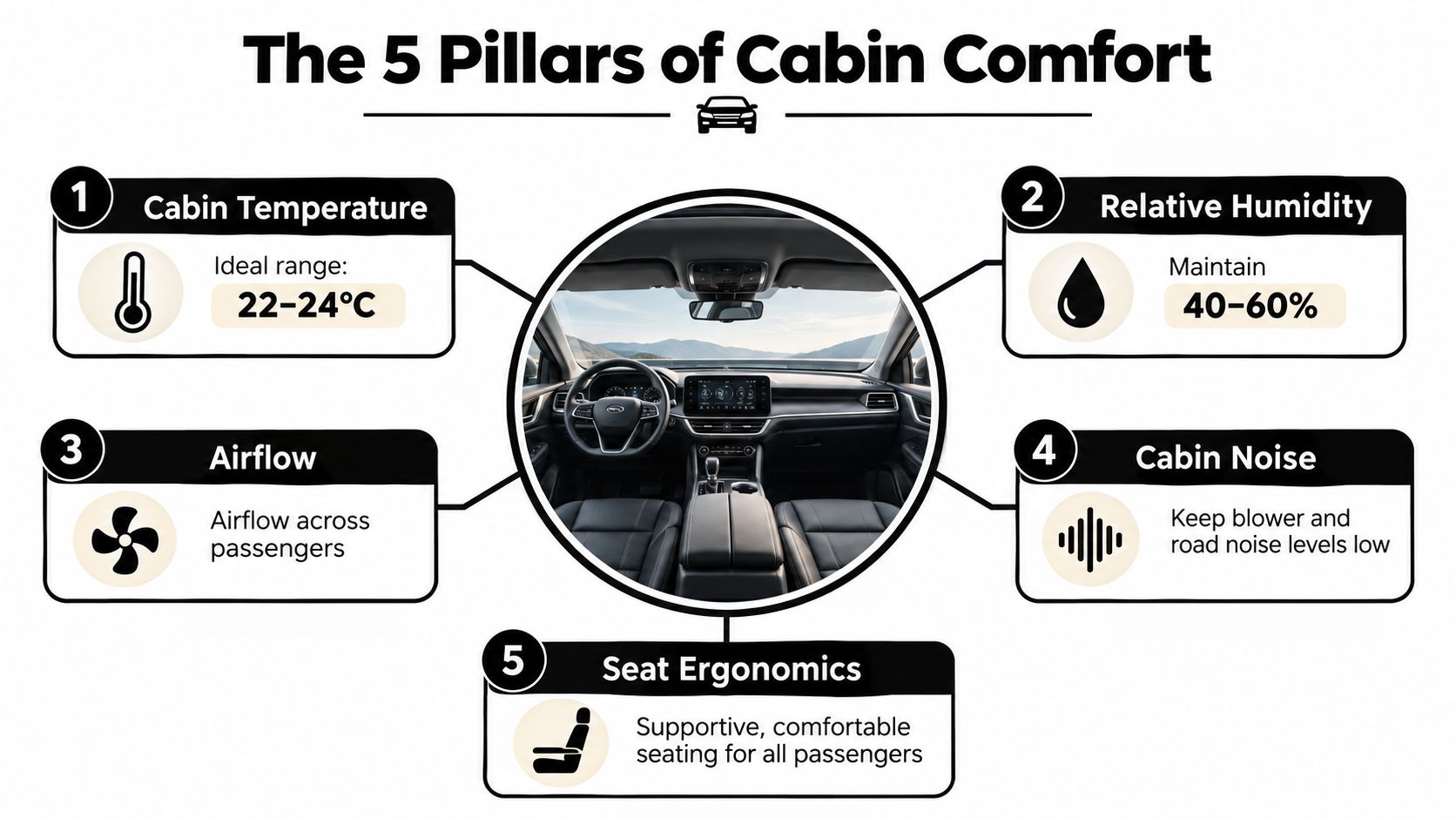
A cabin can therefore feel wrong even when the temperature appears acceptable. If humidity is high, airflow is uneven, the blower is intrusive, or outside odours remain trapped, passengers will register discomfort through more than heat alone.
Temperature, Humidity, Airflow, and Cabin Feel
The most useful way to tune a transfer cabin is to treat each factor as part of one moving environment. Doors open at pickups, sunlight enters through glass, several passengers add body heat, and luggage can restrict the space around vents. The settings that feel right on an empty vehicle may need modest adjustment once the journey is underway.
UK guidance provides several reference points rather than one universal vehicle setting. CIBSE-based guidance places office comfort-cooling setpoints around 22 to 24°C, and around 21 to 23°C where air conditioning is used, with relative humidity ideally between 40 and 60% and generally within 40 to 70%, as outlined in CIBSE Guide B. Those figures describe buildings, not a specific minibus, but they provide a useful technical frame for passenger comfort.
Practical cabin targets
For many transfers, a sensible working preference is a cabin around the lower part of the UK comfort range, without forcing every passenger into the same experience.
| Factor | Target Range | Why It Matters |
|---|---|---|
| Cabin temperature | About 20 to 23°C | Limits heat stress without creating an abrupt cold shock after boarding |
| Relative humidity | About 40 to 55% | Helps the cabin feel fresh and dry without irritating eyes or throat |
| Airflow | Gentle and distributed | Prevents one seat from receiving a harsh draught while others remain warm |
| Blower noise | Low and steady | Supports conversation, rest, and a calmer post-flight experience |
| Air quality | Filtered with appropriate fresh-air changes | Reduces stale odours and limits the sense of recycled air |
Humidity deserves particular attention. At the upper end of a damp day, a cabin may feel oppressive even after the air temperature has fallen. Lowering the temperature further can make one passenger cold without solving the underlying sensation, so dehumidification and controlled ventilation are more useful than just turning the dial down.
Airflow design creates another common trade-off. A front vent aimed directly at a face produces immediate cooling, but it can lead to dry eyes, a cold shoulder, or an uncomfortable draught. Wider distribution, rear vents, and roof-mounted outlets help move air through the passenger area more evenly.
Ventilation and recirculation
Recirculation can cool a loaded cabin efficiently because the system conditions air that has already been cooled. It shouldn't become a permanent substitute for fresh-air management, particularly after a full group has been travelling for some time. A sensible approach uses filtration and controlled ventilation, then resets the cabin between passenger groups where operationally possible.
Solar gain also changes the experience from one seat to another. A passenger beside a sunny window can feel warmer than someone in the shaded centre aisle even when both are in the same air mass. Window shades, seat-level vents, and modest zone adjustments often work better than a large temperature change for the entire vehicle.
How Different Vehicles Shape the Comfort Experience
Vehicle size changes the problem. A saloon has a relatively small air volume and can cool quickly, but a minibus has more seats, more glass, more luggage movement, and greater distance between the front and rear passengers. Travellers should choose a format based not only on capacity, but also on how long the transfer will last and how much boarding activity the journey involves.
| Vehicle Format | Best For | Cabin Cooling | Air Distribution | Noise Level | Luggage & Group Capacity |
|---|---|---|---|---|---|
| Saloon car | Individuals or small parties | Rapid response in a compact cabin | Usually concentrated around the front | Often quiet | Limited luggage and seating |
| MPV | Families needing easier access | Good balance between volume and response | Better reach into the second row | Generally moderate | More flexible space for luggage and passengers |
| Minibus | Groups, cruise transfers, and substantial luggage | Requires more time to stabilise after doors open | Needs rear vents, roof outlets, or multiple zones | Depends on insulation, road surface, and blower setting | Suits larger groups and coordinated luggage handling |
Saloons and MPVs
A saloon can feel settled quickly because the conditioned space is compact. The trade-off is that luggage may compete with passenger space, and rear occupants can have fewer independent airflow options. It works well for short hotel journeys or small parties travelling light.
An MPV gives passengers more headroom and easier rear access. Its larger cabin takes longer to recover after boarding, but vents can often reach the second row more effectively than in a saloon. This format suits families, passengers with mobility considerations, and groups carrying more than hand luggage.
Minibuses and longer runs
A minibus provides the room that cruise passengers often need, particularly when several suitcases must be loaded without compressing the passenger area. The larger volume also creates real engineering demands. The front may cool before the rear, doors may open repeatedly at a cruise terminal, and passengers seated near glass can receive more solar heat.
That's why rear distribution and multi-zone control matter. The system needs to move conditioned air beyond the driver's area, while the driver must monitor how the cabin feels rather than relying only on the front display.
For a clearer view of how vehicle formats and features are presented, review the EC Minibus fleet. The right choice depends on group size, luggage, access needs, and the expected length of the airport, hotel, or cruise-port journey.
Smart Passenger Habits for a Cooler Cabin
Passengers can't redesign the climate system, but small choices can improve comfort quickly. The most effective approach is cooperative: give the vehicle time to work, reduce unnecessary heat entering the cabin, and tell the driver what feels wrong before the adjustment becomes disruptive for everyone.
A simple boarding checklist
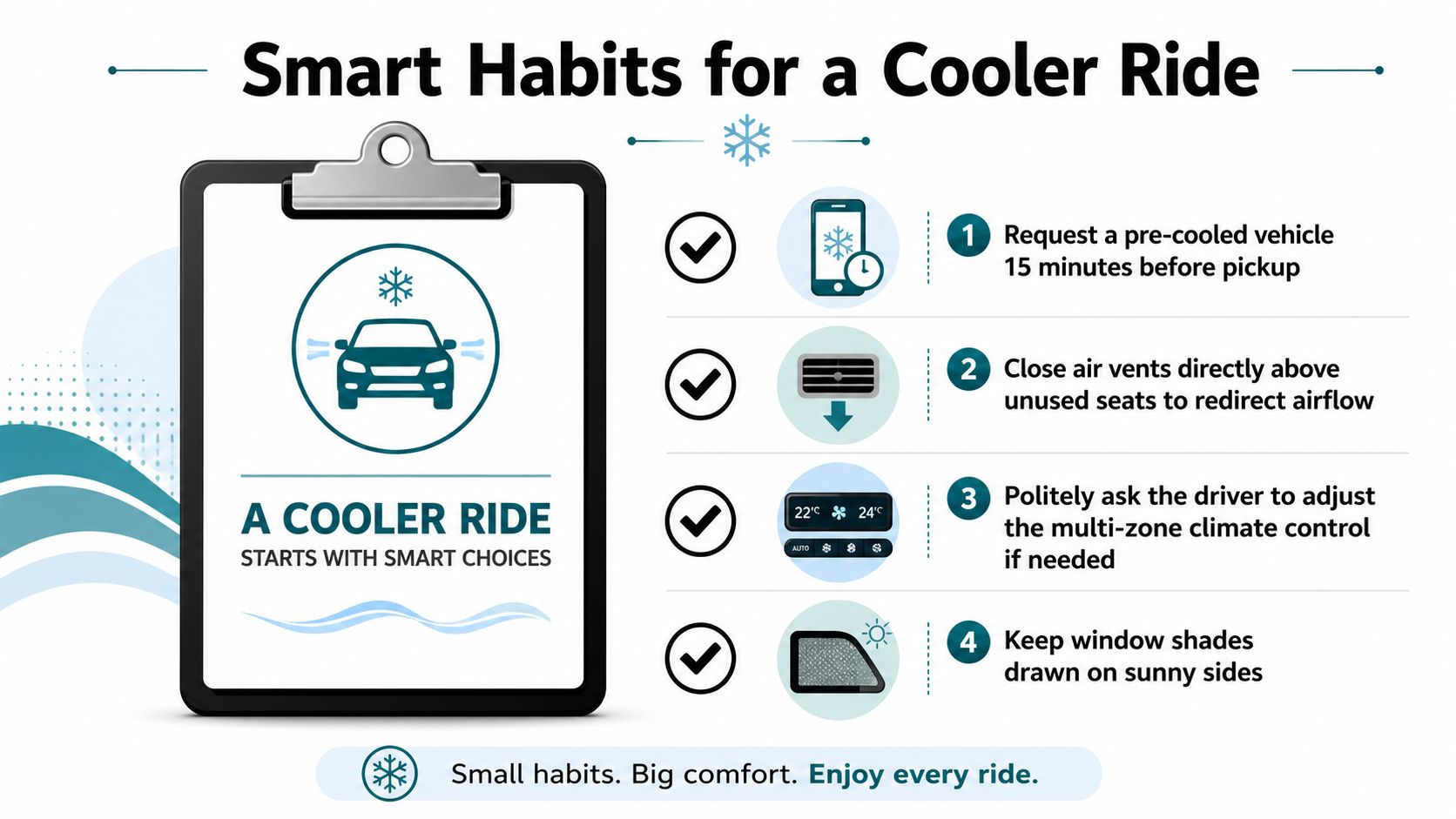
- Request a pre-cooled vehicle: If the journey follows a long flight or a hot day, ask whether the cabin can be prepared before pickup. This allows the interior surfaces and seats to lose stored heat rather than relying on a sudden blast after boarding.
- Use vents selectively: Close or redirect a vent above an unused seat if the design allows it. That can reduce wasted airflow, but don't block outlets needed to reach the rear rows.
- Ask for a zone adjustment: A polite request such as “Could we reduce the airflow on this seat?” gives the driver useful information without asking for an uncomfortable temperature change across the whole cabin.
- Manage sunlight: Keep shades drawn on the sunny side where available. Reducing direct solar load can make a seat feel cooler without lowering the system setting.
Clothing also affects the result. A jumper worn on a cold aircraft may become uncomfortable inside a conditioned vehicle, while a light layer helps passengers adapt between an airport, a shaded kerb, and a cooler cruise terminal. Keep the layer accessible rather than buried in checked luggage.
Hydration helps after a dry flight, particularly during a summer transfer, but extremely hot drinks can add to the perception of warmth while the cabin is settling. Choose a drink that suits the journey and keep bottles secure so the driver doesn't need to make avoidable adjustments.
If you feel uncomfortable, speak up early and describe the problem precisely. “The air is blowing directly on my neck” is more useful than “the air conditioning isn't working,” because the driver can redirect airflow instead of making the entire cabin colder.
This short video offers a visual reminder of practical vehicle-cooling habits:
How EC Minibus Engineers Comfort End to End
Comfort depends on coordination between the vehicle, the dispatcher, and the driver. A climate system may have enough capacity, but passengers will still feel uncomfortable if the vehicle arrives hot, the rear vents aren't checked, or the driver has no useful information about a delayed flight or ship disembarkation.
A practical operating sequence links each part of the comfort definition to a specific action:
Vehicle selection
Late-model saloons, MPVs, and minibuses can be matched to the group rather than treating every transfer as the same journey. Multi-zone climate control helps separate front and rear needs, while roof-mounted evaporators can distribute conditioned air through a larger passenger area. Cabin insulation also has a role, because reducing compressor and road noise allows the blower to run without dominating conversation.
Particulate filtration supports the air-quality side of comfort. It won't remove every source of odour or replace proper ventilation, but a maintained filter helps the cabin feel cleaner than a vehicle that recirculates unfiltered air.
Pre-journey preparation
Flight and cruise monitoring gives the operation a better chance to prepare the cabin at the right time. If a flight is delayed or a ship disembarks later than expected, the driver and dispatcher can avoid leaving passengers waiting beside an unprepared vehicle. Pre-conditioning before luggage is loaded also means the system isn't starting from the hottest possible interior.
Temperature policies should favour a stable, reasonable range rather than extremes. No-recirculation resets between passenger groups, system checks, and attention to unusual smells help protect the fresh-air experience across separate bookings.
On-road adjustments
The driver manages more than the steering wheel. Quiet driving reduces road noise, while small climate adjustments can respond to sunlight, door openings, and passenger feedback without creating a dramatic swing for the whole cabin.
Operational visibility supports that process. Passenger updates and live journey information, such as the mobile app tracking service, help coordinate the pickup without unnecessary waiting or rushed boarding.
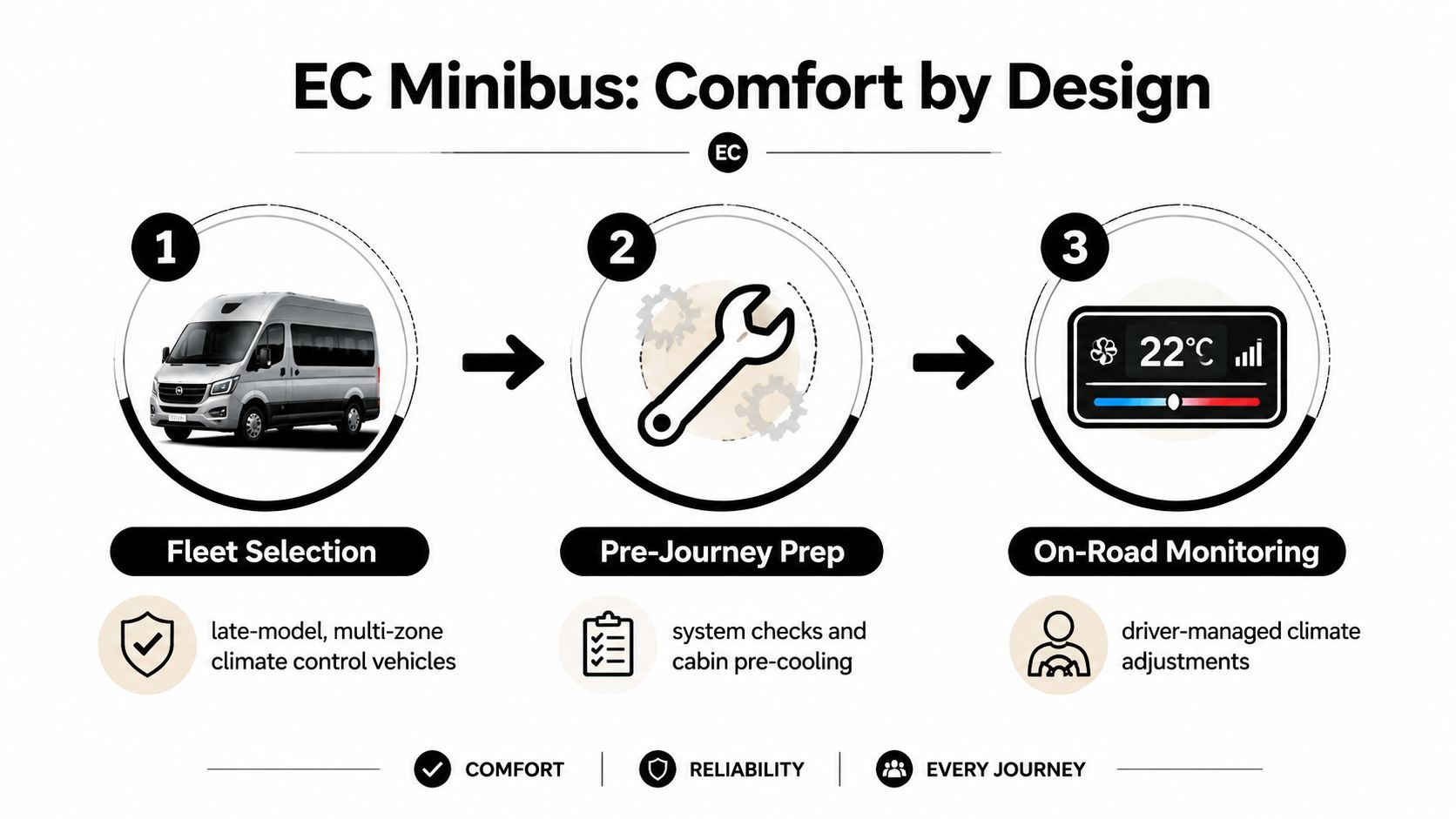
The result isn't a single impressive setting. It's a chain of small decisions that address temperature, humidity, airflow, noise, and air quality before and during the transfer.
Comfort Is a System, Not a Setting
Lowering the temperature doesn't automatically improve air conditioning comfort. Cold air blown hard into a warm, humid cabin can feel worse than a slightly warmer interior with steady airflow, controlled moisture, clean filtration, and a quiet blower.
UK building guidance illustrates why comfort is managed through balance. Glasgow's 2025 guidance gives cooled offices a summer target of 24°C and teaching spaces 23°C, while naturally ventilated spaces can use an acceptable operating range of 18°C to 28°C during operating hours, according to the University of Glasgow thermal comfort guidance. The same document notes that cooling systems should generally not exceed 120% of design cooling load and should achieve a minimum seasonal energy efficiency ratio of 4.0 in cooling mode. Those principles reinforce a useful transfer lesson, oversized or overly aggressive cooling isn't the same as comfort.
A comfortable Heathrow or Southampton pickup feels prepared rather than dramatic. The cabin is already settled when the luggage is loaded, the blower runs, filtered air moves evenly through the passenger area, and the driver watches the road instead of constantly chasing the temperature dial.
Passengers step out calm, alert, and ready for the hotel, rail station, or ship. That's the practical meaning of air conditioning comfort, a complete system working in the background.
EC Minibus provides private, door-to-door transfers between Heathrow, London hotels, and UK cruise ports in modern, fully air-conditioned saloons, MPVs, and minibuses, with flight and cruise monitoring to support well-timed pickups. Visit EC Minibus to choose a vehicle for your group, confirm your journey, and arrange a calmer transfer from arrival to destination.