

You've just landed at Heathrow after a long-haul flight. Your bags are off the belt, your phone battery is slipping, and the cruise line has already made it clear that the ship won't wait for late arrivals. That's the airport to cruise port problem, not “how do I get there?”, but “how do I get there on time, with luggage, without gambling my holiday on traffic or a delayed train?”
Southampton is the UK's largest cruise port, with around 3 million cruise passengers in 2025 according to the current cruise-port ranking data, which is why airport-to-port transfers have become a routine part of UK cruise logistics (busiest cruise ports by passengers). Heathrow remains the main long-haul gateway for many North American travellers heading to Southampton and other south coast ports, so this journey is usually a road transfer, not a simple hop across town. If you treat it like a standard taxi ride, you're setting yourself up for avoidable stress.
The smart way to think about it is simple. This is a timed connection with a cruise check-in window, motorway risk, and luggage friction. You're not just buying transport, you're buying reliability.
Table of Contents
- Why the Airport to Cruise Port Leg Matters More Than You Think
- Comparing Transfer Options from Heathrow to UK Cruise Ports
- How to Book and Prepare Your Cruise Port Transfer
- The Real Cost of Getting from the Airport to the Cruise Terminal
- Planning for Delays and Missed Connections
- Essential Checklist and FAQs for Cruise Transfers
Why the Airport to Cruise Port Leg Matters More Than You Think
A couple lands at Heathrow at breakfast time, clears customs, waits for luggage, and then realises their ship from Southampton stops boarding long before they'd casually hoped. That's where the whole day can go wrong. The airport to cruise port leg looks short on a map, but it behaves like a time-sensitive connection, not a sightseeing transfer.
The real constraint is the clock, not the postcode
Southampton, Dover, Portsmouth and Tilbury are all cruise hubs that sit outside the airport system, so the transfer depends on roads, timing, and how well the driver knows the port handoff. Heathrow is especially important because it functions as the main long-haul gateway for travellers coming into the UK for cruises on the south coast. The journey from airport to terminal must absorb flight delays, immigration queues, luggage collection, and then whatever the M25 decides to do that day.
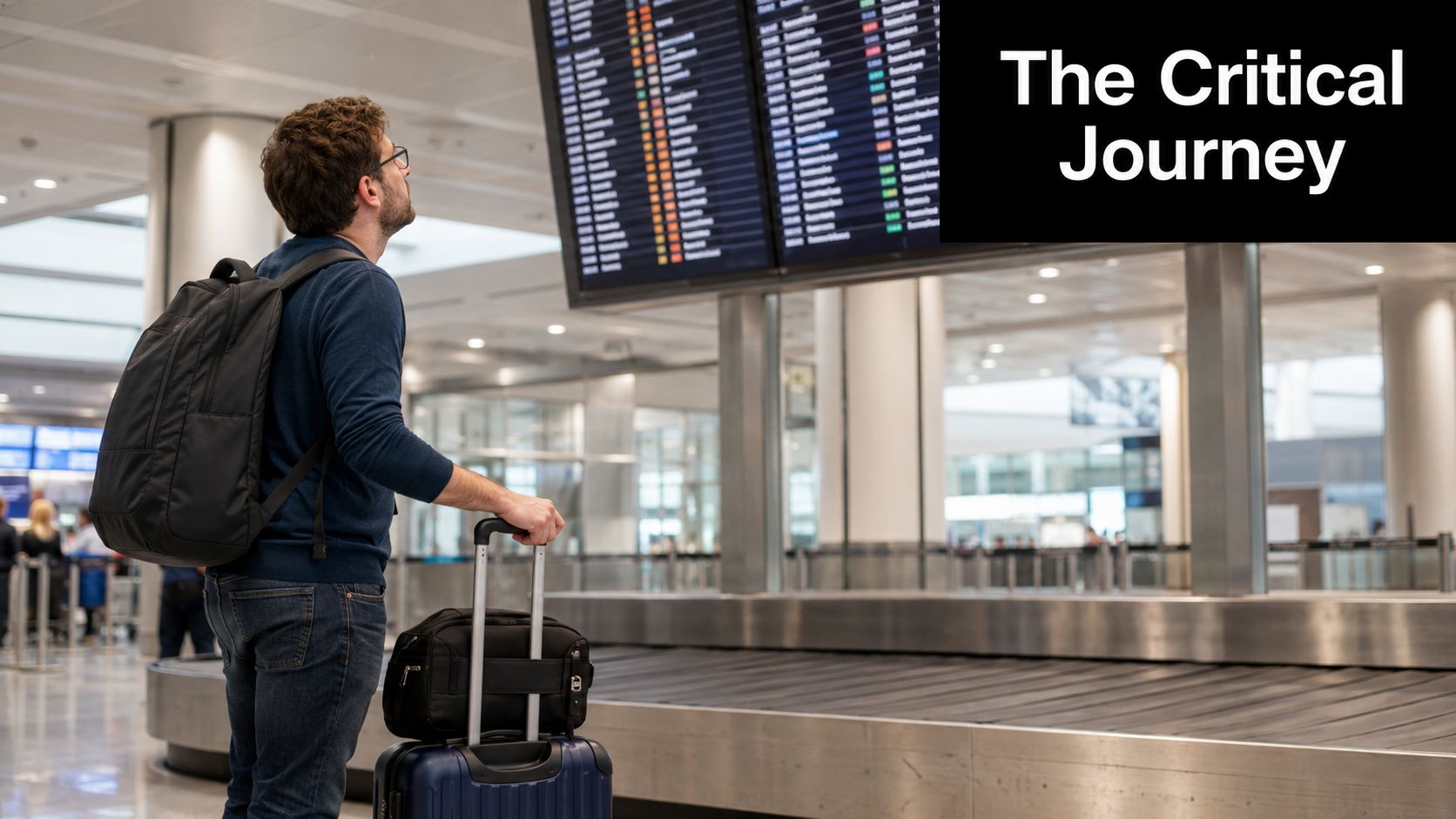
A cruise passenger can't “make up time” once the ship's check-in closes. That's why a transfer needs to be planned around the embarkation window, not just mileage. The port and the airport are connected by a road corridor that can look smooth in advance and turn messy in real life.
Practical rule: if your cruise departure is same-day, treat the transfer as part of the boarding process, not as travel after arrival.
Why private planning beats improvisation
Cruise passengers often arrive tired, carrying more luggage than they expected, and moving with family groups or older relatives who don't want a chain of changes. A taxi queue, an unhelpful train connection, or a shuttle that doesn't align with your flight can turn a holiday into a logistics exercise. The safest approach is to pre-book a fixed pickup, with the exact terminal name, flight details, and cruise ship information already in the booking.
This matters even more in the UK because the port transfer is almost always a multimodal move, especially for travellers landing in London and heading south. The more people in the group, the more the hidden costs of confusion show up in the form of delays, missed handoffs, and excess stress. If you want the trip to feel easy, the transfer has to be choreographed before you land, not after.
Comparing Transfer Options from Heathrow to UK Cruise Ports
The best transfer is the one that survives real-world pressure. That means luggage, delay risk, family size, and whether you're landing tired after a long-haul flight. A cheap headline fare can look clever and still be the wrong call if it forces two changes, a drag across a station, and a taxi at the other end.
What each option actually does well
Private transfers are the simplest choice for cruise passengers because the driver meets you, loads the bags, and goes directly to the port. That's the main reason many travellers prefer a door-to-door service over piecing together rail tickets and local cabs. A pre-booked taxi or black cab can also work well for smaller groups, but it's weaker when you have a lot of luggage or need flight monitoring.
Train plus local taxi is the weakest option for most cruise passengers arriving at Heathrow. It can look affordable on paper, but it introduces multiple handoffs, platform changes, and baggage handling that gets old fast after an overnight flight. Shared coaches and cruise-line shuttles can suit solo travellers or couples who aren't in a hurry, but they usually trade convenience for waiting time and less control over pickup.
If your group includes older travellers, children, or more than a couple of large bags, the direct option usually wins on comfort and predictability.
Heathrow to Cruise Port Transfer Options at a Glance
| Transfer Option | Typical Journey Time | Luggage Capacity | Best For | Delay Resilience |
|---|---|---|---|---|
| Private minibus or chauffeur transfer | Direct door-to-door road transfer | Strong for multiple suitcases and family bags | Families, older travellers, cruise groups, passengers who want one handoff | High, especially with flight monitoring and a fixed pickup |
| Black cab or pre-booked taxi | Direct road transfer | Good for moderate luggage, less ideal for oversized bags | Couples, small parties, short-notice bookings | Medium, depends on availability and traffic |
| Train plus local taxi | Multi-leg journey | Limited by your ability to carry everything through stations | Light packers, experienced UK rail users | Low, because missed trains and station changes add risk |
| Shared coach or cruise-line shuttle | Group transfer with other passengers | Varies, often less flexible with bulky bags | Budget-conscious travellers with simple itineraries | Medium to low, because timings are fixed to the group |
For a straightforward service overview, this airport shuttle services guide is useful reading if you're comparing door-to-door ground transport models.
My blunt recommendation
If you're landing at Heathrow and cruising from Southampton, Dover, Portsmouth, or Tilbury, book private if your schedule is tight or your bags are heavy. Use a taxi only if your group is small and you're happy with the fare and availability. Use rail only if you enjoy carrying luggage through stations and you've already built in a wide buffer.
For travellers who want a direct airport-to-port booking with meet-and-greet and monitoring, EC Minibus is one example of a private transfer provider operating this corridor. The service model matters more than the brand name, though, because the winning feature is always the same, one pickup, one vehicle, one drop-off.
How to Book and Prepare Your Cruise Port Transfer
Booking the right transfer is mostly about giving the operator the right facts. If you leave out the terminal, luggage profile, or cruise check-in window, you're inviting a mismatch before the journey even begins. A good booking should feel precise, not vague.
The details you need before you book
Start with the cruise terminal name, not just the port city. Southampton has multiple terminals, and the driver needs the exact handoff point to avoid confusion on arrival. Add your flight number, arrival time, passenger count, number of suitcases, and whether anyone in the group needs mobility support.
A licensed provider should be able to confirm the pickup in writing and explain how they handle flight delays. The transfer-policy research in the brief points to the same practical truth every time, unclear handoff rules and weak schedule coordination are the most common failure points in transfer systems (TCRP transfer-policy research). That means your confirmation is not paperwork, it's protection.
What a proper Heathrow meet-and-greet looks like
At Heathrow, a professional driver waits at the agreed arrival point with your name or booking reference visible, then helps you with luggage and guides you to the vehicle. The driver should already know your cruise ship, and if your flight runs late, the provider should track it and adjust pickup time automatically. That's the difference between a real transfer service and a vague promise to “watch for you”.
Do this 24 hours ahead: reconfirm the flight number, cruise terminal, passenger count, and luggage count in writing. That one habit cuts out most awkward surprises.
Keep the rest of the itinerary simple
If you're staying in London before or after the cruise, separate the hotel transfer from the port transfer and book both cleanly. Don't assume a driver will improvise around a hotel change, a luggage drop, and a cruise departure all at once. If you need a return journey from the port back to Heathrow, book it before you sail so you're not trying to solve ground transport on disembarkation morning.
For a booking-style overview of direct transfers, this door-to-door cruise transfers guide gives a clear picture of how a fixed pickup works in practice.
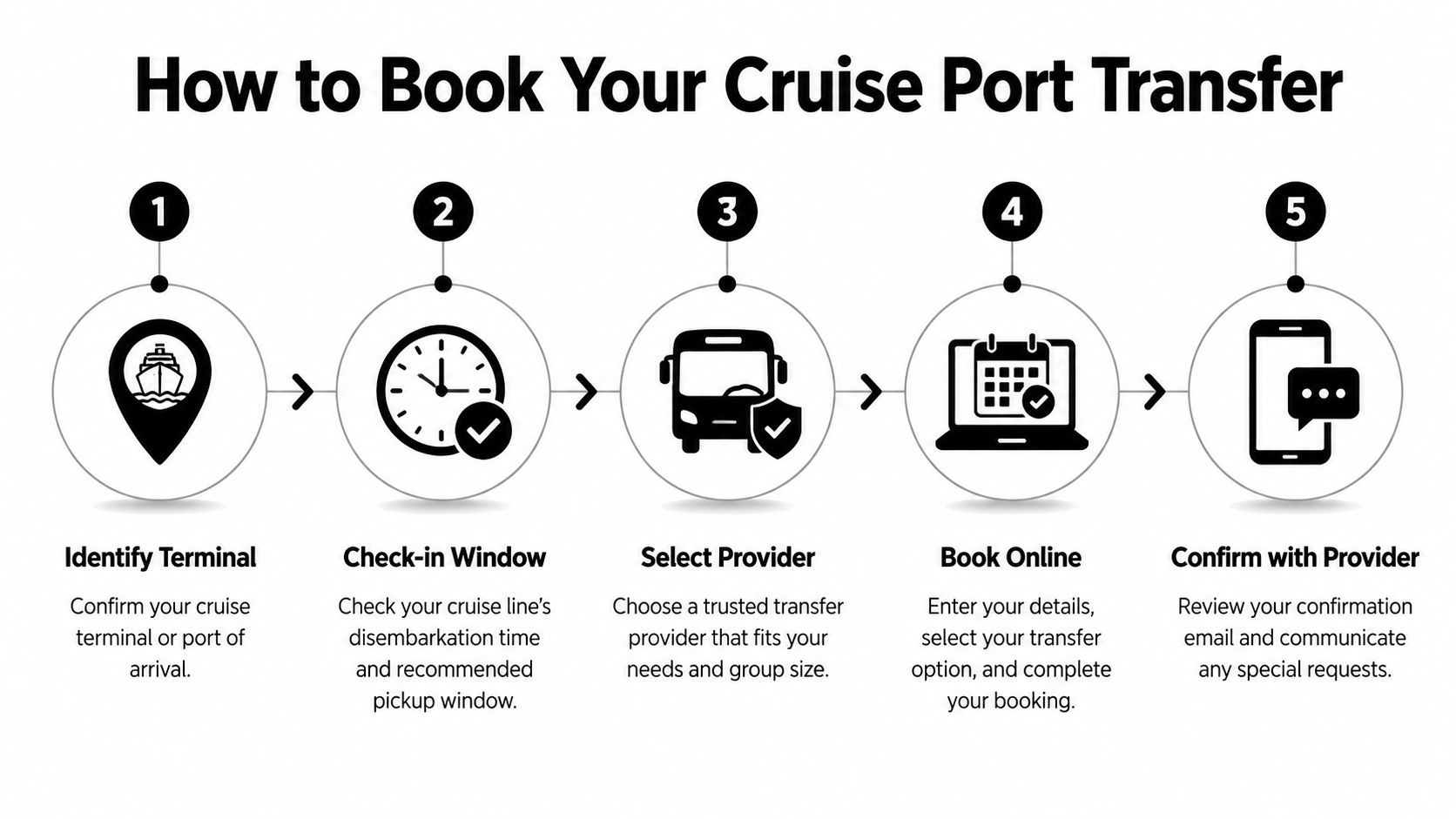
The booking sequence is straightforward. Identify the terminal, check the cruise line's boarding window, choose a provider that handles flight monitoring, reserve online, and then confirm the details the day before. That's the minimum standard if you want the transfer to feel boring, which is exactly what you want on embarkation day.
The Real Cost of Getting from the Airport to the Cruise Terminal
Headline prices mislead cruise passengers all the time. A cheap rail ticket looks clever until you add a taxi at either end, extra bag handling, and the time cost of dragging luggage through stations. Once you total the whole journey, the “budget” option often stops being budget.
Compare the full door-to-door picture
A couple with two large suitcases usually values simplicity more than a solo traveller with a backpack. A family of four has even less tolerance for handoffs, especially if children are tired after the flight. A small group of friends sharing a vehicle can often make a private transfer look far more sensible once the cost is divided.
The question is not which option has the lowest sticker price, but which one gives you the lowest reliable door-to-door cost. That means including last-mile taxis, luggage stress, and the risk of a missed connection. The brief's travel guidance also makes the broader point that the cheapest option on paper can become expensive in time and stress when cruise-day constraints are added (Direct Line Cruises transfer guidance).
Where the value changes by traveller type
For a couple, a train might seem like a good deal until the changeovers start. For a family, that same route becomes awkward fast because every extra bag and every extra platform multiplies the effort. For a small group, a private vehicle often spreads the cost so neatly that it stops looking like a premium choice and starts looking like the sensible one.
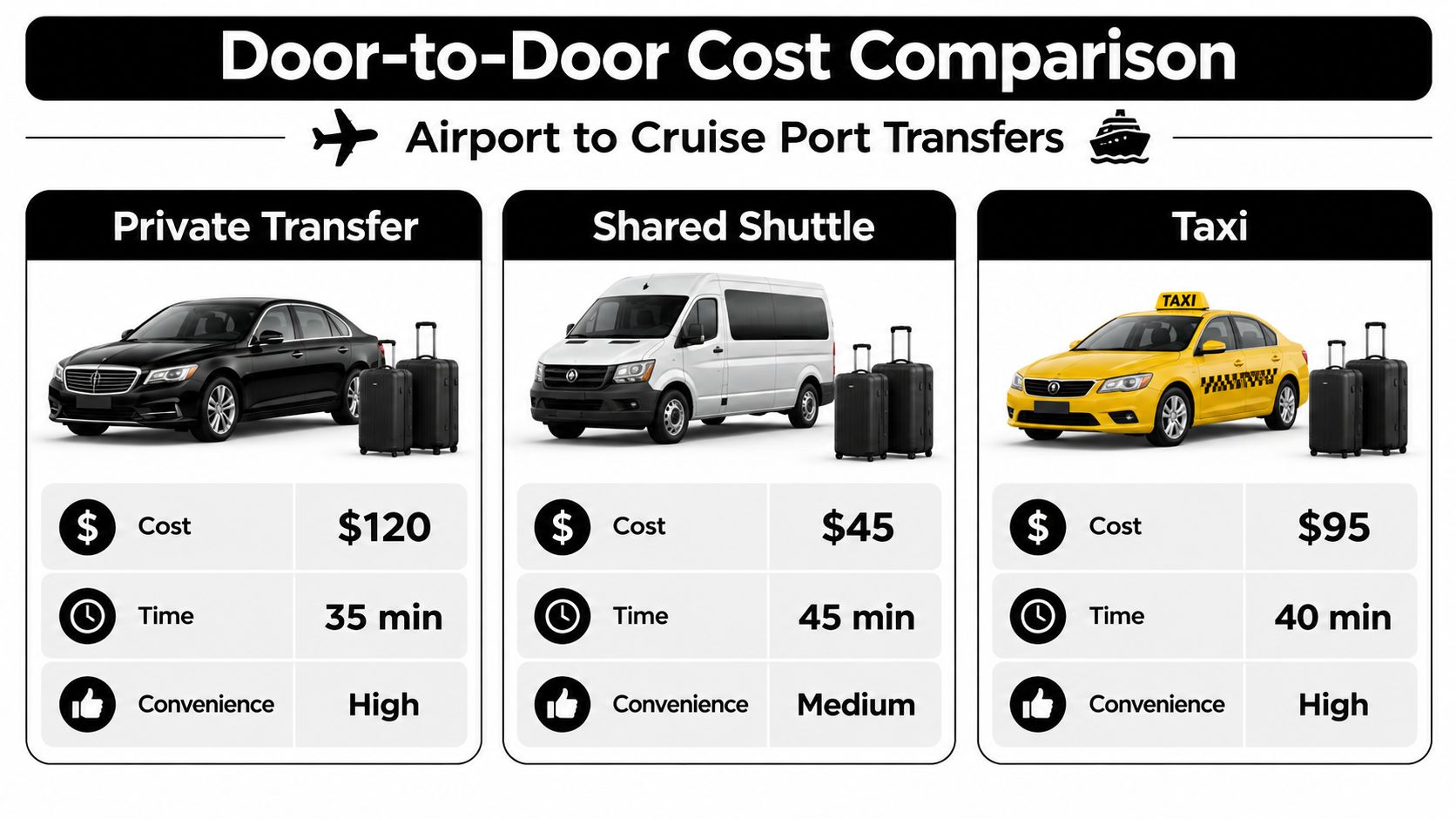
The sensible way to judge value is to ask one blunt question. How much time, effort, and uncertainty am I buying back? If the answer is “a lot”, the higher fare may be the cheaper decision.
A transfer that gets you to the terminal calm, early, and with your bags intact is often better value than a bargain route that arrives with you frazzled.
Planning for Delays and Missed Connections
Cruise transfers fail when passengers pretend the journey is routine. It isn't. The route from Heathrow or central London to a cruise port can be disrupted by flight delays, rail problems, or motorway works, and the M25 can make a clean plan look overconfident very quickly. If your holiday depends on same-day embarkation, you need a fallback plan, not optimism.
Build a buffer that matches the risk
The safest choice is to treat the transfer as part of your cruise check-in window, not the time after landing. That means allowing enough room for baggage reclaim, customs, loading, and road traffic before you even think about walking through the terminal doors. If the route depends on the M25, or if you are considering rail during a period of disruption, private road transfer becomes the cleaner option because it removes station changes and gives the driver more flexibility.
National Highways reported major works and closures affecting the M25 in 2025 to 26, and Transport for London continues to publish live disruption and engineering-works updates. That doesn't mean every day is a problem, but it does mean generic “allow extra time” advice is too weak to be useful. You need a plan that assumes something could move against you.
Choose the fallback before you travel
If your flight arrives late in the day, arrive the day before and book a hotel near the port. If your flight is early and your cruise check-in window is broad, a same-day transfer can still work, but only with a fixed pickup and clear monitoring. If you're travelling with older relatives, children, or lots of luggage, the extra night is usually worth more than the risk you'd save by not taking it.
For late availability and short-notice scheduling, this last-minute availability note is a useful reminder that good ground transport sells out for a reason.
Use this decision rule
- Arrive the day before if your flight is long-haul, arrives in the afternoon, or has any realistic chance of being delayed.
- Book same-day private transfer if you land early, have one port to reach, and want flight monitoring built into the booking.
- Avoid rail on a tight cruise day if you'd have to cross London, switch stations, or drag heavy luggage through disruption-prone routes.
The rule is simple. If missing the ship would ruin the trip, don't build your transfer around luck.
Essential Checklist and FAQs for Cruise Transfers
A good cruise transfer is won or lost before you leave home. The passengers who stay calm are the ones who have already checked the terminal, the luggage, and the pickup details. The ones who panic are usually the ones who assumed “we'll sort it at the airport”.
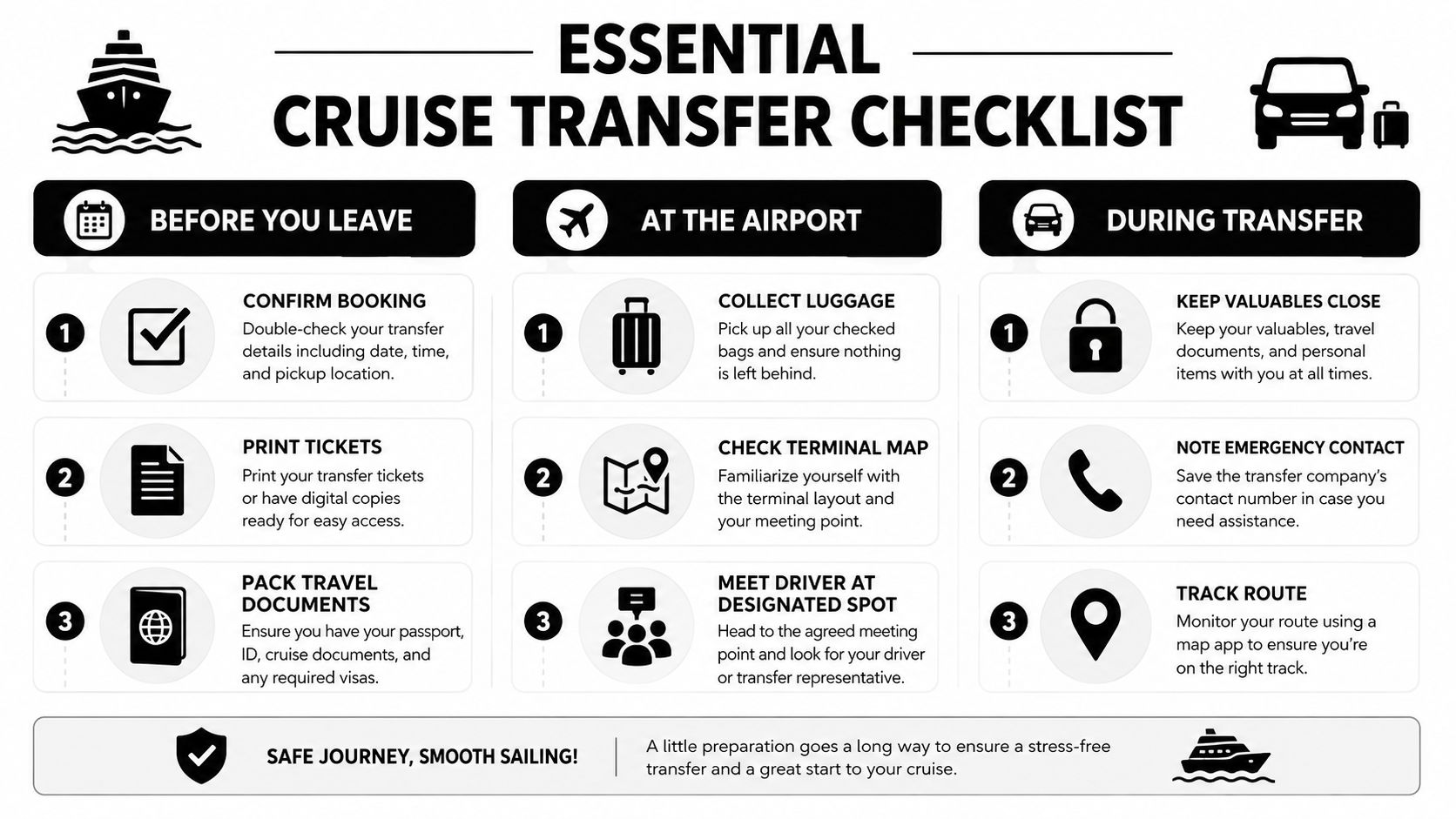
Keep this checklist close
- Before you leave: confirm the cruise terminal, check your booking confirmation, and print or save every travel document in one place.
- At the airport: collect all luggage before looking for your driver, and head to the agreed meet point instead of wandering the arrivals hall.
- During the transfer: keep passports, wallets, medication, and phones with you, not buried in checked bags.
- Before boarding the ship: recheck that your bag count matches what you told the transfer provider.
Quick FAQs
What if my flight arrives very early?
That usually helps, but don't assume the port will accept you immediately. Use the extra time for a hotel stop, a lounge, or a careful transfer rather than wandering with luggage.
What if my flight arrives very late?
Do not gamble on same-day embarkation unless the cruise line and transfer provider have both confirmed the timing. In most cases, the safer answer is to stay near the port overnight.
Can private transfers provide child seats?
Some can, but you need to request this when you book. Don't assume the vehicle will have one waiting.
What if my cruise itinerary changes after I book?
Tell the provider immediately. The terminal, ship, or embarkation window may change, and the booking needs to be updated before travel day.
If you're moving between Heathrow, London, and Southampton or another UK cruise port, EC Minibus can handle the door-to-door transfer side of the trip with meet-and-greet, flight monitoring, and direct port links. If you want that kind of fixed, luggage-friendly transfer, visit EC Minibus and book the ride before embarkation day turns into a guessing game.