

A new driver can appear ideal on paper. They arrive on time for the interview, speak confidently about customer service, and hold the correct-looking documents. Yet a passenger transfer involves more than a successful conversation. The employer may be trusting that person with passengers, luggage, vehicle access, travel information, and responsibility for a safe journey.
That's why background check procedures should be treated as a layered trust system, not a single search for criminal records. Identity, right to work, criminal-record information, driving history, and employment references answer different questions. Used together, they help an employer make a proportionate decision while giving applicants a clear, fair process.
Table of Contents
- Why Background Checks Matter Before You Hire
- How Background Check Procedures Work as a Layered System
- Types of Checks Every Employer Should Understand
- Step by Step Workflow From Consent to Recordkeeping
- UK Legal Compliance Frequency and Common Pitfalls
- How EC Minibus Vets Drivers to Protect Passengers
- Putting It All Together and Next Steps for Safer Hiring
Why Background Checks Matter Before You Hire
A hiring decision often begins with limited information. An application shows what someone says about their experience. An interview shows how they communicate in a particular setting. Neither proves that the applicant is the person named on the application, has permission to work, holds the required driving entitlement, or is suitable for a role involving passengers.
For a transport operator, the practical stakes are easy to understand. A driver may collect a family at Heathrow, meet an older passenger at a cruise terminal, or carry a business group between a hotel and a rail station. The customer expects the person arriving at the meeting point to be identifiable, authorised to work, properly licensed, and suitable for a position of trust.
Practical rule: A check should answer a specific risk question. If nobody can explain what a check is meant to verify, it may not belong in the hiring process.
Background screening also protects applicants. A structured process gives every candidate the same route to provide identity evidence, explain a discrepancy, and understand how information will be used. That's fairer than allowing an informal impression, an unverified allegation, or an inconsistent reference to determine someone's future.
The UK system shows how seriously screening is measured. The Disclosure and Barring Service aims to issue 75% of disclosures within 14 calendar days, 90% within 28 days, and 99% within 60 days, while its police-force standards set separate completion milestones. These targets, described in the DBS performance and statistics guidance, show that checking is treated as an organised public-service process, not an informal employer search.
The same guidance recognises that roles call for different levels of disclosure. A basic check may be appropriate for one position, while an enhanced check or an enhanced check with barred-list information may be relevant to a role with particular safeguarding responsibilities. The right outcome isn't “the most checks possible”. It's a defensible match between the role, the risk, and the evidence required.
How Background Check Procedures Work as a Layered System
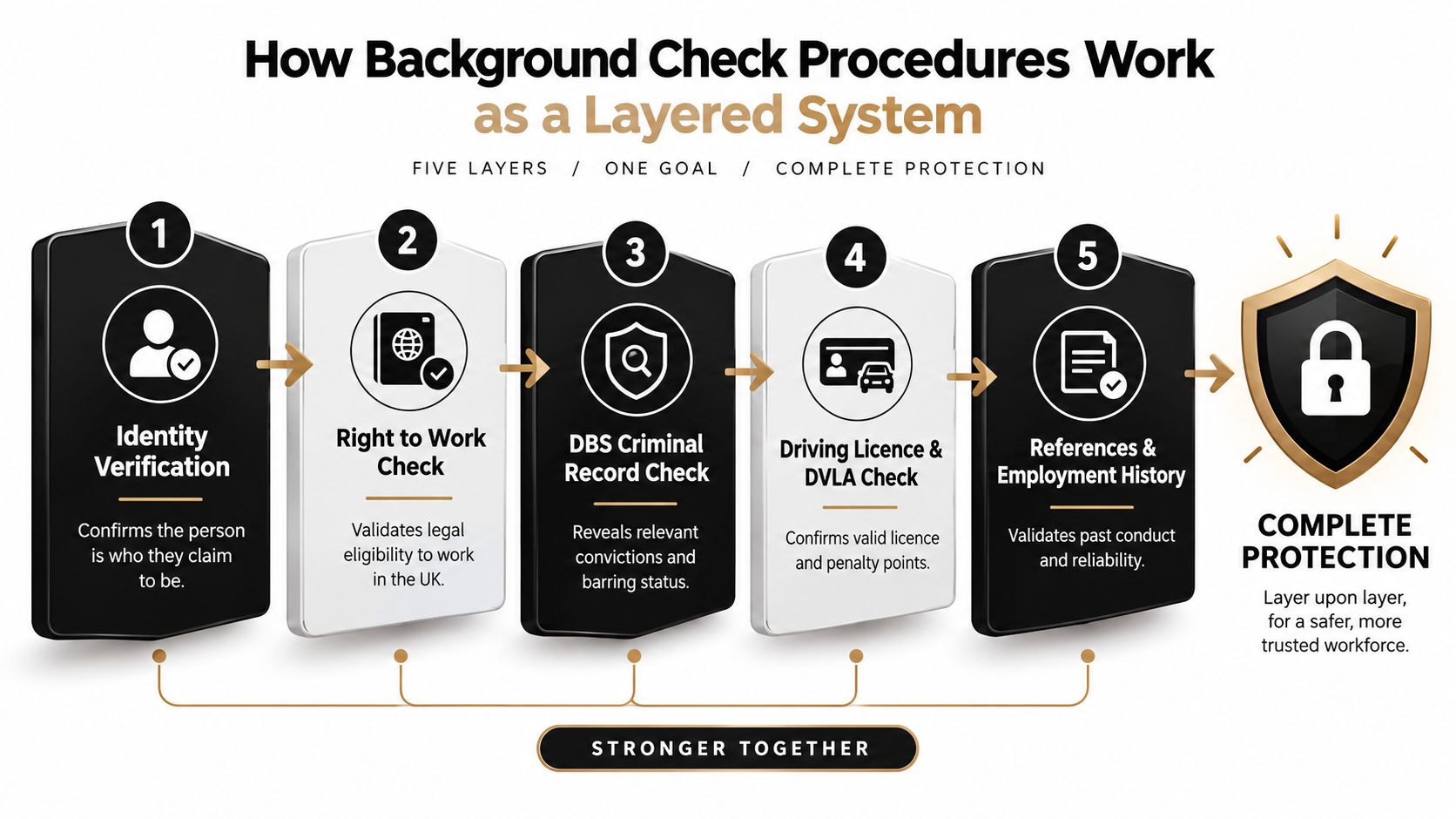
Think of hiring as opening a secure gate. One lock confirms the person's identity. Another confirms their legal ability to work. Further locks address criminal-record eligibility, driving responsibility, and reliability at work. If one lock is missing, the gate may still open, but the employer has a weaker basis for trusting the result.
The five questions behind the gate
Identity verification asks, “Is this applicant the person they claim to be?” The employer compares identity documents and checks consistency across names, dates of birth, and supporting evidence. A criminal-record result or right-to-work decision attached to the wrong person is not a safe result.
Right-to-work verification asks, “Can this person legally work in the UK in this role?” It's a separate control from criminal-record screening. The Home Office permits manual checks, online checks using a share code, and checks through an identity service provider using identity document validation technology, as set out in its employer right-to-work guidance.
DBS screening asks, “What disclosure level is legally available and relevant for this role?” It may reveal conviction information at the level permitted by the check, and some eligible roles can involve barring information. A DBS certificate doesn't confirm driving competence, work authorisation, or general character.
Driving checks ask, “Can this person lawfully and responsibly perform the driving duties?” A valid licence and a review of relevant licence information address a risk that a criminal-record check cannot.
References and employment history ask, “Does the applicant's account of previous work stand up to verification?” A reference can support a hiring decision, but it shouldn't be treated as a substitute for identity, right-to-work, DBS, or driving checks.
The applicant supplies information and consent. The employer selects checks based on the role, follows the applicable process, reviews results fairly, and records the decision. The DBS, Home Office, DVLA-related services, identity providers, and referees each contribute a different piece of evidence.
A single clean result can't answer every question. A layered process avoids both false reassurance and unnecessary screening.
Types of Checks Every Employer Should Understand
The best check depends on the job. A passenger driver, a booking administrator, and a vehicle cleaner may all work for the same business, but they don't create identical risks. Employers should define the duties first, then select checks that relate directly to those duties.
The main checks and their limits
Identity validation confirms that the documents belong to the applicant and that the information is consistent. It doesn't establish a person's suitability or legal right to work by itself.
Right-to-work checking confirms permission to work through an accepted route. It must be completed before employment begins. It doesn't tell an employer whether someone is safe to drive or suitable for passenger-facing work.
DBS checks operate at different levels. The DBS explains the eligibility framework and check routes in its detailed DBS eligibility guidance. Basic, standard, enhanced, and enhanced with barred-list checks are designed for different role requirements. An employer can't choose an enhanced check because it seems more reassuring. The role must be eligible for that level.
Driving licence and DVLA checks help establish whether a driver holds the relevant entitlement and whether licence information raises a role-related concern. They don't verify employment history or criminal-record information.
Employment history and references test whether previous roles, dates, responsibilities, and conduct broadly match the application. They can be limited by a referee's policy, memory, or willingness to provide detail, so they're one part of the evidence rather than a complete assessment.
| Check Type | What It Verifies | When It Is Needed |
|---|---|---|
| Identity verification | The applicant's identity and document consistency | Before submitting other checks or confirming employment |
| Right-to-work check | Legal permission to work in the UK | Before employment starts |
| Basic DBS check | Eligible basic criminal-record disclosure | Where the role and employer's policy support a basic check |
| Standard DBS check | Standard disclosure for an eligible role | Where the position meets standard-check eligibility |
| Enhanced DBS check | Enhanced disclosure for an eligible role | Where the duties justify enhanced screening |
| Enhanced DBS with barred-list information | Enhanced disclosure and relevant barring information | Only where the role is eligible for this level |
| Driving licence and DVLA check | Licence status and relevant driving information | For driving roles and other duties involving vehicle operation |
| References and employment history | Previous work details and relevant reliability evidence | When past experience is material to the appointment |
Matching checks to transport duties
A driver who carries passengers needs a different assessment from an office employee who never enters a vehicle. For the driver, identity, right to work, appropriate DBS eligibility, licence information, and relevant work history may all matter. For an office role, the employer might focus on identity, work authorisation, and checks that the actual duties justify.
The phrase “appropriate level” is important. Over-screening can create unnecessary administration and unfairness. Under-screening can leave a clear gap between the responsibilities advertised and the evidence collected.
Step by Step Workflow From Consent to Recordkeeping
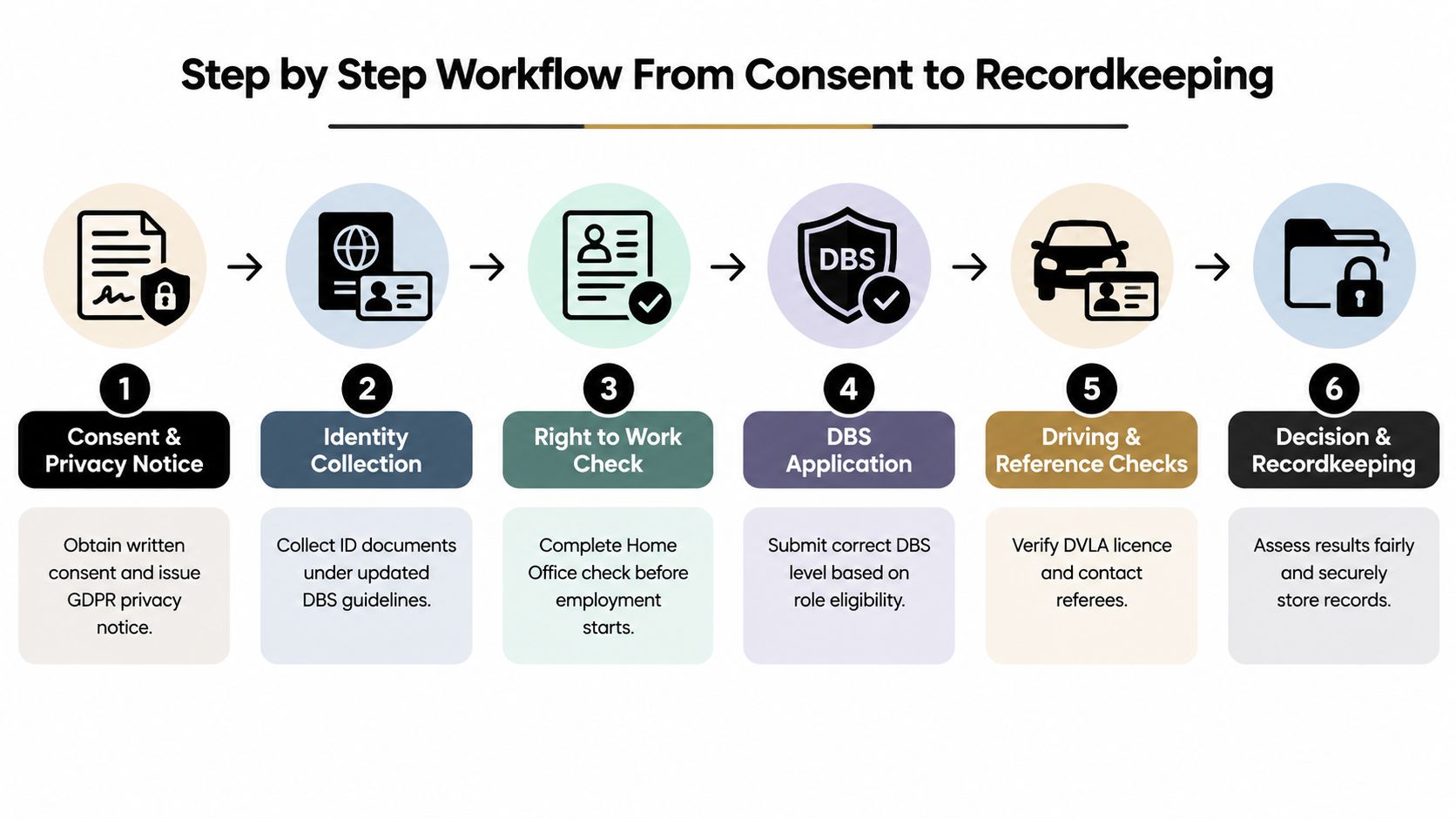
A reliable process starts before anyone sends documents. Write down the role's duties, the checks that relate to them, who will review results, and how the employer will handle discrepancies. This prevents a manager from adding an inconsistent requirement halfway through recruitment.
1. Explain the process and obtain consent
Tell the candidate what checks will be carried out, why they're relevant, how information will be handled, and who may see the results. Provide the relevant privacy information and obtain consent before making checks that require it. Clear communication reduces incomplete forms and gives candidates an opportunity to explain practical issues early.
2. Collect identity evidence using the correct route
The employer or authorised provider should follow the current DBS identity process, not an old checklist copied from a previous recruitment campaign. The current DBS detailed guidance reflects changes introduced in April 2025, including acceptance of e-Visa and PASS card documents in the first instance.
A current address isn't required on one of the documents under the updated process. Identity details must also be retained for two years rather than six months, according to the same GOV.UK guidance. That flexibility can help remote applicants and people without a traditional proof-of-address trail, but it creates a stronger recordkeeping responsibility.
3. Complete the right-to-work check before employment
Use the route that matches the candidate's status and documents. For a manual check, the employer must examine the documents, verify authenticity, compare photographs and dates of birth where required, record the date, and retain evidence. For an online route, follow the share-code process and retain the resulting evidence.
The reason is practical as well as legal. If the employer fails to complete and evidence the check correctly, it may lose the statutory excuse against illegal-working penalties.
4. Submit the DBS application at the eligible level
Check the role's duties and geography before selecting the application type. The DBS framework covers criminal-record checks in England, Wales, the Channel Islands, and the Isle of Man, and eligibility depends on the position. A countersignatory or authorised organisation may need to review and submit the application.
Mismatched names, dates of birth, addresses, or documents can delay the process. Ask the applicant to check every field before submission rather than relying on a later correction.
5. Verify driving and work history
For a driver, review the driving entitlement and relevant licence information. Contact referees using independently verified contact details where possible, and compare the responses with the candidate's stated dates and responsibilities.
A discrepancy isn't automatically proof of misconduct. It may reflect a changed surname, an overseas employer, an administrative mistake, or an incomplete application. Give the candidate a fair opportunity to clarify the issue.
6. Decide, communicate, and retain records securely
Assess the complete picture against the role requirements. Don't let a single item become an automatic decision without considering relevance, accuracy, recency, and the candidate's explanation. If employment is conditional on satisfactory checks, say so clearly in the offer.
Store only what the business needs, restrict access, and follow a documented retention and deletion approach. A good audit file shows what was checked, when it was checked, which route was used, who reviewed the result, and why the final decision was made.
Candidate communication matters: Tell applicants when a check is delayed, when information doesn't match, and what they can do next. Silence turns an administrative delay into a trust problem.
UK Legal Compliance Frequency and Common Pitfalls
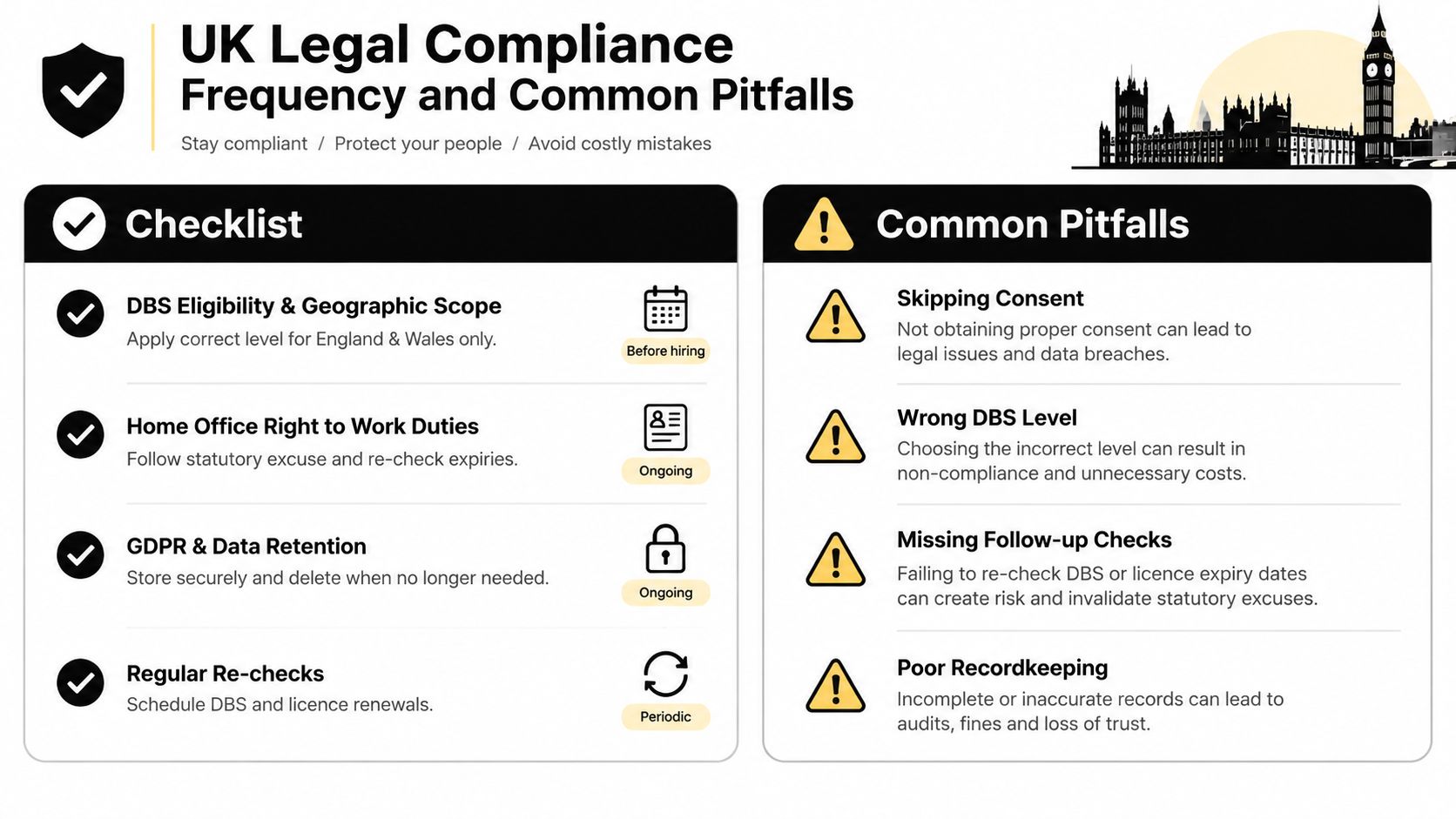
A background check is valid only when the employer uses the correct route for the role and follows the associated duties. DBS eligibility isn't universal, and the DBS framework applies to criminal-record checks in England, Wales, the Channel Islands, and the Isle of Man. An employer should confirm eligibility before requesting a standard or enhanced check, rather than assuming that every passenger-facing position qualifies.
Right-to-work compliance has its own logic. Employers can use a manual process, an online share-code route, or an identity service provider using identity document validation technology. Whichever route applies, the employer needs to complete it before employment begins and retain the required evidence. The Home Office employer requirements make clear that missing evidence can remove the statutory excuse against illegal-working penalties.
What should employers review?
There isn't one universal recheck schedule that fits every role. A business should document when it will review driving entitlement, right-to-work expiry information, DBS status, and role-specific requirements. Driving duties may justify closer attention to licence information than a non-driving office position, while a change in duties may require a fresh eligibility assessment.
The DBS Update Service can support ongoing status checking where the relevant conditions are met. The DBS reported 3,828,880 active subscribers as of April 2026, demonstrating how widely that service is used, as stated in its Basic DBS checks guidance. Subscription alone doesn't remove the employer's responsibility to confirm that the certificate is the right one, that the role is eligible, and that the applicant's identity and circumstances remain consistent.
Common failures and their consequences
- Skipping consent: Starting checks without clear notice can undermine fairness and data-protection compliance.
- Choosing the wrong DBS level: An enhanced check isn't available just because an employer prefers it. Eligibility follows the role.
- Treating DBS as a driving check: A DBS certificate doesn't establish licence entitlement or driving suitability.
- Failing to recheck changing conditions: Right-to-work limits, licence status, duties, or organisational policy may change.
- Keeping weak records: Without dates, routes, evidence, and decision notes, an employer may struggle to demonstrate what it did.
- Using the April 2025 process incorrectly: More flexible identity documents don't mean less care. The employer still needs consistent evidence and stronger retention controls.
For a practical overview of related employer duties, review the legal requirements for passenger transport businesses. It should complement, not replace, role-specific advice from a qualified adviser.
How EC Minibus Vets Drivers to Protect Passengers
Passengers rarely see a recruitment file. They experience the result when a driver arrives at the agreed meeting point, identifies the booking, handles luggage respectfully, and drives them towards a hotel, airport, or cruise terminal. Behind that calm interaction is a chain of checks designed to reduce avoidable risk.

For a passenger transport service, vetting should connect several controls rather than rely on a single certificate. The business needs confidence that the driver's identity is verified, the person has the right to work, the driving entitlement is suitable, and the individual's history is assessed in a way that matches the duties.
What this means for customers
A family arriving from overseas may be tired and unfamiliar with London. A cruise passenger may be working to a terminal departure time. A corporate traveller may need a quiet, punctual transfer with no uncertainty about who will collect them.
Consistent screening supports the practical service customers notice:
- Clear identification: The person collecting passengers should be connected to the booking and the employer's records.
- Responsible driving: Licence information and role-specific checks support safer allocation of driving duties.
- Professional conduct: References, training, and role expectations help shape how drivers interact with passengers.
- Operational confidence: Organised records make it easier to manage onboarding, replacements, and ongoing reviews.
Driver vetting also works alongside training. Screening can identify whether someone meets defined requirements, while training helps them perform the job properly. Guidance on professional driver training can help employers connect those two parts of the trust system.
Customers shouldn't need to know every administrative detail. They should, however, be able to expect that a reputable operator has thought carefully about who represents the business at the kerbside and behind the wheel. That standard matters especially when passengers are travelling with children, older relatives, luggage, or tight connections.
Putting It All Together and Next Steps for Safer Hiring
A sound hiring decision starts with the role, not a favourite screening package. For a first driver hire, define the driving, passenger, safeguarding, and access responsibilities before selecting checks. For an expanding fleet, use a written policy so different managers don't apply different standards to similar drivers. For office staff, remove checks that have no connection to the actual duties.
Use this short decision list:
- Describe the risk: What will the person drive, access, handle, or manage?
- Select proportionate checks: Match identity, right-to-work, DBS, driving, and reference checks to those duties.
- Set the sequence: Obtain consent, verify identity, complete right-to-work checks before employment, then process the remaining checks.
- Plan for exceptions: Decide how candidates can correct inaccurate information or explain discrepancies.
- Record the decision: Keep evidence of the route, dates, reviewer, outcome, and retention action.
- Review after hiring: Schedule role-appropriate checks and update the process when duties or guidance change.
A documented approach also makes growth safer. The industry best-practice guidance can provide useful context, but employers should obtain specialist advice when a role, document route, or result is unclear.
The aim isn't to create suspicion around every applicant. It's to make trust repeatable, evidence-based, and understandable to the people responsible for passengers and staff.
EC Minibus applies structured driver-vetting principles alongside licensed, insured service and professional passenger care for airport, hotel, and cruise-port transfers. Visit EC Minibus to arrange a reliable door-to-door journey and travel with greater confidence in the people handling your transfer.