

The UK requires children to use a child car seat until they're 12 years old or 135 cm tall, whichever comes first. For younger children, the safest practical choice is usually an age- and size-appropriate seat fitted correctly before every journey.
You've just stepped off a long-haul flight at Heathrow, or walked away from a cruise terminal with a sleeping toddler, several bags, and a road transfer still ahead. The drive may be short on paper, but unfamiliar roads, tired children, a hurried installation, and an unfamiliar vehicle can turn a simple journey into a stressful one.
A seat that looks new and compliant isn't necessarily fitted correctly. The same applies to rental cars, taxis, minibuses, and private transfers. The important questions are practical: Which seat suits your child's size? What does UK law require? How can you check that the seat is secure?
Table of Contents
- Why Child Safety Seats Matter When You Travel in the UK
- The Main Types of Child Safety Seats Explained
- UK Law on Child Safety Seats and What It Really Means
- Installing a Child Seat Correctly Every Time
- Bringing, Hiring, or Booking a Seat for Transfers
- A Real Traveller's Day from Heathrow or a Cruise Port
- Common Mistakes Parents Make with Child Safety Seats
- Pre-Departure Checklist and Quick Answers for Families
Why Child Safety Seats Matter When You Travel in the UK
You arrive at Heathrow after a long flight. One adult collects the bags, another checks the private transfer meeting point, and a tired child is already close to sleep. The car seat is still packed away, so installing it quickly can feel like the only practical option.
That pressure creates risk. Safe restraint use means choosing a seat that fits the child, checking that it suits the vehicle, following the manufacturer's instructions, and securing the child correctly. A rushed setup can leave the seat loose, the harness slack, or a rear-facing seat at an unsuitable angle.
UK casualty data shows why these checks matter. In 2016, 5,268 child car casualties were reported to police in Great Britain, including 18 children under 12 killed and 247 seriously injured while travelling in cars. These figures are reported through the UK Road Safety Observatory's child car seat rules reference.
Practical rule: A short transfer needs the same restraint standard as a long drive. A nearby destination does not make a collision less serious.
The three decisions to make before booking
Start at home, before reaching the airport or cruise port.
- Match the seat to the child: Check height, weight, harness limits, and body shape rather than using age alone.
- Check the UK requirement: Confirm that the restraint meets the legal rules for the vehicle and journey. The detailed threshold belongs in the later law section.
- Plan the fitting: Decide who will install the seat, and leave enough time for a calm check before departure.
The vehicle affects the plan too. A private car may have ISOFIX points, while a minibus may require installation with the seat belt. A pre-booked private transfer might supply a child seat, but the booking should confirm the seat type, fitting method, and whether it will already be in the vehicle.
That distinction matters throughout the traveller journey. A seat can be legally available yet unsuitable for the child, incompatible with the vehicle, or fitted poorly after a tiring flight. The same questions apply when travelling from Southampton, Dover, Portsmouth, or a London hotel. Legal compliance is the starting point, not proof that the child is protected as well as they could be.
Recent British parent research found that only 22% of UK children aged two to four were still travelling rear-facing, while 15% of parents with children under two and 14% of parents with children aged two to four said they didn't always secure their child in a car seat. As noted in the 2025 British parent safety report, owning a seat does not guarantee safe use.
The Main Types of Child Safety Seats Explained
Parents usually encounter five broad categories when buying or hiring child safety seats in the UK. The labels can be confusing because older seats are described by weight groups, while newer i-Size seats use height-based approval under UN R129.
A child should move when they've outgrown the current seat's limits, not just because their birthday has arrived. If your child still fits a rear-facing seat, moving forward early usually removes useful protection for the head, neck, and spine.
A quick comparison
| Seat Type | Height Range | Weight Range | Approx. Age | Position |
|---|---|---|---|---|
| Rear-facing infant carrier, Group 0/0+ | Manufacturer limit | Up to the seat's limit | Birth to infancy | Rear-facing |
| Rearward-facing toddler seat, Group 1 | Manufacturer limit | Group 1 range | Infant to toddler years | Rear-facing |
| Forward-facing toddler seat with harness, Group 1 | Manufacturer limit | Group 1 range | After rear-facing stage | Forward-facing |
| High-back booster, Group 2/3 | Height and belt-fit limits | Group 2/3 range | Older child | Forward-facing |
| i-Size R129 seat | Height stated on label | Seat-specific | Depends on model | Rear- or forward-facing according to approval |
The table is a guide, not a substitute for the label and manual. A rear-facing infant carrier is convenient for a very young baby, but a convertible toddler seat may allow longer rear-facing use. A forward-facing harness seat is used only once the child has outgrown the rear-facing option and the particular seat permits that direction.
Why i-Size can be easier to understand
Older R44 seats classify children by weight. Newer R129 seats make height the main reference, which can be easier for parents checking whether a child still fits. In the UK, i-Size, or UN R129, is the mandatory minimum safety standard for new car seats sold, and approved i-Size seats keep children rear-facing until at least 15 months. The UK-focused explanation of updated car seat standards also highlights an important distinction: older R44 seats can legally permit forward-facing travel from 9 kg.
That creates a gap between what's legal and what may offer better protection. If a combination seat allows rear-facing travel for longer, keeping your child in that position can be the more cautious choice, provided the child remains within the seat's limits and the seat is installed as instructed.
UK Law on Child Safety Seats and What It Really Means
UK law provides a safety floor, not a complete travel plan. As noted earlier, children must use a suitable restraint until they reach 12 years old or 135 cm tall, whichever comes first. The restraint must match the child's height or weight and be used according to its instructions.
That rule answers whether a restraint is required. It does not answer which seat gives the child the best protection, whether it fits the vehicle, or whether the seat will be ready when a transfer arrives.
Legal minimum versus safer practice
A legal seat is not automatically the safest choice for every journey. New R129 seats keep children rear-facing until at least 15 months, and many parents continue rear-facing travel beyond that point when the seat permits it. The direction of travel, the child's size, and the seat's stated limits all matter.
This becomes easy to overlook during a private transfer booking. Ask the provider for the seat's height and weight limits, whether it is R129 or R44 approved, and whether it will be rear- or forward-facing. Also ask who will install it and whether it will be ready before collection. Add the answers to the booking notes, rather than relying on a rushed conversation beside the airport.
A child may meet the legal threshold but still need help achieving a good belt fit. The law sets the minimum requirement. Your practical decision should also consider posture, comfort, installation, and how tired your child will be after a flight or before a cruise departure.
Vehicles and the taxi exception
Licensed taxis and some other regulated vehicles have specific exceptions when a child seat is unavailable. That does not create a general exemption for every hired vehicle. A pre-booked private car or minibus may have different arrangements from a licensed taxi, so confirm the operator's policy before travel.
The guide to UK legal requirements for transfers explains the practical distinction between vehicle types. If the supplied restraint is unsuitable or appears incorrectly fitted, ask the driver to stop until the issue is resolved.
Poor restraint use can lead to legal consequences and may complicate responsibility or insurance questions after a collision. Arrange the correct seat in advance, allow time to inspect it, and check that your child is secured before the vehicle moves. Compliance should be the starting point, not the finish line.
Installing a Child Seat Correctly Every Time
A correct installation should be repeatable, even when a different adult handles the vehicle. Read the seat manual beside the vehicle, identify the approved fitting method, and don't assume that a familiar model fits every car in the same way.
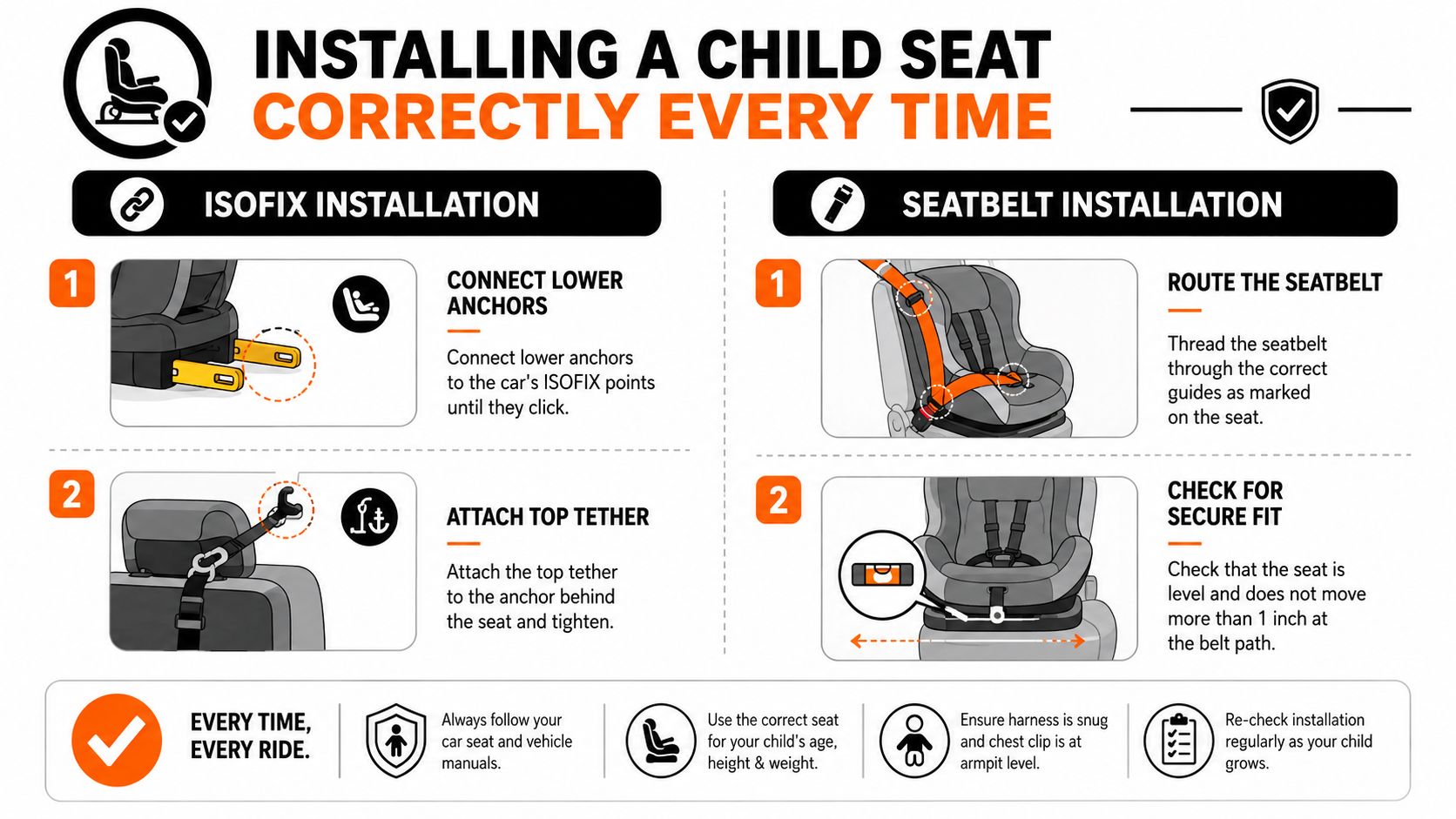
ISOFIX uses the vehicle's lower anchor points. Connect both attachments until they click, check the indicators if the seat has them, and attach the top tether where the instructions require it. A seatbelt installation uses a marked route through the seat shell. Threading the belt through the wrong path can leave the restraint unstable even when the belt feels tight.
Check the harness, not just the base
For a rear-facing seat, the shoulder straps should sit level with or just below the child's shoulders. For a forward-facing seat, they should be level with or just above the shoulders. The chest clip, where the seat has one, belongs at armpit height.
Use the pinch test at the collarbone. After tightening the harness, you shouldn't be able to pinch a fold of webbing between your fingers. Remove thick coats before buckling the child, then place a blanket over the harness if warmth is needed.
Common errors include:
- Twisted straps: Smooth every strap before tightening.
- A slack harness: Pull the adjustment strap until the child is held snugly.
- An unused top tether: Attach it whenever the manual requires it for forward-facing use.
- The wrong belt path: Follow the colour-coded or labelled guides on the seat.
- Excess movement: At the belt path, the seat shouldn't move more than 2.5 cm in any direction. The installation infographic expresses this as one inch.
- An incorrect recline angle: Follow the newborn and rear-facing angle indicator, particularly for a small baby.
After a sharp braking event, inspect the installation. Repeat the check whenever another adult removes or refits the seat.
The following video provides a visual demonstration of fitting principles:
Bringing, Hiring, or Booking a Seat for Transfers
Families usually have three workable choices. None is perfect for every trip, so the right option depends on familiarity, luggage, vehicle type, and how much control you want over the fitting.
| Option | Pros | Cons |
|---|---|---|
| Bring your own seat | You know its history, instructions, and fit | It adds luggage work and may be damaged if placed in the aircraft hold |
| Hire at the destination | Reduces the amount you carry | You must check its condition, suitability, history, and installation |
| Book a supplied seat | The operator can arrange the correct vehicle and restraint before collection | Availability and exact seat details must be confirmed in advance |
Bringing your own
Your own seat is often the least mysterious option. You know whether it has been involved in a crash, whether all parts are present, and how your child sits in it. Before flying, check the airline's rules for carrying or checking child restraints, protect the seat from handling damage, and keep the manual accessible.
Hiring locally
Destination hire can work well when the company provides clear model information and fitting support. Ask how the company checks seat history, whether the seat suits your child's current height and weight, and whether the vehicle arrangement is compatible. Don't accept a seat because it arrives clean and undamaged.
Booking a supplied restraint
A private transfer can remove one task from a difficult arrival, but the arrangement must be specific. Confirm the seat type, approval standard, direction, child details, and booking reference in writing. A service such as EC Minibus airport transfer service can provide child seats subject to availability when requested at booking.
On the day, inspect the seat before loading luggage. If it doesn't match what you ordered, raise the issue immediately rather than hoping it'll be acceptable for one journey.
A Real Traveller's Day from Heathrow or a Cruise Port
The smooth Heathrow arrival usually begins weeks earlier. A family records both children's current measurements, checks the seats' limits, and confirms that the pre-booked transfer will carry the requested restraints.
At the airport, the adults collect bags and the car seats from the oversized baggage area. In the short-stay car park, they install the seats before loading the cases. The toddler is tired, but the seat is familiar, the harness setting is known, and the family can leave without searching a rental desk for instructions.
The alternative is less comfortable. A parent queues for a rental car, receives a seat they don't recognise, and tries to understand the belt route while rain gathers outside. The child is restless, the bags are in the way, and the adult may be tempted to accept an installation that hasn't been checked properly.
The cruise-port version
At Southampton, a family with an infant has arranged a private transfer in advance. The driver is waiting with a name board, and the infant seat has been installed rear-facing in line with the R129 approach. The parents still check the harness and fitting, but they aren't trying to assemble the arrangement beside a busy terminal.
A pre-arranged airport to cruise port transfer can make the vehicle part of the travel plan rather than an improvised final step. The same principle applies at Dover, Portsmouth, or Tilbury.
The important decision was made at home. The transfer day only reveals whether the family confirmed enough detail to make the plan work.
Common Mistakes Parents Make with Child Safety Seats
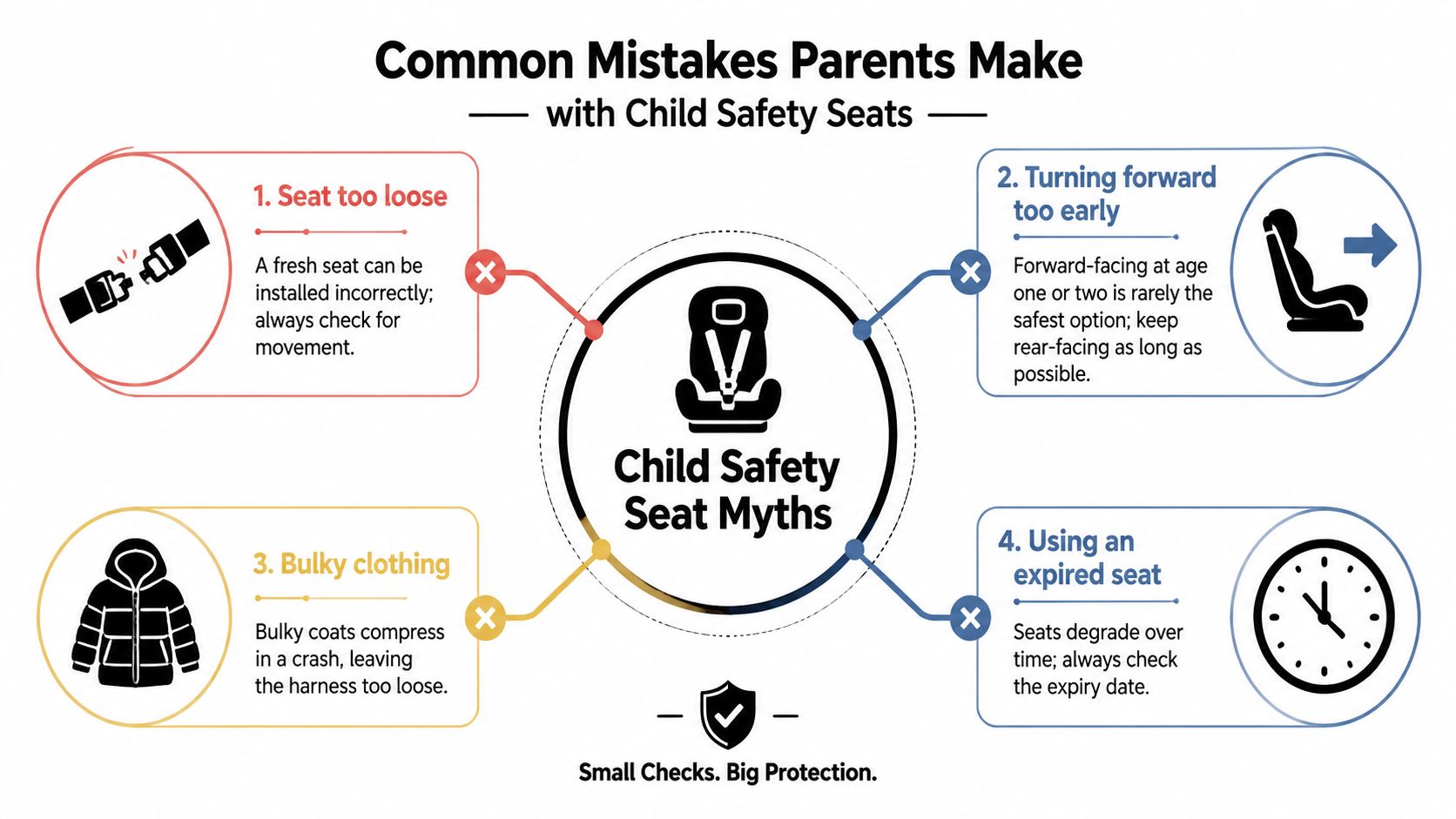
A family can arrive at the vehicle with a new seat, a suitable car, and good intentions, yet still leave without a safe setup. A loose belt, incorrect belt route, or missing top tether can change how the seat moves in a crash. Treat installation like fastening a climbing harness: every connection and adjustment has a purpose.
Forward-facing travel also causes confusion. Older R44 seats can legally permit forward-facing use from 9 kg, but legal permission does not make it the safest choice for every young child. R129 seats keep children rear-facing until at least 15 months, and many families continue rear-facing for longer when the seat allows it.
Assumptions that cause trouble
- “A private transfer is just like a taxi.” Taxi and minibus rules can differ. Confirm the vehicle category and the planned seat arrangement before booking.
- “The top tether is optional.” On a forward-facing seat that requires one, connect it to the vehicle's approved anchorage and check the strap is secure.
- “The coat makes the harness tighter.” Bulky clothing compresses in a crash, leaving too much space between the child and harness. Remove thick outer layers before tightening.
- “The chest clip doesn't matter.” If the seat has one, keep it at armpit height, not near the neck or stomach.
- “A second-hand seat is fine.” Do not use one if you cannot verify its crash history, age, instructions, approval label, and parts.
- “My child looks tall enough.” Appearance is not a reliable test. Check the seat's stated height or weight limit and the harness position.
The figures cited by Brake show why restraint habits remain relevant: children were killed or seriously injured while travelling in cars in Britain. The figures appear in the UK child casualty reporting cited by Brake.
The travelling adult should make the final check before departure. Look at the seat, harness, clothing, tether, and belt path, then ask the driver to wait until everything is secure. Legal compliance is the starting point. Safe travel also depends on fitting, the child's position, and a plan that still works when everyone is tired.
Pre-Departure Checklist and Quick Answers for Families
Read this checklist the night before leaving home, then repeat the physical checks when the vehicle arrives.
- Check the seat label: Confirm the approval marking, model information, and manufacturer instructions.
- Check the seat's history: Avoid a second-hand seat if its crash history or parts can't be verified.
- Check the child's fit: Review current height, weight, shoulder position, and harness limits.
- Check the vehicle method: Confirm whether the seat uses ISOFIX, a top tether, a seatbelt, or a permitted combination.
- Check the harness: Keep straps flat, snug, and correctly positioned.
- Check the chest clip: Place it at armpit height where the seat has one.
- Check clothing: Remove bulky coats before tightening the harness.
- Check the booking: Put the child's age, size, seat direction, and requested restraint in writing.
Questions parents ask before travel
Does the UK rule apply to our child?
Yes. A child needs an appropriate restraint until 12 years old or 135 cm tall, whichever comes first, subject to the vehicle-specific rules and exceptions described in the UK guidance.
How long should a child stay rear-facing?
At least until 15 months in an i-Size seat, and longer where the seat permits it. Legal forward-facing eligibility isn't the same as the safest timing.
Does a short transfer need a child seat?
Yes. Distance doesn't remove the need for correct restraint use.
Are private transfers exempt because taxis can have exceptions?
Don't assume so. A pre-booked private car or minibus should be checked separately, and the seat arrangement should be confirmed before travel.
Can I use a booster cushion?
A booster cushion doesn't meet current UK law for children under 125 cm. Check the child's height and the product's approval before relying on any booster.
What if the supplied seat looks wrong?
Ask the driver to stop loading or moving the vehicle. Check the label, direction, belt path, movement, harness, and recline angle. If it doesn't match the booking or your child's needs, request a suitable alternative.
Book the restraint with the transfer company rather than leaving it until arrival. A written request gives you something practical to check at Heathrow or the cruise terminal, when everyone is tired and time matters.
EC Minibus can arrange child car seats subject to availability when you include the request in your booking, alongside private transfers between Heathrow, London hotels, and UK cruise ports. Visit EC Minibus to provide your journey details and ask for the appropriate child restraint before you travel.