

You've just landed at Heathrow, your phone is on low battery, and the cruise check-in cut-off in Southampton isn't waiting for you. One bag is too heavy to lift cleanly, the terminal feels crowded, and every minute spent figuring out ground transport makes the next connection feel tighter. That's where concierge assistance comes in, not as a luxury flourish, but as a practical way to keep the journey moving when the airport, hotel, and cruise port all have to line up.
For first-time cruise travellers, the phrase can sound vague. In real transfer work, it means a person or team is actively managing the handover between points, watching for delays, meeting you in the right place, handling luggage, and getting you to the next stop with less friction. Heathrow handled 83.9 million passengers in 2024 in a transport environment where meet-and-greet, luggage help, and timed transfers matter for international arrivals heading to London and cruise ports, which is exactly why this kind of service exists (BLS reference).
Table of Contents
- What Concierge Assistance Looks Like on a UK Transfer
- The Core Services Included in Concierge Assistance
- How Concierge Assistance Differs from Taxis and Shuttles
- Who Benefits Most from Concierge-Style Transfers
- Pricing Expectations and What Affects the Quote
- Booking and Preparing for a Concierge Transfer in the UK
- Frequently Asked Questions About Concierge Assistance
What Concierge Assistance Looks Like on a UK Transfer
A tired couple steps off a transatlantic flight at Heathrow and heads into arrivals with two suitcases, a carry-on, and cruise documents they don't want to lose in the shuffle. They're not trying to browse options, wave at cars in a rank, or debate whether a taxi will fit everything. They want one person who knows their flight number, knows the port deadline, and knows how to get them from the terminal to a Southampton cabin without unnecessary drama.

That's the job of concierge assistance in a transfer setting. It's not about folded napkins or lobby pleasantries, it's about ownership of the handover between airport, hotel, and port. A good provider acts like the organiser of the whole chain, especially when a long-haul flight, luggage, and cruise timing all collide.
The difference is easy to miss if you've only used ordinary taxis. A black cab or app car can get you from A to B, but it usually won't be set up to watch your flight, adjust for late arrival, or help with onward cruise timing in a structured way. For first-time cruise travellers, that gap matters most when the journey is multi-part, the bags are heavy, and the next stop has a fixed check-in window. A door-to-door cruise transfer service such as this Heathrow-to-cruise guide shows why the handoff itself is the product, not just the vehicle.
Practical rule: if the trip involves airport-to-hotel or airport-to-port logistics, the value is in reducing uncertainty, not in adding extras.
The Core Services Included in Concierge Assistance
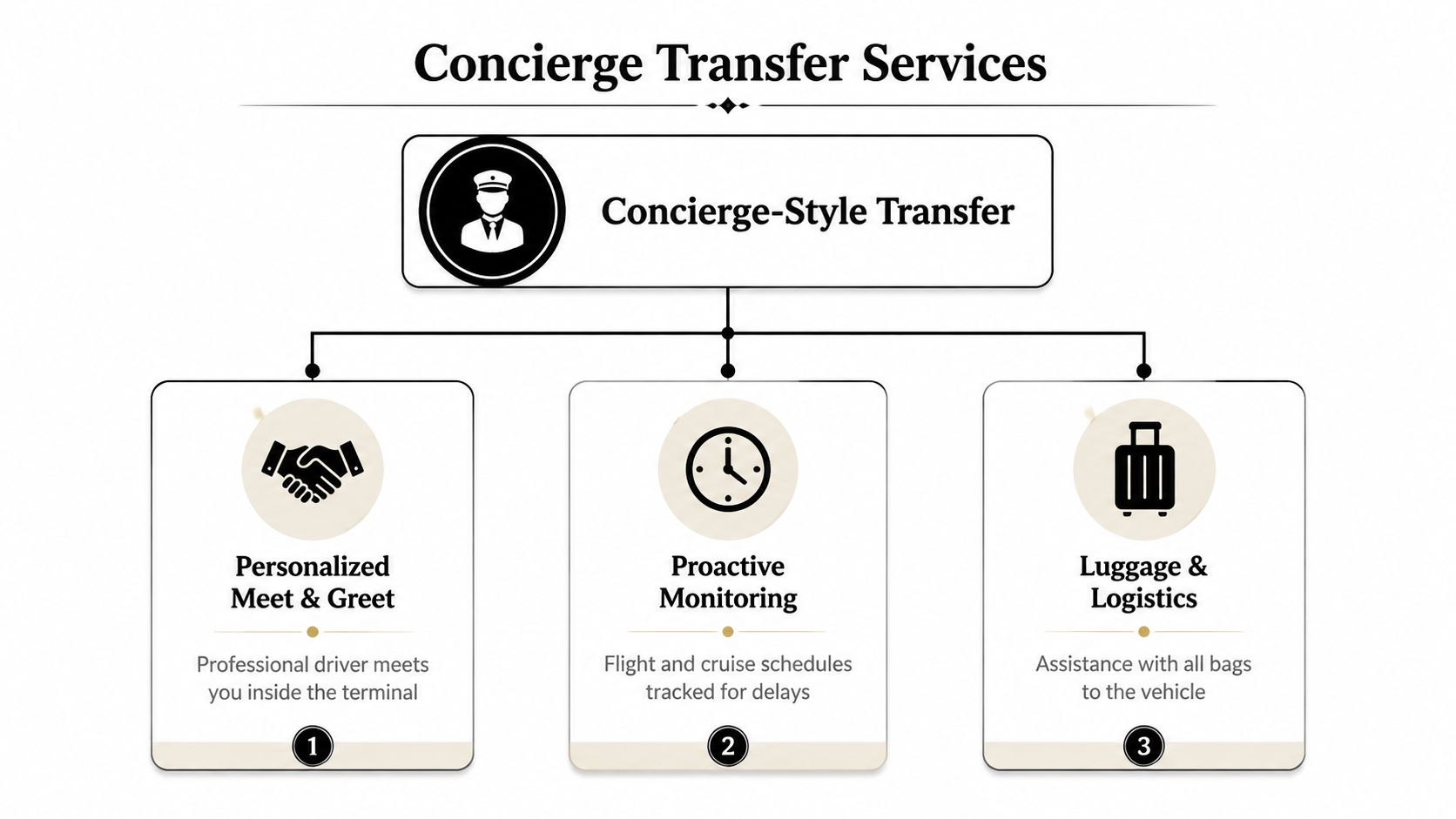
A cruise transfer can look straightforward from the outside, yet the work starts before you ever reach the vehicle. Concierge-style assistance is the set of practical tasks that keeps the handover moving, from arrivals hall to car, and then on to the port or hotel without unnecessary confusion.
Meet and greet in the arrivals hall
The first task is meet and greet. A driver or representative waits where you can see them, usually inside the terminal with clear identification, rather than asking you to hunt for a kerbside pickup point after a long flight. For a first-time cruise traveller, that avoids the awkward pause of wondering whether the car has arrived, and where to go next with bags in hand.
Monitoring and re-timing
The next task is flight and cruise monitoring. If the aircraft lands late, the pickup can be adjusted instead of leaving the traveller in a missed-pickup situation. If the journey includes a hotel night before sailing, the timing can also be matched to port check-in or luggage drop-off, so the transfer follows the actual travel plan rather than a fixed guess.
Luggage and logistics
Then comes luggage assistance. In practice, that means help from the terminal to the vehicle, careful loading of the bags, and a handover that does not become a strain point for older passengers or anyone carrying several cases. The point is simple, the bags are handled as part of the journey, not treated as an inconvenience to work around.
This is the part many travellers underestimate. A transfer can fail on small details, such as where bags are placed, how far someone has to walk, or whether the driver is ready when the traveller reaches arrivals. Good concierge assistance reduces those friction points before they turn into delays.
Clear booking terms
A proper concierge-style transfer also sets out the terms before travel. That includes what is included, which vehicle is assigned, and what happens if the schedule changes. It should also be easy to understand how the handover works in practice, especially for travellers booking a meet and greet service at Heathrow.
For travellers comparing service levels, this clarity is often what separates a coordinated transfer from an ordinary car booking. The details matter because cruise plans leave less room for uncertainty, and older international travellers usually benefit most when every step is explained in advance.
How Concierge Assistance Differs from Taxis and Shuttles
The cleanest way to judge the difference is to compare the jobs each option is built to do. Concierge assistance is designed for handholding across a complex journey. Standard taxis, ride-hailing apps, and shared shuttles are useful in other situations, but they don't all solve the same problem.
The UK transport environment makes that distinction more relevant than most hotel-level explanations admit. London's hospitality and transport history shaped concierge functions over time, and ongoing rail and airport disruption still makes hands-on transfer coordination more valuable than simple hospitality help (Art of Manliness reference). That matters most when a cruise traveller has bags, a deadline, and a port that isn't just around the corner.
| Transfer Options for UK Cruise Travellers | Service Type | Pricing Model | Luggage Help | Flight Monitoring | Cruise Port Drop-off |
|---|---|---|---|---|---|
| Concierge-style transfer | Private, coordinated | Usually fixed and transparent | Direct assistance | Built into the service | Door-to-door, with timing support |
| Black cab | On-demand | Metered or distance-based | Limited to driver discretion | Not typically included | Possible, but not coordinated |
| Ride-hailing app | On-demand | App-based estimate, can change | Limited | Not typically included | Possible, but less tailored |
| Shared shuttle | Shared route | Lower headline cost, less control | Basic | Not usually included | Set stops, less flexible |
Where each option fits
A taxi can work if you're light, flexible, and not worried about precision. A shared shuttle can suit travellers who value cost over control. But neither is built around cruise-day pressure, where the timing between Heathrow, Central London, and ports such as Southampton, Dover, Portsmouth, or Tilbury can shape the whole trip.
A concierge transfer fills the gap when you want one booking to cover the transfer chain rather than manage each part separately. That's why meet and greet at Heathrow is such a useful search term for cruise passengers. It points to the service level, not just the car type.
Who Benefits Most from Concierge-Style Transfers
The people who gain the most from this service are usually not chasing status. They want a transfer that keeps the day moving, cuts down on lifting, and removes a few decisions after a long flight. Older international cruise passengers, couples with checked luggage, and families arriving into Heathrow often see the clearest value.

An older traveller may not need anything theatrical. They usually need a transfer that reduces walking, waiting, and uncertainty. UK demographic change means the 65-plus population continues to grow, so clear communication, reliable pickup, and baggage help matter more than glossy hospitality language.
A business traveller can benefit too, but for a different reason. If the schedule is tight, a concierge-style transfer reduces the number of things that can go wrong between landing and the next appointment or cruise departure. Travel agents also use these services for clients when they need a predictable ground option rather than another variable in the itinerary.
Older international travellers often feel the difference most strongly because the service is built around the parts of the journey that create stress. A chauffeur meeting passengers at the terminal, helping with bags, and staying alert to timing is not the same as ordering a car and hoping it arrives in time. For first-time cruise travellers, that distinction matters because a cruise transfer is part of a time-sensitive chain, not just a lift from one postcode to another.
consumer research also points to transparency, advance communication, and clear service scope as recurring decision factors for travel services, especially for older travellers who care more about reliability than the lowest price. That matches what operators see on the ground. People who feel most at ease are usually the ones who know who is collecting them, where they are being taken, and what help is included before the journey starts.
A useful test is simple, if a traveller would struggle to recover from a missed pickup, this service starts to make sense.
The service is not only for luxury travellers. It suits anyone whose journey would be harder to fix than to plan properly in the first place. That includes guests with mobility limits, people carrying several bags, and travellers who do not want to gamble on last-mile logistics after a transatlantic arrival. It also fits passengers using EC Minibus's UK car service pricing guide to compare what is included before they book.
Pricing Expectations and What Affects the Quote
A sensible quote starts with the basics, distance, vehicle size, timing, and passenger count. The route from Heathrow to a cruise port or Central London hotel will cost differently depending on how far the vehicle has to travel and what kind of space the group needs.
What usually moves the price
- Distance and destination: A longer run to a port naturally costs more than a short hotel transfer.
- Vehicle size: More passengers or more luggage usually means a larger vehicle.
- Time of day: Late-night or very early transfers can change the quote.
- Special requests: Child seats or extra handling needs may affect planning.
- Journey structure: One-way transfers are different from return arrangements.
The key point is not chasing the cheapest headline number. It's knowing what's already included and what might appear later as a surprise. A low opening price can become expensive if luggage, waiting time, or route changes are added after booking.
A fixed-fee model is easier to budget around because the traveller can compare the transfer against the rest of the trip without guessing. That's why transparent pricing is so useful for cruise passengers, especially when the transfer is part of a larger itinerary. EC Minibus's UK car service pricing guide is a straightforward example of how operators present the booking logic before travel.
Budget rule: if the quote feels vague, ask what happens if the flight lands late, the luggage count changes, or the port stop needs an adjustment.
Booking and Preparing for a Concierge Transfer in the UK
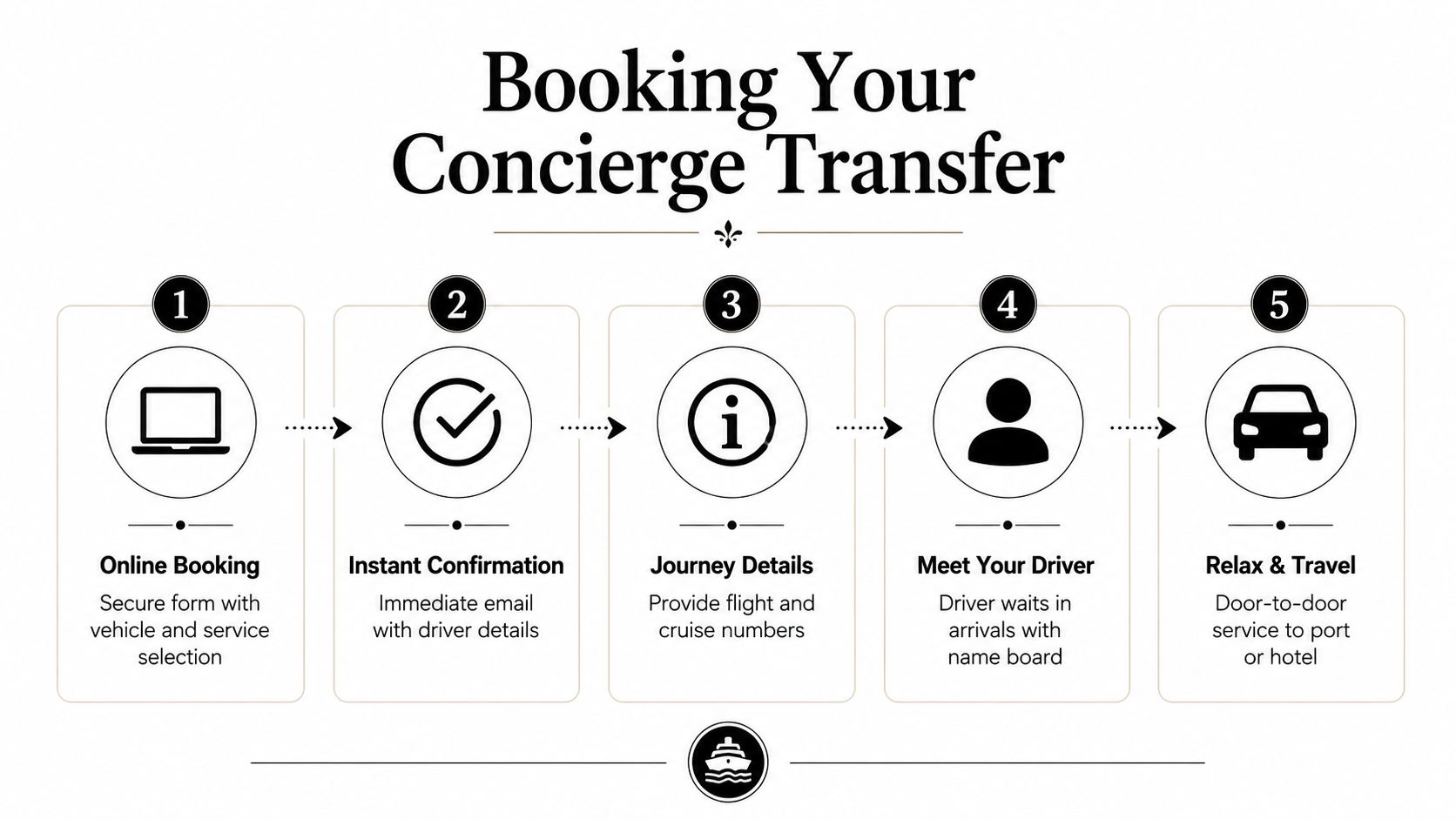
The booking process should feel calm before you ever reach the airport. A traveller enters the flight and cruise details online, gets confirmation, and then receives the kind of pre-trip communication that removes guesswork from the day itself. That's the difference between a transfer that feels managed and one that feels improvised.
What to have ready
- Flight details: So the driver can track arrival timing.
- Cruise information: So port timing and drop-off planning are accurate.
- Luggage count: So the right vehicle is assigned.
- Phone access: So you can receive updates if anything changes.
- Special needs: So child seats, mobility support, or extra space are arranged in advance.
A typical day with a UK private transfer operator starts with online booking and instant confirmation. The passenger then shares the flight and cruise numbers, and the operator uses that information to monitor the journey and prepare the pickup. When the driver meets the traveller at arrivals, the handover is direct, with clear identification and help loading luggage into the vehicle.
That process matters because small mistakes become big problems once you've landed tired. If your phone is switched off, your documents are buried, or nobody knows how many bags you have, the transfer slows down for no good reason. Keep cruise paperwork easy to reach, keep your phone charged, and tell the operator about anything unusual before travel day.
Frequently Asked Questions About Concierge Assistance
Is concierge assistance only for luxury travellers
No. It helps anyone whose journey has more steps than a simple point-to-point trip. For an older cruise passenger, a family with several bags, or someone arriving after a long-haul flight, the value is often in the control it adds, not in the label on the service.
How far in advance should I book
Book as soon as your flight and cruise details are confirmed. That gives the operator time to assign the right vehicle, check timing around the port or hotel stop, and plan the handover properly. A good transfer is a bit like laying out the route before the day begins, so nobody is guessing once the plane lands.
What if my flight arrives very late
A proper transfer provider should use the flight number you gave them to adjust pickup timing. That is why the flight details matter from the start. If you keep your phone on after landing, the operator can deal with changes quickly and avoid a slow start at arrivals.
Can I arrange child seats or extra luggage space
Yes, but say so before travel day. Child seats, extra cases, and mobility-related support all affect which vehicle is suitable, so the booking should reflect the actual journey, not the ideal version of it. If you leave that out, the driver may arrive with a car that does not fit everyone or everything comfortably.
What should I check before the driver arrives
Have your passport, cruise documents, and phone ready, and know how many bags you are carrying. Clear information before pickup makes the handover easier, especially on a day where the timing is tight and the pressure is already high.
If you are travelling through Heathrow, a hotel, or a cruise port, that preparation helps the driver work faster and cuts down the chances of avoidable delays.