

You're trying to get from Coventry to Cambridge without wasting half the day on bad connections, confusing fares, or a parking headache at the far end. That's the core question on this route, not just whether the train is faster on paper or whether the drive looks simple on a map. For students, families, and business travellers, the winning option depends on where you're starting, where you're going in Cambridge, and how much hassle you're willing to absorb.
Table of Contents
- Planning a Trip From Coventry to Cambridge
- The Four Ways to Get From Coventry to Cambridge
- Taking the Train From Coventry to Cambridge
- Driving Yourself From Coventry to Cambridge
- Coaches and Budget Options Between Coventry and Cambridge
- When a Private Transfer Is Worth the Money
- Choosing the Right Option and Booking With Confidence
Planning a Trip From Coventry to Cambridge
A family leaving Coventry for a Cambridge college open day, a student headed to an interview, and a business traveller meeting colleagues near Addenbrooke's are all making different trips, even though they're using the same corridor. That's why Coventry to Cambridge deserves proper planning, not a quick skim of the first result in a booking site.
The route sits in a practical middle band. It's about 70 to 71 miles by rail and about 79.5 to 80 miles by road, so you're not dealing with a tiny hop, but you're also not locked into an all-day journey. Independent planners put train times anywhere from 2h 20m to 3h 59m, while the fastest rail options are about 2h 20m to 2h 31m. Road travel is usually 1h 25m to 1h 30m in normal traffic, which is why the trip can feel deceptively straightforward if you ignore congestion and parking at the Cambridge end. Rome2Rio's Coventry to Cambridge route overview is useful for seeing the corridor's overall shape.
The first decision is where you're really travelling to. Cambridge city centre, a college, a science park, and Addenbrooke's all behave differently once you step off the train or out of a car. If you're visiting for the day, you may want the simplest arrival rather than the cheapest ticket.
Practical rule: Don't book the mode first. Decide whether you need station-to-station convenience, door-to-door certainty, or the lowest fare, then choose the transport that fits.
If you're in the city for a walkable visit, you'll still want to sort the final leg carefully. If you're planning time around sightseeing, a later stop, or a family itinerary, that final stretch matters just as much as the main journey. A useful place to start thinking about what you'll do once you arrive is this Cambridge ideas guide, especially if your schedule has a bit of breathing room.
The Four Ways to Get From Coventry to Cambridge
The honest comparison on this route is simple. Train and coach usually win on price and frequency. Car and private transfer win on simplicity, luggage handling, and predictability.
| Mode | Typical duration | Indicative cost | Best for |
|---|---|---|---|
| Train | About 2h 20m to 3h 59m overall, with the fastest around 2h 20m to 2h 31m | Advance fares can start from £27.80 on one booking source | Solo travellers, students, and business trips where timing matters |
| Coach | Usually about 2h 30m to 4h | Cheapest fares can be very low, but prices vary sharply by time of day | Budget travellers who can tolerate a longer trip |
| Self-drive | About 1h 25m to 1h 30m in normal traffic | Fuel and parking vary by vehicle and city-centre choice | Families, luggage-heavy trips, and flexible schedules |
| Private transfer | Typically close to the road journey, depending on traffic and pickup | Usually a premium fixed-price option | Door-to-door trips, late arrivals, groups, and travellers with limited tolerance for stress |
The biggest mistake is comparing only the in-vehicle time. A train that looks fast can still lose once you add the walk to Coventry station, the interchange, the wait, and the final transfer in Cambridge. A car looks slow on paper, then wins when you're carrying bags, travelling with children, or going straight to a hotel, a college, or a clinic.
Coach is the sharpest budget play, but only if your travel time is flexible. Road travel gives you the most control, but it also puts the burden on you to absorb traffic, fuel, and parking. Private transfer is the premium answer when the cost of hassle is higher than the cost of the ride.
Taking the Train From Coventry to Cambridge
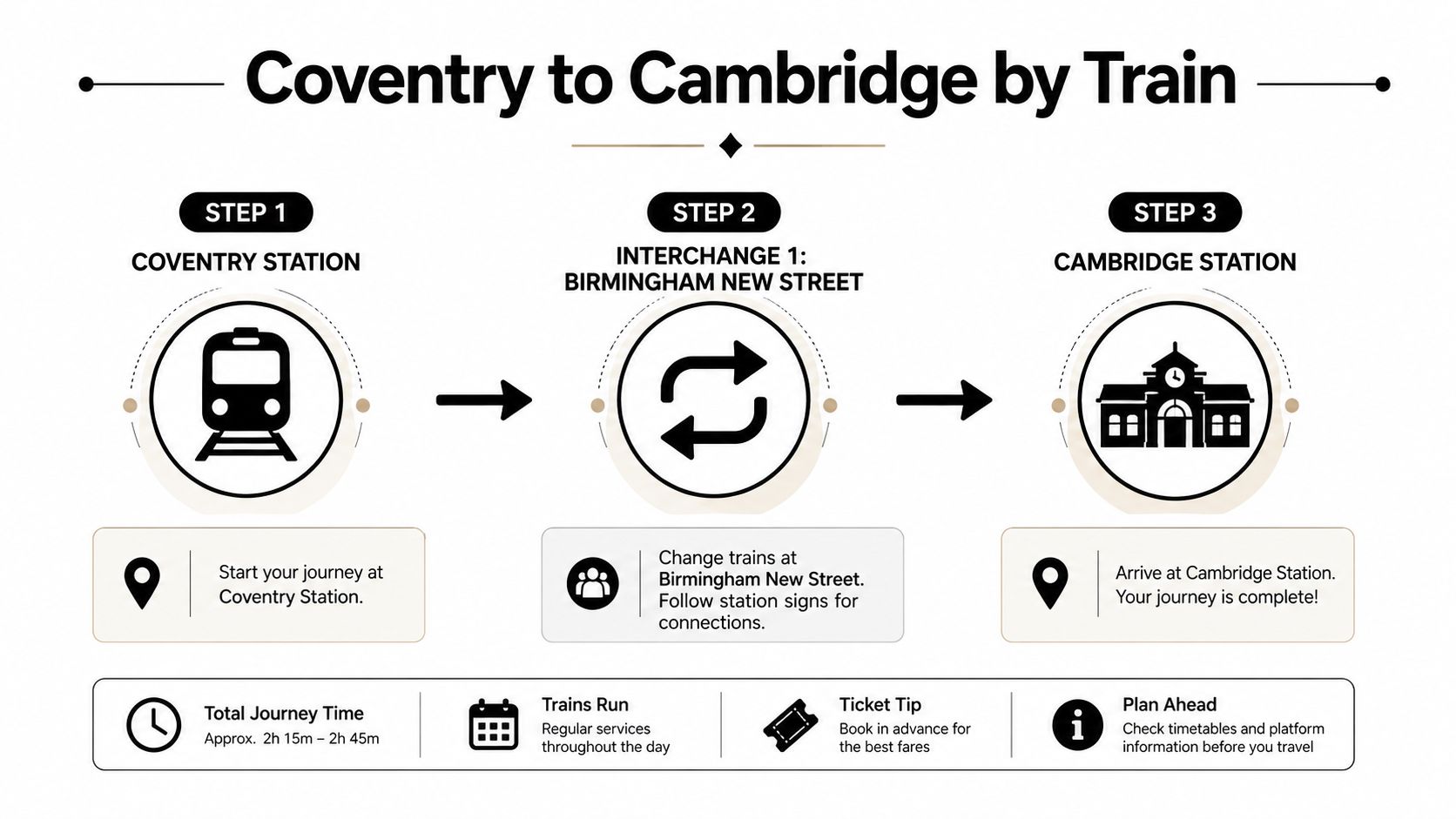
Rail is workable, but it isn't simple. One rail-focused source says there are no direct trains and that journeys can require a change, with 27 possible journeys listed, while another reports around 65 trains per day and departures roughly every 12 minutes. That combination tells you exactly what this route is: frequent, but stitched together through interchange points rather than served by a clean point-to-point line. Rail Europe's Coventry to Cambridge train page is the clearest place to see the no-direct-train reality.
The most useful rail strategy is to choose the interchange you can handle. Birmingham New Street is the practical option for many travellers because it keeps the journey on a regional flow. London Euston can work too, but it's the more demanding choice if you dislike crowded platforms, longer walking distances, or the risk of a missed cross-London connection. The headline fastest journey is not the one everyone ends up taking, because the average itinerary on one booking source is 4h 43m over 71 miles, with 124 trains per day and fares from £27.80 when booked in advance. The same source says the fastest services take 2h 31m. The Trainline's Coventry to Cambridge timetable shows why the fastest fare and the average experience are very different things.
Book the route, not the promise. A single missed connection can turn a neat rail plan into a long wait, so pick an itinerary with a sensible interchange buffer instead of chasing the quickest headline time.
How to book rail without overpaying
Advance fares matter on this corridor. They tend to favour organised travellers who can commit to a date and time, while late bookers get squeezed into whatever's left. Booking engines also differ in what they surface first. The Trainline is strong for broad comparison, Rail Europe is useful for route structure, and operator sites can be better for final ticketing once you've decided on the itinerary.
Common errors are easy to avoid:
- Don't assume the quickest shown journey is the normal one. The fastest itinerary is often a good case, not the everyday outcome.
- Don't ignore the number of changes. One change is manageable. More uncertainty means more risk.
- Don't book late and expect the same fare. Advance rail pricing rewards planning.
If your train link is disrupted, the main issue is the interchange, not the long-distance leg. That's where the delay bites, because one late arrival can throw out the whole connection. For anyone making a wider transfer chain, including onward travel from a London rail hub, this Oxford to Cambridge train guide gives a useful sense of how multi-leg rail planning behaves on comparable UK intercity links.
Driving Yourself From Coventry to Cambridge
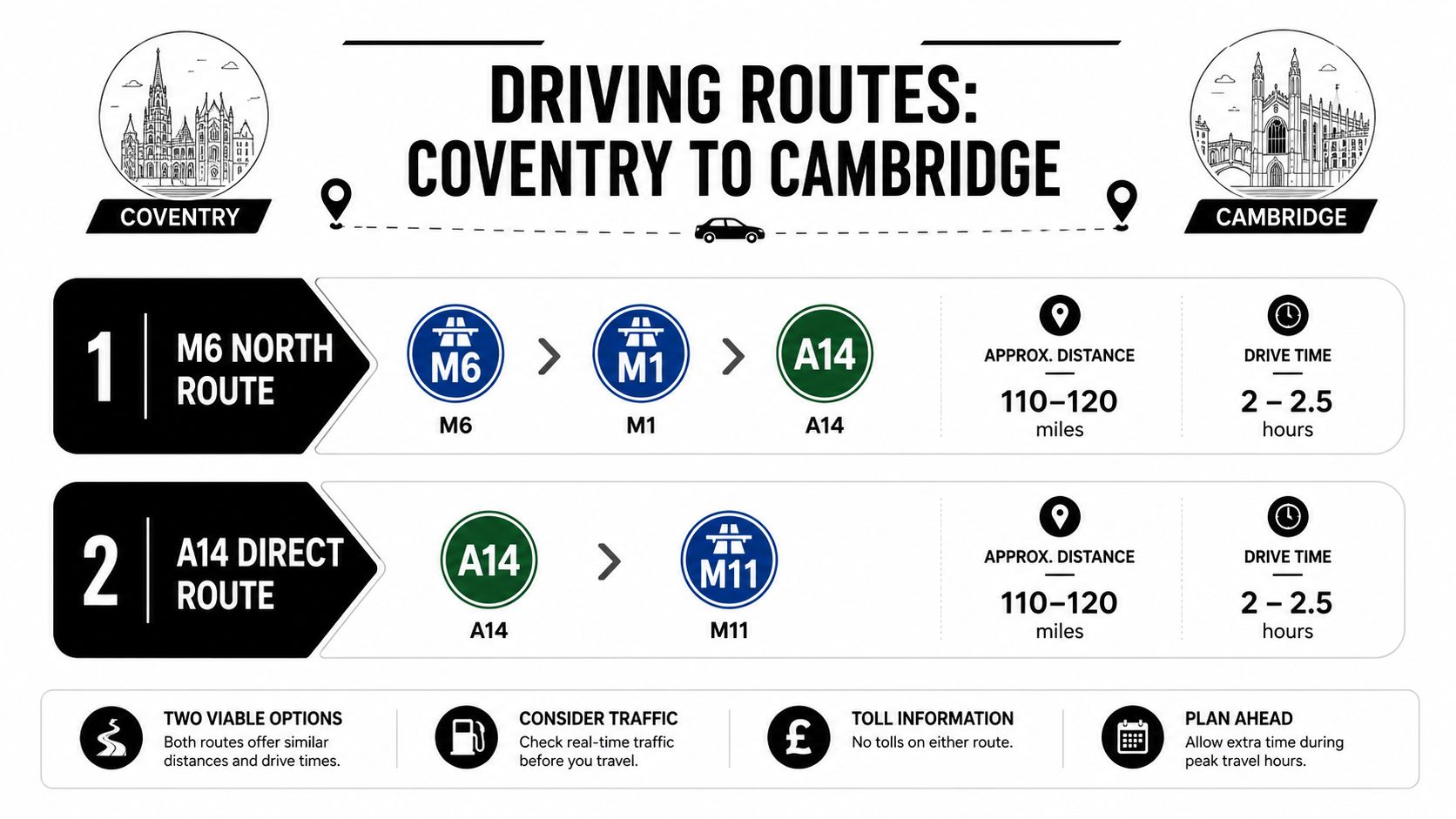
Driving is the cleanest option on this route if you value control. Route planners put the journey at roughly 113 to 115 km by direct distance and about 125 to 129 km by road, with a typical drive time near 1h 30m in normal traffic. The road corridor uses the A14/M11 network toward Cambridge, and that mostly dual-carriageway structure is why the drive can feel tidy when traffic behaves. FromTo's Coventry to Cambridge route page is a useful reference for the road shape.
In practice, I'd treat the drive as a scheduling exercise, not a casual fallback. The route works well when your real destination is not the station, when you've got luggage, or when you need to move a family without the friction of multiple platform changes. It also makes sense if you're collecting someone from Coventry and taking them straight to Cambridge with no interest in railway timetables.
The weak point is Cambridge itself. City-centre parking is the part people underestimate, and that's where the “easy drive” becomes annoying. The best approach is often to park on the edge of the city and finish the trip another way if your destination doesn't need a central drop-off. For short visits, that can be the difference between a smooth day and a slow one.
Practical rule: If your Cambridge destination has parking sorted in advance, driving is strong. If you're relying on luck, it's a poor bet.
What to do on the road
The main motorway logic is straightforward. Use the major northbound and eastbound corridors, keep an eye on the Cambridge approach, and leave slack for congestion. The route-mapping data flags the A14 and M11 corridor as the key long-distance spine, which is exactly where delay tends to build.
I'd also build a stop into the plan if you're travelling with children or elderly passengers. You don't need a dramatic break, just enough to reset the trip and avoid turning a short drive into a tense one. If the journey is time-sensitive, the sensible move is to leave earlier than the sat-nav suggests rather than trusting the baseline estimate.
Here's the useful contrast. If your trip is all about door-to-door simplicity, the car wins. If your trip is about cheapest entry fare, it doesn't. And if Cambridge parking looks messy before you even leave Coventry, that's usually a sign to stop forcing the issue.
Coaches and Budget Options Between Coventry and Cambridge
Coach is where the cheapest headline fares usually live, but the pricing is volatile enough to punish lazy booking. One UK coach comparison shows £6 for the cheapest daytime fare versus £50 in the morning, which is exactly why coach shopping on this route needs timing, not optimism. Traingtickets.com's Coventry to Cambridge comparison is useful here because it shows how sharply prices can swing.
The journey itself is longer than the road route and usually less forgiving than rail if you're carrying bags or travelling with a strict arrival window. National Express and Megabus can both be relevant depending on the day, but the sensible way to judge them is by departure time, stop location, and total door-to-door effort, not by the first fare you see. If the coach arrives in a central location that suits your final stop, it can make real sense. If it drops you somewhere awkward and you still need a taxi, the saving shrinks fast.
When coach makes sense
Coach is a solid fit for:
- Students who can travel off-peak, because the cheapest fares are often the whole point.
- Solo travellers with flexible plans, because the extra travel time is easier to absorb.
- People who can pack light, since easy luggage handling still matters when you're moving between stops.
- Travellers who book early, because coach pricing reacts strongly to departure time.
Comfort is adequate rather than luxurious. Wi-fi, charging, and seat pitch all matter more on this route than they do on a short hop, especially if you're working or revising while you travel. If you're choosing coach purely because it looks cheap, compare the full experience, not just the ticket. The route can be a bargain, but only if the arrival point and departure time line up with your day.
For most families, coach is only worth it if the fare gap is meaningful and everyone's patient. For most business travellers, it's a compromise too far. Budget matters, but so does arriving in one piece and on time.
When a Private Transfer Is Worth the Money
A private transfer makes sense on Coventry to Cambridge when the trip itself is only part of a bigger day. Families with children, older passengers who don't want station changes, business travellers on tight schedules, and anyone connecting to a cruise, airport, or hotel all get more value from door-to-door simplicity than from chasing a cheaper ticket. That's the core of it.
The point isn't luxury. It's removing friction. A good private transfer should give you a fixed price, meet-and-greet where needed, help with luggage, a licensed driver, and clear pickup details. If you've ever tried to move a suitcase through a busy rail interchange, you already know why people pay to avoid that.
A private transfer is worth it when missed connections, parking stress, or luggage handling would cost you more in time and energy than the fare difference itself.
This is also the right option when your schedule is rigid. Early starts and late arrivals can make rail and coach feel fragile, especially when frequency drops and a delay has a knock-on effect. If you're heading to a cruise port after Cambridge, or you're arriving in the UK with multiple bags, the value of a direct vehicle rises quickly. For readers comparing broader airport and transfer patterns, this Heathrow to Cambridge guide gives a useful sense of how fixed-price transfers solve the same kinds of problems.
The market isn't for everyone. Solo students and budget travellers should usually stick with rail or coach, because the premium won't earn its keep. But if you're moving more than one person, or if your day has no room for uncertainty, private transfer is the cleanest answer.
Choosing the Right Option and Booking With Confidence
If you're a student on a budget, start with coach, then rail if the coach times are awkward. If you're a family with luggage, I'd lean toward car or private transfer. If you're a business traveller, choose the rail itinerary with the least risky interchange, then compare it with a direct car journey if your meeting is sensitive to delay.
Quick booking checklist
- Check the interchange time first. That's where rail trips go wrong.
- Compare door-to-door time, not just in-vehicle time.
- Book rail advance fares early, ideally a few weeks ahead.
- Confirm pickup, parking, or final drop-off before you pay.
- Save screenshots of tickets and confirmations so you're not hunting through emails on the day.
The route is short enough that every mode stays viable, which is why the wrong decision hurts. The best choice is the one that fits your reason for travelling, not the one with the prettiest headline fare.
If you want the Coventry to Cambridge trip handled properly, with door-to-door planning that takes luggage, timing, and group travel seriously, EC Minibus is the obvious place to start. They specialise in private transfers that remove the station hassle and keep the journey simple. Visit their site, check the route options, and book the transport that matches the way you travel.