

You've booked the cruise. The cabin is sorted, the flights are probably half sorted, and then Dover lands on your to-do list like a problem no one warned you about.
That's usually the moment the stress starts. You're trying to work out when the ship docks, when passengers are really allowed off, whether your driver should meet you at the terminal or wait, and how much margin you need if you're heading to Heathrow or into London straight after. The Dover cruise ship schedule matters because it tells you far more than a ship name and a time. It tells you how tight your day will feel.
I've seen travellers make the same mistake again and again. They treat the port schedule like a rough guide. It isn't. If you use it properly, it becomes the backbone of your transfer plan. If you ignore it, you end up dragging luggage through a crowded terminal, calling taxis, or worrying about a missed flight before your holiday has even properly started.
Table of Contents
- Your Cruise Is Booked Now Plan Your Journey
- Where to Find the Authoritative Dover Schedule
- How to Interpret Cruise Arrival and Departure Data
- Understanding Dover's Cruise Season Patterns
- Step by Step Transfer Planning Using the Schedule
- Book Your Reliable Dover Transfer with EC Minibus
- Dover Cruise Transfer Frequently Asked Questions
Your Cruise Is Booked Now Plan Your Journey
Travelers don't struggle with the cruise itself. They struggle with the hours before embarkation or the hours after disembarkation.
You might be flying into Heathrow, staying overnight in Central London, then travelling to Dover the next morning with suitcases, passports, and boarding paperwork to keep track of. Or you might be arriving back into Dover and trying to get off the ship, clear the terminal, and make your way to a London hotel or airport without wasting half the day waiting around.
That's why I tell travellers to stop thinking of the schedule as a shipping document. It's a travel timing tool.
What the schedule actually helps you do
Used properly, the Dover cruise ship schedule helps you answer practical questions:
- Departure planning: What time do you need to leave London or Heathrow to reach the terminal comfortably, not breathlessly?
- Arrival planning: If your ship docks early, when can you realistically expect to walk out with your luggage?
- Terminal awareness: Which terminal matters for your meeting point and pick-up instructions?
- Risk control: Is your sailing date likely to feel calm, or busy enough that you need extra buffer?
A lot of cruise anxiety comes from false assumptions. A ship arriving early doesn't mean you'll be standing on the pavement minutes later. A published departure time doesn't mean that's when you should start heading to the port. The schedule gives you the framework, but you still need to interpret it like someone who understands port days.
Practical rule: Build your transfer around what happens on the ground, not around the headline time printed next to the ship.
The smartest mindset for Dover
Be early. Be organised. Pre-book everything that matters.
Dover works well when passengers arrive with a plan. It becomes stressful when people rely on same-day decisions, vague taxi plans, or optimistic timing. If you're travelling internationally, especially with a flight connection, your transfer should be arranged before you leave home. That's not over-cautious. It's sensible.
Where to Find the Authoritative Dover Schedule
If you want the schedule that matters, go straight to the official Port of Dover cruise pages. That's the source I'd trust first for checking live operational information, terminal details, and the overall cruise calendar.
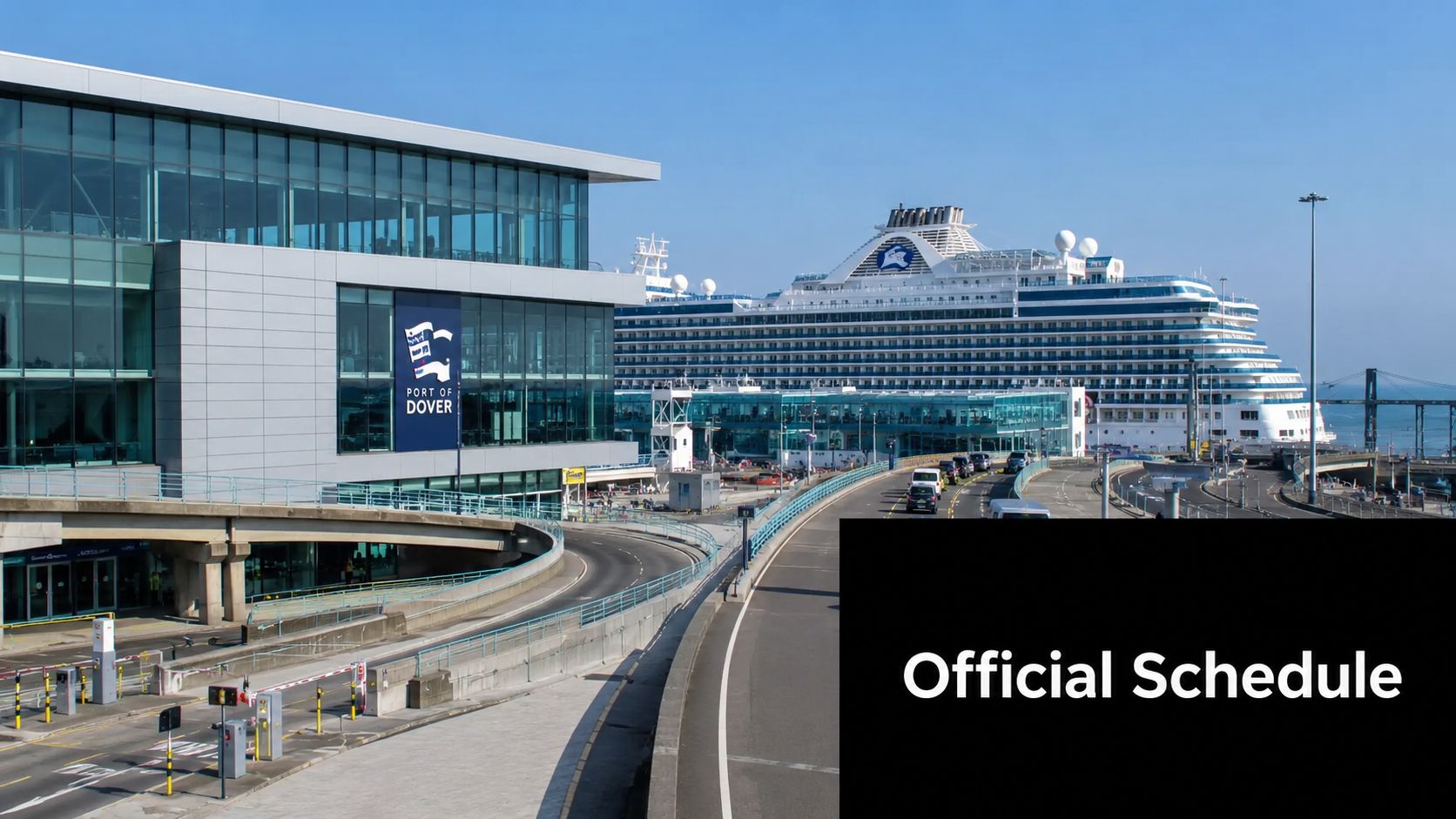
Third-party cruise websites can be useful for a quick glance, but they're not where you should base a flight, hotel checkout, or private transfer. Aggregators often lag behind operational updates, and they don't always make terminal-specific details clear enough for real travel planning.
Use the Port of Dover first
Start with the official port website. Then use any other listing site as a secondary check only if you want extra context.
Here's the order I recommend:
- Check the official port schedule for your ship and date.
- Confirm the terminal or berth information if it's shown.
- Recheck close to travel day in case the timing changes.
- Pass the schedule details to your driver or transfer provider so everyone is working from the same plan.
Why the official source matters even more in 2026
Dover isn't operating a sleepy, predictable season. According to the Port of Dover's 2026 anniversary announcement, the port is celebrating its 30th anniversary as a cruise port in 2026, with a record-breaking four-ship day scheduled during the season. The same announcement notes inaugural calls from Sapphire Princess, TUI Mein Schiff 2 with 2,894 passengers, Silversea Silver Spirit, MS Europa 2, Scenic Eclipse, and Viking Mira.
That matters because busy, high-profile seasons create more moving parts. More ships, more passengers, more coordination.
On a port day, “close enough” information isn't good enough. Use the source the port itself publishes.
What not to do
A quick warning. Don't build your entire day around a screenshot someone posted in a forum, an old cruise calendar indexed by search engines, or a generic itinerary page from months ago.
Use the current official schedule. Then plan your transport around that version, not the one you happened to see first.
How to Interpret Cruise Arrival and Departure Data
A schedule line looks simple. It isn't.
When you read the Dover cruise ship schedule, you need to translate each entry into a real-world sequence: docking, clearance, disembarkation, baggage, meeting point, then onward transfer. If you skip that step, you'll misjudge your day.
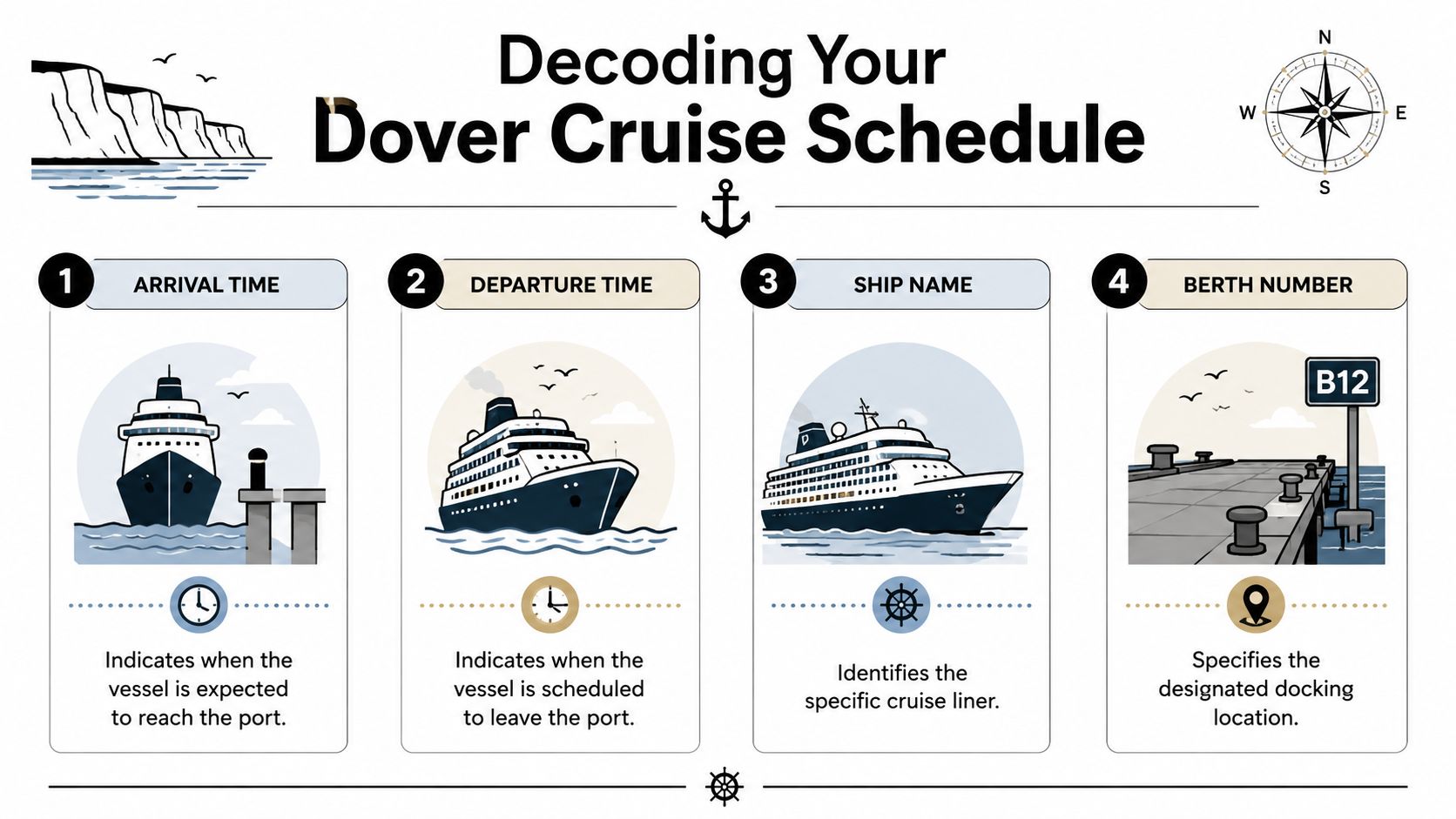
What each schedule field means for you
| Schedule item | What it tells you | What you should do |
|---|---|---|
| Ship name | Confirms you're reading the correct sailing | Match it against your booking documents |
| Arrival time | Shows when the vessel is due in port | Don't treat it as your pick-up time |
| Departure time | Shows when the ship leaves Dover | Work backwards and arrive well before final boarding |
| Terminal or berth | Identifies where the ship is handled | Use it to set the correct meeting point |
The biggest mistake is with arrival time. If your ship shows an early docking time, that means the vessel is due alongside. It doesn't mean every passenger can walk off immediately. The port still has to process the arrival, and the ship still has to manage disembarkation by deck or group.
Use passenger volume as a reality check
The schedule gets more important on busy days. According to CruiseDig's Dover port listing, May 2026 included 12 distinct ship arrivals. On 15 May 2026, Costa Favolosa with 3,012 passengers and ms Nieuw Statendam with 2,666 passengers arrived on the same day, totalling over 5,600 passengers in a single day. The same source notes that embarkation normally closes between 3:00 pm and 4:00 pm, while ships depart between 4:00 pm and 6:00 pm.
That's why I tell departing passengers not to focus on ship departure time alone. The practical deadline is the embarkation closing window, not the sailing time.
If you're comparing Dover with another UK port, this guide to the Ocean Cruise Terminal is useful for seeing how terminal procedures can shape transfer timing differently from one port to another.
A better way to read the schedule
Read the line like this:
- Arrival time: ship reaches port
- Disembarkation: starts later, after the ship is ready
- Embarkation closes: your real cutoff if you're boarding
- Departure time: ship leaves, whether you're on it or not
If you're sailing from Dover, plan to be checked in and comfortable before the terminal starts to tighten up. Don't aim to arrive at the edge of the closing window.
Understanding Dover's Cruise Season Patterns
One ship in port feels manageable. Multiple ships change the whole mood of the day.
The Dover cruise ship schedule for summer 2026 shows that this isn't just a straightforward procession of similar vessels. The port is handling a mix of mainstream and ultra-luxury ships, which means transfer demand, terminal activity, and kerbside pressure can shift sharply depending on the date.
What a busy day really means
According to the Port of Dover cruise schedule information, July 2026 includes a record-breaking four-ship day capability and the port can handle over 6,000 simultaneous passengers during peak overlaps. The same source highlights a mix of vessels such as Seabourn Ovation and Carnival Legend.
For passengers, that means three practical things:
- Road access feels busier: more coaches, more private cars, more loading activity.
- Collection points matter more: you don't want vague instructions when several ships are turning around.
- Last-minute transport gets riskier: demand rises on heavy overlap dates.
Seasonal rhythm changes your strategy
If your date falls in a high-activity stretch, book your transfer early and confirm the pickup details properly. Don't assume the port area will feel relaxed just because your own ship is small or premium.
Busy cruise days also affect the tone of the terminal. On quieter dates, the whole process can feel orderly and easy. On overlap dates, the same journey rewards travellers who've already sorted luggage plans, contact details, and meeting instructions.
The schedule doesn't just tell you when your ship is there. It tells you what kind of port day you're walking into.
Step by Step Transfer Planning Using the Schedule
This is where the schedule becomes useful rather than interesting. You're not reading it for curiosity. You're reading it to decide when a car should arrive, when you should leave your hotel, and how much buffer you need.
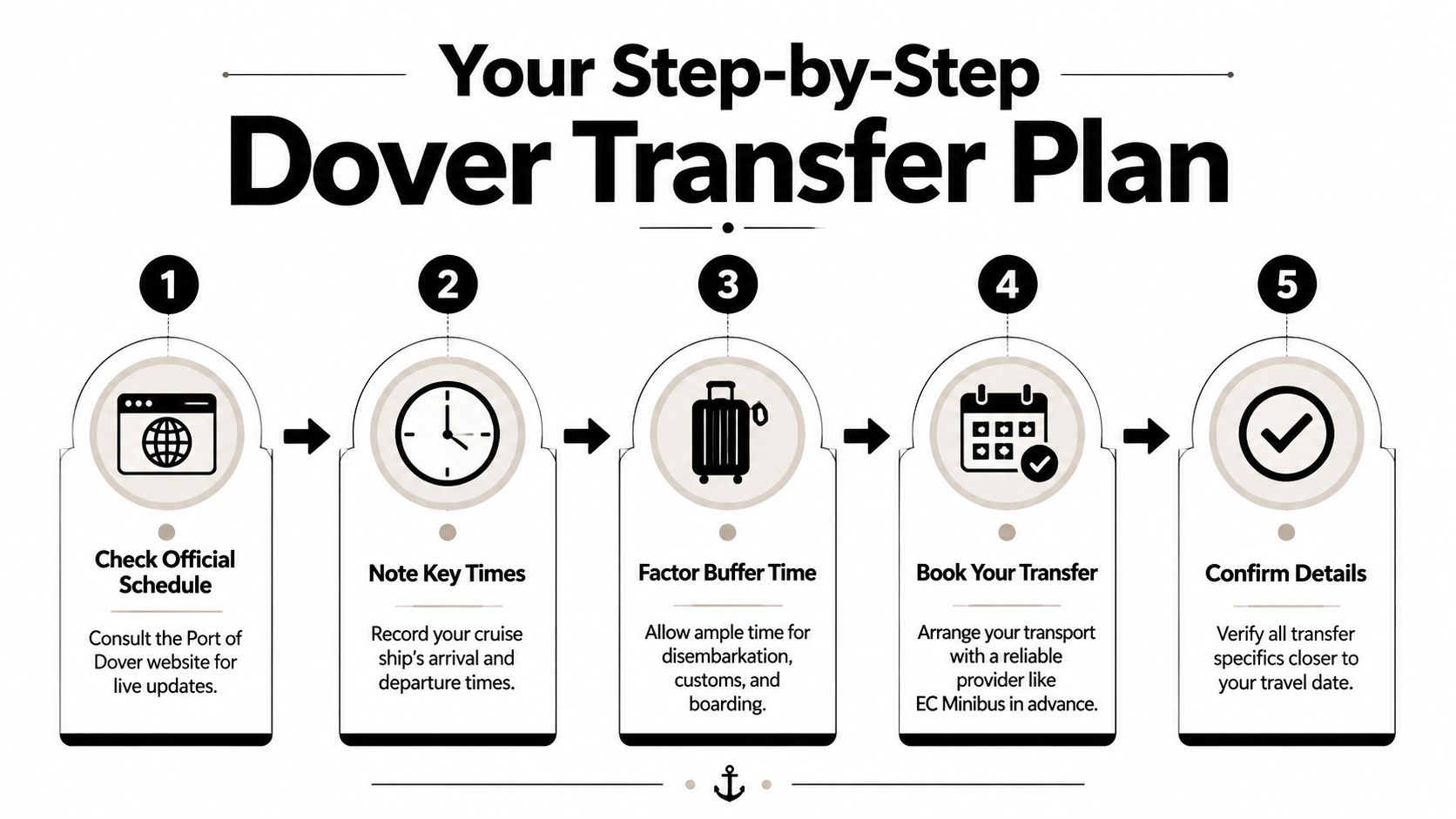
For passengers arriving into Dover
Use the arrival time as your starting point, not your collection time. According to CruiseMapper's Dover port overview, most vessels dock between 05:00 and 06:00 UTC, with assisted disembarkation starting by 07:00, and the port uses that early pattern to complete full turnaround cycles within a 12-to-14-hour window.
That tells you something important. The port is built for fast turnarounds, but passengers still move through a sequence. Docking, clearance, luggage, disembarkation, terminal exit.
Use this checklist:
-
Check your ship's scheduled arrival
If it's in the usual early morning window, expect activity to begin early but don't assume you'll be first off.
-
Look at your disembarkation arrangement
Assisted disembarkation and standard disembarkation move at different speeds. Your ship, not just the port, controls that flow.
-
Set a sensible pickup window
A driver should be booked for when you can realistically exit the terminal, not when the hull touches the berth.
-
Factor in luggage and control points
Families, mobility needs, and large suitcases all slow things down. That's normal.
A dedicated route like Central London to Dover Cruise Terminal works best when the pickup time is built around the operational rhythm, not guesswork.
Here's a useful visual guide before you finalise your day:
For passengers departing from Dover
Work backwards from the cruise line's boarding instructions and the embarkation closing time shown or implied by the day's schedule. This is not the moment to cut things fine.
I recommend this order of decisions:
- First, fix your terminal arrival target. Earlier is calmer.
- Then decide your departure point. Heathrow, a Central London hotel, or another address.
- After that, add buffer for check-out, traffic, stops, and unloading.
- Finally, confirm the exact meeting point and contact details.
The buffer most travellers forget
People plan the driving time and forget the handling time. You don't teleport from kerb to cabin. You unload cases, identify luggage, enter the terminal, and join the embarkation flow.
Local operator view: The smoothest transfer is rarely the fastest one on paper. It's the one with enough breathing room built in.
Book Your Reliable Dover Transfer with EC Minibus
If you've read this far, you already know the issue isn't whether Dover works. It does. The issue is whether your transfer plan is tight enough to match it.
That's where a dedicated cruise transfer service earns its keep. International travellers don't need extra uncertainty on port day. They need a booked vehicle, a driver who understands cruise timings, and a straightforward door-to-door journey between the terminal, London, or Heathrow.
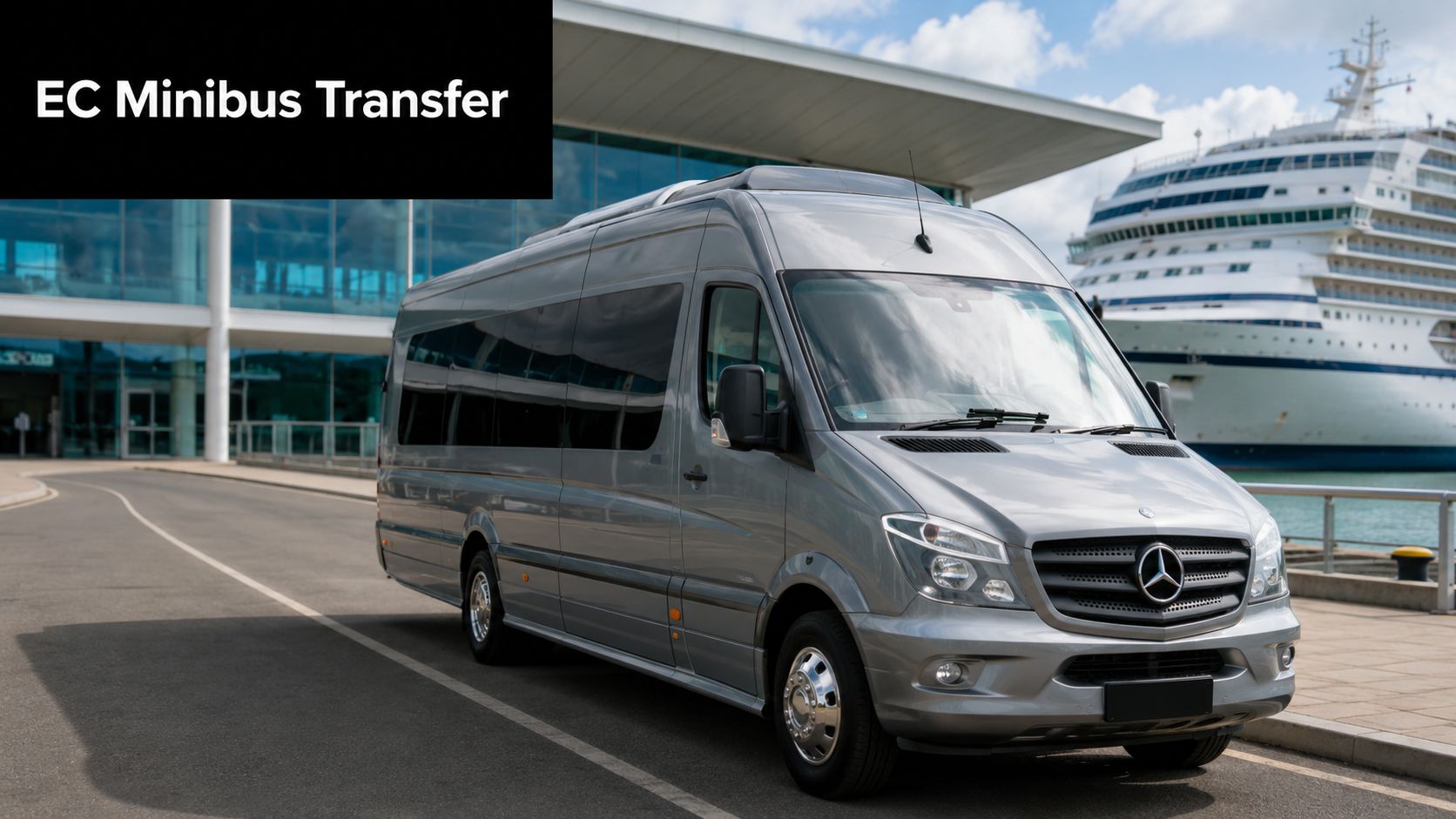
Why a specialist transfer beats improvising
A proper cruise transfer removes the weakest parts of the day:
- No kerbside guesswork: your collection plan is arranged in advance.
- No last-minute price surprises: fixed pricing makes budgeting easier.
- No confusion over luggage: larger vehicles and driver assistance matter on cruise days.
- No need to decode the port alone: experienced operators understand the practicalities of terminal pickups.
For travellers moving between airports, hotels, and cruise terminals, door-to-door cruise transfers are the sensible option because they reduce handoffs. Fewer handoffs usually means fewer problems.
My recommendation
If you're travelling with family, carrying substantial luggage, arriving from a long-haul flight, or trying to connect with a hotel or airport on the same day, book a private transfer before you travel.
That's not indulgent. It's the practical choice.
Dover Cruise Transfer Frequently Asked Questions
When should I book my Dover transfer
Book as soon as your cruise and flights are confirmed. Waiting limits your options, especially on dates when several ships are in port.
Should I rely on the ship's arrival time for my pickup
No. Use it as the opening marker for the day. Your actual pickup should account for disembarkation, baggage, and terminal exit.
What happens if the ship is delayed
That's exactly why you want a transfer provider that monitors cruise timings and keeps in contact. Cruise operations can shift, and your road transfer should adapt with them.
Is Dover straightforward for airport and London transfers
Yes, if the journey is planned properly. It becomes awkward when passengers leave everything to the day itself and assume timing will sort itself out.
Do I need to know my terminal in advance
Yes. Terminal details help avoid confusion and make the meeting point much clearer, especially on busy dates.
If you want a smooth journey between Dover, Heathrow, and Central London, EC Minibus is the right place to book. They specialise in UK cruise transfers, offer meet and greet, monitor flights and cruise timings, and provide fixed pricing with licensed, insured drivers. If your goal is simple, punctual, low-stress travel, book your transfer before you fly.