

You've left the ship at Dover, your luggage is beside you, and a Heathrow flight is waiting several counties away. The headline driving time may look manageable, but cruise-day transfers aren't ordinary car journeys. Disembarkation, customs clearance, luggage release, port traffic and Heathrow's controlled vehicle access all affect whether the journey feels calm or becomes a race against the clock.
For most passengers travelling with suitcases, a pre-booked private transfer from Dover Cruise Terminal to Heathrow Airport is the most dependable choice. Rail can work for flexible solo travellers with light luggage, but the cheapest-looking route isn't always the simplest once you add stations, changes and a separate Heathrow connection.
Table of Contents
- What to Expect from Dover Cruise Terminal to Heathrow Airport
- Comparing Your Transfer Options at a Glance
- How a Private Door to Door Transfer Works
- Using Trains and Tube to Reach Heathrow
- Timing Tips and Booking Mistakes to Avoid
- Choosing the Right Transfer for Your Trip
What to Expect from Dover Cruise Terminal to Heathrow Airport
A typical cruise morning starts with uncertainty. The ship may clear on schedule, yet passengers still need to collect luggage, leave the terminal and find the correct meeting point. A family travelling with several cases can lose valuable time before the vehicle has even reached the port exit.
The road journey is roughly 95 miles, with a typical outside-peak duration of 110 to 145 minutes for a direct private transfer using the M25, M20 and A20 corridor, according to the Dover to Heathrow transfer guidance. That's a useful planning benchmark, not a promise. The M25 can change the practical arrival time quickly, and the port exit can be slow even when the main motorway is moving.
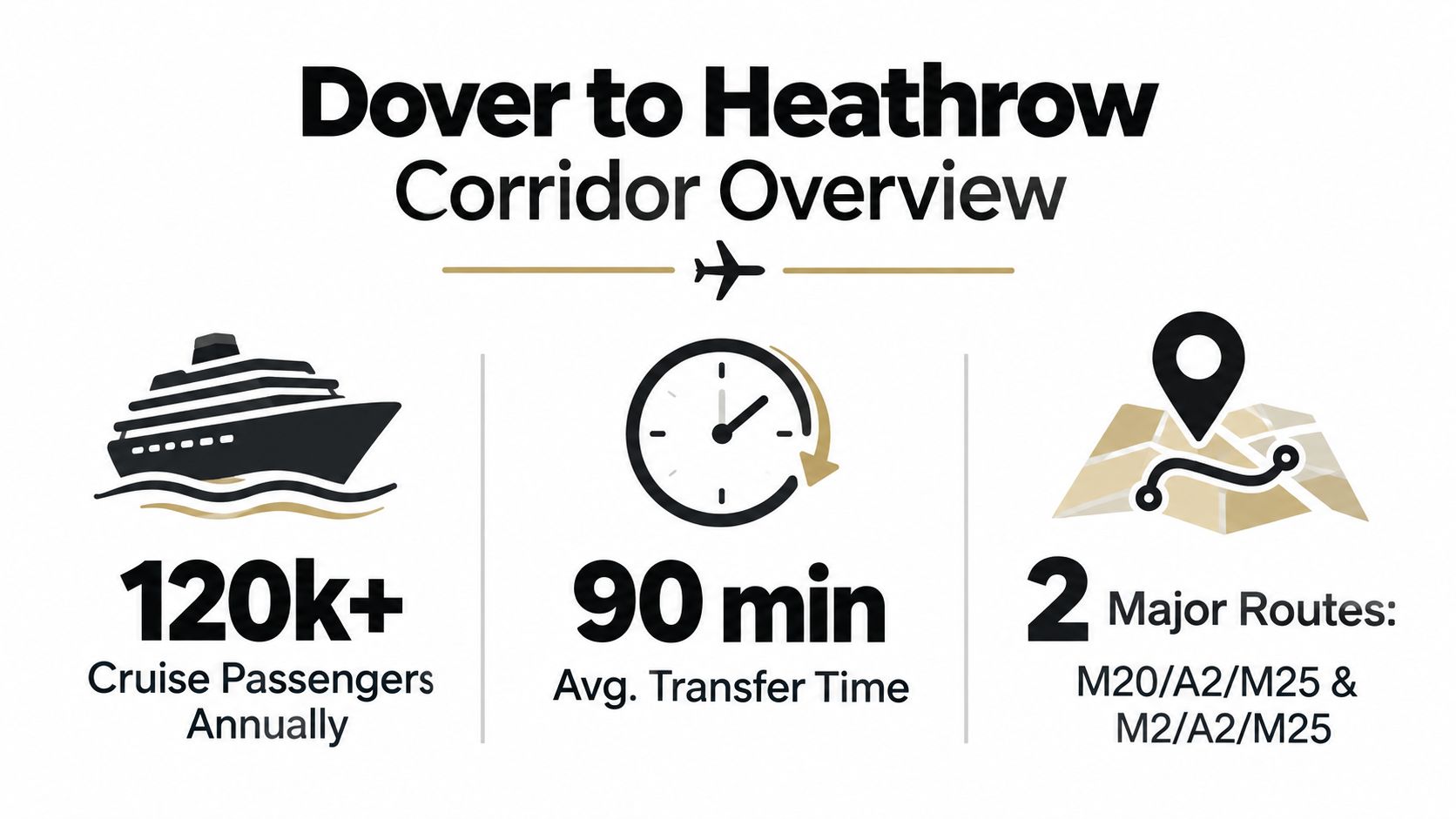
The route matters because it links a substantial cruise gateway with Heathrow, Europe's busiest hub airport by annual passenger volume. Heathrow handled 84.463 million passengers in 2025, up 0.7% year on year, and its busiest December reached 7.189 million passengers, as reported in Heathrow's 2025 passenger results. Dover handled 102,000 international cruise passengers in 2025, within a UK total of 3.1 million, according to the UK sea passenger statistics for 2025.
Why cruise timing changes the calculation
A normal airport transfer starts with a known pickup time. A cruise collection begins with the vessel's actual release process. Your driver might arrive at the agreed time, but you may not yet be ashore, or you may still be waiting for bags.
Practical rule: Treat the ship's clearance and luggage release as part of the journey, not as free time before it begins.
Families, older travellers and passengers with long-haul flights should prioritise predictability over the nominal fastest route. A direct vehicle keeps luggage with you, removes station changes and allows the driver to follow the operational plan from terminal collection to Heathrow drop-off. You can find the relevant Dover Cruise Terminal transfer details before booking.
Comparing Your Transfer Options at a Glance
The right option depends less on the advertised road time than on how many things can go wrong after you leave the ship. A private vehicle offers one continuous movement. A taxi offers similar door-to-door convenience, but availability, vehicle size and final pricing need checking in advance. Coach and rail routes may reduce the initial fare, yet they make you responsible for connections, platform changes and luggage handling.
| Transfer Option | Typical Time | Changes and Luggage Ease |
|---|---|---|
| Private transfer | Roughly 110 to 145 minutes outside peak periods | No planned change, luggage stays with you, suitable for families and groups |
| Taxi | Similar direct road routing, subject to traffic and availability | No planned change, but confirm vehicle capacity and fare arrangements |
| Coach or shared shuttle | Longer and schedule-dependent | May involve waiting or additional connections, less control after late disembarkation |
| Train plus Tube or Heathrow connection | Around 2 hours 40 minutes for the shortest rail-based journey | Several stages, awkward with large cases, no direct public transport link |
| Local taxi to station plus rail | Depends on the first connection and onward service | Adds another handover before the main journey begins |
The shortest rail-based journey is around 2 hours 40 minutes, and there's no direct public transport link between Dover and Heathrow, according to Kent Travel Hub's Dover and Heathrow route comparison. Rail passengers generally travel from Dover Priory towards central London, then continue to Heathrow by another service. That can be sensible for a solo traveller carrying hand luggage and travelling with plenty of flexibility.
For a family, the calculation changes. Each suitcase must be lifted on and off trains, moved through stations and kept together during interchanges. A passenger who saves money on the first ticket may still need a taxi at one end, a separate Heathrow connection and contingency for a missed service.
The decision in practical terms
Choose a private transfer when:
- Your flight is the priority: A fixed vehicle removes scheduled rail changes after you leave Dover.
- You have substantial luggage: The driver loads the cases once and you don't have to negotiate platforms or escalators.
- You're travelling as a group: One vehicle keeps everyone together rather than splitting the party across crowded services.
- Your disembarkation time may move: Cruise monitoring gives the operator a better chance to adjust the collection plan.
- You value a fixed fare: You can budget without relying on live taxi availability or changing demand.
Choose rail when you're travelling light, your flight schedule is forgiving and you're comfortable navigating London stations. I wouldn't recommend it for a tight same-day international flight after a cruise, particularly if you're unfamiliar with the UK network.
How a Private Door to Door Transfer Works
A well-organised private transfer follows a simple sequence. The important part is confirming the details before the ship arrives, because the driver can't solve an unclear meeting point, unsuitable vehicle or missing terminal information at the kerb.
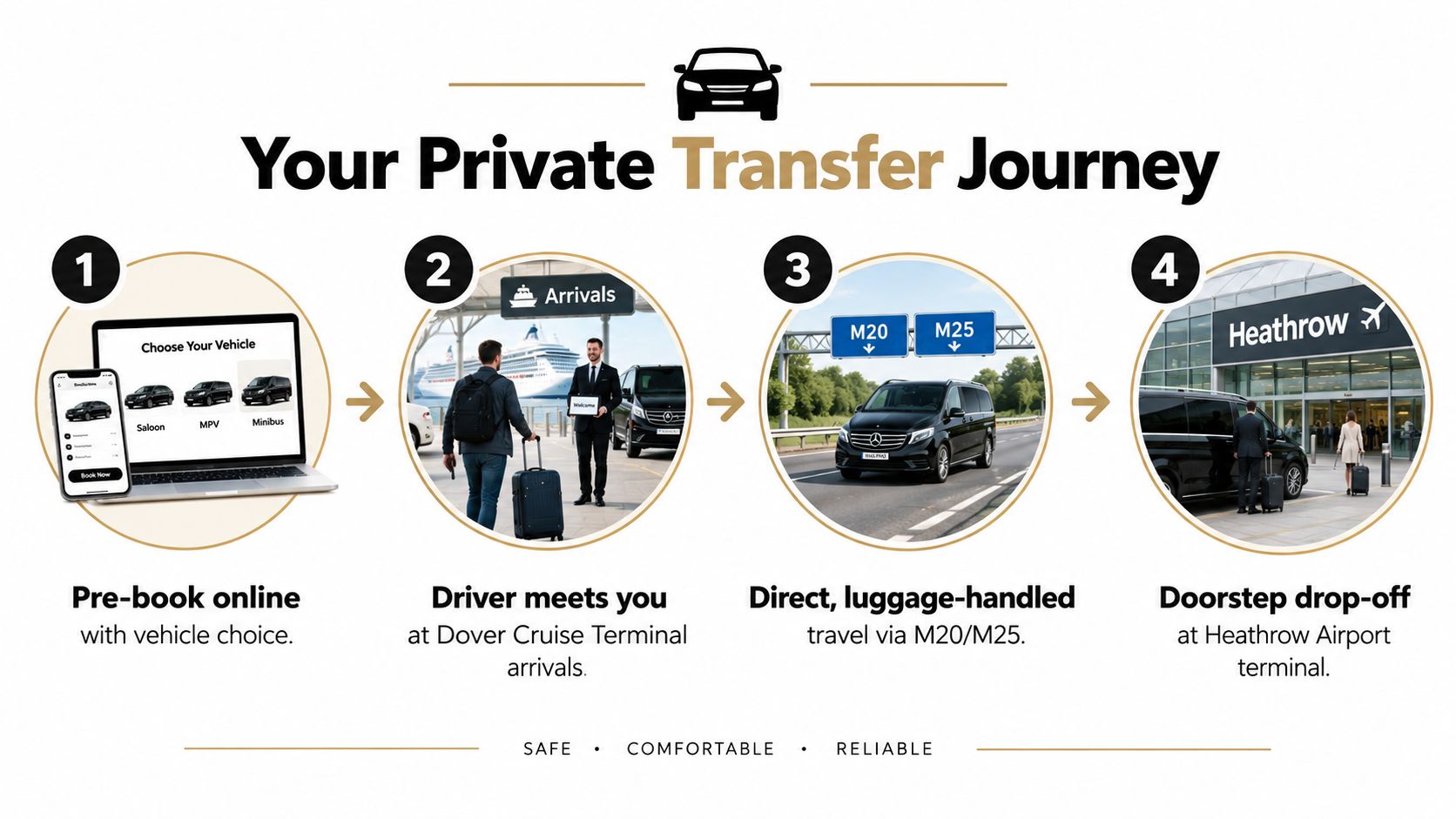
Book the vehicle around the luggage
Enter the cruise name, arrival date, terminal details, passenger count and luggage profile when booking. A saloon may suit a couple with modest cases, while families and groups usually need a larger minibus so luggage doesn't compromise passenger space.
A service such as EC Minibus lists private Dover cruise terminal transfers with Heathrow drop-off, online booking, vehicle selection and fixed pricing. The booking should show the collection instructions clearly, rather than leaving you to decide where to stand after disembarkation.
Meet the driver at the terminal
The driver should meet you at the agreed arrivals point or another clearly defined terminal location. Keep the booking confirmation accessible on your phone, and make sure the operator has a working mobile number for the lead passenger.
The useful distinction is between a vague kerbside pickup and a proper meet-and-greet arrangement. With the latter, the operator knows which ship you're leaving, where the handover should happen and how to contact you if the terminal process changes.
Leave Dover using the main corridor
The practical road plan is to leave Dover via the A20, connect with the M20, then use the M25 for Heathrow-bound access. The route follows the strategic road network rather than relying on local roads, although the port exit and the M25 interchange remain sensitive points.
Kent corridor evidence records about 17,000 vehicles per day on the approach to the Port of Dover and 137,800 vehicles per day on the A2 at Dartford, as shown in the Kent Corridors to M25 evidence report. Those figures illustrate why a clear inland motorway doesn't guarantee a smooth terminal departure or interchange.
Arrive at the correct Heathrow terminal
Heathrow doesn't operate like a roadside hotel pickup. Passenger collection rules direct vehicles to designated parking or park-and-ride areas rather than allowing casual terminal-forecourt access, as explained in the official Heathrow passenger pick-up guidance.
For a drop-off, confirm the airline and terminal before travel. Give the driver the exact flight details, not just “Heathrow”, because the correct terminal helps prevent a stressful final handover. A professional operator can also monitor the cruise and flight information, provide luggage assistance and issue instant booking confirmation.
Using Trains and Tube to Reach Heathrow
Rail is a split journey, not a single Dover to Heathrow service. You'll usually start at Dover Priory, travel towards central London and then continue to Heathrow using another rail or Underground connection. The route can be perfectly workable, but every interchange adds a task at the point when most cruise passengers are already tired and managing luggage.

The usual interchange pattern
One route travels towards London Victoria, followed by an Underground or rail connection towards Heathrow. Another may use St Pancras International, then continue through the London transport network. The best choice depends on the service running on the day, engineering works, accessibility needs and your comfort with moving through a busy station.
Before leaving the ship, check the live route rather than relying solely on a timetable saved during the booking process. The Dover to London transfer information can help you understand the first part of the journey, but you'll still need to plan the London-to-Heathrow connection separately.
Luggage is the hidden difficulty
A suitcase with wheels helps, but it doesn't remove the problem. You may need to find lifts, cross a concourse, wait for a platform and board a busy train while keeping multiple bags and passengers together. Stairs, narrow passageways and crowds can make a short interchange feel much longer.
Contactless payment can be convenient for eligible London journeys, but check the complete route and ticket requirements before departure. If anyone in your party needs step-free access, confirm the station arrangements in advance rather than assuming every interchange provides a lift.
When rail is a sensible choice
Rail makes sense for a solo traveller with light luggage, an adaptable itinerary and no immediate pressure to reach a flight. It can also suit someone staying overnight near Heathrow, where a small delay won't jeopardise a same-day departure.
I'd choose a private road transfer for a family with several cases, an older traveller who wants to avoid station changes, or anyone connecting to a long-haul flight after the cruise. If the ship releases passengers late, rail doesn't wait for you. You'll have to rework the route while carrying your luggage through the network.
Timing Tips and Booking Mistakes to Avoid
The most dangerous assumption is that the published driving time equals the time you need to protect. It doesn't. The journey starts with cruise clearance and luggage release, then passes through a busy port exit before reaching the M20 and M25.
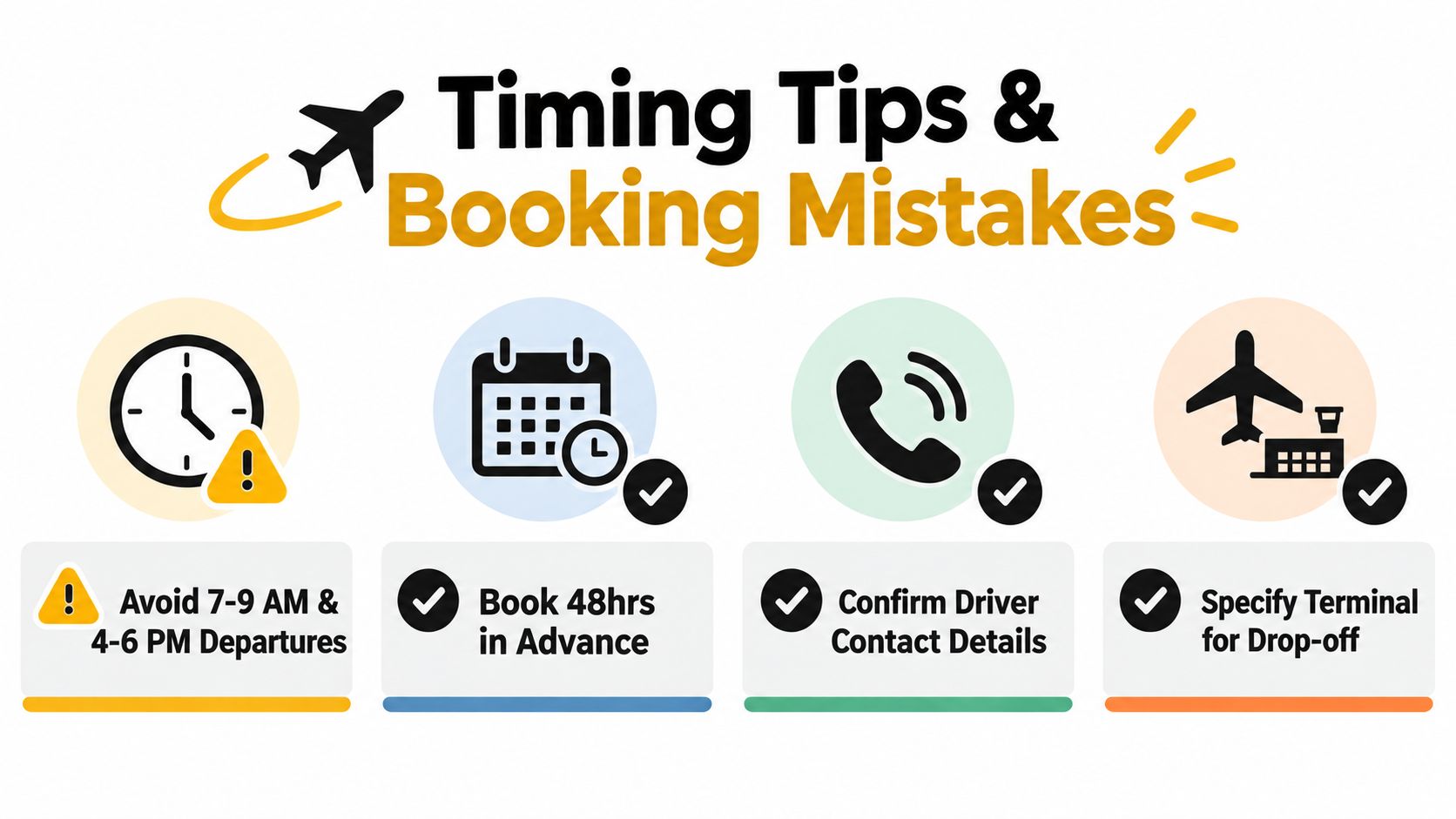
Plan a 30 to 60 minute contingency buffer for port exit uncertainty and Heathrow arrival processing. This is a practical operating allowance, not a guarantee against severe disruption. Heathrow also advises passengers to check live traffic and travel information before moving, which is especially important when your onward flight has a fixed departure time.
Protect the vulnerable points
Traffic risk isn't evenly distributed along the corridor. The final approach out of Dover can slow as cruise passengers, port vehicles and local traffic leave the docks. Later, the M25 interchange can create a delay that has little relationship to the conditions you experienced on the M20.
Allow the operator to monitor the route on the day. A driver who knows the corridor can assess whether a short tactical adjustment is sensible, but no local-road alternative should be treated as automatically faster.
Timing advice: Build the schedule around your latest realistic disembarkation time, not the earliest time printed in your cruise paperwork.
Avoid these common booking errors
- Using the nominal drive time as your whole plan: The rough road benchmark excludes the uncertainty of disembarkation, luggage release and airport processing.
- Leaving the meeting point vague: Confirm the terminal, arrivals area, sign details and driver contact before the ship docks.
- Booking the wrong vehicle: State the number and size of cases. Passenger capacity alone doesn't tell you whether the luggage will fit comfortably.
- Assuming a shared shuttle runs whenever you need it: Shared services can be limited and may operate only on dates when major cruise ships are in port, as noted in London Toolkit's Dover transfer guidance.
- Ignoring cruise monitoring: If the vehicle is dispatched against a rigid time rather than the vessel's live status, a late release can create an avoidable wait or a missed handover.
- Treating Heathrow's forecourt as a normal pickup point: Heathrow directs passenger pickups to designated areas, so confirm where the vehicle will meet you if the arrangement involves collecting rather than dropping off.
Use a simple same-day checklist
Before the cruise arrives, confirm:
- The ship name and terminal.
- The number of passengers and luggage pieces.
- The Heathrow airline and terminal.
- The driver's contact method.
- The collection instructions if disembarkation runs late.
- The planned buffer before flight check-in and airport processing.
Don't book a vehicle based only on the lowest advertised figure. The cost of a missed flight, rushed replacement transport or an uncomfortable luggage transfer can outweigh the original saving.
Choosing the Right Transfer for Your Trip
The choice is straightforward once you rank the risks. Private transfer means paying for continuity, while rail means accepting several separate stages in exchange for a potentially lower initial fare. Neither option suits every passenger, but one will usually fit your cruise-day priorities better.
For families with cases, I recommend a pre-booked vehicle with enough luggage capacity, a named meeting point and cruise monitoring. Keep the children and bags together, avoid station interchanges and arrive at Heathrow through a planned terminal drop-off.
Older long-haul travellers should choose the same approach. A direct vehicle reduces walking, lifting and uncertainty after a tiring ship departure. Ask for assistance with luggage and confirm that the driver knows the exact terminal before the day of travel.
Solo travellers with hand luggage have more flexibility. Rail can be a reasonable choice if the flight is not tight and you're comfortable changing in London. If your connection is important, a private transfer remains the calmer option because it removes the need to manage multiple services after leaving Dover.
Groups should focus on vehicle fit and coordination. One properly sized minibus is easier to manage than several taxis, particularly when everyone has cruise luggage and the party needs to arrive at the same Heathrow terminal.
My recommendation: For a same-day Heathrow flight after a Dover cruise, choose a fixed-fare private transfer with cruise monitoring and a realistic contingency buffer. Use rail only when your luggage is light and your schedule can absorb disruption.
Confirm the ship, terminal, passenger count, luggage, flight and Heathrow terminal before paying. That information gives the operator what it needs to plan the right vehicle and collection arrangement, and it gives you a much better chance of turning a complicated cruise morning into a controlled journey.
EC Minibus provides private Dover Cruise Terminal to Heathrow transfers with online booking, vehicle choices, luggage assistance, fixed pricing and cruise monitoring. Visit EC Minibus to confirm your terminal details, choose a suitable vehicle and arrange a direct airport transfer before you disembark.