

You're standing on the Dover approach road before breakfast, watching ferry traffic build while your cruise departure time gets closer. Your cases are packed, your passport is accessible, and the route planner says you have plenty of time. Then a coach turns towards the cruise entrance, lorries slow near the port lanes, and the neat journey shown on your phone starts looking less convincing.
That's the central fact about the Dover Cruise Terminal. The ship is only one part of the journey. Dover is also a busy ferry and trade gateway, so the critical planning decision is how you'll reach the port, where your luggage will change hands, and how much time you'll leave for Kent roads. This guide gives you the practical playbook, not another generic list of terminal facilities.
Table of Contents
- Why Dover Feels Different From Southampton
- Where Dover Cruise Terminal Sits and What Is Inside
- Step-by-Step Check-In, Security, and Boarding
- Getting to Dover From London, Heathrow, and Beyond
- Realistic Journey Times and Costs You Can Plan Around
- Parking, Drop-Off, Hotels, and Accessibility
- Your Day-of-Cruise Action Plan and Common Questions
Why Dover Feels Different From Southampton
If you arrive at 06:30, the Western Docks can already feel like a working transport interchange, not a conventional cruise campus. Sea mist catches the headlights, ferry traffic occupies separate lanes, and cruise coaches share the approaches with passengers heading for embarkation.
That compact layout works in your favour. Dover is easier to understand than Southampton, with fewer cruise buildings and a shorter route from vehicle drop-off to passenger processing. You will not spend the morning crossing a sprawling terminal complex. The trade-off is shared operating space, where cruise traffic meets cross-Channel freight, ferries, coaches, taxis, and port vehicles.
The Port of Dover is widely described as the UK's second-busiest cruise port. Its cruise material says it welcomes more than 20 individual cruise lines and over 200,000 cruise passengers each year, with facilities able to handle four ships at once across two terminals and a 320-metre berth, according to the Port of Dover overview. Those figures show the port's capacity, not a promise that every embarkation morning will run like a dedicated resort terminal.
What the smaller footprint changes
Plan for a concentrated process:
- Fewer cruise zones: Staff will usually direct you to the relevant terminal entrance instead of sending you across a large campus of named buildings.
- Shared access roads: Ferry, commercial, coach, taxi, and cruise traffic can converge around the port approaches.
- Tighter practical windows: A short walk inside the terminal does not protect you from delays on Kent roads.
- Seasonal pressure: Cruise calls are concentrated against a port that operates as a busy ferry gateway, so popular sailing dates can create sharp local peaks.
Dover's cruise operation combines regular ship calls with substantial passenger volume. In 2019, the port accommodated 130 cruise ship port calls and more than 200,000 passengers. That history shows why you should plan for several transport patterns operating together, rather than assuming cruise passengers control the approach roads.
Practical rule: Treat the transfer to Dover as part of your embarkation, not as an afterthought once the cruise booking is complete.
The final leg catches out passengers travelling from London, Heathrow, the Midlands, or farther inland. A route planner may show a manageable driving distance while ignoring ferry queues, coaches, freight movements, roadworks, or a slow approach to the docks. Use the broader ocean cruise terminal transfer guidance for general planning, then apply stricter timing to Dover's Kent-road conditions. A transfer service such as EC Minibus can handle the port journey directly, but you still need to book a pickup time that leaves room before your required terminal arrival.
Where Dover Cruise Terminal Sits and What Is Inside
The cruise facilities sit within Dover's dock area, with access from the A20 and connections towards the M20 and A2. The white cliffs rise behind the port, while the harbour entrance opens towards the Channel. That geography is memorable, but road signs can still confuse first-time visitors because the ferry operation is next door and much more prominent.
Dover's cruise facilities are built around two dedicated terminals and Berth 4. They operate around the clock with VTS Channel 74, while berth dimensions are the more important detail for passengers trying to understand why larger ships can call here. The cruise brochure lists 340-metre berths with 8.5-metre depth for both Terminal 1 and Terminal 2, and the trade information lists an upgraded maximum ship length of 350 metres for Terminal 2. The Port of Dover cruise brochure explains the relevant berth infrastructure.
What you'll find inside
The passenger experience is functional rather than airport-like. You'll generally move through a main processing hall containing:
- Luggage handling, normally outside or at a designated drop point before you enter.
- Check-in desks, where staff verify your booking and travel documents.
- Security screening, with hand luggage examined before you reach the waiting area.
- Passenger seating, suitable for a short wait rather than a long pre-departure stay.
- Refreshment facilities, such as a café or vending provision, alongside toilets.
- The boarding route, which leads towards the ship by covered connection, shuttle, or walking route depending on berth and operational arrangements.
The exact boarding path can vary with the ship's position, tide, and port instructions. Follow the signs and staff directions rather than assuming the route you used on a previous call will be identical.
Don't follow ferry signs by mistake
The Western Docks ferry terminal serves cross-Channel traffic and has its own vehicle lanes, check-in arrangements, and security procedures. A sat-nav may bring you close to both operations, but “Dover port” isn't precise enough for a cruise morning. Use the cruise line's terminal instructions and check the vehicle access point before leaving.
Dover accommodates a varied cruise programme, including operators such as Saga, Viking, and Ambassador, alongside seasonal smaller-vessel calls. Don't assume every major Southampton brand operates a Dover homeport service. P&O Cruises and Cunard are associated with Southampton rather than regular Dover departures, so confirm the departure port printed on your booking before arranging accommodation or transfers.
Step-by-Step Check-In, Security, and Boarding
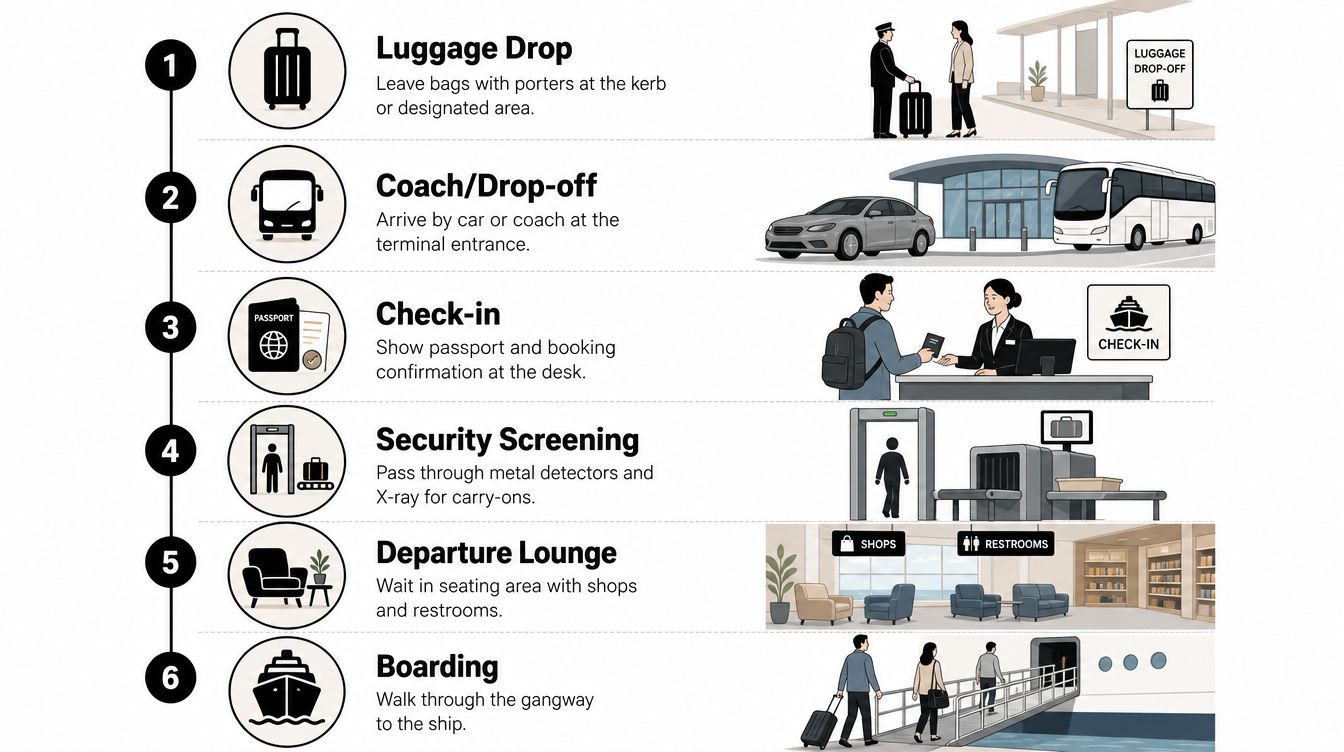
Dover's embarkation process is straightforward when your documents and luggage are organised before you reach the kerb. Most delays happen at handoff points, especially when a passenger hasn't separated the bags going into the hold from the hand luggage they need during the journey.
Start outside the doors
Your first stop is the designated luggage drop area. Attach the cruise line's luggage labels before you arrive, keep medication and travel documents in your cabin bag, and don't hand over anything you'll need during check-in.
The driver should use the signed cruise drop-off area rather than the ferry lanes. If you're travelling by private vehicle, ask the driver to remain available until the porters have accepted the cases and you've confirmed the correct terminal entrance.
Complete check-in before security
Inside the hall, staff will check your passport, cruise booking confirmation, and any forms required by the operator. Keep your passport in your hand, not buried inside a suitcase. A booking email on a phone is useful, but a charged device and an offline copy of the confirmation are safer than relying on weak reception.
Security follows check-in. Place cabin baggage through the x-ray process, remove items as directed, and tell staff about mobility aids before screening begins. Treat liquids conservatively and follow the cruise line's current instructions, particularly for containers that would be restricted in an airport-style screening environment.
Don't confuse a cruise card with travel identification. Your boarding credential gets you through the ship's processes, but it doesn't replace the passport requirements for the itinerary.
Expect a simple boarding handoff
After security, you'll wait in the departure area until your group or boarding number is called. The final route may use a covered walkway, a shuttle, or a walking connection to the gangway. Keep your boarding card accessible because staff may check it again as you leave the terminal.
First-time passengers often get caught out by four details:
- Passport confusion: A photo ID may not satisfy the cruise line or itinerary requirements.
- Oversized luggage: Large or unusual items may need separate handling and won't necessarily follow the standard porter route.
- Mobility arrangements: Wheelchairs, scooters, and other aids should be declared to the cruise line before arrival.
- Airport expectations: Dover isn't designed as a duty-free shopping journey with multiple retail zones between security and boarding.
For a UK embarkation, follow the cruise line's stated arrival appointment and allow enough time for road uncertainty, luggage handoff, and screening. On the return journey, allow additional time for disembarkation and border processing before booking a tight onward train or flight. The terminal may be compact, but your total journey still depends on customs, luggage collection, and the road beyond the port.
Getting to Dover From London, Heathrow, and Beyond
Choose transport by luggage and consequence, not just by the cheapest headline fare. A solo traveller with one case can use rail efficiently. A family with several cases may find a coach cheaper but more tiring. A group arriving at Heathrow usually benefits from a pre-arranged vehicle because changing trains with luggage is exactly the kind of friction that causes missed connections.
Southeastern Highspeed from St Pancras is the cleanest rail option for light packers. Conventional rail via London Bridge can work, but it requires more attention to connections and the final taxi or local transfer from Dover Priory. National Express is more suitable for passengers prioritising budget over control, provided everyone can manage their cases and you've allowed for road traffic.
| Mode | From London (Time) | From Heathrow (Time) | Luggage Handling | Indicative Cost | Best For |
|---|---|---|---|---|---|
| Southeastern Highspeed | Direct rail approach to Dover Priory | Requires city or interchange connection | Passenger-managed | Fare varies | Solo or light-packing travellers |
| Conventional rail | Connection-dependent | Multiple connections likely | Passenger-managed | Fare varies | Confident rail users |
| National Express coach | Road journey via Kent | Airport coach connection may be needed | Coach storage plus terminal handling | Fare varies | Budget-conscious families |
| Black cab or ride-hail | Door-to-door | Door-to-door, subject to availability | Easy at both ends | Fare varies | Couples with a tight schedule |
| Scheduled shuttle | Fixed route and timetable | Route-dependent | Shared handling | Fare varies | Passengers near the pickup route |
| Private hire, including EC Minibus | Door-to-door | Door-to-door from the airport | Driver-assisted | Group fare | Groups with heavy luggage |
The published Dover to London transfer guide is useful for comparing the final road leg, but don't treat any listed journey as guaranteed on an embarkation morning. A taxi is convenient for two people with a narrow window. For three to eight passengers with substantial luggage, a private minibus normally makes the most sense because one vehicle, one pickup, and one agreed fare remove several handoffs.
If the M20 is disrupted
Dover's ferry and cruise traffic means a motorway problem can affect more than one type of traveller. If authorities introduce a contraflow or traffic-management scheme, don't wait until your planned departure time to react. Ask your driver or operator for the current route, leave earlier if possible, and avoid improvising through Dover town centre unless local instructions direct you there.
Rail offers a useful fallback when the road network is badly affected, but it won't solve luggage or last-mile problems by itself. The right backup is the one you can execute with your cases, mobility needs, and sailing deadline.
Realistic Journey Times and Costs You Can Plan Around
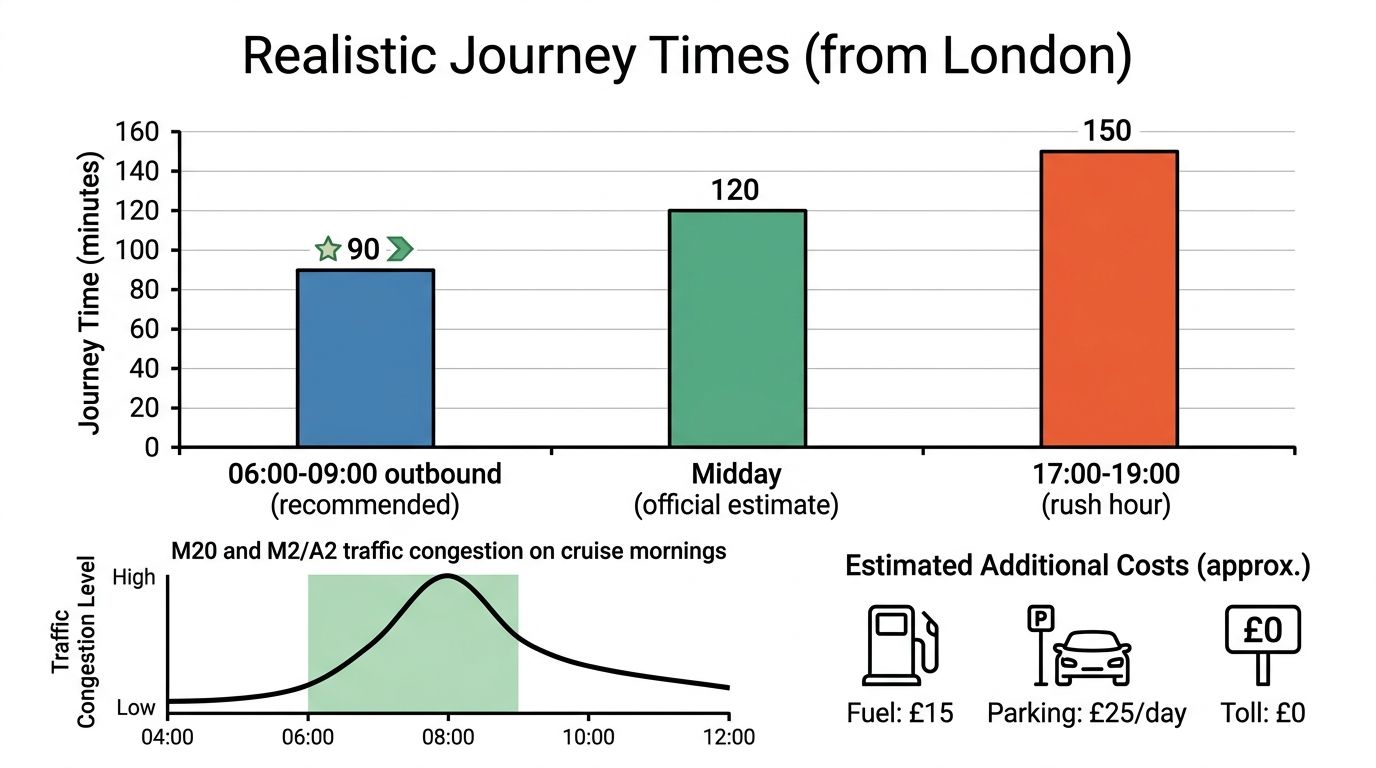
Dover is a busy ferry and trade gateway as well as a cruise port, so the final road journey deserves more attention than the terminal map. A route that looks straightforward can unravel around the M20, M2, A2, or Dartford Crossing, particularly when ferry traffic and ordinary Kent traffic build together.
Plan with ranges, not an optimistic single arrival time:
- Central London to Dover Western Docks: roughly 100 to 130 minutes off-peak, or 130 to 180 minutes in peak conditions.
- Heathrow to Dover: roughly 110 to 150 minutes off-peak, or 150 to 210 minutes during peak conditions.
- Gatwick to Dover: around 90 to 140 minutes.
- Southampton to Dover: around 165 to 225 minutes via the M3 and M20.
These figures are planning ranges from the supplied route guidance, not a promise from the port. A Dartford Crossing queue can add 30 to 45 minutes, so passengers travelling east from central London should check the crossing as well as the M20.
Use cost as a group decision
A London-to-Dover taxi commonly falls around £150 to £220 per vehicle, while a coach seat may be around £18 to £30. A private minibus for up to eight passengers may be around £220 to £380, depending on pickup and booking details. Treat these as indicative figures and confirm the live fare before booking.
Rail or coach can suit one passenger. Families and small groups should compare the complete journey cost, including local taxis, several rail tickets, and luggage handling. The apparent saving can narrow quickly once those extras are included.
Leave earlier than the minimum route time. Early travel is normally easier, but the road network still needs a buffer:
Add 45 minutes to any Heathrow journey and 30 minutes to any trip using the M20 corridor.
The port's published terminal information confirms its substantial berth capability. That does not protect you from a delayed vehicle. A ship can be ready while you are still held up on the wrong side of Kent traffic, so treat the road plan as part of your embarkation plan, not an afterthought.
Parking, Drop-Off, Hotels, and Accessibility
Set up your vehicle plan before embarkation morning. Dover cruise facilities include on-site valet parking and visitor parking, but spaces, instructions, and charges can change. Check the port's current parking guidance and book ahead if the cruise line or port offers that option. Dover also handles heavy ferry and trade traffic, so a short terminal transfer can still become awkward if you arrive without a clear plan.
Use the signed cruise drop-off point, not a ferry lane. Keep unloading brief, leave cases where porters direct you, and do not assume a private hire vehicle can wait outside the doors. Pickup controls may differ from drop-off arrangements. Agree the meeting point before the driver leaves, particularly if you are travelling with children or mobility equipment.
Choose accommodation for access, not just views
Dover town hotels work well if you want a short final transfer and local facilities. Chain properties near the A20 junction suit early departures, while accommodation around the docks reduces the last road leg. Boutique hotels in town make more sense if you want to arrive early and visit the white cliffs or Dover's historic attractions.
Choose the hotel based on how much travel risk you can accept. A long flight or international rail connection makes a local overnight stay a sensible way to remove the most fragile part of the morning. If you are already in London and have a reliable private transfer, another Dover night may add little.
Make assistance arrangements explicit
Dover's cruise operation supports passengers with mobility needs, but the cruise line needs clear notice. Report a wheelchair, mobility scooter, walking frame, assistance animal, or other aid before travel. Ask where the aid will be collected, whether it can stay with you through check-in, and how you will reach the ship if a shuttle replaces the covered walkway.
Use this checklist the night before:
- Documents: Passport, cruise confirmation, medication list, and travel insurance details in your hand luggage.
- Luggage: Cruise labels attached, valuables removed from hold bags, and essentials kept with you.
- Driver instructions: Terminal entrance and pickup arrangement confirmed.
- Accessibility: Assistance request acknowledged by the cruise line.
- Food and water: A small supply ready for the road and terminal wait.
- Phone: Charged, with booking confirmations available offline.
For one vehicle from a London hotel or Heathrow to the ship, door-to-door cruise transfers reduce luggage handoffs and simplify the ground journey. Book around the ship's check-in requirements, not merely the time you would prefer to leave your hotel.
Your Day-of-Cruise Action Plan and Common Questions
Set the alarm, documents, luggage, and transport details the night before. Work backwards from the cruise line's required arrival time, not the ship's departure. Check-in, security, luggage delivery, and boarding must all be completed before sailing.
A workable countdown
- T-4 hours: Leave central London, Heathrow, or your overnight location. Keep extra time for airport-area roads and the Kent approach.
- T-3 hours: Aim to have cleared the key M20 approach. A route decision made at this point is already too late.
- T-90 minutes: Reach the cruise terminal area and follow the cruise signage.
- T-60 minutes: Complete luggage drop and enter the check-in hall.
- T-45 minutes: Finish security screening and wait in the departure area.
- T-30 minutes: Be ready for boarding instructions and the route to the gangway.
These are planning blocks, not a substitute for the cruise line's assigned appointment. Add time for children, mobility equipment, several bags, or a flight arriving that morning. Dover handles cruise passengers alongside busy ferry and commercial traffic, so a short-looking road journey can still become the part that breaks your schedule.
Questions passengers ask before travelling
How early can I arrive?
The terminal may not process passengers before it is ready for your sailing. Use the cruise line's stated arrival window, then arrange transport to reach Dover with time to spare rather than relying on early arrival as a backup plan.
Is priority boarding available?
The cruise operator and your booking status decide this. Check your documents for suite, loyalty, priority, or assistance arrangements. Arriving earlier does not create priority boarding.
Can I walk from Dover Priory with luggage?
A local connection is possible, but heavy cases, poor weather, port roads, and the distance to the cruise entrance make a taxi or shuttle the sensible choice for most passengers.
Are e-gates available after the cruise?
Border procedures can vary by nationality, sailing, and current port arrangements. Follow the instructions given during disembarkation instead of treating the terminal like an airport.
Where is the nearest ATM?
Do not depend on finding one inside the terminal. Carry a small amount of sterling before arrival and use card payment where accepted.
What happens if my transfer is late?
Call the driver or transfer operator immediately. If the delay threatens your check-in window, contact the cruise line as well. Early notice gives both parties more options than an explanation after arrival.
What is the biggest mistake first-time passengers make?
Booking a 06:00 coach when the M20 contraflow typically starts at 05:30 leaves no useful margin. Check planned roadworks and traffic restrictions, then choose transport that protects the cruise line's arrival window. Keep your booking details and documents in hand luggage so a driver change or roadside delay does not leave you searching through cases.
EC Minibus provides private, door-to-door transfers between Heathrow, London hotels, Dover Cruise Terminal, and other UK cruise ports, with meet-and-greet collection, flight and cruise monitoring, driver assistance with luggage, and fixed pricing. Visit EC Minibus to arrange a transfer suited to your group size, pickup point, luggage, and sailing schedule.