

Your flight has landed at Heathrow, but your holiday hasn't really started. You're waiting for luggage, checking the route to Southampton, and wondering whether the driver will still be there if border control takes longer than expected. If you're travelling with children, several large cases, or a cruise departure that won't wait, an airport transfer is not a vehicle taking you from A to B. It's a coordination problem involving flight status, terminal procedures, luggage, vehicle capacity, and a fixed onward schedule.
The right way to book airport transfers is to plan those variables before you pay. That means selecting a vehicle for your actual luggage, entering accurate flight and destination details, confirming how the provider handles delays, and checking whether the service is suitable for a hotel, railway station, or cruise terminal.
Table of Contents
- Understanding Your Transfer Needs Before Booking
- Comparing Vehicle Types and Service Options
- Completing Your Online Booking Step by Step
- Coordinating Pickup Timing with Flight and Cruise Schedules
- Navigating Arrival, Pickup, and Booking Changes
- Choosing a Reliable Transfer Provider
Understanding Your Transfer Needs Before Booking
Heathrow handled 84.5 million passengers in 2025, its busiest year on record, compared with 83.9 million in 2024, according to Heathrow's 2025 financial results_Limited_FY_2025.pdf). The airport also recorded nearly 480,000 aircraft movements that year and passed 8 million passengers in a single month for the first time in August. At that scale, a minor mistake in a booking can become a long wait, a vehicle that cannot take your luggage, or a missed connection to a cruise port.
Before opening a booking form, settle five questions: who is travelling, what luggage you have, how much personal assistance you need, where you're going, and what level of cost you accept.
Start with people and luggage
Passenger count is only the first capacity check. A family may fit into a vehicle by seat count but still need a larger model because cases occupy boot space. Count large suitcases, cabin bags, folding pushchairs, mobility aids, golf equipment, and any items that cannot be placed safely on a passenger's lap.
A useful booking note should state the group and luggage plainly, such as “five passengers, three large suitcases, two cabin bags, and one folding pushchair”. Don't rely on a vehicle label such as “up to six passengers” unless the provider confirms the luggage arrangement.
Decide whether meet-and-greet earns its place
Meet-and-greet service is particularly useful after a long international flight, for older travellers, and for anyone unfamiliar with Heathrow's arrivals process. The driver normally waits in the agreed arrivals area with a name board, helps with luggage, and directs you to the vehicle. A simpler kerbside service may cost less, but it requires you to locate the pickup point, manage your cases, and contact the driver if you're delayed.
Consider the destination, too. A Central London hotel usually has more flexibility than a cruise terminal. A Southampton, Dover, Portsmouth, or Tilbury transfer must fit around a sailing schedule and port check-in process, so a monitored, pre-arranged journey has more practical value than an improvised taxi queue.
Set the route before comparing prices
Airport-to-hotel and airport-to-port journeys shouldn't be compared as though they're identical products. A port transfer may require more driving time, additional luggage capacity, clearer arrival coordination, and a contingency plan if the inbound flight changes. Decide whether you need a direct journey or a multi-drop service, then compare like with like.
Practical rule: Book for the complete journey, not just the number of seats. The vehicle, luggage, assistance, and destination schedule all affect whether the reservation works.
Comparing Vehicle Types and Service Options
Vehicle selection is where many otherwise careful bookings go wrong. A sedan can be comfortable for a couple with light luggage but unsuitable for a larger family whose cases fill the boot. An MPV or minibus may cost more, yet the extra space can be worthwhile on a longer journey to a cruise terminal.
The table below is a practical guide rather than a price list. Operators calculate fares differently, and the final quote depends on route, date, passenger numbers, service level, and vehicle availability.
Vehicle Types for Airport Transfers
| Vehicle Type | Passenger Capacity | Luggage Fit | Best For | Price Indicator |
|---|---|---|---|---|
| Sedan | Small group | Limited boot space, suitable for modest luggage | Individuals or couples travelling to a London hotel | Lower for short hotel routes |
| Estate | Small group | More flexible boot space than a standard saloon | Couples or small families with additional cases | Lower to mid-range |
| MPV | Small to medium group | Better balance of seats and luggage | Families, business groups, and direct hotel transfers | Mid-range |
| Minibus | Medium to larger group | Strongest option for numerous or bulky bags | Cruise parties, extended families, and port journeys | Mid-range to premium |
Passenger capacity alone can be misleading. A family of five with three large suitcases and two cabin bags may technically fit into a four-seat or compact MPV arrangement only if the provider has assessed the configuration. In practice, a minibus can provide more useful space, easier access, and less pressure to stack luggage around passengers.
Match the service to the journey
For a short trip into Central London, a standard private transfer may be enough. For Southampton or another port, a dedicated vehicle is usually easier to manage because everyone travels together and luggage stays with the group. Multi-drop routes can reduce the individual fare, but they introduce extra timing and coordination, which is a poor trade if you're working towards a cruise embarkation window.
Service features deserve the same scrutiny as the vehicle itself:
- Child seats: Confirm whether the correct seat is supplied and whether it must be requested in advance.
- Meet and greet: Check where the driver waits and how long the included waiting arrangement lasts.
- Accessibility: Explain wheelchair dimensions, walking limitations, or assistance requirements before vehicle allocation.
- Executive service: Decide whether a higher-grade vehicle, quieter cabin, or enhanced personal assistance justifies the additional charge.
- Port handling: Confirm that the provider serves your specific terminal, not merely the town or wider port area.
You can also review practical guidance on airport shuttle services when comparing shared and private arrangements. The important distinction is whether the service gives you the control required by your itinerary.
Completing Your Online Booking Step by Step
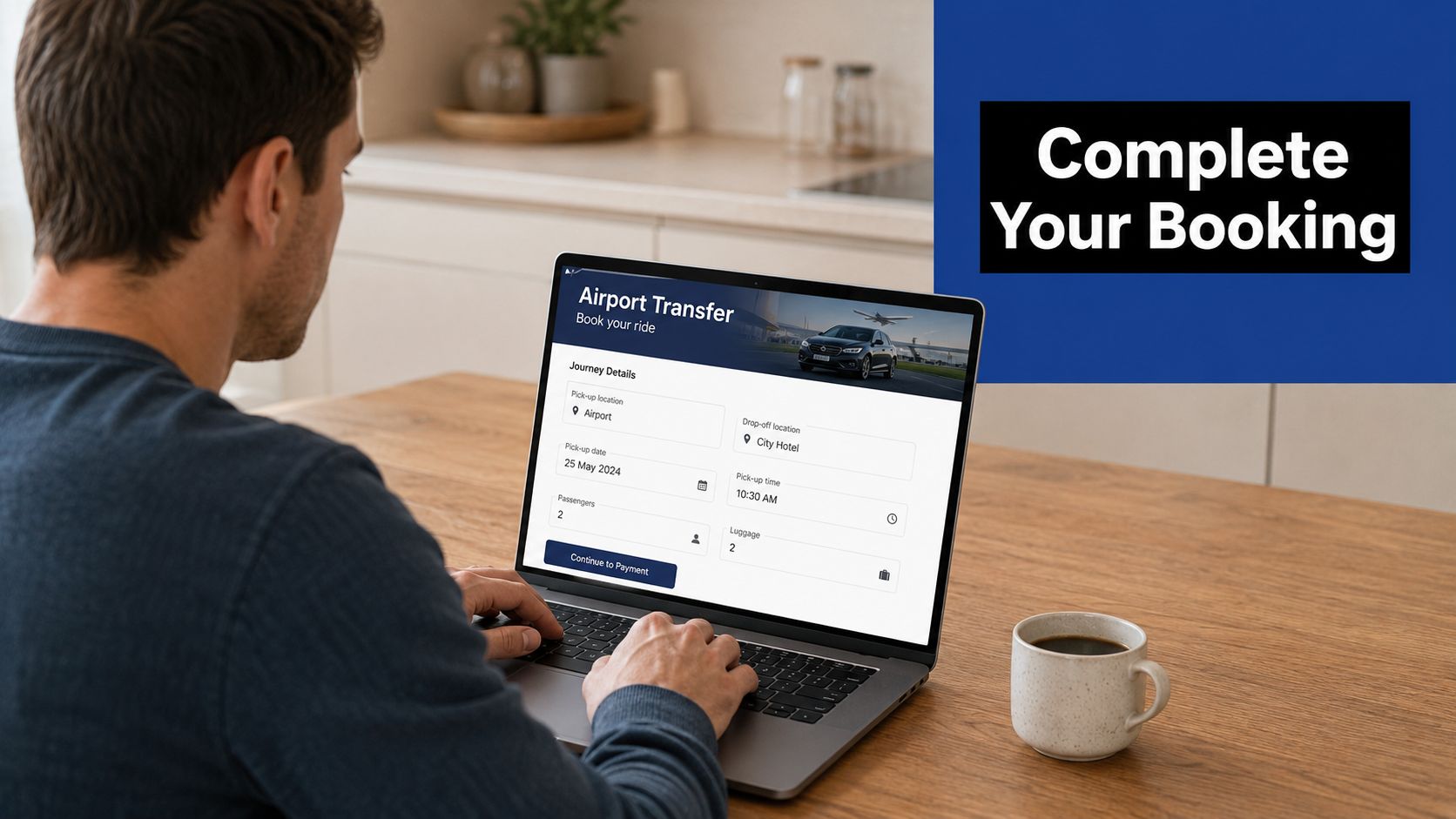
Online forms are usually simple, but incomplete details create most of the avoidable problems. Gather your travel information first, then enter it consistently. Your airline confirmation, hotel reservation, cruise documents, and passenger details should be open before you begin.
Select the journey direction
Choose arrival or departure carefully. An arrival booking normally requires the flight number, airport, terminal where available, and scheduled landing time. A departure booking needs the pickup address, flight departure time, and a realistic collection time that allows for the journey to Heathrow and airport procedures.
For a cruise transfer, select the exact port and terminal if the form offers that option. “Southampton” is useful, but the terminal name or ship details can make the dispatch process clearer. The same principle applies to Dover, Portsmouth, and Tilbury.
Enter the flight and passenger details
Use the flight number rather than entering only a landing time. A provider that monitors flights can use that reference to track changes and adjust the operational plan. If the form requests an airline, booking reference, or terminal, copy the details from your confirmation rather than relying on memory.
Add every traveller who'll use the vehicle, then provide the luggage quantity and type. Mention pushchairs, wheelchairs, musical instruments, sports equipment, or unusually large cases in the notes field. A vague note such as “lots of bags” doesn't give a dispatcher enough information to assign the right vehicle.
Add the destination accurately
For a hotel, enter the full name, street address, and town. Check that the hotel has more than one property in London, especially if the brand operates in several areas. For a private residence, include the postcode and any building-access information that helps the driver locate the entrance.
Cruise passengers should enter the port, terminal, ship name if requested, and any relevant embarkation information. Don't assume the driver can infer the correct terminal from the port town alone.
Review the confirmation method
Some bookings confirm immediately. Others go through a manual availability check, particularly when the route, group size, vehicle, or timing requires dispatcher review. A pending status isn't the same as a confirmed reservation, so check your email and contact the provider if the confirmation doesn't arrive.
Before payment or final submission, verify:
- The date and direction are correct.
- The flight number and terminal match the airline confirmation.
- The destination address is complete.
- The passenger and luggage details describe the group.
- The contact number and email will work during travel.
- The amendment and cancellation terms are visible.
Save the confirmation offline or print it. Airport Wi-Fi, roaming access, and phone batteries can all become problems at the least convenient moment.
Coordinating Pickup Timing with Flight and Cruise Schedules
A scheduled arrival time is a planning reference, not a promise that you'll be standing in the arrivals hall at that minute. Heathrow passengers still need to leave the aircraft, pass border control where applicable, collect luggage, and reach the agreed meeting point. The flight may also land earlier or later than scheduled.
The Civil Aviation Authority's airport punctuality framework measures Heathrow arrival punctuality against a 10-minute threshold, while departures use 25 minutes. Those thresholds show why a transfer workflow needs an operational cushion rather than treating gate arrival as the pickup moment.
Use a monitored booking model
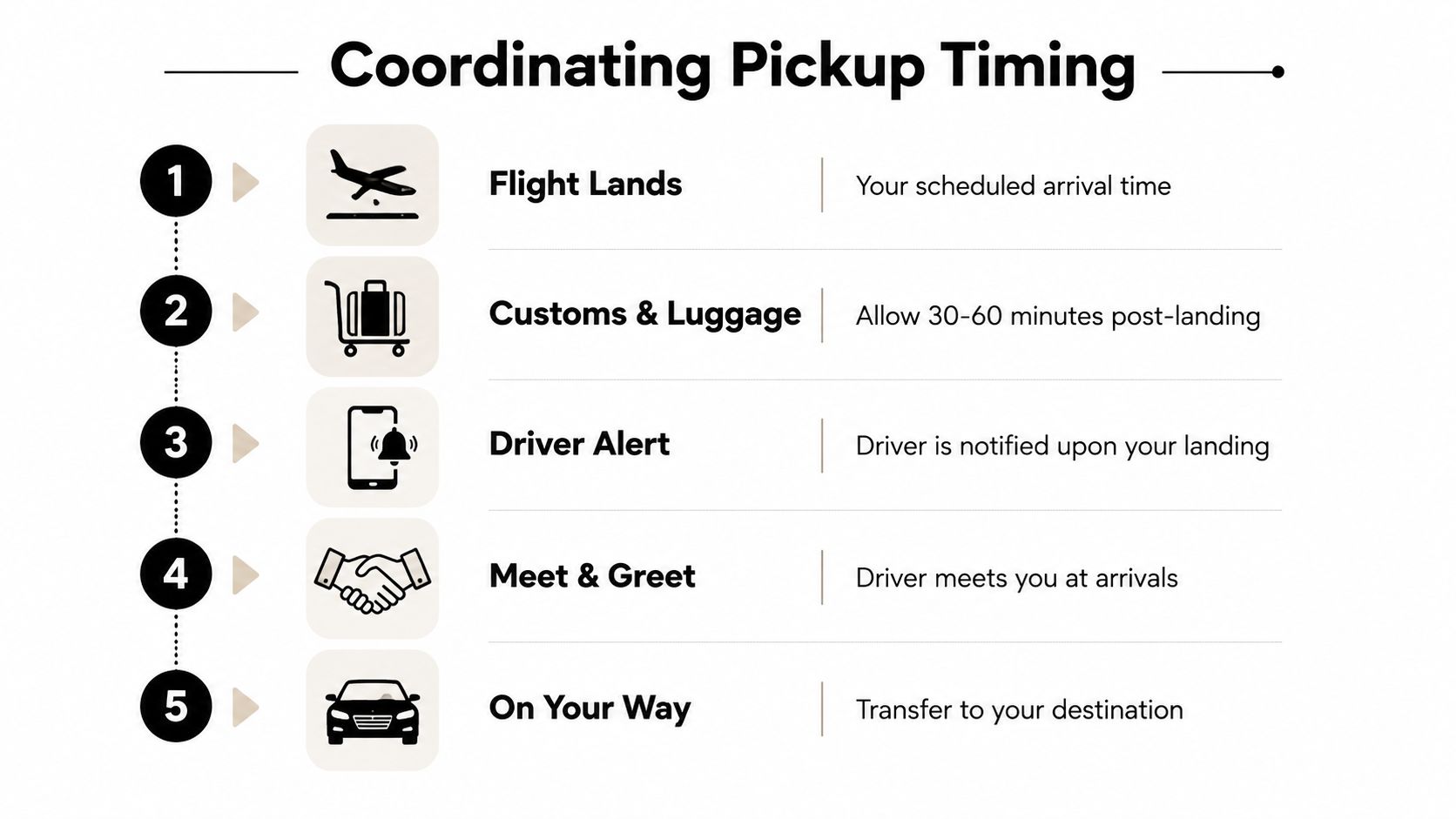
A process looks like this:
- Scheduled flight: The provider records the airline's published arrival time.
- Flight movement: The provider checks whether the aircraft is early, delayed, or operating normally.
- Passenger processing: The driver's expected arrival is aligned with landing and the time needed to reach arrivals.
- Contact process: The passenger receives clear instructions for contacting the driver if they can't find the meeting point.
- Dispatch adjustment: The provider modifies the operational plan when flight information changes.
Research from University College London used Heathrow operational datasets, including flight punctuality and real-time airport information, to model transfer passenger flow in its airport transfer forecasting study. The practical lesson is straightforward: a system connected to live flight status is better suited to variable arrivals than one based only on a static timetable.
Cruise journeys make the timing problem stricter. UK cruise passenger numbers reached 3.1 million in 2024, compared with 2.6 million in 2023 and 2.0 million in 2019, as reported in the UK Government's sea passenger statistics. Southampton accounted for around 2.65 million cruise passengers in 2023, so airport, hotel, and port movements converge around a busy national gateway.
Don't book a Heathrow-to-port transfer using only the ship's departure time. Confirm the port check-in window, allow for airport processing, and ask what happens if the flight changes. If availability is the concern, review the provider's last-minute availability guidance, but pre-booking remains the safer choice for a time-sensitive sailing.
Navigating Arrival, Pickup, and Booking Changes
A delayed Heathrow arrival can affect more than the airport pickup. It may compress the drive to Southampton, reduce time for port check-in, and leave little room for a missed connection. Manage the booking as a live travel plan, not as a fixed appointment.
Before departure, save the booking reference, flight number, ship name, cruise terminal, destination address, and provider's support number. Keep these details available offline as well as on your phone. They allow the support team to identify the correct journey quickly if roaming fails or the itinerary changes.
If the flight is delayed, follow the provider's stated process rather than entering a new arrival time yourself. Many operators monitor flight information, but you should still respond promptly to requests for confirmation. Check the booking terms for waiting, amendment, and cancellation charges, then keep your phone reachable after landing.
Contact the provider as soon as you know about a same-day change. Give the revised flight details, passenger count, and required destination, then ask for a specific response:
- Has the pickup time been adjusted?
- Will the assigned vehicle remain available?
- Is a different vehicle or driver being arranged?
- Could the new arrival leave too little time for cruise check-in?
- What extra charges apply, if any?
Cruise passengers need a contingency plan because the ship will not normally wait for a late flight. Ask whether the provider can offer a later pickup, a different meeting arrangement, or an alternative route if the original plan becomes impractical. A transfer company may be able to adjust its operation, but no operator can guarantee unlimited waiting or last-minute availability.
The costly mistake is leaving a change undisclosed, then assuming the original reservation will update itself.
Use the company's live contact options during disruption, including mobile app tracking if offered. Record the name of anyone who confirms an amendment and keep the updated instructions with your booking documents. For the meet-and-greet location and standard arrival procedure, refer back to Section 1. Vehicle suitability, luggage capacity, and accessibility arrangements were covered in Section 2, and should not be renegotiated during a time-sensitive disruption unless the passenger requirements have changed.
Choosing a Reliable Transfer Provider
A low quote doesn't tell you whether a provider will manage a delayed international arrival or a port connection. For Heathrow-to-cruise journeys, reliability depends on operational clarity: who monitors the flight, where the driver waits, how changes are handled, and what happens if the luggage or passenger details differ from the booking.
Start with evidence you can verify:
- Independent reviews: Read recent feedback on platforms such as Trustpilot and Tripadvisor. Look for comments about airport meet-and-greet, communication, luggage handling, and cruise-port timing, not just general friendliness.
- Licensing and insurance: Ask whether the operator and drivers hold the required documents for the service offered. A professional company should be able to explain its compliance arrangements clearly.
- Transparent pricing: Confirm what the quote includes, including waiting arrangements, meet-and-greet, luggage, tolls where relevant, and amendments. Vague “from” pricing can make comparisons unreliable.
- Flight monitoring: Ask whether the provider tracks the flight number and adjusts the pickup plan when the aircraft schedule changes.
- Accessible contact: Check for a working phone number, email address, and a clear out-of-hours process. A contact form alone is a weak safeguard on a travel day.
Long operating experience can be useful, but it shouldn't replace current evidence. Reviews should be detailed, varied, and relevant to your route. A large rating with no explanation tells you less than a smaller body of specific comments describing how the provider handled a late flight, multiple cases, or a Southampton terminal arrival.
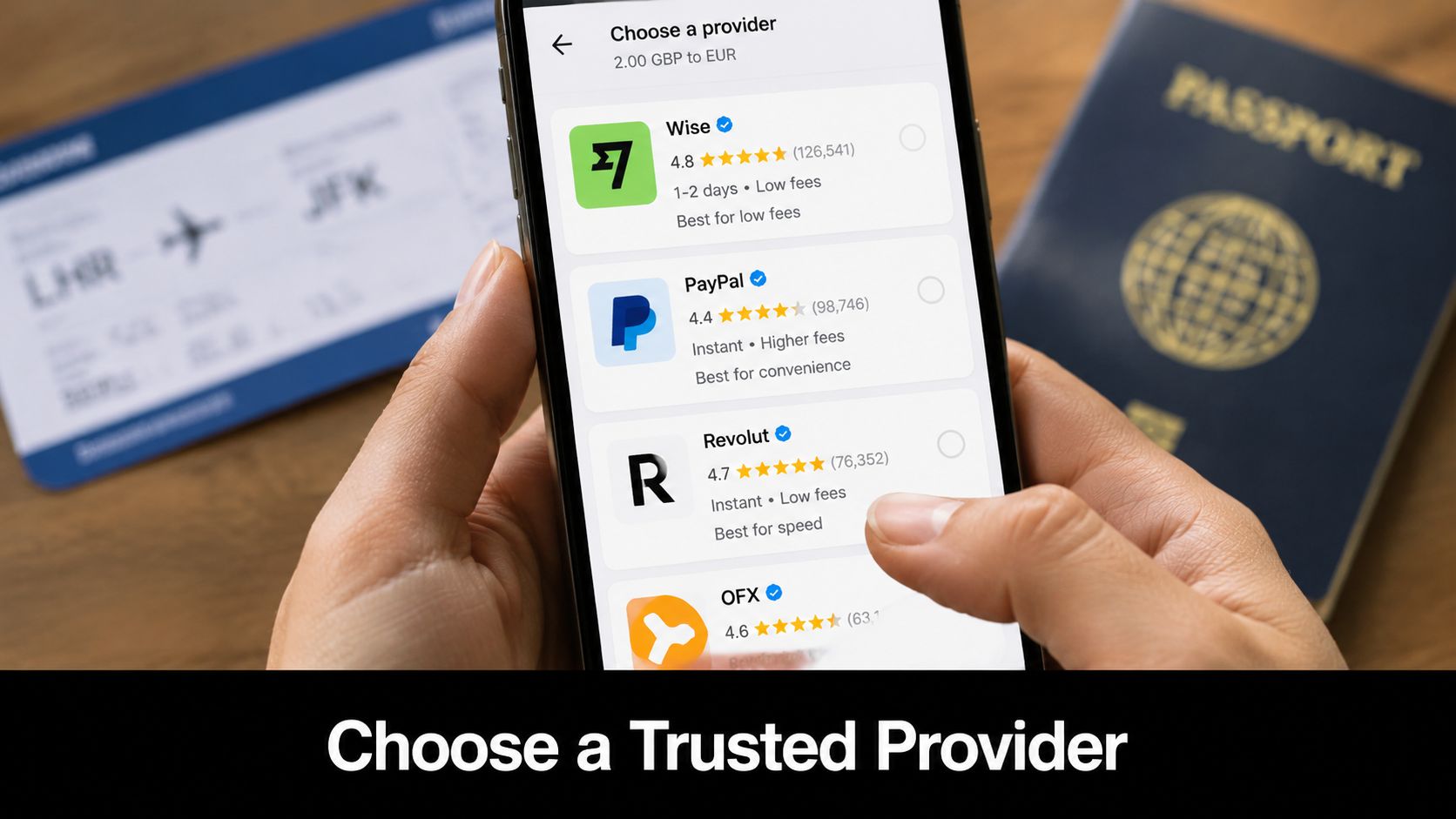
For American and Canadian travellers, especially those unfamiliar with UK airport procedures, written confirmation and accountable support can matter more than choosing the cheapest available option. Ask direct questions before booking, then judge the answer by its specificity. “We'll take care of it” is less reassuring than a clear explanation of flight monitoring, meeting location, luggage capacity, and amendment terms.
EC Minibus provides private transfers between Heathrow, London hotels, St Pancras International, and UK cruise ports including Southampton, Dover, Portsmouth, and Tilbury. Its booking service includes online reservation, meet-and-greet, flight and cruise monitoring, licensed and insured drivers, and fixed pricing, so it's one option to assess against your own route and requirements.
For a coordinated Heathrow, London, or cruise-port journey, review your passenger and luggage details before requesting a quote. Visit EC Minibus to check the route, submit your travel information, and arrange a pre-booked transfer with meet-and-greet and flight-monitoring options.