

You've just booked flights into Heathrow and reserved a cruise from Southampton. Now you need to pay for the transfer, but the checkout offers several possibilities: a credit card, Apple Pay, PayPal, a bank transfer, a fintech account, or cash on arrival. The right choice depends on more than whether a payment technically works. You need to consider acceptance, settlement time, total foreign-exchange cost, security, and your ability to recover if a card is declined or a phone loses power.
That matters even more when you're travelling with luggage, arriving after a long flight, or connecting directly with a ship. A delayed payment can affect a booking, while an unclear currency conversion can make a fare cost more than expected. For a pre-booked UK journey such as an EC Minibus transfer between Heathrow, a London hotel and a cruise port, the safest method is the one that confirms the booking clearly and leaves you enough time to resolve a problem.
The options below compare how each of these international payment methods performs when booking from abroad, reaching a UK airport, travelling onwards to a cruise terminal, and handling last-minute disruption. Each method also has a different place in the journey for individual travellers, families, groups, travel agents and corporate buyers.
Table of Contents
- 1. Credit and Debit Cards
- 2. PayPal and Digital Wallets
- 3. Bank Transfers
- 4. Cryptocurrency and Blockchain Payments
- 5. Revolut and Fintech Money Transfer Apps
- 6. Travel Insurance and Payment Plans Through Travel Agencies
- 7. Multi-Currency Corporate Expense Cards and Programmes
- 8. Wise Borderless Accounts
- 9. Purchase Orders and Net 30 or Net 60 Payment Terms
- 10. Foreign Exchange and Currency Exchange Services
- International Payment Methods, 10-Point Comparison
- Build a Payment Backup Plan Before Departure
1. Credit and Debit Cards
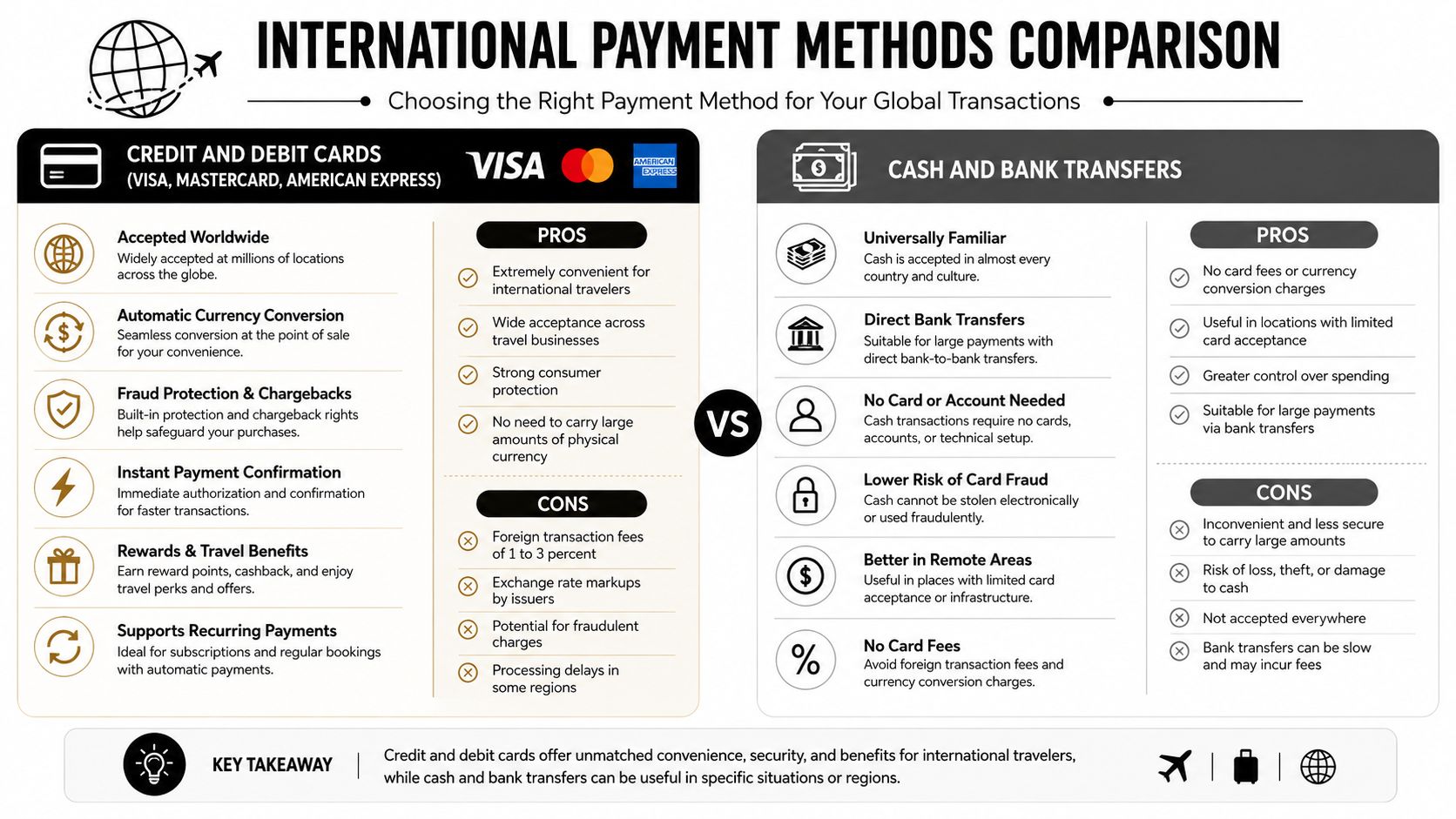
Credit and debit cards remain the most practical first choice for most international travellers booking a UK airport or cruise-port transfer. Visa and Mastercard are widely recognised, while American Express can be useful for travellers whose card includes rewards, travel insurance or other benefits. EC Minibus accepts major cards, including American Express, Visa and MasterCard, so an overseas traveller can generally pay online without arranging a separate UK bank account.
Cards are fast for online bookings. A successful authorisation can provide immediate confirmation, which is valuable when your Heathrow arrival, hotel check-in and ship departure all depend on the same itinerary. Credit cards also give you a clear transaction record and may offer dispute procedures if a payment problem occurs, although you should check your issuer's conditions rather than assuming every purchase has identical protection.
Watch the conversion, not just the fare
The displayed price may be in pounds, but your card issuer controls the conversion into your home currency. The total cost can therefore include an exchange-rate spread or a foreign-transaction fee. Choose a card with transparent international pricing, and check whether the payment page offers a currency choice. A quoted conversion into your home currency isn't automatically cheaper.
Practical rule: Pay in GBP when you understand your card's conversion terms, and save the receipt showing the agreed fare.
Before departure, confirm that your issuer has current travel details and that your contact number works overseas. Keep a second card separate from your wallet, and save the booking reference and itemised invoice. For a family or small group, one card is convenient, but a backup card is essential if the primary issuer blocks an unfamiliar overseas transaction.
2. PayPal and Digital Wallets
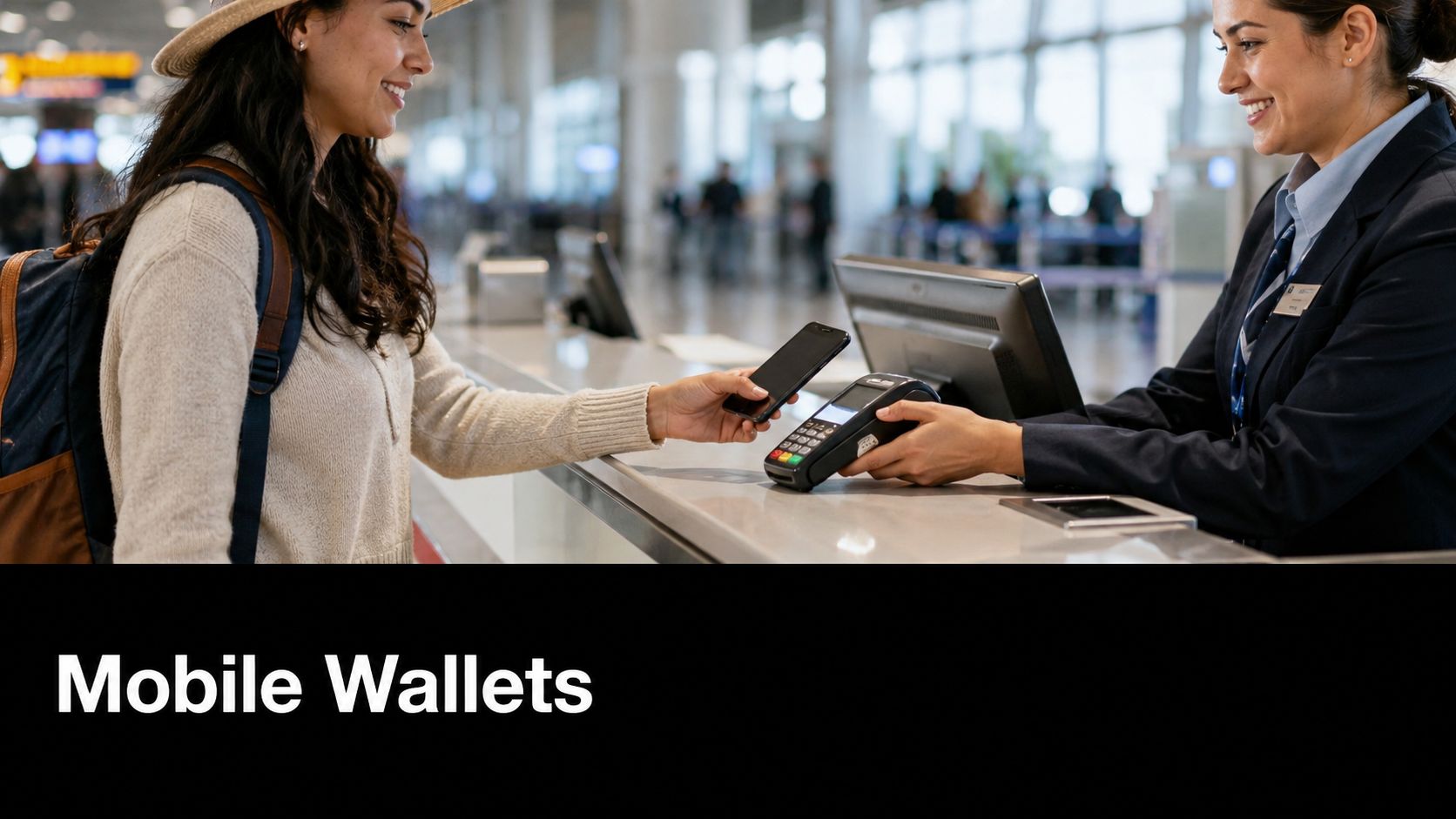
PayPal, Apple Pay and Google Pay reduce the need to type card details into every booking form. PayPal acts as an intermediary between the traveller and the merchant, while a mobile wallet stores an eligible card or account token on the device. That can make payment quicker and limit the amount of sensitive card information shared directly with a transport provider.
EC Minibus offers PayPal checkout for booking deposits, which gives travellers another way to secure a transfer before flying. Check the available option on the actual booking page, because wallet and PayPal availability can depend on the checkout setup, device, browser and the payment method linked to the account.
The phone becomes part of the payment
A digital wallet is excellent when your phone is charged, active and connected to the account holding the payment card. It works well for booking from home and for contactless spending after arrival, but it shouldn't be your only plan for a Heathrow-to-cruise journey. A dead battery, a lost device, a security lock or an unsupported card can remove access at the worst moment.
UK payment infrastructure has a strong digital foundation. The Bank of England's payment options explainer says almost all UK internet and telephone banking payments, including standing orders, now pass through Faster Payments, which operates in real time throughout the year. The same explainer shows that cards and cash still play important roles in household spending, so digital wallet use should complement, not replace, a physical card.
Use biometric authentication, keep your phone charged before landing and store the booking confirmation outside the wallet app. For a group booking, PayPal can simplify collection by keeping the transaction in one account. For an individual traveller, Apple Pay or Google Pay is usually best when the linked card has suitable FX terms.
3. Bank Transfers
Bank transfers suit advance bookings, group travel and business arrangements where the payer needs a formal audit trail. SWIFT transfers move money internationally through banking networks, while ACH is a domestic US clearing method that may be used only when a merchant or payment partner supports it. You shouldn't assume that an ACH instruction can reach a UK transport provider directly.
A transfer can be dependable once the recipient confirms cleared funds, but it isn't the best choice for a booking made shortly before a flight or cruise. Banks may apply their own transfer fee, an exchange-rate margin or intermediary charges. The recipient may also need time to identify the payment and match it to your booking reference.
Use the method only with a clear deadline
Ask the provider for the exact account details, currency, reference format and payment deadline. Send the reference exactly as instructed, then retain the transfer confirmation. Contact the provider after initiating the payment, but don't treat a bank receipt as proof that the merchant has received cleared funds.
For a travel agency booking several vehicles, a bank transfer can make reconciliation easier than collecting many individual card payments. A cruise line or corporate travel department may also prefer the method for supplier settlement. Individual passengers should use it only when the provider confirms the funds will arrive before the booking becomes active.
A transfer also needs protection against account-detail fraud. Verify the recipient details through a trusted channel before sending money, especially if revised bank information arrives by email. Never rush a high-value payment because a message claims the vehicle or reservation will otherwise be released.
4. Cryptocurrency and Blockchain Payments
Cryptocurrency can move value across borders without using a conventional card network or bank transfer. Bitcoin, Ethereum and stablecoins operate through blockchain systems, but the practical question for a traveller is simpler: does the actual transport provider accept the asset, and can the payment be matched to the booking before pickup?
For most cruise and airport transfers, cryptocurrency is a niche option rather than a dependable default. Acceptance varies sharply between merchants. A transaction may also involve wallet-address errors, network congestion, exchange conversion, identity checks at an exchange, or a value that changes between booking and settlement. Blockchain confirmation doesn't guarantee that a transport provider has recognised your reservation.
Treat crypto as a specialist arrangement
Use cryptocurrency only after the provider confirms the accepted asset, wallet instructions, refund policy and settlement requirement in writing. Don't send funds to an address copied from an unverified message. A stablecoin may reduce price volatility compared with a freely fluctuating asset, but it still carries platform, custody and acceptance risks.
This method is more suitable for a technology-focused business or a group arranging a special payment agreement than for a tired passenger arriving at Heathrow. It also creates more complicated records for refunds and expense reporting. Keep the transaction identifier, booking reference, exchange receipt and provider confirmation together.
EC Minibus payment options should be verified directly before you consider cryptocurrency. If the method isn't shown during checkout or confirmed by the company, choose a supported card or PayPal instead. For a cruise departure, reliability matters more than experimenting with a payment rail that may not be available when you need assistance.
5. Revolut and Fintech Money Transfer Apps
Revolut, Wise, N26 and Bunq can help frequent travellers manage several currencies through one app. Depending on the product and account terms, you may exchange funds, hold GBP and use a virtual or physical card for an online booking. That gives a traveller more control over the point at which currency is converted, rather than leaving every conversion to a card issuer.
The main benefit is visibility. You can check the balance, review the exchange transaction and separate a UK travel budget from your everyday account. Loading GBP before arrival may also make the booking amount easier to understand, because the transport charge can be paid from a sterling balance rather than converted at checkout.
Compare the complete transaction
Don't judge an app by its advertised exchange rate alone. Check the account plan, conversion conditions, transfer fee, weekend treatment, card usage rules and any limits that apply to your transaction. A low headline fee doesn't help if the transfer takes too long or the merchant doesn't support the account's payment route.
For an individual traveller or couple, a fintech card works well as a planned spending method and backup to a conventional card. Families should make sure more than one adult can access funds. A travel agency or tour operator needs to confirm that the provider accepts the app's card or transfer before using it for multiple bookings.
Use the app's security controls, enable notifications and keep a physical payment method available. A fintech account is not automatically safer or cheaper for every journey. It becomes useful when you understand the fee schedule, load funds early and have enough recovery time before your flight or ship departure.
6. Travel Insurance and Payment Plans Through Travel Agencies
A travel agency can collect one payment for a wider itinerary that includes flights, accommodation, insurance and ground transport. This arrangement reduces the number of separate transactions for a cruise passenger, and it can be convenient when a travel adviser is already coordinating Southampton, Dover, Portsmouth or Tilbury arrangements.
The trade-off is visibility. You may pay the agency, not the transport company, so you need to know exactly which service is included, when the transfer provider is paid and who handles changes. An itinerary that lists “airport transfer” without naming the operator leaves important questions unanswered, particularly if your flight is delayed or your cruise schedule changes.
Ask for the transport details
Request an itemised invoice showing the transfer, insurance and other components separately. Confirm whether the fare is fixed, whether the booking includes meet and greet, and what happens if the flight or ship timetable changes. Also check whether the agency's cancellation terms match the transport provider's terms.
Travel-agent partnerships can make group administration easier, especially when several passengers arrive on different flights. They can also help older travellers who prefer one point of contact. However, an agency payment doesn't remove the need to keep the booking reference and the transport provider's contact information.
Before paying, review EC Minibus travel agent partnership information and confirm the arrangement directly with the relevant party. Ask who will monitor the flight, who will meet the passenger and how last-minute instructions will reach the driver. Insurance may cover certain disruption costs, but it doesn't automatically guarantee a replacement vehicle or a refund for every missed connection.
7. Multi-Currency Corporate Expense Cards and Programmes
Corporate expense cards suit businesses that need control, reporting and repeatable approvals rather than a one-off personal booking. A travel management company, cruise operator or employer can issue cards for approved travel spending, set vendor rules and collect transactions into a central reporting system.
For an executive arriving at Heathrow, the card can provide a quick online booking and a clean expense record. For a tour operator moving several clients to a cruise port, a corporate programme can help separate passenger costs, driver charges and booking references. The method is less useful when an employee has no access to the card, the transaction exceeds an internal limit or the provider requires a different payment channel.
Align the account with the supplier
Speak with the transport provider before attempting to build a recurring process. Establish whether the supplier can issue consolidated invoices, accept the organisation's card brand and record purchase-order or traveller references. A corporate card may simplify payment, but it won't resolve an FX dispute unless the company understands which party set the conversion rate.
The EC Minibus corporate rates information is the appropriate starting point for businesses considering recurring arrangements. Ask about account setup, booking processes and how invoices will be delivered. Don't assume that a volume relationship automatically creates credit terms or a special currency rate.
Security controls matter as much as convenience. Use spending alerts, named cardholders and approval rules for unusual transactions. Keep a second authorised payment route for urgent changes, but restrict it to staff who can verify the booking. This method is strongest for business buyers with regular UK travel, not for a family making one airport transfer booking.
8. Wise Borderless Accounts
Wise provides an account-based way to hold and convert money in supported currencies, with a card option for eligible users. For a Canadian or American traveller who expects to pay several UK suppliers, holding GBP in advance can make the sterling cost clearer. It can also reduce the need to convert every individual purchase through a home-country bank card.
The account is most useful when prepared before departure. Open and verify the account, understand how money is added, and allow enough time for funds to become available. A last-minute transfer made at the airport is a poor recovery plan, especially if identity checks or bank processing delay access.
Separate cost control from acceptance
Wise can help you manage the currency side of a payment, but it doesn't guarantee that every merchant accepts a Wise transfer or Wise card. Confirm whether the transport provider wants a card payment, a bank transfer or another supported method. For a pre-booked EC Minibus journey, the booking page or direct confirmation should decide the method, not an assumption that every UK business can receive funds from a borderless account.
Save the conversion receipt, the booking confirmation and the final GBP amount. If the provider permits a balance payment in another currency, ask when the conversion occurs and which rate applies. EC Minibus allows the remaining balance to be paid in US dollars or euros, with conversion handled on the day of service, so travellers should confirm the exact arrangement and total cost before relying on it.
Wise suits frequent travellers, expatriates and people managing several European journeys. It isn't necessary for every visitor, and it shouldn't replace a conventional card when the booking must be confirmed immediately.
9. Purchase Orders and Net 30 or Net 60 Payment Terms
Purchase orders and post-service invoices are business arrangements, not ordinary tourist checkout methods. A travel agency, tour operator or corporate travel department can agree a supplier relationship in advance, issue a purchase order for transport and pay after the journey under negotiated terms.
This approach helps organisations keep bookings tied to internal references and cash-flow processes. It also lets a tour operator coordinate multiple cruise transfers without asking each passenger to pay the driver separately. The transport provider must approve the account first, and the written terms must state who can book, who can change a journey and when payment becomes due.
Formal terms require formal controls
Ask for the account-opening requirements, accepted booking references, invoice format and dispute process. Confirm whether a purchase order is mandatory before the vehicle is reserved. A booking confirmation isn't the same as an approved credit account, so don't tell travellers that payment is deferred until the provider confirms the arrangement.
Use a central register for passenger names, flight details, cruise-port destination and invoice references. Reconcile the invoice against the completed journeys, including cancellations or itinerary changes. If your organisation books internationally, check which entity receives the invoice and how VAT or currency treatment is shown.
The EC Minibus terms and conditions should be reviewed before a business requests this structure. Ask the company whether the proposed payment terms are available for your organisation and booking pattern. Net terms are best for established buyers with repeat requirements. They aren't a shortcut for an individual traveller who needs a transfer tomorrow.
10. Foreign Exchange and Currency Exchange Services
Currency exchange services convert your home currency into pounds through a bank, online provider, exchange bureau or airport counter. The method gives travellers direct access to GBP, which can be useful for small purchases, tips or a backup fare if electronic payment fails.
It also has clear weaknesses. Airport exchange counters may build their margin into the rate, and a traveller exchanging money under time pressure has little opportunity to compare alternatives. Carrying cash introduces loss and theft risk, and a cash payment may not produce the same booking record or dispute route as an online transaction.
Keep cash limited and purposeful
Obtain a modest emergency amount before travelling or use a reputable service with clearly displayed rates. Don't exchange the entire trip budget at an airport because it's convenient. Compare the final amount received, not just the advertised rate, and keep the cash separate from your main wallet.
Cash can help an older traveller who prefers physical money, a passenger whose card has been declined or a group dealing with a temporary device problem. It shouldn't be the only plan for a pre-booked airport or cruise transfer. Confirm whether the provider accepts cash, whether payment is due before collection and whether the driver can provide a receipt.
The UK remains highly digital, but that doesn't make every journey failure-proof. The UK Finance consumer payments report reflects the continuing importance of cash, cards and remote payments in consumer payment planning. Carrying a small amount of GBP is sensible resilience. Treating cash as the universal solution isn't.
International Payment Methods, 10-Point Comparison
| Payment Method | 🔄 Implementation Complexity | ⚡ Resource Requirements | ⭐ Expected Outcomes | 📊 Ideal Use Cases | 💡 Key Advantages / Tips |
|---|---|---|---|---|---|
| Credit & Debit Cards (Visa, Mastercard, Amex) | 🔄 Low | Merchant account / card processor, PCI compliance, issuer fees | High acceptance, instant confirmation; moderate fees | Individual international travelers, online/recurring bookings | Notify issuer, use no-foreign-fee cards, keep receipts |
| PayPal & Digital Wallets (Apple Pay, Google Pay) | 🔄🔄 Low–Medium | Third‑party account, mobile/web integration, internet access | Fast, secure checkout; buyer protection; variable fees | Mobile bookings, tech‑savvy travelers, one‑click payments | Link no‑fee card, enable biometrics, confirm merchant acceptance |
| Bank Transfers (SWIFT & ACH) | 🔄🔄 Medium | Bank accounts, SWIFT/ACH setup, beneficiary details | Low fees for large transfers; slow settlement (days) | Corporate/group bookings, advance payments | Plan 3–5 business days, include reference, keep proof |
| Cryptocurrency & Blockchain (BTC, ETH, Stablecoins) | 🔄🔄🔄 Medium–High | Crypto wallet, exchange access, merchant crypto support | Very fast settlement (with stablecoins); limited acceptance; regulatory risk | Tech‑forward customers, optional large transfers via stablecoins | Use stablecoins, verify acceptance, use reputable exchanges & wallets |
| Revolut & Fintech Apps | 🔄🔄 Low–Medium | Mobile app account, virtual cards, internet | Low fees, real mid‑market rates, strong UX | Frequent travelers, multi‑currency budgeting, virtual card use | Set up before travel, preload GBP, compare providers for best rates |
| Travel Agencies (Insurance & Payment Plans) | 🔄🔄 Medium | Agent intermediary, bundled invoicing, insurance integration | Simplified booking and support; possible agency markup | Complex itineraries, customers wanting insurance/support | Use established agencies, request itemized invoices, confirm policies |
| Multi‑Currency Corporate Expense Cards & Programs | 🔄🔄🔄 High | Corporate account setup, spend controls, accounting integration | Consolidated billing, strict controls, better negotiated rates | Corporate travelers, travel management companies, tour operators | Negotiate volume discounts, integrate expense reporting, set limits |
| Wise (Borderless Accounts) | 🔄🔄 Low–Medium | Wise account, local bank details, debit card | Transparent mid‑market rates, very low fees, fast transfers | Frequent international travelers, expats, supplier payments | Open account early, load GBP pre‑travel, use rate alerts |
| Purchase Orders / Net 30/60 (B2B) | 🔄🔄🔄 High | Credit approval, PO systems, invoicing & reconciliation | Improved buyer cash flow; administrative overhead for supplier | Established B2B partners, tour operators, corporate accounts | Negotiate terms, meet minimums, implement booking refs for reconciliation |
| Forex & Currency Exchange Services | 🔄 Low | Cash or online pre‑order, pickup locations or ATMs | Immediate access to local currency; higher markups than mid‑market | Travelers needing cash for tips/local expenses, seniors | Pre‑order online for better rates, compare airport vs city ATMs/exchanges |
Build a Payment Backup Plan Before Departure
The best international payment method is the one that matches the booking deadline and the consequences of failure. For most individual travellers, start with a credit or debit card that supports overseas transactions and offers a clear conversion rate. Add Apple Pay, Google Pay or PayPal when the transport provider supports it and your phone or account is ready, but keep the physical card available.
Choose a fintech card or Wise when you want more control over currency conversion and already understand the account's fees and access rules. These options work particularly well for frequent travellers who hold GBP before arrival. They aren't a substitute for checking merchant acceptance, and they shouldn't be activated for the first time while you're standing at an airport pickup point.
Bank transfers suit groups, travel agents and corporate buyers who have enough time for the recipient to confirm cleared funds. Agency payment plans work well for bundled cruise itineraries, provided the invoice identifies the transport service and the agency explains who handles disruption. Corporate cards and purchase orders are stronger choices for repeat business travel, where approvals, reporting and reconciliation matter as much as speed.
Use cash as a limited fallback, not as your main booking method. UK payments are heavily supported by digital and account-to-account infrastructure. The Bank of England's CHAPS statistics also show how the UK payment system separates everyday volume from high-value settlement, which is a useful reminder that the method designed for a large institutional transfer isn't automatically suitable for a traveller buying a local transfer.
Complete these checks before you fly
- Confirm acceptance: Ask the transport provider which card brands, wallets, currencies and balance-payment options it accepts.
- Check settlement timing: Find out when funds must clear, not merely when you press “send”.
- Calculate total cost: Include the provider's price, card fees, transfer charges and the FX rate used at conversion.
- Prepare issuer access: Notify your card issuer if required, check overseas contact options and enable transaction alerts.
- Save evidence: Keep the booking reference, receipt, invoice, payment confirmation and transport contact details offline.
- Carry a second method: Bring a separate physical card and a small cash reserve in case the phone, card or network fails.
Consumer expectations in the UK are built around fast, dependable payments. The Payment Systems Regulator's 2024 to 2025 consumer research reports that 95% of consumers agreed UK payment systems are working well, while 92% said they can make and receive payments in a timely manner. That baseline makes a failed payment especially stressful for visitors, so your plan should include a recovery option before departure.
For an EC Minibus booking, verify the payment route directly through EC Minibus. Do not rely on cryptocurrency, cash or an unsupported wallet because it worked with another travel company. A confirmed booking, a saved receipt and a backup payment method will give you far more protection when your journey connects Heathrow, London and a cruise port.
EC Minibus provides pre-booked private transfers between Heathrow, London hotels, St Pancras International and UK cruise ports, including Southampton, Dover, Portsmouth and Tilbury. Confirm the accepted payment method, fare currency and booking details before travel, then visit EC Minibus to arrange your transfer.