

You're probably staring at three quotes right now for the same Heathrow transfer and wondering why one looks cheap, one looks padded, and one looks suspiciously vague. That's the corporate rates problem in ground transport, not enough clarity on what you're buying, and too much focus on the headline price instead of the trip that has to happen on time.
For Heathrow, London hotels, and cruise ports, the wrong rate costs more than money. It costs control, especially when flights slip, cruise check-in windows move, or a team arrives on different services and still expects one clean handover.
Table of Contents
- The Transfer Booking Problem Most Companies Face
- What Corporate Rates Mean for Ground Transfers
- How Corporate Transfer Pricing and Contracts Typically Work
- Who Qualifies and What You Need to Apply
- Opening a Corporate Account Step by Step
- Two Real Transfer Scenarios at Corporate Rates
- Smart Questions and Next Steps with EC Minibus
The Transfer Booking Problem Most Companies Face
A typical mess starts with a simple request. Twenty-four cruise passengers land at Heathrow, all on different flights, all heading for Southampton the same day, and someone has to turn that into a workable plan without holding a room full of travellers hostage in arrivals.
That's where ad hoc booking falls apart. One provider gives a low quote with strict conditions, another prices flexibility properly, and a third hides the actual cost until the job is already booked. The result is not just price comparison fatigue, it's operational risk, because the cheapest number on the page often isn't the cheapest trip.
Why one-off pricing fails for repeat travel
Single bookings are built for convenience, not consistency. They work when you only need one transfer and you can accept whatever terms come with it, but they're poor at handling repeat Heathrow runs, hotel collections in Central London, or port-bound movements where timing is everything.
For travel managers, the issue is predictability. If your team, clients, or passengers keep using the same corridors, you want a rate structure that behaves the same way every time. Otherwise, every request becomes a fresh negotiation, and every negotiation eats time.
Practical rule: if the route repeats, the pricing should repeat too. Otherwise, you're paying staff to manage uncertainty instead of transport.
For companies that need last-minute coverage, the difference is even sharper. A provider that can't offer stable availability turns every delay into a scramble, which is exactly why availability matters as much as price on repeat transfer work. For a useful example of how tight capacity can become, see this note on last-minute availability.
What Corporate Rates Mean for Ground Transfers
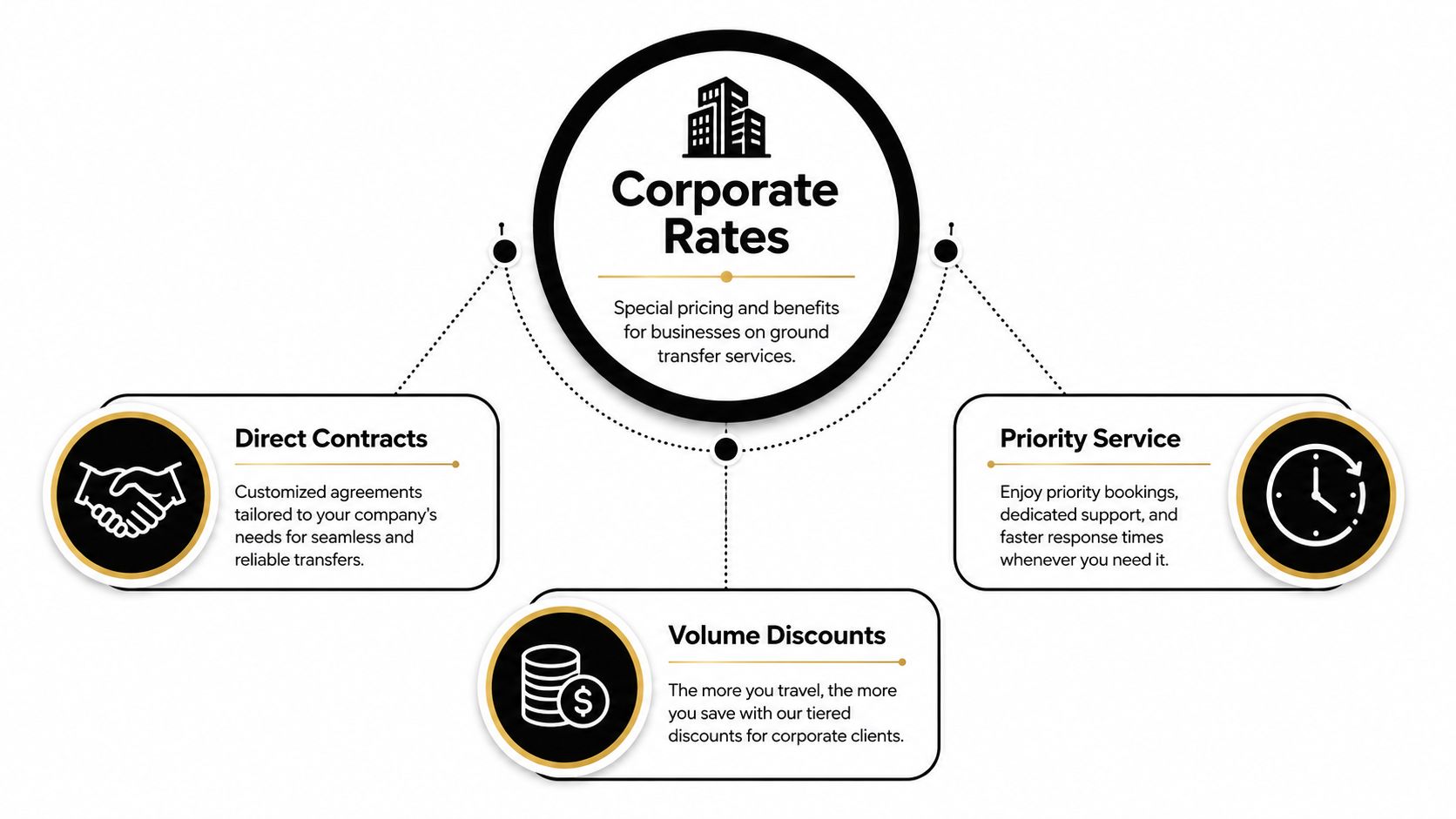
A corporate rate for ground transfers is a contracted price for a defined journey, usually between an airport, hotel, rail hub, or cruise terminal. It's not a hotel-only idea, and it's not a random discount. It's a proper service arrangement built around a route, a vehicle class, and a service expectation.
A business mobile tariff works the same way. You're not buying “cheap calls”, you're agreeing a plan that gives you predictable usage, one point of contact, and fewer surprises. Ground transport works the same way, except the valuable part is not minutes or data, it's a vehicle turning up with the right capacity, at the right place, with the right flexibility.
What the rate is really buying
The first thing it buys is price certainty. A contracted route price lets you budget without rewriting every trip from scratch.
The second is capacity control. That matters on heavy travel days, especially for cruise embarkation patterns and airport peaks, when vehicles can disappear fast.
The third is service consistency. Travellers want the same pickup standard, the same handling of luggage, and the same instructions every time. That's worth more than a meaningless percentage off a tariff.
A good corporate transfer rate is not the lowest visible number. It is the cleanest total arrangement for the routes you use most.
If you're used to hotel or airline corporate pricing, the logic will feel familiar, but the unit is different. Hotel rates are about rooms. Ground transfer rates are about moving people through a specific corridor without chaos. For a side-by-side industry explanation, this guide on car service cost in the UK helps show how the route, vehicle, and service shape the price.
How Corporate Transfer Pricing and Contracts Typically Work
Most ground-transfer contracts are built around the vehicle, not the passenger. That matters because a saloon, MPV, and minibus all solve different problems, and the provider prices the vehicle class, route length, waiting exposure, and operational complexity accordingly. If a proposal only shows a single attractive number, read it twice.
The terms that change the real cost
The hidden cost usually isn't in the base fare. It appears in the flexibility terms. UK travel guidance on corporate hotel rates is blunt about this, and the same logic applies to transfers, where a lower headline price can come with advance-purchase rules, blackout-style restrictions, less flexible cancellation, or tighter amendment windows. The result is that the “cheap” rate can become expensive the moment a flight lands late or a cruise schedule shifts.
What to look at first:
- Vehicle basis: whether the price is per vehicle, not per person.
- Waiting terms: how much slack you get before extra charges appear.
- Cancellation terms: whether changes are cheap, costly, or heavily restricted.
- Luggage handling: whether bulky bags, extra cases, or oversize items are included.
- Amendments: whether same-day changes are treated as routine or penalised.
Checklist mindset: compare the effective rate, not the room or vehicle tariff in isolation. A rate that looks lower on paper can be worse once flexibility is added back.
For travel teams, billing matters just as much. Many corporate arrangements rely on invoicing cycles rather than immediate card payment, which is useful when several departments book against one account. The trade-off is that your finance team has to be comfortable with what's included, what's extra, and who can authorise a change.
| Item | Usually Included | Often Charged Extra |
|---|---|---|
| Standard route transfer | Yes | No |
| Agreed vehicle class | Yes | Upgrade request |
| Basic waiting allowance | Sometimes | Extended wait time |
| Standard luggage load | Often | Oversize or excess luggage |
| Flight or cruise monitoring | In some contracts | Premium service add-on |
| Cancellation flexibility | Sometimes limited | Late cancellation |
| Same-day amendments | Sometimes limited | Re-dispatch or rerouting |
| Meet and greet | Often on request | Special handling or extra service |
If you're reviewing a proposal, start with the friction points. The provider may talk about discount, but your real exposure is usually disruption. A clear contract protects both sides by stating what happens when the day doesn't go to plan. For a procurement-friendly view of partnering with operators, see this note on travel agent partnership.
Who Qualifies and What You Need to Apply
A corporate account makes sense when your organisation moves people often enough that repeat booking friction becomes a problem. That usually includes companies, travel agents, tour operators, and conference organisers with regular movement into or out of Heathrow, London hotels, and major cruise ports.
Good fits and poor fits
A good fit is a business with recurring transfer demand, shared booking responsibility, and a need for consistency. A poor fit is someone making a one-off personal booking and hoping to access business pricing without a repeat use case.
Before you start the conversation, have the basics ready:
- Company profile: who you are and what kind of travel you arrange.
- Route pattern: the main corridors you use, such as airport to hotel or airport to port.
- Expected volume: a realistic sense of how often you book.
- Vehicle preference: saloon, MPV, minibus, or mixed usage.
- Single contact: one booker or finance lead who can approve changes and invoices.
The application itself should be conversational, not bureaucratic. A provider needs enough detail to judge whether a fixed arrangement will work for both sides. If the volume is too irregular, a corporate rate may not help. If the routes are predictable, it usually does.

The main thing to avoid is overcomplicating the first discussion. You do not need a full procurement pack to have a sensible conversation. You need clarity on who books, who pays, and which journeys matter most.
Opening a Corporate Account Step by Step
The process should feel like setting up a practical travel tool, not filing a complaint with finance. A serious operator will ask what routes you use, how often you book, and how much flexibility you need, then shape the account around that reality.
From enquiry to active account
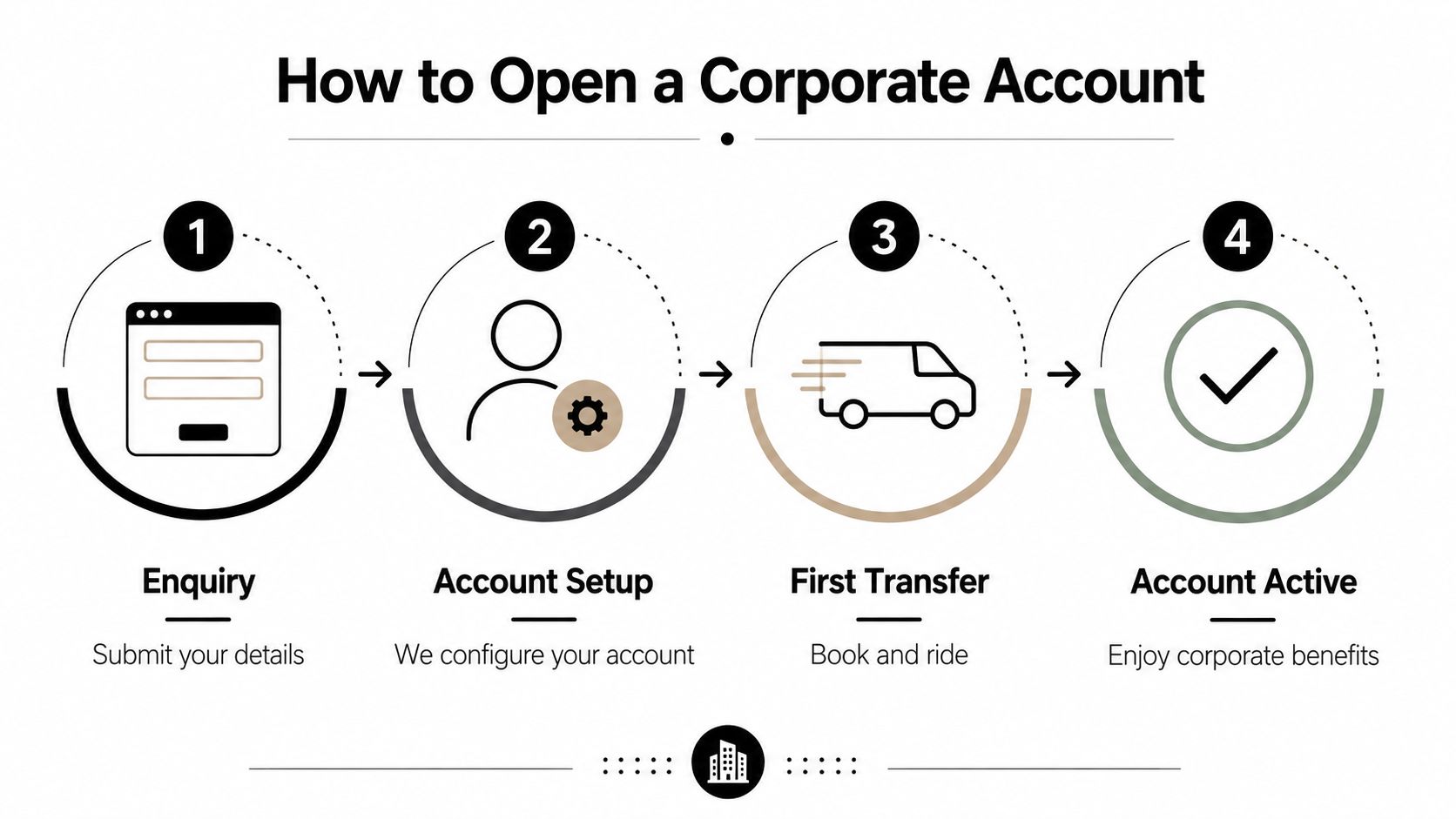
First, send a clear enquiry through the website. Include your core routes, likely booking volume, and the people who will manage approvals. That saves time because the operator can respond with something usable instead of a generic brochure.
Second, have a short needs conversation. Route patterns, pickup timing, vehicle class, and any recurring problems get discussed here. If your travellers often arrive on different flights or connect through rail, say so now rather than after the first miss.
Third, review the quote and contract. This is the point to check what's included, what counts as extra, and how changes are handled. If the terms don't match your actual travel pattern, walk away or ask for a different structure.
Fourth, connect the account to your booking workflow. That might mean a small approval chain, one finance contact, or a set of named travellers who can book directly. Once that's in place, ordinary bookings become much faster.
The best account setup removes admin from the day of travel. If staff still have to explain the same journey twice, the account isn't doing its job.
After activation, good corporate arrangements usually support the extras that matter on real trips, such as flight and cruise monitoring, meet-and-greet handling, and consolidated invoicing. Those features aren't decoration, they reduce the work your team has to do when arrival times change.
Two Real Transfer Scenarios at Corporate Rates
A good corporate rate proves itself in the messy jobs, not the tidy ones. The first example is the one most providers want to price badly, because it has complexity. The second is smaller, but it still rewards a structured arrangement.
Heathrow to Southampton with split arrivals
Twenty-four cruise passengers land at Heathrow on different flights and need to reach Southampton the same morning. A consumer-style booking approach treats each arrival separately, which is clumsy and risky. A corporate transfer arrangement lets the provider coordinate two minibuses, stage the pickups, and keep the boarding schedule in view instead of forcing the organiser to improvise.
The value here is not just transport. It's coordination. One contact handles the moving parts, the vehicles are matched to the group, and the timing is managed as one job instead of twenty-four fragments. That's exactly where a corporate rate earns its keep.
Heathrow to central London, then St Pancras
Now take a smaller executive team flying into Heathrow for a meeting in Central London, then needing a return move to St Pancras International for an onward rail journey. A saloon or MPV under a corporate arrangement keeps the journey neat, with one agreed pickup standard and one invoice line instead of several scattered bookings.
The operational gain is simple. The company gets a consistent passenger experience, while the traveller avoids re-explaining every leg. That matters when the day includes a hotel check-in, a meeting, and a rail connection.
In both cases, the right rate is not the biggest nominal discount. It's the arrangement that matches the route, the timing risk, and the service expectation without generating avoidable admin.
Smart Questions and Next Steps with EC Minibus
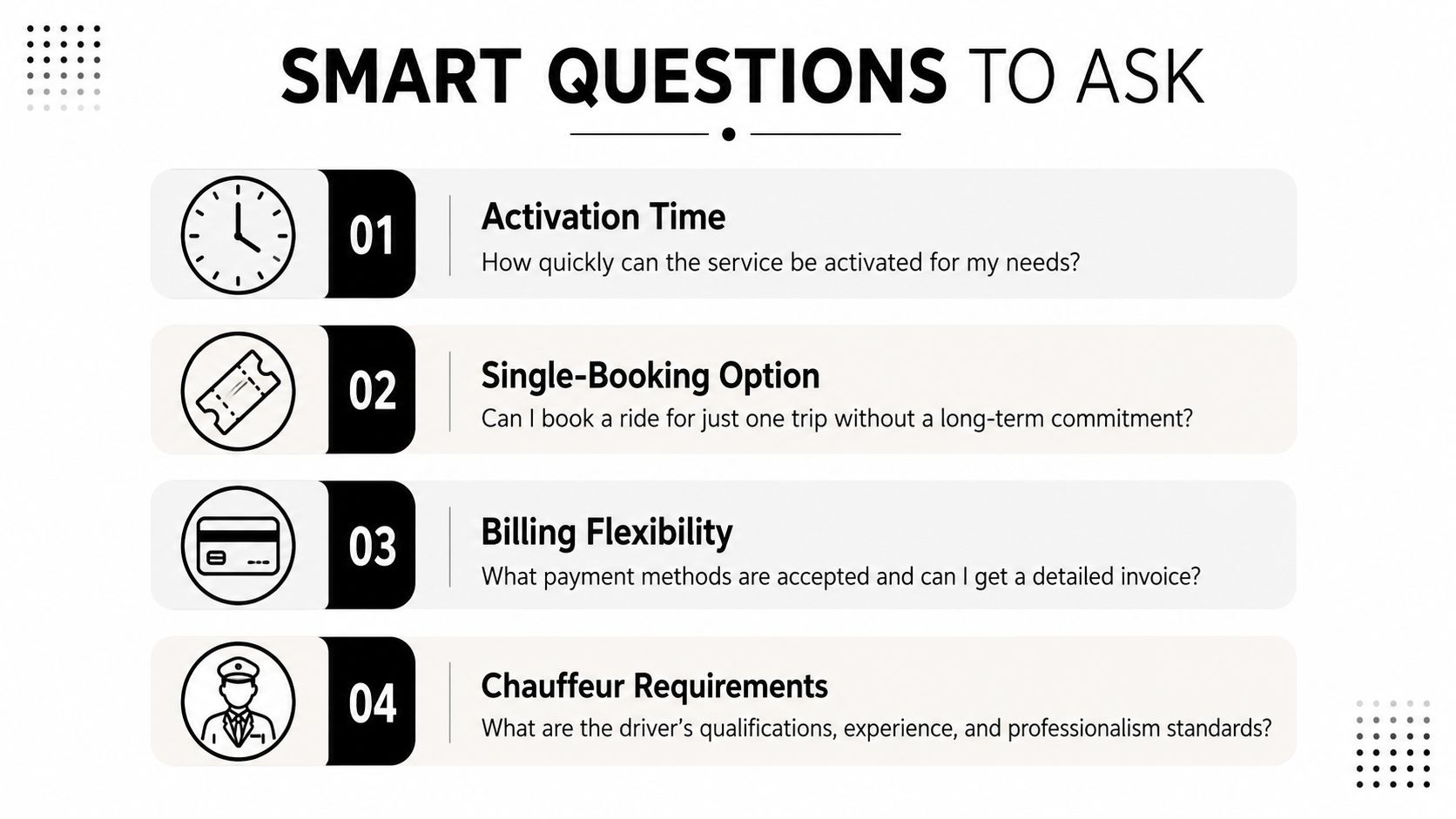
The questions that matter are usually the simplest ones. How fast can the account go live, can you book before the contract is signed, and what happens if service goes wrong? You want those answers upfront, because corporate buyers don't have time for vague promises.
A sensible provider should also make it clear whether single bookings can be made while the account is being set up, and whether support is available when an itinerary changes. For decision-makers, the trust signals count too. EC Minibus has operated since 2006, uses licensed and insured drivers, and has verified reviews on Trustpilot and Tripadvisor.
The right next step is plain. If your organisation moves people between Heathrow, London hotels, and UK cruise ports, stop comparing transfer quotes as if they were all the same. Ask for a corporate arrangement that matches your routes, your volume, and your need for flexibility.
If you need dependable ground transfers with clear pricing and proper account handling, visit EC Minibus to book instantly or start a corporate enquiry. You'll get a transport setup built around Heathrow, Central London hotels, and major cruise ports, with the kind of service logic that keeps travel managers out of firefighting mode.