

You've landed at Heathrow with several suitcases, a cruise departure ahead, and a hotel check-out time that doesn't match the ship's boarding window. Your bags are too heavy for a relaxed day on the Tube, too numerous for an easy station connection, and too important to leave to a vague “we'll find somewhere to store them” plan.
That's the central problem with arranging a luggage service in London. Travellers often book each part separately, airport storage, a train, a taxi, a hotel hold, and finally a transfer to the cruise terminal. The journey becomes a chain of handovers, each creating another opportunity for delay, confusion, or physical strain. A properly planned service treats the luggage journey as one connected movement, from Heathrow arrivals to your hotel and then to Southampton, Dover, Portsmouth, or Tilbury.
Table of Contents
- Understanding London Luggage Services for International Travelers
- Types of Luggage Services Available in London
- Airport to Cruise Port Luggage Logistics
- Heathrow Baggage Handling and Storage Options
- How EC Minibus Includes Luggage Assistance in Every Transfer
- Booking Your Luggage Service and Transfer in Advance
- Choosing the Right Luggage Service for Your Travel Type
Understanding London Luggage Services for International Travelers
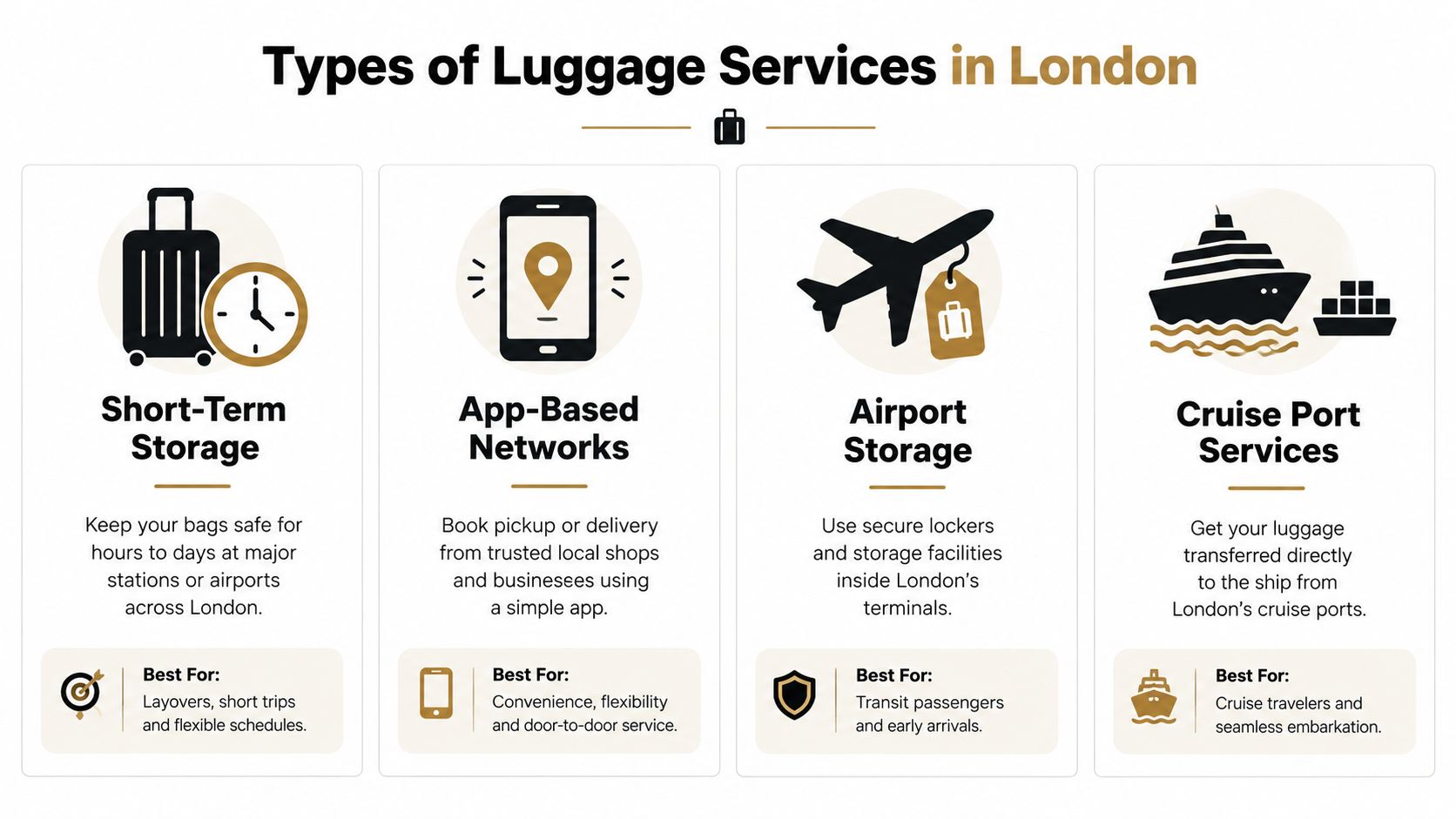
A cruise passenger arriving at Heathrow usually has four practical choices. They can store bags at the airport or a station, use a dispersed app-based storage network, pay for porter assistance inside the terminal, or arrange a door-to-door transfer that includes luggage handling. Each option solves a different problem, but they aren't interchangeable.
London's storage network reflects the way people move around the city. VisitLondon lists left-luggage options at major train stations, airports, and Victoria Coach Station, alongside more than 300 Bounce locations, more than 140 LuggageHero locations, and 300 Stasher locations across the capital. You can compare those options through VisitLondon's luggage and left-luggage guide, which also shows prices ranging from £1.19 per hour at some locations to daily rates of £4.30 at Bounce, £4.50 at Nannybag, and £5 at Radical Storage.
The four choices travellers actually face
Short-term storage suits a few hours between hotel check-out and an evening train, especially if you want to explore without your bags. It doesn't solve the journey to a cruise terminal, however. Someone still has to collect the luggage, reach the right station, and manage the final port connection.
App-based storage gives you more flexibility because locations sit in shops, hotels, and other neighbourhood businesses rather than only in transport hubs. That convenience is useful in central London, but it adds another handover and may leave you carrying bags across pavements or between stations.
Airport porterage is designed for the immediate physical burden. It helps when you have multiple checked cases, mobility concerns, or a tight connection inside Heathrow. It isn't a substitute for transport to a hotel or cruise port.
Door-to-door transfer assistance is the most coherent choice when luggage must move between several points. A meet-and-greet driver can collect you at arrivals, load the bags, take you to your accommodation, and continue the planned journey to the ship without making you coordinate separate storage and transport providers.
Practical rule: If your luggage has to change hands more than once, plan the entire route before booking any individual storage service.
Heathrow's scale explains why this matters. The airport can handle 180,000 items per day, according to BBC reporting published through Heathrow's media centre. Heathrow is also the UK's largest international gateway and a major transfer point for travellers heading to London hotels, rail hubs, coach connections, and cruise ports. A small disruption in a high-volume system can affect many travellers, so a pre-arranged handover is safer than relying on improvisation.
Types of Luggage Services Available in London
The right service depends on what you need the luggage to do. Storage keeps bags in one place. Porterage moves them across a terminal. A transfer takes both passenger and luggage to another destination. Treating all three as “luggage service” is how travellers end up paying for the wrong solution.
Storage for a fixed gap
Traditional storage works well when you need to leave bags for a defined period. Greenwich's tourist information centre lists £5 for up to three hours and £8 for up to 24 hours, while VisitLondon's guide shows app-based rates starting at £1.19 per hour in some locations. These services are sensible for a hotel check-out gap, an afternoon in central London, or a short stop near a station.
They become less attractive when you need bags delivered elsewhere. Storage doesn't include the onward movement, so you must retrieve everything and transport it yourself.
App-based networks for neighbourhood flexibility
Bounce, LuggageHero, Stasher, Nannybag, and Radical Storage spread storage across London rather than concentrating it in one terminal. That helps if your hotel is nowhere near a major station, or if you want to leave bags close to an attraction.
The limitation is practical, not technological. You still need to carry the cases to the partner location, confirm opening arrangements, collect them later, and make the next connection. A large cruise case can turn a short walk into a difficult detour.
Airport porterage for hands-on help
Heathrow's porter service starts at £35, with porters operating daily from 6am to 9pm, as described in Heathrow's official porter information. This is a premium labour service for passengers who need help between the arrivals concourse, taxi rank, rail link, or coach pick-up.
It makes sense for families, older passengers, travellers with mobility constraints, and anyone managing several heavy cases. It doesn't provide a complete airport-to-port journey, so book it alongside transport only when you need assistance at Heathrow itself.
Door-to-door assistance for linked journeys
For a Heathrow arrival followed by a London hotel and cruise-port departure, an integrated private transfer is usually the cleanest arrangement. The provider can match the vehicle to the passenger group and luggage volume, manage loading and unloading, and take responsibility for the route rather than leaving you to solve each connection independently. You can review how airport transport is typically structured in this guide to airport shuttle services.
| Service Type | Typical Cost | Best For | Limitations |
|---|---|---|---|
| Short-term storage | From £1.19 per hour at some London locations | A few hours between check-out and onward travel | You must retrieve and carry the bags |
| App-based networks | From £4.30 per day at Bounce, with other daily rates listed by VisitLondon | Flexible storage near hotels and attractions | Partner locations may not suit large cases or late collection |
| Heathrow porter service | From £35 | Heavy bags, mobility needs, and terminal assistance | Porterage doesn't include the full transfer |
| Heathrow left luggage | £10 for 0 to 3 hours | Airport-based storage during a short wait | Bags remain at Heathrow and need onward transport |
| Door-to-door transfer | Provider-dependent | Airport, hotel, and cruise-port journeys | Requires accurate passenger, luggage, and timing details |
The cheapest headline rate isn't always the lowest total cost. Add the time, taxi connections, station stairs, and physical effort, then compare the complete journey.
Airport to Cruise Port Luggage Logistics
Heathrow to a cruise port is not one route. Southampton, Dover, Portsmouth, and Tilbury each create different final-connection problems, and your bags must be planned around the ship's boarding window rather than the airport landing time.
Start with the handover point
After landing, collect checked luggage, clear the arrival process, and move to the agreed meeting point. Don't assume that a driver, porter, or courier can find you anywhere in the terminal. Confirm the terminal, arrivals area, flight number, and mobile contact before departure.
For Southampton, a train-based journey commonly leaves a final taxi or other road connection between Southampton Central and the cruise terminal. That last leg is easy with a small bag and awkward with several large cases. Dover, Portsmouth, and Tilbury create similar issues, because the station or central transport hub isn't necessarily beside the ship.
Compare transport by luggage burden
The Heathrow Express can move you quickly towards central London, but it doesn't eliminate platform changes, lifts, escalators, or the onward route. National Express coaches may reduce station handling, yet you still need to check the operator's luggage terms and reach the correct departure point.
A private transfer costs more than the simplest public transport fare, but it removes several physical handovers. It takes you from the airport or hotel directly to the cruise terminal, with the vehicle selected around the group and its luggage. That is the sensible choice when bags are bulky, passengers are tired, or the cruise schedule leaves little room for recovery.
Use this Heathrow to cruise-port transfer guide to think through the route before you book. The key question isn't “Which vehicle is cheapest?” It's “How many times will we need to lift, drag, identify, or re-check these bags?”
Your transfer plan should include the final metres from the transport drop-off to the cruise check-in area, not just the main road journey.
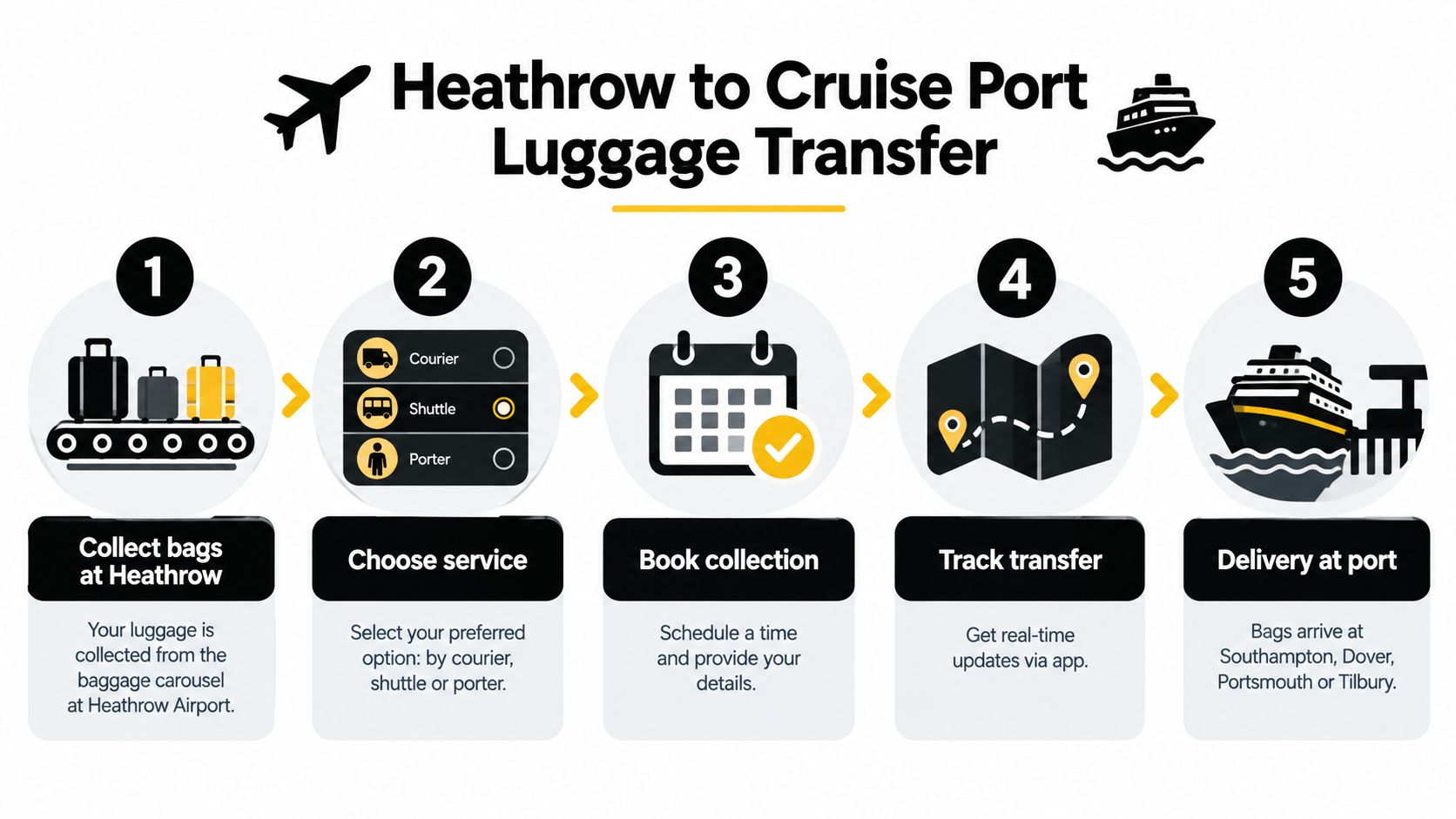
A clear sequence prevents most failures:
- Collect and identify: Keep luggage tags visible and count the cases before leaving arrivals.
- Choose the movement: Decide whether you need storage, a porter, a coach, a train, or a private vehicle.
- Confirm the collection: Give the provider the flight, hotel, port, ship, and passenger details.
- Allow recovery time: Build in room for baggage reclaim, border formalities, traffic, and the cruise line's check-in process.
- Verify the destination: Southampton has multiple terminals, so use the specific terminal named by the cruise line.
Here's a short visual guide to the journey:
Never treat the airport-to-port journey as a simple extension of your flight. It's a separate logistics operation with its own timing, access, and luggage constraints.
Heathrow Baggage Handling and Storage Options
After an overnight flight, Heathrow may solve the first part of your luggage problem, but it will not carry your cases through to the cruise terminal. Use airport services for airport tasks, then arrange the onward journey as one connected plan.
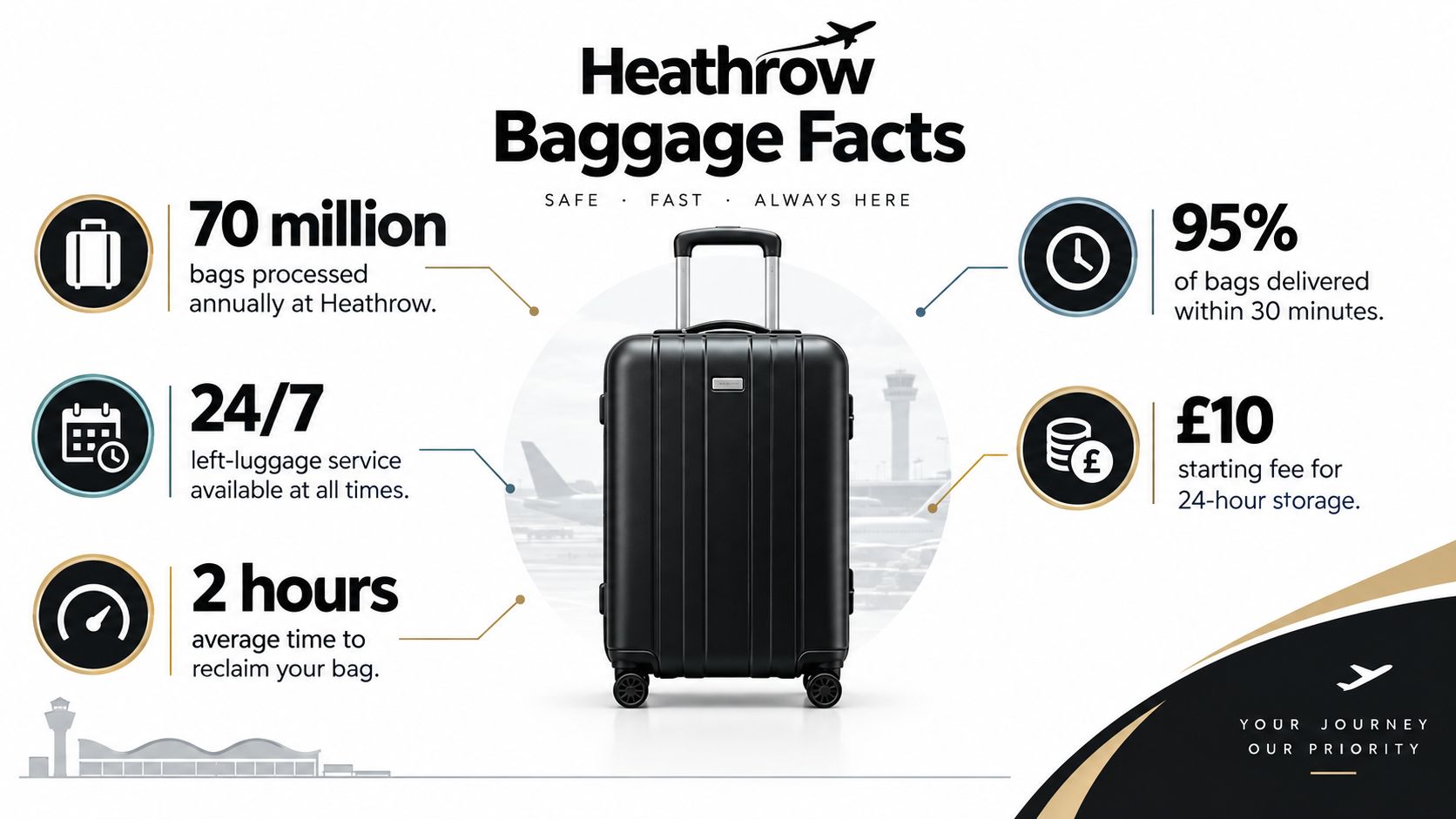
Heathrow's baggage operation handles a very high daily volume, and recent performance reporting showed a load rate above 98%. That scale supports efficient processing, but passengers still need to identify the correct cases, complete arrivals formalities, and move them to the next destination. Check the practical steps in this Heathrow baggage claim guide before choosing storage or a transfer.
Official left-luggage pricing
Heathrow's official left-luggage service operates across the terminals. Published rates are:
- £10 for 0 to 3 hours, according to Heathrow's left-luggage information.
- £15 for 3 to 24 hours.
- £27.50 for 24 to 48 hours.
- £40 for 48 to 72 hours.
- £12.50 for each additional day after 72 hours.
The counters are landside in arrivals and generally operate from about 05:00 to 23:00 daily. That makes storage useful when your hotel room is unavailable or your onward departure is later. During busy travel periods, allow extra time for queues and collection, especially if several passengers are retrieving bags together.
Storage ends at Heathrow. Your cases will not be delivered to Southampton, Dover, Portsmouth, or Tilbury, so you still need a reliable onward vehicle and enough time for terminal access.
When porterage earns its place
Porterage solves a different problem. A porter moves bags within the airport, while storage holds them for collection. Independent Heathrow airport guidance lists porterage availability daily from 6am to 9pm, with prices starting at £35. Heathrow has no self-service lockers, so staffed, security-screened storage is the practical airport option.
Choose porterage when stairs, long walks, heavy cases, or reduced mobility make terminal movement difficult. For a cruise departure, pair that help with a pre-arranged transfer. Otherwise, you may pay for assistance at arrivals and then face the same bags, handovers, and uncertainty outside the airport.
The reliable sequence is simple: collect and check every case, store bags only when the waiting period justifies it, then use a direct transfer to the confirmed cruise terminal. That is safer than piecing together storage, taxis, and hope.
How EC Minibus Includes Luggage Assistance in Every Transfer
A fragmented plan asks you to coordinate airport storage, a porter, a train, a taxi, and a cruise-terminal arrival. An integrated private transfer assigns the luggage journey to one provider. EC Minibus offers private transfers between Heathrow, Central London hotels, St Pancras International, and major cruise ports, with meet-and-greet service, luggage assistance, and vehicle allocation based on passenger and luggage volume.
The driver meets you at Heathrow, helps with loading, and takes the group directly to the booked destination. For a cruise journey, that can mean a hotel first and the Southampton, Dover, Portsmouth, or Tilbury terminal later, depending on the booking. The value isn't just comfort. It's the reduction in handovers.
What the service removes
You don't need to drag large cases through an interchange, locate a storage shop, or arrange a separate taxi from a station to the port. The driver handles loading and unloading, while flight and cruise monitoring helps the scheduled collection reflect changes to the journey.
That matters most for travellers who can't afford a missed connection. Families often have different bags and different levels of mobility. Older passengers may manage a suitcase perfectly well on a flat surface but struggle with stairs, platforms, or a long walk between terminal points. Business travellers usually value a predictable hotel or airport arrival more than the lowest public transport fare.
A good luggage plan reduces the number of times a passenger has to touch the bags.
The service also gives travel agents and tour operators a clearer operating model. Instead of passing passengers a list of unrelated storage locations and transport links, they can provide one booked route with passenger details, luggage requirements, and destination information held together.
You should still provide accurate information. Vehicle suitability depends on the number and size of cases, and cruise terminals require the correct ship and terminal details. Integrated assistance works when the booking reflects the luggage load, not an optimistic estimate.
Booking Your Luggage Service and Transfer in Advance
Book the transfer around the complete itinerary, not only the flight. Your arrival time, hotel address, cruise terminal, ship departure window, and luggage quantity all affect the service that will work on the day.
Gather the details first
Have these items ready before opening the booking form:
- Flight information: Airline, flight number, arrival date, and Heathrow terminal if known.
- Passenger details: Full names, mobile number, and the number of adults, children, or passengers needing extra assistance.
- Luggage inventory: Number of suitcases, cabin bags, prams, wheelchairs, sports equipment, or unusually large items.
- Hotel information: Full address, booking name, check-out or collection instructions, and reception contact if relevant.
- Cruise information: Cruise line, ship name, departure date, port, and exact terminal where available.
- Timing requirements: Preferred collection time, boarding window, and any onward flight or rail commitment.
Don't understate luggage to reduce friction during booking. A minibus chosen for passenger numbers alone may not provide enough room for several large cruise cases.
Complete the reservation carefully
Enter the route in stages if your journey includes Heathrow, a London hotel, and a cruise port. Check that the booking shows the correct pickup location and final destination, then review the luggage notes before payment. A confirmation should leave you with the service details and a way to contact support if the itinerary changes.
Flight monitoring is particularly useful for airport collections because arrival times can move. Cruise departures are less forgiving, so don't use monitoring as a reason to schedule an unnecessarily tight connection. Leave room for baggage reclaim, arrival formalities, traffic, and the cruise line's own check-in procedure.
Keep a change plan
If your flight changes, update the provider as soon as you know. If the cruise line changes the terminal or boarding instruction, send that information directly rather than assuming an old booking will update itself. Save the confirmation on your phone and keep the driver contact available offline in case airport connectivity is poor.
The best advance booking is specific without being rigid. It identifies every bag and destination clearly, while leaving enough time for the parts of international travel that no transfer company controls.
Choosing the Right Luggage Service for Your Travel Type
A solo traveller with one cabin bag shouldn't book the same arrangement as a family arriving from North America with several checked cases. Start with the physical burden, then consider the timing and number of handovers.
Match the service to the journey
One small bag and a flexible schedule: Use public transport or app-based storage if you only need a short gap between hotel access and sightseeing. Choose a location that sits directly on your route, not one that requires a special detour.
Several bags and a London hotel stop: Arrange a direct airport transfer with luggage assistance. Airport storage may help temporarily, but it leaves you responsible for the next movement.
Family or multigenerational cruise group: Use a private vehicle sized for both passengers and luggage. Avoid splitting the group across trains, taxis, and separate storage points unless everyone is comfortable lifting and supervising the cases.
Tight Heathrow-to-port connection: Pre-book the complete airport-to-terminal journey. A porter can help inside Heathrow, but the main decision is how to avoid repeated transfers after arrivals.
Post-cruise passengers: Plan the terminal-to-hotel or terminal-to-airport movement before disembarkation. Travelling hands-free is more practical than carrying cases through a station after several days at sea.
Use this final test
Ask four questions:
- How many times will we handle each bag?
- Where does the luggage wait, and who has responsibility for it?
- What happens if the flight arrives late?
- Can every passenger manage the route physically?
If the answers involve several uncoordinated handovers, simplify the plan. For most international cruise passengers, the sensible choice is a pre-booked door-to-door transfer with luggage assistance, supported by storage only when a genuine waiting gap requires it.
EC Minibus provides private transfers with meet-and-greet, flight and cruise monitoring, vehicle planning for passenger and luggage volume, and assistance loading and unloading bags. Visit EC Minibus to arrange a direct Heathrow, London hotel, or cruise-port transfer before travel day.