

You've just landed at Heathrow after an overnight flight, your shoulders are stiff, the bags are heavier than they looked at check-in, and there's still a long ride to Southampton or Dover ahead. At that point, a luxury airport transfer stops feeling like a status choice and starts feeling like common sense. You need someone waiting, space for the luggage, and a driver who understands that the next stop isn't a hotel lobby, it's a cruise terminal or a central London address that still has to be reached without stress.
Table of Contents
- The Moment You Realise You Need a Luxury Airport Transfer
- What Luxury Airport Transfers Mean in the UK
- The Core Features You Should Expect
- Typical Pricing for Heathrow, Central London, and Cruise Transfers
- How to Choose and Book the Right Provider
- Why a Black Cab or Ride-Hail Is Not the Same Product
- Booking a Heathrow to Cruise Transfer With EC Minibus
The Moment You Realise You Need a Luxury Airport Transfer
The decision usually arrives at baggage reclaim, not in advance. You've flown in from New York or Toronto, you've got two large cases, maybe hand luggage as well, and you can already see the problem, because the journey isn't ending in London, it's continuing to a cruise ship, a hotel, or both.
The parts that go wrong first
The first friction is the taxi queue. The second is the uncertainty, because nobody wants to stand there guessing whether the next car is large enough for the luggage, or whether the driver knows the cruise terminal layout. A ride-hailing app looks easy until you're trying to load awkward bags into a car that wasn't really meant for serious long-haul travel.
Practical rule: if your onward trip depends on timing, luggage space, and a calm handover at arrivals, you need a pre-booked transfer, not a last-minute gamble.
Luxury airport transfers earn their place. They're not about showing off, they're about removing friction from the most exhausting part of the journey. For travellers heading from Heathrow to Southampton, the service matters even more because the transfer isn't just a lift into town, it's the bridge between aviation and cruise departure.
The essential questions are simple. What will it cost? Will somebody be waiting for me? Will all of my luggage fit without a scene at the kerb? If the answer to any of those is unclear, the service isn't luxury in any meaningful sense.
What Luxury Airport Transfers Mean in the UK
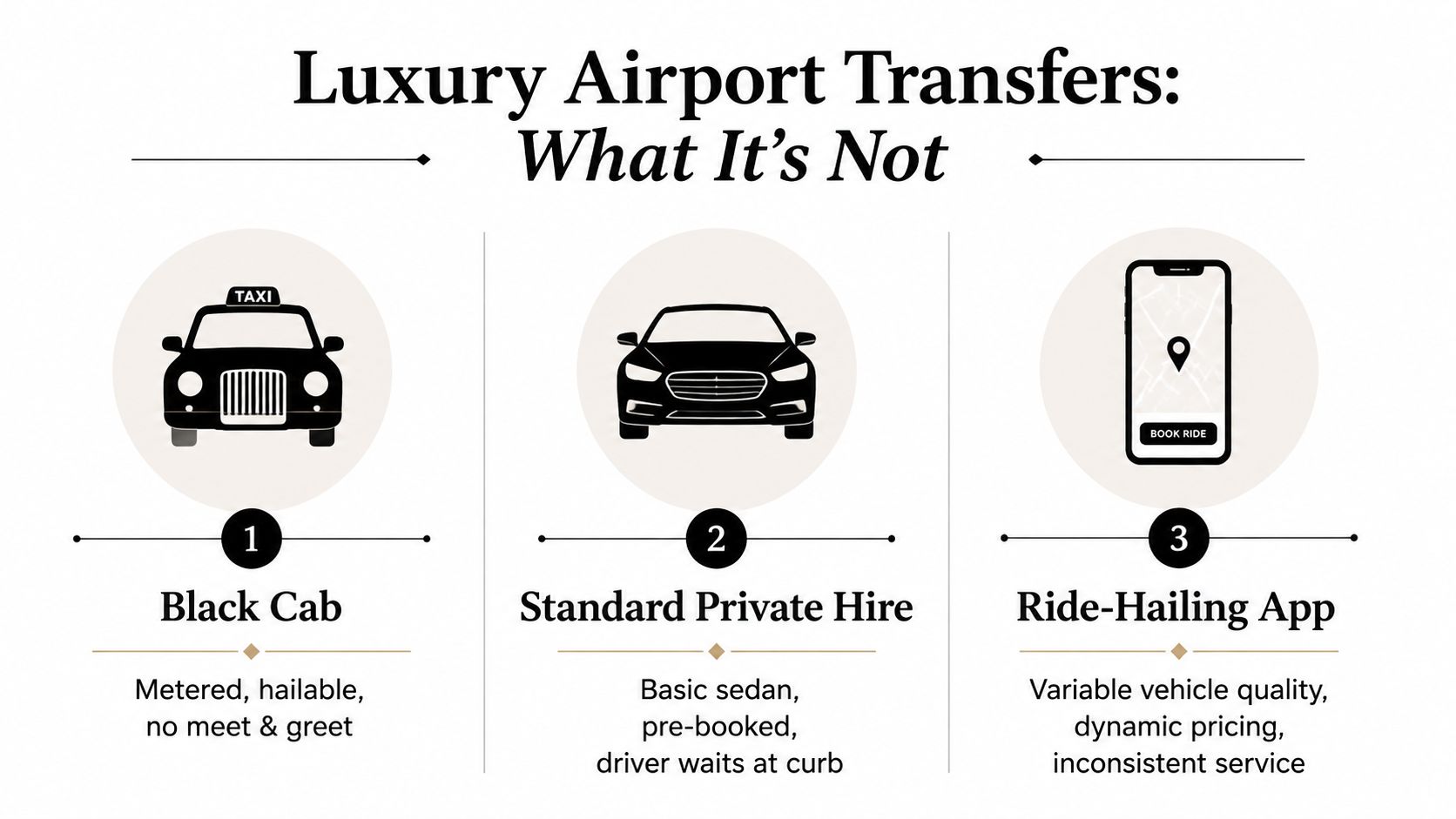
A proper luxury airport transfer in the UK is a pre-booked, fixed-fare, door-to-door service. You get a licensed private-hire operator, a vetted driver, a higher-spec vehicle, and operational extras such as flight monitoring and meet and greet. That is what separates the service from a dressed-up taxi.
What it is not
A black cab is hailable and useful, but it is still a metered street taxi, not a bespoke transfer. A standard private hire car can be pre-booked, but it is often just a curbside pickup with basic service and no real airport or cruise handling. A ride-hailing app can be convenient for short city hops, but vehicle quality, pricing, and support vary too much for a long, luggage-heavy transfer.
For a first-time visitor, the simplest test is this. If the operator cannot confirm the pickup point, luggage fit, and flight tracking in writing, you are not buying a luxury transfer, you are buying a hope. If the fare can change because demand spikes, that is not fixed pricing, and it is not the same product.
A professional provider should feel organised before you arrive. The driver should know whether you are landing at Heathrow T2, T3, T4, or T5, and the booking should show the terminal, destination, vehicle class, and contact route in plain English. For a useful benchmark on the chauffeur side of the market, this London chauffeur guide from EC Minibus is a sensible place to compare expectations.
The point is simple. In the UK, luxury airport transfers are about continuity from arrivals to the front door, and that matters even more on Heathrow to Southampton or Heathrow to Dover runs, where luggage, timing, and cruise connections are doing most of the work.
The Core Features You Should Expect
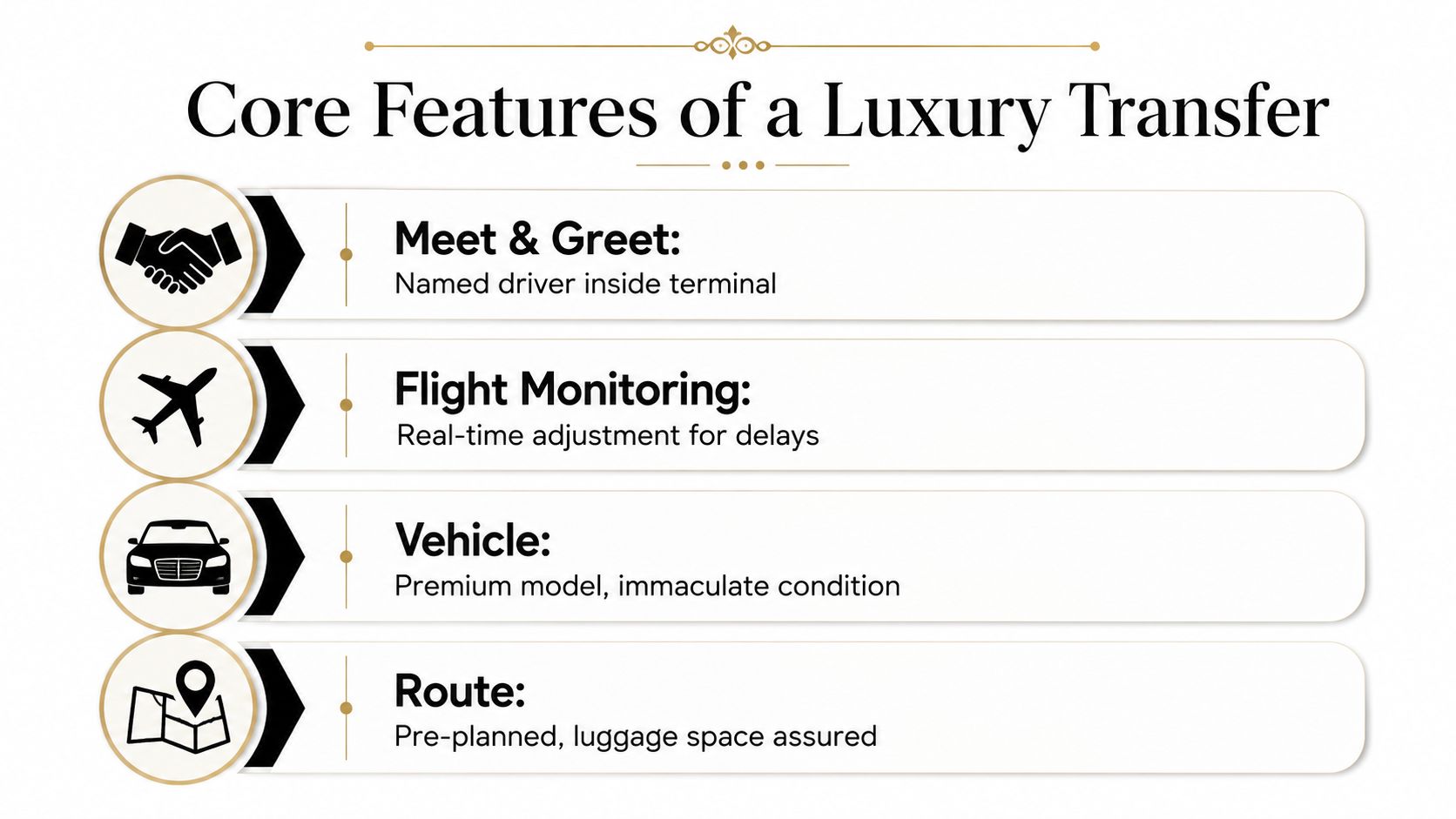
A luxury transfer succeeds or fails on the basics, not the branding. The useful features are the ones that reduce effort for the passenger, especially after a long-haul flight and especially when cruise luggage is involved.
Meet and greet that actually helps
A named driver inside the terminal changes the whole experience. You're not wandering around arrivals trying to decode a meeting point. You're getting a clear handover, help with bags, and a route into the vehicle without having to negotiate every step.
Flight and ship monitoring
Flight monitoring matters because delays happen, and the driver should be tracking them rather than making you chase the booking office. For cruise passengers, ship monitoring is just as important, because pickup times need to match embarkation windows, hotel checkouts, and any chain of connections you've booked the same day.
Luggage assistance and vehicle fit
The vehicle has to fit the trip, not just the seat count. A saloon might look elegant, but elegance doesn't help if it can't handle two large cases per person. For group travel, the Mercedes-Benz V-Class is a practical fit because it can legally and comfortably carry up to 7 passengers with 6 large suitcases plus hand luggage, and the extra-long wheelbase version can take 7 large cases and 7 pieces of hand luggage. That matters more than polished trim, because luggage is often the constraint that breaks the transfer.
Support, access, and flexibility
A strong provider should also offer real human support, not just a booking form. If a flight is diverted, someone needs to answer the phone. If a passenger needs a child seat, multi-stop routing, or wheelchair accessibility, those details should be handled before the day, not argued over at arrivals.
Good operators sell continuity, not just transport. That means one booking, one pickup plan, one accountable team.
The operational side matters for electric fleets too. In practical UK private-hire planning, EV luxury vehicles need roughly 250 to 350 miles of real-world range and 60 to 90 kWh batteries, with DC charging up to 250 kW and paired 350 kW chargers for high-throughput curb operations. That's the kind of planning that keeps transfers moving between passenger arrivals without unnecessary downtime. The same logic applies to passenger handling. If the provider is serious, the service is designed around the journey, not around a brochure.
Typical Pricing for Heathrow, Central London, and Cruise Transfers
Pricing in London is rarely simple, and that's exactly why you should insist on a fixed quote. The market for pre-book airport transfers is built around advance booking, with international travellers representing 61.5% of demand and private transportation taking 68.4% of transportation-type revenue in 2025 in one market analysis. That tells you what kind of buyer this service is really for, people who want certainty before they land. The same analysis also projects the segment growing from USD 13.4 billion in 2025 to USD 38.8 billion by 2035, and a separate luxury ground transportation study gives airport transfers a 24.7% market share with 6.2% CAGR growth. Those numbers are useful because they show this isn't a niche indulgence, it's a mainstream premium mobility category. See the wider market framing in the luxury ground transportation report.
Indicative 2026 pricing for Heathrow routes
| Route | Saloon Car (1-3 pax) | MPV / V-Class (4-6 pax) | Minibus (7+ pax) |
|---|---|---|---|
| Heathrow to central London hotel | Fixed quote, varies by vehicle and waiting terms | Fixed quote, varies by luggage and routing | Fixed quote, depends on group size and access |
| Heathrow to Southampton cruise terminal | Fixed quote, longer-distance premium transfer | Fixed quote, suited to heavier luggage loads | Fixed quote, suited to larger parties |
| Heathrow to Dover cruise terminal | Fixed quote, longer-distance premium transfer | Fixed quote, suited to cruise luggage | Fixed quote, suited to family or group travel |
The price changes with vehicle class, passenger count, luggage volume, time of day, and whether you bundle the return journey. A quote for a saloon makes no sense if you're carrying cruise baggage for four people. A bigger vehicle can look more expensive up front, but it often saves you from awkward extras, second cars, or luggage compromises.
For a rough pricing comparison against broader UK car-service norms, this UK car service pricing guide from EC Minibus is useful context. The key point is simple. A fixed luxury quote is easier to judge than a meter you can't control.
Tipping in the UK is not an obligation here. If the driver helps with heavy luggage and the service is polished, a small tip is appreciated, but the transfer should already stand on the agreed fare.
How to Choose and Book the Right Provider
Start with licensing and insurance. If a company can't show you that it operates properly in the UK private-hire framework, move on. After that, check whether the price is fixed in writing, whether amendments are straightforward, and whether the operator has independent reviews on places like Trustpilot or Tripadvisor.
What to confirm before you pay
- Vehicle specification: Make sure the booking matches the luggage count, not just the passenger count.
- Flight and ship details: Enter terminal, cruise port, arrival time, and any hotel stop in full.
- Contact route: Save the driver or dispatch number before you fly.
- Cancellation terms: Read the policy before you confirm, not after.
- Support access: Look for a real phone number or live chat, not only a contact form.
That checklist sounds basic because it is basic, and basic is what gets missed most often. A polished website means nothing if the confirmation email is vague, the pickup instructions are missing, or the vehicle category doesn't fit the job.
The booking workflow should be dull in the best way. Compare two or three quotes, check the luggage allowance, verify the terminal details, and make sure the provider understands cruise timing if you're going straight to the port. If the operator works both airport and cruise legs, that's a good sign, because Heathrow-to-ship transfers have more moving parts than a city centre drop-off.
If a provider can't explain how it handles delays, terminal changes, or large luggage loads, it's not ready for international arrival work.
Specialist knowledge matters here more than glossy branding. A company that routinely handles Heathrow, Southampton, Dover, Portsmouth, Tilbury, and central London hotels knows the handover points, the timing pressure, and the practical issues that come with long-haul travel.
Why a Black Cab or Ride-Hail Is Not the Same Product
A black cab can be fine for a short hop across London. A ride-hailing app can be convenient when you're light, local, and flexible. Neither is the same thing as a luxury airport transfer for a tired family with cruise bags.
The differences that matter on the day
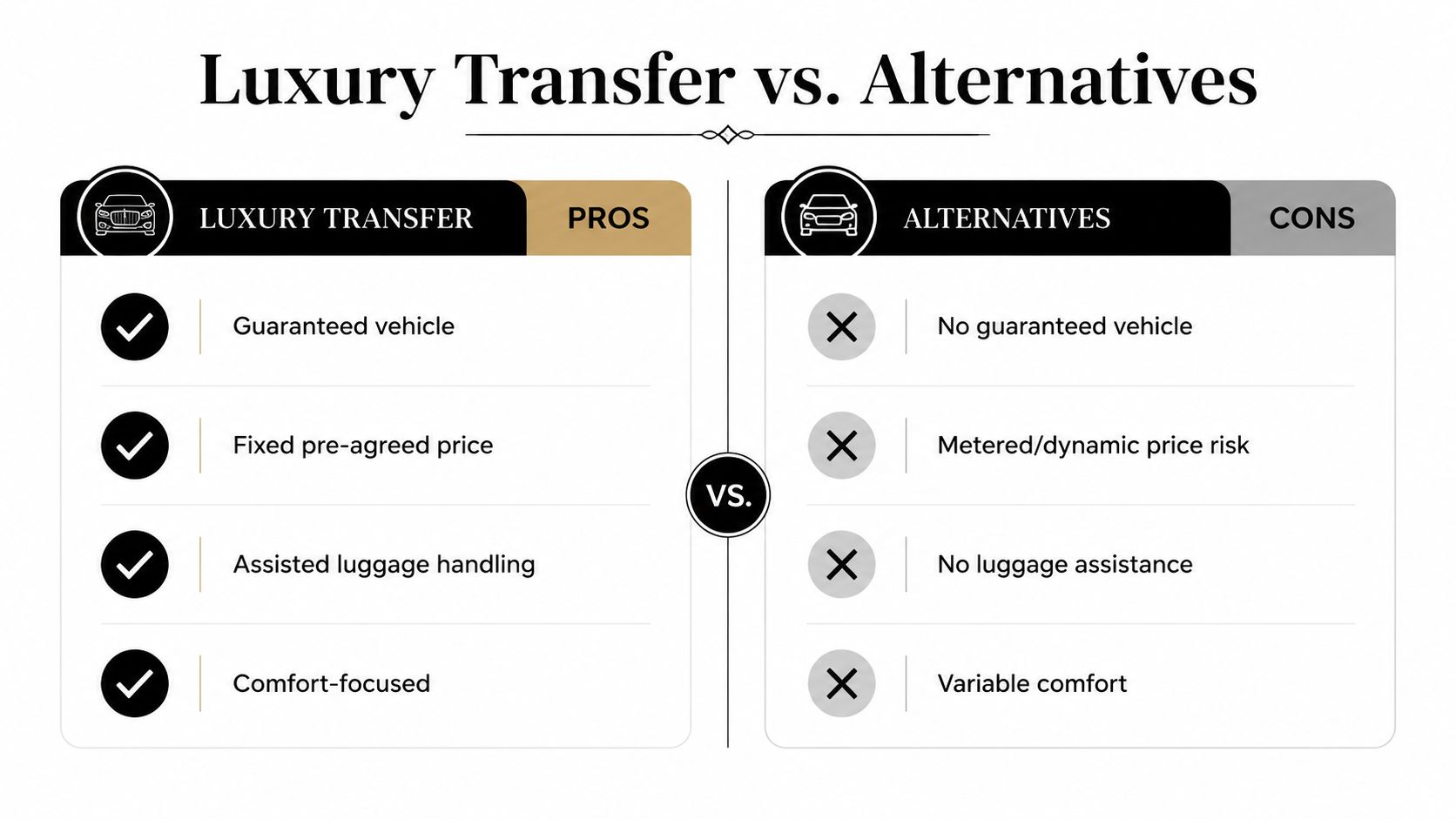
A private transfer gives you a guaranteed vehicle and a pre-agreed price. With a taxi or app, you're still exposed to queue times, availability, and the possibility that the car arriving isn't the one you expected. That matters when you've just cleared customs and need to move quickly.
Luggage handling is another hard divider. A saloon with a boot full of cases is a bad start to a four-hour onward leg. A V-Class or minibus solves that problem properly, and it gives older passengers room to breathe, sit comfortably, and avoid struggling at the kerb.
For cruise travellers, reliability beats improvisation. The cheapest ride is expensive if it creates stress, delays, or a luggage problem you didn't plan for.
Driver knowledge matters too. Cruise terminals are not random hotel entrances. Southampton, Dover, Portsmouth, and Tilbury each have their own access patterns and passenger flow, and the driver needs to understand those logistics before departure. A good transfer also gives you accountability if something changes, which is something an app booking often handles badly when your flight is delayed or your connection shifts.
For families and older travellers, the accessibility question is central. A well-chosen transfer can handle mobility aids, heavier luggage, and multi-generational seating in one vehicle. A city taxi may be cheaper on paper, but it doesn't solve the full journey.
Booking a Heathrow to Cruise Transfer With EC Minibus
For travellers moving from Heathrow to central London hotels, then on to Southampton, Dover, Portsmouth, Tilbury, or St Pancras International, one operator can simplify the whole chain. EC Minibus has operated since 2006, uses licensed and insured drivers, and builds in meet and greet, flight and cruise monitoring, and fixed transparent pricing for door-to-door journeys. For passengers who want to see the cruise side laid out plainly, this Heathrow-to-port transfer guide is the most relevant companion piece.
The value here is operational, not theatrical. You book online, get instant confirmation, and the pickup adjusts if the flight or sailing timing changes. That's exactly what first-time visitors need when they're trying to bridge airport arrival, hotel stay, and cruise departure without piecing together three separate transport decisions.
If you want one provider to handle the airport, the hotel, and the port with the same booking discipline, that's the model to look for. The right service doesn't make you think about terminals, boot space, or waiting rules on the day, because those decisions were already handled when you booked.
If you need a Heathrow transfer that's built around luggage, cruise timing, and real door-to-door continuity, book with EC Minibus and keep the handover simple. Visit EC Minibus to reserve a fixed-fare transfer that connects Heathrow, London hotels, and major UK cruise ports without the usual airport stress.